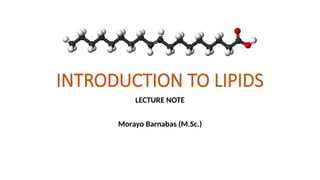
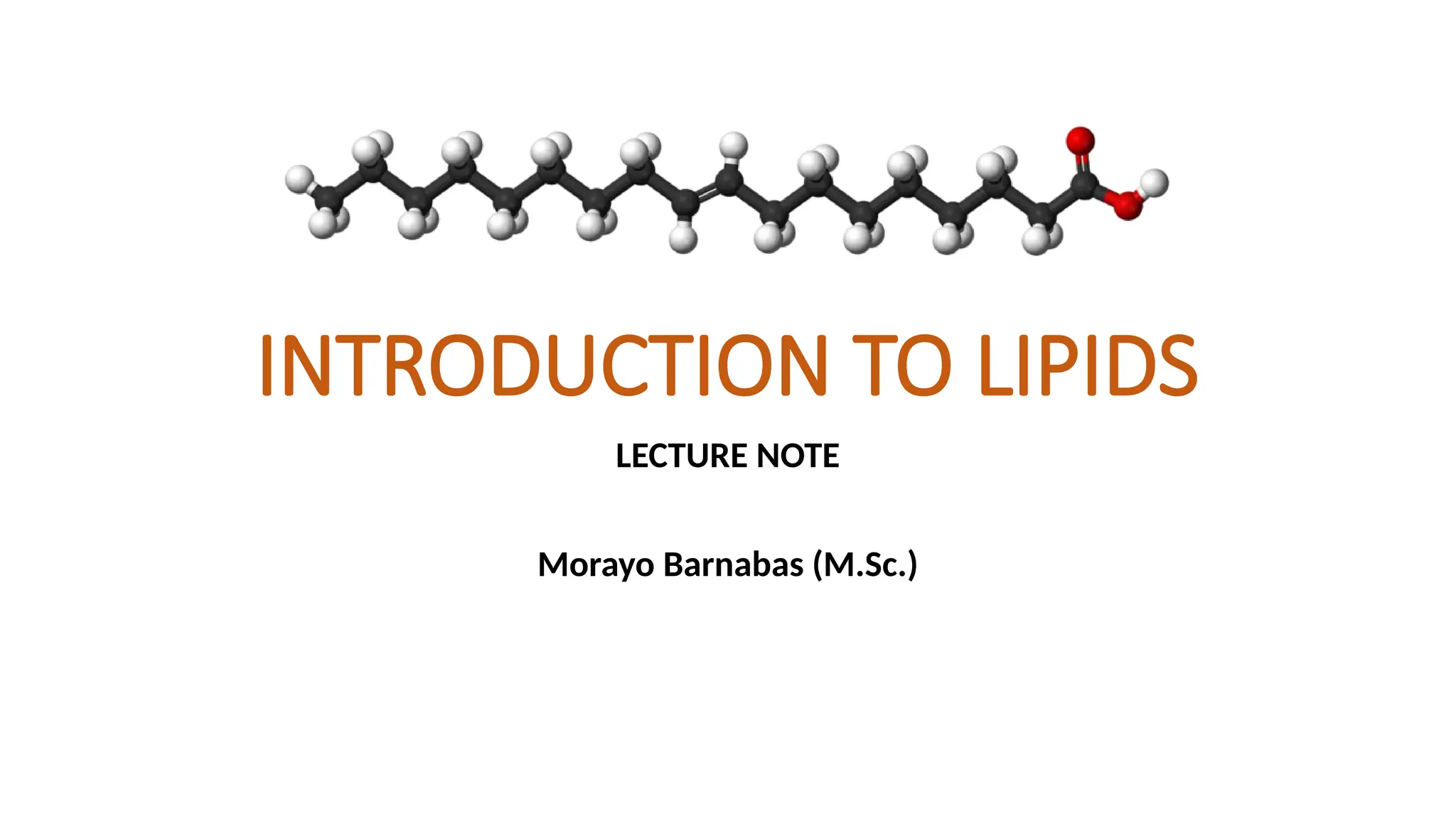
INTRODUCTION TO LIPIDS
LECTURE NOTE
Morayo Barnabas (M.Sc.)
2
1.0 What are Lipids?
• Lipids are a heterogeneous group of compounds, including fats, oils,
steroids, waxes, and related compounds, which are related more by
their physical than by their chemical properties.
• Lipids are distinguished by their insolubility in water and solubility in
non-polar solvents like hydrocarbons, chloroform, alcohols, etc.
• Lipids are important in biological systems because they form the cell
membrane, a mechanical barrier that divides a cell from the external
environment. Lipids also provide energy for life and several essential
vitamins are lipids.
3
2.0 Functions of Lipids
• Food material: lipids provide food, highly rich in calorific value. 1g of lipid produces 9k/cal
of energy.
• Energy storage: lipids can be stored readily in the body for energy when carbohydrates
and proteins have been exhausted especially during starvation.
• Structural component: lipids are an important constituent of the cell membrane.
• Structural component: lipids are a major component of the cell membrane.
• Lipids serve as signaling molecules: they have important functions in sustaining nerve
impulse transmission and they are catalysts of electrical impulse activity within the brain.
• Hormone sysnthesis: hormones (prostaglandin, testosterone, estrogen), adrenocorticoids,
cholic acids and vitamin D are all synthesized from cholesterol, a steroidal lipid.
• Vitamin carriers: lipids act as carriers of natural fat-soluble vitamins (ADEK).
• Heat insulator: Fat is stored in adipose tissue, where it also serves as a thermal insulator
in the subcutaneous tissues and around certain organs.
4
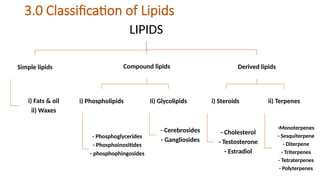
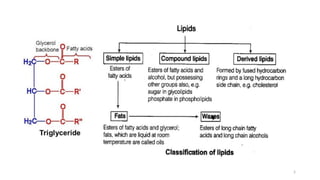
3.0 Classification of Lipids
LIPIDS
Simple lipids
i) Fats & oil
ii) Waxes
Compound lipids
i) Phospholipids
- Phosphoglycerides
- Phosphoinositides
- phosphophingosides
ii) Glycolipids
- Cerebrosides
- Gangliosides
Derived lipids
i) Steroids
- Cholesterol
- Testosterone
- Estradiol
ii) Terpenes
-Monoterpenes
- Sesquiterpene
- Diterpene
- Triterpenes
- Tetraterpenes
- Polyterpenes
5
6
4.0 Fatty Acids (FAs)
• FAs are long chain organic acids having usually from 4 to 30 carbon
atoms.
• FAs are straight aliphatic chains with a methyl group at one end and a
carboxyl group at the other end.
• They can be represented by the formula R—COOH where R is the alkyl
group – CH3 (CH2)n (hydrocarbon chain).The hydrocarbon chain is
hydrophobic and the carboxylate group (COOH) is hydrophilic.
• FAs occur primarily as esters of glycerol.
• FAs can be grouped into Saturated and Unsaturated Fatty Acids.
7
4.1 Saturated & Unsaturated Fatty Acids
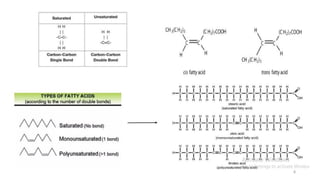
• Saturated fatty acids do not have any double bonds. A fatty acid is saturated
when every carbon atom in the hydrocarbon chain is bonded to as many
hydrogen atoms as possible (the carbon atoms are saturated with hydrogen).
Saturated fatty acids are solids at room temperature and have a low melting
point. Animal fats are a source of saturated fatty acids. In addition, fatty acids
pack easily and form rigid structures (e.g., fatty acids are found in membranes).
• Unsaturated fatty acids can have one or more double bonds along its
hydrocarbon chain. A fatty acid with one double bond is called
monounsaturated. If it contains two or more double bonds, we say that the
fatty acid is polyunsaturated. The melting point of a fatty acid is influenced by
the number of double bonds that the molecule contains and by the length of
the hydrocarbon tail. The more double bonds it contains, the lower the melting
point. As the length of the tail increases, the melting point increases. Plants are
the source of unsaturated fatty acids
8
9
4.2 Nomenclature of Fatty Acids
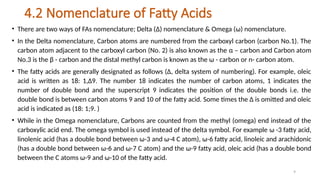
• There are two ways of FAs nomenclature; Delta (Δ) nomenclature & Omega (ω) nomenclature.
• In the Delta nomenclature, Carbon atoms are numbered from the carboxyl carbon (carbon No.1). The
carbon atom adjacent to the carboxyl carbon (No. 2) is also known as the α – carbon and Carbon atom
No.3 is the β - carbon and the distal methyl carbon is known as the ω - carbon or n- carbon atom.
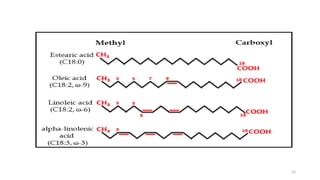
• The fatty acids are generally designated as follows (Δ, delta system of numbering). For example, oleic
acid is written as 18: 1,Δ9. The number 18 indicates the number of carbon atoms, 1 indicates the
number of double bond and the superscript 9 indicates the position of the double bonds i.e. the
double bond is between carbon atoms 9 and 10 of the fatty acid. Some times the Δ is omitted and oleic
acid is indicated as (18: 1;9. )
• While in the Omega nomenclature, Carbons are counted from the methyl (omega) end instead of the
carboxylic acid end. The omega symbol is used instead of the delta symbol. For example ω -3 fatty acid,
linolenic acid (has a double bond between ω-3 and ω-4 C atom), ω-6 fatty acid, linoleic and arachidonic
(has a double bond between ω-6 and ω-7 C atom) and the ω-9 fatty acid, oleic acid (has a double bond
between the C atoms ω-9 and ω-10 of the fatty acid.
10
11
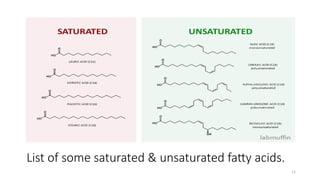
List of some saturated & unsaturated fatty acids.
12
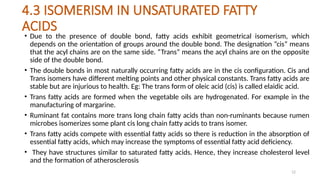
4.3 ISOMERISM IN UNSATURATED FATTY
ACIDS
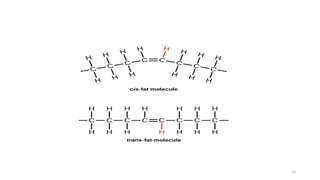
• Due to the presence of double bond, fatty acids exhibit geometrical isomerism, which
depends on the orientation of groups around the double bond. The designation “cis” means
that the acyl chains are on the same side. “Trans” means the acyl chains are on the opposite
side of the double bond.
• The double bonds in most naturally occurring fatty acids are in the cis configuration. Cis and
Trans isomers have different melting points and other physical constants. Trans fatty acids are
stable but are injurious to health. Eg: The trans form of oleic acid (cis) is called elaidic acid.
• Trans fatty acids are formed when the vegetable oils are hydrogenated. For example in the
manufacturing of margarine.
• Ruminant fat contains more trans long chain fatty acids than non-ruminants because rumen
microbes isomerizes some plant cis long chain fatty acids to trans isomer.
• Trans fatty acids compete with essential fatty acids so there is reduction in the absorption of
essential fatty acids, which may increase the symptoms of essential fatty acid deficiency.
• They have structures similar to saturated fatty acids. Hence, they increase cholesterol level
and the formation of atherosclerosis
13
14
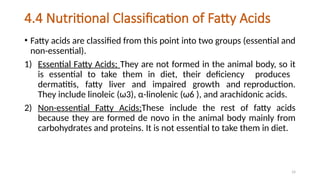
4.4 Nutritional Classification of Fatty Acids
• Fatty acids are classified from this point into two groups (essential and
non-essential).
1) Essential Fatty Acids; They are not formed in the animal body, so it
is essential to take them in diet, their deficiency produces
dermatitis, fatty liver and impaired growth and reproduction.
They include linoleic (ω3), α-linolenic (ω6 ), and arachidonic acids.
2) Non-essential Fatty Acids;These include the rest of fatty acids
because they are formed de novo in the animal body mainly from
carbohydrates and proteins. It is not essential to take them in diet.
15
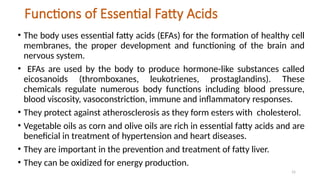
Functions of Essential Fatty Acids
• The body uses essential fatty acids (EFAs) for the formation of healthy cell
membranes, the proper development and functioning of the brain and
nervous system.
• EFAs are used by the body to produce hormone-like substances called
eicosanoids (thromboxanes, leukotrienes, prostaglandins). These
chemicals regulate numerous body functions including blood pressure,
blood viscosity, vasoconstriction, immune and inflammatory responses.
• They protect against atherosclerosis as they form esters with cholesterol.
• Vegetable oils as corn and olive oils are rich in essential fatty acids and are
beneficial in treatment of hypertension and heart diseases.
• They are important in the prevention and treatment of fatty liver.
• They can be oxidized for energy production.
16
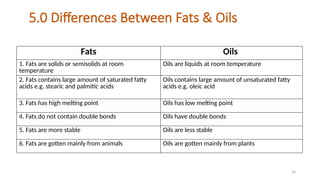
5.0 Differences Between Fats & Oils
Fats Oils
1. Fats are solids or semisolids at room
temperature
Oils are liquids at room temperature
2. Fats contains large amount of saturated fatty
acids e.g. stearic and palmitic acids
Oils contains large amount of unsaturated fatty
acids e.g. oleic acid
3. Fats has high melting point Oils has low melting point
4. Fats do not contain double bonds Oils have double bonds
5. Fats are more stable Oils are less stable
6. Fats are gotten mainly from animals Oils are gotten mainly from plants
17
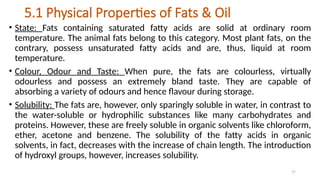
5.1 Physical Properties of Fats & Oil
• State: Fats containing saturated fatty acids are solid at ordinary room
temperature. The animal fats belong to this category. Most plant fats, on the
contrary, possess unsaturated fatty acids and are, thus, liquid at room
temperature.
• Colour, Odour and Taste: When pure, the fats are colourless, virtually
odourless and possess an extremely bland taste. They are capable of
absorbing a variety of odours and hence flavour during storage.
• Solubility: The fats are, however, only sparingly soluble in water, in contrast to
the water-soluble or hydrophilic substances like many carbohydrates and
proteins. However, these are freely soluble in organic solvents like chloroform,
ether, acetone and benzene. The solubility of the fatty acids in organic
solvents, in fact, decreases with the increase of chain length. The introduction
of hydroxyl groups, however, increases solubility.
18
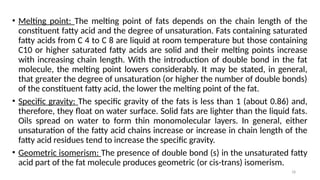
• Melting point: The melting point of fats depends on the chain length of the
constituent fatty acid and the degree of unsaturation. Fats containing saturated
fatty acids from C 4 to C 8 are liquid at room temperature but those containing
C10 or higher saturated fatty acids are solid and their melting points increase
with increasing chain length. With the introduction of double bond in the fat
molecule, the melting point lowers considerably. It may be stated, in general,
that greater the degree of unsaturation (or higher the number of double bonds)
of the constituent fatty acid, the lower the melting point of the fat.
• Specific gravity: The specific gravity of the fats is less than 1 (about 0.86) and,
therefore, they float on water surface. Solid fats are lighter than the liquid fats.
Oils spread on water to form thin monomolecular layers. In general, either
unsaturation of the fatty acid chains increase or increase in chain length of the
fatty acid residues tend to increase the specific gravity.
• Geometric isomerism: The presence of double bond (s) in the unsaturated fatty
acid part of the fat molecule produces geometric (or cis-trans) isomerism.
19
5.2 Chemical Properties of Fats & Oil
• REACTIONS INVOLVING THE COOH GROUP
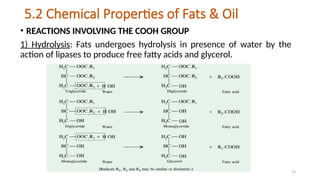
1) Hydrolysis: Fats undergoes hydrolysis in presence of water by the
action of lipases to produce free fatty acids and glycerol.
20
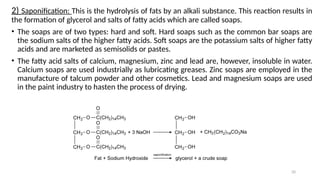
2) Saponification: This is the hydrolysis of fats by an alkali substance. This reaction results in
the formation of glycerol and salts of fatty acids which are called soaps.
• The soaps are of two types: hard and soft. Hard soaps such as the common bar soaps are
the sodium salts of the higher fatty acids. Soft soaps are the potassium salts of higher fatty
acids and are marketed as semisolids or pastes.
• The fatty acid salts of calcium, magnesium, zinc and lead are, however, insoluble in water.
Calcium soaps are used industrially as lubricating greases. Zinc soaps are employed in the
manufacture of talcum powder and other cosmetics. Lead and magnesium soaps are used
in the paint industry to hasten the process of drying.
21
3) Hydrolytic rancidity: When butter or other fats are stored, they often become
rancid and hence unpalatable. Rancidity is caused by the growth of
microorganisms which secrete enzymes like lipases. These split the fats into
glycerol and free fatty acids. The fatty acids impart an unpleasant odour and
flavour to the fat. However, butter may be prevented from becoming rancid by
refrigeration or by exclusion of water.
• REACTIONS INVOLVING DOUBLE BOND
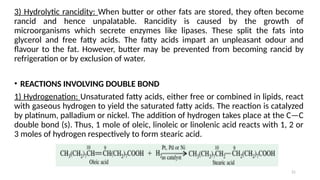
1) Hydrogenation: Unsaturated fatty acids, either free or combined in lipids, react
with gaseous hydrogen to yield the saturated fatty acids. The reaction is catalyzed
by platinum, palladium or nickel. The addition of hydrogen takes place at the C—C
double bond (s). Thus, 1 mole of oleic, linoleic or linolenic acid reacts with 1, 2 or
3 moles of hydrogen respectively to form stearic acid.
22
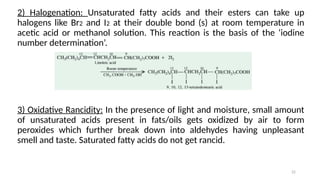
2) Halogenation: Unsaturated fatty acids and their esters can take up
halogens like Br2 and I2 at their double bond (s) at room temperature in
acetic acid or methanol solution. This reaction is the basis of the ‘iodine
number determination’.
3) Oxidative Rancidity: In the presence of light and moisture, small amount
of unsaturated acids present in fats/oils gets oxidized by air to form
peroxides which further break down into aldehydes having unpleasant
smell and taste. Saturated fatty acids do not get rancid.
23
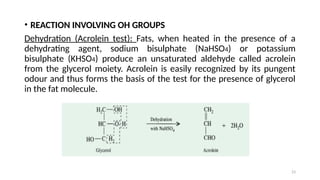
• REACTION INVOLVING OH GROUPS
Dehydration (Acrolein test): Fats, when heated in the presence of a
dehydrating agent, sodium bisulphate (NaHSO4) or potassium
bisulphate (KHSO4) produce an unsaturated aldehyde called acrolein
from the glycerol moiety. Acrolein is easily recognized by its pungent
odour and thus forms the basis of the test for the presence of glycerol
in the fat molecule.
24
5.3 Analytical Tests
1. Acid value: It is the number of milligrams of KOH required to neutralize
the free fatty acids present in 1 gm of fat. The acid number, thus, tells us of
the quantity of free fatty acid present in a fat. Obviously, a fat which has
been both processed and stored properly has a very low acid number.
2. Saponification number: It is the number of milligrams of KOH required to
saponify 1 gm of fat. The saponification number, thus, provides information
of the average chain length of the fatty acids in the fat. It varies inversely
with the chain length of the fatty acids. The shorter the average chain
length of the fatty acids, the higher is the saponification number.
3. Iodine value (or Koettstorfer number): It is the number of grams of iodine
absorbed by 100 g of fat. The iodine number is, thus, a measure of the
degree of unsaturation of the fatty acids in the fat.
25
4. Polenske number: It is the number of millilitres of 0.1N(normality) KOH
required to neutralize the insoluble fatty acids obtained from 5 gm of fat.
5. Reichert-Meissl number: It is the number of millilitres of 0.1N KOH
required to neutralize the soluble, volatile fatty acids derived from 5 g of fat.
The Reichert-Meissl number, thus, measures the quantity of short chain
fatty acids (up to C 10 inclusive) in the fat molecule.
6. Acetyl number: It is the number of milligrams of KOH required to
neutralize the acetic acid obtained by saponification of 1 gm of fat after it
has been acetylated (The treatment of fat or fatty acid mixture with acetic
anhydride results in acetylation of all alcoholic OH groups). The acetyl
number is, thus, a measure of the number of OH groups in the fat. For
example, the castor oil has a high acetyl number (146) because of high
content of a hydroxy acid, ricinoleic acid, in it.
26
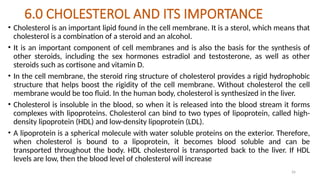
6.0 CHOLESTEROL AND ITS IMPORTANCE
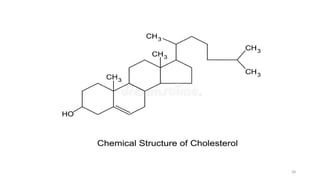
• Cholesterol is an important lipid found in the cell membrane. It is a sterol, which means that
cholesterol is a combination of a steroid and an alcohol.
• It is an important component of cell membranes and is also the basis for the synthesis of
other steroids, including the sex hormones estradiol and testosterone, as well as other
steroids such as cortisone and vitamin D.
• In the cell membrane, the steroid ring structure of cholesterol provides a rigid hydrophobic
structure that helps boost the rigidity of the cell membrane. Without cholesterol the cell
membrane would be too fluid. In the human body, cholesterol is synthesized in the liver.
• Cholesterol is insoluble in the blood, so when it is released into the blood stream it forms
complexes with lipoproteins. Cholesterol can bind to two types of lipoprotein, called high-
density lipoprotein (HDL) and low-density lipoprotein (LDL).
• A lipoprotein is a spherical molecule with water soluble proteins on the exterior. Therefore,
when cholesterol is bound to a lipoprotein, it becomes blood soluble and can be
transported throughout the body. HDL cholesterol is transported back to the liver. If HDL
levels are low, then the blood level of cholesterol will increase
27
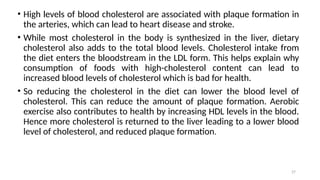
• High levels of blood cholesterol are associated with plaque formation in
the arteries, which can lead to heart disease and stroke.
• While most cholesterol in the body is synthesized in the liver, dietary
cholesterol also adds to the total blood levels. Cholesterol intake from
the diet enters the bloodstream in the LDL form. This helps explain why
consumption of foods with high-cholesterol content can lead to
increased blood levels of cholesterol which is bad for health.
• So reducing the cholesterol in the diet can lower the blood level of
cholesterol. This can reduce the amount of plaque formation. Aerobic
exercise also contributes to health by increasing HDL levels in the blood.
Hence more cholesterol is returned to the liver leading to a lower blood
level of cholesterol, and reduced plaque formation.
28
29
THANK YOU

INTRODUCTION TO LIPIDS - GENERAL BIOCHEMISTRY.pptx

  • 1.
    INTRODUCTION TO LIPIDS LECTURENOTE Morayo Barnabas (M.Sc.)
  • 2.
    2 1.0 What areLipids? • Lipids are a heterogeneous group of compounds, including fats, oils, steroids, waxes, and related compounds, which are related more by their physical than by their chemical properties. • Lipids are distinguished by their insolubility in water and solubility in non-polar solvents like hydrocarbons, chloroform, alcohols, etc. • Lipids are important in biological systems because they form the cell membrane, a mechanical barrier that divides a cell from the external environment. Lipids also provide energy for life and several essential vitamins are lipids.
  • 3.
    3 2.0 Functions ofLipids • Food material: lipids provide food, highly rich in calorific value. 1g of lipid produces 9k/cal of energy. • Energy storage: lipids can be stored readily in the body for energy when carbohydrates and proteins have been exhausted especially during starvation. • Structural component: lipids are an important constituent of the cell membrane. • Structural component: lipids are a major component of the cell membrane. • Lipids serve as signaling molecules: they have important functions in sustaining nerve impulse transmission and they are catalysts of electrical impulse activity within the brain. • Hormone sysnthesis: hormones (prostaglandin, testosterone, estrogen), adrenocorticoids, cholic acids and vitamin D are all synthesized from cholesterol, a steroidal lipid. • Vitamin carriers: lipids act as carriers of natural fat-soluble vitamins (ADEK). • Heat insulator: Fat is stored in adipose tissue, where it also serves as a thermal insulator in the subcutaneous tissues and around certain organs.
  • 4.
    4 3.0 Classification ofLipids LIPIDS Simple lipids i) Fats & oil ii) Waxes Compound lipids i) Phospholipids - Phosphoglycerides - Phosphoinositides - phosphophingosides ii) Glycolipids - Cerebrosides - Gangliosides Derived lipids i) Steroids - Cholesterol - Testosterone - Estradiol ii) Terpenes -Monoterpenes - Sesquiterpene - Diterpene - Triterpenes - Tetraterpenes - Polyterpenes
  • 5.
  • 6.
    6 4.0 Fatty Acids(FAs) • FAs are long chain organic acids having usually from 4 to 30 carbon atoms. • FAs are straight aliphatic chains with a methyl group at one end and a carboxyl group at the other end. • They can be represented by the formula R—COOH where R is the alkyl group – CH3 (CH2)n (hydrocarbon chain).The hydrocarbon chain is hydrophobic and the carboxylate group (COOH) is hydrophilic. • FAs occur primarily as esters of glycerol. • FAs can be grouped into Saturated and Unsaturated Fatty Acids.
  • 7.
    7 4.1 Saturated &Unsaturated Fatty Acids • Saturated fatty acids do not have any double bonds. A fatty acid is saturated when every carbon atom in the hydrocarbon chain is bonded to as many hydrogen atoms as possible (the carbon atoms are saturated with hydrogen). Saturated fatty acids are solids at room temperature and have a low melting point. Animal fats are a source of saturated fatty acids. In addition, fatty acids pack easily and form rigid structures (e.g., fatty acids are found in membranes). • Unsaturated fatty acids can have one or more double bonds along its hydrocarbon chain. A fatty acid with one double bond is called monounsaturated. If it contains two or more double bonds, we say that the fatty acid is polyunsaturated. The melting point of a fatty acid is influenced by the number of double bonds that the molecule contains and by the length of the hydrocarbon tail. The more double bonds it contains, the lower the melting point. As the length of the tail increases, the melting point increases. Plants are the source of unsaturated fatty acids
  • 8.
  • 9.
    9 4.2 Nomenclature ofFatty Acids • There are two ways of FAs nomenclature; Delta (Δ) nomenclature & Omega (ω) nomenclature. • In the Delta nomenclature, Carbon atoms are numbered from the carboxyl carbon (carbon No.1). The carbon atom adjacent to the carboxyl carbon (No. 2) is also known as the α – carbon and Carbon atom No.3 is the β - carbon and the distal methyl carbon is known as the ω - carbon or n- carbon atom. • The fatty acids are generally designated as follows (Δ, delta system of numbering). For example, oleic acid is written as 18: 1,Δ9. The number 18 indicates the number of carbon atoms, 1 indicates the number of double bond and the superscript 9 indicates the position of the double bonds i.e. the double bond is between carbon atoms 9 and 10 of the fatty acid. Some times the Δ is omitted and oleic acid is indicated as (18: 1;9. ) • While in the Omega nomenclature, Carbons are counted from the methyl (omega) end instead of the carboxylic acid end. The omega symbol is used instead of the delta symbol. For example ω -3 fatty acid, linolenic acid (has a double bond between ω-3 and ω-4 C atom), ω-6 fatty acid, linoleic and arachidonic (has a double bond between ω-6 and ω-7 C atom) and the ω-9 fatty acid, oleic acid (has a double bond between the C atoms ω-9 and ω-10 of the fatty acid.
  • 10.
  • 11.
    11 List of somesaturated & unsaturated fatty acids.
  • 12.
    12 4.3 ISOMERISM INUNSATURATED FATTY ACIDS • Due to the presence of double bond, fatty acids exhibit geometrical isomerism, which depends on the orientation of groups around the double bond. The designation “cis” means that the acyl chains are on the same side. “Trans” means the acyl chains are on the opposite side of the double bond. • The double bonds in most naturally occurring fatty acids are in the cis configuration. Cis and Trans isomers have different melting points and other physical constants. Trans fatty acids are stable but are injurious to health. Eg: The trans form of oleic acid (cis) is called elaidic acid. • Trans fatty acids are formed when the vegetable oils are hydrogenated. For example in the manufacturing of margarine. • Ruminant fat contains more trans long chain fatty acids than non-ruminants because rumen microbes isomerizes some plant cis long chain fatty acids to trans isomer. • Trans fatty acids compete with essential fatty acids so there is reduction in the absorption of essential fatty acids, which may increase the symptoms of essential fatty acid deficiency. • They have structures similar to saturated fatty acids. Hence, they increase cholesterol level and the formation of atherosclerosis
  • 13.
  • 14.
    14 4.4 Nutritional Classificationof Fatty Acids • Fatty acids are classified from this point into two groups (essential and non-essential). 1) Essential Fatty Acids; They are not formed in the animal body, so it is essential to take them in diet, their deficiency produces dermatitis, fatty liver and impaired growth and reproduction. They include linoleic (ω3), α-linolenic (ω6 ), and arachidonic acids. 2) Non-essential Fatty Acids;These include the rest of fatty acids because they are formed de novo in the animal body mainly from carbohydrates and proteins. It is not essential to take them in diet.
  • 15.
    15 Functions of EssentialFatty Acids • The body uses essential fatty acids (EFAs) for the formation of healthy cell membranes, the proper development and functioning of the brain and nervous system. • EFAs are used by the body to produce hormone-like substances called eicosanoids (thromboxanes, leukotrienes, prostaglandins). These chemicals regulate numerous body functions including blood pressure, blood viscosity, vasoconstriction, immune and inflammatory responses. • They protect against atherosclerosis as they form esters with cholesterol. • Vegetable oils as corn and olive oils are rich in essential fatty acids and are beneficial in treatment of hypertension and heart diseases. • They are important in the prevention and treatment of fatty liver. • They can be oxidized for energy production.
  • 16.
    16 5.0 Differences BetweenFats & Oils Fats Oils 1. Fats are solids or semisolids at room temperature Oils are liquids at room temperature 2. Fats contains large amount of saturated fatty acids e.g. stearic and palmitic acids Oils contains large amount of unsaturated fatty acids e.g. oleic acid 3. Fats has high melting point Oils has low melting point 4. Fats do not contain double bonds Oils have double bonds 5. Fats are more stable Oils are less stable 6. Fats are gotten mainly from animals Oils are gotten mainly from plants
  • 17.
    17 5.1 Physical Propertiesof Fats & Oil • State: Fats containing saturated fatty acids are solid at ordinary room temperature. The animal fats belong to this category. Most plant fats, on the contrary, possess unsaturated fatty acids and are, thus, liquid at room temperature. • Colour, Odour and Taste: When pure, the fats are colourless, virtually odourless and possess an extremely bland taste. They are capable of absorbing a variety of odours and hence flavour during storage. • Solubility: The fats are, however, only sparingly soluble in water, in contrast to the water-soluble or hydrophilic substances like many carbohydrates and proteins. However, these are freely soluble in organic solvents like chloroform, ether, acetone and benzene. The solubility of the fatty acids in organic solvents, in fact, decreases with the increase of chain length. The introduction of hydroxyl groups, however, increases solubility.
  • 18.
    18 • Melting point:The melting point of fats depends on the chain length of the constituent fatty acid and the degree of unsaturation. Fats containing saturated fatty acids from C 4 to C 8 are liquid at room temperature but those containing C10 or higher saturated fatty acids are solid and their melting points increase with increasing chain length. With the introduction of double bond in the fat molecule, the melting point lowers considerably. It may be stated, in general, that greater the degree of unsaturation (or higher the number of double bonds) of the constituent fatty acid, the lower the melting point of the fat. • Specific gravity: The specific gravity of the fats is less than 1 (about 0.86) and, therefore, they float on water surface. Solid fats are lighter than the liquid fats. Oils spread on water to form thin monomolecular layers. In general, either unsaturation of the fatty acid chains increase or increase in chain length of the fatty acid residues tend to increase the specific gravity. • Geometric isomerism: The presence of double bond (s) in the unsaturated fatty acid part of the fat molecule produces geometric (or cis-trans) isomerism.
  • 19.
    19 5.2 Chemical Propertiesof Fats & Oil • REACTIONS INVOLVING THE COOH GROUP 1) Hydrolysis: Fats undergoes hydrolysis in presence of water by the action of lipases to produce free fatty acids and glycerol.
  • 20.
    20 2) Saponification: Thisis the hydrolysis of fats by an alkali substance. This reaction results in the formation of glycerol and salts of fatty acids which are called soaps. • The soaps are of two types: hard and soft. Hard soaps such as the common bar soaps are the sodium salts of the higher fatty acids. Soft soaps are the potassium salts of higher fatty acids and are marketed as semisolids or pastes. • The fatty acid salts of calcium, magnesium, zinc and lead are, however, insoluble in water. Calcium soaps are used industrially as lubricating greases. Zinc soaps are employed in the manufacture of talcum powder and other cosmetics. Lead and magnesium soaps are used in the paint industry to hasten the process of drying.
  • 21.
    21 3) Hydrolytic rancidity:When butter or other fats are stored, they often become rancid and hence unpalatable. Rancidity is caused by the growth of microorganisms which secrete enzymes like lipases. These split the fats into glycerol and free fatty acids. The fatty acids impart an unpleasant odour and flavour to the fat. However, butter may be prevented from becoming rancid by refrigeration or by exclusion of water. • REACTIONS INVOLVING DOUBLE BOND 1) Hydrogenation: Unsaturated fatty acids, either free or combined in lipids, react with gaseous hydrogen to yield the saturated fatty acids. The reaction is catalyzed by platinum, palladium or nickel. The addition of hydrogen takes place at the C—C double bond (s). Thus, 1 mole of oleic, linoleic or linolenic acid reacts with 1, 2 or 3 moles of hydrogen respectively to form stearic acid.
  • 22.
    22 2) Halogenation: Unsaturatedfatty acids and their esters can take up halogens like Br2 and I2 at their double bond (s) at room temperature in acetic acid or methanol solution. This reaction is the basis of the ‘iodine number determination’. 3) Oxidative Rancidity: In the presence of light and moisture, small amount of unsaturated acids present in fats/oils gets oxidized by air to form peroxides which further break down into aldehydes having unpleasant smell and taste. Saturated fatty acids do not get rancid.
  • 23.
    23 • REACTION INVOLVINGOH GROUPS Dehydration (Acrolein test): Fats, when heated in the presence of a dehydrating agent, sodium bisulphate (NaHSO4) or potassium bisulphate (KHSO4) produce an unsaturated aldehyde called acrolein from the glycerol moiety. Acrolein is easily recognized by its pungent odour and thus forms the basis of the test for the presence of glycerol in the fat molecule.
  • 24.
    24 5.3 Analytical Tests 1.Acid value: It is the number of milligrams of KOH required to neutralize the free fatty acids present in 1 gm of fat. The acid number, thus, tells us of the quantity of free fatty acid present in a fat. Obviously, a fat which has been both processed and stored properly has a very low acid number. 2. Saponification number: It is the number of milligrams of KOH required to saponify 1 gm of fat. The saponification number, thus, provides information of the average chain length of the fatty acids in the fat. It varies inversely with the chain length of the fatty acids. The shorter the average chain length of the fatty acids, the higher is the saponification number. 3. Iodine value (or Koettstorfer number): It is the number of grams of iodine absorbed by 100 g of fat. The iodine number is, thus, a measure of the degree of unsaturation of the fatty acids in the fat.
  • 25.
    25 4. Polenske number:It is the number of millilitres of 0.1N(normality) KOH required to neutralize the insoluble fatty acids obtained from 5 gm of fat. 5. Reichert-Meissl number: It is the number of millilitres of 0.1N KOH required to neutralize the soluble, volatile fatty acids derived from 5 g of fat. The Reichert-Meissl number, thus, measures the quantity of short chain fatty acids (up to C 10 inclusive) in the fat molecule. 6. Acetyl number: It is the number of milligrams of KOH required to neutralize the acetic acid obtained by saponification of 1 gm of fat after it has been acetylated (The treatment of fat or fatty acid mixture with acetic anhydride results in acetylation of all alcoholic OH groups). The acetyl number is, thus, a measure of the number of OH groups in the fat. For example, the castor oil has a high acetyl number (146) because of high content of a hydroxy acid, ricinoleic acid, in it.
  • 26.
    26 6.0 CHOLESTEROL ANDITS IMPORTANCE • Cholesterol is an important lipid found in the cell membrane. It is a sterol, which means that cholesterol is a combination of a steroid and an alcohol. • It is an important component of cell membranes and is also the basis for the synthesis of other steroids, including the sex hormones estradiol and testosterone, as well as other steroids such as cortisone and vitamin D. • In the cell membrane, the steroid ring structure of cholesterol provides a rigid hydrophobic structure that helps boost the rigidity of the cell membrane. Without cholesterol the cell membrane would be too fluid. In the human body, cholesterol is synthesized in the liver. • Cholesterol is insoluble in the blood, so when it is released into the blood stream it forms complexes with lipoproteins. Cholesterol can bind to two types of lipoprotein, called high- density lipoprotein (HDL) and low-density lipoprotein (LDL). • A lipoprotein is a spherical molecule with water soluble proteins on the exterior. Therefore, when cholesterol is bound to a lipoprotein, it becomes blood soluble and can be transported throughout the body. HDL cholesterol is transported back to the liver. If HDL levels are low, then the blood level of cholesterol will increase
  • 27.
    27 • High levelsof blood cholesterol are associated with plaque formation in the arteries, which can lead to heart disease and stroke. • While most cholesterol in the body is synthesized in the liver, dietary cholesterol also adds to the total blood levels. Cholesterol intake from the diet enters the bloodstream in the LDL form. This helps explain why consumption of foods with high-cholesterol content can lead to increased blood levels of cholesterol which is bad for health. • So reducing the cholesterol in the diet can lower the blood level of cholesterol. This can reduce the amount of plaque formation. Aerobic exercise also contributes to health by increasing HDL levels in the blood. Hence more cholesterol is returned to the liver leading to a lower blood level of cholesterol, and reduced plaque formation.
  • 28.
  • 29.