Lipids
Presented by
MICHAEL KANHAI
lipid
an oily organic compound insoluble in water but
soluble in organic solvents; essential structural
component of living cells (along with proteins
and carbohydrates)
wordnetweb.princeton.edu/perl/webwn
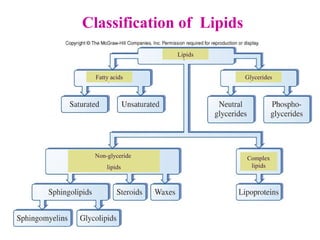
Classification of Lipids
Lipids
Complex
lipids
Non-glyceride
lipids
GlyceridesFatty acids
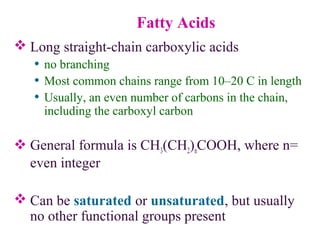
Fatty Acids
 Long straight-chain carboxylic acids
• no branching
• Most common chains range from 10–20 C in length
• Usually, an even number of carbons in the chain,
including the carboxyl carbon
 General formula is CH3(CH2)nCOOH, where n=
even integer
 Can be saturated or unsaturated, but usually
no other functional groups present
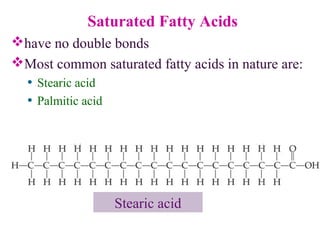
Saturated Fatty Acids
have no double bonds
Most common saturated fatty acids in nature are:
• Stearic acid
• Palmitic acid
Stearic acid
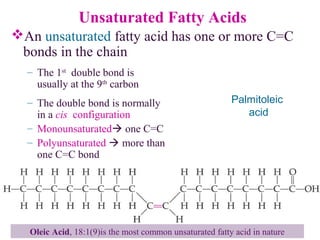
Unsaturated Fatty Acids
An unsaturated fatty acid has one or more C=C
bonds in the chain
C
O
OCH2CH2
C C
CH2
CH2
CH2
CH2
CH2
CH2
HH
CH2
CH2
CH2
CH2
CH3
Palmitoleic
acid
– The 1st
double bond is
usually at the 9th
carbon
– The double bond is normally
in a cis configuration
– Monounsaturated one C=C
– Polyunsaturated  more than
one C=C bond
Oleic Acid, 18:1(9)is the most common unsaturated fatty acid in nature
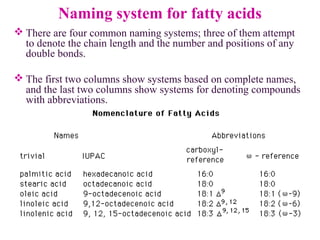
Naming system for fatty acids
 There are four common naming systems; three of them attempt
to denote the chain length and the number and positions of any
double bonds.
 The first two columns show systems based on complete names,
and the last two columns show systems for denoting compounds
with abbreviations.
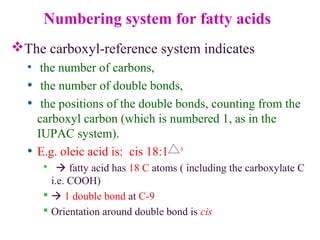
Numbering system for fatty acids
The carboxyl-reference system indicates
• the number of carbons,
• the number of double bonds,
• the positions of the double bonds, counting from the
carboxyl carbon (which is numbered 1, as in the
IUPAC system).
• E.g. oleic acid is: cis 18:1 9
  fatty acid has 18 C atoms ( including the carboxylate C
i.e. COOH)
  1 double bond at C-9
 Orientation around double bond is cis
The omega-reference system
• indicates the number of carbons,
• the number of double bonds
• and the position of the double bond closest to the omega
carbon, (the CH3 end)
Numbering system for fatty acids
•This system is useful in physiological considerations because of the
important physiological differences between omega - 3 and omega -
6 fatty acids, and the impossibility of interchanging them in the
human body.
Fatty Acid Properties
Melting point increases with increasing carbon number
Melting point of a saturated fatty acid is higher than an
unsaturated fatty acid with the same number of carbons
• they always form straight, rigid chains
• they have no kinks and are able to pack tightly
• solid at room temperature
Double bonds lower melting point relative to saturated
acid
• cis double bonds give them a kink along their chain length
• prevent good alignment of molecules in unsaturated fatty acids
leading to poor packing
• Have lower melting temperatures
• Liquid at room temperature
Essential Fatty Acids
Body can make most fatty acids from
carbohydrate, protein and other fats
• Any fatty acid that cannot be synthesized by the body
is called an essential fatty acid
• Must be obtained from the diet
Exceptions: linoleic acid and linolenic acid
• Polyunsaturated fatty acids that must be obtained
from diet
• Cannot be made from other materials
• Cells cannot convert one into the other
Essential Fatty Acids
Sources of linoleic acid:
• Leafy vegetables, nuts. Vegetable oils (seasame, corn oil,
sunflower, soybean), poultry fat
Sources o f linolenic acid:
• Nuts and seeds (soybean, walnuts, flaxseed), oils (soybean,
canola)
Both play an important role in the health of the heart
• Reduce plasma triglycerides
• Reduce blood clotting
• Reduce inflammatory responses in the body
Essential Fatty Acids
linoleic acid and linolenic acid are important for
synthesizing arachidonic acid (20 C atoms)
arachidonic acid in turn is the precursor for the
synthesis of eicosanoids
• Prostaglandins
• Leukotrienes
• Thromboxanes
COO
-
arachadonic acid
Biological Processes Regulated by Eicosanoids
Prostaglandins
• Mediate aspects of inflammatory response e.g. pain
and fever
• Stimulation of smooth muscle during labour (PGE2)
• Inhibit gastric secretion
• Increase secretion of protective mucus in GI tract
• Inhibition of hormone-sensitive lipases in GI tract
• Dilate renal blood vessels Results in increased
water and electrolyte excretion
Biological Processes Regulated by Eicosanoids
Leukotrienes
• promote the constriction of bronchi
Thromboxane
• stimulates constriction of blood vessels and platelet
aggregation
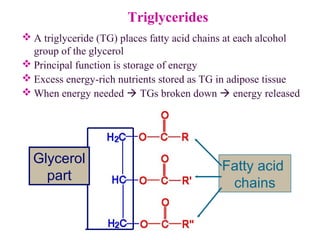
Triglycerides
 A triglyceride (TG) places fatty acid chains at each alcohol
group of the glycerol
 Principal function is storage of energy
 Excess energy-rich nutrients stored as TG in adipose tissue
 When energy needed  TGs broken down  energy released
Fatty acid
chains
Glycerol
part
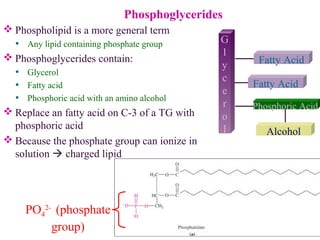
Phosphoglycerides
 Phospholipid is a more general term
• Any lipid containing phosphate group
 Phosphoglycerides contain:
• Glycerol
• Fatty acid
• Phosphoric acid with an amino alcohol
 Replace an fatty acid on C-3 of a TG with
phosphoric acid
 Because the phosphate group can ionize in
solution  charged lipid
G
l
y
c
e
r
o
l
Fatty Acid
Fatty Acid
Phosphoric Acid
Alcohol
PO4
2-
(phosphate
group)
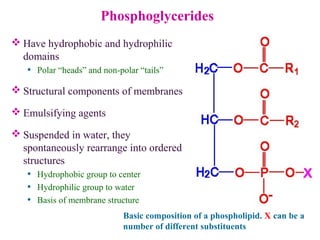
Phosphoglycerides
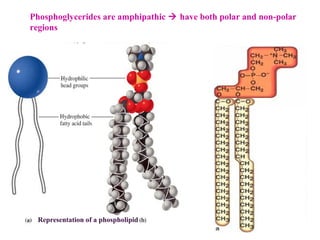
 Have hydrophobic and hydrophilic
domains
• Polar “heads” and non-polar “tails”
 Structural components of membranes
 Emulsifying agents
 Suspended in water, they
spontaneously rearrange into ordered
structures
• Hydrophobic group to center
• Hydrophilic group to water
• Basis of membrane structure
Basic composition of a phospholipid. X can be a
number of different substituents
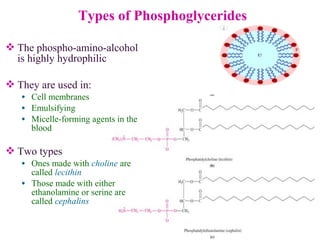
Types of Phosphoglycerides
 The phospho-amino-alcohol
is highly hydrophilic
 They are used in:
• Cell membranes
• Emulsifying
• Micelle-forming agents in the
blood
 Two types
• Ones made with choline are
called lecithin
• Those made with either
ethanolamine or serine are
called cephalins
Phosphoglycerides are amphipathic  have both polar and non-polar
regions
Representation of a phospholipid
Nonglyceride Lipids
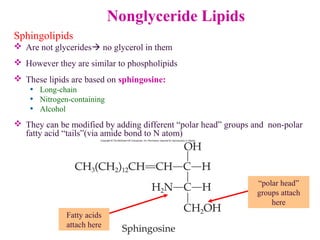
Sphingolipids
 Are not glycerides no glycerol in them
 However they are similar to phospholipids
 These lipids are based on sphingosine:
• Long-chain
• Nitrogen-containing
• Alcohol
 They can be modified by adding different “polar head” groups and non-polar
fatty acid “tails”(via amide bond to N atom)
Fatty acids
attach here
“polar head”
groups attach
here
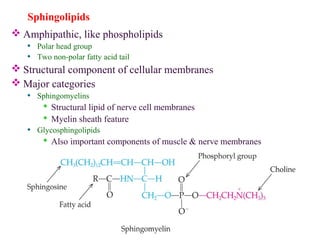
Sphingolipids
 Amphipathic, like phospholipids
• Polar head group
• Two non-polar fatty acid tail
 Structural component of cellular membranes
 Major categories
• Sphingomyelins
 Structural lipid of nerve cell membranes
 Myelin sheath feature
• Glycosphingolipids
 Also important components of muscle & nerve membranes
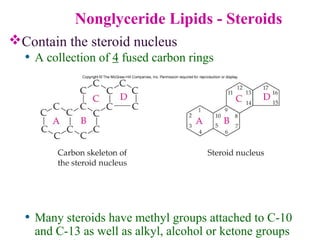
Nonglyceride Lipids - Steroids
Contain the steroid nucleus
• A collection of 4 fused carbon rings
• Many steroids have methyl groups attached to C-10
and C-13 as well as alkyl, alcohol or ketone groups
Steroids
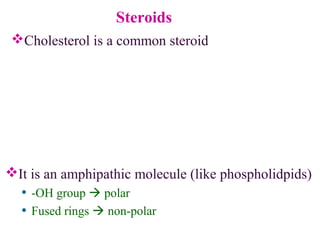
Cholesterol is a common steroid
CH CH2 CH2 CH2 CH(CH3)2
OH
H
CH3 H
CH3
H H
H
CH3
Cholesterol
It is an amphipathic molecule (like phospholidpids)
• -OH group  polar
• Fused rings  non-polar
Importance of cholesterol in the body
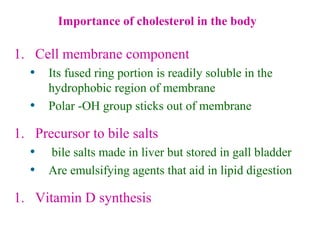
1. Cell membrane component
• Its fused ring portion is readily soluble in the
hydrophobic region of membrane
• Polar -OH group sticks out of membrane
1. Precursor to bile salts
• bile salts made in liver but stored in gall bladder
• Are emulsifying agents that aid in lipid digestion
1. Vitamin D synthesis
Importance of cholesterol in the body
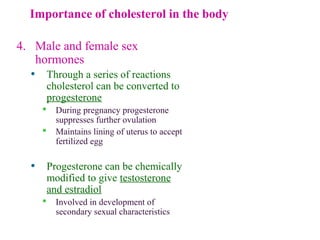
4. Male and female sex
hormones
• Through a series of reactions
cholesterol can be converted to
progesterone
 During pregnancy progesterone
suppresses further ovulation
 Maintains lining of uterus to accept
fertilized egg
• Progesterone can be chemically
modified to give testosterone
and estradiol
 Involved in development of
secondary sexual characteristics
O
CH3
CH3
C
CH3
O
progesterone
O
CH3
CH3
OH
testosterone
Importance of cholesterol in the body
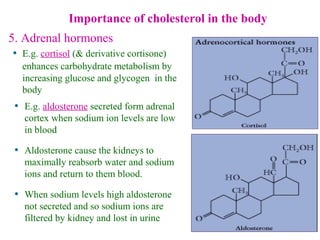
5. Adrenal hormones
• E.g. cortisol (& derivative cortisone)
enhances carbohydrate metabolism by
increasing glucose and glycogen in the
body
• E.g. aldosterone secreted form adrenal
cortex when sodium ion levels are low
in blood
• Aldosterone cause the kidneys to
maximally reabsorb water and sodium
ions and return to them blood.
• When sodium levels high aldosterone
not secreted and so sodium ions are
filtered by kidney and lost in urine
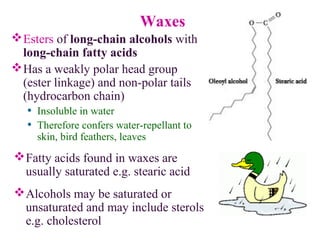
Waxes
Esters of long-chain alcohols with
long-chain fatty acids
Has a weakly polar head group
(ester linkage) and non-polar tails
(hydrocarbon chain)
• Insoluble in water
• Therefore confers water-repellant to
skin, bird feathers, leaves
Fatty acids found in waxes are
usually saturated e.g. stearic acid
Alcohols may be saturated or
unsaturated and may include sterols
e.g. cholesterol
Waxes
Linolin (woolwax) -obtained from the wool
of sheep during the cleaning or refining
process
• Base for pharmaceutical & cosmetic products
because it is rapidly assimilated by human skin
Spermaceti or sperm whale oil
• was once in great demand as a lubricant but now is
prescribed.
• Many marine animals from invertebrates to whales contain
appreciable amounts of waxes
 Have a variety of functions in fish, from serving as an
energy source to insulation, buoyancy and even echo
location.
Biological Functions of Lipids
 As an energy source, lipids provide 9 kcal of energy/gram
 Triglycerides provide energy storage in adipocytes
 Phosphoglycerides, sphingolipids, and steroids are
structural components of cell membranes
 Steroid hormones are critical intercellular messengers
• See functions of cholesterol
 Emulsifiers
Uses of fats in the body
Provide padding
• Adipose tissue pads our body and
protects organs e.g. liver &
kidney
Provide insulation
• Fat under skin insulates our body
to help us retain heat
Enable the transport of fat-soluble vitamins (A,D, E, into
cells of small intestine
References
wordnetweb.princeton.edu/perl/webwn
www.chemguide.co.uk
http://www.mcgraw-hill.com/
http://www.chemcases.com/olestra/olestra05.htm
The end
Oh look Aaron ent
have not thing to do
again.

Chem 134 unit 8 lipids

  • 1.
  • 2.
  • 3.
    lipid an oily organiccompound insoluble in water but soluble in organic solvents; essential structural component of living cells (along with proteins and carbohydrates) wordnetweb.princeton.edu/perl/webwn
  • 4.
  • 5.
    Fatty Acids  Longstraight-chain carboxylic acids • no branching • Most common chains range from 10–20 C in length • Usually, an even number of carbons in the chain, including the carboxyl carbon  General formula is CH3(CH2)nCOOH, where n= even integer  Can be saturated or unsaturated, but usually no other functional groups present
  • 6.
    Saturated Fatty Acids haveno double bonds Most common saturated fatty acids in nature are: • Stearic acid • Palmitic acid Stearic acid
  • 7.
    Unsaturated Fatty Acids Anunsaturated fatty acid has one or more C=C bonds in the chain C O OCH2CH2 C C CH2 CH2 CH2 CH2 CH2 CH2 HH CH2 CH2 CH2 CH2 CH3 Palmitoleic acid – The 1st double bond is usually at the 9th carbon – The double bond is normally in a cis configuration – Monounsaturated one C=C – Polyunsaturated  more than one C=C bond Oleic Acid, 18:1(9)is the most common unsaturated fatty acid in nature
  • 8.
    Naming system forfatty acids  There are four common naming systems; three of them attempt to denote the chain length and the number and positions of any double bonds.  The first two columns show systems based on complete names, and the last two columns show systems for denoting compounds with abbreviations.
  • 9.
    Numbering system forfatty acids The carboxyl-reference system indicates • the number of carbons, • the number of double bonds, • the positions of the double bonds, counting from the carboxyl carbon (which is numbered 1, as in the IUPAC system). • E.g. oleic acid is: cis 18:1 9   fatty acid has 18 C atoms ( including the carboxylate C i.e. COOH)   1 double bond at C-9  Orientation around double bond is cis
  • 10.
    The omega-reference system •indicates the number of carbons, • the number of double bonds • and the position of the double bond closest to the omega carbon, (the CH3 end) Numbering system for fatty acids •This system is useful in physiological considerations because of the important physiological differences between omega - 3 and omega - 6 fatty acids, and the impossibility of interchanging them in the human body.
  • 11.
    Fatty Acid Properties Meltingpoint increases with increasing carbon number Melting point of a saturated fatty acid is higher than an unsaturated fatty acid with the same number of carbons • they always form straight, rigid chains • they have no kinks and are able to pack tightly • solid at room temperature Double bonds lower melting point relative to saturated acid • cis double bonds give them a kink along their chain length • prevent good alignment of molecules in unsaturated fatty acids leading to poor packing • Have lower melting temperatures • Liquid at room temperature
  • 12.
    Essential Fatty Acids Bodycan make most fatty acids from carbohydrate, protein and other fats • Any fatty acid that cannot be synthesized by the body is called an essential fatty acid • Must be obtained from the diet Exceptions: linoleic acid and linolenic acid • Polyunsaturated fatty acids that must be obtained from diet • Cannot be made from other materials • Cells cannot convert one into the other
  • 13.
    Essential Fatty Acids Sourcesof linoleic acid: • Leafy vegetables, nuts. Vegetable oils (seasame, corn oil, sunflower, soybean), poultry fat Sources o f linolenic acid: • Nuts and seeds (soybean, walnuts, flaxseed), oils (soybean, canola) Both play an important role in the health of the heart • Reduce plasma triglycerides • Reduce blood clotting • Reduce inflammatory responses in the body
  • 14.
    Essential Fatty Acids linoleicacid and linolenic acid are important for synthesizing arachidonic acid (20 C atoms) arachidonic acid in turn is the precursor for the synthesis of eicosanoids • Prostaglandins • Leukotrienes • Thromboxanes COO - arachadonic acid
  • 15.
    Biological Processes Regulatedby Eicosanoids Prostaglandins • Mediate aspects of inflammatory response e.g. pain and fever • Stimulation of smooth muscle during labour (PGE2) • Inhibit gastric secretion • Increase secretion of protective mucus in GI tract • Inhibition of hormone-sensitive lipases in GI tract • Dilate renal blood vessels Results in increased water and electrolyte excretion
  • 16.
    Biological Processes Regulatedby Eicosanoids Leukotrienes • promote the constriction of bronchi Thromboxane • stimulates constriction of blood vessels and platelet aggregation
  • 17.
    Triglycerides  A triglyceride(TG) places fatty acid chains at each alcohol group of the glycerol  Principal function is storage of energy  Excess energy-rich nutrients stored as TG in adipose tissue  When energy needed  TGs broken down  energy released Fatty acid chains Glycerol part
  • 18.
    Phosphoglycerides  Phospholipid isa more general term • Any lipid containing phosphate group  Phosphoglycerides contain: • Glycerol • Fatty acid • Phosphoric acid with an amino alcohol  Replace an fatty acid on C-3 of a TG with phosphoric acid  Because the phosphate group can ionize in solution  charged lipid G l y c e r o l Fatty Acid Fatty Acid Phosphoric Acid Alcohol PO4 2- (phosphate group)
  • 19.
    Phosphoglycerides  Have hydrophobicand hydrophilic domains • Polar “heads” and non-polar “tails”  Structural components of membranes  Emulsifying agents  Suspended in water, they spontaneously rearrange into ordered structures • Hydrophobic group to center • Hydrophilic group to water • Basis of membrane structure Basic composition of a phospholipid. X can be a number of different substituents
  • 20.
    Types of Phosphoglycerides The phospho-amino-alcohol is highly hydrophilic  They are used in: • Cell membranes • Emulsifying • Micelle-forming agents in the blood  Two types • Ones made with choline are called lecithin • Those made with either ethanolamine or serine are called cephalins
  • 21.
    Phosphoglycerides are amphipathic have both polar and non-polar regions Representation of a phospholipid
  • 22.
    Nonglyceride Lipids Sphingolipids  Arenot glycerides no glycerol in them  However they are similar to phospholipids  These lipids are based on sphingosine: • Long-chain • Nitrogen-containing • Alcohol  They can be modified by adding different “polar head” groups and non-polar fatty acid “tails”(via amide bond to N atom) Fatty acids attach here “polar head” groups attach here
  • 23.
    Sphingolipids  Amphipathic, likephospholipids • Polar head group • Two non-polar fatty acid tail  Structural component of cellular membranes  Major categories • Sphingomyelins  Structural lipid of nerve cell membranes  Myelin sheath feature • Glycosphingolipids  Also important components of muscle & nerve membranes
  • 24.
    Nonglyceride Lipids -Steroids Contain the steroid nucleus • A collection of 4 fused carbon rings • Many steroids have methyl groups attached to C-10 and C-13 as well as alkyl, alcohol or ketone groups
  • 25.
    Steroids Cholesterol is acommon steroid CH CH2 CH2 CH2 CH(CH3)2 OH H CH3 H CH3 H H H CH3 Cholesterol It is an amphipathic molecule (like phospholidpids) • -OH group  polar • Fused rings  non-polar
  • 26.
    Importance of cholesterolin the body 1. Cell membrane component • Its fused ring portion is readily soluble in the hydrophobic region of membrane • Polar -OH group sticks out of membrane 1. Precursor to bile salts • bile salts made in liver but stored in gall bladder • Are emulsifying agents that aid in lipid digestion 1. Vitamin D synthesis
  • 27.
    Importance of cholesterolin the body 4. Male and female sex hormones • Through a series of reactions cholesterol can be converted to progesterone  During pregnancy progesterone suppresses further ovulation  Maintains lining of uterus to accept fertilized egg • Progesterone can be chemically modified to give testosterone and estradiol  Involved in development of secondary sexual characteristics O CH3 CH3 C CH3 O progesterone O CH3 CH3 OH testosterone
  • 28.
    Importance of cholesterolin the body 5. Adrenal hormones • E.g. cortisol (& derivative cortisone) enhances carbohydrate metabolism by increasing glucose and glycogen in the body • E.g. aldosterone secreted form adrenal cortex when sodium ion levels are low in blood • Aldosterone cause the kidneys to maximally reabsorb water and sodium ions and return to them blood. • When sodium levels high aldosterone not secreted and so sodium ions are filtered by kidney and lost in urine
  • 29.
    Waxes Esters of long-chainalcohols with long-chain fatty acids Has a weakly polar head group (ester linkage) and non-polar tails (hydrocarbon chain) • Insoluble in water • Therefore confers water-repellant to skin, bird feathers, leaves Fatty acids found in waxes are usually saturated e.g. stearic acid Alcohols may be saturated or unsaturated and may include sterols e.g. cholesterol
  • 30.
    Waxes Linolin (woolwax) -obtainedfrom the wool of sheep during the cleaning or refining process • Base for pharmaceutical & cosmetic products because it is rapidly assimilated by human skin Spermaceti or sperm whale oil • was once in great demand as a lubricant but now is prescribed. • Many marine animals from invertebrates to whales contain appreciable amounts of waxes  Have a variety of functions in fish, from serving as an energy source to insulation, buoyancy and even echo location.
  • 31.
    Biological Functions ofLipids  As an energy source, lipids provide 9 kcal of energy/gram  Triglycerides provide energy storage in adipocytes  Phosphoglycerides, sphingolipids, and steroids are structural components of cell membranes  Steroid hormones are critical intercellular messengers • See functions of cholesterol  Emulsifiers
  • 32.
    Uses of fatsin the body Provide padding • Adipose tissue pads our body and protects organs e.g. liver & kidney Provide insulation • Fat under skin insulates our body to help us retain heat Enable the transport of fat-soluble vitamins (A,D, E, into cells of small intestine
  • 33.
  • 34.
    The end Oh lookAaron ent have not thing to do again.