Derived Lipids
 Definition
 Examples
 Fatty acids
 Definition
 Classification
 Nomenclature
 List the derived lipids of biological importance
 Fatty acids
 Glycerol
Derived lipids
“ Derivative obtained on hydrolysis of simple and
compound lipids and exhibit lipid characteristics”
Examples of Derived lipids
On hydrolysis of simple/compound fats yield
 Fatty acids (FA)
 Alcohol: High molecular weight , straight chain of
alcohol yield on wax hydrolysis
Examples:
Glycerol (Monoacylglycerol /Diglycerides, Glycerol)
Cholesterol
1- Fatty Acid (FA)
“ Carboxylic acid with a long aliphatic chain(C4- C24)
• Occurs naturally as Triglycerides (TGs)
Types of Fatty Acids (FA)
a) Straight chain FA
b) Branched chain FA
c) Substituted FA
d) Cyclic FA
e) Eicosanoids
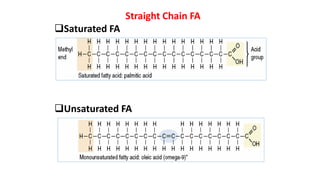
Straight Chain FA
Saturated FA
Unsaturated FA
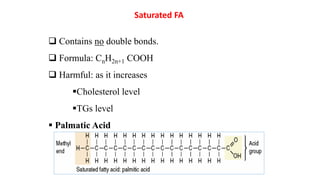
Saturated FA
 Contains no double bonds.
 Formula: CnH2n+1 COOH
 Harmful: as it increases
Cholesterol level
TGs level
 Palmatic Acid
Saturated FA
Classify as
Lower fatty acids : FA having less than 10 carbon atoms
Higher fatty acids: FA having greater than 10 carbon
atoms
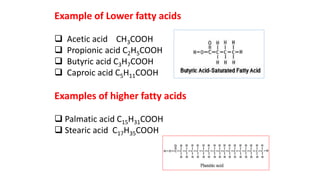
Example of Lower fatty acids
 Acetic acid CH3COOH
 Propionic acid C2H5COOH
 Butyric acid C3H7COOH
 Caproic acid C5H11COOH
Examples of higher fatty acids
 Palmatic acid C15H31COOH
 Stearic acid C17H35COOH
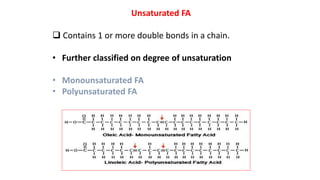
Unsaturated FA
 Contains 1 or more double bonds in a chain.
• Further classified on degree of unsaturation
• Monounsaturated FA
• Polyunsaturated FA
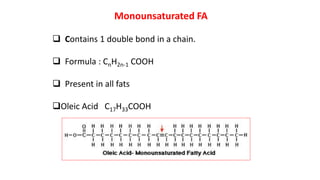
Monounsaturated FA
 Contains 1 double bond in a chain.
 Formula : CnH2n-1 COOH
 Present in all fats
Oleic Acid C17H33COOH
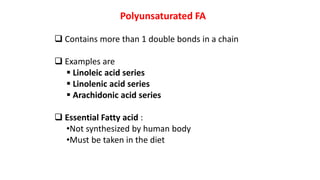
Polyunsaturated FA
 Contains more than 1 double bonds in a chain
 Examples are
 Linoleic acid series
 Linolenic acid series
 Arachidonic acid series
 Essential Fatty acid :
•Not synthesized by human body
•Must be taken in the diet
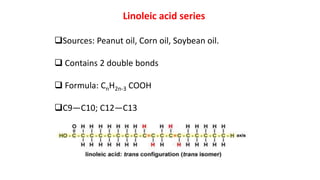
Linoleic acid series
Sources: Peanut oil, Corn oil, Soybean oil.
 Contains 2 double bonds
 Formula: CnH2n-3 COOH
C9—C10; C12—C13
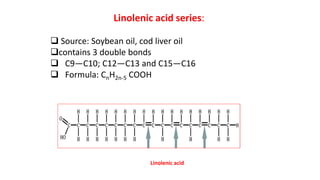
Linolenic acid series:
 Source: Soybean oil, cod liver oil
contains 3 double bonds
 C9—C10; C12—C13 and C15—C16
 Formula: CnH2n-5 COOH
Linolenic acid
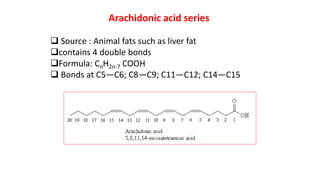
Arachidonic acid series
 Source : Animal fats such as liver fat
contains 4 double bonds
Formula: CnH2n-7 COOH
 Bonds at C5—C6; C8—C9; C11—C12; C14—C15
b) Branched chain FA
 Odd Carbon branched chain fatty acid
 Even Carbon branched chain fatty acid
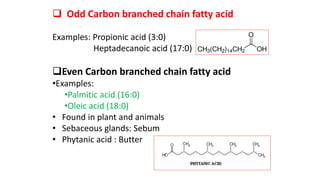
 Odd Carbon branched chain fatty acid
Examples: Propionic acid (3:0)
Heptadecanoic acid (17:0)
Even Carbon branched chain fatty acid
•Examples:
•Palmitic acid (16:0)
•Oleic acid (18:0)
• Found in plant and animals
• Sebaceous glands: Sebum
• Phytanic acid : Butter
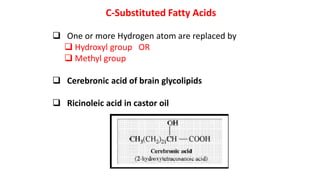
C-Substituted Fatty Acids
 One or more Hydrogen atom are replaced by
 Hydroxyl group OR
 Methyl group
 Cerebronic acid of brain glycolipids
 Ricinoleic acid in castor oil
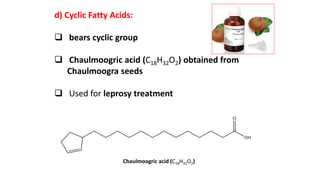
d) Cyclic Fatty Acids:
 bears cyclic group
 Chaulmoogric acid (C18H32O2) obtained from
Chaulmoogra seeds
 Used for leprosy treatment
Chaulmoogric acid (C18H32O2)
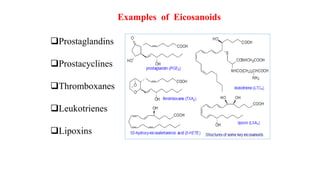
E- Eicosanoids
Compounds derived from long chain polyenoic fatty acids
(20-C).
Examples: Prostaglandins, Thromboxanes, Leukotrienes etc
Most are produced from Arachidonic acid.
Considered "local hormones”
Examples of Eicosanoids
Prostaglandins
Prostacyclines
Thromboxanes
Leukotrienes
Lipoxins
Eicosanoid
Functions
Inflammation
Fever
Regulation of blood pressure
Blood viscosity
Male fertility
Female conception
Muscle contraction
Blood clotting
Tissue growth
Regulation of sleep/wake cycle
Asthma.
Nomenclature of Fatty acids
Nomenclature
• Saturated FA ends “ anoic “
• Example
• Octanoic acid
• Unsaturated FA ends “ enoic”
• Example
• Octadecenoic (oleic)
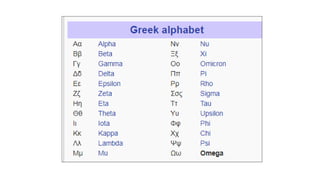
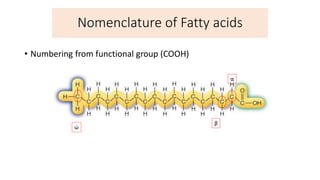
• Numbering from functional group (COOH)
α
β
ώ
Nomenclature of Fatty acids
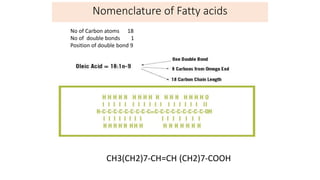
No of Carbon atoms 18
No of double bonds 1
Position of double bond 9
CH3(CH2)7-CH=CH (CH2)7-COOH
Nomenclature of Fatty acids
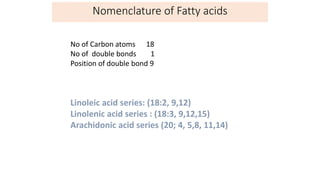
No of Carbon atoms 18
No of double bonds 1
Position of double bond 9
Linoleic acid series: (18:2, 9,12)
Linolenic acid series : (18:3, 9,12,15)
Arachidonic acid series (20; 4, 5,8, 11,14)
Nomenclature of Fatty acids
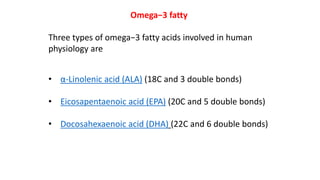
Omega−3 fatty
Three types of omega−3 fatty acids involved in human
physiology are
• α-Linolenic acid (ALA) (18C and 3 double bonds)
• Eicosapentaenoic acid (EPA) (20C and 5 double bonds)
• Docosahexaenoic acid (DHA) (22C and 6 double bonds)
Nomenclature
Isomerism
2 types of isomerism found in unsaturated fatty acid
Geometric Isomerism
Positional Isomerism
Nomenclature of Fatty acids
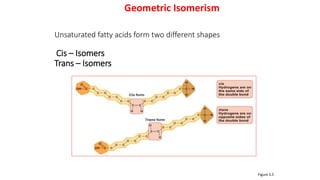
Figure 5.5
Unsaturated fatty acids form two different shapes
Cis – Isomers
Trans – Isomers
Geometric Isomerism
Flow chart of lipid classification
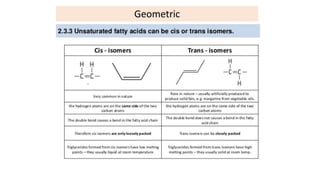
Geometric
Cis- unsaturated fatty acids
Decreases total cholesterol and TGs level.
Increases HDL level
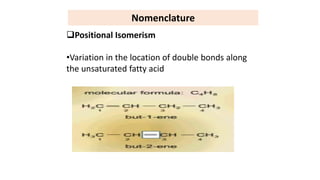
Nomenclature
Positional Isomerism
•Variation in the location of double bonds along
the unsaturated fatty acid
Essential Fatty Acid (EFA)
 Linoleic acid, Linolenic acid, Arachidonic acid
 Linoleic acid is the most important
 Arachidonic acid is also synthesized by Linoleic acid
 Arachidonic is the precursor for prostaglandins and
leukotrienes
Biomedical importance of EFA
 Structural element of tissues
 Structural element of gonads
 Synthesize of prostagladins
 Structural element of mitochondria
 Serum levels of cholesterol
Deficiency
 Growth retardation
 Skin lesions
 Fatty liver
 Kidney demage
Derived lipids
• Fatty Acids
• Alcohols
Alcohols contained in the lipid molecule includes
 Glycerol
 Sterol (Cholesterol)
 Higher alcohols
Glycerol
 Commonly called as “Glycerine”
 Colorless oily fluid with a sweetish taste
 Soluble in water and alcohol
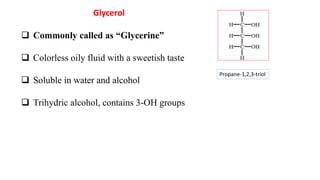
 Trihydric alcohol, contains 3-OH groups
Propane-1,2,3-triol
Glycerol
Sources:
Exogenous : Directly absorbs from the gut (22%)
Endogenous : Breakdown of fats(lipolysis) in adipose tissues
Uses:
• Nutrient value : Glycerol is converted to glucose and
glycogen by process gluconeogenesis
• Glycerol therapy:
in Cerebrovascular disease reduces cerebral oedema
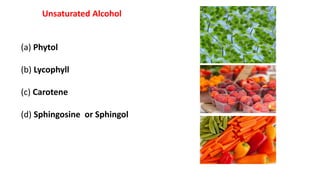
Unsaturated Alcohol
(a) Phytol
(b) Lycophyll
(c) Carotene
(d) Sphingosine or Sphingol
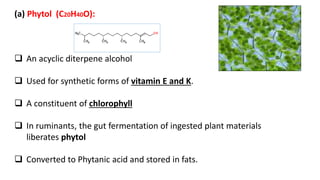
(a) Phytol (C20H40O):
 An acyclic diterpene alcohol
 Used for synthetic forms of vitamin E and K.
 A constituent of chlorophyll
 In ruminants, the gut fermentation of ingested plant materials
liberates phytol
 Converted to Phytanic acid and stored in fats.
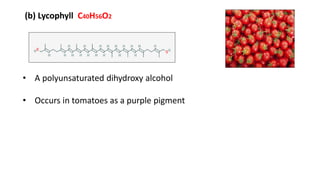
(b) Lycophyll C40H56O2
• A polyunsaturated dihydroxy alcohol
• Occurs in tomatoes as a purple pigment
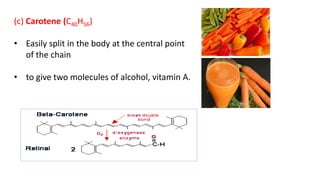
(c) Carotene (C40H56)
• Easily split in the body at the central point
of the chain
• to give two molecules of alcohol, vitamin A.
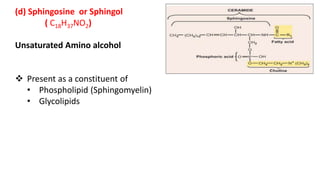
(d) Sphingosine or Sphingol
( C18H37NO2)
Unsaturated Amino alcohol
 Present as a constituent of
• Phospholipid (Sphingomyelin)
• Glycolipids
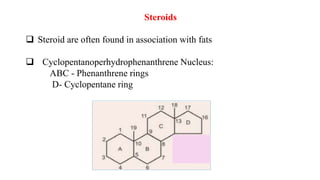
Steroids
 Steroid are often found in association with fats
 Cyclopentanoperhydrophenanthrene Nucleus:
ABC - Phenanthrene rings
D- Cyclopentane ring
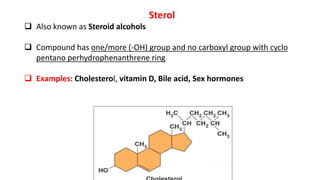
Sterol
 Also known as Steroid alcohols
 Compound has one/more (-OH) group and no carboxyl group with cyclo
pentano perhydrophenanthrene ring
 Examples: Cholesterol, vitamin D, Bile acid, Sex hormones
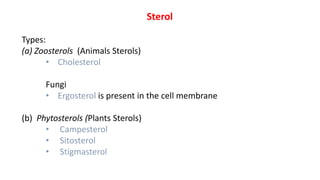
Sterol
Types:
(a) Zoosterols (Animals Sterols)
• Cholesterol
Fungi
• Ergosterol is present in the cell membrane
(b) Phytosterols (Plants Sterols)
• Campesterol
• Sitosterol
• Stigmasterol
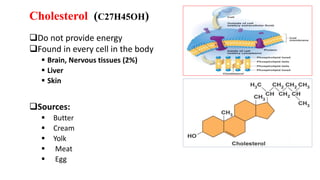
Cholesterol (C27H45OH)
Do not provide energy
Found in every cell in the body
 Brain, Nervous tissues (2%)
 Liver
 Skin
Sources:
 Butter
 Cream
 Yolk
 Meat
 Egg
Forms of Cholesterol
It exist in two states
 Free form E.g. Brain and Nervous
 Bond form E.g. Adrenal Cortex
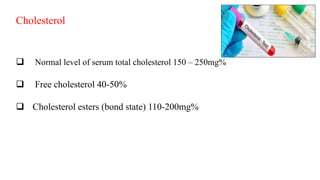
Cholesterol
 Normal level of serum total cholesterol 150 – 250mg%
 Free cholesterol 40-50%
 Cholesterol esters (bond state) 110-200mg%
Others Sterols
 7 dehydocholesterol
 Ergosterol
 Stigmasterol and sitosterol
 Coprosterol
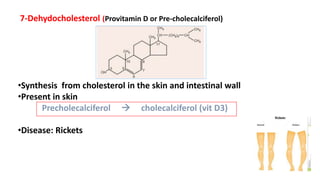
7-Dehydocholesterol (Provitamin D or Pre-cholecalciferol)
•Synthesis from cholesterol in the skin and intestinal wall
•Present in skin
Precholecalciferol  cholecalciferol (vit D3)
•Disease: Rickets
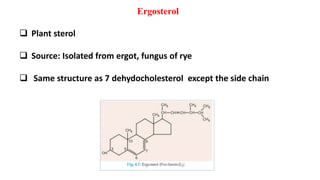
Ergosterol
 Plant sterol
 Source: Isolated from ergot, fungus of rye
 Same structure as 7 dehydocholesterol except the side chain
Stigmasterol and Sitosterol
 Plant sterols, occurs in higher plant
 No nutritional value
 Sitosterol decrease the intestinal absorption of Cholesterol
and low blood cholesterol levels
Coprosterol ( Coprostanol)
 Result of reduction of Cholesterol
(hydrogenation of = bonds) by bacterial action
55
Reference:
Textbook Medical Biochemistry by Chatterjea,
Sixth Edition, Chapter 4
https://www.amazon.com/Textbook-Medical-Biochemistry-M-D-
Chatterjea/dp/9350254840

Derived lipids

  • 1.
    Derived Lipids  Definition Examples  Fatty acids  Definition  Classification  Nomenclature  List the derived lipids of biological importance  Fatty acids  Glycerol
  • 2.
    Derived lipids “ Derivativeobtained on hydrolysis of simple and compound lipids and exhibit lipid characteristics”
  • 3.
    Examples of Derivedlipids On hydrolysis of simple/compound fats yield  Fatty acids (FA)  Alcohol: High molecular weight , straight chain of alcohol yield on wax hydrolysis Examples: Glycerol (Monoacylglycerol /Diglycerides, Glycerol) Cholesterol
  • 4.
    1- Fatty Acid(FA) “ Carboxylic acid with a long aliphatic chain(C4- C24) • Occurs naturally as Triglycerides (TGs)
  • 5.
    Types of FattyAcids (FA) a) Straight chain FA b) Branched chain FA c) Substituted FA d) Cyclic FA e) Eicosanoids
  • 6.
    Straight Chain FA SaturatedFA Unsaturated FA
  • 7.
    Saturated FA  Containsno double bonds.  Formula: CnH2n+1 COOH  Harmful: as it increases Cholesterol level TGs level  Palmatic Acid
  • 8.
    Saturated FA Classify as Lowerfatty acids : FA having less than 10 carbon atoms Higher fatty acids: FA having greater than 10 carbon atoms
  • 9.
    Example of Lowerfatty acids  Acetic acid CH3COOH  Propionic acid C2H5COOH  Butyric acid C3H7COOH  Caproic acid C5H11COOH Examples of higher fatty acids  Palmatic acid C15H31COOH  Stearic acid C17H35COOH
  • 10.
    Unsaturated FA  Contains1 or more double bonds in a chain. • Further classified on degree of unsaturation • Monounsaturated FA • Polyunsaturated FA
  • 11.
    Monounsaturated FA  Contains1 double bond in a chain.  Formula : CnH2n-1 COOH  Present in all fats Oleic Acid C17H33COOH
  • 12.
    Polyunsaturated FA  Containsmore than 1 double bonds in a chain  Examples are  Linoleic acid series  Linolenic acid series  Arachidonic acid series  Essential Fatty acid : •Not synthesized by human body •Must be taken in the diet
  • 13.
    Linoleic acid series Sources:Peanut oil, Corn oil, Soybean oil.  Contains 2 double bonds  Formula: CnH2n-3 COOH C9—C10; C12—C13
  • 14.
    Linolenic acid series: Source: Soybean oil, cod liver oil contains 3 double bonds  C9—C10; C12—C13 and C15—C16  Formula: CnH2n-5 COOH Linolenic acid
  • 15.
    Arachidonic acid series Source : Animal fats such as liver fat contains 4 double bonds Formula: CnH2n-7 COOH  Bonds at C5—C6; C8—C9; C11—C12; C14—C15
  • 16.
    b) Branched chainFA  Odd Carbon branched chain fatty acid  Even Carbon branched chain fatty acid
  • 17.
     Odd Carbonbranched chain fatty acid Examples: Propionic acid (3:0) Heptadecanoic acid (17:0) Even Carbon branched chain fatty acid •Examples: •Palmitic acid (16:0) •Oleic acid (18:0) • Found in plant and animals • Sebaceous glands: Sebum • Phytanic acid : Butter
  • 18.
    C-Substituted Fatty Acids One or more Hydrogen atom are replaced by  Hydroxyl group OR  Methyl group  Cerebronic acid of brain glycolipids  Ricinoleic acid in castor oil
  • 19.
    d) Cyclic FattyAcids:  bears cyclic group  Chaulmoogric acid (C18H32O2) obtained from Chaulmoogra seeds  Used for leprosy treatment Chaulmoogric acid (C18H32O2)
  • 20.
    E- Eicosanoids Compounds derivedfrom long chain polyenoic fatty acids (20-C). Examples: Prostaglandins, Thromboxanes, Leukotrienes etc Most are produced from Arachidonic acid. Considered "local hormones”
  • 21.
  • 22.
    Eicosanoid Functions Inflammation Fever Regulation of bloodpressure Blood viscosity Male fertility Female conception Muscle contraction Blood clotting Tissue growth Regulation of sleep/wake cycle Asthma.
  • 23.
  • 24.
    Nomenclature • Saturated FAends “ anoic “ • Example • Octanoic acid • Unsaturated FA ends “ enoic” • Example • Octadecenoic (oleic)
  • 26.
    • Numbering fromfunctional group (COOH) α β ώ Nomenclature of Fatty acids
  • 27.
    No of Carbonatoms 18 No of double bonds 1 Position of double bond 9 CH3(CH2)7-CH=CH (CH2)7-COOH Nomenclature of Fatty acids
  • 28.
    No of Carbonatoms 18 No of double bonds 1 Position of double bond 9 Linoleic acid series: (18:2, 9,12) Linolenic acid series : (18:3, 9,12,15) Arachidonic acid series (20; 4, 5,8, 11,14) Nomenclature of Fatty acids
  • 29.
    Omega−3 fatty Three typesof omega−3 fatty acids involved in human physiology are • α-Linolenic acid (ALA) (18C and 3 double bonds) • Eicosapentaenoic acid (EPA) (20C and 5 double bonds) • Docosahexaenoic acid (DHA) (22C and 6 double bonds)
  • 30.
    Nomenclature Isomerism 2 types ofisomerism found in unsaturated fatty acid Geometric Isomerism Positional Isomerism Nomenclature of Fatty acids
  • 31.
    Figure 5.5 Unsaturated fattyacids form two different shapes Cis – Isomers Trans – Isomers Geometric Isomerism
  • 32.
    Flow chart oflipid classification Geometric
  • 33.
    Cis- unsaturated fattyacids Decreases total cholesterol and TGs level. Increases HDL level
  • 34.
    Nomenclature Positional Isomerism •Variation inthe location of double bonds along the unsaturated fatty acid
  • 35.
    Essential Fatty Acid(EFA)  Linoleic acid, Linolenic acid, Arachidonic acid  Linoleic acid is the most important  Arachidonic acid is also synthesized by Linoleic acid  Arachidonic is the precursor for prostaglandins and leukotrienes
  • 36.
    Biomedical importance ofEFA  Structural element of tissues  Structural element of gonads  Synthesize of prostagladins  Structural element of mitochondria  Serum levels of cholesterol Deficiency  Growth retardation  Skin lesions  Fatty liver  Kidney demage
  • 37.
    Derived lipids • FattyAcids • Alcohols Alcohols contained in the lipid molecule includes  Glycerol  Sterol (Cholesterol)  Higher alcohols
  • 38.
    Glycerol  Commonly calledas “Glycerine”  Colorless oily fluid with a sweetish taste  Soluble in water and alcohol  Trihydric alcohol, contains 3-OH groups Propane-1,2,3-triol
  • 39.
    Glycerol Sources: Exogenous : Directlyabsorbs from the gut (22%) Endogenous : Breakdown of fats(lipolysis) in adipose tissues Uses: • Nutrient value : Glycerol is converted to glucose and glycogen by process gluconeogenesis • Glycerol therapy: in Cerebrovascular disease reduces cerebral oedema
  • 40.
    Unsaturated Alcohol (a) Phytol (b)Lycophyll (c) Carotene (d) Sphingosine or Sphingol
  • 41.
    (a) Phytol (C20H40O): An acyclic diterpene alcohol  Used for synthetic forms of vitamin E and K.  A constituent of chlorophyll  In ruminants, the gut fermentation of ingested plant materials liberates phytol  Converted to Phytanic acid and stored in fats.
  • 42.
    (b) Lycophyll C40H56O2 •A polyunsaturated dihydroxy alcohol • Occurs in tomatoes as a purple pigment
  • 43.
    (c) Carotene (C40H56) •Easily split in the body at the central point of the chain • to give two molecules of alcohol, vitamin A.
  • 44.
    (d) Sphingosine orSphingol ( C18H37NO2) Unsaturated Amino alcohol  Present as a constituent of • Phospholipid (Sphingomyelin) • Glycolipids
  • 45.
    Steroids  Steroid areoften found in association with fats  Cyclopentanoperhydrophenanthrene Nucleus: ABC - Phenanthrene rings D- Cyclopentane ring
  • 46.
    Sterol  Also knownas Steroid alcohols  Compound has one/more (-OH) group and no carboxyl group with cyclo pentano perhydrophenanthrene ring  Examples: Cholesterol, vitamin D, Bile acid, Sex hormones
  • 47.
    Sterol Types: (a) Zoosterols (AnimalsSterols) • Cholesterol Fungi • Ergosterol is present in the cell membrane (b) Phytosterols (Plants Sterols) • Campesterol • Sitosterol • Stigmasterol
  • 48.
    Cholesterol (C27H45OH) Do notprovide energy Found in every cell in the body  Brain, Nervous tissues (2%)  Liver  Skin Sources:  Butter  Cream  Yolk  Meat  Egg
  • 49.
    Forms of Cholesterol Itexist in two states  Free form E.g. Brain and Nervous  Bond form E.g. Adrenal Cortex
  • 50.
    Cholesterol  Normal levelof serum total cholesterol 150 – 250mg%  Free cholesterol 40-50%  Cholesterol esters (bond state) 110-200mg%
  • 51.
    Others Sterols  7dehydocholesterol  Ergosterol  Stigmasterol and sitosterol  Coprosterol
  • 52.
    7-Dehydocholesterol (Provitamin Dor Pre-cholecalciferol) •Synthesis from cholesterol in the skin and intestinal wall •Present in skin Precholecalciferol  cholecalciferol (vit D3) •Disease: Rickets
  • 53.
    Ergosterol  Plant sterol Source: Isolated from ergot, fungus of rye  Same structure as 7 dehydocholesterol except the side chain
  • 54.
    Stigmasterol and Sitosterol Plant sterols, occurs in higher plant  No nutritional value  Sitosterol decrease the intestinal absorption of Cholesterol and low blood cholesterol levels Coprosterol ( Coprostanol)  Result of reduction of Cholesterol (hydrogenation of = bonds) by bacterial action
  • 55.
    55 Reference: Textbook Medical Biochemistryby Chatterjea, Sixth Edition, Chapter 4 https://www.amazon.com/Textbook-Medical-Biochemistry-M-D- Chatterjea/dp/9350254840

Editor's Notes

  • #21 The eicosanoids are a family of oxygenated derivatives of 20-carbon polyunsaturated fatty acids that includes prostaglandins, thromboxanes, leukotrienes, endocannabinoids, and isoecosanoids.
  • #39 propane-1,2,3-triol. Is saturated alcohol, is a simple polyol compound. It is a colorless, odorless, viscous liquid that is sweet-tasting and non-toxic. The glycerolbackbone is found in all lipids known as triglycerides.
  • #40 Cerebral edema is excess accumulation of fluid in the intracellular or extracellular spaces of the brain.  Healthcare providers sometimes give glycerol intravenously (by IV) to reduce pressure inside the brain in various conditions including stroke, meningitis, encephalitis, Reye's syndrome, pseudotumor cerebri, central nervous system (CNS) trauma, and CNS tumors; for reducing brain volume for neurosurgical procedures; and for treating fainting on standing due to poor blood flow to the brain (postural syncope). Some people apply glycerol to the skin as a moisturizer. Eye doctors sometimes put a solution that contains glycerol in the eye to reduce fluid in the cornea before an eye exam. Rectally, glycerol is used as a laxative. Vasodilation is the widening of blood vessels. It results from relaxation of smooth muscle cells within the vessel walls, in particular in the large veins (called venodilators), large arteries, and smaller arterioles. The process is the opposite of vasoconstriction, which is the narrowing of blood vessels.
  • #41 Most of the unsaturated alcohols are pigments. Biological pigments[edit] See conjugated systems for electron bond chemistry that causes these molecules to have pigment. Heme/porphyrin-based: chlorophyll, bilirubin, hemocyanin, hemoglobin, myoglobin
  • #42 Fermentation is a metabolic process that consumes sugar in the absence of oxygen. The products are organic acids, gases, or alcohol. It occurs in yeast and bacteria, and also in oxygen-starved muscle cells, as in the case of lactic acid fermentation. Ruminant: chewing over again  cattle, sheep, antelopes, deer, giraffes
  • #49  cholesterol also serves as a precursor for the biosynthesis of steroid hormones, bile acid[5] and vitamin D. 80% of total daily cholesterol production occurs in the liver; other sites of higher synthesis rates include the intestines, adrenal glands, and reproductive organs.
  • #50 Cholesterol (Ancient Greek  chole- (bile) and stereos (solid), Cholesterol esters are major constituents of the adrenal glands, and they accumulate in the fatty lesions of atherosclerotic plaques. Similarly, esters of steroidal hormones are also present in the adrenal glands, where they are concentrated in cytosolic lipid droplets adjacent to the endoplasmic reticulum; 17β-estradiol, the principal oestrogen in fertile women, is transported in lipoproteins in the form of a fatty acid ester. Because of the mechanism of synthesis (see below), plasma cholesterol esters tend to contain relatively high proportions of the polyunsaturated components typical of phosphatidylcholine (Table 1). Arachidonic and “adrenic” (20:4(n-6)) acids can be especially abundant in cholesterol esters from the adrenal gland.