BAR CODE TECHNOLOGY  FOR SMEs Indian Institute of Management, Indore Prof M Scalem IMPETUS Chair of IT & Systems Email:  [email_address] Mr. Kishor C. Satpathy Librarian Email:  [email_address]
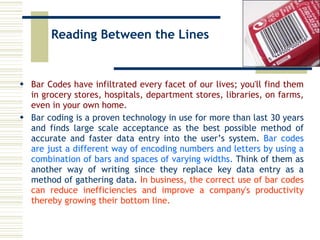
Reading Between the Lines Bar Codes have infiltrated every facet of our lives; you'll find them in grocery stores, hospitals, department stores, libraries, on farms, even in your own home.   Bar coding is a proven technology in use for more than last 30 years and finds large scale acceptance as the best possible method of accurate and faster data entry into the user’s system.  Bar codes are just a different way of encoding numbers and letters by using a combination of bars and spaces of varying widths.  Think of them as another way of writing since they replace key data entry as a method of gathering data.  In business, the correct use of bar codes can reduce inefficiencies and improve a company's productivity thereby growing their bottom line.
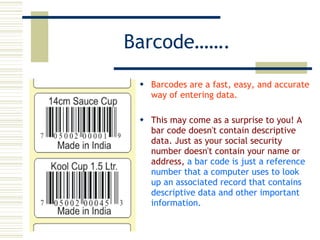
Barcode……. Barcodes are a fast, easy, and accurate way of entering data. This may come as a surprise to you! A bar code doesn't contain descriptive data. Just as your social security number doesn't contain your name or address,  a bar code is just a reference number that a computer uses to look up an associated record that contains descriptive data and other important information.
Bar Code Technology It is an automatic identification technology Bar code is a predefined formatted series of black and white bars and spaces that represents a series of characters and symbols. Bar codes are read by sweeping a small spot of light across the printed bar code symbols.   Structured to contain a specific piece of information Information are stored from left to right. Letters, numbers, characters and symbols are designed to store information in the form easily read and printed by machine. It allows real-time data to be collected accurately and rapidly Combination of barcode technology with computer and application software improves performance, productivity and profitability
Why Barcode ? Bar codes are accurate They eliminate manual data entry errors  Barcodes speed data entry. A bar code can be scanned in a fraction of the time it takes to enter the information manually Barcodes can be produced easily and cheaply Can be printed on most computer printers, for the cost of ink and printer
Use Since their invention in the 20th century, barcodes — especially the  UPC  — have slowly become an essential part of modern civilization. Their use is widespread, and the technology behind barcodes is constantly improving. Some modern applications of barcodes include: Practically every item purchased from a  grocery store ,  department store , and mass merchandiser has a barcode on it. This greatly helps in keeping track of the large number of items in a store and also reduces instances of  shoplifting  (since shoplifters could no longer easily switch price tags from a lower-cost item to a higher-priced one). Since the adoption of barcodes, both consumers and retailers have benefited from the savings generated.
Use….. Document Management  tools often allow for barcoded sheets to facilitate the separation and  indexing  of documents that have been imaged in batch scanning applications.  The tracking of item movement, including rental cars, airline luggage, nuclear waste, mail and parcels .  Recently, researchers have placed tiny barcodes on individual  bees  to track the insects' mating habits.   Many tickets now have barcodes that need to be validated before allowing the holder to enter sports arenas, cinemas, theatres, fairgrounds, transportation etc.  Used on automobiles, can be located on front or back.
Advantages of Bar Code Speed:  data can be entered into the computer more rapidly Accuracy:  bar code systems are error free. They don’t reply on human beings to type  Reliability:  they have formats designed with built in error checking Easy to operate Reduced man power Reduction in paper work Clerical work is reduced
Benefits… Cost Efficient Real Time Data Collection Measurement of Work in Progress throughout the Factory Rapid Access to Total Production Costs More Accurate Dispatch
Benefits…. Represent Unique Identity of a Product Accuracy of Data Input (Error Free) Aid Effective Management of Resources And Inventories Labour Savings by Avoiding Manual System
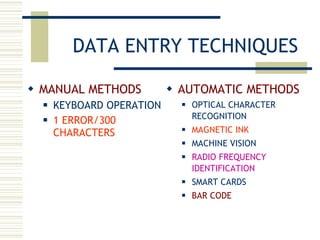
DATA ENTRY TECHNIQUES MANUAL METHODS KEYBOARD OPERATION 1 ERROR/300 CHARACTERS AUTOMATIC METHODS OPTICAL CHARACTER RECOGNITION MAGNETIC INK MACHINE VISION RADIO FREQUENCY IDENTIFICATION SMART CARDS BAR CODE
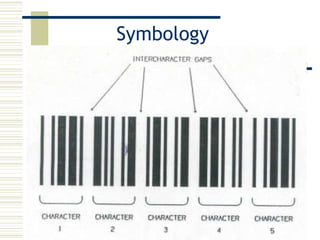
Symbology Symbology is considered a language in bar code technology.  Just as you might speak French while traveling in France, a symbology allows a scanner and a bar code to "speak" to each other.  When a bar code is scanned, it's the symbology that enables the information to be read accurately.   And then when a bar code is printed, it's the symbology that allows the printer to understand the information that needs to be turned into a label.
Symbology
How Bar Codes are Read Bar codes are read by sweeping a small spot of light across the printed bar code symbol.  Your eyes only see a thin red line emitted from the laser scanner. But what’s happening is that the scanner’s light source is being absorbed by the dark bars and reflected by the light spaces.  A device in the scanner takes the reflected light and converts it into an electrical signal.  The scanner’s laser (light source) starts to read the bar code at a white space (the quiet zone) before the first bar and continues passing by the last bar, ending in the white space which follows it. Because a bar code cannot be read if the sweep wanders outside the symbol area, bar heights are chosen to make it easy to keep the sweep within the bar code area.  The longer the information to be coded, the longer the bar code needed. And as the length increases, so does the height of the bars and spaces to be read .
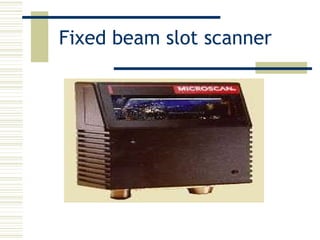
BAR CODE TERMINOLOGY BAR - The darker, non reflective element of a Bar Code BI-DIRECTIONAL SYMBOL - A Bar Code symbol format which permits reading in either direction across the bars and spaces CHECK DIGIT - A calculated character included within the Bar Code for error detection FIXED BEAM SCANNER - A stationary Bar Code Scanner.  The symbol must be  moved through the light beam to be read
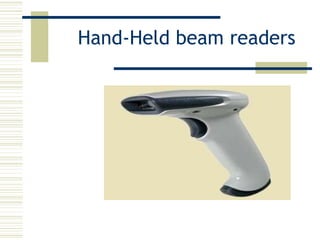
TERMINOLOGY … HAND-HELD SCANNER A scanner held and operated by a human operator INTER-CHARACTER GAP The space between the bars or spaces MOVING BEAM SCANNER A Bar Code scanner that uses a moving light beam to dynamically scan and decode a Bar Code symbol
TERMINOLOGY … SPACE The lighter, reflective element of a Bar Code START CHARACTER A special pattern of bars and spaces used to identify the beginning of a Bar Code symbol STOP CHARACTER A special pattern of bars and spaces used to identify the end of a Bar Code symbol
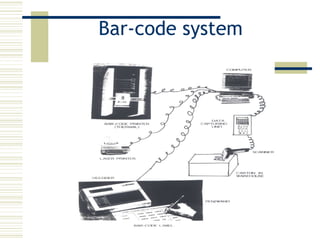
Bar-code system
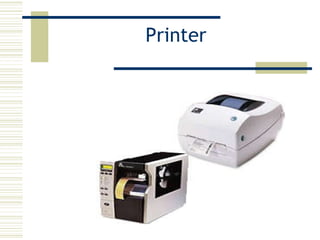
Printer
BAR CODE SCANNERS A device used to extract information optically from a Bar Code Bar Code symbol consists of series of vertical dark bars separated by light spaces When illuminated reflected light is detected by electro optical sensor The intensity of reflected light from the dark bars is less than that of spaces
SCANNERS … Reflected light is converted into electrical voltage signals Analog voltages are digitized into raw data The decoder converts this data into the character data representation of the symbol’s code
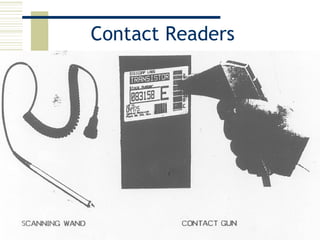
TYPES OF SCANNERS (READERS) CONTACT READERS Must touch or come in close proximity of symbol Good where the label cannot be placed in an easy-to-view position Normally hand-held/stationary units Common type is pen/wand reader A high-density resolution wand used to read a low-density symbol might see an ink spot as bar or an ink void as a space
CONTACT READERS  … A low-resolution wand may not be able to recognise a narrow bar of high-density symbol Positioned angle of wand to the surface and movement speed across the symbol are key parameters
Contact Readers
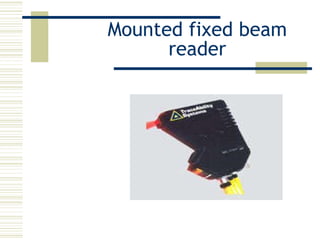
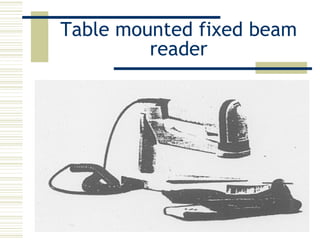
NON-CONTACT READERS Reader need not come in contact with symbol Scan distance may be from 6” to several feet depending upon symbol size and scanner design Hand-held, fixed beam readers
Mounted fixed beam reader
Table mounted fixed beam reader
Hand-Held beam readers
Fixed beam slot scanner
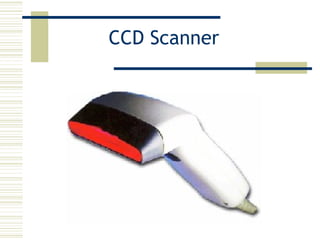
CCD Scanner
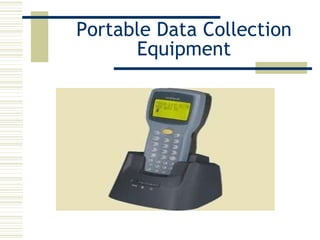
Portable Data Collection Equipment
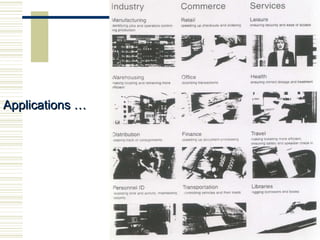
Typical Applications for Bar Coding  Retail Receiving and Put away   Warehouse and Inventory Management  Work – In - Process tracking   Transportation and Logistics  Shipping and Distribution
Applications…. Product labeling Shipping labels Stores management Compliance labeling Warehouse and distribution
Applications….. INVENTORY CONTROL Portable readers WORK-IN PROCESS TRACKING (WIP) COMPANY INVENTORY Raw materials WIP (Components, Assemblies, Semi finished Products) Finished Products
Applications … ELECTRONIC DATA INTERCHANGE (EDI) Direct communication between computers of two companies (Manufacturer & Vendor) Industry-wide EDI standards Reduces cost and saves time of business transaction
Applications  … RETAIL APPLICATIONS Super markets Counter-mounted Bar Code scanners Universal Product Code (UPC) Price and description information WARE HOUSING HEALTH CARE APPLICATIONS Drugs, devices, instruments Identification of expiry date Blood banking Blood group Expiry date Donor traceability
Bar Coding in Educational Organisations Paper valuation Attendance register Asset tracking Materials management Library Management
Applications …
Requirements of Bar Code Technology Computer system Bar code printer Laser scanner  Consumables like labels, printer ink, etc.
BAR CODING IN LIBRARIES:  A CASE STUDY OF IIM INDORE Background….. Libraries always had cumbersome manual check in/check out systems. Borrowers had to wait for a long time at the issue/return counters, as manual operations take a very long time.  Presently, the modern bar code technology approach for processing books is reducing operational costs and time, the operational staff too can devote more time to users’ requirements and interact with them. The users’ feedback too was positive towards this technique .
Applications…. Bar code technology was applied in 2 prominent areas of library operations: Circulation services Stack taking
Bar Codes ID Cards The library users were admitted to the library only on production of ID Cards (alpha numerical). These were with the bar codes transferring the ID numbers into bar codes.  The ID Cards were prepared with details like name, address, duration and photograph with signature on the reverse side.  The borrowing  capacity of the users too was indicated here.
Bar Code Labels on Reading Materials Bar Coding of books means transferring the accession number of the book into bar code using a specific software. Bar Coded labels designed with a required size ranging from 19mm to 114 mm width. These labels were pasted in the book. The label contain-  name of the library, bar code, accession number and  call number
How it worked in Lib Environment… Circulation counter-  while issuing and returning books, the ID card alongwith books were scanned. The entry for issuing and receiving the books were thus entered with greater speed and accuracy. Books without bar-coded labels cannot be picked out easily from the stack. Stack Taking-   the Data capture unit were used to scan the available bar coded books in the library at the point of time and it can be verified with the list of books under circulation within short span of time.
BARCODING IN LIBRARIES … DATABASE PROGRAM LINKS THE BAR CODE TO BIBLIOGRAPHIC DETAILS OF DOCUMENTS AUTHORISED ID CARD INCLUDES BAR CODE Card could be used by library Institutional ID card BAR CODE READER INTERFACED TO COMPUTER TRACKING OF BOOKS
ADVANTAGES OF BAR CODE IN LIBRARIES Quick and error free entry of access and membership codes Ensures total integrity of collected data No queuing up at check out/check in counters Avoids piling up of data entry work for counter staff Aids generation of suitable reminders to delinquent borrowers   Stock verification made easy
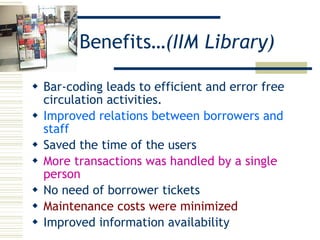
Benefits… (IIM Library) Bar-coding leads to efficient and error free circulation activities.  Improved relations between borrowers and staff Saved the time of the users More transactions was handled by a single person No need of borrower tickets Maintenance costs were minimized Improved information availability
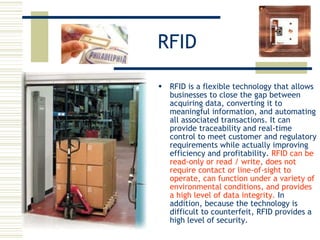
RFID RFID is a flexible technology that allows businesses to close the gap between acquiring data, converting it to meaningful information, and automating all associated transactions. It can provide traceability and real-time control to meet customer and regulatory requirements while actually improving efficiency and profitability.  RFID can be read-only or read / write, does not require contact or line-of-sight to operate, can function under a variety of environmental conditions, and provides a high level of data integrity.  In addition, because the technology is difficult to counterfeit, RFID provides a high level of security.
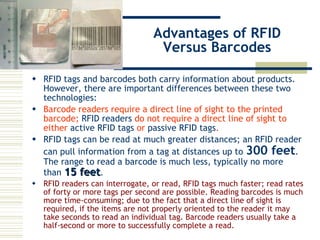
Advantages of RFID Versus Barcodes RFID tags  and barcodes both carry information about products. However, there are important differences between these two technologies:  Barcode readers require a direct line of sight to the printed barcode;  RFID readers  do not require a direct line of sight to either  active RFID tags  or  passive RFID tags .   RFID tags can be read at much greater distances; an RFID reader can pull information from a tag at distances up to  300 feet . The range to read a barcode is much less, typically no more than  15 feet .  RFID readers can interrogate, or read, RFID tags much faster; read rates of forty or more tags per second are possible. Reading barcodes is much more time-consuming; due to the fact that a direct line of sight is required, if the items are not properly oriented to the reader it may take seconds to read an individual tag. Barcode readers usually take a half-second or more to successfully complete a read.
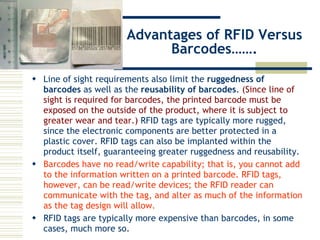
Advantages of RFID Versus Barcodes……. Line of sight requirements also limit the  ruggedness of barcodes  as well as the  reusability of barcodes .  (Since line of sight is required for barcodes, the printed barcode must be exposed on the outside of the product, where it is subject to greater wear and tear.)  RFID tags are typically more rugged, since the electronic components are better protected in a plastic cover. RFID tags can also be implanted within the product itself, guaranteeing greater ruggedness and reusability.  Barcodes have no read/write capability; that is, you cannot add to the information written on a printed barcode. RFID tags, however, can be read/write devices; the RFID reader can communicate with the tag, and alter as much of the information as the tag design will allow.  RFID tags are typically more expensive than barcodes, in some cases, much more so.
Any Questions….?? Thank You..

Silchar paper final

  • 1.
    BAR CODE TECHNOLOGY FOR SMEs Indian Institute of Management, Indore Prof M Scalem IMPETUS Chair of IT & Systems Email: [email_address] Mr. Kishor C. Satpathy Librarian Email: [email_address]
  • 2.
    Reading Between theLines Bar Codes have infiltrated every facet of our lives; you'll find them in grocery stores, hospitals, department stores, libraries, on farms, even in your own home.   Bar coding is a proven technology in use for more than last 30 years and finds large scale acceptance as the best possible method of accurate and faster data entry into the user’s system. Bar codes are just a different way of encoding numbers and letters by using a combination of bars and spaces of varying widths. Think of them as another way of writing since they replace key data entry as a method of gathering data. In business, the correct use of bar codes can reduce inefficiencies and improve a company's productivity thereby growing their bottom line.
  • 3.
    Barcode……. Barcodes area fast, easy, and accurate way of entering data. This may come as a surprise to you! A bar code doesn't contain descriptive data. Just as your social security number doesn't contain your name or address, a bar code is just a reference number that a computer uses to look up an associated record that contains descriptive data and other important information.
  • 4.
    Bar Code TechnologyIt is an automatic identification technology Bar code is a predefined formatted series of black and white bars and spaces that represents a series of characters and symbols. Bar codes are read by sweeping a small spot of light across the printed bar code symbols. Structured to contain a specific piece of information Information are stored from left to right. Letters, numbers, characters and symbols are designed to store information in the form easily read and printed by machine. It allows real-time data to be collected accurately and rapidly Combination of barcode technology with computer and application software improves performance, productivity and profitability
  • 5.
    Why Barcode ?Bar codes are accurate They eliminate manual data entry errors Barcodes speed data entry. A bar code can be scanned in a fraction of the time it takes to enter the information manually Barcodes can be produced easily and cheaply Can be printed on most computer printers, for the cost of ink and printer
  • 6.
    Use Since theirinvention in the 20th century, barcodes — especially the UPC — have slowly become an essential part of modern civilization. Their use is widespread, and the technology behind barcodes is constantly improving. Some modern applications of barcodes include: Practically every item purchased from a grocery store , department store , and mass merchandiser has a barcode on it. This greatly helps in keeping track of the large number of items in a store and also reduces instances of shoplifting (since shoplifters could no longer easily switch price tags from a lower-cost item to a higher-priced one). Since the adoption of barcodes, both consumers and retailers have benefited from the savings generated.
  • 7.
    Use….. Document Management tools often allow for barcoded sheets to facilitate the separation and indexing of documents that have been imaged in batch scanning applications. The tracking of item movement, including rental cars, airline luggage, nuclear waste, mail and parcels . Recently, researchers have placed tiny barcodes on individual bees to track the insects' mating habits. Many tickets now have barcodes that need to be validated before allowing the holder to enter sports arenas, cinemas, theatres, fairgrounds, transportation etc. Used on automobiles, can be located on front or back.
  • 8.
    Advantages of BarCode Speed: data can be entered into the computer more rapidly Accuracy: bar code systems are error free. They don’t reply on human beings to type Reliability: they have formats designed with built in error checking Easy to operate Reduced man power Reduction in paper work Clerical work is reduced
  • 9.
    Benefits… Cost EfficientReal Time Data Collection Measurement of Work in Progress throughout the Factory Rapid Access to Total Production Costs More Accurate Dispatch
  • 10.
    Benefits…. Represent UniqueIdentity of a Product Accuracy of Data Input (Error Free) Aid Effective Management of Resources And Inventories Labour Savings by Avoiding Manual System
  • 11.
    DATA ENTRY TECHNIQUESMANUAL METHODS KEYBOARD OPERATION 1 ERROR/300 CHARACTERS AUTOMATIC METHODS OPTICAL CHARACTER RECOGNITION MAGNETIC INK MACHINE VISION RADIO FREQUENCY IDENTIFICATION SMART CARDS BAR CODE
  • 12.
    Symbology Symbology isconsidered a language in bar code technology. Just as you might speak French while traveling in France, a symbology allows a scanner and a bar code to "speak" to each other. When a bar code is scanned, it's the symbology that enables the information to be read accurately. And then when a bar code is printed, it's the symbology that allows the printer to understand the information that needs to be turned into a label.
  • 13.
  • 14.
    How Bar Codesare Read Bar codes are read by sweeping a small spot of light across the printed bar code symbol. Your eyes only see a thin red line emitted from the laser scanner. But what’s happening is that the scanner’s light source is being absorbed by the dark bars and reflected by the light spaces. A device in the scanner takes the reflected light and converts it into an electrical signal. The scanner’s laser (light source) starts to read the bar code at a white space (the quiet zone) before the first bar and continues passing by the last bar, ending in the white space which follows it. Because a bar code cannot be read if the sweep wanders outside the symbol area, bar heights are chosen to make it easy to keep the sweep within the bar code area. The longer the information to be coded, the longer the bar code needed. And as the length increases, so does the height of the bars and spaces to be read .
  • 15.
    BAR CODE TERMINOLOGYBAR - The darker, non reflective element of a Bar Code BI-DIRECTIONAL SYMBOL - A Bar Code symbol format which permits reading in either direction across the bars and spaces CHECK DIGIT - A calculated character included within the Bar Code for error detection FIXED BEAM SCANNER - A stationary Bar Code Scanner. The symbol must be moved through the light beam to be read
  • 16.
    TERMINOLOGY … HAND-HELDSCANNER A scanner held and operated by a human operator INTER-CHARACTER GAP The space between the bars or spaces MOVING BEAM SCANNER A Bar Code scanner that uses a moving light beam to dynamically scan and decode a Bar Code symbol
  • 17.
    TERMINOLOGY … SPACEThe lighter, reflective element of a Bar Code START CHARACTER A special pattern of bars and spaces used to identify the beginning of a Bar Code symbol STOP CHARACTER A special pattern of bars and spaces used to identify the end of a Bar Code symbol
  • 18.
  • 19.
  • 20.
    BAR CODE SCANNERSA device used to extract information optically from a Bar Code Bar Code symbol consists of series of vertical dark bars separated by light spaces When illuminated reflected light is detected by electro optical sensor The intensity of reflected light from the dark bars is less than that of spaces
  • 21.
    SCANNERS … Reflectedlight is converted into electrical voltage signals Analog voltages are digitized into raw data The decoder converts this data into the character data representation of the symbol’s code
  • 22.
    TYPES OF SCANNERS(READERS) CONTACT READERS Must touch or come in close proximity of symbol Good where the label cannot be placed in an easy-to-view position Normally hand-held/stationary units Common type is pen/wand reader A high-density resolution wand used to read a low-density symbol might see an ink spot as bar or an ink void as a space
  • 23.
    CONTACT READERS … A low-resolution wand may not be able to recognise a narrow bar of high-density symbol Positioned angle of wand to the surface and movement speed across the symbol are key parameters
  • 24.
  • 25.
    NON-CONTACT READERS Readerneed not come in contact with symbol Scan distance may be from 6” to several feet depending upon symbol size and scanner design Hand-held, fixed beam readers
  • 26.
  • 27.
  • 28.
  • 29.
  • 30.
  • 31.
  • 32.
    Typical Applications forBar Coding Retail Receiving and Put away Warehouse and Inventory Management Work – In - Process tracking Transportation and Logistics Shipping and Distribution
  • 33.
    Applications…. Product labelingShipping labels Stores management Compliance labeling Warehouse and distribution
  • 34.
    Applications….. INVENTORY CONTROLPortable readers WORK-IN PROCESS TRACKING (WIP) COMPANY INVENTORY Raw materials WIP (Components, Assemblies, Semi finished Products) Finished Products
  • 35.
    Applications … ELECTRONICDATA INTERCHANGE (EDI) Direct communication between computers of two companies (Manufacturer & Vendor) Industry-wide EDI standards Reduces cost and saves time of business transaction
  • 36.
    Applications …RETAIL APPLICATIONS Super markets Counter-mounted Bar Code scanners Universal Product Code (UPC) Price and description information WARE HOUSING HEALTH CARE APPLICATIONS Drugs, devices, instruments Identification of expiry date Blood banking Blood group Expiry date Donor traceability
  • 37.
    Bar Coding inEducational Organisations Paper valuation Attendance register Asset tracking Materials management Library Management
  • 38.
  • 39.
    Requirements of BarCode Technology Computer system Bar code printer Laser scanner Consumables like labels, printer ink, etc.
  • 40.
    BAR CODING INLIBRARIES: A CASE STUDY OF IIM INDORE Background….. Libraries always had cumbersome manual check in/check out systems. Borrowers had to wait for a long time at the issue/return counters, as manual operations take a very long time. Presently, the modern bar code technology approach for processing books is reducing operational costs and time, the operational staff too can devote more time to users’ requirements and interact with them. The users’ feedback too was positive towards this technique .
  • 41.
    Applications…. Bar codetechnology was applied in 2 prominent areas of library operations: Circulation services Stack taking
  • 42.
    Bar Codes IDCards The library users were admitted to the library only on production of ID Cards (alpha numerical). These were with the bar codes transferring the ID numbers into bar codes. The ID Cards were prepared with details like name, address, duration and photograph with signature on the reverse side. The borrowing capacity of the users too was indicated here.
  • 43.
    Bar Code Labelson Reading Materials Bar Coding of books means transferring the accession number of the book into bar code using a specific software. Bar Coded labels designed with a required size ranging from 19mm to 114 mm width. These labels were pasted in the book. The label contain- name of the library, bar code, accession number and call number
  • 44.
    How it workedin Lib Environment… Circulation counter- while issuing and returning books, the ID card alongwith books were scanned. The entry for issuing and receiving the books were thus entered with greater speed and accuracy. Books without bar-coded labels cannot be picked out easily from the stack. Stack Taking- the Data capture unit were used to scan the available bar coded books in the library at the point of time and it can be verified with the list of books under circulation within short span of time.
  • 45.
    BARCODING IN LIBRARIES… DATABASE PROGRAM LINKS THE BAR CODE TO BIBLIOGRAPHIC DETAILS OF DOCUMENTS AUTHORISED ID CARD INCLUDES BAR CODE Card could be used by library Institutional ID card BAR CODE READER INTERFACED TO COMPUTER TRACKING OF BOOKS
  • 46.
    ADVANTAGES OF BARCODE IN LIBRARIES Quick and error free entry of access and membership codes Ensures total integrity of collected data No queuing up at check out/check in counters Avoids piling up of data entry work for counter staff Aids generation of suitable reminders to delinquent borrowers Stock verification made easy
  • 47.
    Benefits… (IIM Library)Bar-coding leads to efficient and error free circulation activities. Improved relations between borrowers and staff Saved the time of the users More transactions was handled by a single person No need of borrower tickets Maintenance costs were minimized Improved information availability
  • 48.
    RFID RFID isa flexible technology that allows businesses to close the gap between acquiring data, converting it to meaningful information, and automating all associated transactions. It can provide traceability and real-time control to meet customer and regulatory requirements while actually improving efficiency and profitability. RFID can be read-only or read / write, does not require contact or line-of-sight to operate, can function under a variety of environmental conditions, and provides a high level of data integrity. In addition, because the technology is difficult to counterfeit, RFID provides a high level of security.
  • 49.
    Advantages of RFIDVersus Barcodes RFID tags and barcodes both carry information about products. However, there are important differences between these two technologies: Barcode readers require a direct line of sight to the printed barcode; RFID readers do not require a direct line of sight to either active RFID tags or passive RFID tags . RFID tags can be read at much greater distances; an RFID reader can pull information from a tag at distances up to 300 feet . The range to read a barcode is much less, typically no more than 15 feet . RFID readers can interrogate, or read, RFID tags much faster; read rates of forty or more tags per second are possible. Reading barcodes is much more time-consuming; due to the fact that a direct line of sight is required, if the items are not properly oriented to the reader it may take seconds to read an individual tag. Barcode readers usually take a half-second or more to successfully complete a read.
  • 50.
    Advantages of RFIDVersus Barcodes……. Line of sight requirements also limit the ruggedness of barcodes as well as the reusability of barcodes . (Since line of sight is required for barcodes, the printed barcode must be exposed on the outside of the product, where it is subject to greater wear and tear.) RFID tags are typically more rugged, since the electronic components are better protected in a plastic cover. RFID tags can also be implanted within the product itself, guaranteeing greater ruggedness and reusability. Barcodes have no read/write capability; that is, you cannot add to the information written on a printed barcode. RFID tags, however, can be read/write devices; the RFID reader can communicate with the tag, and alter as much of the information as the tag design will allow. RFID tags are typically more expensive than barcodes, in some cases, much more so.
  • 51.