BARCODE
& RFID
TECHNOLOGY
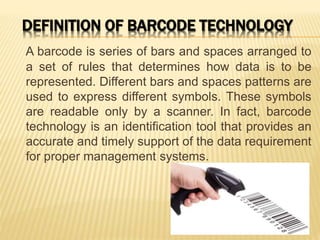
DEFINITION OF BARCODE TECHNOLOGY
A barcode is series of bars and spaces arranged to
a set of rules that determines how data is to be
represented. Different bars and spaces patterns are
used to express different symbols. These symbols
are readable only by a scanner. In fact, barcode
technology is an identification tool that provides an
accurate and timely support of the data requirement
for proper management systems.
FUNDAMENTAL REQUIREMENTS
 The fundamental requirements of
Barcode technology can be
categorized
 Hardware requirements
 Software requirements
HARDWARE REQUIREMENTS
 The following hardware will be required for
implementing barcode technology:
 i)Scanner: is required for reading and scanning the
information.
 ii)Printers: Three categories of the barcode printers
are available, which are as follows: Laser printers,
Thermal printers and Impact printers.

 Each technology is suited for certain kinds of
applications, and no one technology is best for all.
 iii)Decoder
 iv)Data entry terminal
SOFTWARE REQUIREMENTS
◊ The following software will be
required to implement the barcode
technology :
a) Application software
b) System software
USE AND APPLICATION OF BARCODE TECHNOLOGY
Member identification :
The barcode can be useful for checking
the authorized user of the library. A
barcode reader can be installed at the
gate of the information institutions to give
permit to the valid user of the information
institution or library. The computer will
provide the alarm and thus restricts the
entry of the illegal user.
USE AND APPLICATION OF BARCODE TECHNOLOGY
Circulation:
In barcode environment, the tedious process
of issue and return can be avoided. The
information user can submit his/her identity
cards to activate the borrowing status. This
step, computer scan the documents for
accession number and is issues to the user.
USE AND APPLICATION OF BARCODE TECHNOLOGY
User statistics
The barcode facilitates in preparing the list
of the user who are using of the library and
their arrival and departure time and can
avoid doing entries in the register manually.
USE AND APPLICATION OF BARCODE TECHNOLOGY
Checking the gate :
When user leaves the library with the
documents library with the documents , the
accession number of that document can be
scanned by the scanner informed whether it
is issued or not.
USE AND APPLICATION OF BARCODE TECHNOLOGY
Issue of no due certificate:
When a member leaves the organization, his
membership is cancelled and the information
institutions no due certificate. This
processes is time consumed than traditional
systems.
USE AND APPLICATION OF BARCODE TECHNOLOGY
Stock verification:
Weeding out of the resources and updating of
records also become simpler through this
process. This technology helps to verify the
stock of the information institutions
systematically, quickly and accurately.
MERITS OF BARCODE TECHNOLOGY
Professional efficiency and quality of
services-
Barcode technology improves the
efficiency of the information
professionals and the quality of the
information services.
MERITS OF BARCODE TECHNOLOGY
Accelerate the functions/operations-
It increases the operations of information
services.
Space saved-
The space of preserving the borrowers
card and the catalogue card can be saved.
.
MERITS OF BARCODE TECHNOLOGY
Increase the accuracy of services-
It increases and ensures the accuracy of
information services.
Time saved-
Save the time of the users as well as
information professionals.
MERITS OF BARCODE TECHNOLOGY
Data integrity-
It ensures data integrity and data
consistency.
Creates positive user attitude-
It creates and establishes positive user
attitudes towards the information institutions.
DEMERITS OF BARCODE TECHNOLOGY
Lack of consciousness among the users-
The user may not press the barcode identity
card on the scanner kept on the main gate. One
staff has to be deputed at the gate for checking
whether users are pressing their identity card or
not.
In case of violation of law, one employee needed-
If any user violate any rule, one employee has
to be there for instant checking.
DEMERITS OF BARCODE TECHNOLOGY
Problems of internet and electricity-
At the circulation section, the network systems
and electricity problems should not come in this
process otherwise these weakness decrease the
efficiency of the system.
Problems of pasting barcode labels-
To paste the barcode labels and to scan the
barcodes from the documents is time consuming.
DEMERITS OF BARCODE TECHNOLOGY
Problems of software-
If the library automation software is not efficient,
it may create problems to use barcode technology.
Costly-
To make the infrastructure for barcode
technology, it will require adequate funds. So
barcode technology is costly.
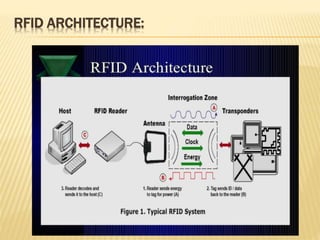
DEFINITION OF RFID
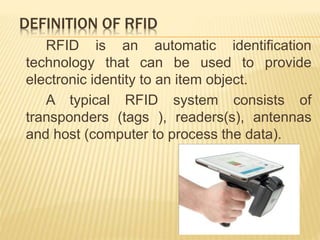
RFID is an automatic identification
technology that can be used to provide
electronic identity to an item object.
A typical RFID system consists of
transponders (tags ), readers(s), antennas
and host (computer to process the data).
RFID MIDDLEWARE
Radio Frequency Identification (RFID)
middleware is a new class of software which
facilities data and information communication
between automatic identification physical layer
and enterprise applications. It provides a
distributed environment to process the data
form tags read by the readers, translates the
data where necessary and routes it to a variety
of backend applications using suitable
technologies such as WEB, remote and
Windows Services.
BENEFITS OF RFID:
 Automatic monitoring without the staff
realize.
 No need enforcement
 Low cost due to the less number of controller
and reader.
 More coverage- Cover wider area
 Less maintenance
RFID ARCHITECTURE:
HOW IT WORKS:
 It provides a distributed environment to
 process the data form tags read by the
readers
 Translates the data where necessary
 Routs it to a variety of backend applications
using suitable technologies such as Web,
Remote and Windows Service.
WHY IT IS IMPORTANT
 Towards this end , industry is looking for a
new paradigm which can provide
 Real time visibility for most of the activities to
the collaborating partners involved
 Activities which are in the forefront of this
plan, are management and tracking theft
prevention access restrictions and security
hazardous material management and others.
UNIQUENESS OF RFID:
 RFID does not require line of sight access to
communicate
 Without requiring physical contact
 Multiple tags can be identified
 Tags mounted on products of consignments
can survive in harsh environments such as
extreme temperatures, moisture and tough
handling.
RFID FEATURES :
The strong interest shown by industry in RFID is
mainly on account of the following features which
potentially would lead to better business and
workflow process:
 Tags can store or archive data which can be updated
during various stages of the process
 Automation of data collection at a huge rate
climinating the need for manual scanning
 Accurate data collection hence less problems due to
erroneous data for decision making.
 Less handling of goods and hence less labor required
simultaneously identification of multiple tagged items
in the read area.
RECOMMENDATION :
 To install REFID system at strategic location
 Comprehensive Design to ensure the full
coverage
 Embedded exiting staff card with RFID Chip.
BARCODE VS RFID TECHNOLOGY
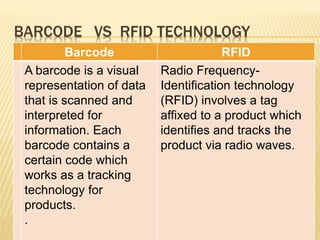
What is it?
A barcode is a visual representation of data
that is scanned and interpreted for
information. Each barcode contains a certain
code which works as a tracking technology
for products.
Radio Frequency-Identification technology
(RFID) involves a tag affixed to a product
which identifies and tracks the product via
radio waves.
Barcode RFID
A barcode is a visual
representation of data
that is scanned and
interpreted for
information. Each
barcode contains a
certain code which
works as a tracking
technology for
products.
.
Radio Frequency-
Identification technology
(RFID) involves a tag
affixed to a product which
identifies and tracks the
product via radio waves.
BARCODE VS RFID TECHNOLOGY
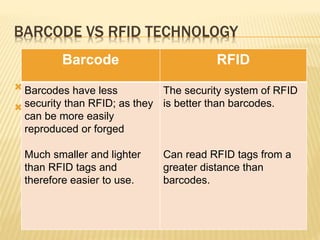
 advantage
 Barcodes have less security than RFID; as
they can be more easily reproduced or
forged
Barcode RFID
Barcodes have less
security than RFID; as they
can be more easily
reproduced or forged
Much smaller and lighter
than RFID tags and
therefore easier to use.
The security system of RFID
is better than barcodes.
Can read RFID tags from a
greater distance than
barcodes.
BARCODE VS RFID TECHNOLOGY
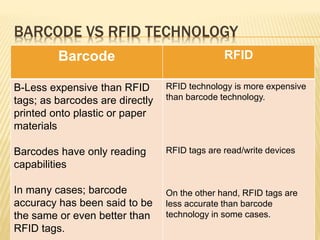
Barcode RFID
B-Less expensive than RFID
tags; as barcodes are directly
printed onto plastic or paper
materials
Barcodes have only reading
capabilities
In many cases; barcode
accuracy has been said to be
the same or even better than
RFID tags.
RFID technology is more expensive
than barcode technology.
RFID tags are read/write devices
On the other hand, RFID tags are
less accurate than barcode
technology in some cases.
BARCODE VS RFID TECHNOLOGY
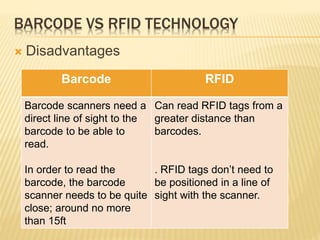
 Disadvantages
Barcode RFID
Barcode scanners need a
direct line of sight to the
barcode to be able to
read.
In order to read the
barcode, the barcode
scanner needs to be quite
close; around no more
than 15ft
Can read RFID tags from a
greater distance than
barcodes.
. RFID tags don’t need to
be positioned in a line of
sight with the scanner.

Bar code VS RFID

  • 1.
  • 2.
    DEFINITION OF BARCODETECHNOLOGY A barcode is series of bars and spaces arranged to a set of rules that determines how data is to be represented. Different bars and spaces patterns are used to express different symbols. These symbols are readable only by a scanner. In fact, barcode technology is an identification tool that provides an accurate and timely support of the data requirement for proper management systems.
  • 3.
    FUNDAMENTAL REQUIREMENTS  Thefundamental requirements of Barcode technology can be categorized  Hardware requirements  Software requirements
  • 4.
    HARDWARE REQUIREMENTS  Thefollowing hardware will be required for implementing barcode technology:  i)Scanner: is required for reading and scanning the information.  ii)Printers: Three categories of the barcode printers are available, which are as follows: Laser printers, Thermal printers and Impact printers.   Each technology is suited for certain kinds of applications, and no one technology is best for all.  iii)Decoder  iv)Data entry terminal
  • 5.
    SOFTWARE REQUIREMENTS ◊ Thefollowing software will be required to implement the barcode technology : a) Application software b) System software
  • 6.
    USE AND APPLICATIONOF BARCODE TECHNOLOGY Member identification : The barcode can be useful for checking the authorized user of the library. A barcode reader can be installed at the gate of the information institutions to give permit to the valid user of the information institution or library. The computer will provide the alarm and thus restricts the entry of the illegal user.
  • 7.
    USE AND APPLICATIONOF BARCODE TECHNOLOGY Circulation: In barcode environment, the tedious process of issue and return can be avoided. The information user can submit his/her identity cards to activate the borrowing status. This step, computer scan the documents for accession number and is issues to the user.
  • 8.
    USE AND APPLICATIONOF BARCODE TECHNOLOGY User statistics The barcode facilitates in preparing the list of the user who are using of the library and their arrival and departure time and can avoid doing entries in the register manually.
  • 9.
    USE AND APPLICATIONOF BARCODE TECHNOLOGY Checking the gate : When user leaves the library with the documents library with the documents , the accession number of that document can be scanned by the scanner informed whether it is issued or not.
  • 10.
    USE AND APPLICATIONOF BARCODE TECHNOLOGY Issue of no due certificate: When a member leaves the organization, his membership is cancelled and the information institutions no due certificate. This processes is time consumed than traditional systems.
  • 11.
    USE AND APPLICATIONOF BARCODE TECHNOLOGY Stock verification: Weeding out of the resources and updating of records also become simpler through this process. This technology helps to verify the stock of the information institutions systematically, quickly and accurately.
  • 12.
    MERITS OF BARCODETECHNOLOGY Professional efficiency and quality of services- Barcode technology improves the efficiency of the information professionals and the quality of the information services.
  • 13.
    MERITS OF BARCODETECHNOLOGY Accelerate the functions/operations- It increases the operations of information services. Space saved- The space of preserving the borrowers card and the catalogue card can be saved. .
  • 14.
    MERITS OF BARCODETECHNOLOGY Increase the accuracy of services- It increases and ensures the accuracy of information services. Time saved- Save the time of the users as well as information professionals.
  • 15.
    MERITS OF BARCODETECHNOLOGY Data integrity- It ensures data integrity and data consistency. Creates positive user attitude- It creates and establishes positive user attitudes towards the information institutions.
  • 16.
    DEMERITS OF BARCODETECHNOLOGY Lack of consciousness among the users- The user may not press the barcode identity card on the scanner kept on the main gate. One staff has to be deputed at the gate for checking whether users are pressing their identity card or not. In case of violation of law, one employee needed- If any user violate any rule, one employee has to be there for instant checking.
  • 17.
    DEMERITS OF BARCODETECHNOLOGY Problems of internet and electricity- At the circulation section, the network systems and electricity problems should not come in this process otherwise these weakness decrease the efficiency of the system. Problems of pasting barcode labels- To paste the barcode labels and to scan the barcodes from the documents is time consuming.
  • 18.
    DEMERITS OF BARCODETECHNOLOGY Problems of software- If the library automation software is not efficient, it may create problems to use barcode technology. Costly- To make the infrastructure for barcode technology, it will require adequate funds. So barcode technology is costly.
  • 19.
    DEFINITION OF RFID RFIDis an automatic identification technology that can be used to provide electronic identity to an item object. A typical RFID system consists of transponders (tags ), readers(s), antennas and host (computer to process the data).
  • 20.
    RFID MIDDLEWARE Radio FrequencyIdentification (RFID) middleware is a new class of software which facilities data and information communication between automatic identification physical layer and enterprise applications. It provides a distributed environment to process the data form tags read by the readers, translates the data where necessary and routes it to a variety of backend applications using suitable technologies such as WEB, remote and Windows Services.
  • 21.
    BENEFITS OF RFID: Automatic monitoring without the staff realize.  No need enforcement  Low cost due to the less number of controller and reader.  More coverage- Cover wider area  Less maintenance
  • 22.
  • 23.
    HOW IT WORKS: It provides a distributed environment to  process the data form tags read by the readers  Translates the data where necessary  Routs it to a variety of backend applications using suitable technologies such as Web, Remote and Windows Service.
  • 24.
    WHY IT ISIMPORTANT  Towards this end , industry is looking for a new paradigm which can provide  Real time visibility for most of the activities to the collaborating partners involved  Activities which are in the forefront of this plan, are management and tracking theft prevention access restrictions and security hazardous material management and others.
  • 25.
    UNIQUENESS OF RFID: RFID does not require line of sight access to communicate  Without requiring physical contact  Multiple tags can be identified  Tags mounted on products of consignments can survive in harsh environments such as extreme temperatures, moisture and tough handling.
  • 26.
    RFID FEATURES : Thestrong interest shown by industry in RFID is mainly on account of the following features which potentially would lead to better business and workflow process:  Tags can store or archive data which can be updated during various stages of the process  Automation of data collection at a huge rate climinating the need for manual scanning  Accurate data collection hence less problems due to erroneous data for decision making.  Less handling of goods and hence less labor required simultaneously identification of multiple tagged items in the read area.
  • 27.
    RECOMMENDATION :  Toinstall REFID system at strategic location  Comprehensive Design to ensure the full coverage  Embedded exiting staff card with RFID Chip.
  • 28.
    BARCODE VS RFIDTECHNOLOGY What is it? A barcode is a visual representation of data that is scanned and interpreted for information. Each barcode contains a certain code which works as a tracking technology for products. Radio Frequency-Identification technology (RFID) involves a tag affixed to a product which identifies and tracks the product via radio waves. Barcode RFID A barcode is a visual representation of data that is scanned and interpreted for information. Each barcode contains a certain code which works as a tracking technology for products. . Radio Frequency- Identification technology (RFID) involves a tag affixed to a product which identifies and tracks the product via radio waves.
  • 29.
    BARCODE VS RFIDTECHNOLOGY  advantage  Barcodes have less security than RFID; as they can be more easily reproduced or forged Barcode RFID Barcodes have less security than RFID; as they can be more easily reproduced or forged Much smaller and lighter than RFID tags and therefore easier to use. The security system of RFID is better than barcodes. Can read RFID tags from a greater distance than barcodes.
  • 30.
    BARCODE VS RFIDTECHNOLOGY Barcode RFID B-Less expensive than RFID tags; as barcodes are directly printed onto plastic or paper materials Barcodes have only reading capabilities In many cases; barcode accuracy has been said to be the same or even better than RFID tags. RFID technology is more expensive than barcode technology. RFID tags are read/write devices On the other hand, RFID tags are less accurate than barcode technology in some cases.
  • 31.
    BARCODE VS RFIDTECHNOLOGY  Disadvantages Barcode RFID Barcode scanners need a direct line of sight to the barcode to be able to read. In order to read the barcode, the barcode scanner needs to be quite close; around no more than 15ft Can read RFID tags from a greater distance than barcodes. . RFID tags don’t need to be positioned in a line of sight with the scanner.