Pushkar
Sadhukha
(265)

Saurabh
Upadhyay
(282)

BAR-CODES
Akshay
Shelake
(271)

Nikhil
Poojary
(258)
AGENDA
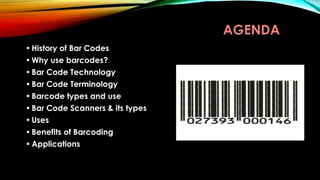
• History of Bar Codes
• Why use barcodes?
• Bar Code Technology
• Bar Code Terminology
• Barcode types and use
• Bar Code Scanners & its types
• Uses
• Benefits of Barcoding
• Applications
HISTORY OF BAR CODES
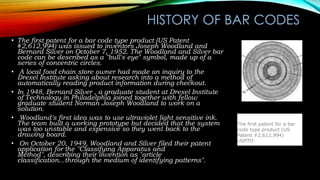
• The first patent for a bar code type product (US Patent
#2,612,994) was issued to inventors Joseph Woodland and
Bernard Silver on October 7, 1952. The Woodland and Silver bar
code can be described as a "bull's eye" symbol, made up of a
series of concentric circles.
• A local food chain store owner had made an inquiry to the
Drexel Institute asking about research into a method of
automatically reading product information during checkout.
• In 1948, Bernard Silver , a graduate student at Drexel Institute
of Technology in Philadelphia joined together with fellow
graduate student Norman Joseph Woodland to work on a
solution.
• Woodland's first idea was to use ultraviolet light sensitive ink.
The team built a working prototype but decided that the system
was too unstable and expensive so they went back to the
drawing board.
• On October 20, 1949, Woodland and Silver filed their patent
application for the "Classifying Apparatus and
Method", describing their invention as "article
classification...through the medium of identifying patterns".

The first patent for a bar
code type product (US
Patent #2,612,994)
USPTO
WHY USE BARCODES?
• As far back as the 1960s, barcodes were used in
industrial work environments. Some of the early
implementations of barcodes included the ability identify
rail road cars.
• In the early 1970s, common barcodes started appearing
on grocery shelves. To automate the process of
identifying grocery items, UPC barcodes were placed on
products.
• Today, barcodes are just about everywhere and are used
for identification in almost all types of business.
CONTINUED….
• When barcodes are used in the business
process, procedures are automated to increase
productivity and reduce human error.
• Whenever there is a need to accurately identify or track
something, bar-coding should be used.
• Instead of manually typing a customer identification
number into a database, if the information is contained in
a barcode, a data entry operator may scan it in & this
would increase automation and reduce human error.
BAR CODE TECHNOLOGY
It is an automatic identification technology

Bar code is a predefined format of dark bars and white spaces
It contain a specific information
It allows real-time data to be collected accurately and rapidly
Combination of barcode technology with computer and application software
improves performance, And productivity
BAR CODE TERMINOLOGY
BAR
- The darker, non reflective element of a Bar Code
BI-DIRECTIONAL SYMBOL
- A Bar Code symbol format which permits reading in either direction across the
bars and spaces
CHECK DIGIT
- A calculated character included within the Bar Code for error detection
FIXED BEAM SCANNER
- A stationary Bar Code Scanner. The symbol must be moved through the light
beam to be read
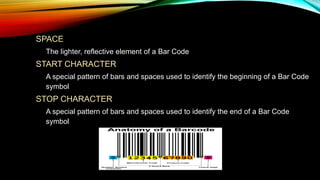
• SPACE
o The lighter, reflective element of a Bar Code

• START CHARACTER

o A special pattern of bars and spaces used to identify the beginning of a Bar Code
symbol

• STOP CHARACTER

o A special pattern of bars and spaces used to identify the end of a Bar Code
symbol
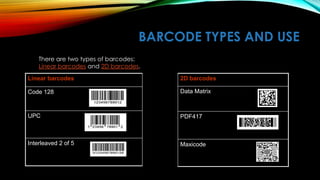
BARCODE TYPES AND USE
There are two types of barcodes:
Linear barcodes and 2D barcodes.
Linear barcodes

2D barcodes

Code 128

Data Matrix

UPC

PDF417

Interleaved 2 of 5

Maxicode
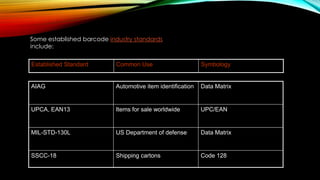
Some established barcode industry standards
include:
Established Standard

Common Use

Symbology

AIAG

Automotive item identification

Data Matrix

UPCA, EAN13

Items for sale worldwide

UPC/EAN

MIL-STD-130L

US Department of defense

Data Matrix

SSCC-18

Shipping cartons

Code 128
Linear barcodes
UPC-A: - Universal product code seen on almost all retail products in the USA and Canada

EAN-13: -European Article Numbering international retail product code.
It is used world-wide where the country code is required for marking retail items . This code is
composed of 2 numbers for country code,10 numbers for data characters and one for
checksum.
Coda bar: - Older code often used in library systems, sometimes in blood banks
Code 128: Very capable code, excellent density, high reliability; in very wide use world-wide
Code 39: General-purpose code in very wide use world-wide
2-DIMENSIONAL BARCODES
• PDF417:

Excellent for encoding large amounts of data

• DataMatrix:

Can hold large amounts of data, especially suited
for making very small codes

• Maxicode:

Fixed length, used by United Parcel Service for
automated package sorting
ALGORITHM TO CALCULATE THE CHECK
DIGIT
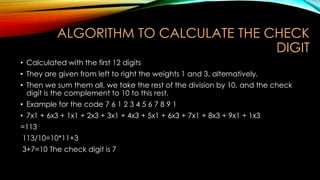
• Calculated with the first 12 digits
• They are given from left to right the weights 1 and 3, alternatively.
• Then we sum them all, we take the rest of the division by 10, and the check
digit is the complement to 10 to this rest.

• Example for the code 7 6 1 2 3 4 5 6 7 8 9 1
• 7x1 + 6x3 + 1x1 + 2x3 + 3x1 + 4x3 + 5x1 + 6x3 + 7x1 + 8x3 + 9x1 + 1x3
=113
113/10=10*11+3
3+7=10 The check digit is 7
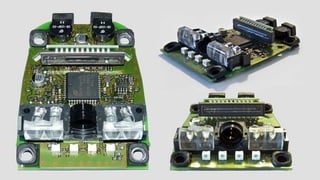
BAR CODE SCANNERS

• A device used to extract information optically from a Bar Code
• Bar Code symbol consists of series of vertical dark bars separated by
spaces

• When illuminated reflected light is detected by electro optical sensor
• The intensity of reflected light from the dark bars is less than that of spaces
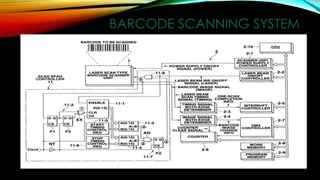
BARCODE SCANNING SYSTEM
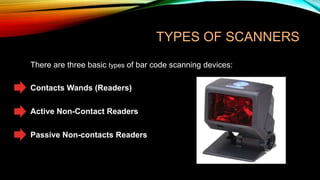
TYPES OF SCANNERS

• There are three basic types of bar code scanning devices:
• Contacts Wands (Readers)
• Active Non-Contact Readers

• Passive Non-contacts Readers
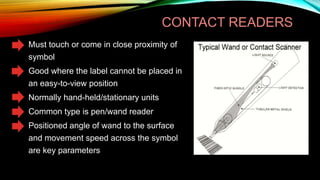
CONTACT READERS
Must touch or come in close proximity of
symbol
Good where the label cannot be placed in
an easy-to-view position
Normally hand-held/stationary units
Common type is pen/wand reader
Positioned angle of wand to the surface
and movement speed across the symbol
are key parameters
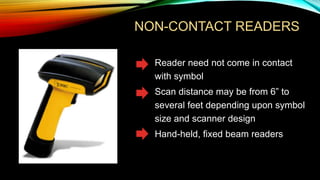
NON-CONTACT READERS

• Reader need not come in contact
with symbol

• Scan distance may be from 6” to
several feet depending upon symbol
size and scanner design

• Hand-held, fixed beam readers
NON-CONTACT READERS
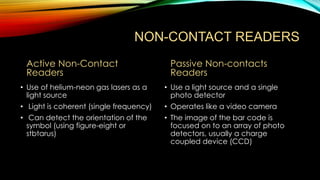
Active Non-Contact
Readers

Passive Non-contacts
Readers

• Use of helium-neon gas lasers as a
light source

• Use a light source and a single
photo detector

• Light is coherent (single frequency)

• Operates like a video camera

• Can detect the orientation of the
symbol (using figure-eight or
stbtarus)

• The image of the bar code is
focused on to an array of photo
detectors, usually a charge
coupled device (CCD)
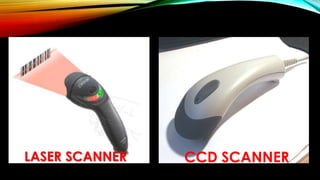
CCD SCANNER
USES OF BAR CODES
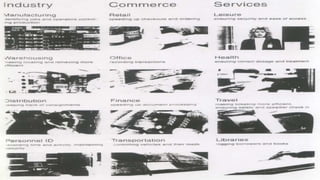
Bar codes can be used in every business around the world

to track assets in any building including every desk, computer, telephone, copier
and desk accessory.
to track mail from the time it arrives in the mail room to the time it is delivered to
each desk or location within an office.
to help security guards identify every employee, every door they enter and every
room they work in.
to secure, lock or unlock entrances or exits throughout the plant.
to manage and track your vehicle fleet and each driver
BENEFITS OF BAR CODING
REPRESENT UNIQUE IDENTITY OF A PRODUCT
ACCURACY OF DATA INPUT (ERROR FREE)
AID EFFECTIVE MANAGEMENT OF RESOURCES AND INVENTORIES
LABOUR SAVINGS BY AVOIDING MANUAL SYSTEM
COST EFFICIENT
REAL TIME DATA COLLECTION
RAPID ACCESS TO TOTAL PRODUCTION COSTS
• SHIPPING
• ELECTRONIC DATA INTERCHANGE (EDI)

APPLICATIONS

• Direct communication between computers of two companies (Manufacturer & Vendor)
• Industry-wide EDI standards
• Reduces cost and saves time of business transaction

• RETAIL APPLICATIONS
•
•
•
•

Super markets
Counter-mounted Bar Code scanners
Universal Product Code (UPC)
Price and description information

• WARE HOUSING
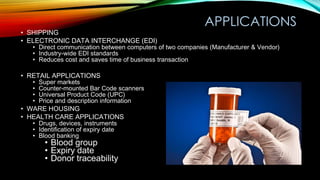
• HEALTH CARE APPLICATIONS
• Drugs, devices, instruments
• Identification of expiry date
• Blood banking

• Blood group
• Expiry date
• Donor traceability
CONCLUSION
• Barcodes are very useful and used all over the world
• With the common use of mobile phone, 2D barcodes will become the most
spread ones
• Not only will they be used to identify products but also to communicate
(SMS, MMS ,address contact also to communicate
(SMS, MMS, address, contact cards)
Bar codes and its type with different scanner and its application

Bar codes and its type with different scanner and its application

  • 1.
  • 2.
    AGENDA • History ofBar Codes • Why use barcodes? • Bar Code Technology • Bar Code Terminology • Barcode types and use • Bar Code Scanners & its types • Uses • Benefits of Barcoding • Applications
  • 3.
    HISTORY OF BARCODES • The first patent for a bar code type product (US Patent #2,612,994) was issued to inventors Joseph Woodland and Bernard Silver on October 7, 1952. The Woodland and Silver bar code can be described as a "bull's eye" symbol, made up of a series of concentric circles. • A local food chain store owner had made an inquiry to the Drexel Institute asking about research into a method of automatically reading product information during checkout. • In 1948, Bernard Silver , a graduate student at Drexel Institute of Technology in Philadelphia joined together with fellow graduate student Norman Joseph Woodland to work on a solution. • Woodland's first idea was to use ultraviolet light sensitive ink. The team built a working prototype but decided that the system was too unstable and expensive so they went back to the drawing board. • On October 20, 1949, Woodland and Silver filed their patent application for the "Classifying Apparatus and Method", describing their invention as "article classification...through the medium of identifying patterns". The first patent for a bar code type product (US Patent #2,612,994) USPTO
  • 4.
    WHY USE BARCODES? •As far back as the 1960s, barcodes were used in industrial work environments. Some of the early implementations of barcodes included the ability identify rail road cars. • In the early 1970s, common barcodes started appearing on grocery shelves. To automate the process of identifying grocery items, UPC barcodes were placed on products. • Today, barcodes are just about everywhere and are used for identification in almost all types of business.
  • 5.
    CONTINUED…. • When barcodesare used in the business process, procedures are automated to increase productivity and reduce human error. • Whenever there is a need to accurately identify or track something, bar-coding should be used. • Instead of manually typing a customer identification number into a database, if the information is contained in a barcode, a data entry operator may scan it in & this would increase automation and reduce human error.
  • 6.
    BAR CODE TECHNOLOGY Itis an automatic identification technology Bar code is a predefined format of dark bars and white spaces It contain a specific information It allows real-time data to be collected accurately and rapidly Combination of barcode technology with computer and application software improves performance, And productivity
  • 7.
    BAR CODE TERMINOLOGY BAR -The darker, non reflective element of a Bar Code BI-DIRECTIONAL SYMBOL - A Bar Code symbol format which permits reading in either direction across the bars and spaces CHECK DIGIT - A calculated character included within the Bar Code for error detection FIXED BEAM SCANNER - A stationary Bar Code Scanner. The symbol must be moved through the light beam to be read
  • 8.
    • SPACE o Thelighter, reflective element of a Bar Code • START CHARACTER o A special pattern of bars and spaces used to identify the beginning of a Bar Code symbol • STOP CHARACTER o A special pattern of bars and spaces used to identify the end of a Bar Code symbol
  • 9.
    BARCODE TYPES ANDUSE There are two types of barcodes: Linear barcodes and 2D barcodes. Linear barcodes 2D barcodes Code 128 Data Matrix UPC PDF417 Interleaved 2 of 5 Maxicode
  • 10.
    Some established barcodeindustry standards include: Established Standard Common Use Symbology AIAG Automotive item identification Data Matrix UPCA, EAN13 Items for sale worldwide UPC/EAN MIL-STD-130L US Department of defense Data Matrix SSCC-18 Shipping cartons Code 128
  • 11.
    Linear barcodes UPC-A: -Universal product code seen on almost all retail products in the USA and Canada EAN-13: -European Article Numbering international retail product code. It is used world-wide where the country code is required for marking retail items . This code is composed of 2 numbers for country code,10 numbers for data characters and one for checksum. Coda bar: - Older code often used in library systems, sometimes in blood banks Code 128: Very capable code, excellent density, high reliability; in very wide use world-wide Code 39: General-purpose code in very wide use world-wide
  • 12.
    2-DIMENSIONAL BARCODES • PDF417: Excellentfor encoding large amounts of data • DataMatrix: Can hold large amounts of data, especially suited for making very small codes • Maxicode: Fixed length, used by United Parcel Service for automated package sorting
  • 13.
    ALGORITHM TO CALCULATETHE CHECK DIGIT • Calculated with the first 12 digits • They are given from left to right the weights 1 and 3, alternatively. • Then we sum them all, we take the rest of the division by 10, and the check digit is the complement to 10 to this rest. • Example for the code 7 6 1 2 3 4 5 6 7 8 9 1 • 7x1 + 6x3 + 1x1 + 2x3 + 3x1 + 4x3 + 5x1 + 6x3 + 7x1 + 8x3 + 9x1 + 1x3 =113 113/10=10*11+3 3+7=10 The check digit is 7
  • 14.
    BAR CODE SCANNERS •A device used to extract information optically from a Bar Code • Bar Code symbol consists of series of vertical dark bars separated by spaces • When illuminated reflected light is detected by electro optical sensor • The intensity of reflected light from the dark bars is less than that of spaces
  • 15.
  • 17.
    TYPES OF SCANNERS •There are three basic types of bar code scanning devices: • Contacts Wands (Readers) • Active Non-Contact Readers • Passive Non-contacts Readers
  • 18.
    CONTACT READERS Must touchor come in close proximity of symbol Good where the label cannot be placed in an easy-to-view position Normally hand-held/stationary units Common type is pen/wand reader Positioned angle of wand to the surface and movement speed across the symbol are key parameters
  • 19.
    NON-CONTACT READERS • Readerneed not come in contact with symbol • Scan distance may be from 6” to several feet depending upon symbol size and scanner design • Hand-held, fixed beam readers
  • 20.
    NON-CONTACT READERS Active Non-Contact Readers PassiveNon-contacts Readers • Use of helium-neon gas lasers as a light source • Use a light source and a single photo detector • Light is coherent (single frequency) • Operates like a video camera • Can detect the orientation of the symbol (using figure-eight or stbtarus) • The image of the bar code is focused on to an array of photo detectors, usually a charge coupled device (CCD)
  • 21.
  • 22.
    USES OF BARCODES Bar codes can be used in every business around the world to track assets in any building including every desk, computer, telephone, copier and desk accessory. to track mail from the time it arrives in the mail room to the time it is delivered to each desk or location within an office. to help security guards identify every employee, every door they enter and every room they work in. to secure, lock or unlock entrances or exits throughout the plant. to manage and track your vehicle fleet and each driver
  • 23.
    BENEFITS OF BARCODING REPRESENT UNIQUE IDENTITY OF A PRODUCT ACCURACY OF DATA INPUT (ERROR FREE) AID EFFECTIVE MANAGEMENT OF RESOURCES AND INVENTORIES LABOUR SAVINGS BY AVOIDING MANUAL SYSTEM COST EFFICIENT REAL TIME DATA COLLECTION RAPID ACCESS TO TOTAL PRODUCTION COSTS
  • 24.
    • SHIPPING • ELECTRONICDATA INTERCHANGE (EDI) APPLICATIONS • Direct communication between computers of two companies (Manufacturer & Vendor) • Industry-wide EDI standards • Reduces cost and saves time of business transaction • RETAIL APPLICATIONS • • • • Super markets Counter-mounted Bar Code scanners Universal Product Code (UPC) Price and description information • WARE HOUSING • HEALTH CARE APPLICATIONS • Drugs, devices, instruments • Identification of expiry date • Blood banking • Blood group • Expiry date • Donor traceability
  • 26.
    CONCLUSION • Barcodes arevery useful and used all over the world • With the common use of mobile phone, 2D barcodes will become the most spread ones • Not only will they be used to identify products but also to communicate (SMS, MMS ,address contact also to communicate (SMS, MMS, address, contact cards)

Editor's Notes

  • #6 For example, in a data entry work environment, workers may be required to enter an enormous amount of data into a customer database system.