What Is a Barcode?
• Optical machine readable representation of
data.
• Represents data in widths and spacing of
parallel lines.
• Structured to contain a specific piece of
information.
• A predefined format of dark bars and white
spaces.
• In 1948 Bernard Silver, a graduate from Drexel
Institute of Technology and his friend Norman Joseph
Woodland first worked on a project using UV ink.
• Woodland further worked on this project and formed
his first barcode from sand on beach,which was
inspired by morse code.
• On 20 October 1949 Woodland and Silver filed a
patent application for "Classifying Apparatus and
Method", in which they described both the linear and
bullseye printing patterns, as well as the mechanical
and electronic systems needed to read the code. The
patent was issued on 7 October 1952 as US Patent
2,612,994
• In 1932, Wallace Flint suggested that an automated
retail checkout system might be feasible.
• David Collins after receiving his master's degree from
MIT in 1959, started working at Sylvania and developed
a system for automatically identifying railroad cars using
blue and yellow reflective stripes attached to the side of
the cars, encoding a six-digit company identifier and a
four-digit car number. Light reflected off the stripes was
fed into one of two photomultipliers, filtered for blue or
yellow.
Bull’s eye barcode sy
Initial uses of Barcodes
• Computer Identics installed their first two systems in early
1969, one at a General Motors factory in Pontiac,
Michigan, and another at a distribution center at the
General Trading Company in Carlstadt, New Jersey.
• In 1972, a Kroger store in Cincinnati began using a bull’s-
eye code.
• In Troy, Ohio. On June 26, 1974, the first product with a
bar code was scanned at a check-out counter. It was a 10-
pack of Wrigley's Juicy Fruit chewing gum. Today, the
pack of gum is on display at the Smithsonian Institution's
National Museum of American History.
• Bar codes provide a simple and inexpensive method of encoding
text information that is easily read by inexpensive electronic readers.
• Bar coding also allows data to be collected rapidly and with extreme
accuracy.
• Bar codes can be thought of as a printed type of the Morse code
with narrow bars (and spaces) representing dots, and wide bars
representing dashes.
• Due to the design of most bar code it does not make any difference if
you scan a bar code from right to left or from left to right.
Barcode symbol’s
characteristics
• Magnification
• Bar height
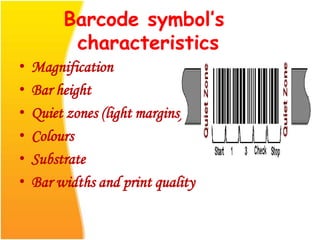
• Quiet zones (light margins)
• Colours
• Substrate
• Bar widths and print quality
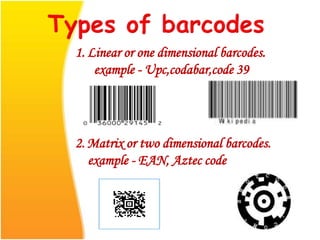
1. Linear or one dimensional barcodes.
example - Upc,codabar,code 39
2. Matrix or two dimensional barcodes.
example - EAN, Aztec code
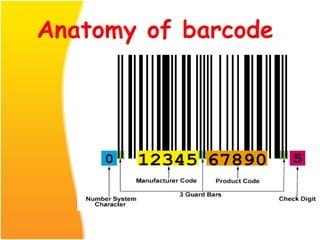
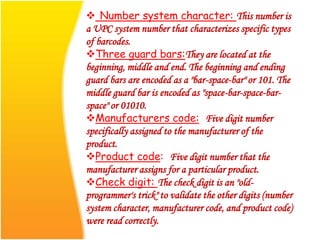
 Number system character: This number is
a UPC system number that characterizes specific types
of barcodes.
Three guard bars:They are located at the
beginning, middle and end. The beginning and ending
guard bars are encoded as a "bar-space-bar" or 101. The
middle guard bar is encoded as "space-bar-space-bar-
space" or 01010.
Manufacturers code: Five digit number
specifically assigned to the manufacturer of the
product.
Product code: Five digit number that the
manufacturer assigns for a particular product.
Check digit: The check digit is an "old-
programmer's trick" to validate the other digits (number
system character, manufacturer code, and product code)
were read correctly.
Codes of the Number System Character:
0 - Standard UPC number.
1 - Reserved.
2 - Random weight items like fruits, vegetables, and meats,
etc.
3 - Pharmaceuticals
4 - In-store code for retailers.
5 - Coupons
6 - Standard UPC number.
7 - Standard UPC number.
8 - Reserved.
9 - Reserved.
Where is the price?
The price is kept in the store's centralized computer database. The item record is
"keyed" by manufacturer code and product code (same numbers as on the barcode).
When the item is scanned by the employee, a computer program reads the barcode. It
then converts the "bars and spaces" into the manufacturer and product "digital
number". Using the manufacturer and product "digital number", the program reads
the store's "item database". It then retrieves the price from the "item database" for
that item.
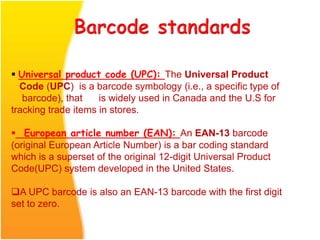
 Universal product code (UPC): The Universal Product
Code (UPC) is a barcode symbology (i.e., a specific type of
barcode), that is widely used in Canada and the U.S for
tracking trade items in stores.
 European article number (EAN): An EAN-13 barcode
(original European Article Number) is a bar coding standard
which is a superset of the original 12-digit Universal Product
Code(UPC) system developed in the United States.
A UPC barcode is also an EAN-13 barcode with the first digit
set to zero.
A device used to extract information optically from a Bar Code
Bar Code symbol consists of series of vertical dark bars separated by light spaces
When illuminated reflected light is detected by electro optical sensor
The intensity of reflected light from the dark bars is less than that of spaces
Reflected light is converted into electrical voltage signals
Analog voltages are digitized into raw data
The decoder converts this data into the character data
representation of the symbol’s code
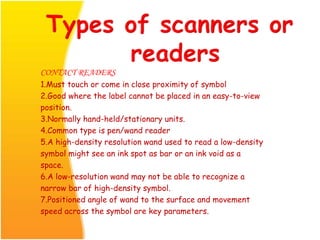
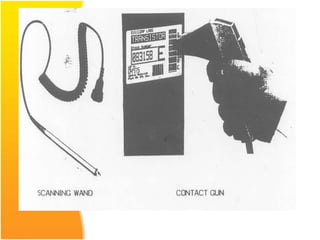
CONTACT READERS
1.Must touch or come in close proximity of symbol
2.Good where the label cannot be placed in an easy-to-view
position.
3.Normally hand-held/stationary units.
4.Common type is pen/wand reader
5.A high-density resolution wand used to read a low-density
symbol might see an ink spot as bar or an ink void as a
space.
6.A low-resolution wand may not be able to recognize a
narrow bar of high-density symbol.
7.Positioned angle of wand to the surface and movement
speed across the symbol are key parameters.
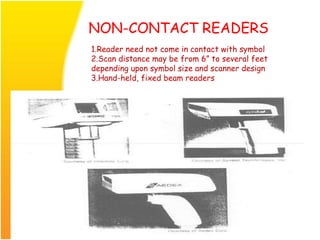
NON-CONTACT READERS
1.Reader need not come in contact with symbol
2.Scan distance may be from 6” to several feet
depending upon symbol size and scanner design
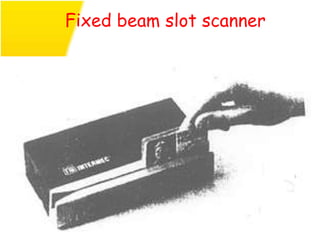
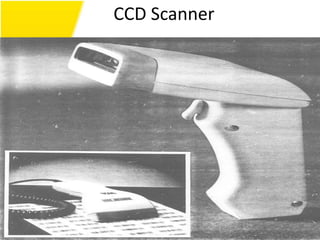
3.Hand-held, fixed beam readers
Fixed beam slot scanner
CCD Scanner
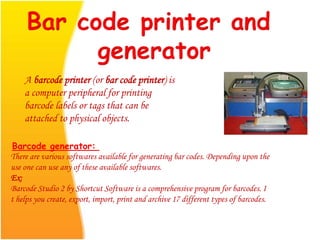
A barcode printer (or bar code printer) is
a computer peripheral for printing
barcode labels or tags that can be
attached to physical objects.
Barcode generator:
There are various softwares available for generating bar codes. Depending upon the
use one can use any of these available softwares.
Ex:
Barcode Studio 2 by Shortcut Software is a comprehensive program for barcodes. I
t helps you create, export, import, print and archive 17 different types of barcodes.
INVENTORY CONTROL
Portable readers
WORK-IN PROCESS TRACKING (WIP) COMPANY
INVENTORY
Raw materials
WIP (Components, Assemblies, Semi finished
Products)
Finished Products
SHIPPING
ELECTRONIC DATA INTERCHANGE (EDI)
Direct communication between computers of two
companies (Manufacturer & Vendor)
Industry-wide EDI standards
Reduces cost and saves time of business transaction
RETAIL APPLICATIONS
Super markets
Counter-mounted Bar Code scanners
Universal Product Code (UPC)
Price and description information
WARE HOUSING
HEALTH CARE APPLICATIONS
Drugs, devices, instruments
Identification of expiry date
Blood banking
Blood group
Expiry date
Donor traceability
At the turn of the century, many artists started using
barcodes in art, such as Scott Blake's Barcode Jesus.
Tracking sale of items.
 This technology also enabled the profiling of individual
consumers, typically through a voluntary registration of
discount cards.
 the scanners are relatively low cost and extremely accurate
compared to key-entry, with only about 1 substitution error in
15,000 to 36 trillion characters entered. The exact error rate
depends on the type of barcode.
Thank
You…

seminar-on-barcodes

  • 2.
    What Is aBarcode? • Optical machine readable representation of data. • Represents data in widths and spacing of parallel lines. • Structured to contain a specific piece of information. • A predefined format of dark bars and white spaces.
  • 3.
    • In 1948Bernard Silver, a graduate from Drexel Institute of Technology and his friend Norman Joseph Woodland first worked on a project using UV ink. • Woodland further worked on this project and formed his first barcode from sand on beach,which was inspired by morse code. • On 20 October 1949 Woodland and Silver filed a patent application for "Classifying Apparatus and Method", in which they described both the linear and bullseye printing patterns, as well as the mechanical and electronic systems needed to read the code. The patent was issued on 7 October 1952 as US Patent 2,612,994
  • 4.
    • In 1932,Wallace Flint suggested that an automated retail checkout system might be feasible. • David Collins after receiving his master's degree from MIT in 1959, started working at Sylvania and developed a system for automatically identifying railroad cars using blue and yellow reflective stripes attached to the side of the cars, encoding a six-digit company identifier and a four-digit car number. Light reflected off the stripes was fed into one of two photomultipliers, filtered for blue or yellow. Bull’s eye barcode sy
  • 5.
    Initial uses ofBarcodes • Computer Identics installed their first two systems in early 1969, one at a General Motors factory in Pontiac, Michigan, and another at a distribution center at the General Trading Company in Carlstadt, New Jersey. • In 1972, a Kroger store in Cincinnati began using a bull’s- eye code. • In Troy, Ohio. On June 26, 1974, the first product with a bar code was scanned at a check-out counter. It was a 10- pack of Wrigley's Juicy Fruit chewing gum. Today, the pack of gum is on display at the Smithsonian Institution's National Museum of American History.
  • 6.
    • Bar codesprovide a simple and inexpensive method of encoding text information that is easily read by inexpensive electronic readers. • Bar coding also allows data to be collected rapidly and with extreme accuracy. • Bar codes can be thought of as a printed type of the Morse code with narrow bars (and spaces) representing dots, and wide bars representing dashes. • Due to the design of most bar code it does not make any difference if you scan a bar code from right to left or from left to right.
  • 7.
    Barcode symbol’s characteristics • Magnification •Bar height • Quiet zones (light margins) • Colours • Substrate • Bar widths and print quality
  • 8.
    1. Linear orone dimensional barcodes. example - Upc,codabar,code 39 2. Matrix or two dimensional barcodes. example - EAN, Aztec code
  • 10.
     Number systemcharacter: This number is a UPC system number that characterizes specific types of barcodes. Three guard bars:They are located at the beginning, middle and end. The beginning and ending guard bars are encoded as a "bar-space-bar" or 101. The middle guard bar is encoded as "space-bar-space-bar- space" or 01010. Manufacturers code: Five digit number specifically assigned to the manufacturer of the product. Product code: Five digit number that the manufacturer assigns for a particular product. Check digit: The check digit is an "old- programmer's trick" to validate the other digits (number system character, manufacturer code, and product code) were read correctly.
  • 11.
    Codes of theNumber System Character: 0 - Standard UPC number. 1 - Reserved. 2 - Random weight items like fruits, vegetables, and meats, etc. 3 - Pharmaceuticals 4 - In-store code for retailers. 5 - Coupons 6 - Standard UPC number. 7 - Standard UPC number. 8 - Reserved. 9 - Reserved. Where is the price? The price is kept in the store's centralized computer database. The item record is "keyed" by manufacturer code and product code (same numbers as on the barcode). When the item is scanned by the employee, a computer program reads the barcode. It then converts the "bars and spaces" into the manufacturer and product "digital number". Using the manufacturer and product "digital number", the program reads the store's "item database". It then retrieves the price from the "item database" for that item.
  • 12.
     Universal productcode (UPC): The Universal Product Code (UPC) is a barcode symbology (i.e., a specific type of barcode), that is widely used in Canada and the U.S for tracking trade items in stores.  European article number (EAN): An EAN-13 barcode (original European Article Number) is a bar coding standard which is a superset of the original 12-digit Universal Product Code(UPC) system developed in the United States. A UPC barcode is also an EAN-13 barcode with the first digit set to zero.
  • 13.
    A device usedto extract information optically from a Bar Code Bar Code symbol consists of series of vertical dark bars separated by light spaces When illuminated reflected light is detected by electro optical sensor The intensity of reflected light from the dark bars is less than that of spaces Reflected light is converted into electrical voltage signals Analog voltages are digitized into raw data The decoder converts this data into the character data representation of the symbol’s code
  • 14.
    CONTACT READERS 1.Must touchor come in close proximity of symbol 2.Good where the label cannot be placed in an easy-to-view position. 3.Normally hand-held/stationary units. 4.Common type is pen/wand reader 5.A high-density resolution wand used to read a low-density symbol might see an ink spot as bar or an ink void as a space. 6.A low-resolution wand may not be able to recognize a narrow bar of high-density symbol. 7.Positioned angle of wand to the surface and movement speed across the symbol are key parameters.
  • 16.
    NON-CONTACT READERS 1.Reader neednot come in contact with symbol 2.Scan distance may be from 6” to several feet depending upon symbol size and scanner design 3.Hand-held, fixed beam readers
  • 17.
  • 18.
  • 19.
    A barcode printer(or bar code printer) is a computer peripheral for printing barcode labels or tags that can be attached to physical objects. Barcode generator: There are various softwares available for generating bar codes. Depending upon the use one can use any of these available softwares. Ex: Barcode Studio 2 by Shortcut Software is a comprehensive program for barcodes. I t helps you create, export, import, print and archive 17 different types of barcodes.
  • 20.
    INVENTORY CONTROL Portable readers WORK-INPROCESS TRACKING (WIP) COMPANY INVENTORY Raw materials WIP (Components, Assemblies, Semi finished Products) Finished Products SHIPPING ELECTRONIC DATA INTERCHANGE (EDI) Direct communication between computers of two companies (Manufacturer & Vendor) Industry-wide EDI standards Reduces cost and saves time of business transaction
  • 21.
    RETAIL APPLICATIONS Super markets Counter-mountedBar Code scanners Universal Product Code (UPC) Price and description information WARE HOUSING HEALTH CARE APPLICATIONS Drugs, devices, instruments Identification of expiry date Blood banking Blood group Expiry date Donor traceability At the turn of the century, many artists started using barcodes in art, such as Scott Blake's Barcode Jesus.
  • 22.
    Tracking sale ofitems.  This technology also enabled the profiling of individual consumers, typically through a voluntary registration of discount cards.  the scanners are relatively low cost and extremely accurate compared to key-entry, with only about 1 substitution error in 15,000 to 36 trillion characters entered. The exact error rate depends on the type of barcode.
  • 23.