




Dr. T. R. Lenka
Asst. Professor. Dept. of ECE,
NIT Silchar
Email: trlenka@ece.nits.ac.in 1
Outlines
 What is VLSI?
 VLSI and HPC
 FLOPS
 Serial v/s Parallel System
 Need of HPC in Higher Education Research
 Problem Solving Capabilities of HPC
 HPC Research domains
 Architecture of HPC System
 Cost of HPC
 NIT Silchar Supercomputing Centre
 Conclusion
9/2/2015 2NIT Silchar
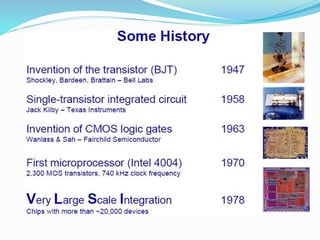
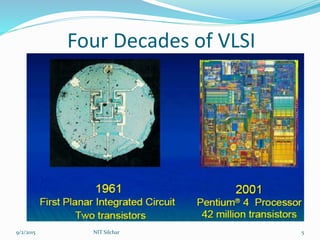
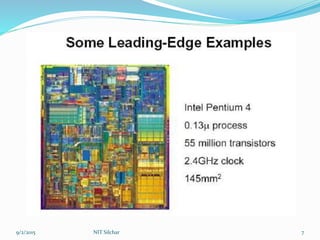
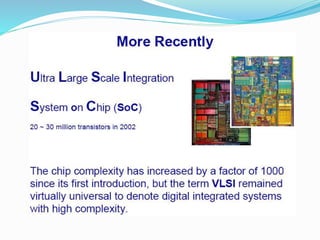
Four Decades of VLSI
9/2/2015 NIT Silchar 5
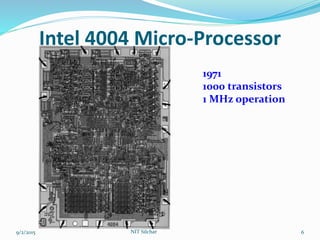
Intel 4004 Micro-Processor
9/2/2015 NIT Silchar 6
1971
1000 transistors
1 MHz operation
9/2/2015 NIT Silchar 7
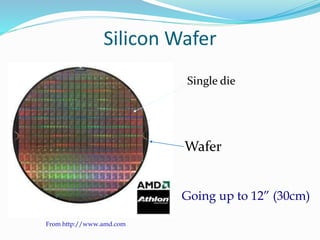
Silicon Wafer
Single die
Wafer
From http://www.amd.com
Going up to 12” (30cm)
What is HPC?
 High Performance Computing (HPC) refers to any
computational activity requiring more than a single
computer to execute a task.
 Supercomputers and computer clusters are used to solve
advanced Computational Science and Engineering
Research problems.
 High-performance computing (HPC) is the use
of parallel processing for running advanced application
programs efficiently, reliably and quickly.
9/2/2015 NIT Silchar 10
High Performance Computing (HPC)
 HPC has the capacity to handle and analyze massive
amounts of data at high speed.
 Tasks that can take months using normal computers
can be done in days or even minutes.
 It can be used to model and solve highly complex
problems in all sectors.
9/2/2015 11NIT Silchar
FLOPS
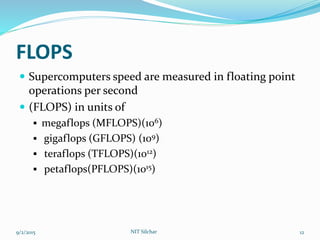
 Supercomputers speed are measured in floating point
operations per second
 (FLOPS) in units of
 megaflops (MFLOPS)(106)
 gigaflops (GFLOPS) (109)
 teraflops (TFLOPS)(1012)
 petaflops(PFLOPS)(1015)
9/2/2015 NIT Silchar 12
FLOPS Calculation
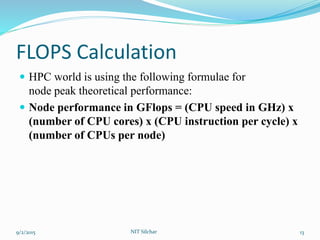
 HPC world is using the following formulae for
node peak theoretical performance:
 Node performance in GFlops = (CPU speed in GHz) x
(number of CPU cores) x (CPU instruction per cycle) x
(number of CPUs per node)
9/2/2015 NIT Silchar 13
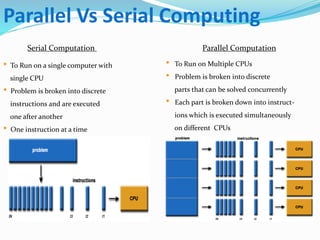
Parallel Vs Serial Computing
Serial Computation Parallel Computation
• To Run on a single computer with
single CPU
• Problem is broken into discrete
instructions and are executed
one after another
• One instruction at a time
• To Run on Multiple CPUs
• Problem is broken into discrete
parts that can be solved concurrently
• Each part is broken down into instruct-
ions which is executed simultaneously
on different CPUs
9/2/2015 NIT Silchar 15
Requirement of HPC
 Many computational problems in science and engineering
require the most powerful computers available today.
 The widespread deployment of multicore and many core
architectures has highlighted the need to exploit parallel
computing techniques.
 Research in high performance computing (HPC) spans
algorithms, software, tools and applications that exploit
modern HPC platforms.
 The use of low-latency Infiniband interconnect and high
performance parallel file system storage gives the best
performance for intriguing large data set problems.
9/2/2015 NIT Silchar 16
9/2/2015 NIT Silchar 17
Serial Software in Research
 Matlab
 Ansys
 CATIA
 Silvaco
 etc..
9/2/2015 18NIT Silchar
Parallel Software in Research
 OpenCV
 Lammps
 OpenFOAM
 Calculix
 Parallel Python
 RedMD
 And many more..
9/2/2015 19NIT Silchar
HPC efficiently and parallel
solutions
 Linear Algebra: BLAS routines are vector-vector (Level
1), matrix-vector(Level 2) and matrix matrix(Level 3)
operations for real and complex single and double
precision data. LAPACK consists of tuned LU, Cholesky
and QR factorizations, eigen value and least squares
solvers.
 FFT(Fast Fourier Transform): Transform from 1D to
multidimensional, complex to complex, real to complex,
and real to real transforms of arbitrary lengths.
 Vector Math: Functions include computationally
intensive core mathematical operations for single and
double precision real and complex data types.
9/2/2015 20NIT Silchar
Cont..
 Statistics: Functions include random number generators
and probability distributions. optimized for multicore
processors. Also included are compute-intensive in and
out-of-core routines to compute basic statistics, estimation
of dependencies etc.
 Data fitting: Functions include splines (linear, quadratic,
cubic, look-up, stepwise constant) for 1-dimensional
interpolation that can be used in data analytics, geometric
modeling and surface approximation applications.
9/2/2015 21NIT Silchar
Cont..
 Tools for Solving Differential Equation:
trigonometric transform routines and Poisson solver
 Data fitting functions: For spline-based approximation
of functions, derivatives and integrals of functions, and
search
 Support Vector Machine(SVM):
 Used for Machine Learning Application to train the
machine.
 Optimized version for both HPC System and NVIDIA.
9/2/2015 22NIT Silchar
9/2/2015 NIT Silchar 23
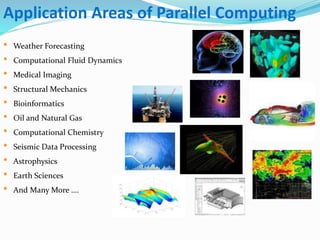
Application Areas of Parallel Computing
• Weather Forecasting
• Computational Fluid Dynamics
• Medical Imaging
• Structural Mechanics
• Bioinformatics
• Oil and Natural Gas
• Computational Chemistry
• Seismic Data Processing
• Astrophysics
• Earth Sciences
• And Many More ….
HPC can also be used to
 Develop and redesign products
 Optimize production and delivery processes
 Analyze or develop large datasets
 Conduct large-scale research projects
 Store large amounts of data for future analysis
 Perform consumer trend monitoring, searching or profiling
 Create computer visualizations that explain research results
 Carry out simulations and / or modeling of complex
processes
9/2/2015 NIT Silchar 25
Manufacturing
9/2/2015 NIT Silchar 26
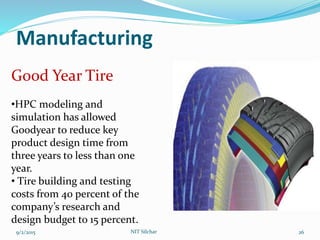
Good Year Tire
•HPC modeling and
simulation has allowed
Goodyear to reduce key
product design time from
three years to less than one
year.
• Tire building and testing
costs from 40 percent of the
company’s research and
design budget to 15 percent.
Cont..
9/2/2015 NIT Silchar 27
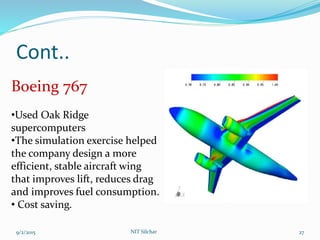
Boeing 767
•Used Oak Ridge
supercomputers
•The simulation exercise helped
the company design a more
efficient, stable aircraft wing
that improves lift, reduces drag
and improves fuel consumption.
• Cost saving.
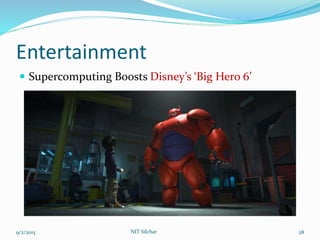
Entertainment
 Supercomputing Boosts Disney’s ‘Big Hero 6’
9/2/2015 NIT Silchar 28
Bollywood Animation Movies
 India's first international quality 3D animation film by Yash Raj
Film’s released in 2007.
 Eka(supercomputer) used to reduce rendering times for
animation frames, computer generated imagery (CGI), visual
effects (vfx) and compositing in the domains of high end 3D
modelling, 2D & 3D animation and game asset development
 Eka manufactured by Tata sons has 117 Teraflops computing
Power.
 Avatar,Ra-one, Bahubali for visual effects.
9/2/2015 NIT Silchar 29
9/2/2015 NIT Silchar 30
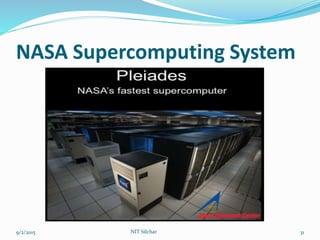
NASA Supercomputing System
9/2/2015 NIT Silchar 31
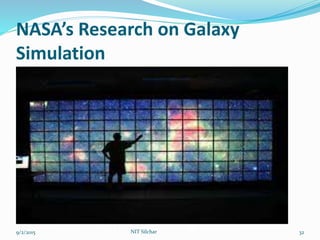
NASA’s Research on Galaxy
Simulation
9/2/2015 NIT Silchar 32
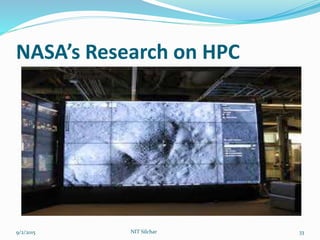
NASA’s Research on HPC
9/2/2015 NIT Silchar 33
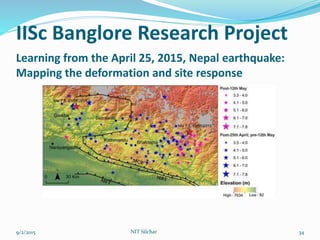
Learning from the April 25, 2015, Nepal earthquake:
Mapping the deformation and site response
9/2/2015 34NIT Silchar
IISc Banglore Research Project
9/2/2015 NIT Silchar 35
Cost of HPC System
Cost in terms of
 System Perspective
 Application Perspective
9/2/2015 36NIT Silchar
 System Perspective Cost
It includes cost required to build the HPC System
 Cost of Node: Consist of processor RAM and Hard Disk
Cost e.g SuperMicro, IBM,HP.
 Cost Of Storage: Cost of storage box e.g Seagate
 Cost Of PACS: required to maintain the temperature
and humidity level. e.g Uniflair.
 Maintenace of HPC and cost of electricity.
9/2/2015 37NIT Silchar
 Application Perspective Cost
 Cost of OS: RHEL, Cluster Suite.
 Cost of Parallel Compliers: OpenMPI, MPICH, etc
 Cost of scheduler to run the job: PBS Scheduler.
 Most of the applications are opensource .
 99% of the Supercomputers use Linux.
9/2/2015 38NIT Silchar
Cont..
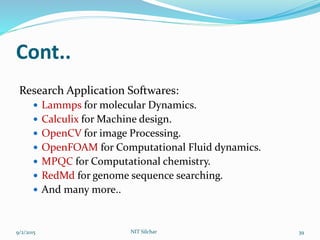
Research Application Softwares:
 Lammps for molecular Dynamics.
 Calculix for Machine design.
 OpenCV for image Processing.
 OpenFOAM for Computational Fluid dynamics.
 MPQC for Computational chemistry.
 RedMd for genome sequence searching.
 And many more..
9/2/2015 39NIT Silchar
9/2/2015 NIT Silchar 40
Establishment of HPC Centre
NIT Silchar
 MOU was signed between NIT Silchar and CDAC Pune
on 25th May 2013 to establish HPC Centre at NIT
Silchar.
 The state-of-the-art HPC Data Centre built by Sify
Technologies, Kolkata and Servers/Clusters supplied
by Netweb Technologies, New Delhi by open tender.
9/2/2015 NIT Silchar 41
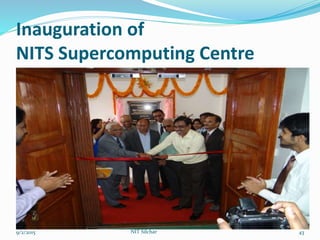
Inauguration of
NITS Supercomputing Centre
 NITS Supercomputing Centre: The Centre of
Excellence in High Performance Computing.
 Inaugurated on 05th Apr 2014
 Hon’ble JS&FA, Sri Yogendra Tripathy, MHRD, Govt.
of India
 Prof. L. M. Patnaik (FIEEE), IISc, Bangalore
 Dr. Pradeep K. Sinha, (FIEEE, ACM Distinguished
Engineer), Sr. Director, C-DAC.
9/2/2015 NIT Silchar 42
Inauguration of
NITS Supercomputing Centre
9/2/2015 NIT Silchar 43
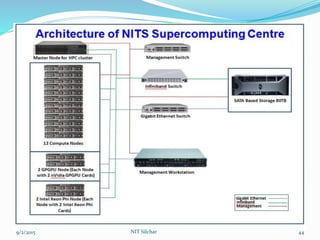
9/2/2015 NIT Silchar 44
Software Configuration
 Red Hat Enterprise Linux Server release 6.4 in all the
master and compute nodes
 IBM® Platform™ HPC 4.1.1.1
 LSF Express 9.1.1.0 job scheduler
 Intel Cluster Studio
9/2/2015 NIT Silchar 45
NITS Supercomputing Centre
 NITS Supercomputing Centre runs over 272 processors
using state-of-art data center with 2 Precision Air
Conditioning (PAC), grouped in 2 racks connected by
high-speed optical network.
9/2/2015 NIT Silchar 46
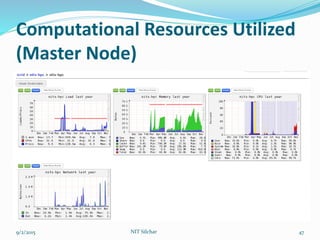
Computational Resources Utilized
(Master Node)
9/2/2015 NIT Silchar 47
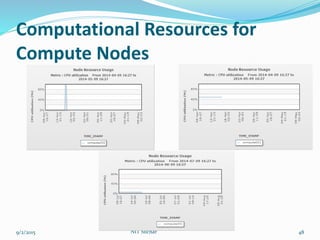
Computational Resources for
Compute Nodes
9/2/2015 NIT Silchar 48
Latest Processors and
Coaccelerator Cards
 NITS Supercomputing Centre is established in
collaboration with C-DAC & it is one of the most
powerful system in the North East India.
 Equipped with x86_64 bit based latest Intel Ivy Bridge
processing and Accelerator (Intel Xeon Phi and Nvidia
Kepler based Co-processing technologies).
 Interconnected with Mellanox FDR Infiniband with
RHEL OS on servers.
 IBM Platform Computing (Job Scheduler, Cluster
Manager, Integrated Portal for Job Submission) and
Intel Cluster Studio having a compute power of
approximately 15 Tera Flops.
9/2/2015 NIT Silchar 49
Specifications of
NITS Supercomputing Centre
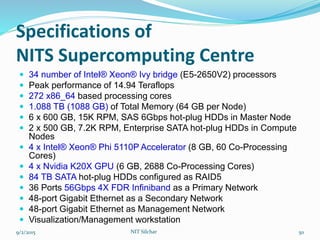
 34 number of Intel® Xeon® Ivy bridge (E5-2650V2) processors
 Peak performance of 14.94 Teraflops
 272 x86_64 based processing cores
 1.088 TB (1088 GB) of Total Memory (64 GB per Node)
 6 x 600 GB, 15K RPM, SAS 6Gbps hot-plug HDDs in Master Node
 2 x 500 GB, 7.2K RPM, Enterprise SATA hot-plug HDDs in Compute
Nodes
 4 x Intel® Xeon® Phi 5110P Accelerator (8 GB, 60 Co-Processing
Cores)
 4 x Nvidia K20X GPU (6 GB, 2688 Co-Processing Cores)
 84 TB SATA hot-plug HDDs configured as RAID5
 36 Ports 56Gbps 4X FDR Infiniband as a Primary Network
 48-port Gigabit Ethernet as a Secondary Network
 48-port Gigabit Ethernet as Management Network
 Visualization/Management workstation
9/2/2015 NIT Silchar 50
Activities Done
 16 Students of NIT Silchar (CSE & ECE) did summer
internship at C-DAC Pune from 15th May - 30th June 2014.
 Round table meet held for academia of NE region at NIT
Silchar on 4th April, 2014.
 Summer/Winter Hands on Trainings and Workshop on
HPC are being held regularly.
 Joint research & PhD Guidance for Faculty of NIT Silchar.
9/2/2015 NIT Silchar 51
Future Scope
 Interconnecting all North East NITs through HPC facility
of NIT Silchar.
 Facilitate the researchers/scholars/faculties of National
Laboratories, Universities of NE for high-end
Interdisciplinary Computational Science &
Engineering Research.
9/2/2015 NIT Silchar 52
Conclusion
 In todays world Supercomputers are an essential part
of research in higher education.
 High-performance computing (HPC) adds
tremendous value to engineering education in diverse
areas of applications.
 The role VLSI technology in HPC is vital.
 High Power Computation has influenced everybody's
life.
9/2/2015 NIT Silchar 53
9/2/2015 NIT Silchar 54

HPC in higher education

  • 1.
    Dr. T. R.Lenka Asst. Professor. Dept. of ECE, NIT Silchar Email: trlenka@ece.nits.ac.in 1
  • 2.
    Outlines  What isVLSI?  VLSI and HPC  FLOPS  Serial v/s Parallel System  Need of HPC in Higher Education Research  Problem Solving Capabilities of HPC  HPC Research domains  Architecture of HPC System  Cost of HPC  NIT Silchar Supercomputing Centre  Conclusion 9/2/2015 2NIT Silchar
  • 5.
    Four Decades ofVLSI 9/2/2015 NIT Silchar 5
  • 6.
    Intel 4004 Micro-Processor 9/2/2015NIT Silchar 6 1971 1000 transistors 1 MHz operation
  • 7.
  • 9.
    Silicon Wafer Single die Wafer Fromhttp://www.amd.com Going up to 12” (30cm)
  • 10.
    What is HPC? High Performance Computing (HPC) refers to any computational activity requiring more than a single computer to execute a task.  Supercomputers and computer clusters are used to solve advanced Computational Science and Engineering Research problems.  High-performance computing (HPC) is the use of parallel processing for running advanced application programs efficiently, reliably and quickly. 9/2/2015 NIT Silchar 10
  • 11.
    High Performance Computing(HPC)  HPC has the capacity to handle and analyze massive amounts of data at high speed.  Tasks that can take months using normal computers can be done in days or even minutes.  It can be used to model and solve highly complex problems in all sectors. 9/2/2015 11NIT Silchar
  • 12.
    FLOPS  Supercomputers speedare measured in floating point operations per second  (FLOPS) in units of  megaflops (MFLOPS)(106)  gigaflops (GFLOPS) (109)  teraflops (TFLOPS)(1012)  petaflops(PFLOPS)(1015) 9/2/2015 NIT Silchar 12
  • 13.
    FLOPS Calculation  HPCworld is using the following formulae for node peak theoretical performance:  Node performance in GFlops = (CPU speed in GHz) x (number of CPU cores) x (CPU instruction per cycle) x (number of CPUs per node) 9/2/2015 NIT Silchar 13
  • 14.
    Parallel Vs SerialComputing Serial Computation Parallel Computation • To Run on a single computer with single CPU • Problem is broken into discrete instructions and are executed one after another • One instruction at a time • To Run on Multiple CPUs • Problem is broken into discrete parts that can be solved concurrently • Each part is broken down into instruct- ions which is executed simultaneously on different CPUs
  • 15.
  • 16.
    Requirement of HPC Many computational problems in science and engineering require the most powerful computers available today.  The widespread deployment of multicore and many core architectures has highlighted the need to exploit parallel computing techniques.  Research in high performance computing (HPC) spans algorithms, software, tools and applications that exploit modern HPC platforms.  The use of low-latency Infiniband interconnect and high performance parallel file system storage gives the best performance for intriguing large data set problems. 9/2/2015 NIT Silchar 16
  • 17.
  • 18.
    Serial Software inResearch  Matlab  Ansys  CATIA  Silvaco  etc.. 9/2/2015 18NIT Silchar
  • 19.
    Parallel Software inResearch  OpenCV  Lammps  OpenFOAM  Calculix  Parallel Python  RedMD  And many more.. 9/2/2015 19NIT Silchar
  • 20.
    HPC efficiently andparallel solutions  Linear Algebra: BLAS routines are vector-vector (Level 1), matrix-vector(Level 2) and matrix matrix(Level 3) operations for real and complex single and double precision data. LAPACK consists of tuned LU, Cholesky and QR factorizations, eigen value and least squares solvers.  FFT(Fast Fourier Transform): Transform from 1D to multidimensional, complex to complex, real to complex, and real to real transforms of arbitrary lengths.  Vector Math: Functions include computationally intensive core mathematical operations for single and double precision real and complex data types. 9/2/2015 20NIT Silchar
  • 21.
    Cont..  Statistics: Functionsinclude random number generators and probability distributions. optimized for multicore processors. Also included are compute-intensive in and out-of-core routines to compute basic statistics, estimation of dependencies etc.  Data fitting: Functions include splines (linear, quadratic, cubic, look-up, stepwise constant) for 1-dimensional interpolation that can be used in data analytics, geometric modeling and surface approximation applications. 9/2/2015 21NIT Silchar
  • 22.
    Cont..  Tools forSolving Differential Equation: trigonometric transform routines and Poisson solver  Data fitting functions: For spline-based approximation of functions, derivatives and integrals of functions, and search  Support Vector Machine(SVM):  Used for Machine Learning Application to train the machine.  Optimized version for both HPC System and NVIDIA. 9/2/2015 22NIT Silchar
  • 23.
  • 24.
    Application Areas ofParallel Computing • Weather Forecasting • Computational Fluid Dynamics • Medical Imaging • Structural Mechanics • Bioinformatics • Oil and Natural Gas • Computational Chemistry • Seismic Data Processing • Astrophysics • Earth Sciences • And Many More ….
  • 25.
    HPC can alsobe used to  Develop and redesign products  Optimize production and delivery processes  Analyze or develop large datasets  Conduct large-scale research projects  Store large amounts of data for future analysis  Perform consumer trend monitoring, searching or profiling  Create computer visualizations that explain research results  Carry out simulations and / or modeling of complex processes 9/2/2015 NIT Silchar 25
  • 26.
    Manufacturing 9/2/2015 NIT Silchar26 Good Year Tire •HPC modeling and simulation has allowed Goodyear to reduce key product design time from three years to less than one year. • Tire building and testing costs from 40 percent of the company’s research and design budget to 15 percent.
  • 27.
    Cont.. 9/2/2015 NIT Silchar27 Boeing 767 •Used Oak Ridge supercomputers •The simulation exercise helped the company design a more efficient, stable aircraft wing that improves lift, reduces drag and improves fuel consumption. • Cost saving.
  • 28.
    Entertainment  Supercomputing BoostsDisney’s ‘Big Hero 6’ 9/2/2015 NIT Silchar 28
  • 29.
    Bollywood Animation Movies India's first international quality 3D animation film by Yash Raj Film’s released in 2007.  Eka(supercomputer) used to reduce rendering times for animation frames, computer generated imagery (CGI), visual effects (vfx) and compositing in the domains of high end 3D modelling, 2D & 3D animation and game asset development  Eka manufactured by Tata sons has 117 Teraflops computing Power.  Avatar,Ra-one, Bahubali for visual effects. 9/2/2015 NIT Silchar 29
  • 30.
  • 31.
  • 32.
    NASA’s Research onGalaxy Simulation 9/2/2015 NIT Silchar 32
  • 33.
    NASA’s Research onHPC 9/2/2015 NIT Silchar 33
  • 34.
    Learning from theApril 25, 2015, Nepal earthquake: Mapping the deformation and site response 9/2/2015 34NIT Silchar IISc Banglore Research Project
  • 35.
  • 36.
    Cost of HPCSystem Cost in terms of  System Perspective  Application Perspective 9/2/2015 36NIT Silchar
  • 37.
     System PerspectiveCost It includes cost required to build the HPC System  Cost of Node: Consist of processor RAM and Hard Disk Cost e.g SuperMicro, IBM,HP.  Cost Of Storage: Cost of storage box e.g Seagate  Cost Of PACS: required to maintain the temperature and humidity level. e.g Uniflair.  Maintenace of HPC and cost of electricity. 9/2/2015 37NIT Silchar
  • 38.
     Application PerspectiveCost  Cost of OS: RHEL, Cluster Suite.  Cost of Parallel Compliers: OpenMPI, MPICH, etc  Cost of scheduler to run the job: PBS Scheduler.  Most of the applications are opensource .  99% of the Supercomputers use Linux. 9/2/2015 38NIT Silchar
  • 39.
    Cont.. Research Application Softwares: Lammps for molecular Dynamics.  Calculix for Machine design.  OpenCV for image Processing.  OpenFOAM for Computational Fluid dynamics.  MPQC for Computational chemistry.  RedMd for genome sequence searching.  And many more.. 9/2/2015 39NIT Silchar
  • 40.
  • 41.
    Establishment of HPCCentre NIT Silchar  MOU was signed between NIT Silchar and CDAC Pune on 25th May 2013 to establish HPC Centre at NIT Silchar.  The state-of-the-art HPC Data Centre built by Sify Technologies, Kolkata and Servers/Clusters supplied by Netweb Technologies, New Delhi by open tender. 9/2/2015 NIT Silchar 41
  • 42.
    Inauguration of NITS SupercomputingCentre  NITS Supercomputing Centre: The Centre of Excellence in High Performance Computing.  Inaugurated on 05th Apr 2014  Hon’ble JS&FA, Sri Yogendra Tripathy, MHRD, Govt. of India  Prof. L. M. Patnaik (FIEEE), IISc, Bangalore  Dr. Pradeep K. Sinha, (FIEEE, ACM Distinguished Engineer), Sr. Director, C-DAC. 9/2/2015 NIT Silchar 42
  • 43.
    Inauguration of NITS SupercomputingCentre 9/2/2015 NIT Silchar 43
  • 44.
  • 45.
    Software Configuration  RedHat Enterprise Linux Server release 6.4 in all the master and compute nodes  IBM® Platform™ HPC 4.1.1.1  LSF Express 9.1.1.0 job scheduler  Intel Cluster Studio 9/2/2015 NIT Silchar 45
  • 46.
    NITS Supercomputing Centre NITS Supercomputing Centre runs over 272 processors using state-of-art data center with 2 Precision Air Conditioning (PAC), grouped in 2 racks connected by high-speed optical network. 9/2/2015 NIT Silchar 46
  • 47.
    Computational Resources Utilized (MasterNode) 9/2/2015 NIT Silchar 47
  • 48.
    Computational Resources for ComputeNodes 9/2/2015 NIT Silchar 48
  • 49.
    Latest Processors and CoacceleratorCards  NITS Supercomputing Centre is established in collaboration with C-DAC & it is one of the most powerful system in the North East India.  Equipped with x86_64 bit based latest Intel Ivy Bridge processing and Accelerator (Intel Xeon Phi and Nvidia Kepler based Co-processing technologies).  Interconnected with Mellanox FDR Infiniband with RHEL OS on servers.  IBM Platform Computing (Job Scheduler, Cluster Manager, Integrated Portal for Job Submission) and Intel Cluster Studio having a compute power of approximately 15 Tera Flops. 9/2/2015 NIT Silchar 49
  • 50.
    Specifications of NITS SupercomputingCentre  34 number of Intel® Xeon® Ivy bridge (E5-2650V2) processors  Peak performance of 14.94 Teraflops  272 x86_64 based processing cores  1.088 TB (1088 GB) of Total Memory (64 GB per Node)  6 x 600 GB, 15K RPM, SAS 6Gbps hot-plug HDDs in Master Node  2 x 500 GB, 7.2K RPM, Enterprise SATA hot-plug HDDs in Compute Nodes  4 x Intel® Xeon® Phi 5110P Accelerator (8 GB, 60 Co-Processing Cores)  4 x Nvidia K20X GPU (6 GB, 2688 Co-Processing Cores)  84 TB SATA hot-plug HDDs configured as RAID5  36 Ports 56Gbps 4X FDR Infiniband as a Primary Network  48-port Gigabit Ethernet as a Secondary Network  48-port Gigabit Ethernet as Management Network  Visualization/Management workstation 9/2/2015 NIT Silchar 50
  • 51.
    Activities Done  16Students of NIT Silchar (CSE & ECE) did summer internship at C-DAC Pune from 15th May - 30th June 2014.  Round table meet held for academia of NE region at NIT Silchar on 4th April, 2014.  Summer/Winter Hands on Trainings and Workshop on HPC are being held regularly.  Joint research & PhD Guidance for Faculty of NIT Silchar. 9/2/2015 NIT Silchar 51
  • 52.
    Future Scope  Interconnectingall North East NITs through HPC facility of NIT Silchar.  Facilitate the researchers/scholars/faculties of National Laboratories, Universities of NE for high-end Interdisciplinary Computational Science & Engineering Research. 9/2/2015 NIT Silchar 52
  • 53.
    Conclusion  In todaysworld Supercomputers are an essential part of research in higher education.  High-performance computing (HPC) adds tremendous value to engineering education in diverse areas of applications.  The role VLSI technology in HPC is vital.  High Power Computation has influenced everybody's life. 9/2/2015 NIT Silchar 53
  • 54.

Editor's Notes

  • #12 http://searchenterpriselinux.techtarget.com/definition/high-performance-computing
  • #20 Opencv for image processing Lammps: molecular dynamics Openfoam aerodynamics calculix modeling machine. Python: computer programming RedMd: bio-informatics
  • #27 http://hpc4energy.org/hpc-road-map/success-stories/goodyear/index.html
  • #28 http://hpc4energy.org/hpc-road-map/success-stories/boeing/index.html
  • #35 Research Project of IISc computation and Simulation run on HPC system. Done by Team of Professor,PhD and M-tech Students. http://www.iisc.ernet.in/CEaS_Nepal_report_2015_web_page_final.htm