| 1
| 1
| | 1
Research &
Rankings
– BRICS
Tahseen Khanday
Solution Sales Manager, Elsevier South
Asia
QS University Rankings
BRICS 2015 Launch
Seminar
| 2
| 2
| | 2
How important are rankings? Students
Source:
University selection by students (IDP Research)
85% of students find university ranking as
important in their selection of institute to study
33% of students find university ranking as the
most important factor (number 1 factor, followed
by 21% employer recognition, etc.)
| 3
| 3
| | 3
“We aim to have 10 Japanese institutes in the top
100 THE World University Ranking in the next
decade”
Mr. Shinzo Abe ,Prime Minister - Japan
How important are rankings? Excellency's take note
“We have less to trumpet about the quality of our
institutes. None of our institutions are ranked in the top
two hundred positions…a vast majority…are mired in
mediocrity”
April 10, 2015 convocation address at Mizoram University
Shri Pranab Mukherjee, Honorable President of India
| 4
| 4
| | 4
How important are rankings? Funding and development
Russia: The goal of the
program is to provide that by
2020 not fewer than five Russian
universities will be in the first
hundred of leading world
universities QS World University
Rankings
China: Action Plan for World-Class
Universities initiated in 2014 aims at
building world class universities based on
their position in THE or QS ranking. More
funds will be allocated for those
universities achieving a rank within the top
300
| 5
| 5
| | 5
• Rankings provide an outside view, reducing complexity
 a first indicator “the symptoms”
• Transparent performance metrics provide an inside view
 making in-depth analysis possible – “the recipe..”
• Use rankings, metrics & faculty discussions to identify areas of
strength & weakness, to drive change towards excellence
Rankings & Performance Metrics
| 6
| 6
| | 6
BRICS Ranking - QS
| 7
| 7
| | 7
World Research Outlook
Data Set : 2010 to 2014
Source : www.Scival.com
| 8
| 8
| | 8
BRICS Nations Research Output
Data Set : 2010 to 2014
Source : www.Scival.com
| 9
| 9
| | 9
Top Research Output Institutions of BRICS Nations
Indian Institute of Science Bangalore, India
University of Cape Town, South Africa
Universidade de Sao Paulo, Brazil
Moscow State University, Russia
Tsinghua University, China
Data Set : 2010 to 2014
Source : www.Scival.com
Indian Institute of Technology Bombay, India
| 10
| 10
| | 10
Top Research Output Institutions of BRICS Nations
Name
Scholarly
Output Citation Count
Citations per
Publication
International
Collaboration
(%)
Universidade de Sao Paulo 58407 262459 4.5 29.4
Tsinghua University 54092 274531 5.1 23.9
Moscow State University 24547 99965 4.1 35.0
University of Cape Town 12794 101991 8.0 53.6
Indian Institute of Science
Bangalore 10898 56411 5.2 25.3
Indian Institute of Technology
Bombay 6875 31567 4.6 27.1
Data Set : 2010 to 2014
Source : www.Scival.com
| 11
| 11
| | 11
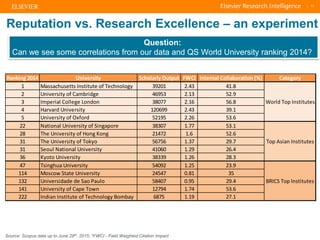
Reputation vs. Research Excellence – an experiment
Source: Scopus data up to June 29th, 2015; *FWCI - Field Weighted Citation Impact
Question:
Can we see some correlations from our data and QS World University ranking 2014?
Ranking 2014 University Scholarly Output FWCI Internal Collaboration (%) Category
1 Massachusetts Institute of Technology 39201 2.43 41.8
2 University of Cambridge 46953 2.13 52.9
3 Imperial College London 38077 2.16 56.8
4 Harvard University 120699 2.43 39.1
5 University of Oxford 52195 2.26 53.6
22 National University of Singapore 38307 1.77 53.1
28 The University of Hong Kong 21472 1.6 52.6
31 The University of Tokyo 56756 1.37 29.7
31 Seoul National University 41060 1.29 26.4
36 Kyoto University 38339 1.26 28.3
47 Tsinghua University 54092 1.25 23.9
114 Moscow State University 24547 0.81 35
132 Universidade de Sao Paulo 58407 0.95 29.4
141 University of Cape Town 12794 1.74 53.6
222 Indian Institute of Technology Bombay 6875 1.19 27.1
World Top Institutes
Top Asian Institutes
BRICS Top Institutes
| 12
| 12
| | 12
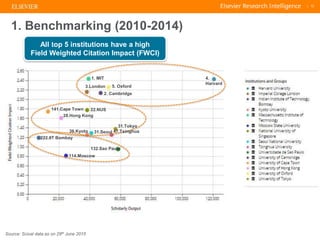
1. Benchmarking (2010-2014)
Source: Scival data as on 29th June 2015
All top 5 institutions have a high
Field Weighted Citation Impact (FWCI)
4.
Harvard
1. MIT
5. Oxford
2. Cambridge
3.London
141.Cape Town 22.NUS
28.Hong Kong
31.Tokyo
47.Tsinghua31.Seoul36.Kyoto
222.IIT Bombay
114.Moscow
132.Sao Paulo
| 13
| 13
| | 13
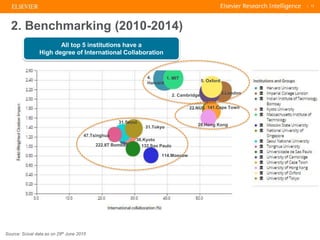
2. Benchmarking (2010-2014)
All top 5 institutions have a
High degree of International Collaboration
Source: Scival data as on 29th June 2015
4.
Harvard
1. MIT
5. Oxford
2. Cambridge 3.London
22.NUS
28.Hong Kong
141.Cape Town
31.Tokyo
47.Tsinghua
31.Seoul
36.Kyoto
222.IIT Bombay
114.Moscow
132.Sao Paulo
| 14
| 14
| | 14
How to boost reputation?
• Make sure you are internationally connected
• Strive for unique research excellence areas
• And listen to Socrates..
| 15
| 15
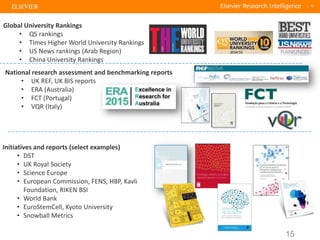
| | 15
15
National research assessment and benchmarking reports
• UK REF, UK BIS reports
• ERA (Australia)
• FCT (Portugal)
• VQR (Italy)
September 12, 2011
Global University Rankings
• QS rankings
• Times Higher World University Rankings
• US News rankings (Arab Region)
• China University Rankings
Initiatives and reports (select examples)
• DST
• UK Royal Society
• Science Europe
• European Commission, FENS, HBP, Kavli
Foundation, RIKEN BSI
• World Bank
• EuroStemCell, Kyoto University
• Snowball Metrics
| 16
| 16
| | 16
Each year
• 1 million article manuscripts received by ~2,000 journals (all offer Open Access options)
• 350,000 new articles published, in addition to 11M existing articles
• 2,000 new books published
• ScienceDirect: 750M digital article downloads
• Scopus: 56M records, 22,000 titles, 5,000 publishers, 700M citations
• SciVal: 75 trillion metrics values
• Pure: current research information system: >200,000 researchers supported
• Mendeley: 3M users globally
• Grants:7,000 sponsors, 20,000+ active opportunities, ~5M awarded grants
• Patents: >93m records, 100 patent offices
• Compounds: 22M compounds, 35M reactions; 3.3M molecular facts
• Drug information: 16k branded drugs; 12k generic drugs
Elsevier has a unique vantage point on Research
| 17
| 17
| | 17
CONFERENCES
80K events
6.7M records (12%)
Conf. expansion:
1,000 conferences
6,000 conf. events
400k conf. papers
5M citations
Mainly Engineering
and Physical
Sciences
BOOKS
512 book series
- 28K Volumes
- 1.0M items
81,000 books
- 472K items
Books expansion:
120K books by end
of 2015
- Focus on Social
Sciences and A&H
PATENTS
24M patents
from 5 major
patent offices:
• UK
• US
• Japan
• Europe
• World
JOURNALS
21,398 peer-reviewed journals
373 trade journals
• Full metadata, abstracts and
cited references (references for
post-1995 only)
• >2,800 fully Open Access titles
• Going back to 1823
• Funding data from
acknowledgements
Physical
Sciences
7,456
Health
Sciences
6,834
Social
Sciences
8,042
Life
Sciences
4,509
What content types does Scopus include?
Source: Scopus title list (November 2014)
| 18
| 18
| | 18
Scopus continue to grow daily – article growth year over year
0
5,00,000
10,00,000
15,00,000
20,00,000
25,00,000
30,00,000
35,00,000
2004 2005 2006 2007 2008 2009 2010 2011 2012 2013
Physical Sciences Health Sciences Life Sciences Social Sciences
Source: Scopus data November 2014
| 19
| 19
| | 19
2014
• Conference
expansion
program
complete
Q1 2015
• 75k books
in Scopus
and
extension
of project
end date
• Elsevier
archive
processed
in Scopus
Q2 2015
• Release
2014
journal
metrics
• 2nd tier
publisher
archives
processed
Q3 2015
• 6M pre-
1996 docs
with
references
in Scopus
Q4 2015
• Complete
books
project
(120k
books)
• FundRef
ontology
2016 and
beyond
• Archive
project
complete
(2016)
• Funding
opps
• Patents
• Datasets
2015 Scopus content and data roadmap
| 20
| 20
| | 20
www.elsevier.com/research-intelligence
Thank you!

Research & Ranking

  • 1.
    | 1 | 1 || 1 Research & Rankings – BRICS Tahseen Khanday Solution Sales Manager, Elsevier South Asia QS University Rankings BRICS 2015 Launch Seminar
  • 2.
    | 2 | 2 || 2 How important are rankings? Students Source: University selection by students (IDP Research) 85% of students find university ranking as important in their selection of institute to study 33% of students find university ranking as the most important factor (number 1 factor, followed by 21% employer recognition, etc.)
  • 3.
    | 3 | 3 || 3 “We aim to have 10 Japanese institutes in the top 100 THE World University Ranking in the next decade” Mr. Shinzo Abe ,Prime Minister - Japan How important are rankings? Excellency's take note “We have less to trumpet about the quality of our institutes. None of our institutions are ranked in the top two hundred positions…a vast majority…are mired in mediocrity” April 10, 2015 convocation address at Mizoram University Shri Pranab Mukherjee, Honorable President of India
  • 4.
    | 4 | 4 || 4 How important are rankings? Funding and development Russia: The goal of the program is to provide that by 2020 not fewer than five Russian universities will be in the first hundred of leading world universities QS World University Rankings China: Action Plan for World-Class Universities initiated in 2014 aims at building world class universities based on their position in THE or QS ranking. More funds will be allocated for those universities achieving a rank within the top 300
  • 5.
    | 5 | 5 || 5 • Rankings provide an outside view, reducing complexity  a first indicator “the symptoms” • Transparent performance metrics provide an inside view  making in-depth analysis possible – “the recipe..” • Use rankings, metrics & faculty discussions to identify areas of strength & weakness, to drive change towards excellence Rankings & Performance Metrics
  • 6.
    | 6 | 6 || 6 BRICS Ranking - QS
  • 7.
    | 7 | 7 || 7 World Research Outlook Data Set : 2010 to 2014 Source : www.Scival.com
  • 8.
    | 8 | 8 || 8 BRICS Nations Research Output Data Set : 2010 to 2014 Source : www.Scival.com
  • 9.
    | 9 | 9 || 9 Top Research Output Institutions of BRICS Nations Indian Institute of Science Bangalore, India University of Cape Town, South Africa Universidade de Sao Paulo, Brazil Moscow State University, Russia Tsinghua University, China Data Set : 2010 to 2014 Source : www.Scival.com Indian Institute of Technology Bombay, India
  • 10.
    | 10 | 10 || 10 Top Research Output Institutions of BRICS Nations Name Scholarly Output Citation Count Citations per Publication International Collaboration (%) Universidade de Sao Paulo 58407 262459 4.5 29.4 Tsinghua University 54092 274531 5.1 23.9 Moscow State University 24547 99965 4.1 35.0 University of Cape Town 12794 101991 8.0 53.6 Indian Institute of Science Bangalore 10898 56411 5.2 25.3 Indian Institute of Technology Bombay 6875 31567 4.6 27.1 Data Set : 2010 to 2014 Source : www.Scival.com
  • 11.
    | 11 | 11 || 11 Reputation vs. Research Excellence – an experiment Source: Scopus data up to June 29th, 2015; *FWCI - Field Weighted Citation Impact Question: Can we see some correlations from our data and QS World University ranking 2014? Ranking 2014 University Scholarly Output FWCI Internal Collaboration (%) Category 1 Massachusetts Institute of Technology 39201 2.43 41.8 2 University of Cambridge 46953 2.13 52.9 3 Imperial College London 38077 2.16 56.8 4 Harvard University 120699 2.43 39.1 5 University of Oxford 52195 2.26 53.6 22 National University of Singapore 38307 1.77 53.1 28 The University of Hong Kong 21472 1.6 52.6 31 The University of Tokyo 56756 1.37 29.7 31 Seoul National University 41060 1.29 26.4 36 Kyoto University 38339 1.26 28.3 47 Tsinghua University 54092 1.25 23.9 114 Moscow State University 24547 0.81 35 132 Universidade de Sao Paulo 58407 0.95 29.4 141 University of Cape Town 12794 1.74 53.6 222 Indian Institute of Technology Bombay 6875 1.19 27.1 World Top Institutes Top Asian Institutes BRICS Top Institutes
  • 12.
    | 12 | 12 || 12 1. Benchmarking (2010-2014) Source: Scival data as on 29th June 2015 All top 5 institutions have a high Field Weighted Citation Impact (FWCI) 4. Harvard 1. MIT 5. Oxford 2. Cambridge 3.London 141.Cape Town 22.NUS 28.Hong Kong 31.Tokyo 47.Tsinghua31.Seoul36.Kyoto 222.IIT Bombay 114.Moscow 132.Sao Paulo
  • 13.
    | 13 | 13 || 13 2. Benchmarking (2010-2014) All top 5 institutions have a High degree of International Collaboration Source: Scival data as on 29th June 2015 4. Harvard 1. MIT 5. Oxford 2. Cambridge 3.London 22.NUS 28.Hong Kong 141.Cape Town 31.Tokyo 47.Tsinghua 31.Seoul 36.Kyoto 222.IIT Bombay 114.Moscow 132.Sao Paulo
  • 14.
    | 14 | 14 || 14 How to boost reputation? • Make sure you are internationally connected • Strive for unique research excellence areas • And listen to Socrates..
  • 15.
    | 15 | 15 || 15 15 National research assessment and benchmarking reports • UK REF, UK BIS reports • ERA (Australia) • FCT (Portugal) • VQR (Italy) September 12, 2011 Global University Rankings • QS rankings • Times Higher World University Rankings • US News rankings (Arab Region) • China University Rankings Initiatives and reports (select examples) • DST • UK Royal Society • Science Europe • European Commission, FENS, HBP, Kavli Foundation, RIKEN BSI • World Bank • EuroStemCell, Kyoto University • Snowball Metrics
  • 16.
    | 16 | 16 || 16 Each year • 1 million article manuscripts received by ~2,000 journals (all offer Open Access options) • 350,000 new articles published, in addition to 11M existing articles • 2,000 new books published • ScienceDirect: 750M digital article downloads • Scopus: 56M records, 22,000 titles, 5,000 publishers, 700M citations • SciVal: 75 trillion metrics values • Pure: current research information system: >200,000 researchers supported • Mendeley: 3M users globally • Grants:7,000 sponsors, 20,000+ active opportunities, ~5M awarded grants • Patents: >93m records, 100 patent offices • Compounds: 22M compounds, 35M reactions; 3.3M molecular facts • Drug information: 16k branded drugs; 12k generic drugs Elsevier has a unique vantage point on Research
  • 17.
    | 17 | 17 || 17 CONFERENCES 80K events 6.7M records (12%) Conf. expansion: 1,000 conferences 6,000 conf. events 400k conf. papers 5M citations Mainly Engineering and Physical Sciences BOOKS 512 book series - 28K Volumes - 1.0M items 81,000 books - 472K items Books expansion: 120K books by end of 2015 - Focus on Social Sciences and A&H PATENTS 24M patents from 5 major patent offices: • UK • US • Japan • Europe • World JOURNALS 21,398 peer-reviewed journals 373 trade journals • Full metadata, abstracts and cited references (references for post-1995 only) • >2,800 fully Open Access titles • Going back to 1823 • Funding data from acknowledgements Physical Sciences 7,456 Health Sciences 6,834 Social Sciences 8,042 Life Sciences 4,509 What content types does Scopus include? Source: Scopus title list (November 2014)
  • 18.
    | 18 | 18 || 18 Scopus continue to grow daily – article growth year over year 0 5,00,000 10,00,000 15,00,000 20,00,000 25,00,000 30,00,000 35,00,000 2004 2005 2006 2007 2008 2009 2010 2011 2012 2013 Physical Sciences Health Sciences Life Sciences Social Sciences Source: Scopus data November 2014
  • 19.
    | 19 | 19 || 19 2014 • Conference expansion program complete Q1 2015 • 75k books in Scopus and extension of project end date • Elsevier archive processed in Scopus Q2 2015 • Release 2014 journal metrics • 2nd tier publisher archives processed Q3 2015 • 6M pre- 1996 docs with references in Scopus Q4 2015 • Complete books project (120k books) • FundRef ontology 2016 and beyond • Archive project complete (2016) • Funding opps • Patents • Datasets 2015 Scopus content and data roadmap
  • 20.
    | 20 | 20 || 20 www.elsevier.com/research-intelligence Thank you!