WELCOME
ARYAN INSTITUTE OF TECHNOLOGYGHAZIABADSEMINARDTH
DTH can be defined as :
The reception of  satellite programmers with a personal dish at individual home.
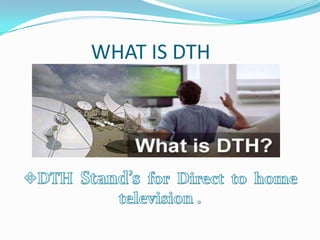
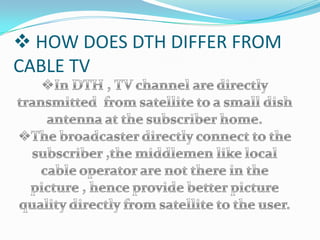
DTH does not require the local cable operator  and put the broadcaster  directly  in touch with the consumer.               WHAT IS DTHDTH  Stand’s  for  Direct  to  home   television .HISTORY
The first person who invented the technology for DTH was sir ARTHURE CLARLES CLARKE , a british  inventor in late 1946.
The DTH service was first proposed in INDIA in 1996 , but  was not approved due to concern over national security.
Finally , 2000 DTH service was allowded and Doordarshan was first to To provide the service to the consumers from 1st   of April ,2000.
After this other DTH service provider like ZEE and STAR starded pushing hard for DTH service in INDIA and setup earth station whose cost was 2.15 million and was valid for 10 years in INDIA. MAIN PARAMETER OF DTH
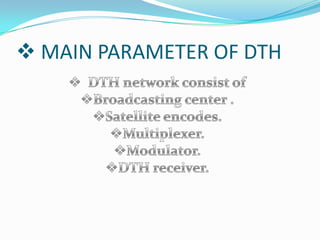
  DTH network consist of
Broadcasting center .
Satellite encodes.
Multiplexer.
Modulator.
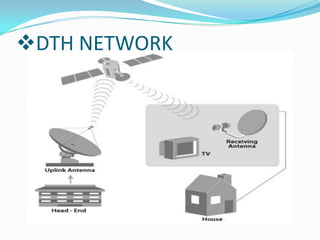
DTH receiver.DTH NETWORKUPLINK ANTENNA
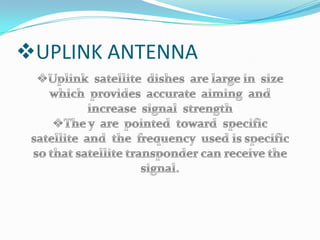
Uplink  satellite  dishes  are large in  size which  provides  accurate aiming  and increase  signal  strength
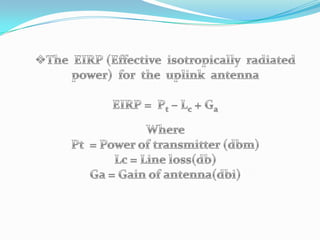
The y  are  pointed  toward  specific  satellite  and  the  frequency  used is specific  so that satellite transponder can receive the signal. The  EIRP (Effective  isotropically  radiated power)  for  the  uplink  antenna EIRP =  Pt – Lc + GaWhere Pt  = Power of transmitter (dbm)Lc = Line loss(db)Ga = Gain of antenna(dbi)
SATELLITE
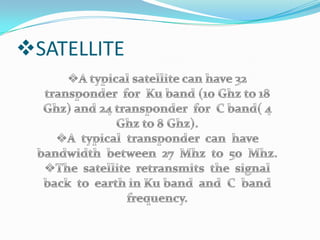
A typical satellite can have 32 transponder  for  Ku band (10 Ghz to 18 Ghz) and 24 transponder  for  C band( 4  Ghz to 8 Ghz).
A  typical  transponder  can  have bandwidth  between  27  Mhz  to  50  Mhz.
The  satellite  retransmits  the  signal back  to  earth in Ku band  and  C  band frequency.MINIDISH ANTENNA
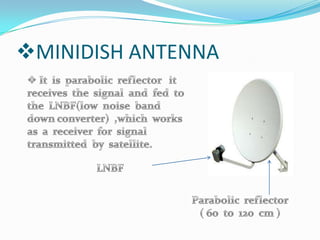
 It  is  parabolic  reflector   it receives  the  signal  and  fed  to the  LNBF(low  noise  band down converter)  ,which  works  as  a  receiver  for  signal transmitted  by  satellite.LNBFParabolic  reflector( 60  to  120  cm )
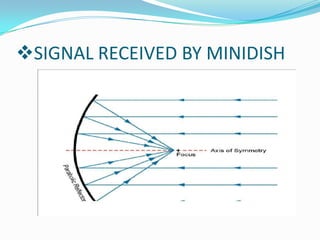
SIGNAL RECEIVED BY MINIDISHLOW NOISE BLOCK DOWN CONVERTER(LNBF)
It  collect  the  signal  from  minidish.
It  receive  the  signal  from  Ku  band  and  down convert  to  radio  frequency  signal.
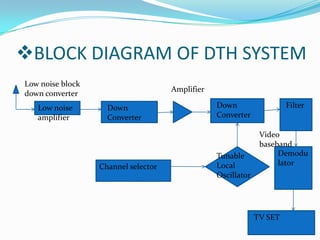
It  amplify  and remove  the  distortion  from  the  received  signal. BLOCK DIAGRAM OF DTH SYSTEMLow noise block down converterAmplifier Down Converter Filter Low noise amplifierDown Converter Video baseband Demodulator Tunable Local Oscillator Channel selector TV SET

Seminar on direct to home

  • 1.
  • 2.
    ARYAN INSTITUTE OFTECHNOLOGYGHAZIABADSEMINARDTH
  • 3.
    DTH can bedefined as :
  • 4.
    The reception of satellite programmers with a personal dish at individual home.
  • 5.
    DTH does notrequire the local cable operator and put the broadcaster directly in touch with the consumer. WHAT IS DTHDTH Stand’s for Direct to home television .HISTORY
  • 6.
    The first personwho invented the technology for DTH was sir ARTHURE CLARLES CLARKE , a british inventor in late 1946.
  • 7.
    The DTH servicewas first proposed in INDIA in 1996 , but was not approved due to concern over national security.
  • 8.
    Finally , 2000DTH service was allowded and Doordarshan was first to To provide the service to the consumers from 1st of April ,2000.
  • 9.
    After this otherDTH service provider like ZEE and STAR starded pushing hard for DTH service in INDIA and setup earth station whose cost was 2.15 million and was valid for 10 years in INDIA. MAIN PARAMETER OF DTH
  • 10.
    DTHnetwork consist of
  • 11.
  • 12.
  • 13.
  • 14.
  • 15.
  • 16.
    Uplink satellite dishes are large in size which provides accurate aiming and increase signal strength
  • 17.
    The y are pointed toward specific satellite and the frequency used is specific so that satellite transponder can receive the signal. The EIRP (Effective isotropically radiated power) for the uplink antenna EIRP = Pt – Lc + GaWhere Pt = Power of transmitter (dbm)Lc = Line loss(db)Ga = Gain of antenna(dbi)
  • 18.
  • 19.
    A typical satellitecan have 32 transponder for Ku band (10 Ghz to 18 Ghz) and 24 transponder for C band( 4 Ghz to 8 Ghz).
  • 20.
    A typical transponder can have bandwidth between 27 Mhz to 50 Mhz.
  • 21.
    The satellite retransmits the signal back to earth in Ku band and C band frequency.MINIDISH ANTENNA
  • 22.
    It is parabolic reflector it receives the signal and fed to the LNBF(low noise band down converter) ,which works as a receiver for signal transmitted by satellite.LNBFParabolic reflector( 60 to 120 cm )
  • 23.
    SIGNAL RECEIVED BYMINIDISHLOW NOISE BLOCK DOWN CONVERTER(LNBF)
  • 24.
    It collect the signal from minidish.
  • 25.
    It receive the signal from Ku band and down convert to radio frequency signal.
  • 26.
    It amplify and remove the distortion from the received signal. BLOCK DIAGRAM OF DTH SYSTEMLow noise block down converterAmplifier Down Converter Filter Low noise amplifierDown Converter Video baseband Demodulator Tunable Local Oscillator Channel selector TV SET