
Presented By
Anupam Chanda
(Ph.D. Research Scholar)
Dept. of Library and Information Science
Assam University, Silchar.
&
Dr. Manoj Kumar Sinha
(Associate Prof and HOD)
Dept. of Library and Information Science
Assam University, Silchar.
• RFID (RADIO FREQUENCY IDENTIFICATION) is a technology that is
sparking interest in the library community because of its applications that
promise to increase efficiency, productivity and enhance user satisfaction.
• RFID is a combination of radio-frequency-based technology and microchip
technology (works on high frequency = 13.56 MHZ).
• RFID Technology is considered as “the next big thing” in libraries since the
technology enables the optimization of multiple library process through the
improvement, the automation, or even the elimination of existing process and
the emergence of new process called “intelligent process” or “smart process”,
which are automatically triggering actions or events.
• RFID-based systems includes tracking systems + security throughout the library, including easier
and faster inventorying and materials handling.
• In libraries, all the library assets like books, manuscripts, CDS, DVDs, videos, audio cassettes,
etc. have to be embedded with RFID tags.
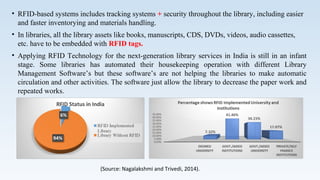
• Applying RFID Technology for the next-generation library services in India is still in an infant
stage. Some libraries has automated their housekeeping operation with different Library
Management Software’s but these software’s are not helping the libraries to make automatic
circulation and other activities. The software just allow the library to decrease the paper work and
repeated works.
(Source: Nagalakshmi and Trivedi, 2014).
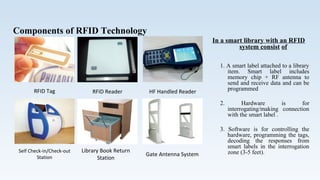
Components of RFID Technology
RFID Tag RFID Reader HF Handled Reader
Self Check-in/Check-out
Station
Library Book Return
Station
Gate Antenna System
In a smart library with an RFID
system consist of
1. A smart label attached to a library
item. Smart label includes
memory chip + RF antenna to
send and receive data and can be
programmed
2. Hardware is for
interrogating/making connection
with the smart label .
3. Software is for controlling the
hardware, programming the tags,
decoding the responses from
smart labels in the interrogation
zone (3-5 feet).
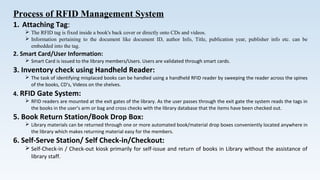
Process of RFID Management System
1. Attaching Tag:
 The RFID tag is fixed inside a book's back cover or directly onto CDs and videos.
 Information pertaining to the document like document ID, author Info, Title, publication year, publisher info etc. can be
embedded into the tag.
2. Smart Card/User Information:
 Smart Card is issued to the library members/Users. Users are validated through smart cards.
3. Inventory check using Handheld Reader:
 The task of identifying misplaced books can be handled using a handheld RFID reader by sweeping the reader across the spines
of the books, CD’s, Videos on the shelves.
4. RFID Gate System:
 RFID readers are mounted at the exit gates of the library. As the user passes through the exit gate the system reads the tags in
the books in the user’s arm or bag and cross checks with the library database that the items have been checked out.
5. Book Return Station/Book Drop Box:
 Library materials can be returned through one or more automated book/material drop boxes conveniently located anywhere in
the library which makes returning material easy for the members.
6. Self-Serve Station/ Self Check-in/Checkout:
 Self-Check-in / Check-out kiosk primarily for self-issue and return of books in Library without the assistance of
library staff.
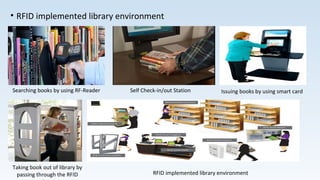
• RFID implemented library environment
Searching books by using RF-Reader Self Check-in/out Station Issuing books by using smart card
Taking book out of library by
passing through the RFID RFID implemented library environment
RFID Technology for the Next-Generation
Library Services
• RFID Technology has become more and more widely used in real-world applications even
without people realizing it. RFID tags are often envisioned as a replacement for a Barcode
Technology in the future. The reason to this is that RFID has many advantages over
Barcode, such as a sight angle, distance, collision, tag size etc.
• Recent key development in technology with respect to software and hardware have
permitted to overcome some technical limitations of RFID application. However, if the
ability for automatic capture of data has improved substantially, the capacity of efficiently
manage this data in the big library services can be improved so that more number of
libraries may go for RFID Technology in near future.
• It is important to educate library staff and library users about RFID Technology before
implementing a program. RFID is a technology that is booming in libraries due to
increased productivity in library process and a possible increase in the security of items for
loan.
• The only barrier in the journey is high cost of it, but it is expected that in coming days the
cost will come down further and very early we will see mass adoption of this technology in
various libraries in Indian and World.
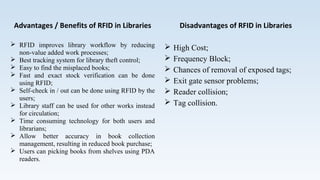
Advantages / Benefits of RFID in Libraries
 RFID improves library workflow by reducing
non-value added work processes;
 Best tracking system for library theft control;
 Easy to find the misplaced books;
 Fast and exact stock verification can be done
using RFID;
 Self-check in / out can be done using RFID by the
users;
 Library staff can be used for other works instead
for circulation;
 Time consuming technology for both users and
librarians;
 Allow better accuracy in book collection
management, resulting in reduced book purchase;
 Users can picking books from shelves using PDA
readers.
Disadvantages of RFID in Libraries
 High Cost;
 Frequency Block;
 Chances of removal of exposed tags;
 Exit gate sensor problems;
 Reader collision;
 Tag collision.
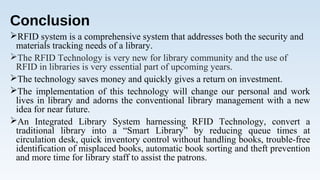
Conclusion
RFID system is a comprehensive system that addresses both the security and
materials tracking needs of a library.
The RFID Technology is very new for library community and the use of
RFID in libraries is very essential part of upcoming years.
The technology saves money and quickly gives a return on investment.
The implementation of this technology will change our personal and work
lives in library and adorns the conventional library management with a new
idea for near future.
An Integrated Library System harnessing RFID Technology, convert a
traditional library into a “Smart Library” by reducing queue times at
circulation desk, quick inventory control without handling books, trouble-free
identification of misplaced books, automatic book sorting and theft prevention
and more time for library staff to assist the patrons.
Wnl 160 introducing rfid technology by anupam

Wnl 160 introducing rfid technology by anupam

  • 1.
    Presented By Anupam Chanda (Ph.D.Research Scholar) Dept. of Library and Information Science Assam University, Silchar. & Dr. Manoj Kumar Sinha (Associate Prof and HOD) Dept. of Library and Information Science Assam University, Silchar.
  • 2.
    • RFID (RADIOFREQUENCY IDENTIFICATION) is a technology that is sparking interest in the library community because of its applications that promise to increase efficiency, productivity and enhance user satisfaction. • RFID is a combination of radio-frequency-based technology and microchip technology (works on high frequency = 13.56 MHZ). • RFID Technology is considered as “the next big thing” in libraries since the technology enables the optimization of multiple library process through the improvement, the automation, or even the elimination of existing process and the emergence of new process called “intelligent process” or “smart process”, which are automatically triggering actions or events.
  • 3.
    • RFID-based systemsincludes tracking systems + security throughout the library, including easier and faster inventorying and materials handling. • In libraries, all the library assets like books, manuscripts, CDS, DVDs, videos, audio cassettes, etc. have to be embedded with RFID tags. • Applying RFID Technology for the next-generation library services in India is still in an infant stage. Some libraries has automated their housekeeping operation with different Library Management Software’s but these software’s are not helping the libraries to make automatic circulation and other activities. The software just allow the library to decrease the paper work and repeated works. (Source: Nagalakshmi and Trivedi, 2014).
  • 4.
    Components of RFIDTechnology RFID Tag RFID Reader HF Handled Reader Self Check-in/Check-out Station Library Book Return Station Gate Antenna System In a smart library with an RFID system consist of 1. A smart label attached to a library item. Smart label includes memory chip + RF antenna to send and receive data and can be programmed 2. Hardware is for interrogating/making connection with the smart label . 3. Software is for controlling the hardware, programming the tags, decoding the responses from smart labels in the interrogation zone (3-5 feet).
  • 5.
    Process of RFIDManagement System 1. Attaching Tag:  The RFID tag is fixed inside a book's back cover or directly onto CDs and videos.  Information pertaining to the document like document ID, author Info, Title, publication year, publisher info etc. can be embedded into the tag. 2. Smart Card/User Information:  Smart Card is issued to the library members/Users. Users are validated through smart cards. 3. Inventory check using Handheld Reader:  The task of identifying misplaced books can be handled using a handheld RFID reader by sweeping the reader across the spines of the books, CD’s, Videos on the shelves. 4. RFID Gate System:  RFID readers are mounted at the exit gates of the library. As the user passes through the exit gate the system reads the tags in the books in the user’s arm or bag and cross checks with the library database that the items have been checked out. 5. Book Return Station/Book Drop Box:  Library materials can be returned through one or more automated book/material drop boxes conveniently located anywhere in the library which makes returning material easy for the members. 6. Self-Serve Station/ Self Check-in/Checkout:  Self-Check-in / Check-out kiosk primarily for self-issue and return of books in Library without the assistance of library staff.
  • 6.
    • RFID implementedlibrary environment Searching books by using RF-Reader Self Check-in/out Station Issuing books by using smart card Taking book out of library by passing through the RFID RFID implemented library environment
  • 7.
    RFID Technology forthe Next-Generation Library Services • RFID Technology has become more and more widely used in real-world applications even without people realizing it. RFID tags are often envisioned as a replacement for a Barcode Technology in the future. The reason to this is that RFID has many advantages over Barcode, such as a sight angle, distance, collision, tag size etc. • Recent key development in technology with respect to software and hardware have permitted to overcome some technical limitations of RFID application. However, if the ability for automatic capture of data has improved substantially, the capacity of efficiently manage this data in the big library services can be improved so that more number of libraries may go for RFID Technology in near future. • It is important to educate library staff and library users about RFID Technology before implementing a program. RFID is a technology that is booming in libraries due to increased productivity in library process and a possible increase in the security of items for loan. • The only barrier in the journey is high cost of it, but it is expected that in coming days the cost will come down further and very early we will see mass adoption of this technology in various libraries in Indian and World.
  • 8.
    Advantages / Benefitsof RFID in Libraries  RFID improves library workflow by reducing non-value added work processes;  Best tracking system for library theft control;  Easy to find the misplaced books;  Fast and exact stock verification can be done using RFID;  Self-check in / out can be done using RFID by the users;  Library staff can be used for other works instead for circulation;  Time consuming technology for both users and librarians;  Allow better accuracy in book collection management, resulting in reduced book purchase;  Users can picking books from shelves using PDA readers. Disadvantages of RFID in Libraries  High Cost;  Frequency Block;  Chances of removal of exposed tags;  Exit gate sensor problems;  Reader collision;  Tag collision.
  • 9.
    Conclusion RFID system isa comprehensive system that addresses both the security and materials tracking needs of a library. The RFID Technology is very new for library community and the use of RFID in libraries is very essential part of upcoming years. The technology saves money and quickly gives a return on investment. The implementation of this technology will change our personal and work lives in library and adorns the conventional library management with a new idea for near future. An Integrated Library System harnessing RFID Technology, convert a traditional library into a “Smart Library” by reducing queue times at circulation desk, quick inventory control without handling books, trouble-free identification of misplaced books, automatic book sorting and theft prevention and more time for library staff to assist the patrons.