Department of Electronics and Communication Engineering
M.V.S.R. ENGINEERING COLLEGE
(Affiliated to Osmania University & Recognized by AICTE)
Nadergul, Saroor Nagar Mandal, Hyderabad – 501 510
2017-18.
A Project Review
on
RFID Based Library
management system
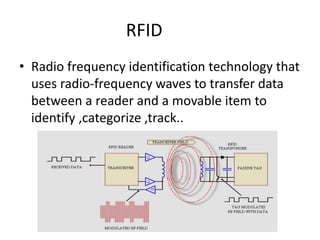
RFID
• Radio frequency identification technology that
uses radio-frequency waves to transfer data
between a reader and a movable item to
identify ,categorize ,track..
WHY RFID FOR LIBRARY?
• Fast, efficient ways
• Efficient Book circulation management
• Automatic Check-in and Check-out
• Library inventory tracking in minutes instead of hours
• Multiple books can be read simultaneously
• Unique ID of the RFID tag prevents counterfeiting
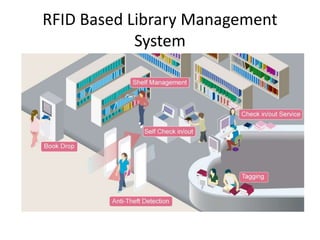
RFID Based Library Management
System
Technical specifications
Software:
• Embedded ‘C’
• RIDE To Write Code
• At89c52 ISP To Burn The Chip
Hardware:
• At89c52 Based Our Own Developed Board
• Power Supply
• RFID Reader
• EEPROM
• LCD,Buzzer,LED
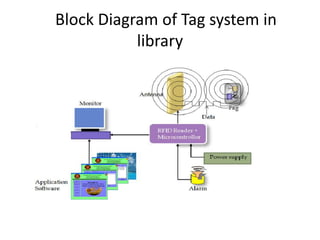
Block Diagram of Tag system in
library
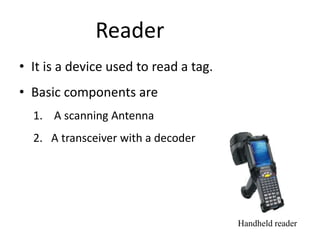
Reader
• It is a device used to read a tag.
• Basic components are
1. A scanning Antenna
2. A transceiver with a decoder
Handheld reader
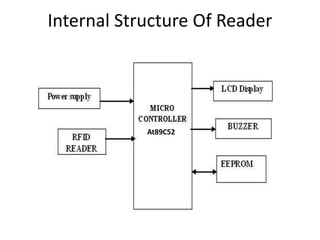
Internal Structure Of Reader
At89C52
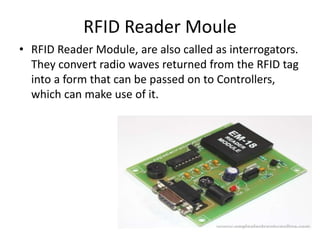
RFID Reader Moule
• RFID Reader Module, are also called as interrogators.
They convert radio waves returned from the RFID tag
into a form that can be passed on to Controllers,
which can make use of it.
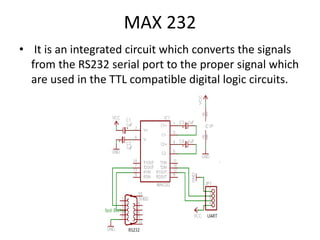
MAX 232
• It is an integrated circuit which converts the signals
from the RS232 serial port to the proper signal which
are used in the TTL compatible digital logic circuits.
RFID Module Selection
• RFID module is selected based on the
following parameters:
• Type
EX: to read and write
• Maximum clock frequency
• range
• supply current
• supply voltage
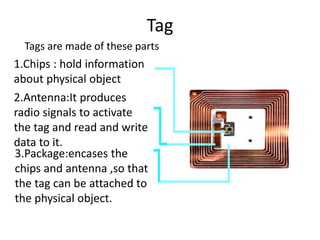
Tag
Tags are made of these parts
1.Chips : hold information
about physical object
2.Antenna:It produces
radio signals to activate
the tag and read and write
data to it.
3.Package:encases the
chips and antenna ,so that
the tag can be attached to
the physical object.
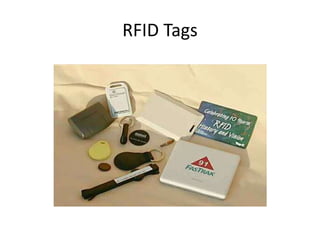
RFID Tags
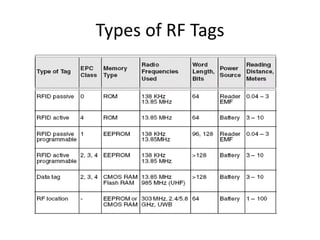
Types of RF Tags
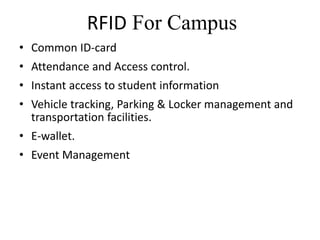
RFID For Campus
• Common ID-card
• Attendance and Access control.
• Instant access to student information
• Vehicle tracking, Parking & Locker management and
transportation facilities.
• E-wallet.
• Event Management
Benefits
• Time saving
• Fast accessing of books
• Improved services
• Security
• Low Cost, Automated Operation, Low Power
Consumption.
• RFID technology is taking off in libraries at an
increasingly rapid pace. It is easy to envision that, the
RFID tag contents will increase in power, prices are
expected to decline and tag will dramatically improve
its efficiency, security and accuracy.
CONCLUSION
References:
• Karen coyle,”management of RFID in libraries”,preprint version
of article published in the journal of academic
librarianship.v.31.5.pp.486-489
• K.Finkenzeller, RFID handbook 3rd ed.,wiley 2010
• K.Fujisaki “the implementation of RFID technology in the
library and electromagnetic compatibility“ [in
japanese],monthly EMC,183,86-94.

RFID Based Library Management System

  • 1.
    Department of Electronicsand Communication Engineering M.V.S.R. ENGINEERING COLLEGE (Affiliated to Osmania University & Recognized by AICTE) Nadergul, Saroor Nagar Mandal, Hyderabad – 501 510 2017-18. A Project Review on RFID Based Library management system
  • 2.
    RFID • Radio frequencyidentification technology that uses radio-frequency waves to transfer data between a reader and a movable item to identify ,categorize ,track..
  • 3.
    WHY RFID FORLIBRARY? • Fast, efficient ways • Efficient Book circulation management • Automatic Check-in and Check-out • Library inventory tracking in minutes instead of hours • Multiple books can be read simultaneously • Unique ID of the RFID tag prevents counterfeiting
  • 4.
    RFID Based LibraryManagement System
  • 5.
    Technical specifications Software: • Embedded‘C’ • RIDE To Write Code • At89c52 ISP To Burn The Chip Hardware: • At89c52 Based Our Own Developed Board • Power Supply • RFID Reader • EEPROM • LCD,Buzzer,LED
  • 6.
    Block Diagram ofTag system in library
  • 7.
    Reader • It isa device used to read a tag. • Basic components are 1. A scanning Antenna 2. A transceiver with a decoder Handheld reader
  • 8.
    Internal Structure OfReader At89C52
  • 9.
    RFID Reader Moule •RFID Reader Module, are also called as interrogators. They convert radio waves returned from the RFID tag into a form that can be passed on to Controllers, which can make use of it.
  • 10.
    MAX 232 • Itis an integrated circuit which converts the signals from the RS232 serial port to the proper signal which are used in the TTL compatible digital logic circuits.
  • 11.
    RFID Module Selection •RFID module is selected based on the following parameters: • Type EX: to read and write • Maximum clock frequency • range • supply current • supply voltage
  • 12.
    Tag Tags are madeof these parts 1.Chips : hold information about physical object 2.Antenna:It produces radio signals to activate the tag and read and write data to it. 3.Package:encases the chips and antenna ,so that the tag can be attached to the physical object.
  • 13.
  • 14.
  • 15.
    RFID For Campus •Common ID-card • Attendance and Access control. • Instant access to student information • Vehicle tracking, Parking & Locker management and transportation facilities. • E-wallet. • Event Management
  • 16.
    Benefits • Time saving •Fast accessing of books • Improved services • Security • Low Cost, Automated Operation, Low Power Consumption.
  • 17.
    • RFID technologyis taking off in libraries at an increasingly rapid pace. It is easy to envision that, the RFID tag contents will increase in power, prices are expected to decline and tag will dramatically improve its efficiency, security and accuracy. CONCLUSION
  • 18.
    References: • Karen coyle,”managementof RFID in libraries”,preprint version of article published in the journal of academic librarianship.v.31.5.pp.486-489 • K.Finkenzeller, RFID handbook 3rd ed.,wiley 2010 • K.Fujisaki “the implementation of RFID technology in the library and electromagnetic compatibility“ [in japanese],monthly EMC,183,86-94.