Sheet Metal Forming

     IME 240/340
Sheet Metal Forming

• For products with versatile shapes and lightweight
• Dates to 5000 B.C.
• Products include metal desks, file cabinets, appliances,
  car bodies, beverage cans
• Common materials: low-carbon steel, aluminum or
  titanium
• First take sheet plate and cut into pieces by shearing,
  slitting, cutting, or sawing or produce from coil
• Then form into shapes by punching, blanking, stamping,
  embossing, bending, forming, deep drawing, and a variety
  of other processes
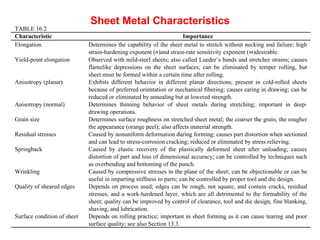
Sheet Metal Characteristics
TABLE 16.2
Characteristic                                                        Importance
Elongation                   Determines the capability of the sheet metal to stretch without necking and failure; high
                             strain-hardening exponent (n)and strain-rate sensitivity exponent (m)desirable.
Yield-point elongation       Observed with mild-steel sheets; also called Lueder’s bands and stretcher strains; causes
                             flamelike depressions on the sheet surfaces; can be eliminated by temper rolling, but
                             sheet must be formed within a certain time after rolling.
Anisotropy (planar)          Exhibits different behavior in different planar directions; present in cold-rolled sheets
                             because of preferred orientation or mechanical fibering; causes earing in drawing; can be
                             reduced or eliminated by annealing but at lowered strength.
Anisotropy (normal)          Determines thinning behavior of sheet metals during stretching; important in deep-
                             drawing operations.
Grain size                   Determines surface roughness on stretched sheet metal; the coarser the grain, the rougher
                             the appearance (orange peel); also affects material strength.
Residual stresses            Caused by nonuniform deformation during forming; causes part distortion when sectioned
                             and can lead to stress-corrosion cracking; reduced or eliminated by stress relieving.
Springback                   Caused by elastic recovery of the plastically deformed sheet after unloading; causes
                             distortion of part and loss of dimensional accuracy; can be controlled by techniques such
                             as overbending and bottoming of the punch.
Wrinkling                    Caused by compressive stresses in the plane of the sheet; can be objectionable or can be
                             useful in imparting stiffness to parts; can be controlled by proper tool and die design.
Quality of sheared edges     Depends on process used; edges can be rough, not square, and contain cracks, residual
                             stresses, and a work-hardened layer, which are all detrimental to the formability of the
                             sheet; quality can be improved by control of clearance, tool and die design, fine blanking,
                             shaving, and lubrication.
Surface condition of sheet   Depends on rolling practice; important in sheet forming as it can cause tearing and poor
                             surface quality; see also Section 13.3.
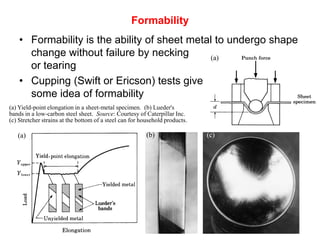
Formability
    • Formability is the ability of sheet metal to undergo shape
      change without failure by necking       (a)
      or tearing
    • Cupping (Swift or Ericson) tests give
      some idea of formability
(a) Yield-point elongation in a sheet-metal specimen. (b) Lueder's
bands in a low-carbon steel sheet. Source: Courtesy of Caterpillar Inc.
(c) Stretcher strains at the bottom of a steel can for household products.

   (a)                                                   (b)                 (c)
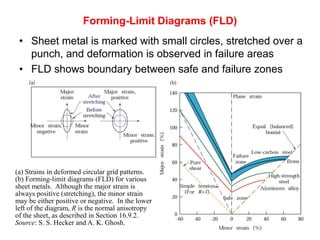
Forming-Limit Diagrams (FLD)
 • Sheet metal is marked with small circles, stretched over a
   punch, and deformation is observed in failure areas
 • FLD shows boundary between safe and failure zones


(a) Strains in deformed circular grid patterns.
(b) Forming-limit diagrams (FLD) for various
sheet metals. Although the major strain is
always positive (stretching), the minor strain
may be either positive or negative. In the lower
left of the diagram, R is the normal anisotropy
of the sheet, as described in Section 16.9.2.
Source: S. S. Hecker and A. K. Ghosh.
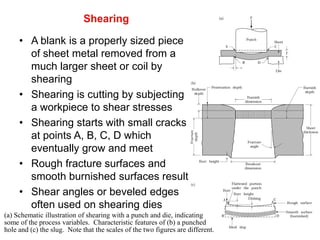
Shearing

     • A blank is a properly sized piece
       of sheet metal removed from a
       much larger sheet or coil by
       shearing
     • Shearing is cutting by subjecting
       a workpiece to shear stresses
     • Shearing starts with small cracks
       at points A, B, C, D which
       eventually grow and meet
     • Rough fracture surfaces and
       smooth burnished surfaces result
     • Shear angles or beveled edges
       often used on shearing dies
(a) Schematic illustration of shearing with a punch and die, indicating
some of the process variables. Characteristic features of (b) a punched
hole and (c) the slug. Note that the scales of the two figures are different.
Shearing Parameters

• Clearance, c, between the punch and die typically
  between 2% and 10% of sheet metal thickness
• As clearance increases, sheared edge becomes rougher
  and zone of deformation becomes larger – clearances are
  smaller for softer metals, thinner sheets, or larger holes
• Ratio of burnished to rough edges increases with:
  increasing ductility, decreasing clearance and thickness
• Faster punch speeds cause narrower sheared zones and
  less burr formation
• Burr height increases with increasing clearance, ductility,
  or dull tools
• Maximum Punch Force, F = 0.7 T L (UTS)
  (product of thickness, sheared edge perimeter, and UTS)
Shearing Operations

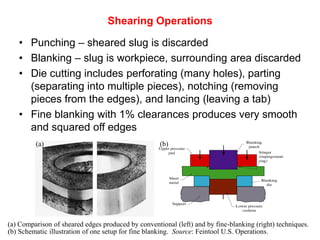
   • Punching – sheared slug is discarded
   • Blanking – slug is workpiece, surrounding area discarded
   • Die cutting includes perforating (many holes), parting
     (separating into multiple pieces), notching (removing
     pieces from the edges), and lancing (leaving a tab)
   • Fine blanking with 1% clearances produces very smooth
     and squared off edges
         (a)                                        (b)


(a) Comparison of sheared edges produced by conventional (left) and by fine-blanking (right) techniques.
(b) Schematic illustration of one setup for fine blanking. Source: Feintool U.S. Operations.
Shearing Operations

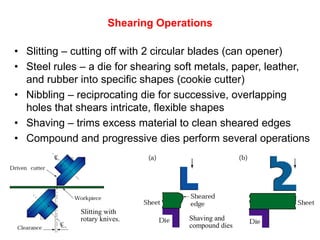
• Slitting – cutting off with 2 circular blades (can opener)
• Steel rules – a die for shearing soft metals, paper, leather,
  and rubber into specific shapes (cookie cutter)
• Nibbling – reciprocating die for successive, overlapping
  holes that shears intricate, flexible shapes
• Shaving – trims excess material to clean sheared edges
• Compound and progressive dies perform several operations


              Slitting with
              rotary knives.         Shaving and
                                     compound dies
Other Methods of Cutting Sheet Metal

• Band saw – metal material removal process that produces
  chips as in other machining
• Flame cutting – especially for thick steel plates, as in
  shipbuilding
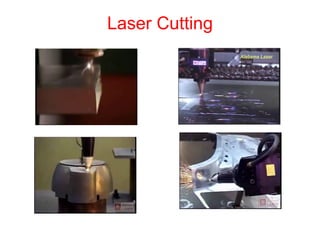
• Laser-beam cutting – newer process used with computer
  controlled equipment
• Plasma cutting – high energy plasma formed by electric arc
  between tool and work material
• Friction sawing – disk or blade that rubs against sheet or
  plate at high speeds
• Water-jet cutting – for metallic and non-metallic workpieces
Laser Cutting
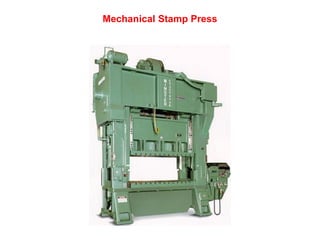
Mechanical Stamp Press
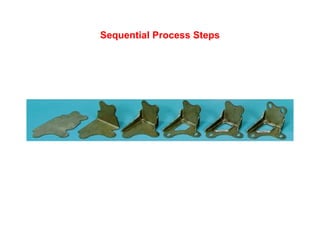
Sequential Process Steps
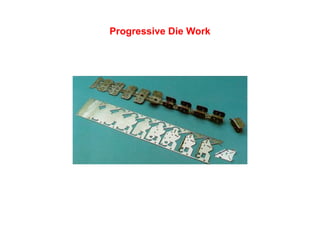
Progressive Die Work
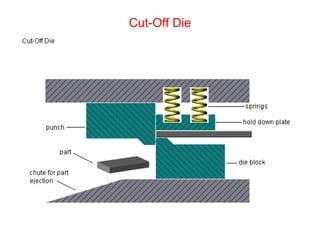
Cut-Off Die
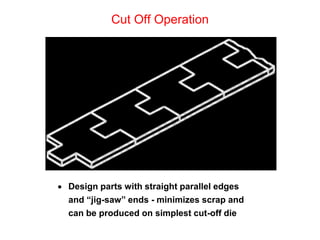
Cut Off Operation


 Design parts with straight parallel edges
  and “jig-saw” ends - minimizes scrap and
  can be produced on simplest cut-off die
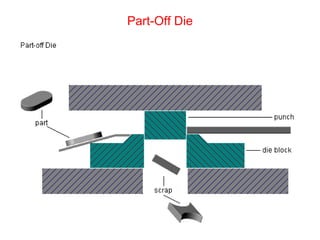
Part-Off Die
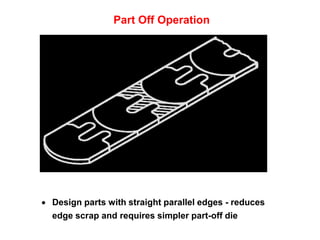
Part Off Operation


 Design parts with straight parallel edges - reduces
  edge scrap and requires simpler part-off die
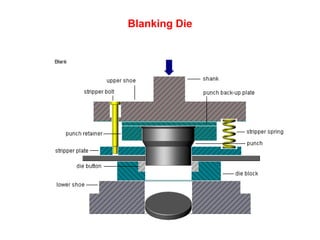
Blanking Die
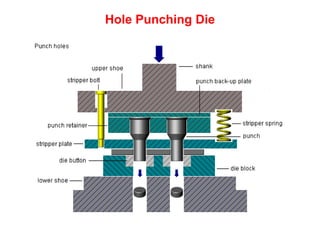
Hole Punching Die
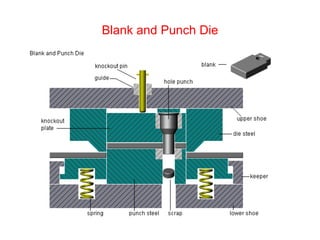
Blank and Punch Die
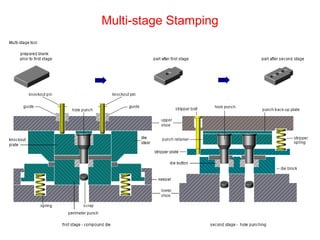
Multi-stage Stamping
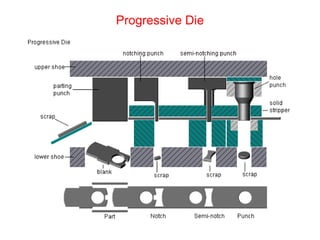
Progressive Die
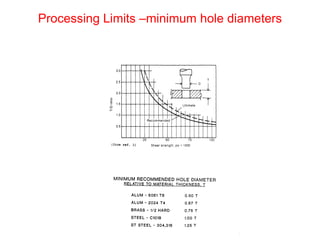
Processing Limits –minimum hole diameters
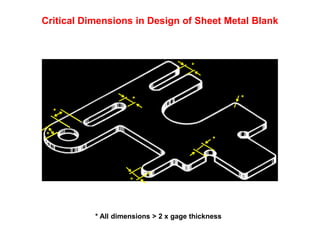
Critical Dimensions in Design of Sheet Metal Blank


                                       *


                     *                             *
     *


 *
                                             *


                     *


           * All dimensions > 2 x gage thickness
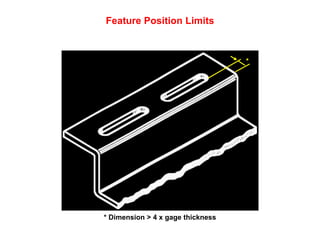
Feature Position Limits


                                   *


* Dimension > 4 x gage thickness
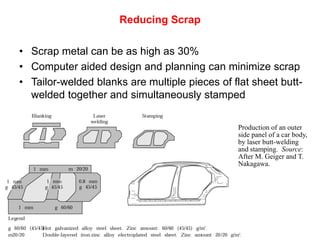
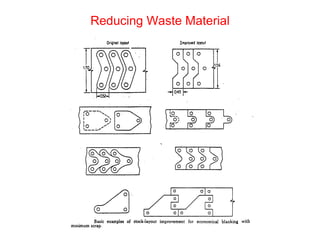
Reducing Scrap

• Scrap metal can be as high as 30%
• Computer aided design and planning can minimize scrap
• Tailor-welded blanks are multiple pieces of flat sheet butt-
  welded together and simultaneously stamped

                                               Production of an outer
                                               side panel of a car body,
                                               by laser butt-welding
                                               and stamping. Source:
                                               After M. Geiger and T.
                                               Nakagawa.
Reducing Waste Material
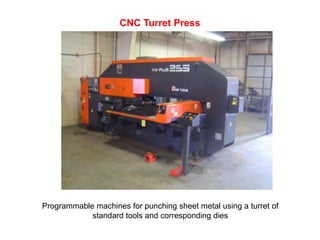
CNC Turret Press


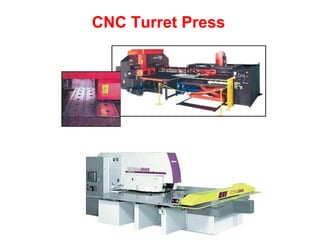
Programmable machines for punching sheet metal using a turret of
            standard tools and corresponding dies
CNC Turret Press
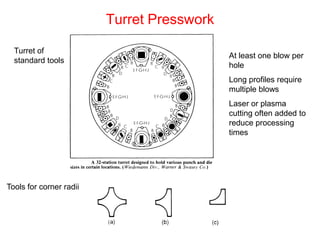
Turret Presswork

  Turret of
                                            At least one blow per
  standard tools
                                            hole
                                            Long profiles require
                                            multiple blows
                                            Laser or plasma
                                            cutting often added to
                                            reduce processing
                                            times


Tools for corner radii
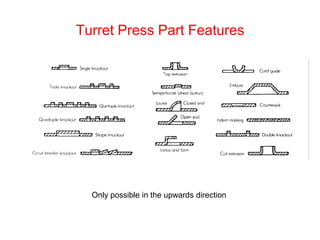
Turret Press Part Features


  Only possible in the upwards direction
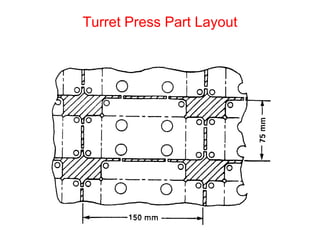
Turret Press Part Layout
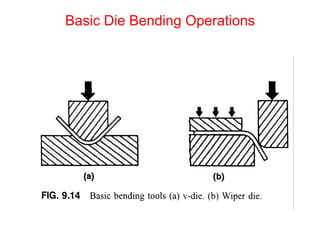
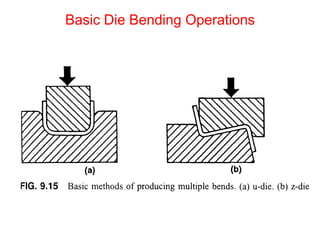
Basic Die Bending Operations
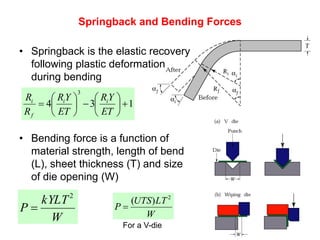
Springback and Bending Forces

• Springback is the elastic recovery
  following plastic deformation
  during bending
              3
 Ri     RiY      RiY 
     4       3      1
 Rf     ET       ET 

• Bending force is a function of
  material strength, length of bend
  (L), sheet thickness (T) and size
  of die opening (W)

   kYLT 2                 (UTS ) LT 2
P                     P
                             W
     W
                         For a V-die
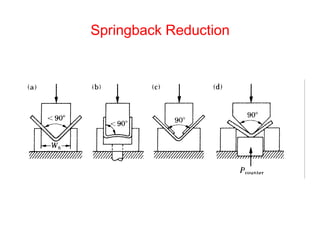
Springback Reduction
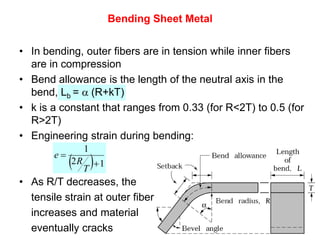
Bending Sheet Metal


• In bending, outer fibers are in tension while inner fibers
  are in compression
• Bend allowance is the length of the neutral axis in the
  bend, Lb = a (R+kT)
• k is a constant that ranges from 0.33 (for R<2T) to 0.5 (for
  R>2T)
• Engineering strain during bending:
                 1
        e
             2R T  1
• As R/T decreases, the
  tensile strain at outer fiber
  increases and material
  eventually cracks
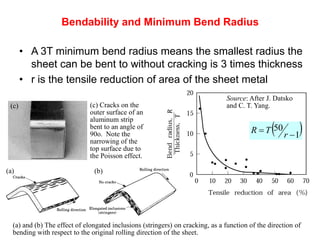
Bendability and Minimum Bend Radius

       • A 3T minimum bend radius means the smallest radius the
         sheet can be bent to without cracking is 3 times thickness
       • r is the tensile reduction of area of the sheet metal
                                                                               Source: After J. Datsko
 (c)                          (c) Cracks on the                                and C. T. Yang.
                              outer surface of an

                                                                                                         
                              aluminum strip
                              bent to an angle of
                                                                                        R  T 50
                              90o. Note the                                                         r 1
                              narrowing of the
                              top surface due to
                              the Poisson effect.

(a)                            (b)


  (a) and (b) The effect of elongated inclusions (stringers) on cracking, as a function of the direction of
  bending with respect to the original rolling direction of the sheet.
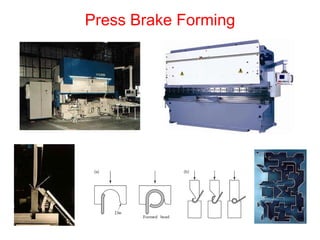
Press Brake Forming
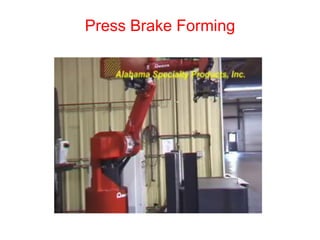
Press Brake Forming
Other Bending Operations

• Roll-bending – bending plates with a set of rolls
• Beading – bending the periphery of sheet metal into a
  cavity of a die to improve appearance and eliminate
  exposed edges
• Flanging – bending edges of sheet metal to 90 degrees
• Dimpling – punching a hole, followed immediately by
  flanging the edges
• Hemming – folding the edge of a sheet over itself
• Seaming – joining 2 edges of sheet metal by hemming
• Roll Forming – Multiple rolls to form linear products
  similar to extrusion
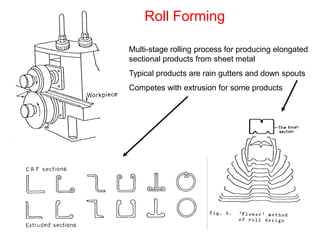
Roll Forming

Multi-stage rolling process for producing elongated
sectional products from sheet metal
Typical products are rain gutters and down spouts
Competes with extrusion for some products
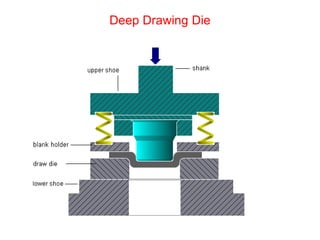
Deep Drawing Die
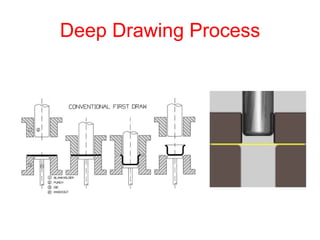
Deep Drawing Process
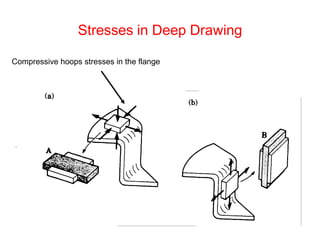
Stresses in Deep Drawing

Compressive hoops stresses in the flange
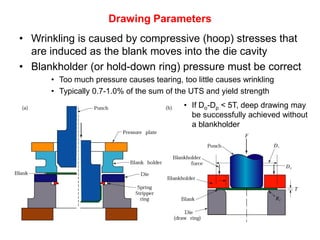
Drawing Parameters
• Wrinkling is caused by compressive (hoop) stresses that
  are induced as the blank moves into the die cavity
• Blankholder (or hold-down ring) pressure must be correct
      • Too much pressure causes tearing, too little causes wrinkling
      • Typically 0.7-1.0% of the sum of the UTS and yield strength
                                           • If Do-Dp < 5T, deep drawing may
                                             be successfully achieved without
                                             a blankholder
Drawing Parameters

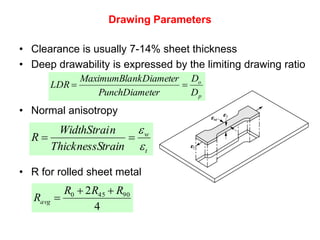
• Clearance is usually 7-14% sheet thickness
• Deep drawability is expressed by the limiting drawing ratio
                MaximumBlankDiameter Do
          LDR                      
                    PunchDiameter     Dp
• Normal anisotropy
      WidthStrai n    w
  R                
     ThicknessStrain  t

• R for rolled sheet metal
            R0  2 R45  R90
   Ravg   
                   4
Drawing Parameters

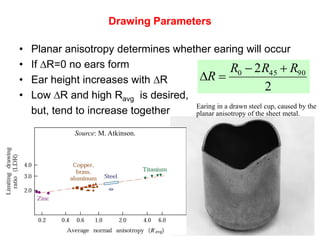
•   Planar anisotropy determines whether earing will occur
•   If DR=0 no ears form                         R0  2 R45  R90
•   Ear height increases with DR      DR 
                                                             2
•   Low DR and high Ravg is desired,
                                     Earing in a drawn steel cup, caused by the
    but, tend to increase together   planar anisotropy of the sheet metal.

               Source: M. Atkinson.
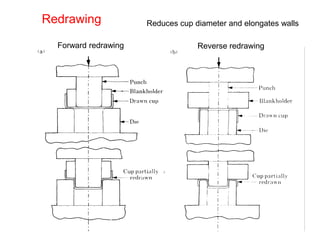
Redrawing             Reduces cup diameter and elongates walls

  Forward redrawing                Reverse redrawing
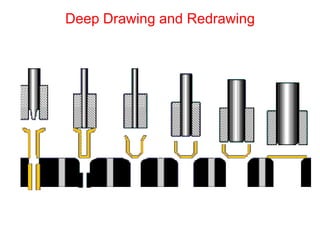
Deep Drawing and Redrawing
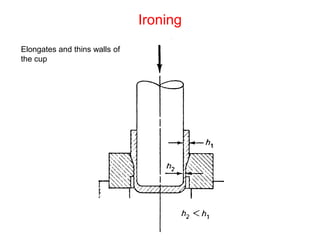
Ironing
Elongates and thins walls of
the cup
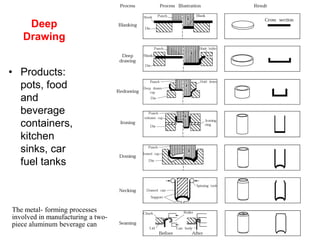
Deep
   Drawing


• Products:
  pots, food
  and
  beverage
  containers,
  kitchen
  sinks, car
  fuel tanks


The metal- forming processes
involved in manufacturing a two-
piece aluminum beverage can
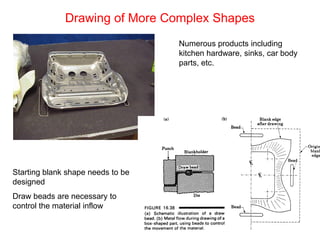
Drawing of More Complex Shapes
                                   Numerous products including
                                   kitchen hardware, sinks, car body
                                   parts, etc.


Starting blank shape needs to be
designed
Draw beads are necessary to
control the material inflow
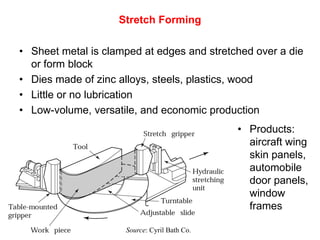
Stretch Forming

• Sheet metal is clamped at edges and stretched over a die
  or form block
• Dies made of zinc alloys, steels, plastics, wood
• Little or no lubrication
• Low-volume, versatile, and economic production
                                              • Products:
                                                aircraft wing
                                                skin panels,
                                                automobile
                                                door panels,
                                                window
                                                frames

                     Source: Cyril Bath Co.
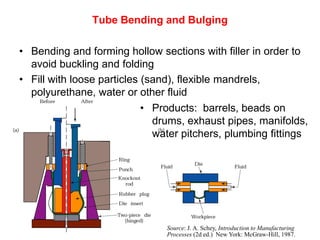
Tube Bending and Bulging

• Bending and forming hollow sections with filler in order to
  avoid buckling and folding
• Fill with loose particles (sand), flexible mandrels,
  polyurethane, water or other fluid
                            • Products: barrels, beads on
                              drums, exhaust pipes, manifolds,
                              water pitchers, plumbing fittings


                                Source: J. A. Schey, Introduction to Manufacturing
                                Processes (2d ed.) New York: McGraw-Hill, 1987.
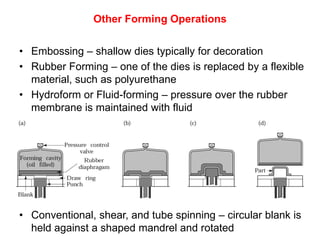
Other Forming Operations


• Embossing – shallow dies typically for decoration
• Rubber Forming – one of the dies is replaced by a flexible
  material, such as polyurethane
• Hydroform or Fluid-forming – pressure over the rubber
  membrane is maintained with fluid


• Conventional, shear, and tube spinning – circular blank is
  held against a shaped mandrel and rotated
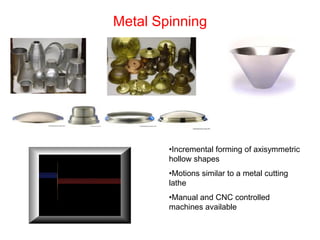
Metal Spinning


        •Incremental forming of axisymmetric
        hollow shapes
        •Motions similar to a metal cutting
        lathe
        •Manual and CNC controlled
        machines available
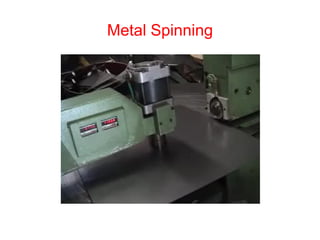
Metal Spinning
Other Forming Operations

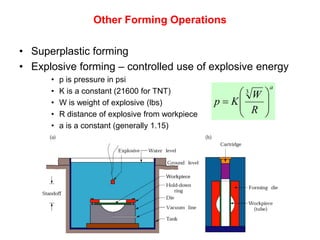
• Superplastic forming
• Explosive forming – controlled use of explosive energy
      •   p is pressure in psi
                                                                a
      •   K is a constant (21600 for TNT)                W
                                                        3
      •   W is weight of explosive (lbs)           p  K   
                                                         R 
      •   R distance of explosive from workpiece           
      •   a is a constant (generally 1.15)
Other Forming Operations

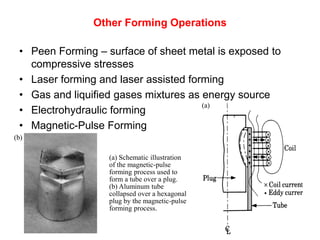
 • Peen Forming – surface of sheet metal is exposed to
   compressive stresses
 • Laser forming and laser assisted forming
 • Gas and liquified gases mixtures as energy source
                                       (a)
 • Electrohydraulic forming
 • Magnetic-Pulse Forming
(b)

                   (a) Schematic illustration
                   of the magnetic-pulse
                   forming process used to
                   form a tube over a plug.
                   (b) Aluminum tube
                   collapsed over a hexagonal
                   plug by the magnetic-pulse
                   forming process.

Sheet metworking 1

  • 1.
  • 2.
    Sheet Metal Forming •For products with versatile shapes and lightweight • Dates to 5000 B.C. • Products include metal desks, file cabinets, appliances, car bodies, beverage cans • Common materials: low-carbon steel, aluminum or titanium • First take sheet plate and cut into pieces by shearing, slitting, cutting, or sawing or produce from coil • Then form into shapes by punching, blanking, stamping, embossing, bending, forming, deep drawing, and a variety of other processes
  • 3.
    Sheet Metal Characteristics TABLE16.2 Characteristic Importance Elongation Determines the capability of the sheet metal to stretch without necking and failure; high strain-hardening exponent (n)and strain-rate sensitivity exponent (m)desirable. Yield-point elongation Observed with mild-steel sheets; also called Lueder’s bands and stretcher strains; causes flamelike depressions on the sheet surfaces; can be eliminated by temper rolling, but sheet must be formed within a certain time after rolling. Anisotropy (planar) Exhibits different behavior in different planar directions; present in cold-rolled sheets because of preferred orientation or mechanical fibering; causes earing in drawing; can be reduced or eliminated by annealing but at lowered strength. Anisotropy (normal) Determines thinning behavior of sheet metals during stretching; important in deep- drawing operations. Grain size Determines surface roughness on stretched sheet metal; the coarser the grain, the rougher the appearance (orange peel); also affects material strength. Residual stresses Caused by nonuniform deformation during forming; causes part distortion when sectioned and can lead to stress-corrosion cracking; reduced or eliminated by stress relieving. Springback Caused by elastic recovery of the plastically deformed sheet after unloading; causes distortion of part and loss of dimensional accuracy; can be controlled by techniques such as overbending and bottoming of the punch. Wrinkling Caused by compressive stresses in the plane of the sheet; can be objectionable or can be useful in imparting stiffness to parts; can be controlled by proper tool and die design. Quality of sheared edges Depends on process used; edges can be rough, not square, and contain cracks, residual stresses, and a work-hardened layer, which are all detrimental to the formability of the sheet; quality can be improved by control of clearance, tool and die design, fine blanking, shaving, and lubrication. Surface condition of sheet Depends on rolling practice; important in sheet forming as it can cause tearing and poor surface quality; see also Section 13.3.
  • 4.
    Formability • Formability is the ability of sheet metal to undergo shape change without failure by necking (a) or tearing • Cupping (Swift or Ericson) tests give some idea of formability (a) Yield-point elongation in a sheet-metal specimen. (b) Lueder's bands in a low-carbon steel sheet. Source: Courtesy of Caterpillar Inc. (c) Stretcher strains at the bottom of a steel can for household products. (a) (b) (c)
  • 5.
    Forming-Limit Diagrams (FLD) • Sheet metal is marked with small circles, stretched over a punch, and deformation is observed in failure areas • FLD shows boundary between safe and failure zones (a) Strains in deformed circular grid patterns. (b) Forming-limit diagrams (FLD) for various sheet metals. Although the major strain is always positive (stretching), the minor strain may be either positive or negative. In the lower left of the diagram, R is the normal anisotropy of the sheet, as described in Section 16.9.2. Source: S. S. Hecker and A. K. Ghosh.
  • 6.
    Shearing • A blank is a properly sized piece of sheet metal removed from a much larger sheet or coil by shearing • Shearing is cutting by subjecting a workpiece to shear stresses • Shearing starts with small cracks at points A, B, C, D which eventually grow and meet • Rough fracture surfaces and smooth burnished surfaces result • Shear angles or beveled edges often used on shearing dies (a) Schematic illustration of shearing with a punch and die, indicating some of the process variables. Characteristic features of (b) a punched hole and (c) the slug. Note that the scales of the two figures are different.
  • 7.
    Shearing Parameters • Clearance,c, between the punch and die typically between 2% and 10% of sheet metal thickness • As clearance increases, sheared edge becomes rougher and zone of deformation becomes larger – clearances are smaller for softer metals, thinner sheets, or larger holes • Ratio of burnished to rough edges increases with: increasing ductility, decreasing clearance and thickness • Faster punch speeds cause narrower sheared zones and less burr formation • Burr height increases with increasing clearance, ductility, or dull tools • Maximum Punch Force, F = 0.7 T L (UTS) (product of thickness, sheared edge perimeter, and UTS)
  • 8.
    Shearing Operations • Punching – sheared slug is discarded • Blanking – slug is workpiece, surrounding area discarded • Die cutting includes perforating (many holes), parting (separating into multiple pieces), notching (removing pieces from the edges), and lancing (leaving a tab) • Fine blanking with 1% clearances produces very smooth and squared off edges (a) (b) (a) Comparison of sheared edges produced by conventional (left) and by fine-blanking (right) techniques. (b) Schematic illustration of one setup for fine blanking. Source: Feintool U.S. Operations.
  • 9.
    Shearing Operations • Slitting– cutting off with 2 circular blades (can opener) • Steel rules – a die for shearing soft metals, paper, leather, and rubber into specific shapes (cookie cutter) • Nibbling – reciprocating die for successive, overlapping holes that shears intricate, flexible shapes • Shaving – trims excess material to clean sheared edges • Compound and progressive dies perform several operations Slitting with rotary knives. Shaving and compound dies
  • 10.
    Other Methods ofCutting Sheet Metal • Band saw – metal material removal process that produces chips as in other machining • Flame cutting – especially for thick steel plates, as in shipbuilding • Laser-beam cutting – newer process used with computer controlled equipment • Plasma cutting – high energy plasma formed by electric arc between tool and work material • Friction sawing – disk or blade that rubs against sheet or plate at high speeds • Water-jet cutting – for metallic and non-metallic workpieces
  • 11.
  • 12.
  • 13.
  • 14.
  • 15.
  • 16.
    Cut Off Operation Design parts with straight parallel edges and “jig-saw” ends - minimizes scrap and can be produced on simplest cut-off die
  • 17.
  • 18.
    Part Off Operation Design parts with straight parallel edges - reduces edge scrap and requires simpler part-off die
  • 19.
  • 20.
  • 21.
  • 22.
  • 23.
  • 24.
  • 25.
    Critical Dimensions inDesign of Sheet Metal Blank * * * * * * * * All dimensions > 2 x gage thickness
  • 26.
    Feature Position Limits * * Dimension > 4 x gage thickness
  • 27.
    Reducing Scrap • Scrapmetal can be as high as 30% • Computer aided design and planning can minimize scrap • Tailor-welded blanks are multiple pieces of flat sheet butt- welded together and simultaneously stamped Production of an outer side panel of a car body, by laser butt-welding and stamping. Source: After M. Geiger and T. Nakagawa.
  • 28.
  • 29.
    CNC Turret Press Programmablemachines for punching sheet metal using a turret of standard tools and corresponding dies
  • 30.
  • 31.
    Turret Presswork Turret of At least one blow per standard tools hole Long profiles require multiple blows Laser or plasma cutting often added to reduce processing times Tools for corner radii
  • 32.
    Turret Press PartFeatures Only possible in the upwards direction
  • 33.
  • 34.
  • 35.
  • 36.
    Springback and BendingForces • Springback is the elastic recovery following plastic deformation during bending 3 Ri  RiY   RiY   4   3  1 Rf  ET   ET  • Bending force is a function of material strength, length of bend (L), sheet thickness (T) and size of die opening (W) kYLT 2 (UTS ) LT 2 P P W W For a V-die
  • 37.
  • 38.
    Bending Sheet Metal •In bending, outer fibers are in tension while inner fibers are in compression • Bend allowance is the length of the neutral axis in the bend, Lb = a (R+kT) • k is a constant that ranges from 0.33 (for R<2T) to 0.5 (for R>2T) • Engineering strain during bending: 1 e 2R T  1 • As R/T decreases, the tensile strain at outer fiber increases and material eventually cracks
  • 39.
    Bendability and MinimumBend Radius • A 3T minimum bend radius means the smallest radius the sheet can be bent to without cracking is 3 times thickness • r is the tensile reduction of area of the sheet metal Source: After J. Datsko (c) (c) Cracks on the and C. T. Yang. outer surface of an   aluminum strip bent to an angle of R  T 50 90o. Note the r 1 narrowing of the top surface due to the Poisson effect. (a) (b) (a) and (b) The effect of elongated inclusions (stringers) on cracking, as a function of the direction of bending with respect to the original rolling direction of the sheet.
  • 40.
  • 41.
  • 42.
    Other Bending Operations •Roll-bending – bending plates with a set of rolls • Beading – bending the periphery of sheet metal into a cavity of a die to improve appearance and eliminate exposed edges • Flanging – bending edges of sheet metal to 90 degrees • Dimpling – punching a hole, followed immediately by flanging the edges • Hemming – folding the edge of a sheet over itself • Seaming – joining 2 edges of sheet metal by hemming • Roll Forming – Multiple rolls to form linear products similar to extrusion
  • 43.
    Roll Forming Multi-stage rollingprocess for producing elongated sectional products from sheet metal Typical products are rain gutters and down spouts Competes with extrusion for some products
  • 44.
  • 45.
  • 46.
    Stresses in DeepDrawing Compressive hoops stresses in the flange
  • 47.
    Drawing Parameters • Wrinklingis caused by compressive (hoop) stresses that are induced as the blank moves into the die cavity • Blankholder (or hold-down ring) pressure must be correct • Too much pressure causes tearing, too little causes wrinkling • Typically 0.7-1.0% of the sum of the UTS and yield strength • If Do-Dp < 5T, deep drawing may be successfully achieved without a blankholder
  • 48.
    Drawing Parameters • Clearanceis usually 7-14% sheet thickness • Deep drawability is expressed by the limiting drawing ratio MaximumBlankDiameter Do LDR   PunchDiameter Dp • Normal anisotropy WidthStrai n w R  ThicknessStrain  t • R for rolled sheet metal R0  2 R45  R90 Ravg  4
  • 49.
    Drawing Parameters • Planar anisotropy determines whether earing will occur • If DR=0 no ears form R0  2 R45  R90 • Ear height increases with DR DR  2 • Low DR and high Ravg is desired, Earing in a drawn steel cup, caused by the but, tend to increase together planar anisotropy of the sheet metal. Source: M. Atkinson.
  • 50.
    Redrawing Reduces cup diameter and elongates walls Forward redrawing Reverse redrawing
  • 51.
  • 52.
  • 53.
    Deep Drawing • Products: pots, food and beverage containers, kitchen sinks, car fuel tanks The metal- forming processes involved in manufacturing a two- piece aluminum beverage can
  • 54.
    Drawing of MoreComplex Shapes Numerous products including kitchen hardware, sinks, car body parts, etc. Starting blank shape needs to be designed Draw beads are necessary to control the material inflow
  • 55.
    Stretch Forming • Sheetmetal is clamped at edges and stretched over a die or form block • Dies made of zinc alloys, steels, plastics, wood • Little or no lubrication • Low-volume, versatile, and economic production • Products: aircraft wing skin panels, automobile door panels, window frames Source: Cyril Bath Co.
  • 56.
    Tube Bending andBulging • Bending and forming hollow sections with filler in order to avoid buckling and folding • Fill with loose particles (sand), flexible mandrels, polyurethane, water or other fluid • Products: barrels, beads on drums, exhaust pipes, manifolds, water pitchers, plumbing fittings Source: J. A. Schey, Introduction to Manufacturing Processes (2d ed.) New York: McGraw-Hill, 1987.
  • 57.
    Other Forming Operations •Embossing – shallow dies typically for decoration • Rubber Forming – one of the dies is replaced by a flexible material, such as polyurethane • Hydroform or Fluid-forming – pressure over the rubber membrane is maintained with fluid • Conventional, shear, and tube spinning – circular blank is held against a shaped mandrel and rotated
  • 58.
    Metal Spinning •Incremental forming of axisymmetric hollow shapes •Motions similar to a metal cutting lathe •Manual and CNC controlled machines available
  • 59.
  • 60.
    Other Forming Operations •Superplastic forming • Explosive forming – controlled use of explosive energy • p is pressure in psi a • K is a constant (21600 for TNT)  W 3 • W is weight of explosive (lbs) p  K   R  • R distance of explosive from workpiece   • a is a constant (generally 1.15)
  • 61.
    Other Forming Operations • Peen Forming – surface of sheet metal is exposed to compressive stresses • Laser forming and laser assisted forming • Gas and liquified gases mixtures as energy source (a) • Electrohydraulic forming • Magnetic-Pulse Forming (b) (a) Schematic illustration of the magnetic-pulse forming process used to form a tube over a plug. (b) Aluminum tube collapsed over a hexagonal plug by the magnetic-pulse forming process.