12/31/2016 Jahangirabad institute of technology 1
*
*LIQUID PENETRATE
INSPECTION-CONTINUED…
*By:
Zoha Nasir
Assistant professor
JIT, Barabanki
*
Penetrants are carefully formulated to produce the level of sensitivity desired by
the inspector. The penetrant must possess a number of important characteristics:
Spread easily over the surface of the material being inspected to provide
complete and even coverage.
Be drawn into surface breaking defects by capillary action.
Remain in the defect but remove easily from the surface of the part.
Remain fluid so it can be drawn back to the surface of the part through the
drying and developing steps.
Be highly visible or fluoresce brightly to produce easy to see indications.
Not be harmful to the material being tested or the inspector.
12/31/2016 Jahangirabad institute of technology 2
*
Penetrant materials come in two basic types:
Type 1 - Fluorescent Penetrants: they contain a dye or several dyes
that fluoresce when exposed to ultraviolet radiation.
Type 2 - Visible Penetrants: they contain a red dye that provides
high contrast against the white developer background
12/31/2016 Jahangirabad institute of technology 3
Fluorescent penetrant systems are more sensitive than visible
penetrant systems because the eye is drawn to the glow of the
fluorescing indication.
However, visible penetrants do not require a darkened area and
an ultraviolet light in order to make an inspection.
12/31/2016 Jahangirabad institute of technology 4
Penetrants are then classified by the method:
Method A - Water Washable: penetrants can be removed from
the part by rinsing with water alone. These penetrants contain
an emulsifying agent (detergent) that makes it possible to wash
the penetrant from the part surface with water alone. Water
washable penetrants are sometimes referred to as self-
emulsifying systems.
Method B - Post- Emulsifiable, Lipophilic: the penetrant is oil
soluble and interacts with the oil-based emulsifier to make
removal possible.
12/31/2016 Jahangirabad institute of technology 5
Method C - Solvent Removable: they require the use
of a solvent to remove the penetrant from the part.
Method D - Post- Emulsifiable, Hydrophilic: they
use an emulsifier that is a water soluble detergent
which lifts the excess penetrant from the surface of the
part with a water wash.
12/31/2016 Jahangirabad institute of technology 6
Penetrants are then classified based on the strength or
detectability of the indication that is produced for a
number of very small and tight fatigue cracks.
Level ½ - Ultra Low Sensitivity
Level 1 - Low Sensitivity
Level 2 - Medium Sensitivity
Level 3 - High Sensitivity
Level 4 - Ultra-High Sensitivity
12/31/2016 Jahangirabad institute of technology 7
*
The role of the developer is to pull the trapped penetrant
material out of defects and spread it out on the surface of the part
so it can be seen by an inspector.
Developers used with visible penetrants create a white
background so there is a greater degree of contrast between the
indication and the surrounding background.
On the other hand, developers used with fluorescent penetrants
both reflect and refract the incident ultraviolet light, allowing
more of it to interact with the penetrant, causing more efficient
fluorescence.
12/31/2016 Jahangirabad institute of technology 8
According to standards, developers are classified based on the
method that the developer is applied (as a dry powder, or dissolved
or suspended in a liquid carrier). The six standard forms of
developers are:
Form a - Dry Powder
Form b - Water Soluble
Form c - Water Suspendable
Form d – Non aqueous Type 1: Fluorescent (Solvent Based)
Form e – Non aqueous Type 2: Visible Dye (Solvent Based)
Form f - Special Applications
12/31/2016 Jahangirabad institute of technology 9
*
It is a zyglo fluorescent penetration process.
Zyglo is the trademark of MAGNAFLUX corporation for
fluorescent penetration process.
It is a modern testing process
It is accurate and quick process for locating surface flaws as-
Shrinkage cracks
Porosity
Cold shuts
Fatigue cracks etc…
12/31/2016 Jahangirabad institute of technology 10
*
INTRODUCTION:
Magnetism is the ability of matter to attract other matter to itself. Objects
that possess the property of magnetism are said to be magnetic or magnetized
and magnetic lines of force can be found in and around the objects.
A magnetic pole is a point where the a magnetic line of force exits or enters
a material.
Magnetic field lines:
• Form complete loops.
• Do not cross.
• Follow the path of least resistance.
• All have the same strength.
• Have a direction such that cause poles to attract or repel.
12/31/2016 Jahangirabad institute of technology 11
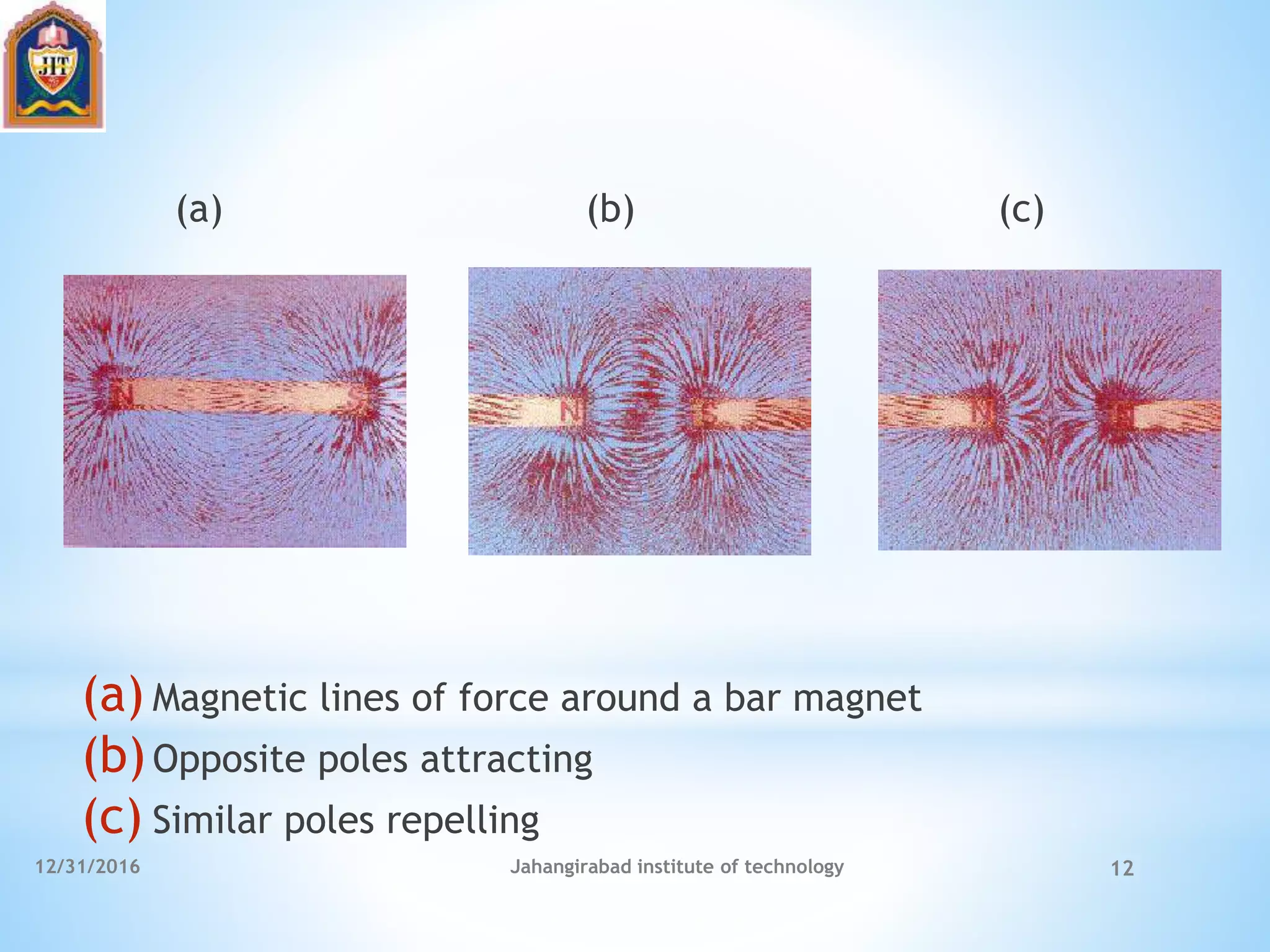
(a) (b) (c)
(a) Magnetic lines of force around a bar magnet
(b)Opposite poles attracting
(c) Similar poles repelling
12/31/2016 Jahangirabad institute of technology 12
*
A ferromagnetic test specimen is magnetized
with a strong magnetic field created by a magnet
or special equipment.
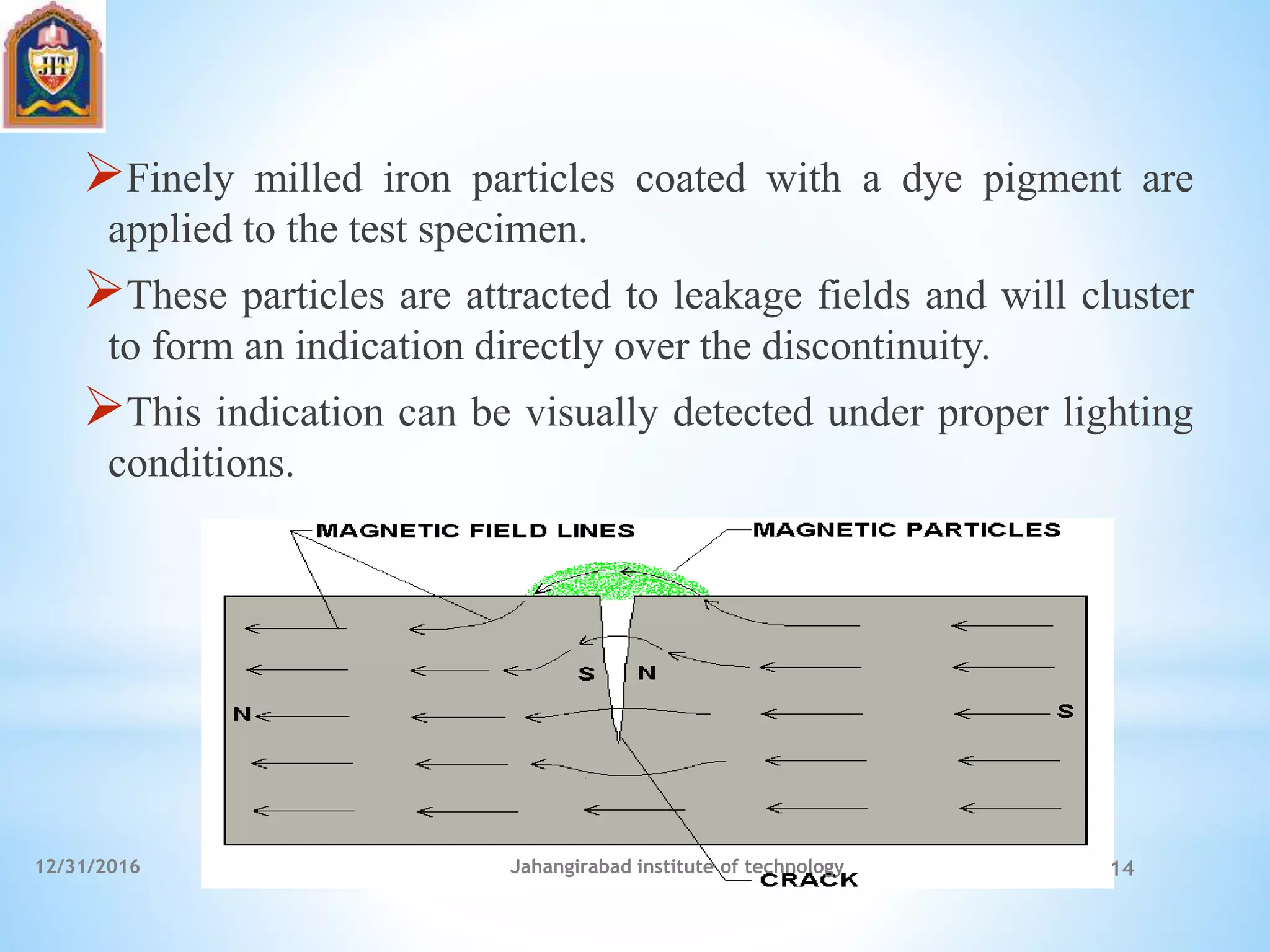
If the specimen has a discontinuity, the
discontinuity will interrupt the magnetic field
flowing through the specimen and a leakage field
will occur.
12/31/2016 Jahangirabad institute of technology 13
Finely milled iron particles coated with a dye pigment are
applied to the test specimen.
These particles are attracted to leakage fields and will cluster
to form an indication directly over the discontinuity.
This indication can be visually detected under proper lighting
conditions.
12/31/2016 Jahangirabad institute of technology 14
*
Basic steps involved:
Component pre-cleaning.
Introduction of magnetic field.
Application of magnetic media.
Interpretation of magnetic particle indications.
12/31/2016 Jahangirabad institute of technology 15
*
When inspecting a test part with the magnetic particle
method it is essential for the particles to have an unimpeded
path for migration to both strong and weak leakage fields
alike.
 The part’s surface should be clean and dry before
inspection.
Contaminants such as oil, grease, or scale may not only
prevent particles from being attracted to leakage fields, they
may also interfere with interpretation of indications.
12/31/2016 Jahangirabad institute of technology 16
*
The required magnetic field can be introduced into a component
in a number of different ways.
Using a permanent magnet or an electromagnet that contacts
the test piece.
Flowing an electrical current through the specimen.
Flowing an electrical current through a coil of wire around the
part or through a central conductor running near the part.
12/31/2016 Jahangirabad institute of technology 17
*
MPI can be performed using either dry particles, or
particles suspended in a liquid.
With the dry method, the particles are lightly dusted on to
the surface.
With the wet method, the part is flooded with a solution
carrying the particles. The dry method is more portable.
The wet method is generally more sensitive since the
liquid carrier gives the magnetic particles additional
mobility.
12/31/2016 Jahangirabad institute of technology 18
*
Magnetic particles come in a variety of
colors. A color that produces a high level
of contrast against the background
should be used.
12/31/2016 Jahangirabad institute of technology 19
*
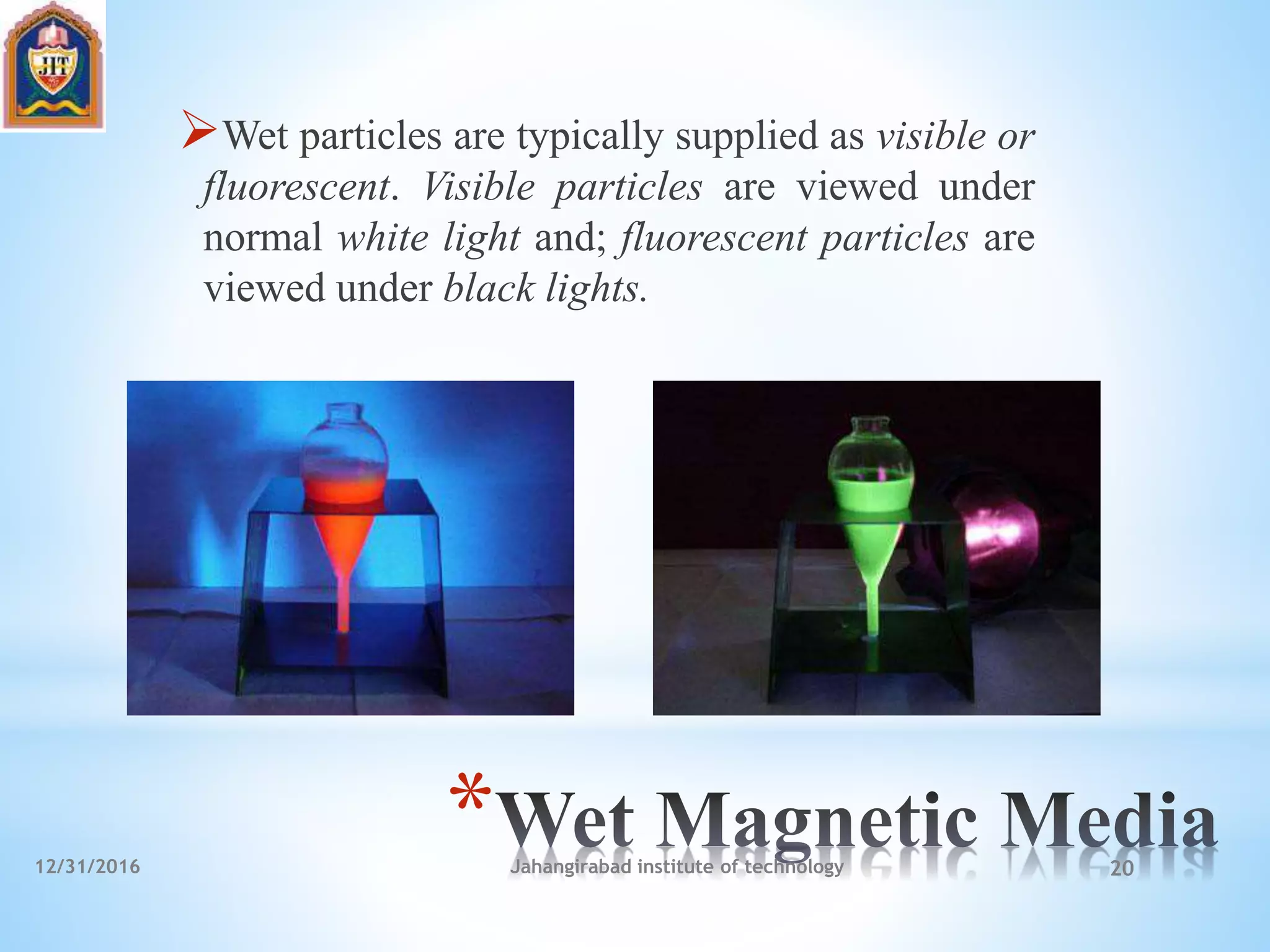
Wet particles are typically supplied as visible or
fluorescent. Visible particles are viewed under
normal white light and; fluorescent particles are
viewed under black lights.
12/31/2016 Jahangirabad institute of technology 20
*
After applying the magnetic field, indications that form
must interpreted.
This process requires that the inspector distinguish
between relevant and non relevant indications.
The following series of images depict relevant
indications produced from a variety of components
inspected with the magnetic particle method.
12/31/2016 Jahangirabad institute of technology 21

Liquid penetrate testing continued

  • 1.
    12/31/2016 Jahangirabad instituteof technology 1 * *LIQUID PENETRATE INSPECTION-CONTINUED… *By: Zoha Nasir Assistant professor JIT, Barabanki
  • 2.
    * Penetrants are carefullyformulated to produce the level of sensitivity desired by the inspector. The penetrant must possess a number of important characteristics: Spread easily over the surface of the material being inspected to provide complete and even coverage. Be drawn into surface breaking defects by capillary action. Remain in the defect but remove easily from the surface of the part. Remain fluid so it can be drawn back to the surface of the part through the drying and developing steps. Be highly visible or fluoresce brightly to produce easy to see indications. Not be harmful to the material being tested or the inspector. 12/31/2016 Jahangirabad institute of technology 2
  • 3.
    * Penetrant materials comein two basic types: Type 1 - Fluorescent Penetrants: they contain a dye or several dyes that fluoresce when exposed to ultraviolet radiation. Type 2 - Visible Penetrants: they contain a red dye that provides high contrast against the white developer background 12/31/2016 Jahangirabad institute of technology 3
  • 4.
    Fluorescent penetrant systemsare more sensitive than visible penetrant systems because the eye is drawn to the glow of the fluorescing indication. However, visible penetrants do not require a darkened area and an ultraviolet light in order to make an inspection. 12/31/2016 Jahangirabad institute of technology 4
  • 5.
    Penetrants are thenclassified by the method: Method A - Water Washable: penetrants can be removed from the part by rinsing with water alone. These penetrants contain an emulsifying agent (detergent) that makes it possible to wash the penetrant from the part surface with water alone. Water washable penetrants are sometimes referred to as self- emulsifying systems. Method B - Post- Emulsifiable, Lipophilic: the penetrant is oil soluble and interacts with the oil-based emulsifier to make removal possible. 12/31/2016 Jahangirabad institute of technology 5
  • 6.
    Method C -Solvent Removable: they require the use of a solvent to remove the penetrant from the part. Method D - Post- Emulsifiable, Hydrophilic: they use an emulsifier that is a water soluble detergent which lifts the excess penetrant from the surface of the part with a water wash. 12/31/2016 Jahangirabad institute of technology 6
  • 7.
    Penetrants are thenclassified based on the strength or detectability of the indication that is produced for a number of very small and tight fatigue cracks. Level ½ - Ultra Low Sensitivity Level 1 - Low Sensitivity Level 2 - Medium Sensitivity Level 3 - High Sensitivity Level 4 - Ultra-High Sensitivity 12/31/2016 Jahangirabad institute of technology 7
  • 8.
    * The role ofthe developer is to pull the trapped penetrant material out of defects and spread it out on the surface of the part so it can be seen by an inspector. Developers used with visible penetrants create a white background so there is a greater degree of contrast between the indication and the surrounding background. On the other hand, developers used with fluorescent penetrants both reflect and refract the incident ultraviolet light, allowing more of it to interact with the penetrant, causing more efficient fluorescence. 12/31/2016 Jahangirabad institute of technology 8
  • 9.
    According to standards,developers are classified based on the method that the developer is applied (as a dry powder, or dissolved or suspended in a liquid carrier). The six standard forms of developers are: Form a - Dry Powder Form b - Water Soluble Form c - Water Suspendable Form d – Non aqueous Type 1: Fluorescent (Solvent Based) Form e – Non aqueous Type 2: Visible Dye (Solvent Based) Form f - Special Applications 12/31/2016 Jahangirabad institute of technology 9
  • 10.
    * It is azyglo fluorescent penetration process. Zyglo is the trademark of MAGNAFLUX corporation for fluorescent penetration process. It is a modern testing process It is accurate and quick process for locating surface flaws as- Shrinkage cracks Porosity Cold shuts Fatigue cracks etc… 12/31/2016 Jahangirabad institute of technology 10
  • 11.
    * INTRODUCTION: Magnetism is theability of matter to attract other matter to itself. Objects that possess the property of magnetism are said to be magnetic or magnetized and magnetic lines of force can be found in and around the objects. A magnetic pole is a point where the a magnetic line of force exits or enters a material. Magnetic field lines: • Form complete loops. • Do not cross. • Follow the path of least resistance. • All have the same strength. • Have a direction such that cause poles to attract or repel. 12/31/2016 Jahangirabad institute of technology 11
  • 12.
    (a) (b) (c) (a)Magnetic lines of force around a bar magnet (b)Opposite poles attracting (c) Similar poles repelling 12/31/2016 Jahangirabad institute of technology 12
  • 13.
    * A ferromagnetic testspecimen is magnetized with a strong magnetic field created by a magnet or special equipment. If the specimen has a discontinuity, the discontinuity will interrupt the magnetic field flowing through the specimen and a leakage field will occur. 12/31/2016 Jahangirabad institute of technology 13
  • 14.
    Finely milled ironparticles coated with a dye pigment are applied to the test specimen. These particles are attracted to leakage fields and will cluster to form an indication directly over the discontinuity. This indication can be visually detected under proper lighting conditions. 12/31/2016 Jahangirabad institute of technology 14
  • 15.
    * Basic steps involved: Componentpre-cleaning. Introduction of magnetic field. Application of magnetic media. Interpretation of magnetic particle indications. 12/31/2016 Jahangirabad institute of technology 15
  • 16.
    * When inspecting atest part with the magnetic particle method it is essential for the particles to have an unimpeded path for migration to both strong and weak leakage fields alike.  The part’s surface should be clean and dry before inspection. Contaminants such as oil, grease, or scale may not only prevent particles from being attracted to leakage fields, they may also interfere with interpretation of indications. 12/31/2016 Jahangirabad institute of technology 16
  • 17.
    * The required magneticfield can be introduced into a component in a number of different ways. Using a permanent magnet or an electromagnet that contacts the test piece. Flowing an electrical current through the specimen. Flowing an electrical current through a coil of wire around the part or through a central conductor running near the part. 12/31/2016 Jahangirabad institute of technology 17
  • 18.
    * MPI can beperformed using either dry particles, or particles suspended in a liquid. With the dry method, the particles are lightly dusted on to the surface. With the wet method, the part is flooded with a solution carrying the particles. The dry method is more portable. The wet method is generally more sensitive since the liquid carrier gives the magnetic particles additional mobility. 12/31/2016 Jahangirabad institute of technology 18
  • 19.
    * Magnetic particles comein a variety of colors. A color that produces a high level of contrast against the background should be used. 12/31/2016 Jahangirabad institute of technology 19
  • 20.
    * Wet particles aretypically supplied as visible or fluorescent. Visible particles are viewed under normal white light and; fluorescent particles are viewed under black lights. 12/31/2016 Jahangirabad institute of technology 20
  • 21.
    * After applying themagnetic field, indications that form must interpreted. This process requires that the inspector distinguish between relevant and non relevant indications. The following series of images depict relevant indications produced from a variety of components inspected with the magnetic particle method. 12/31/2016 Jahangirabad institute of technology 21