SHEET METAL
FORMING
Presented by:
Makadiya Jay (16SOEME13055)
Makavana Ravi (16SOEME13020)
SHEET METAL FORMING
Sheet metal forming is a grouping of many complementary
processes that are used to form sheet metal parts. One or more of
these processes is used to take a flat sheet of ductile metal, and
mechanically apply deformation forces that alter the shape of the
material. Before deciding on the processes, one should determine
whether a particular sheet metal can be formed into the desired
shape without failure. The sheet metal operations done on a press
may be grouped into two categories, shearing(cutting) operations
and forming operations…….
SHEET METAL FORMING
 Shearing(Cutting) Operations: In this operation, the workpiece is stressed
beyond its ultimate strength. The stresses caused in the metal by the applied
forces will be shearing stresses. The cutting operations include:
Punching
Blanking
Notching
Perforating
Slitting
Lancing
Parting
Shaving
Trimming
Fine blanking
SHEET METAL FORMING
 Shearing Operations:
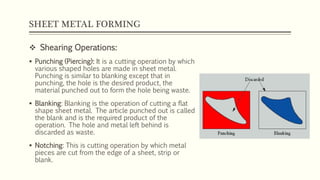
 Punching (Piercing): It is a cutting operation by which
various shaped holes are made in sheet metal.
Punching is similar to blanking except that in
punching, the hole is the desired product, the
material punched out to form the hole being waste.
 Blanking: Blanking is the operation of cutting a flat
shape sheet metal. The article punched out is called
the blank and is the required product of the
operation. The hole and metal left behind is
discarded as waste.
 Notching: This is cutting operation by which metal
pieces are cut from the edge of a sheet, strip or
blank.
SHEET METAL FORMING
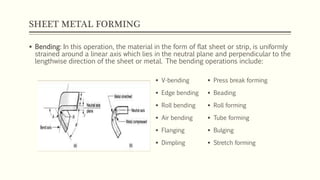
 Bending: In this operation, the material in the form of flat sheet or strip, is uniformly
strained around a linear axis which lies in the neutral plane and perpendicular to the
lengthwise direction of the sheet or metal. The bending operations include:
 V-bending
 Edge bending
 Roll bending
 Air bending
 Flanging
 Dimpling
 Press break forming
 Beading
 Roll forming
 Tube forming
 Bulging
 Stretch forming
Bending:
V-bending
Bending in 4-slide machine
Roll bending
Edge bending
SHEET METAL FORMING
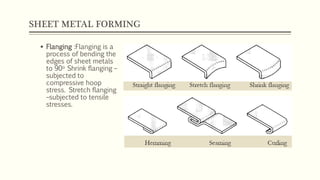
 Flanging :Flanging is a
process of bending the
edges of sheet metals
to 90o Shrink flanging –
subjected to
compressive hoop
stress. Stretch flanging
–subjected to tensile
stresses.
SHEET METAL FORMING
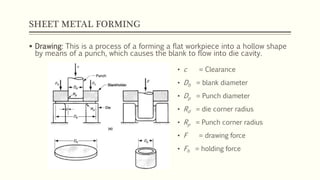
 Drawing: This is a process of a forming a flat workpiece into a hollow shape
by means of a punch, which causes the blank to flow into die cavity.
• c = Clearance
• Db = blank diameter
• Dp = Punch diameter
• Rd = die corner radius
• Rp = Punch corner radius
• F = drawing force
• Fh = holding force
SHEET METAL FORMING
 Drawing
SHEET METAL FORMING
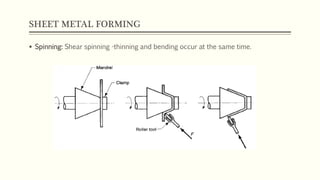
 Spinning: Shear spinning -thinning and bending occur at the same time.
SHEET METAL FORMING
 Advantages
◦Produces finer and detailed surface finish
◦Provides accurate bends in a consistent manner
◦Does not require expensive machinery
◦The work hardened surface can resist impact and abrasion
◦Eliminates the need for complex finishing processes
◦Plastic flow reduces the surface grain size and work hardens the surface.
SHEET METAL FORMING
 Industrial Applications
◦Minting of coins
◦Making badges, buttons, precision-energy springs
◦Making complex electronic parts
◦Making precision parts that require finer polished surface finishes
SHEET METAL FORMING
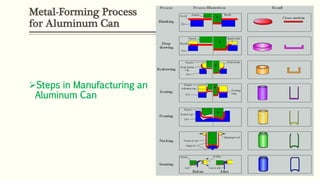
 Best Example of Sheet Metal Forming
Aluminum Can
Metal-Forming Process
for Aluminum Can
Steps in Manufacturing an
Aluminum Can
Any Question ???
THANK YOU FOR
YOUR ATTENTION

Sheet metal working

  • 1.
    SHEET METAL FORMING Presented by: MakadiyaJay (16SOEME13055) Makavana Ravi (16SOEME13020)
  • 2.
    SHEET METAL FORMING Sheetmetal forming is a grouping of many complementary processes that are used to form sheet metal parts. One or more of these processes is used to take a flat sheet of ductile metal, and mechanically apply deformation forces that alter the shape of the material. Before deciding on the processes, one should determine whether a particular sheet metal can be formed into the desired shape without failure. The sheet metal operations done on a press may be grouped into two categories, shearing(cutting) operations and forming operations…….
  • 3.
    SHEET METAL FORMING Shearing(Cutting) Operations: In this operation, the workpiece is stressed beyond its ultimate strength. The stresses caused in the metal by the applied forces will be shearing stresses. The cutting operations include: Punching Blanking Notching Perforating Slitting Lancing Parting Shaving Trimming Fine blanking
  • 4.
    SHEET METAL FORMING Shearing Operations:  Punching (Piercing): It is a cutting operation by which various shaped holes are made in sheet metal. Punching is similar to blanking except that in punching, the hole is the desired product, the material punched out to form the hole being waste.  Blanking: Blanking is the operation of cutting a flat shape sheet metal. The article punched out is called the blank and is the required product of the operation. The hole and metal left behind is discarded as waste.  Notching: This is cutting operation by which metal pieces are cut from the edge of a sheet, strip or blank.
  • 5.
    SHEET METAL FORMING Bending: In this operation, the material in the form of flat sheet or strip, is uniformly strained around a linear axis which lies in the neutral plane and perpendicular to the lengthwise direction of the sheet or metal. The bending operations include:  V-bending  Edge bending  Roll bending  Air bending  Flanging  Dimpling  Press break forming  Beading  Roll forming  Tube forming  Bulging  Stretch forming
  • 6.
    Bending: V-bending Bending in 4-slidemachine Roll bending Edge bending
  • 8.
    SHEET METAL FORMING Flanging :Flanging is a process of bending the edges of sheet metals to 90o Shrink flanging – subjected to compressive hoop stress. Stretch flanging –subjected to tensile stresses.
  • 9.
    SHEET METAL FORMING Drawing: This is a process of a forming a flat workpiece into a hollow shape by means of a punch, which causes the blank to flow into die cavity. • c = Clearance • Db = blank diameter • Dp = Punch diameter • Rd = die corner radius • Rp = Punch corner radius • F = drawing force • Fh = holding force
  • 10.
  • 11.
    SHEET METAL FORMING Spinning: Shear spinning -thinning and bending occur at the same time.
  • 12.
    SHEET METAL FORMING Advantages ◦Produces finer and detailed surface finish ◦Provides accurate bends in a consistent manner ◦Does not require expensive machinery ◦The work hardened surface can resist impact and abrasion ◦Eliminates the need for complex finishing processes ◦Plastic flow reduces the surface grain size and work hardens the surface.
  • 13.
    SHEET METAL FORMING Industrial Applications ◦Minting of coins ◦Making badges, buttons, precision-energy springs ◦Making complex electronic parts ◦Making precision parts that require finer polished surface finishes
  • 14.
    SHEET METAL FORMING Best Example of Sheet Metal Forming Aluminum Can
  • 15.
    Metal-Forming Process for AluminumCan Steps in Manufacturing an Aluminum Can
  • 16.
  • 17.

Editor's Notes

  • #2 NOTE: To change the image on this slide, select the picture and delete it. Then click the Pictures icon in the placeholder to insert your own image.