





DEEP DRAWING
&
EQUIPMENTS FOR SHEET
MERTAL FORMING
Rana_sajjad484@yahoo.com
Facebook Id
HISTORY
• Deep drawing is one of
the most important and
widely used metal forming
• This process first
developed in the 1700s
consequently has been
studied extensively until
has become an important
metalworking process.
DEFINITION
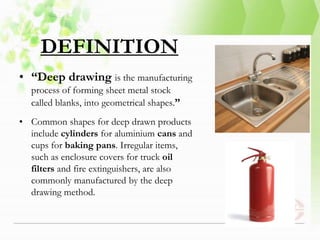
• “Deep drawing is the manufacturing
process of forming sheet metal stock
called blanks, into geometrical shapes.”
• Common shapes for deep drawn products
include cylinders for aluminium cans and
cups for baking pans. Irregular items,
such as enclosure covers for truck oil
filters and fire extinguishers, are also
commonly manufactured by the deep
drawing method.
MECHANICS OF DRAWING
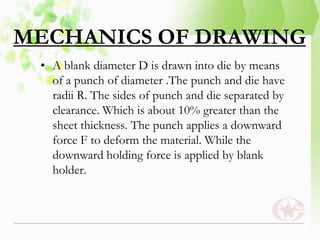
• A blank diameter D is drawn into die by means
of a punch of diameter .The punch and die have
radii R. The sides of punch and die separated by
clearance. Which is about 10% greater than the
sheet thickness. The punch applies a downward
force F to deform the material. While the
downward holding force is applied by blank
holder.
PROCESS
• A round blank is first cut from flat stock .The
blank is placed in the draw die, when pushes the
blank through the die on the return stroke the
cup is stripped from the punch by the counter-
bore in the die .The tope edge of the shell
expands slightly in order to make this possible .
The punch has an air vent to prevent a vacuum
from being formed when the part is stripped
from the punch.
DEEP DRAWING STATION
TYPES
• BLANKING
• DRAWING
• PIERCING
• TRIMMING
Blanking
Blanking is the process of
cutting the initial sheet coil stock
into round or shaped flats
required for deep drawing.
DRAWING
• Drawing is the process of
forming the metal with a
punch and die, and is the heart
of the deep drawing process.
PIERCING
• Piercing is the process of
punching holes in the metal
stock that are required for the
finished part.
TRIMMING
TRIMMING
• In the Trimming process,
excess metal that is necessary
to draw the part is cut away
from the finished part.
METAL FLOW DURING
DRAWING
DETAIL
• During the first stage of process the
punch contact the blanks .This section
forms the flat bottom of the cup and is
not distorted by the punch.
• Upon further penetration of the punch the
metal is bent or wrapped around the
punch nose and die radius.
TOOL MATERIAL
• Punches and dies are typically made
of tool steel, however carbon steel is
cheaper, but not as hard and is
therefore used in less severe
applications, it is also common to see
cemented carbides used where high
wear and abrasive resistance is
present..
LUBRICATION AND COOLING
EXPLINATION
Lubricants are used to reduce friction
between the working material and the
punch and die. They also used for
removing the part from the punch. Some
examples of lubricants used in drawing
operations are heavy-duty emulsions,
phosphates, white lead, and wax films
RECOMMENDED METALS
Deep drawing applications also benefit from the wide
amount of metals that can efficiently be subjected to the
process. The following metals are currently used to
manufacture products through deep drawing
Alloy
Aluminum
Brass
Bronze
Cold rolled steel
Copper
Invar
Iron
Kovar
Molybdenum
Nickel
Silver
Stainless steel
Tungsten
DEFECTS
WRINKLES
• Wrinkles - caused due to
excessive clearance between
the punch and die. Also caused
due to improper pressure pad
pressure and die and punch
radius.
RUPTURES
• Ruptures - caused by
incorrect draw ratio another
reason is improper die and
punch radius.
EXCESS THINNING
Excess thinning- of the cup wall
caused by incorrect die and
punch clearance and radii and
also excessive pressure by
pressure pad.
ADVANTAGES
• Tool construction costs are lower in comparison to
similar manufacturing processes.
• The technique is ideal for products that require
significant strength and minimal weight.
• The process is also recommended for product
geometries that are unachievable through other
manufacturing techniques.
• Deep drawing is especially beneficial when
producing high volumes, since unit cost decreases
considerably as unit count increases
DISADVANTAGES
• Material thickness has a large effect on
processing price.
• Special sleeves required to assist in driving the
parts into the dies.
• This process is costly for low production rate.
COMPARISON
DEEP DRAWING
• Deep drawing is the
manufacturing process of
forming sheet metal stock,
called blanks, into geometrical
shapes.
• Only used for limited die
design.
• It can be suffer from spring
back.
• No Preheating required,
process done at room temp.
SUPERPLASTIC
FORMING
• Super plastic forming is used to
elongate the material beyond
100% of it length.
• It can also be only used for
limited die design.
• It does not suffer from spring
back.
• Preheating required before the
super-plastic forming.
COMPARISON
• Suitable for mass
production.
• Low production
cost.
• Several steps are
required for deep
drawing.
• Low labour cost.
• Also suitable for
mass production.
• High production
cost.
• It is also a one step
process.
• Low labour cost.
APPLICATIONS IN PAKISTAN
INDUSTRY
1. PAKISTAN ENGINEERING CO. LTD
(LAHORE)
Concrete Mixers; Storage Tanks For Oils
APPLICATIONS IN PAKISTAN
INDUSTRY
2. SINGER PAKISTAN LTD (KARACHI)
Washing Machine ; Gas Appliances;
Refrigerator; Deep Freezer
APPLICATIONS IN PAKISTAN
INDUSTRY
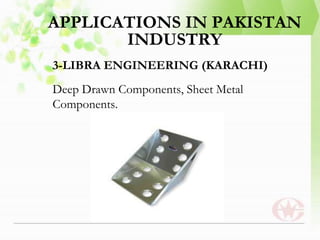
3-LIBRA ENGINEERING (KARACHI)
Deep Drawn Components, Sheet Metal
Components.
APPLICATIONS IN PAKISTAN
INDUSTRY
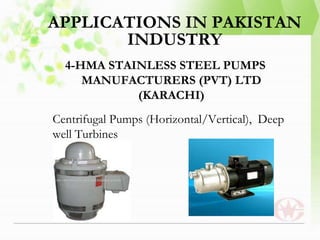
4-HMA STAINLESS STEEL PUMPS
MANUFACTURERS (PVT) LTD
(KARACHI)
Centrifugal Pumps (Horizontal/Vertical), Deep
well Turbines
Why Do We Need Metal Forming
Tools?
Metal forming tools are important for any
project that involves metal. You certainly can't
bend or form a heavy duty steel plate to tight
requirements by hand; you need a machine that
is powered by more than just elbow grease.
Common business that need metal shaping tools
include car production plants, airplane
manufacturers, and small businesses that deal in
iron works and metal fencing.
TYPES
• WHEELING MACHINE
• AIR POWER HAMMER
• SHRINKER STRETCHER
• BEAD FORMING MACHINE
• TUBE FORMING MACHINE
• FORMING DIES
WHEELING MACHINE
The Wheeling Machine, also called an
English Wheel, is a popular type of metal
forming tool that is used to create double
curves in metal. The user puts a flat metal
sheet (usually aluminium or mild steel)
through this C-shaped machine to get
even curves. These machines are usually
used for the curving elements of cars,
boats, and other complicated machinery.
AIR POWER HAMMER
An air power hammer is a tool that has
replaced the need to use a handheld
hammer for blacksmithing projects. This
metal forming tool uses a powerful force
to bend even the toughest metals into
desired shapes. Shaping is done by
modifying the condition of the metal (such
as stretching it out first) and then turning
it into another form.
SHRINKER STRETCHER
• Another metal forming tool is the Shrinker
Stretcher tool. These machines are built to
stretch or shrink various types of metal,
usually mild steel. A special adapter, called a
"jaw" is required for this type of machine.
The Shrinker Stretcher is air-powered and
easily switched from a shrinking setting to a
stretching setting with a simple change of
the jaw.
BEAD FORMING
MACHINE
• Uniform beads are small circular pieces of
metal that have been smoothed around the
edges. Metal beads could be used for jewellery
or as components in major machinery. The
beads are formed when the two interlocking
pieces slide against each other continuously.
TUBE FORMING MACHINE
• Tube forming machines refer to various types of
equipment that are used in order to form tubing, which is
the process of altering tubing into complex shapes. A
tube is defined as a long and thin hollow cylinder that is
most commonly used to either convey a fluid or gas, or to
function as a passage. As a result, tube forming machines
are generally either dedicated machines or automated
manufacturing cells. Some examples of applications and
industries that utilize tube forming machinery include:
marine, for use in exhaust products, heat exchangers,
piping systems and more;
DRUM MAKING MACHINE
• Horizontal drum making machine is
complete line machine includes cutting,
welding, forming, seaming, steel drum
body production line and painting line.
The whole equipment is automatic,
controlled by programming controller.
The feeding and transporting devices are
driven by hydraulic system
FORMING DIES
• It is sometimes difficult to distinguish
between a bending and forming dies . a
forming operation is generally along curved
axes rather than a straight axes.
• Forming operations may strengthened the
work piece and add rigidity.
• The particular type of forming operations
are classified in group.
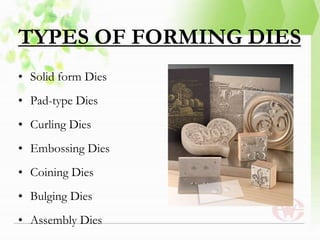
TYPES OF FORMING DIES
• Solid form Dies
• Pad-type Dies
• Curling Dies
• Embossing Dies
• Coining Dies
• Bulging Dies
• Assembly Dies
SOLID FORM DIES
• Solid form dies generally consist of
a male and female die shaped to
contour of work piece. This type
of tooling is generally used for
forming operation in progressive
dies.
CURLING DIES
• A curling die rolls a raw edge of sheet
metal into a roll .The purpose is to
strengthen the raw edge provide a
protective edge and improve the
appearance of the product .A lubricant
should be used during curling operation.
EMBOSSING DIES
• Embossing is a shallow forming
operation in which the work piece
material is stretched over a male
die and caused to conform to the
male die surface by a mating
female die surface .
BULGING DIES
• Bulging is an internal forming
operation used to expand portion
of a drawn shell or tube. The
forming force is applied from
inside the work piece and is
transmitted through a medium
that will flow and not compress.
ASSEMBLY DIES
• In this type of dies are used for assembling
two or more parts held in position and then
locked in position by riveting staking crimping
or press fitting. The operator may be
physically place the parts in position in die. A
large quantity of parts may justify a more
complicated die that would automatically
assemble the parts in the die while being from
a hoper.

Deep drawing

  • 1.
    DEEP DRAWING & EQUIPMENTS FORSHEET MERTAL FORMING
  • 2.
  • 3.
    HISTORY • Deep drawingis one of the most important and widely used metal forming • This process first developed in the 1700s consequently has been studied extensively until has become an important metalworking process.
  • 4.
    DEFINITION • “Deep drawingis the manufacturing process of forming sheet metal stock called blanks, into geometrical shapes.” • Common shapes for deep drawn products include cylinders for aluminium cans and cups for baking pans. Irregular items, such as enclosure covers for truck oil filters and fire extinguishers, are also commonly manufactured by the deep drawing method.
  • 5.
    MECHANICS OF DRAWING •A blank diameter D is drawn into die by means of a punch of diameter .The punch and die have radii R. The sides of punch and die separated by clearance. Which is about 10% greater than the sheet thickness. The punch applies a downward force F to deform the material. While the downward holding force is applied by blank holder.
  • 6.
    PROCESS • A roundblank is first cut from flat stock .The blank is placed in the draw die, when pushes the blank through the die on the return stroke the cup is stripped from the punch by the counter- bore in the die .The tope edge of the shell expands slightly in order to make this possible . The punch has an air vent to prevent a vacuum from being formed when the part is stripped from the punch.
  • 7.
    DEEP DRAWING STATION TYPES •BLANKING • DRAWING • PIERCING • TRIMMING
  • 8.
    Blanking Blanking is theprocess of cutting the initial sheet coil stock into round or shaped flats required for deep drawing.
  • 9.
    DRAWING • Drawing isthe process of forming the metal with a punch and die, and is the heart of the deep drawing process.
  • 10.
    PIERCING • Piercing isthe process of punching holes in the metal stock that are required for the finished part.
  • 11.
  • 12.
    TRIMMING • In theTrimming process, excess metal that is necessary to draw the part is cut away from the finished part.
  • 13.
  • 14.
    DETAIL • During thefirst stage of process the punch contact the blanks .This section forms the flat bottom of the cup and is not distorted by the punch. • Upon further penetration of the punch the metal is bent or wrapped around the punch nose and die radius.
  • 15.
    TOOL MATERIAL • Punchesand dies are typically made of tool steel, however carbon steel is cheaper, but not as hard and is therefore used in less severe applications, it is also common to see cemented carbides used where high wear and abrasive resistance is present..
  • 16.
  • 17.
    EXPLINATION Lubricants are usedto reduce friction between the working material and the punch and die. They also used for removing the part from the punch. Some examples of lubricants used in drawing operations are heavy-duty emulsions, phosphates, white lead, and wax films
  • 18.
    RECOMMENDED METALS Deep drawingapplications also benefit from the wide amount of metals that can efficiently be subjected to the process. The following metals are currently used to manufacture products through deep drawing Alloy Aluminum Brass Bronze Cold rolled steel Copper Invar Iron Kovar Molybdenum Nickel Silver Stainless steel Tungsten
  • 19.
  • 20.
    WRINKLES • Wrinkles -caused due to excessive clearance between the punch and die. Also caused due to improper pressure pad pressure and die and punch radius.
  • 21.
    RUPTURES • Ruptures -caused by incorrect draw ratio another reason is improper die and punch radius.
  • 22.
    EXCESS THINNING Excess thinning-of the cup wall caused by incorrect die and punch clearance and radii and also excessive pressure by pressure pad.
  • 23.
    ADVANTAGES • Tool constructioncosts are lower in comparison to similar manufacturing processes. • The technique is ideal for products that require significant strength and minimal weight. • The process is also recommended for product geometries that are unachievable through other manufacturing techniques. • Deep drawing is especially beneficial when producing high volumes, since unit cost decreases considerably as unit count increases
  • 24.
    DISADVANTAGES • Material thicknesshas a large effect on processing price. • Special sleeves required to assist in driving the parts into the dies. • This process is costly for low production rate.
  • 25.
    COMPARISON DEEP DRAWING • Deepdrawing is the manufacturing process of forming sheet metal stock, called blanks, into geometrical shapes. • Only used for limited die design. • It can be suffer from spring back. • No Preheating required, process done at room temp. SUPERPLASTIC FORMING • Super plastic forming is used to elongate the material beyond 100% of it length. • It can also be only used for limited die design. • It does not suffer from spring back. • Preheating required before the super-plastic forming.
  • 26.
    COMPARISON • Suitable formass production. • Low production cost. • Several steps are required for deep drawing. • Low labour cost. • Also suitable for mass production. • High production cost. • It is also a one step process. • Low labour cost.
  • 27.
    APPLICATIONS IN PAKISTAN INDUSTRY 1.PAKISTAN ENGINEERING CO. LTD (LAHORE) Concrete Mixers; Storage Tanks For Oils
  • 28.
    APPLICATIONS IN PAKISTAN INDUSTRY 2.SINGER PAKISTAN LTD (KARACHI) Washing Machine ; Gas Appliances; Refrigerator; Deep Freezer
  • 29.
    APPLICATIONS IN PAKISTAN INDUSTRY 3-LIBRAENGINEERING (KARACHI) Deep Drawn Components, Sheet Metal Components.
  • 30.
    APPLICATIONS IN PAKISTAN INDUSTRY 4-HMASTAINLESS STEEL PUMPS MANUFACTURERS (PVT) LTD (KARACHI) Centrifugal Pumps (Horizontal/Vertical), Deep well Turbines
  • 32.
    Why Do WeNeed Metal Forming Tools? Metal forming tools are important for any project that involves metal. You certainly can't bend or form a heavy duty steel plate to tight requirements by hand; you need a machine that is powered by more than just elbow grease. Common business that need metal shaping tools include car production plants, airplane manufacturers, and small businesses that deal in iron works and metal fencing.
  • 33.
    TYPES • WHEELING MACHINE •AIR POWER HAMMER • SHRINKER STRETCHER • BEAD FORMING MACHINE • TUBE FORMING MACHINE • FORMING DIES
  • 34.
    WHEELING MACHINE The WheelingMachine, also called an English Wheel, is a popular type of metal forming tool that is used to create double curves in metal. The user puts a flat metal sheet (usually aluminium or mild steel) through this C-shaped machine to get even curves. These machines are usually used for the curving elements of cars, boats, and other complicated machinery.
  • 35.
    AIR POWER HAMMER Anair power hammer is a tool that has replaced the need to use a handheld hammer for blacksmithing projects. This metal forming tool uses a powerful force to bend even the toughest metals into desired shapes. Shaping is done by modifying the condition of the metal (such as stretching it out first) and then turning it into another form.
  • 36.
    SHRINKER STRETCHER • Anothermetal forming tool is the Shrinker Stretcher tool. These machines are built to stretch or shrink various types of metal, usually mild steel. A special adapter, called a "jaw" is required for this type of machine. The Shrinker Stretcher is air-powered and easily switched from a shrinking setting to a stretching setting with a simple change of the jaw.
  • 37.
    BEAD FORMING MACHINE • Uniformbeads are small circular pieces of metal that have been smoothed around the edges. Metal beads could be used for jewellery or as components in major machinery. The beads are formed when the two interlocking pieces slide against each other continuously.
  • 38.
    TUBE FORMING MACHINE •Tube forming machines refer to various types of equipment that are used in order to form tubing, which is the process of altering tubing into complex shapes. A tube is defined as a long and thin hollow cylinder that is most commonly used to either convey a fluid or gas, or to function as a passage. As a result, tube forming machines are generally either dedicated machines or automated manufacturing cells. Some examples of applications and industries that utilize tube forming machinery include: marine, for use in exhaust products, heat exchangers, piping systems and more;
  • 39.
    DRUM MAKING MACHINE •Horizontal drum making machine is complete line machine includes cutting, welding, forming, seaming, steel drum body production line and painting line. The whole equipment is automatic, controlled by programming controller. The feeding and transporting devices are driven by hydraulic system
  • 40.
    FORMING DIES • Itis sometimes difficult to distinguish between a bending and forming dies . a forming operation is generally along curved axes rather than a straight axes. • Forming operations may strengthened the work piece and add rigidity. • The particular type of forming operations are classified in group.
  • 41.
    TYPES OF FORMINGDIES • Solid form Dies • Pad-type Dies • Curling Dies • Embossing Dies • Coining Dies • Bulging Dies • Assembly Dies
  • 42.
    SOLID FORM DIES •Solid form dies generally consist of a male and female die shaped to contour of work piece. This type of tooling is generally used for forming operation in progressive dies.
  • 43.
    CURLING DIES • Acurling die rolls a raw edge of sheet metal into a roll .The purpose is to strengthen the raw edge provide a protective edge and improve the appearance of the product .A lubricant should be used during curling operation.
  • 44.
    EMBOSSING DIES • Embossingis a shallow forming operation in which the work piece material is stretched over a male die and caused to conform to the male die surface by a mating female die surface .
  • 45.
    BULGING DIES • Bulgingis an internal forming operation used to expand portion of a drawn shell or tube. The forming force is applied from inside the work piece and is transmitted through a medium that will flow and not compress.
  • 46.
    ASSEMBLY DIES • Inthis type of dies are used for assembling two or more parts held in position and then locked in position by riveting staking crimping or press fitting. The operator may be physically place the parts in position in die. A large quantity of parts may justify a more complicated die that would automatically assemble the parts in the die while being from a hoper.