Manufacturing Technology II
(ME-202)
Sheet Metal
Operations
Dr. Chaitanya Sharma
PhD. IIT Roorkee
Title of slide
Lesson Objectives
In this chapter we shall discuss the following:
Learning Activities
1. Look up
Keywords
2. View Slides;
3. Read Notes,
4. Listen to
lecture
Keywords:
Sheet-Metal Forming (SMF) Processes
 SMF, also called press working, press forming or stamping, is
among the most important of metal working processes.
 This processes was known to human as early as 5000 B.C. when
household utensils, jewelry and other objects were made by
hammering and stamping metal such as gold silver and copper.
 SMF operations are cold working operations which produce a
wide range of light weight consumer and industrial products of
low cost parts with very high volume and at a fast rate using plate.
 SMF involves workpiece with a high ratio of surface area to
thickness i.e. plate of thickness less than 5 mm.
 SMF products include metal desks, aircraft fuselages, beverage
cans, car bodies and kitchen utensils.
 Rectangular, large sheets of include black iron, galvanized iron,
copper, aluminium, tin, stainless steel, brass, lead, zinc etc.
 Various SMF operations include: Shearing, Punching, Piercing,
Blanking, Bending, shaving, Deep drawing etc.
Sheet-Metal
Parts
(a) (b)
Figure : Examples of sheet-metal parts.
(a) Die-formed and cut stamped parts. (b) Parts produced by spinning.
Characteristics of Sheet-Metal Forming
Processes
Stresses In Sheet Metal
Operations
Stress Induced Operations
Shearing Shearing, blanking, piercing,
trimming, shaving, notching,
nibbling.
Tension Stretch forming
Compression Coining, sizing, ironing, hobbing
Tension &
Compression
Drawing, spinning, bending,
forming and embossing
Shearing Process
 Shearing process involves cutting sheet metal and other objects
into individual pieces by subjecting it to shear stress in the
thickness direction, typically using a punch and a die.
 This is similar to paper punch in action.
 Shearing usually starts with formation of cracks on both the top
and bottom edges of the work piece. These cracks meet each
other and separation occurs with rough fracture surface.
 The punch and die may be of any shape circular, straight blade
etc.
 The important process variables are Punch force, Speed of
punching, edge conditions of the sheet, punch and die
materials, corner radii of punch and die, lubrication and
clearance.
 Clearance determine the shape and quality of sheared edge.
Shearing with a Punch & Die
Figure 16.2 (a) Schematic illustration of
shearing with a punch and die, indicating
some of the process variables.
Characteristic features of (b) a punched
hole and (c) the slug

Punch force, F  0.7TL UTS 
Shearing is a sheet metal cutting
operation along a straight line
between two cut-ting edges.
Metal is brought to plastic stage
by pressing between two shearing
blades which initiates fracture at
cutting points.
The fracture progresses on either
side of the sheet further progress
downward resulting in separation.
Clearance & Its Effect
 Clearance is the gap between die and punch as indicated by “c” in fig.
 Clearance determine the shape and quality of sheared edge. As
clearance increases the edges becomes rougher and deformation zone
becomes larger.
 Furthermore, metal is pulled into the clearance area, and the sheared
edges become more and more rounded.
 In fact. If the clearance is too large the sheet metal is bent and thus
subjected to tensile stresses.
 Generally, clearance range between 2 to 8 % of the sheet thickness but
may be as small as 1% in fine blanking.
 Clearances are smaller for soft metals and they are higher as the sheet
thickness increases
Clearance & Its
Effect
Effect of the clearance on
Shearing
Figure : (a) Effect of the clearance, c, between punch and die on the deformation zone in
shearing. As the clearance increases, the material tends to be pulled into the die rather
than be sheared
(b) Microhardness (HV) contours for a 6.4-mm (0.25-in.) thick AISI 1020 hot-rolled steel
in the sheared region.
Shearing operations
 In punching the sheared slug is discarded while in
blanking the slug is the part itself and rest is the scrap.
Following are the operations based on shearing process:
 Die cutting is used for producing parts for various uses
by perforating, parting, notching, slitting, lancing.
 Fine blanking
 Slitting
 Nibbling
SMF Operations
 Shaving is removing of thin strip of metal along edges to
obtain smooth and straight edges of accurate dimensions.
 Perforating is punching a number of small holes in a sheet.
 Parting or shearing sheet into two or more pieces usually
when the adjacent blanks do not have matching contour.
 Slitting is a shearing operation carried out with a pair of
circular blades
 Notching is cutting the metal by punch from the edges
SMF Operations
 Trimming is removing of unwanted excess material from
the periphery of previously formed component.
 Lancing is cutting operation in which a hole is partially cut
and then one side is bent down to form a sort of tab.
 Fine blanking is used to produce very smooth and square
edges in gears, cams etc.
 Nibbling is the operation of making a number of
overlapping holes using nibbler which moves a straight
punch up and down rapidly into a die. This is used to
make large elongated hole.
The Shaving Process
Figure 16.9 Schematic illustrations of the shaving process. (a) Shaving a sheared edge. (b)
Shearing and shaving combined in one stroke.
Shaving is removing of thin strip of metal along edges to
obtain smooth and straight edges of accurate dimensions.
Slitting with Rotary Knives
Figure 16.6 Slitting with rotary knives. This process is similar to opening cans.
 Slitting is a shearing operation carried out with a pair of
circular blades
Shear Angles
Manufacturing,
Engineering &
Figure 16.10 Examples of the use of shear angles on punches and dies.
SMF Equipments
SMF equipments includes:
• Forming presses
• Dies
• Punches/Tools
Figure: Equipments in SMF Process
Classification of Presses for
SMF
1. Source of power
a) Mechanical Presses
b) Hydraulic Presses
2. Method of actuation of ram
(slides)
a) Crank shaft driven presses
b) Eccentric driven presses
c) Toggle driven presses
d) Piston operated presses
e) Cam operated presses
f) Rack & pinion driven presses
g) Screw presses
h) Knuckle joint driven presses
a) Single action presses
b) Double action presses
c) Triple action presses
4. Type of frame
a) Open or C frame presses
b) Closed frame presses
5. Type of work
a) Punching presses
b) Blanking presses
c) Drawing presses
d) Bending presses
Presses used in sheet metal forming may be classified according to:
Press
Frames
Figure 16.56 (a)-(f) Schematic illustrations of types of press frames for sheet-forming
operations. (g) A large stamping press.
SMF Machines
SMF is carried out either mechanical or
hydraulic machines
Mechanical Presses
Energy stored in a flywheel is
transferred to the movable slide on
the down stroke of the press.
Quick action, short stroke.
Hydraulic Presses
Hydraulic energy moves the slides.
Slower action, longer stroke, chance of
leakage
Shearing Mechanical M/c
Hydraulic deep drawing press
Presses For SMF
Operation
According to number of slides, which can be operated
independently of each other action of presses may be:
1. Single action presses
 One slide
 Vertical direction
2. Double action Presses
 Two slides
 The second action is used to operated the hold down, which
prevents wrinkling in deep drawing.
3. Triple action presses
 Two action above the die, one action below the die
Single Action Press
 Press brake is single action press, has very long narrow
bed.
 Used to form long, straight bend in pieces such as
channels and corrugated sheets
Tooling For SMF
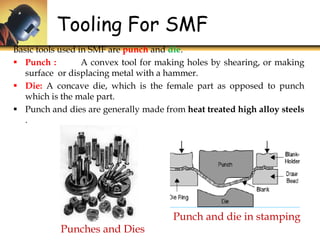
Basic tools used in SMF are punch and die.
 Punch : A convex tool for making holes by shearing, or making
surface or displacing metal with a hammer.
 Die: A concave die, which is the female part as opposed to punch
which is the male part.
 Punch and dies are generally made from heat treated high alloy steels
.
Punches and Dies
Punch and die in stamping
Classification of SMF Dies
 In, practice components are produced essentially by
combinations of blanking, piercing, bending or drawing
operation in a certain order, requiring different dies.
Dies may be classified according to:
1. Type of press operation
a) Cutting dies
b) Forming dies
2. Method of operation
a) Simple die
b) Compound die
c) Combination die
d) Progressive die
e) Transfer die
f) Multiple dies
Types of Dies
Compound Dies:
• Several operations can be performed on the
same piece in one stroke of the press.
• Combined processes and create a complex
product in one shot.
• Used in metal stamping processes of thin sheets.
Transfer Dies:
• Transfer dies are also called compounding type of
dies.
• The part is moved from station to station within
the press for each operation.
Compound die
Transfer die
Progressive die
• Progressive die optimise the material
use
• Determining factor are: Volume of
production and complexity of the shape
Simple Die
 Simple dies: Perform a single operation (for example,
cutting, blanking, or punching) with each stroke of the
press.
Compound Die
 Compound dies: Perform two or more operations at a single
position of the metal strip. To do more than one set of
operations, a compound die consists necessary sets of punches
and dies.
 During the part of stroke , piercing of holes is done in the stock
and further travel, the blanking operation is done.
 These are slower than progressive dies in operation. But higher
tolerance can be achieved than progressive dies. Small strip can
be used .
Figure : Schematic illustrations: (a) before and (b) after blanking a common washer in a
compound die. Note the separate movements of the die (for blanking) and the punch (for
punching the hole in the washer).
Combination Dies
 Combination dies: It is similar to a compound die and can perform
more than one operation at one station.
 The main difference between combination and compound die is
that that a cutting operation is combine with here non-cutting
operations such as bending and forming.
Progressive Dies
 Progressive dies: Perform two or more operations simultaneously in
single stroke of punch at two or more positions of the metal strip.
 The places where each operations are carried out are called
stations.
 These are suited for mass production so that handling cost is
reduced.
Figure : (c) Schematic illustration of making a washer in a progressive die. (d) Forming of
the top piece of an aerosol spray can in a progressive die. Note that the part is attached to
the strip until the last operation is completed.
Characteristics of Metals
Used in Sheet-Forming
Sheet Metal
Manufacturing,
Engineering &
Figure 16.12 (a) Yield-point elongation in a sheet-metal specimen. (b) Luder’s bands in a low-
carbon steel sheet. (c) Stretcher strains at the bottom of a steel can for household products.
Source: (b) Courtesy of Caterpillar Inc.
Cupping Test and Bulge-
Test
Manufacturing,
Engineering &
Figure 16.13 (a) A cupping test (the Erichsen test) to determine the formability of sheet metals.
(b) Bulge-test results on steel sheets of various widths. The specimen farthest left is subjected
to, basically, simple tension. The specimen farthest right is subjected to equal biaxial stretching.
Source: Courtesy of Inland Steel Company.
Bending
 Bending is the operation of transforming a straight length into
curved length.
 It is used for changing sheets and plated into channels, drums,
tanks etc.
 During bending outer surface of material is subjected to tension
and inside surface is in compression.
 Strain in bent material increases with decreasing radius of
curvature.
 Stretching of the bend causes the neutral axis of the section to
move towards the inner surface
Methods of Bending
Following are the commonly used method of bending:
V Bending: A wedge shaped punch forces the metal sheet or strip into
a wedge shape die cavity. The bend angle may be acute, 900 or
obtuse.
Edge Bending: A flat punch forces the stock against the vertical face of
the die. Bend axis is parallel to the edge of the die and the stock is
subjected to cantilever loading.
U Bending: It is similar to V bending in operation. Punch for U bending
is rectangular.
Spring back in Bending
Figure : Spring back in bending.

Ri
Rf
 4
RiY
ET






3
 3
RiY
ET





1
Spring back is the elastic recovery by bent material on the removal of
applied force.
The part tends to recover elastically after bending, and its bend radius
becomes larger.
Under certain conditions, it is possible for the final bend angle to be
smaller than the original angle (negative spring back).
The spring back for low carbon steel is 1-20 , for medium carbon steel is
3-40 and for phosphor bronze and spring steel is 10-150 .
Methods of Reducing or
Eliminating Springback
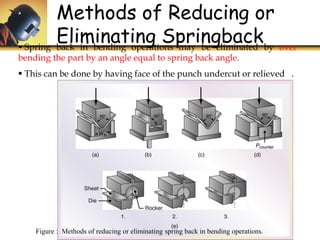
Figure : Methods of reducing or eliminating spring back in bending operations.
 Spring back in bending operations may be eliminated by over
bending the part by an angle equal to spring back angle.
 This can be done by having face of the punch undercut or relieved .
Other Bending Operations
Figure : Examples of various bending operations.
Press Brake
Figure 16.23 (a) through (e) Schematic illustrations of various bending operations in a press brake.
(f) Schematic illustration of a press brake
Bead Forming
Figure 16.24 (a) Bead forming with a single die. (b) and (c) Bead forming
with two dies in a press brake.
Flanging Operations
Figure 16.25 Various
flanging operations. (a)
Flanges on a flat sheet. (b)
Dimpling. (c) The piercing
of sheet metal to form a
flange. In this operation, a
hole does not have to be
pre-punched before the
punch descends. Note,
however, the rough edges
along the circumference of
the flange. (d) The
flanging of a tube. Note the
thinning of the edges of the
flange.
Roll-Forming Process
Figure 16.26 (a) Schematic illustration of the roll-forming process. (b) Examples of
roll-formed cross-sections.
Methods of Bending Tubes
Figure 16.27 Methods of bending tubes. Internal mandrels or filling of tubes with particulate
materials such as sand are often necessary to prevent collapse of the tubes during bending. Tubes
also can be bent by a technique consisting if a stiff, helical tension spring slipped over the tube.
The clearance between the OD of the tube and the ID of the spring is small, thus the tube cannot
kick and the bend is uniform.
Tubular Parts
Figure 16.28 (a) The bulging of a tubular part with a flexible plug. Water pitchers can be
made by this method. (b) Production of fittings for plumbing by expanding tubular
blanks under internal pressure. The bottom of the piece is then punched out to produce a
“T.”
Stretch-Forming Process
Figure : Schematic illustration of a stretch-forming process. Aluminum skins for aircraft can
be made by this method.
 Stretch forming uses only male die or form block to produce large
contour sheets accurately for aircrafts wings and fuselage.
 The sheet metal is stretched to yield point in tension, and then
wrapped over and around the form block.
 This greatly eliminate spring back and require low tooling cost.
Deep-
Drawing
Figure : (a) Schematic illustration of the deep-drawing process on a circular sheet-metal blank. The stripper
ring facilitates the removal of the formed cup from the punch. (b) Process variables in deep drawing.

Fmax  DpT UTS 
Do
Dp





 0.7








Drawing is the process of forming a flat piece of material (blank) into hollow cup like
shape by means of punch which causes blank to flow into die cavity.
If the depth of formed cup exceeds the diameter then it is termed as deep drawing.
This is used for making various geometries and sizes such as bottle caps and
automobile panels.
Conventional Spinning
Figure :(a) Schematic illustration of the conventional spinning process.
(b) Types of parts conventionally spun. All parts are axisymmetric.
Shear-Spinning and Tube-
Spinning
Figure 16.43 (a) Schematic illustration of the shear-spinning process for making conical
parts. The mandrel can be shaped so that curvilinear parts can be spun. (b) and (c) Schematic
illustrations of the tube-spinning process
Hydroform Process
Figure : The hydro form (or fluid-forming) process
In hydro form (or fluid-forming) process a pressurized liquid behind the
rubber pad is used to exert force required for forming. The rubber pad acts as
seal at the end of liquid container.
When container descends over the punch hydrostatic pressure acts over the
sheet equally from all sides forcing the part to be formed to wrapped on to
the punch.
Note that in contrast to the
ordinary deep-drawing
process, the pressure in the
dome forces the cup walls
against the punch. The cup
travels with the punch; in
this way, deep draw ability
is improved.
This is used for deeper cups
of complex shapes with
sharp details
Tube-Hydro-forming
Figure : 1 (a) Tube-hydro forming process. (b) Example of tube-hydro formed parts.
(b)
Automotive exhaust and structural components, bicycle frames, and hydraulic and pneumatic fittings
are produced through tube hydro-forming.
Explosive Forming
Manufacturing,
Engineering &
Figure 16.45 (a) Schematic illustration of the explosive forming process. (b)
Illustration of the confined method of the explosive bulging of tubes.
Embossing with Two Dies
Figure 16.37 An embossing operation with two dies. Letters, numbers, and
designs on sheet-metal parts can be produced by this process.
Bending and Embossing of
Sheet Metal
Manufacturing,
Engineering &
Figure 16.39 Examples of the bending and embossing of sheet metal with a metal punch
and with a flexible pad serving as the female die. Source: Courtesy of Polyurethane
Products Corporation.
Aluminum Beverage Cans
Manufacturing,
Engineering &
Figure 16.38 (a) Aluminum beverage cans. Note the excellent surface finish. (b)
Detail of the can lid showing integral rivet and scored edges for the pop-top.
(a)
Figure : MFP involved in manufacturing a two-piece aluminum beverage can.
Can Manufacture
Efficient Part Nesting for Optimum Material Utilization
Manufacturing,
Engineering &
Figure 16.51 Efficient nesting of parts for optimum material utilization in blanking.
Source: Courtesy of Society of Manufacturing Engineers.
Cost of Conventional Spinning Versus Cost of Deep Drawing
Manufacturing,
Engineering &
Figure 16.57 Cost comparison for manufacturing a round sheet-metal container either by
conventional spinning or by deep drawing. Note that for small quantities, spinning is more
economical.
U4 p4 sheet metal operation

U4 p4 sheet metal operation

  • 1.
    Manufacturing Technology II (ME-202) SheetMetal Operations Dr. Chaitanya Sharma PhD. IIT Roorkee
  • 2.
    Title of slide LessonObjectives In this chapter we shall discuss the following: Learning Activities 1. Look up Keywords 2. View Slides; 3. Read Notes, 4. Listen to lecture Keywords:
  • 3.
    Sheet-Metal Forming (SMF)Processes  SMF, also called press working, press forming or stamping, is among the most important of metal working processes.  This processes was known to human as early as 5000 B.C. when household utensils, jewelry and other objects were made by hammering and stamping metal such as gold silver and copper.  SMF operations are cold working operations which produce a wide range of light weight consumer and industrial products of low cost parts with very high volume and at a fast rate using plate.  SMF involves workpiece with a high ratio of surface area to thickness i.e. plate of thickness less than 5 mm.  SMF products include metal desks, aircraft fuselages, beverage cans, car bodies and kitchen utensils.  Rectangular, large sheets of include black iron, galvanized iron, copper, aluminium, tin, stainless steel, brass, lead, zinc etc.  Various SMF operations include: Shearing, Punching, Piercing, Blanking, Bending, shaving, Deep drawing etc.
  • 4.
    Sheet-Metal Parts (a) (b) Figure :Examples of sheet-metal parts. (a) Die-formed and cut stamped parts. (b) Parts produced by spinning.
  • 5.
  • 6.
    Stresses In SheetMetal Operations Stress Induced Operations Shearing Shearing, blanking, piercing, trimming, shaving, notching, nibbling. Tension Stretch forming Compression Coining, sizing, ironing, hobbing Tension & Compression Drawing, spinning, bending, forming and embossing
  • 7.
    Shearing Process  Shearingprocess involves cutting sheet metal and other objects into individual pieces by subjecting it to shear stress in the thickness direction, typically using a punch and a die.  This is similar to paper punch in action.  Shearing usually starts with formation of cracks on both the top and bottom edges of the work piece. These cracks meet each other and separation occurs with rough fracture surface.  The punch and die may be of any shape circular, straight blade etc.  The important process variables are Punch force, Speed of punching, edge conditions of the sheet, punch and die materials, corner radii of punch and die, lubrication and clearance.  Clearance determine the shape and quality of sheared edge.
  • 8.
    Shearing with aPunch & Die Figure 16.2 (a) Schematic illustration of shearing with a punch and die, indicating some of the process variables. Characteristic features of (b) a punched hole and (c) the slug  Punch force, F  0.7TL UTS  Shearing is a sheet metal cutting operation along a straight line between two cut-ting edges. Metal is brought to plastic stage by pressing between two shearing blades which initiates fracture at cutting points. The fracture progresses on either side of the sheet further progress downward resulting in separation.
  • 9.
    Clearance & ItsEffect  Clearance is the gap between die and punch as indicated by “c” in fig.  Clearance determine the shape and quality of sheared edge. As clearance increases the edges becomes rougher and deformation zone becomes larger.  Furthermore, metal is pulled into the clearance area, and the sheared edges become more and more rounded.  In fact. If the clearance is too large the sheet metal is bent and thus subjected to tensile stresses.  Generally, clearance range between 2 to 8 % of the sheet thickness but may be as small as 1% in fine blanking.  Clearances are smaller for soft metals and they are higher as the sheet thickness increases
  • 10.
  • 11.
    Effect of theclearance on Shearing Figure : (a) Effect of the clearance, c, between punch and die on the deformation zone in shearing. As the clearance increases, the material tends to be pulled into the die rather than be sheared (b) Microhardness (HV) contours for a 6.4-mm (0.25-in.) thick AISI 1020 hot-rolled steel in the sheared region.
  • 12.
    Shearing operations  Inpunching the sheared slug is discarded while in blanking the slug is the part itself and rest is the scrap. Following are the operations based on shearing process:  Die cutting is used for producing parts for various uses by perforating, parting, notching, slitting, lancing.  Fine blanking  Slitting  Nibbling
  • 13.
    SMF Operations  Shavingis removing of thin strip of metal along edges to obtain smooth and straight edges of accurate dimensions.  Perforating is punching a number of small holes in a sheet.  Parting or shearing sheet into two or more pieces usually when the adjacent blanks do not have matching contour.  Slitting is a shearing operation carried out with a pair of circular blades  Notching is cutting the metal by punch from the edges
  • 14.
    SMF Operations  Trimmingis removing of unwanted excess material from the periphery of previously formed component.  Lancing is cutting operation in which a hole is partially cut and then one side is bent down to form a sort of tab.  Fine blanking is used to produce very smooth and square edges in gears, cams etc.  Nibbling is the operation of making a number of overlapping holes using nibbler which moves a straight punch up and down rapidly into a die. This is used to make large elongated hole.
  • 15.
    The Shaving Process Figure16.9 Schematic illustrations of the shaving process. (a) Shaving a sheared edge. (b) Shearing and shaving combined in one stroke. Shaving is removing of thin strip of metal along edges to obtain smooth and straight edges of accurate dimensions.
  • 16.
    Slitting with RotaryKnives Figure 16.6 Slitting with rotary knives. This process is similar to opening cans.  Slitting is a shearing operation carried out with a pair of circular blades
  • 20.
    Shear Angles Manufacturing, Engineering & Figure16.10 Examples of the use of shear angles on punches and dies.
  • 21.
    SMF Equipments SMF equipmentsincludes: • Forming presses • Dies • Punches/Tools Figure: Equipments in SMF Process
  • 22.
    Classification of Pressesfor SMF 1. Source of power a) Mechanical Presses b) Hydraulic Presses 2. Method of actuation of ram (slides) a) Crank shaft driven presses b) Eccentric driven presses c) Toggle driven presses d) Piston operated presses e) Cam operated presses f) Rack & pinion driven presses g) Screw presses h) Knuckle joint driven presses a) Single action presses b) Double action presses c) Triple action presses 4. Type of frame a) Open or C frame presses b) Closed frame presses 5. Type of work a) Punching presses b) Blanking presses c) Drawing presses d) Bending presses Presses used in sheet metal forming may be classified according to:
  • 23.
    Press Frames Figure 16.56 (a)-(f)Schematic illustrations of types of press frames for sheet-forming operations. (g) A large stamping press.
  • 24.
    SMF Machines SMF iscarried out either mechanical or hydraulic machines Mechanical Presses Energy stored in a flywheel is transferred to the movable slide on the down stroke of the press. Quick action, short stroke. Hydraulic Presses Hydraulic energy moves the slides. Slower action, longer stroke, chance of leakage Shearing Mechanical M/c Hydraulic deep drawing press
  • 25.
    Presses For SMF Operation Accordingto number of slides, which can be operated independently of each other action of presses may be: 1. Single action presses  One slide  Vertical direction 2. Double action Presses  Two slides  The second action is used to operated the hold down, which prevents wrinkling in deep drawing. 3. Triple action presses  Two action above the die, one action below the die
  • 26.
    Single Action Press Press brake is single action press, has very long narrow bed.  Used to form long, straight bend in pieces such as channels and corrugated sheets
  • 27.
    Tooling For SMF Basictools used in SMF are punch and die.  Punch : A convex tool for making holes by shearing, or making surface or displacing metal with a hammer.  Die: A concave die, which is the female part as opposed to punch which is the male part.  Punch and dies are generally made from heat treated high alloy steels . Punches and Dies Punch and die in stamping
  • 28.
    Classification of SMFDies  In, practice components are produced essentially by combinations of blanking, piercing, bending or drawing operation in a certain order, requiring different dies. Dies may be classified according to: 1. Type of press operation a) Cutting dies b) Forming dies 2. Method of operation a) Simple die b) Compound die c) Combination die d) Progressive die e) Transfer die f) Multiple dies
  • 29.
    Types of Dies CompoundDies: • Several operations can be performed on the same piece in one stroke of the press. • Combined processes and create a complex product in one shot. • Used in metal stamping processes of thin sheets. Transfer Dies: • Transfer dies are also called compounding type of dies. • The part is moved from station to station within the press for each operation. Compound die Transfer die
  • 30.
    Progressive die • Progressivedie optimise the material use • Determining factor are: Volume of production and complexity of the shape
  • 31.
    Simple Die  Simpledies: Perform a single operation (for example, cutting, blanking, or punching) with each stroke of the press.
  • 32.
    Compound Die  Compounddies: Perform two or more operations at a single position of the metal strip. To do more than one set of operations, a compound die consists necessary sets of punches and dies.  During the part of stroke , piercing of holes is done in the stock and further travel, the blanking operation is done.  These are slower than progressive dies in operation. But higher tolerance can be achieved than progressive dies. Small strip can be used . Figure : Schematic illustrations: (a) before and (b) after blanking a common washer in a compound die. Note the separate movements of the die (for blanking) and the punch (for punching the hole in the washer).
  • 33.
    Combination Dies  Combinationdies: It is similar to a compound die and can perform more than one operation at one station.  The main difference between combination and compound die is that that a cutting operation is combine with here non-cutting operations such as bending and forming.
  • 34.
    Progressive Dies  Progressivedies: Perform two or more operations simultaneously in single stroke of punch at two or more positions of the metal strip.  The places where each operations are carried out are called stations.  These are suited for mass production so that handling cost is reduced. Figure : (c) Schematic illustration of making a washer in a progressive die. (d) Forming of the top piece of an aerosol spray can in a progressive die. Note that the part is attached to the strip until the last operation is completed.
  • 35.
  • 36.
    Sheet Metal Manufacturing, Engineering & Figure16.12 (a) Yield-point elongation in a sheet-metal specimen. (b) Luder’s bands in a low- carbon steel sheet. (c) Stretcher strains at the bottom of a steel can for household products. Source: (b) Courtesy of Caterpillar Inc.
  • 37.
    Cupping Test andBulge- Test Manufacturing, Engineering & Figure 16.13 (a) A cupping test (the Erichsen test) to determine the formability of sheet metals. (b) Bulge-test results on steel sheets of various widths. The specimen farthest left is subjected to, basically, simple tension. The specimen farthest right is subjected to equal biaxial stretching. Source: Courtesy of Inland Steel Company.
  • 38.
    Bending  Bending isthe operation of transforming a straight length into curved length.  It is used for changing sheets and plated into channels, drums, tanks etc.  During bending outer surface of material is subjected to tension and inside surface is in compression.  Strain in bent material increases with decreasing radius of curvature.  Stretching of the bend causes the neutral axis of the section to move towards the inner surface
  • 39.
    Methods of Bending Followingare the commonly used method of bending: V Bending: A wedge shaped punch forces the metal sheet or strip into a wedge shape die cavity. The bend angle may be acute, 900 or obtuse. Edge Bending: A flat punch forces the stock against the vertical face of the die. Bend axis is parallel to the edge of the die and the stock is subjected to cantilever loading. U Bending: It is similar to V bending in operation. Punch for U bending is rectangular.
  • 40.
    Spring back inBending Figure : Spring back in bending.  Ri Rf  4 RiY ET       3  3 RiY ET      1 Spring back is the elastic recovery by bent material on the removal of applied force. The part tends to recover elastically after bending, and its bend radius becomes larger. Under certain conditions, it is possible for the final bend angle to be smaller than the original angle (negative spring back). The spring back for low carbon steel is 1-20 , for medium carbon steel is 3-40 and for phosphor bronze and spring steel is 10-150 .
  • 41.
    Methods of Reducingor Eliminating Springback Figure : Methods of reducing or eliminating spring back in bending operations.  Spring back in bending operations may be eliminated by over bending the part by an angle equal to spring back angle.  This can be done by having face of the punch undercut or relieved .
  • 42.
    Other Bending Operations Figure: Examples of various bending operations.
  • 43.
    Press Brake Figure 16.23(a) through (e) Schematic illustrations of various bending operations in a press brake. (f) Schematic illustration of a press brake
  • 44.
    Bead Forming Figure 16.24(a) Bead forming with a single die. (b) and (c) Bead forming with two dies in a press brake.
  • 45.
    Flanging Operations Figure 16.25Various flanging operations. (a) Flanges on a flat sheet. (b) Dimpling. (c) The piercing of sheet metal to form a flange. In this operation, a hole does not have to be pre-punched before the punch descends. Note, however, the rough edges along the circumference of the flange. (d) The flanging of a tube. Note the thinning of the edges of the flange.
  • 46.
    Roll-Forming Process Figure 16.26(a) Schematic illustration of the roll-forming process. (b) Examples of roll-formed cross-sections.
  • 47.
    Methods of BendingTubes Figure 16.27 Methods of bending tubes. Internal mandrels or filling of tubes with particulate materials such as sand are often necessary to prevent collapse of the tubes during bending. Tubes also can be bent by a technique consisting if a stiff, helical tension spring slipped over the tube. The clearance between the OD of the tube and the ID of the spring is small, thus the tube cannot kick and the bend is uniform.
  • 48.
    Tubular Parts Figure 16.28(a) The bulging of a tubular part with a flexible plug. Water pitchers can be made by this method. (b) Production of fittings for plumbing by expanding tubular blanks under internal pressure. The bottom of the piece is then punched out to produce a “T.”
  • 49.
    Stretch-Forming Process Figure :Schematic illustration of a stretch-forming process. Aluminum skins for aircraft can be made by this method.  Stretch forming uses only male die or form block to produce large contour sheets accurately for aircrafts wings and fuselage.  The sheet metal is stretched to yield point in tension, and then wrapped over and around the form block.  This greatly eliminate spring back and require low tooling cost.
  • 50.
    Deep- Drawing Figure : (a)Schematic illustration of the deep-drawing process on a circular sheet-metal blank. The stripper ring facilitates the removal of the formed cup from the punch. (b) Process variables in deep drawing.  Fmax  DpT UTS  Do Dp       0.7         Drawing is the process of forming a flat piece of material (blank) into hollow cup like shape by means of punch which causes blank to flow into die cavity. If the depth of formed cup exceeds the diameter then it is termed as deep drawing. This is used for making various geometries and sizes such as bottle caps and automobile panels.
  • 51.
    Conventional Spinning Figure :(a)Schematic illustration of the conventional spinning process. (b) Types of parts conventionally spun. All parts are axisymmetric.
  • 52.
    Shear-Spinning and Tube- Spinning Figure16.43 (a) Schematic illustration of the shear-spinning process for making conical parts. The mandrel can be shaped so that curvilinear parts can be spun. (b) and (c) Schematic illustrations of the tube-spinning process
  • 53.
    Hydroform Process Figure :The hydro form (or fluid-forming) process In hydro form (or fluid-forming) process a pressurized liquid behind the rubber pad is used to exert force required for forming. The rubber pad acts as seal at the end of liquid container. When container descends over the punch hydrostatic pressure acts over the sheet equally from all sides forcing the part to be formed to wrapped on to the punch. Note that in contrast to the ordinary deep-drawing process, the pressure in the dome forces the cup walls against the punch. The cup travels with the punch; in this way, deep draw ability is improved. This is used for deeper cups of complex shapes with sharp details
  • 54.
    Tube-Hydro-forming Figure : 1(a) Tube-hydro forming process. (b) Example of tube-hydro formed parts. (b) Automotive exhaust and structural components, bicycle frames, and hydraulic and pneumatic fittings are produced through tube hydro-forming.
  • 55.
    Explosive Forming Manufacturing, Engineering & Figure16.45 (a) Schematic illustration of the explosive forming process. (b) Illustration of the confined method of the explosive bulging of tubes.
  • 56.
    Embossing with TwoDies Figure 16.37 An embossing operation with two dies. Letters, numbers, and designs on sheet-metal parts can be produced by this process.
  • 57.
    Bending and Embossingof Sheet Metal Manufacturing, Engineering & Figure 16.39 Examples of the bending and embossing of sheet metal with a metal punch and with a flexible pad serving as the female die. Source: Courtesy of Polyurethane Products Corporation.
  • 58.
    Aluminum Beverage Cans Manufacturing, Engineering& Figure 16.38 (a) Aluminum beverage cans. Note the excellent surface finish. (b) Detail of the can lid showing integral rivet and scored edges for the pop-top. (a)
  • 59.
    Figure : MFPinvolved in manufacturing a two-piece aluminum beverage can. Can Manufacture
  • 60.
    Efficient Part Nestingfor Optimum Material Utilization Manufacturing, Engineering & Figure 16.51 Efficient nesting of parts for optimum material utilization in blanking. Source: Courtesy of Society of Manufacturing Engineers.
  • 61.
    Cost of ConventionalSpinning Versus Cost of Deep Drawing Manufacturing, Engineering & Figure 16.57 Cost comparison for manufacturing a round sheet-metal container either by conventional spinning or by deep drawing. Note that for small quantities, spinning is more economical.