UNCONVENTIONAL METAL
FORMING PROCESSES
12/31/2016 JIT 1
Unit V
 By:
Zoha Nasir
Assistant Professor
JIT, Barabanki
In these forming processes large amount of energy is
applied for a very short interval of time.
Many metals tend to deform more readily under extra –
fast application of load which make these processes
useful to form large size parts out of most metals
including those which are otherwise difficult – to
form.
High Energy Rate Forming Processes
12/31/2016 JIT 2
The parts are formed at a rapid rate, and thus these processes
are also called high – velocity forming processes.
There are several advantages of using these forming processes,
like die costs are low, easy maintenance of tolerances,
possibility of forming most metals, and material does not show
spring-back effect.
The production cost of components by such processes is low.
The limitation of these processes is the need for skilled
personnel.
12/31/2016 JIT 3
There are three main high energy rate forming processes:
Explosive Forming
Magnetic Forming, And
Electro Hydraulic Forming
Classification
12/31/2016 JIT 4
Explosive forming, is distinguished from conventional
forming in that the punch or diaphragm is replaced by an
explosive charge. T
he explosives used are generally high – explosive
chemicals, gaseous mixtures, or propellants.
There are two techniques of high – explosive forming:
Stand – Off Technique And
The Contact Technique.
Explosive Forming
12/31/2016 JIT 5
Explosive forming is mainly used in the aerospace
industries but has also found successful applications in
the production of automotive related components.
 The process has the greatest potential in limited –
production prototype forming and for forming large size
components for which conventional tooling costs are
prohibitively high.
Applications
12/31/2016 JIT 6
The process is also called magnetic pulse forming and is
mainly used for swaging type operations, such as
fastening fittings on the ends of tubes and crimping
terminal ends of cables.
Other applications are blanking, forming, embossing,
and drawing.
The work coils needed for different applications vary
although the same power source may be used.
Electro Magnetic Forming
12/31/2016 JIT 7
Magnetic forming can be accomplished in any of the
following three ways, depending upon the requirements.
Coil surrounding work piece.
Coil inside work piece.
Coil on flat surface
Continued…
12/31/2016 JIT 8
Electromagnetic forming process is capable of a wide variety
of forming and assembly operations.
 It has found extensive applications in the fabrication of hollow,
non – circular, or asymmetrical shapes from tubular stock.
The compression applications involve swaging to produce
compression, tensile, and torque joints or sealed pressure
joints, and swaging to apply compression bands or shrink rings
for fastening components together.
Flat coils have been used on flat sheets to produce stretch
(internal) and shrink (external) flanges on ring and disc –
shaped work pieces.
Electromagnetic forming has also been used to perform
shearing, piercing, and riveting.
Applications
12/31/2016 JIT 9
Electro hydraulic forming (EHF), also known as electro spark
forming, is a process in which electrical energy is converted
into mechanical energy for the forming of metallic parts.
 A bank of capacitors is first charged to a high voltage and then
discharged across a gap between two electrodes, causing
explosions inside the hollow work piece, which is filled with
some suitable medium, generally water.
These explosions produce shock waves that travel radially in
all directions at high velocity until they meet some obstruction.
If the discharge energy is sufficiently high, the hollow work
piece is deformed.
The deformation can be controlled by applying external
restraints in the form of die or by varying the amount of energy
released.
Electro Hydraulic Forming
12/31/2016 JIT 10
EHF can form hollow shapes with much ease and at less
cost compared to other forming techniques.
EHF is more adaptable to automatic production
compared to other high energy rate forming techniques.
EHF can produce small – to intermediate sized parts that
don't have excessive energy requirements.
Advantages
12/31/2016 JIT 11
 In the manufacturing processes described thus far, the raw
materials used have been metals and alloys either in a molten
state (casting) or in solid form (metalworking).
 This process first was used by the Egyptians in about 3000
B.C. to make iron tools.
 One of its first modern uses was in the early 1900s to make
the tungsten filaments for incandescent light bulbs.
 The availability of a wide range of metal-powder
compositions, the ability to produce parts to net dimensions
(net-shape forming), and the overall economics of the
operation give this unique process its numerous attractive and
expanding applications.
Powder Metallurgy
12/31/2016 JIT 12
Powder metallurgy has become competitive with processes
such as casting, forging, and machining, particularly for
relatively complex parts made of high strength and hard alloys.
The most commonly used metals in PM are iron, copper,
aluminum, tin, nickel, titanium, and the refractory metals. For
parts made of brass, bronze, steels, and stainless steels, pre-
alloyed powders are used, where each powder particle itself is
an alloy. Metal sources are generally bulk metals and alloys,
ores, salts, and other compounds.
12/31/2016 JIT 13
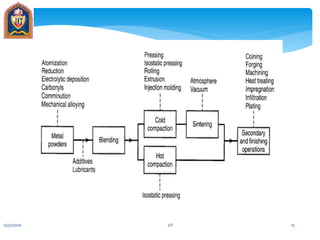
The powder-metallurgy process typically consists of the
following operations, in sequence :
 Powder production;
 Blending;
 Compaction;
 Sintering;
 Finishing operations.
Production Of Metal Powders
12/31/2016 JIT 14
12/31/2016 JIT 15
The process capabilities of powder metallurgy may be
summarized as follows:
 It is a technique for making parts from high-melting-point
refractory metals and parts that may be difficult or
uneconomical to produce by other methods.
 High production rates are possible on relatively complex
parts using automated equipment and requiring little labor.
 Powder-metal processing offers good dimensional control and
(in many instances) the elimination of machining and
finishing operations; in this way, it reduces scrap and waste
and saves energy.
Advantages
12/31/2016 JIT 16
The availability of a wide range of compositions makes it
possible to obtain special mechanical and physical properties,
such as stiffness, vibration damping, hardness, density,
toughness, and specific electrical and magnetic properties.
Some of the newer highly alloyed super alloys can be
manufactured into parts only by PM processing.
 It offers the capability of impregnation and infiltration for
specific applications.
12/31/2016 JIT 17
 There is a great variety of machine components that are
produced from metal powders, many of these are put to use
without any machining operation carried out on them.
Following are some of the prominent PM Products.
 Filters: Permanent metal powder filters have greater strength
and shock resistance than ceramic filters. Fiber metal filters,
having porosity up to 95% and more, are used for filtering air
and fluids.
 Such filters find use in dehydration for filtering air and fluids.
Such filters find use in dehydrators for diffusing moisture –
laden air around some drying agent such as silica gel.
Applications of Powder Metallurgy
12/31/2016 JIT 18
 The high cost of metal powder, particularly those for powder-
injection molding, compared with that of raw materials to be
cast or wrought.
 The high cost of tooling and equipment for small production
runs.
 Limitations on part size and shape complexity.
 Mechanical properties, such as strength and ductility, that
generally are lower than those obtained by forging.
 However, the properties of full-density PM parts made by
HIP or by additional forging operations can be as good as
those made by other processes.
Limitations
12/31/2016 JIT 19
Fixtures, being used in machine shop, are strong and
rigid mechanical devices which enable easy, quick and
consistently accurate locating, supporting and clamping,
blanks against cutting tool(s) and result faster and
accurate machining with consistent quality, functional
ability and interchangeability.
Jig is a fixture with an additional feature of tool
guidance.
Jigs and fractures
12/31/2016 JIT 20
 to eliminate marking, punching, positioning, alignments etc.
 easy, quick and consistently accurate locating, supporting and
clamping the blank in alignment of the cutting tool
 guidance to the cutting tool like drill, reamer etc.
 increase in productivity and maintain product quality consistently
 to reduce operator’s labour and skill – requirement
 to reduce measurement and its cost
 enhancing technological capacity of the machine tools
 reduction of overall machining cost and also increase in
interchangeability.
Purpose Of Using Fixtures And Jigs
12/31/2016 JIT 21
Fixtures:
It is already emphasized that the main functions of the jigs
and fixtures are :
(a) easily, quickly, firmly and consistently accurately
locating
supporting and
clamping
the blank (in the jig or fixture) in respect to the cutting
tool(s)
(b) providing guidance to the slender cutting tools using
proper bushes
Principle
12/31/2016 JIT 22
For accurate machining, the work piece is to be placed and held
in correct position and orientation in the fixture (or jig) which
is again appropriately located and fixed with respect to the
cutting tool and the machine tool.
It has to be assured that the blank, once fixed or clamped, does
not move at all.
Principles or rules of locating in jigs
and fixtures
12/31/2016 JIT 23
 One or more surfaces (preferably machined) and / or drilled / bored
hole(s) are to be taken for reference
 The reference surfaces should be significant and important feature(s)
based on which most of the dimensions are laid down
 Locating should be easy, quick and accurate
 In case of locating by pin, the pins and their mounting and contact
points should be strong, rigid and hard
 A minimum of three point must be used to locate a horizontal flat
surface
 The locating pins should be as far apart as feasible
 V block and cones should be used for self-locating solid and hollow
cylindrical jobs
Some Basic Principles Or Rules Need To
Be Followed While Planning For Locating
Blanks In Fixtures, Such As
12/31/2016 JIT 24
In jigs and fixtures the work piece or blank has to be
strongly and rigidly clamped against the supporting
surfaces and also the locating features so that the blank
does not get displaced at all under the cutting forces
during machining.
Clamping Of Work piece
12/31/2016 JIT 25
Clamping method and system are basically of two
categories :
(a) general type without much consideration on speed
of clamping operations
(b) quick acting types
Various methods of clamping
12/31/2016 JIT 26
 In the last 30 years, plastics have become the most dominant
engineering material for most products. We take a brief look at the
most common types of plastics, and how they are processed.
 All plastics are polymers; these polymers are further divided into
two basic types: thermoplastics and thermosets.
 Thermoplastics melt when heated – so they can be melted and re-
formed again and again. Thermosets harden when they are heated, if
heated further, they will break down chemically and lose their
properties.
 Some thermosets have properties very similar to rubber, and are
used as synthetic rubber; they are categorized as elastomers
Manufacturing Of Plastics
Components
12/31/2016 JIT 27
Thermosets General properties: more durable, harder, tough,
light. Typical uses: automobile parts, construction materials.
Elastomers General properties: these are thermosets, and
have rubber-like properties. Typical uses: medical masks,
gloves, rubber-substitutes
Thermoplastics General properties: low melting point, softer,
flexible. Typical uses: bottles, food wrappers, toys, …
12/31/2016 JIT 28
Methods Of Processing
The most common methods of processing plastics to
manufacture plastic parts are similar to methods we have
learnt for metals and glass. These include Extrusion,
Injection molding, Blow molding, Casting, etc..
12/31/2016 JIT 29
Plastic Extrusion can be used for thermoplastics. The raw
material is in the form of pellets (~10mm sized pieces),
granules (~5 mm), or powder.
Extrusion machines are used to make long pieces of constant
cross-section. The cross-section geometry can be solid or
hollow, and may be quite complex in shape.
 Usually, extruded parts are used as raw stock for use in
manufacture of other products (e.g. channels on the sides of
windows, etc. )
Extrusion
12/31/2016 JIT 30
12/31/2016 JIT 31
Injection Molding
Injection molding is perhaps the most common and important
of all plastic processing processes.
The process is extremely versatile, and can produce very
complex shaped parts, with the use of multi-sided molds. Even
parts with metal inserts can be produced.
While injection molding dies are expensive to produce, each
die can be used to make tens of thousands of components at
very rapid rate, so that per-part cost is very low
12/31/2016 JIT 32
Figure Of Injection Molding
12/31/2016 JIT 33
Welding Of Plastics
Welding for semi-finished plastic materials is described in ISO
472 as a process of uniting softened surfaces of materials,
generally with the aid of heat (except solvent welding).
Welding of thermoplastics is accomplished in three sequential
stages, namely surface preparation, application of heat and
pressure, and cooling.
Numerous welding methods have been developed for the joining
of semi finished plastic materials. Based on the mechanism of
heat generation at the welding interface, welding methods for
thermoplastics can be classified as external and internal heating
methods
12/31/2016 JIT 34
The search for new high performance plastics have always been one of the
major goals of the plastic manufacturing industry. Here are some newer
trends currently entering the market:
 Smart Polymers: These are in fact a set of polymers which can manipulate
their dimensions according to changes in environmental parameters such as
amount of light, temperature, availability of water and so on. These
materials find numerous applications in the medical sector.
 Nano composites: When nanotechnology combines with plastic
engineering, performance is enhanced at the molecular level. Nano
composites generally include materials like nanotalcs , carbon nanotubes,
and nano clays, which are characterized by high electrical conductivity,
dimensional stability, and flame retardancy along with resistance to scratch,
dent and heat. These nano composites are frequently used in the automotive
and aerospace sector as well as in food packaging, electronics, military
hardware and more.
Future and applications Of Plastics
12/31/2016 JIT 35
 RF or Radio Frequency embedded plastics: In these resins, a plastic
medium embeds a signal generator and can assume various
shapes. These plastics are used in clothing inventory tags, security
system badges, hospital patient tracking, highway toll tags, cargo
container seals and many more industrial applications.
 Bio plastics: With the pioneering advancements being made in this
industry, the world is increasingly becoming aware of the
environmental effects of these materials. Greener, more
environmentally friendly plastics are increasingly in demand. Eco-
friendly bio plastics, which are based on polymer resins from plants,
find a wide array of applications in electronics, telecommunications,
aerospace, automotive and other markets. Plastics that decompose
with the help of bacteria have also been developed.
Continued…
12/31/2016 JIT 36
An adhesive is a material used for holding two surfaces
together. An adhesive must wet the surfaces, adhere to
the surfaces, develop strength after it has been applied,
and remain stable.
Adhesion is a specific interfacial phenomenon. There are
three main theories of adhesion: adsorption, electrical
and diffusion. All probably apply to most adhesives.
Adhesives
12/31/2016 JIT 37
For a material to perform as an adhesive it must have four main
requirements:
 It must "wet" the surfaces - that is it must flow out over the surfaces
that are being bonded, displacing all air and other contaminates that
are present.
 It must adhere to the surfaces - That is after flowing over the whole
surface area it must start to adhere and stay in position and become
"tacky".
 It must develop strength - The material must now change its structure
to become strong or non-tacky but still adherent.
 It must remain stable - The material must remain unaffected by age,
environmental conditions and other factors as long as the bond is
required.
Continued…
12/31/2016 JIT 38
Natural adhesives
Organic adhesives
Vegetable adhesives
Synthetic adhesives
Classification Of Adhesives
12/31/2016 JIT 39
A class of organic products either natural or synthetic in origin,
generally having high molecular weight.
Most uncured resins used in open molding are liquids.
Generally resins are used to surround and hold fibers. When
catalyzed, the resin cures going through a polymerization
process transforming the liquid resin into a solid.
The cured resin and reinforcement creates a composite material
with mechanical properties that exceed those of the individual
components.
Resins
12/31/2016 JIT 40
They are classified on the basis of hardness and chemical
compositions into three main categories:
Hard resins
Oleoresins
Gum resins
Types Of Resins
12/31/2016 JIT 41

Unconventional metal forming process

  • 1.
    UNCONVENTIONAL METAL FORMING PROCESSES 12/31/2016JIT 1 Unit V  By: Zoha Nasir Assistant Professor JIT, Barabanki
  • 2.
    In these formingprocesses large amount of energy is applied for a very short interval of time. Many metals tend to deform more readily under extra – fast application of load which make these processes useful to form large size parts out of most metals including those which are otherwise difficult – to form. High Energy Rate Forming Processes 12/31/2016 JIT 2
  • 3.
    The parts areformed at a rapid rate, and thus these processes are also called high – velocity forming processes. There are several advantages of using these forming processes, like die costs are low, easy maintenance of tolerances, possibility of forming most metals, and material does not show spring-back effect. The production cost of components by such processes is low. The limitation of these processes is the need for skilled personnel. 12/31/2016 JIT 3
  • 4.
    There are threemain high energy rate forming processes: Explosive Forming Magnetic Forming, And Electro Hydraulic Forming Classification 12/31/2016 JIT 4
  • 5.
    Explosive forming, isdistinguished from conventional forming in that the punch or diaphragm is replaced by an explosive charge. T he explosives used are generally high – explosive chemicals, gaseous mixtures, or propellants. There are two techniques of high – explosive forming: Stand – Off Technique And The Contact Technique. Explosive Forming 12/31/2016 JIT 5
  • 6.
    Explosive forming ismainly used in the aerospace industries but has also found successful applications in the production of automotive related components.  The process has the greatest potential in limited – production prototype forming and for forming large size components for which conventional tooling costs are prohibitively high. Applications 12/31/2016 JIT 6
  • 7.
    The process isalso called magnetic pulse forming and is mainly used for swaging type operations, such as fastening fittings on the ends of tubes and crimping terminal ends of cables. Other applications are blanking, forming, embossing, and drawing. The work coils needed for different applications vary although the same power source may be used. Electro Magnetic Forming 12/31/2016 JIT 7
  • 8.
    Magnetic forming canbe accomplished in any of the following three ways, depending upon the requirements. Coil surrounding work piece. Coil inside work piece. Coil on flat surface Continued… 12/31/2016 JIT 8
  • 9.
    Electromagnetic forming processis capable of a wide variety of forming and assembly operations.  It has found extensive applications in the fabrication of hollow, non – circular, or asymmetrical shapes from tubular stock. The compression applications involve swaging to produce compression, tensile, and torque joints or sealed pressure joints, and swaging to apply compression bands or shrink rings for fastening components together. Flat coils have been used on flat sheets to produce stretch (internal) and shrink (external) flanges on ring and disc – shaped work pieces. Electromagnetic forming has also been used to perform shearing, piercing, and riveting. Applications 12/31/2016 JIT 9
  • 10.
    Electro hydraulic forming(EHF), also known as electro spark forming, is a process in which electrical energy is converted into mechanical energy for the forming of metallic parts.  A bank of capacitors is first charged to a high voltage and then discharged across a gap between two electrodes, causing explosions inside the hollow work piece, which is filled with some suitable medium, generally water. These explosions produce shock waves that travel radially in all directions at high velocity until they meet some obstruction. If the discharge energy is sufficiently high, the hollow work piece is deformed. The deformation can be controlled by applying external restraints in the form of die or by varying the amount of energy released. Electro Hydraulic Forming 12/31/2016 JIT 10
  • 11.
    EHF can formhollow shapes with much ease and at less cost compared to other forming techniques. EHF is more adaptable to automatic production compared to other high energy rate forming techniques. EHF can produce small – to intermediate sized parts that don't have excessive energy requirements. Advantages 12/31/2016 JIT 11
  • 12.
     In themanufacturing processes described thus far, the raw materials used have been metals and alloys either in a molten state (casting) or in solid form (metalworking).  This process first was used by the Egyptians in about 3000 B.C. to make iron tools.  One of its first modern uses was in the early 1900s to make the tungsten filaments for incandescent light bulbs.  The availability of a wide range of metal-powder compositions, the ability to produce parts to net dimensions (net-shape forming), and the overall economics of the operation give this unique process its numerous attractive and expanding applications. Powder Metallurgy 12/31/2016 JIT 12
  • 13.
    Powder metallurgy hasbecome competitive with processes such as casting, forging, and machining, particularly for relatively complex parts made of high strength and hard alloys. The most commonly used metals in PM are iron, copper, aluminum, tin, nickel, titanium, and the refractory metals. For parts made of brass, bronze, steels, and stainless steels, pre- alloyed powders are used, where each powder particle itself is an alloy. Metal sources are generally bulk metals and alloys, ores, salts, and other compounds. 12/31/2016 JIT 13
  • 14.
    The powder-metallurgy processtypically consists of the following operations, in sequence :  Powder production;  Blending;  Compaction;  Sintering;  Finishing operations. Production Of Metal Powders 12/31/2016 JIT 14
  • 15.
  • 16.
    The process capabilitiesof powder metallurgy may be summarized as follows:  It is a technique for making parts from high-melting-point refractory metals and parts that may be difficult or uneconomical to produce by other methods.  High production rates are possible on relatively complex parts using automated equipment and requiring little labor.  Powder-metal processing offers good dimensional control and (in many instances) the elimination of machining and finishing operations; in this way, it reduces scrap and waste and saves energy. Advantages 12/31/2016 JIT 16
  • 17.
    The availability ofa wide range of compositions makes it possible to obtain special mechanical and physical properties, such as stiffness, vibration damping, hardness, density, toughness, and specific electrical and magnetic properties. Some of the newer highly alloyed super alloys can be manufactured into parts only by PM processing.  It offers the capability of impregnation and infiltration for specific applications. 12/31/2016 JIT 17
  • 18.
     There isa great variety of machine components that are produced from metal powders, many of these are put to use without any machining operation carried out on them. Following are some of the prominent PM Products.  Filters: Permanent metal powder filters have greater strength and shock resistance than ceramic filters. Fiber metal filters, having porosity up to 95% and more, are used for filtering air and fluids.  Such filters find use in dehydration for filtering air and fluids. Such filters find use in dehydrators for diffusing moisture – laden air around some drying agent such as silica gel. Applications of Powder Metallurgy 12/31/2016 JIT 18
  • 19.
     The highcost of metal powder, particularly those for powder- injection molding, compared with that of raw materials to be cast or wrought.  The high cost of tooling and equipment for small production runs.  Limitations on part size and shape complexity.  Mechanical properties, such as strength and ductility, that generally are lower than those obtained by forging.  However, the properties of full-density PM parts made by HIP or by additional forging operations can be as good as those made by other processes. Limitations 12/31/2016 JIT 19
  • 20.
    Fixtures, being usedin machine shop, are strong and rigid mechanical devices which enable easy, quick and consistently accurate locating, supporting and clamping, blanks against cutting tool(s) and result faster and accurate machining with consistent quality, functional ability and interchangeability. Jig is a fixture with an additional feature of tool guidance. Jigs and fractures 12/31/2016 JIT 20
  • 21.
     to eliminatemarking, punching, positioning, alignments etc.  easy, quick and consistently accurate locating, supporting and clamping the blank in alignment of the cutting tool  guidance to the cutting tool like drill, reamer etc.  increase in productivity and maintain product quality consistently  to reduce operator’s labour and skill – requirement  to reduce measurement and its cost  enhancing technological capacity of the machine tools  reduction of overall machining cost and also increase in interchangeability. Purpose Of Using Fixtures And Jigs 12/31/2016 JIT 21
  • 22.
    Fixtures: It is alreadyemphasized that the main functions of the jigs and fixtures are : (a) easily, quickly, firmly and consistently accurately locating supporting and clamping the blank (in the jig or fixture) in respect to the cutting tool(s) (b) providing guidance to the slender cutting tools using proper bushes Principle 12/31/2016 JIT 22
  • 23.
    For accurate machining,the work piece is to be placed and held in correct position and orientation in the fixture (or jig) which is again appropriately located and fixed with respect to the cutting tool and the machine tool. It has to be assured that the blank, once fixed or clamped, does not move at all. Principles or rules of locating in jigs and fixtures 12/31/2016 JIT 23
  • 24.
     One ormore surfaces (preferably machined) and / or drilled / bored hole(s) are to be taken for reference  The reference surfaces should be significant and important feature(s) based on which most of the dimensions are laid down  Locating should be easy, quick and accurate  In case of locating by pin, the pins and their mounting and contact points should be strong, rigid and hard  A minimum of three point must be used to locate a horizontal flat surface  The locating pins should be as far apart as feasible  V block and cones should be used for self-locating solid and hollow cylindrical jobs Some Basic Principles Or Rules Need To Be Followed While Planning For Locating Blanks In Fixtures, Such As 12/31/2016 JIT 24
  • 25.
    In jigs andfixtures the work piece or blank has to be strongly and rigidly clamped against the supporting surfaces and also the locating features so that the blank does not get displaced at all under the cutting forces during machining. Clamping Of Work piece 12/31/2016 JIT 25
  • 26.
    Clamping method andsystem are basically of two categories : (a) general type without much consideration on speed of clamping operations (b) quick acting types Various methods of clamping 12/31/2016 JIT 26
  • 27.
     In thelast 30 years, plastics have become the most dominant engineering material for most products. We take a brief look at the most common types of plastics, and how they are processed.  All plastics are polymers; these polymers are further divided into two basic types: thermoplastics and thermosets.  Thermoplastics melt when heated – so they can be melted and re- formed again and again. Thermosets harden when they are heated, if heated further, they will break down chemically and lose their properties.  Some thermosets have properties very similar to rubber, and are used as synthetic rubber; they are categorized as elastomers Manufacturing Of Plastics Components 12/31/2016 JIT 27
  • 28.
    Thermosets General properties:more durable, harder, tough, light. Typical uses: automobile parts, construction materials. Elastomers General properties: these are thermosets, and have rubber-like properties. Typical uses: medical masks, gloves, rubber-substitutes Thermoplastics General properties: low melting point, softer, flexible. Typical uses: bottles, food wrappers, toys, … 12/31/2016 JIT 28
  • 29.
    Methods Of Processing Themost common methods of processing plastics to manufacture plastic parts are similar to methods we have learnt for metals and glass. These include Extrusion, Injection molding, Blow molding, Casting, etc.. 12/31/2016 JIT 29
  • 30.
    Plastic Extrusion canbe used for thermoplastics. The raw material is in the form of pellets (~10mm sized pieces), granules (~5 mm), or powder. Extrusion machines are used to make long pieces of constant cross-section. The cross-section geometry can be solid or hollow, and may be quite complex in shape.  Usually, extruded parts are used as raw stock for use in manufacture of other products (e.g. channels on the sides of windows, etc. ) Extrusion 12/31/2016 JIT 30
  • 31.
  • 32.
    Injection Molding Injection moldingis perhaps the most common and important of all plastic processing processes. The process is extremely versatile, and can produce very complex shaped parts, with the use of multi-sided molds. Even parts with metal inserts can be produced. While injection molding dies are expensive to produce, each die can be used to make tens of thousands of components at very rapid rate, so that per-part cost is very low 12/31/2016 JIT 32
  • 33.
    Figure Of InjectionMolding 12/31/2016 JIT 33
  • 34.
    Welding Of Plastics Weldingfor semi-finished plastic materials is described in ISO 472 as a process of uniting softened surfaces of materials, generally with the aid of heat (except solvent welding). Welding of thermoplastics is accomplished in three sequential stages, namely surface preparation, application of heat and pressure, and cooling. Numerous welding methods have been developed for the joining of semi finished plastic materials. Based on the mechanism of heat generation at the welding interface, welding methods for thermoplastics can be classified as external and internal heating methods 12/31/2016 JIT 34
  • 35.
    The search fornew high performance plastics have always been one of the major goals of the plastic manufacturing industry. Here are some newer trends currently entering the market:  Smart Polymers: These are in fact a set of polymers which can manipulate their dimensions according to changes in environmental parameters such as amount of light, temperature, availability of water and so on. These materials find numerous applications in the medical sector.  Nano composites: When nanotechnology combines with plastic engineering, performance is enhanced at the molecular level. Nano composites generally include materials like nanotalcs , carbon nanotubes, and nano clays, which are characterized by high electrical conductivity, dimensional stability, and flame retardancy along with resistance to scratch, dent and heat. These nano composites are frequently used in the automotive and aerospace sector as well as in food packaging, electronics, military hardware and more. Future and applications Of Plastics 12/31/2016 JIT 35
  • 36.
     RF orRadio Frequency embedded plastics: In these resins, a plastic medium embeds a signal generator and can assume various shapes. These plastics are used in clothing inventory tags, security system badges, hospital patient tracking, highway toll tags, cargo container seals and many more industrial applications.  Bio plastics: With the pioneering advancements being made in this industry, the world is increasingly becoming aware of the environmental effects of these materials. Greener, more environmentally friendly plastics are increasingly in demand. Eco- friendly bio plastics, which are based on polymer resins from plants, find a wide array of applications in electronics, telecommunications, aerospace, automotive and other markets. Plastics that decompose with the help of bacteria have also been developed. Continued… 12/31/2016 JIT 36
  • 37.
    An adhesive isa material used for holding two surfaces together. An adhesive must wet the surfaces, adhere to the surfaces, develop strength after it has been applied, and remain stable. Adhesion is a specific interfacial phenomenon. There are three main theories of adhesion: adsorption, electrical and diffusion. All probably apply to most adhesives. Adhesives 12/31/2016 JIT 37
  • 38.
    For a materialto perform as an adhesive it must have four main requirements:  It must "wet" the surfaces - that is it must flow out over the surfaces that are being bonded, displacing all air and other contaminates that are present.  It must adhere to the surfaces - That is after flowing over the whole surface area it must start to adhere and stay in position and become "tacky".  It must develop strength - The material must now change its structure to become strong or non-tacky but still adherent.  It must remain stable - The material must remain unaffected by age, environmental conditions and other factors as long as the bond is required. Continued… 12/31/2016 JIT 38
  • 39.
    Natural adhesives Organic adhesives Vegetableadhesives Synthetic adhesives Classification Of Adhesives 12/31/2016 JIT 39
  • 40.
    A class oforganic products either natural or synthetic in origin, generally having high molecular weight. Most uncured resins used in open molding are liquids. Generally resins are used to surround and hold fibers. When catalyzed, the resin cures going through a polymerization process transforming the liquid resin into a solid. The cured resin and reinforcement creates a composite material with mechanical properties that exceed those of the individual components. Resins 12/31/2016 JIT 40
  • 41.
    They are classifiedon the basis of hardness and chemical compositions into three main categories: Hard resins Oleoresins Gum resins Types Of Resins 12/31/2016 JIT 41