This document provides an overview of presses and press classification. It begins with introductions and definitions of press working terminology. Presses are then classified in several ways: by power source (manual, power); frame type (inclinable, gap, straight side); number of actions (single, double, triple); purpose of use (shearing, punching, etc.); and position of frame (inclinable, vertical, horizontal). Common types of presses are also described briefly, including fly, gap frame, hydraulic, and screw presses. The document is from a seminar on press classification presented by Sanket Chandankhede of the Mechanical Engineering department at Yeshwantrao Chavan College of Engineering, Nagpur
Seminar on
“Classification AndTypes of
Press”
By
“Sanket Chandankhede”
DEPARTMENT OF
MECHANICAL ENGINEERING
Yeshwantrao Chavan College of Engineering, Nagpur
1
MTech (Production)
2.
CONTENTS
• Introduction
• PressWorking Terminology
• Press Selection
• Classification of Press
• Types of Press
• References
2
3.
INTRODUCTION
PRESS
“It is amachine by which we can do cutting
and non cutting process by applying force
without removing chip on metallic or non
metallic sheet.”
3
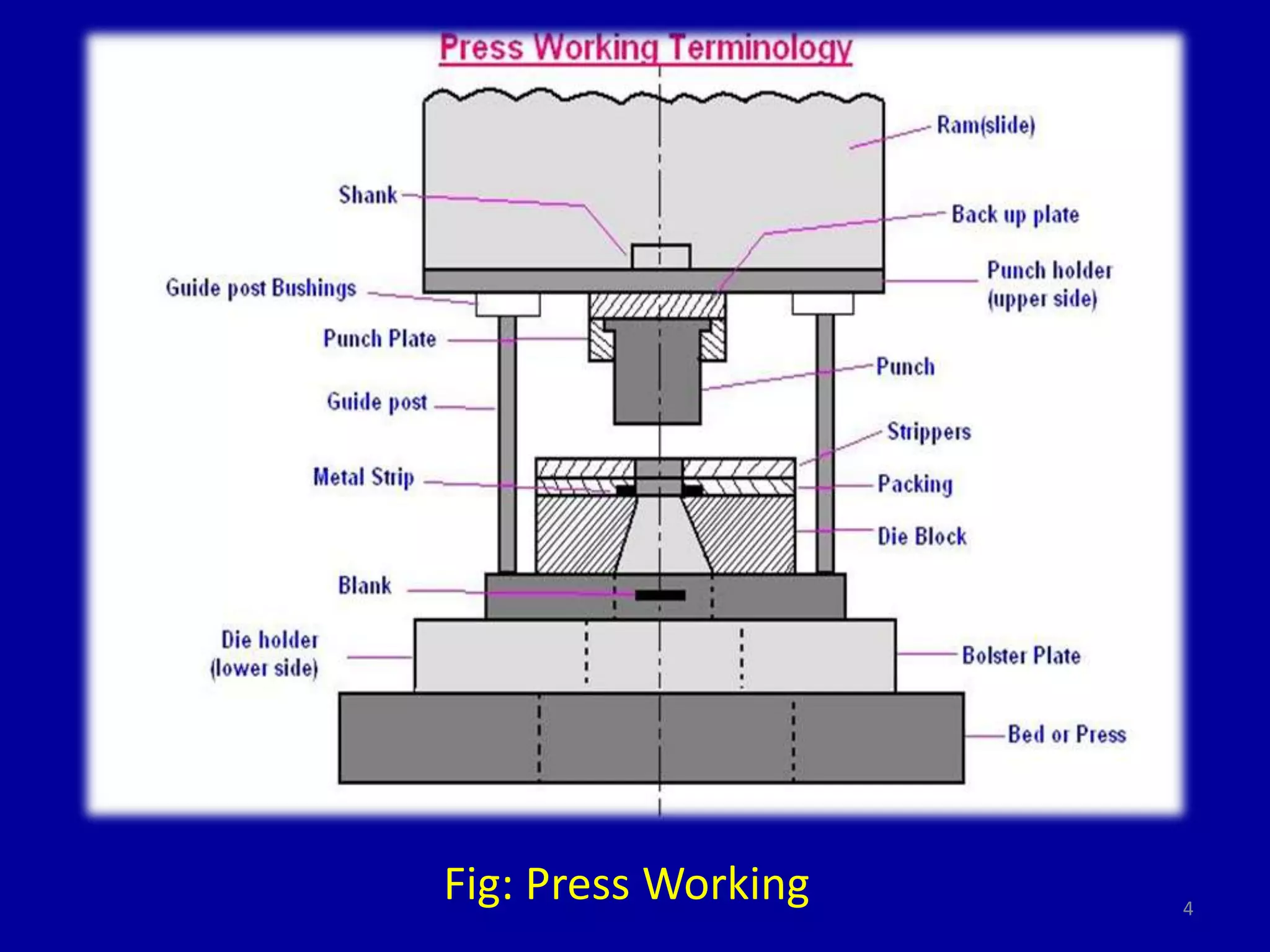
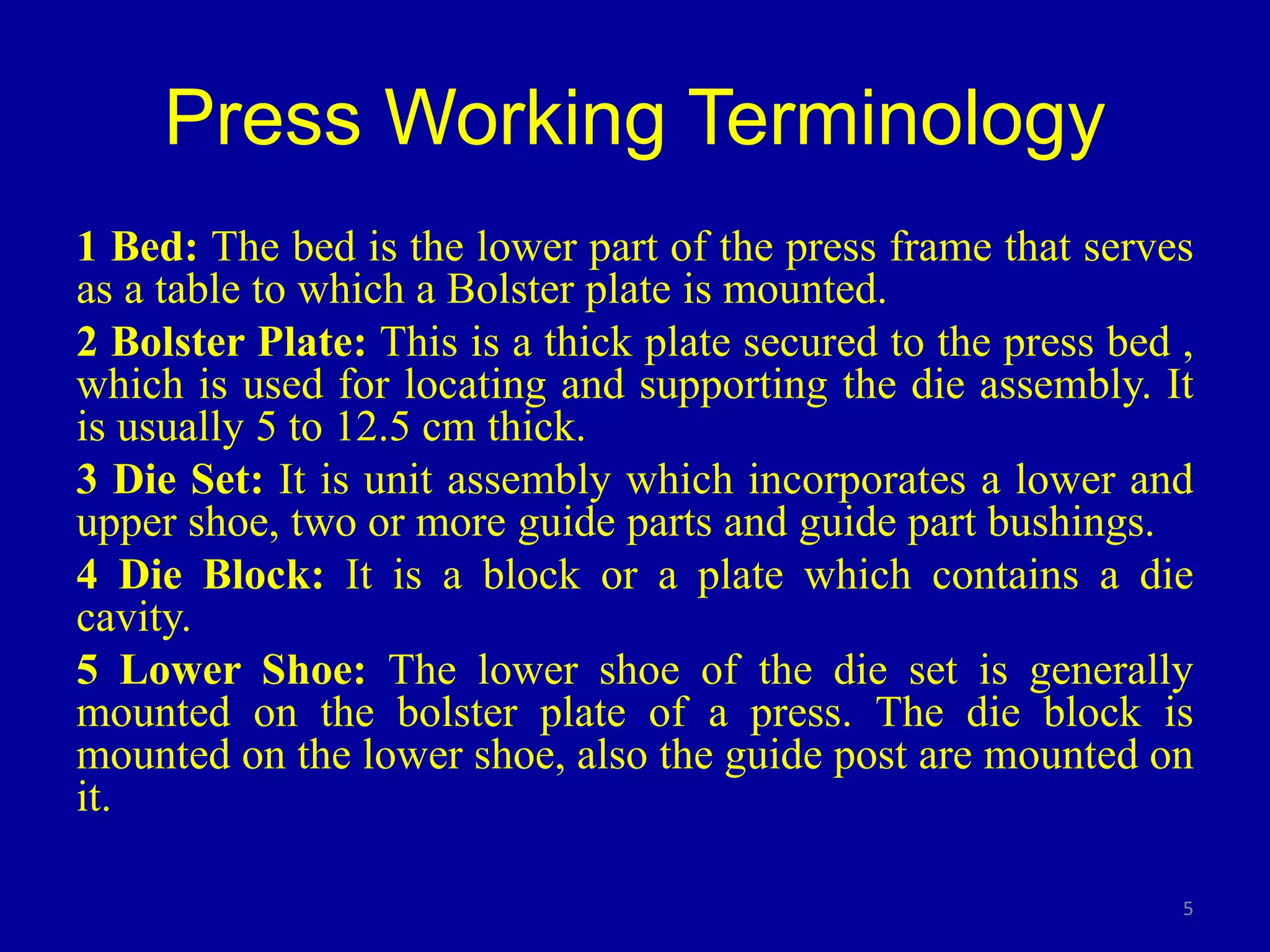
Press Working Terminology
1Bed: The bed is the lower part of the press frame that serves
as a table to which a Bolster plate is mounted.
2 Bolster Plate: This is a thick plate secured to the press bed ,
which is used for locating and supporting the die assembly. It
is usually 5 to 12.5 cm thick.
3 Die Set: It is unit assembly which incorporates a lower and
upper shoe, two or more guide parts and guide part bushings.
4 Die Block: It is a block or a plate which contains a die
cavity.
5 Lower Shoe: The lower shoe of the die set is generally
mounted on the bolster plate of a press. The die block is
mounted on the lower shoe, also the guide post are mounted on
it.
5
6.
6 Punch :Thisis male component of a die assembly,
which is directly or indirectly moved by and fastened to
the press ram or slide.
7 Upper Shoe: This is the upper part of the die set
which contains guide post bushings.
8 Punch Plate : The punch plate or punch retainer fits
closely over the body of the punch and holds it in
proper relative position.
9 Back up Plate: Back up plate or pressure plate is
placed so that intensity of pressure does not become
excessive on punch holder. The plate distributes the
pressure over a wide area and the intensity of
pressure on the punch holder is reduced to avoid
crushing.
10 Stripper: It is a plate which is used to strip the
metal strip from cutting a non-cutting Punch or die. It
may also guide the sheet.
6
7.
Press selection
• Sizeof work piece
• Stock Width and material
• Type of operation
• Power of press and speed of operation
7
8.
Press Size
The sizeof press is designated by its maximum
capacity of applying load on a piece of blank, and
its expressed in tones.
The bed area is also considered in the press size.
8
Mechanical
Capacities to 6000 tons
Force varies throughout the
stroke
Limited/difficult overload
Hydraulic
50,000 +ton capacities
Large force available at
the top of the stroke
Overload protection
According to thePower Source
These power source are categorized as :
Manually Operated
These presses are used to process thin sheet metal
working operations where less pressure or force is
required. These are operated by manual power.
Most of manually operated presses are hand press,
ball press or fly press.
Power Presses
Power presses are normally driven by mechanical
mechanism or hydraulic system. Power source of
these presses may be electric motor or engine.
10
11.
According to theType and Design
of Frame
The type and design of frame depending on
the design of frame these are classified as:
Inclinable.
Straight side.
Adjustable bed.
Gap frame.
Horning and open end.
11
12.
According to theType and Design
of Frame
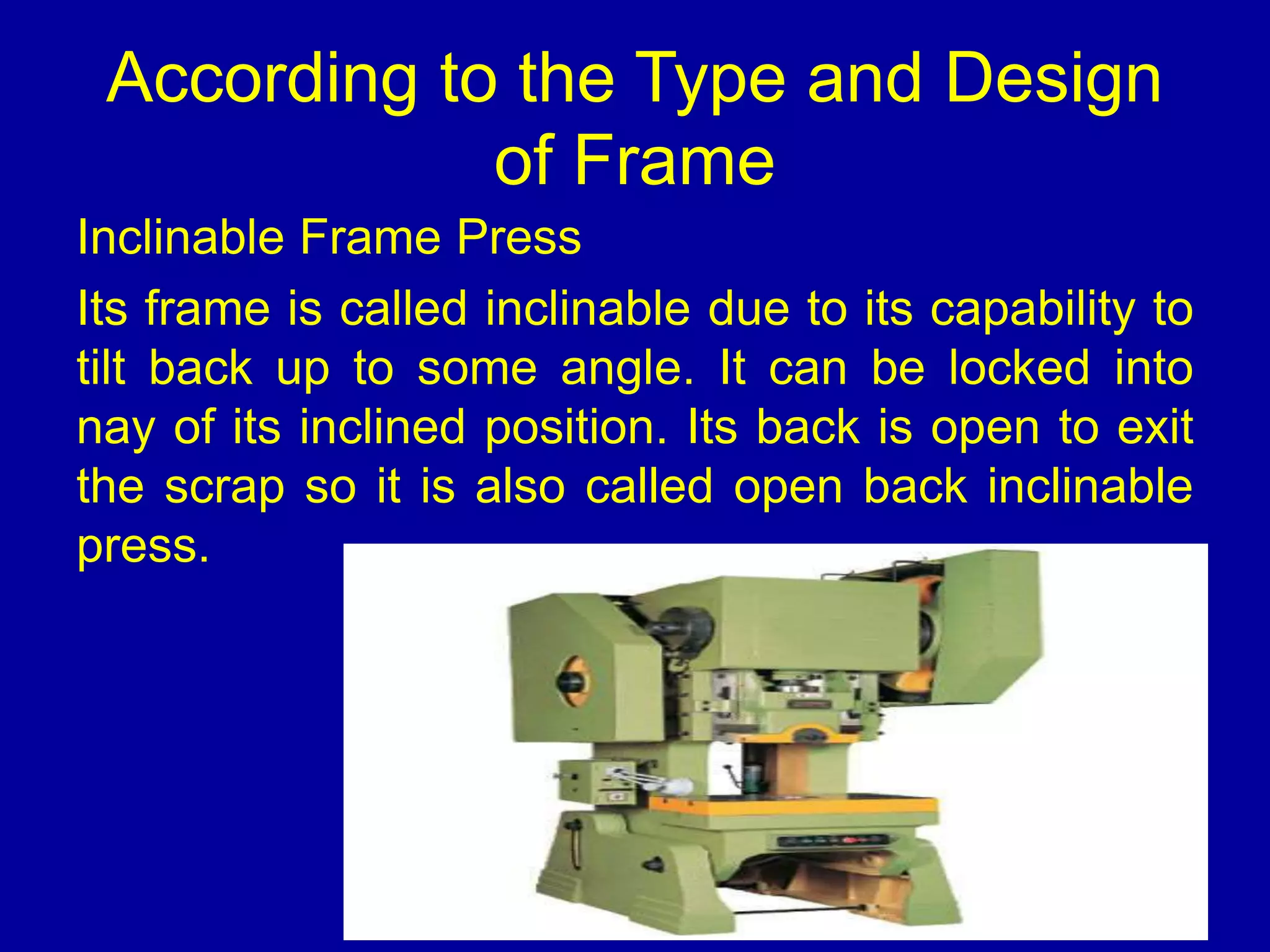
Inclinable Frame Press
Its frame is called inclinable due to its capability to
tilt back up to some angle. It can be locked into
nay of its inclined position. Its back is open to exit
the scrap so it is also called open back inclinable
press.
12
13.
According to theType and Design
of Frame
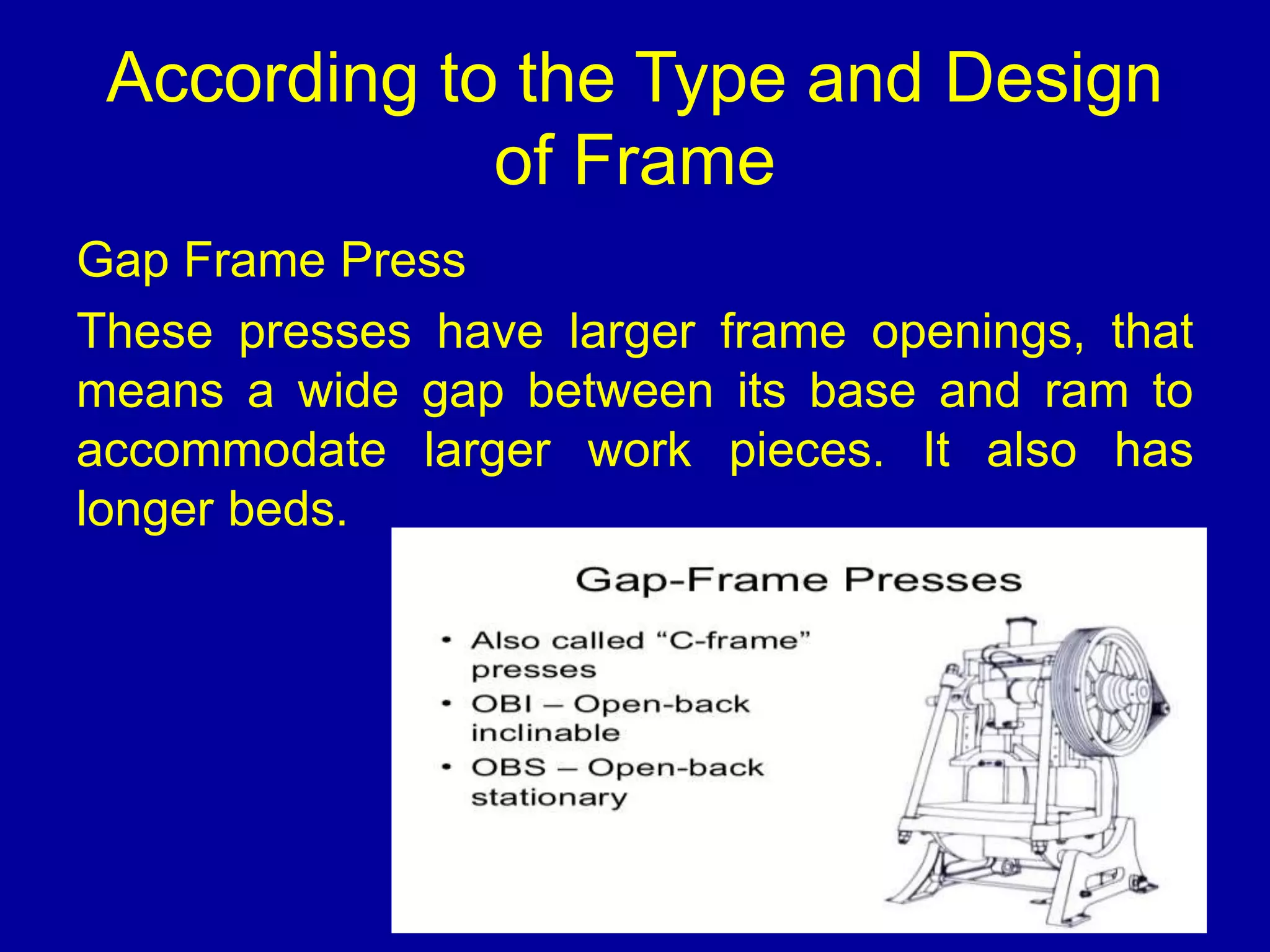
Gap Frame Press
These presses have larger frame openings, that
means a wide gap between its base and ram to
accommodate larger work pieces. It also has
longer beds.
13
14.
According to theType and Design
of Frame
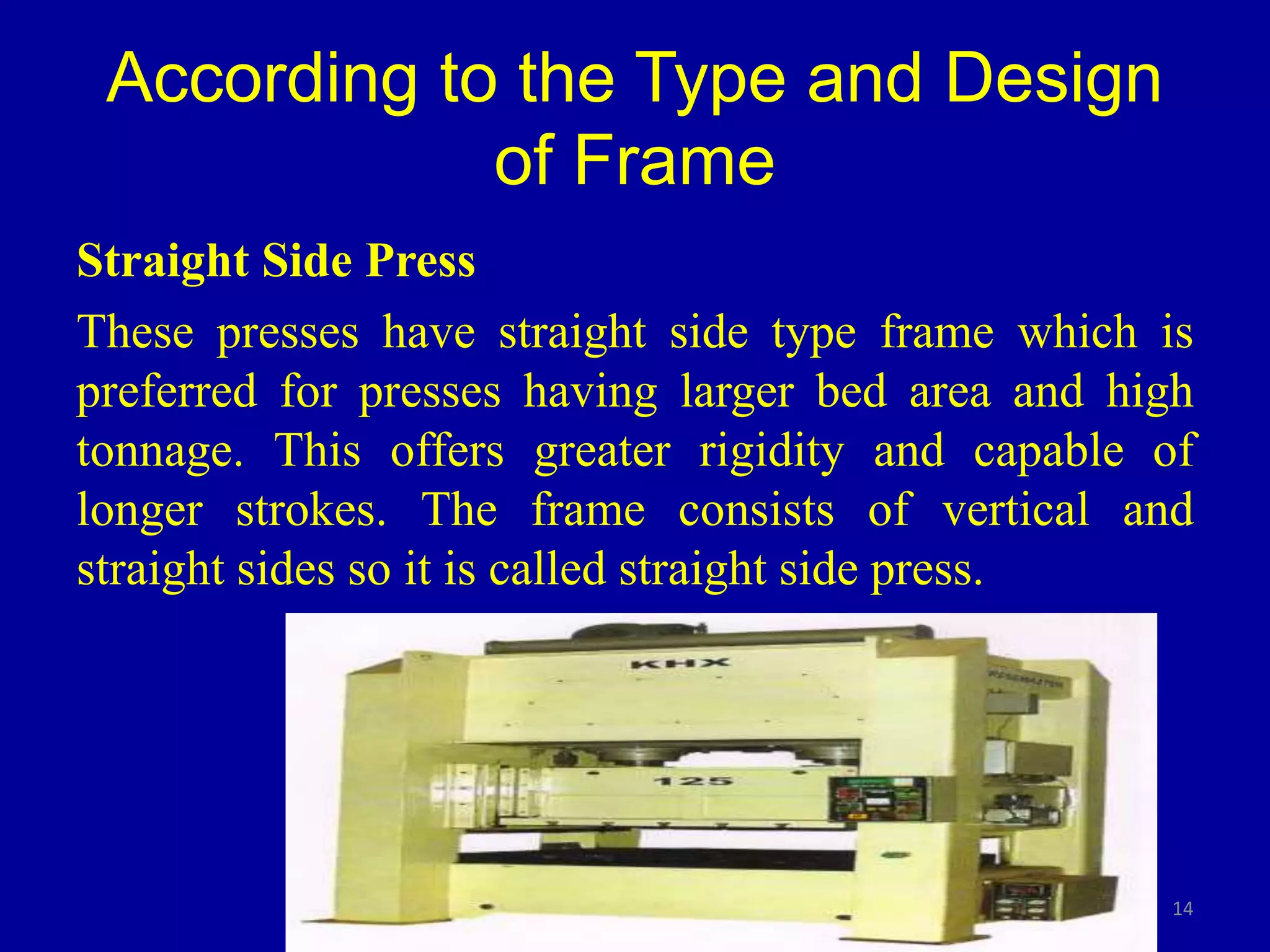
Straight Side Press
These presses have straight side type frame which is
preferred for presses having larger bed area and high
tonnage. This offers greater rigidity and capable of
longer strokes. The frame consists of vertical and
straight sides so it is called straight side press.
14
15.
According to theType and Design
of Frame
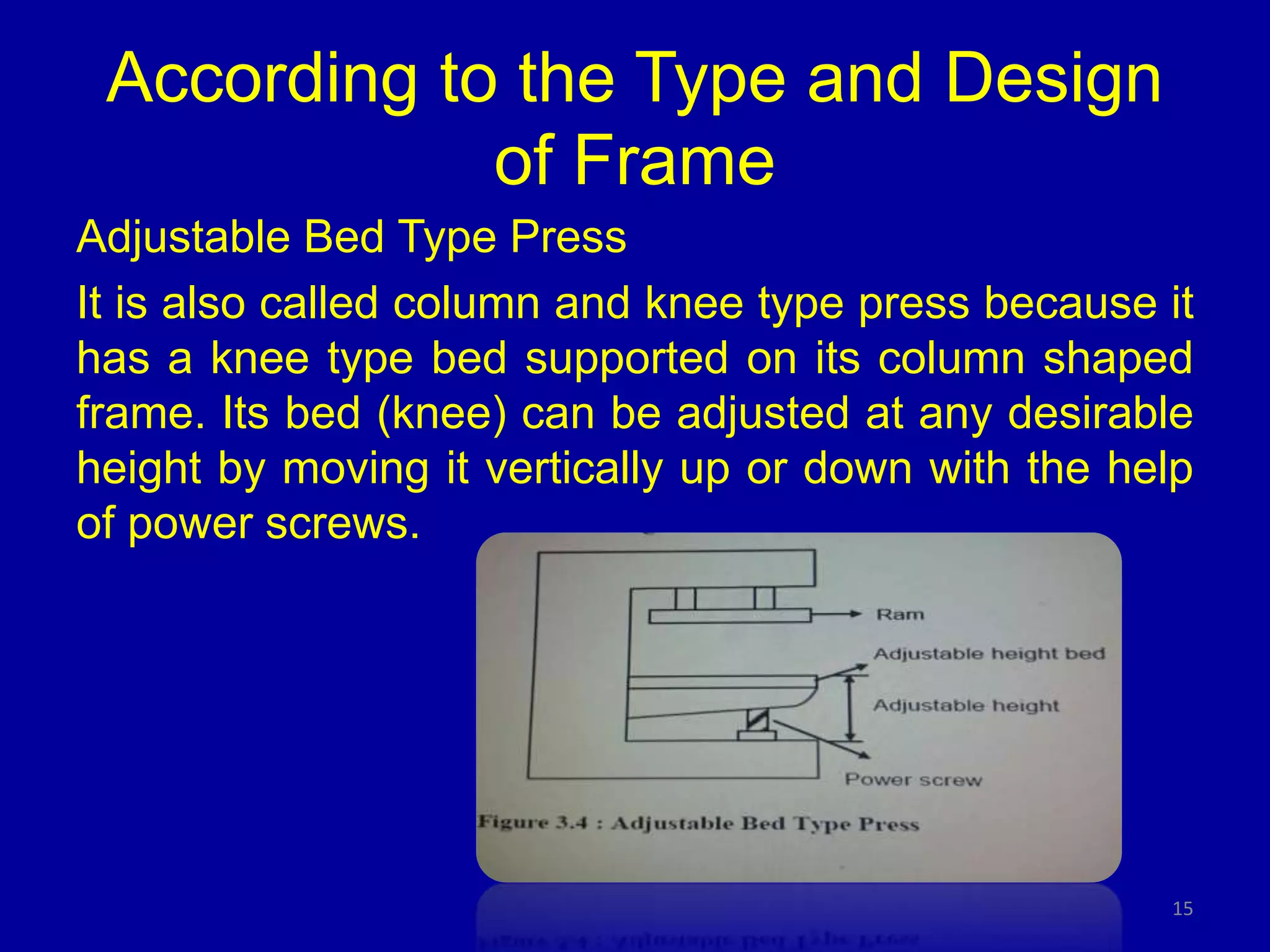
Adjustable Bed Type Press
It is also called column and knee type press because it
has a knee type bed supported on its column shaped
frame. Its bed (knee) can be adjusted at any desirable
height by moving it vertically up or down with the help
of power screws.
15
16.
According to theType and Design
of Frame
Open End Press
It has a solid type of vertical frame with all sides
open. Driving mechanism is housed at the back and
ram controlling mechanism at the front. It is easily to
accommodate work piece and dies in this type of
structure. Its is identified as light duty machine.
Horning Press
It consist of a vertical frame, top of which over hangs
towards the front. The over hanging portion serves
for housing for driving mechanism and ram control.
The frame consists of a front face as a work table
called horn.
16
17.
According to thePosition of Frame
Presses can also be categorized by the position of
frame as described below.
Inclinable Frame: Already described.
Vertical Frame: Vertical frame type of press is
already been discussed, it cannot be adjusted like
inclinable frame. Gap, adjustable bed, straight side,
open end and honing presses are the example of
vertical frames.
Horizontal Frame: It has a fixed frame in horizontal
position. It provides the facility of auto ejection of
produced part and scrap due to gravity.
17
18.
According to theActions
• According to the number of actions it can
be categorized as single action, double
action or triple action press. Here number
of actions is same as the number of rams
on the press.
18
19.
According to thePurpose of Use
Some of the operations require low stroke strength and some lager stroke
strength. In the same way requirements of stroke length is different for
different operations. So depending on power and stroke length presses are
classified as given below depending on their suitability of performing different
operations.
Shearing press
Seaming press
Punching press
Extruding press
Coining press
Forging press
Rolling press
Bending press.
19
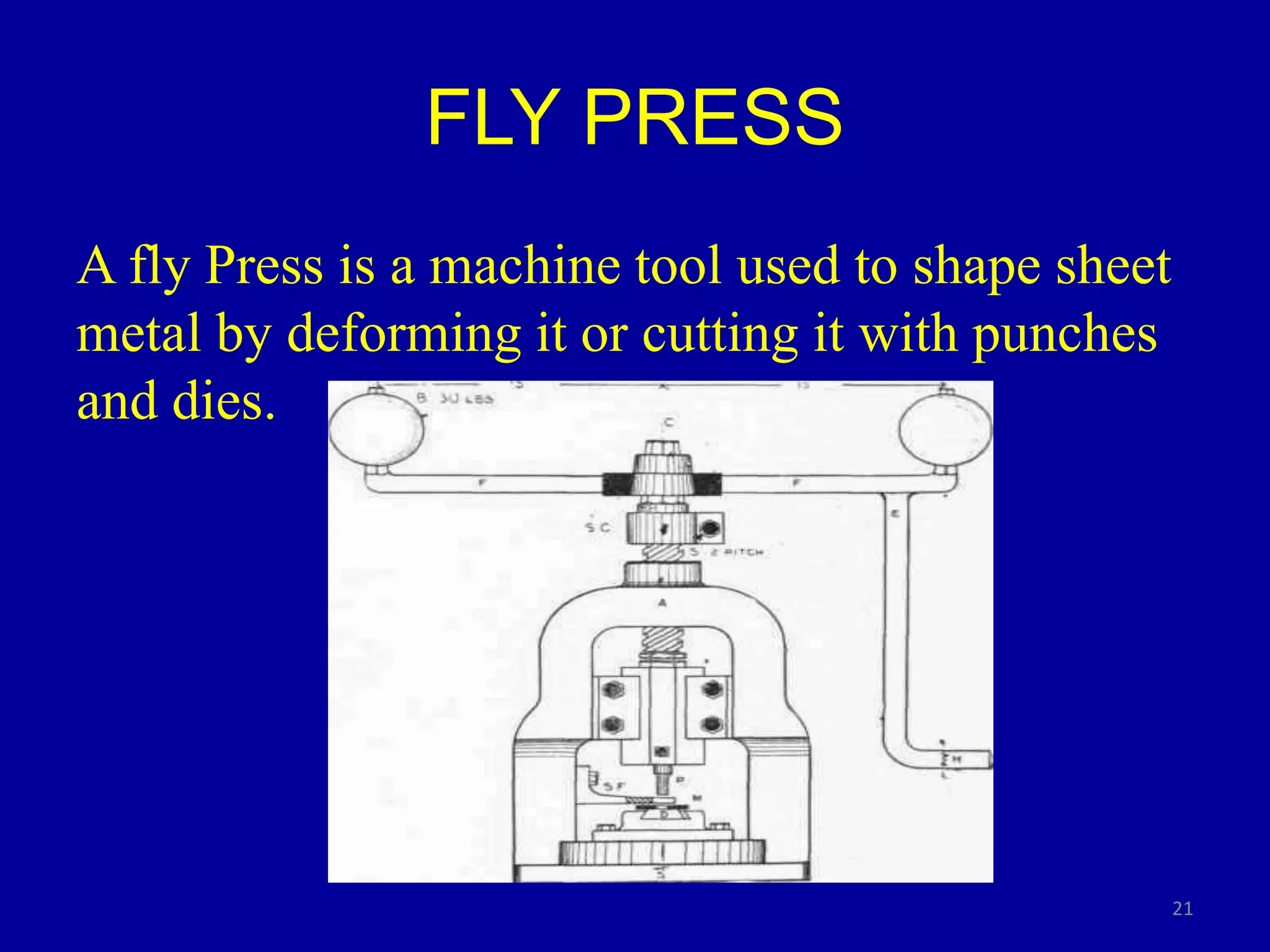
FLY PRESS
A flyPress is a machine tool used to shape sheet
metal by deforming it or cutting it with punches
and dies.
21
22.
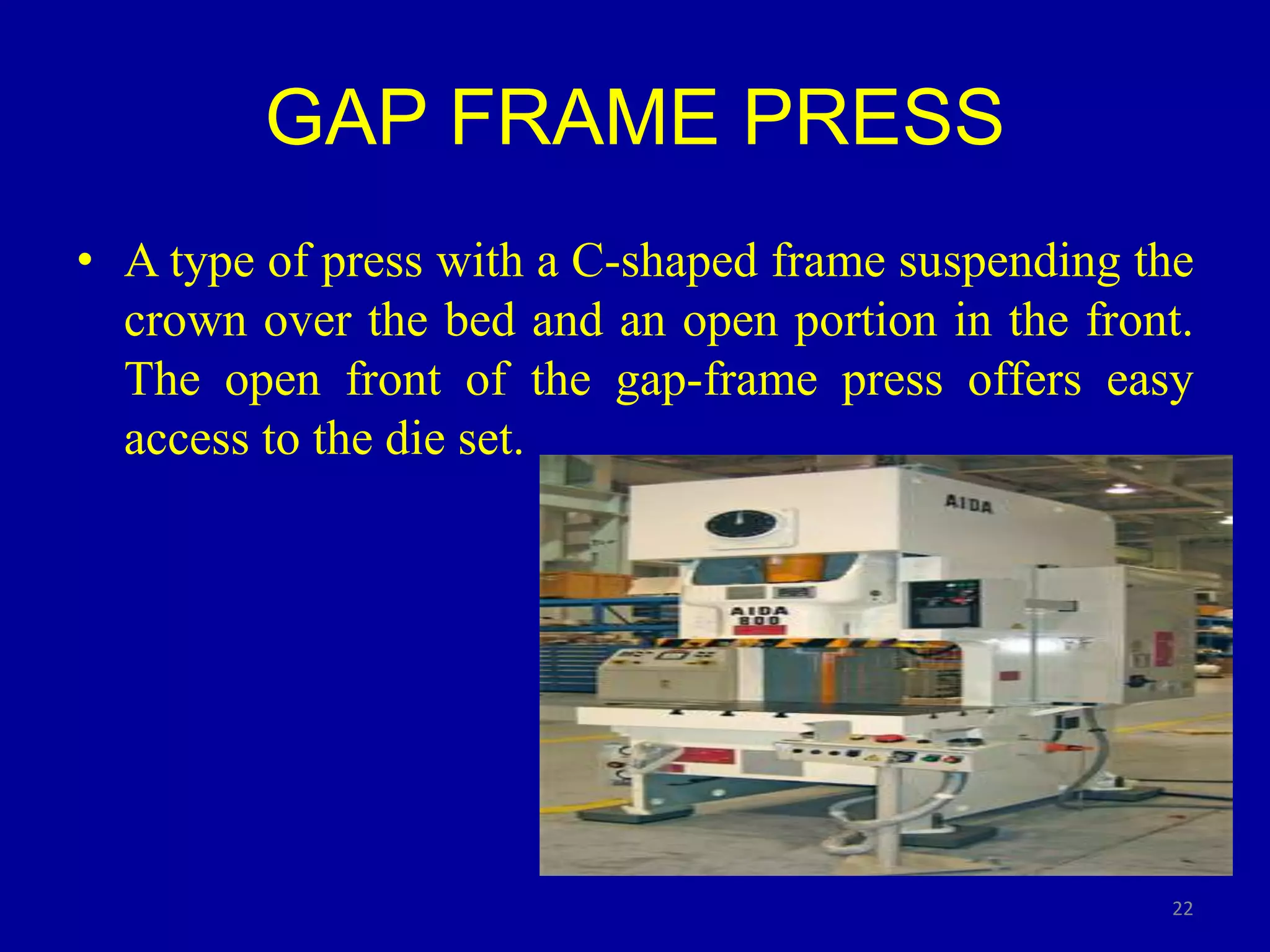
GAP FRAME PRESS
•A type of press with a C-shaped frame suspending the
crown over the bed and an open portion in the front.
The open front of the gap-frame press offers easy
access to the die set.
22
23.
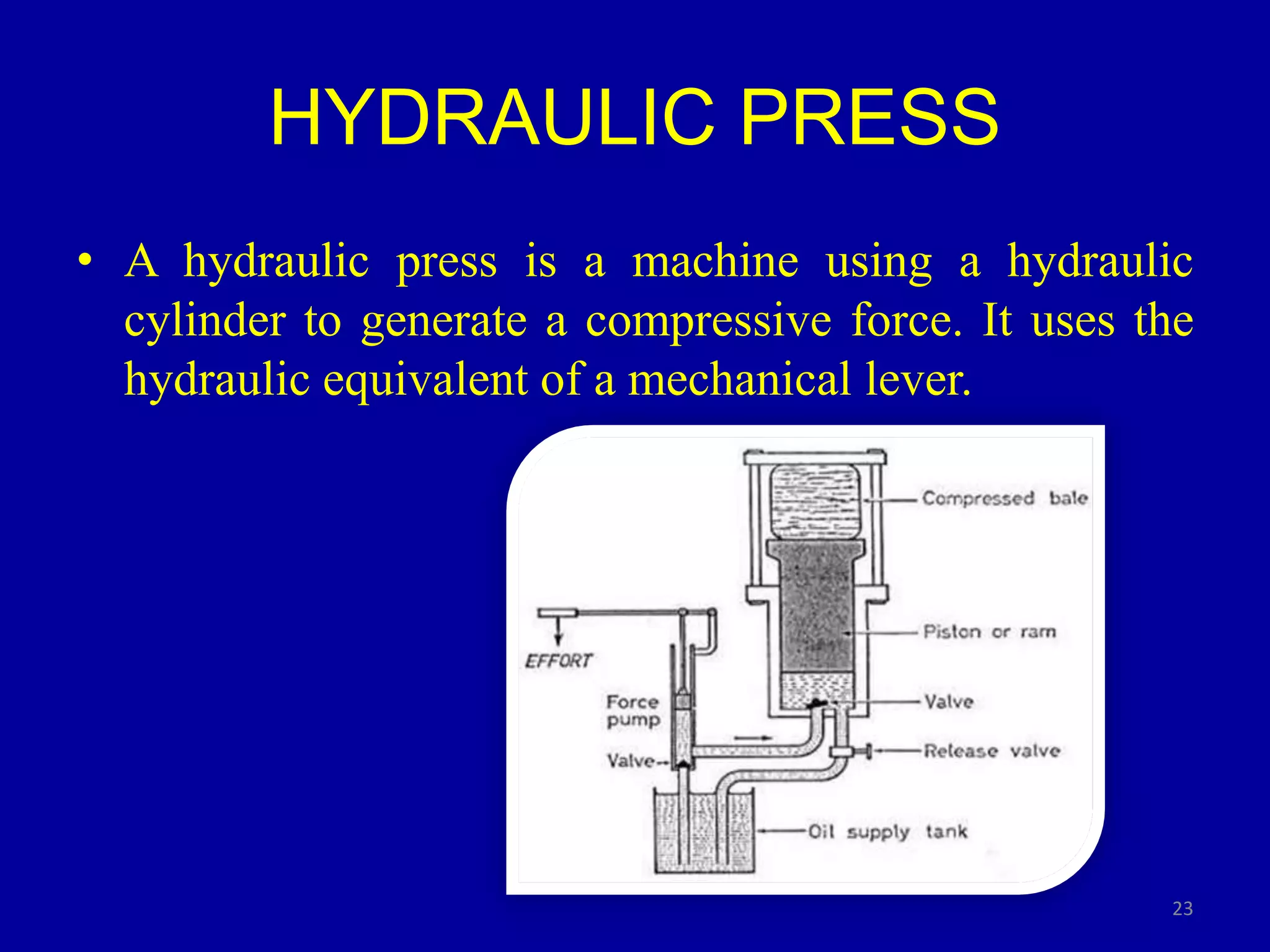
HYDRAULIC PRESS
• Ahydraulic press is a machine using a hydraulic
cylinder to generate a compressive force. It uses the
hydraulic equivalent of a mechanical lever.
23
24.
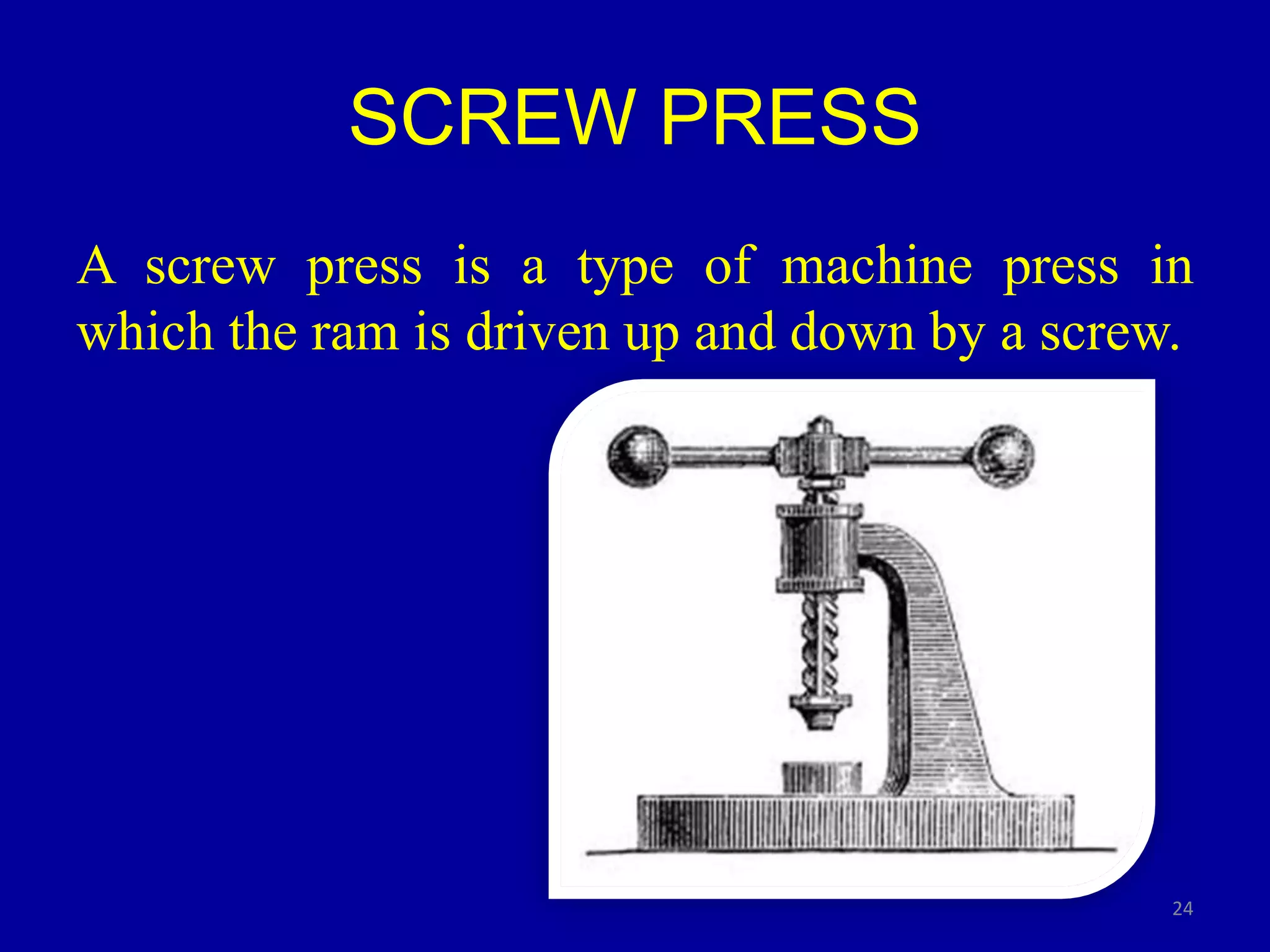
SCREW PRESS
A screwpress is a type of machine press in
which the ram is driven up and down by a screw.
24
25.
REFERENCES
• P CSharma, “Production Technology”, S.
Chand & company Ltd.
• www.nptel.ac.in/courses/112107145/10
25