DEEP DRAWING
Presented by:
Maria Iqbal
MME-13-26
(2013-2017)
Institute of Advanced Materials, BZU, Multan
Deep Drawing
Process definition:
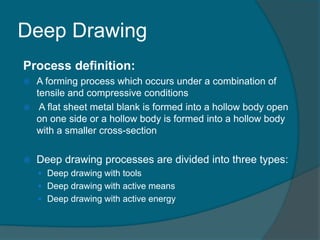
 A forming process which occurs under a combination of
tensile and compressive conditions
 A flat sheet metal blank is formed into a hollow body open
on one side or a hollow body is formed into a hollow body
with a smaller cross-section
 Deep drawing processes are divided into three types:
 Deep drawing with tools
 Deep drawing with active means
 Deep drawing with active energy
Process
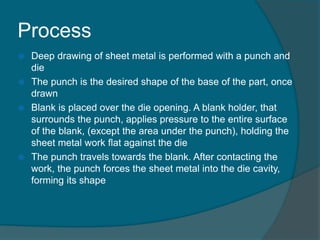
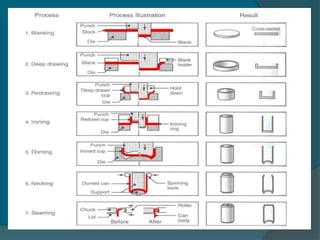
 Deep drawing of sheet metal is performed with a punch and
die
 The punch is the desired shape of the base of the part, once
drawn
 Blank is placed over the die opening. A blank holder, that
surrounds the punch, applies pressure to the entire surface
of the blank, (except the area under the punch), holding the
sheet metal work flat against the die
 The punch travels towards the blank. After contacting the
work, the punch forces the sheet metal into the die cavity,
forming its shape
Deep Drawing of Sheet
Metal
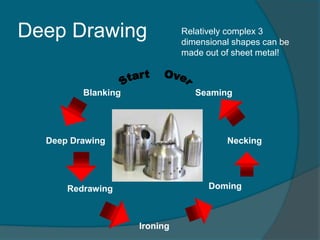
Deep Drawing
Blanking
Deep Drawing
Redrawing
Ironing
Doming
Necking
Seaming
Relatively complex 3
dimensional shapes can be
made out of sheet metal!
Drawing Ratio
 Measurement of the amount of drawing performed on a
sheet metal blank can be quantified with the drawing
ratio
 Higher the drawing ratio, the more extreme the amount
of deep drawing
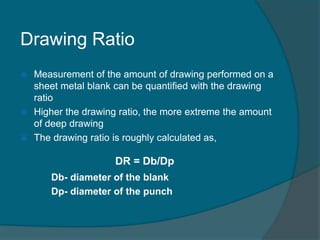
 The drawing ratio is roughly calculated as,
DR = Db/Dp
Db- diameter of the blank
Dp- diameter of the punch
Advantages
 Materials- A wide variety of ferrous and nonferrous
materials can be used
 Rapid Press Times- Deep draw transfer presses have a
rapid press time and can produce large quantities of metal
components in a short space of time
 Product Consistency- capable of high repeatability
which ensures batch to batch consistency in the production
 Complex Designs
 Reduces Material Waste
 Cost efficient process
Defects In Deep Drawing
 Tearing- Maximum thinning of the cup wall occurs
near the base, so, tearing of the sheet metal is most
likely to occur in this region even if the stress is
originating somewhere else
 Wrinkling may often occur if the blankholder force is too
low
 Excessive thinning in areas of the sheet metal
 Earing that is the formation of wavy edges at the open
end of the drawn cup
 Surface scratches or irregularities may appear
on drawn part
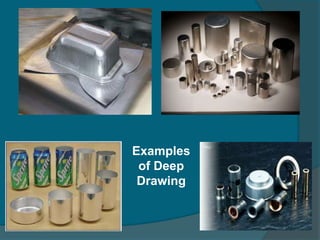
Examples
of Deep
Drawing
Deep drawing

Deep drawing

  • 2.
    DEEP DRAWING Presented by: MariaIqbal MME-13-26 (2013-2017) Institute of Advanced Materials, BZU, Multan
  • 3.
    Deep Drawing Process definition: A forming process which occurs under a combination of tensile and compressive conditions  A flat sheet metal blank is formed into a hollow body open on one side or a hollow body is formed into a hollow body with a smaller cross-section  Deep drawing processes are divided into three types:  Deep drawing with tools  Deep drawing with active means  Deep drawing with active energy
  • 4.
    Process  Deep drawingof sheet metal is performed with a punch and die  The punch is the desired shape of the base of the part, once drawn  Blank is placed over the die opening. A blank holder, that surrounds the punch, applies pressure to the entire surface of the blank, (except the area under the punch), holding the sheet metal work flat against the die  The punch travels towards the blank. After contacting the work, the punch forces the sheet metal into the die cavity, forming its shape
  • 5.
    Deep Drawing ofSheet Metal
  • 6.
    Deep Drawing Blanking Deep Drawing Redrawing Ironing Doming Necking Seaming Relativelycomplex 3 dimensional shapes can be made out of sheet metal!
  • 8.
    Drawing Ratio  Measurementof the amount of drawing performed on a sheet metal blank can be quantified with the drawing ratio  Higher the drawing ratio, the more extreme the amount of deep drawing  The drawing ratio is roughly calculated as, DR = Db/Dp Db- diameter of the blank Dp- diameter of the punch
  • 9.
    Advantages  Materials- Awide variety of ferrous and nonferrous materials can be used  Rapid Press Times- Deep draw transfer presses have a rapid press time and can produce large quantities of metal components in a short space of time  Product Consistency- capable of high repeatability which ensures batch to batch consistency in the production  Complex Designs  Reduces Material Waste  Cost efficient process
  • 10.
    Defects In DeepDrawing  Tearing- Maximum thinning of the cup wall occurs near the base, so, tearing of the sheet metal is most likely to occur in this region even if the stress is originating somewhere else  Wrinkling may often occur if the blankholder force is too low  Excessive thinning in areas of the sheet metal  Earing that is the formation of wavy edges at the open end of the drawn cup  Surface scratches or irregularities may appear on drawn part
  • 11.