

SHEET METAL WORKS
CONTENT
 INTRODUCTION
 PRESS WORKING TERMINOLOGY
 WORKING OPERATION
 DIE AND ITS TYPE
 CUTTING FORCES
IntroductionIntroduction
Sheet metal is simply metal formed into thin and flat pieces. It is one of the
fundamental forms used in metalworking, and can be cut and bent into a variety of
different shapes. Countless everyday objects are constructed of the material.
Thicknesses can vary significantly, although extremely thin thicknesses are considered
foil or leaf, and pieces thicker than 6 mm (0.25 in) are considered plate.
SHEET METAL FORMING PROCESSES
SHEARING PROCESSES: processes which apply shearing forces to cut, fracture, or
separate the material.
FORMING PROCESSES: processes which cause the metal to undergo desired shape
changes without failure, excessive thinning, or cracking. This includes bending and
stretching.
FINISHING PROCESSES: processes which are used to improve the final surface
characteristics.
Press workingPress working
Press working may be defined as, a manufacturing process by which various
components are made from sheet metal. This process is also termed as cold stamping.
The machine used for press working is called a press.
The main features of a press are:
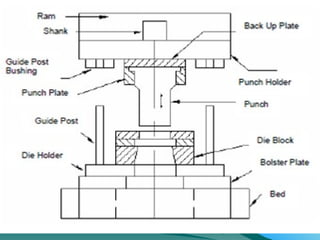
A frame which support a ram or a slide and a bed, a source of mechanism for
operating the ram in line with and normal to the bed.
The ram is equipped with suitable punch/punches and a die block is attached to the
bed.
A stamping is produced by the downward stroke of the ram when the punch moves
towards and into the die block.
The punch and die block assembly is generally termed as a “die set” or simple as the
“die”
Press working terminologyPress working terminology
Bed:
The bed is the lower part of the press frame that serves as a table to which a
Bolster plate is mounted.
Bolster Plate:
This is a thick plate secured to the press bed , which is used for locating and
supporting the die assembly. It is usually 5 to 12.5 cm thick.
Die Set:
It is unit assembly which incorporates a lower and upper shoe, two or more guide parts
and guide part bushings.
Die Block:
It is a block or a plate which contains a die cavity
Lower Shoe:
The lower shoe of the a die set is generally mounted on the bolster plate of a press. The
die block is mounted on the lower shoe, also the guide post are mounted on it.
Punch Plate :
The punch plate or punch retainer fits closely over the body of the punch and holds it
in proper relative position.
Back up Plate:
Back up plate or pressure plate is placed so that intensity of pressure does
not become excessive on punch holder. The plate distributes the pressure
over a wide area and the intensity of pressure on the punch holder is reduced
to avoid crushing
Stripper:
It is a plate which is used to strip the metal strip from cutting a non-cutting
Punch or die. It may also guide the sheet.
Press working operationsPress working operations
The sheet metal operations done a press may be grouped into two categories.
1: Cutting operations
In cutting operations the work piece is stressed by its ultimate strength. The stresses
caused in the metal the applied forces will be shear stresses. The cutting operations
include:
(a) Blanking (b) Punching (c) Notching
(d) Perforating (e) Trimming (f) Shaving
(g) Slitting (h) Lancing
2: Forming operations
In forming operations , the stresses are below the ultimate strength of the metal , in this
operation , there is no cutting of the metal but only the contour of the work piece is
changed to get the desired product.
The forming operations include:
(a) Bending (b) Drawing (c) Squeezing
Shearing processShearing process
PUNCHING:
Punching is a metal forming process that uses a punch press to force a tool, called a
punch, through the workpiece to create a hole via shearing.
BLANKING:
shearing process using a die and punch where the exterior portion of the shearing
operation is to be discarded.
PERFORATING:
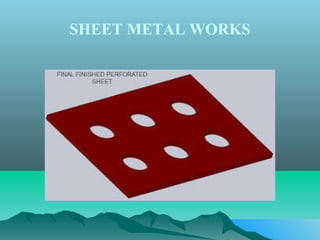
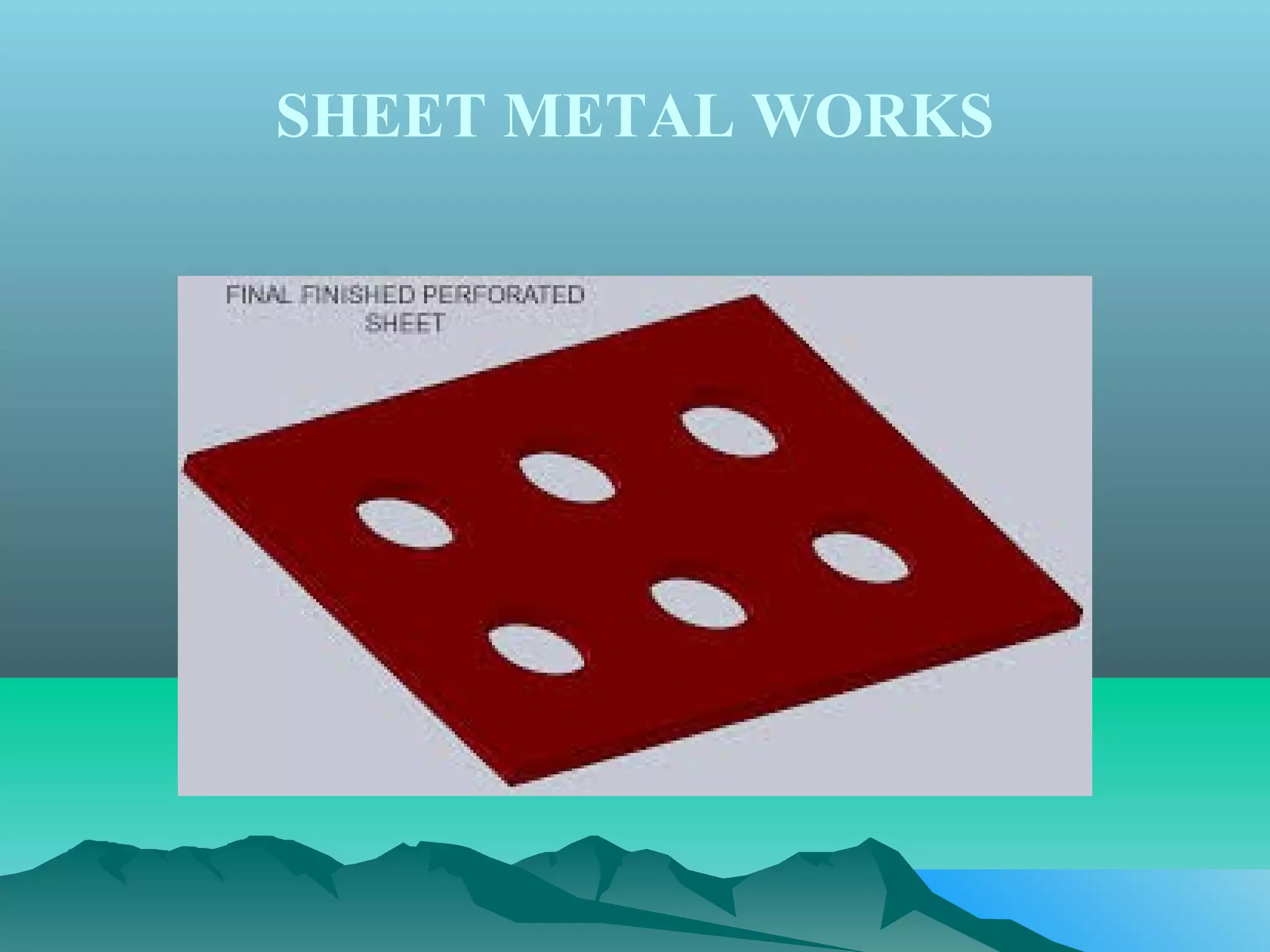
punching a number of holes in a sheet.
PARTING:
shearing the sheet into two or more pieces.
NOTCHING:
removing pieces from the edges.
LANCING:
leaving a tab without removing any material.
Forming processForming process
SHEET METAL BENDING:
Bending is a manufacturing process by which metal can be deformed by plastically
deforming the material and changing its shape. The material is stressed beyond its yield
strength but below its ultimate tensile strength.
STRETCHING:
Forming process causes the sheet metal to undergo the desired shape change by
stretching without failure.
DEEP DRAWING:
Deep Drawing is a sheet metal process in which metal sheet is radial drawn into a
forming die by the mechanical action of punch. It is thus shape transformation process
with material retention.
ROLL FORMING:
Roll forming is a process by which a metal strip is progressively bent as it passes
through a series of forming rolls.
Dies and its Types
Types of dies:
The dies may be classified according to the type of press operation and according to
the method of operation.
(A): According to type of press operation:
According to this criterion , the dies may be classified as cutting dies and forming dies.
1: Cutting Dies:
These dies are used to cut the metal. They utilize the cutting or shearing action. The
common cutting dies are : blanking dies , perforating dies , notching dies , trimming ,
shaving and nibbling dies.
2: Forming Dies:
These dies change the appearance of the blank without removing any stock. Theses
dies include bending, drawing and squeezing dies etc.
(B) According to the method of operation:
According to this criterion, the dies may be classified as : single operation or simple
dies , compound dies , combination dies , progressive dies , transfer dies and multiple
dies.
1: Simple Dies:
Simple dies or single action dies perform single operation for each stroke of the press
slide. The operation may be one of the operation listed under cutting or forming dies.
2: Compound Dies:
In these dies, two or more operations may be performed at one station. Such dies are
considered as cutting tools since, only cutting operations are carried out. Figure shows
a simple compound die in which a washer is made by one stroke of the press. The
washer is produced by simulation blanking and piercing operations. Compound dies are
more accurate and economical in production as compared to single operation dies.
Combination Dies:
In this die also , more than one operation may be performed at one station. It is difficult
from compound die in that in this die, a cutting operation is combined with a bending
or drawing operation, due to that it is called combination die.
Progressive Dies:
A progressive or follow on die has a series of operations. At each station , an operation
is performed on a work piece during a stroke of the press. Between stroke the piece in
the metal strip is transferred to the next station.
Transfer Dies:
Unlike the progressive dies where the stroke is fed progressively from one station to
another. In transfer dies the already cut blanks are fed mechanically from one station to
other station.
Multiple Dies:
Multiple or gang dies produce two or more work piece at each stroke of the press. A
gang or number of simple dies and punches are ganged together to produced two or
more parts at each stoke of the press.
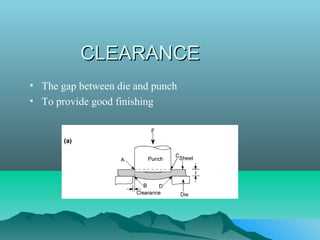
CLEARANCECLEARANCE
• The gap between die and punch
• To provide good finishing
CUTTING FORCESCUTTING FORCES
• The Cutting force is the force which has to act on the on
the stock material in order to cut out the blanker slug.
This determines the capacity of the press to be used for
particular tool. The first step in establishing the cutting
force is to determine the cut length area. The area to be
cut is found by multiplying the length of cut by stock
thickness.
Cutting force = L*S*Tmax
L = Length of periphery to be cut in ‘mm’.
S = Sheet thickness in ‘mm’
T max = Shear strength in N/mm2
Method of reducing CuttingMethod of reducing Cutting
forceforce
1. Stepped punches to be used.
2. Grinding the face of the punch or die to a small shear angle.
• Diameter of piercing
• Minimum 1.2 times greater than thickness of sheet
• For stainless steel and other high tensile metal it should be 2
times
• Centre of pressure
• Point at which distribution of pressure is symmetric about all
point.
• Much more important for designing purpose
DRAWINGDRAWING
 Drawing ratio
 Calculation of blank diameter
 Calculation of drawing force
 Two main factor will cause the punch in deep drawing to draw
the metal into the cavity rather than shearing it.
 Die corner radius and punch corner radius
 Amount of clearance
THANK
YOU
• SUBMITTED BY-
• KANHAIYA KUMAR JHA(A12405413033)
• BADRI VISHAL (A12405413038)
• SHYAM TEJRA (A12405413039)
• JEMS AHAMAD (A12405413020)

Module 5

  • 1.
  • 2.
    CONTENT  INTRODUCTION  PRESSWORKING TERMINOLOGY  WORKING OPERATION  DIE AND ITS TYPE  CUTTING FORCES
  • 3.
    IntroductionIntroduction Sheet metal issimply metal formed into thin and flat pieces. It is one of the fundamental forms used in metalworking, and can be cut and bent into a variety of different shapes. Countless everyday objects are constructed of the material. Thicknesses can vary significantly, although extremely thin thicknesses are considered foil or leaf, and pieces thicker than 6 mm (0.25 in) are considered plate. SHEET METAL FORMING PROCESSES SHEARING PROCESSES: processes which apply shearing forces to cut, fracture, or separate the material. FORMING PROCESSES: processes which cause the metal to undergo desired shape changes without failure, excessive thinning, or cracking. This includes bending and stretching. FINISHING PROCESSES: processes which are used to improve the final surface characteristics.
  • 4.
    Press workingPress working Pressworking may be defined as, a manufacturing process by which various components are made from sheet metal. This process is also termed as cold stamping. The machine used for press working is called a press. The main features of a press are: A frame which support a ram or a slide and a bed, a source of mechanism for operating the ram in line with and normal to the bed. The ram is equipped with suitable punch/punches and a die block is attached to the bed. A stamping is produced by the downward stroke of the ram when the punch moves towards and into the die block. The punch and die block assembly is generally termed as a “die set” or simple as the “die”
  • 5.
    Press working terminologyPressworking terminology Bed: The bed is the lower part of the press frame that serves as a table to which a Bolster plate is mounted. Bolster Plate: This is a thick plate secured to the press bed , which is used for locating and supporting the die assembly. It is usually 5 to 12.5 cm thick. Die Set: It is unit assembly which incorporates a lower and upper shoe, two or more guide parts and guide part bushings. Die Block: It is a block or a plate which contains a die cavity Lower Shoe: The lower shoe of the a die set is generally mounted on the bolster plate of a press. The die block is mounted on the lower shoe, also the guide post are mounted on it.
  • 6.
    Punch Plate : Thepunch plate or punch retainer fits closely over the body of the punch and holds it in proper relative position. Back up Plate: Back up plate or pressure plate is placed so that intensity of pressure does not become excessive on punch holder. The plate distributes the pressure over a wide area and the intensity of pressure on the punch holder is reduced to avoid crushing Stripper: It is a plate which is used to strip the metal strip from cutting a non-cutting Punch or die. It may also guide the sheet.
  • 8.
    Press working operationsPressworking operations The sheet metal operations done a press may be grouped into two categories. 1: Cutting operations In cutting operations the work piece is stressed by its ultimate strength. The stresses caused in the metal the applied forces will be shear stresses. The cutting operations include: (a) Blanking (b) Punching (c) Notching (d) Perforating (e) Trimming (f) Shaving (g) Slitting (h) Lancing 2: Forming operations In forming operations , the stresses are below the ultimate strength of the metal , in this operation , there is no cutting of the metal but only the contour of the work piece is changed to get the desired product. The forming operations include: (a) Bending (b) Drawing (c) Squeezing
  • 9.
    Shearing processShearing process PUNCHING: Punchingis a metal forming process that uses a punch press to force a tool, called a punch, through the workpiece to create a hole via shearing. BLANKING: shearing process using a die and punch where the exterior portion of the shearing operation is to be discarded. PERFORATING: punching a number of holes in a sheet. PARTING: shearing the sheet into two or more pieces. NOTCHING: removing pieces from the edges. LANCING: leaving a tab without removing any material.
  • 10.
    Forming processForming process SHEETMETAL BENDING: Bending is a manufacturing process by which metal can be deformed by plastically deforming the material and changing its shape. The material is stressed beyond its yield strength but below its ultimate tensile strength. STRETCHING: Forming process causes the sheet metal to undergo the desired shape change by stretching without failure. DEEP DRAWING: Deep Drawing is a sheet metal process in which metal sheet is radial drawn into a forming die by the mechanical action of punch. It is thus shape transformation process with material retention. ROLL FORMING: Roll forming is a process by which a metal strip is progressively bent as it passes through a series of forming rolls.
  • 11.
    Dies and itsTypes Types of dies: The dies may be classified according to the type of press operation and according to the method of operation. (A): According to type of press operation: According to this criterion , the dies may be classified as cutting dies and forming dies. 1: Cutting Dies: These dies are used to cut the metal. They utilize the cutting or shearing action. The common cutting dies are : blanking dies , perforating dies , notching dies , trimming , shaving and nibbling dies. 2: Forming Dies: These dies change the appearance of the blank without removing any stock. Theses dies include bending, drawing and squeezing dies etc.
  • 12.
    (B) According tothe method of operation: According to this criterion, the dies may be classified as : single operation or simple dies , compound dies , combination dies , progressive dies , transfer dies and multiple dies. 1: Simple Dies: Simple dies or single action dies perform single operation for each stroke of the press slide. The operation may be one of the operation listed under cutting or forming dies. 2: Compound Dies: In these dies, two or more operations may be performed at one station. Such dies are considered as cutting tools since, only cutting operations are carried out. Figure shows a simple compound die in which a washer is made by one stroke of the press. The washer is produced by simulation blanking and piercing operations. Compound dies are more accurate and economical in production as compared to single operation dies.
  • 13.
    Combination Dies: In thisdie also , more than one operation may be performed at one station. It is difficult from compound die in that in this die, a cutting operation is combined with a bending or drawing operation, due to that it is called combination die. Progressive Dies: A progressive or follow on die has a series of operations. At each station , an operation is performed on a work piece during a stroke of the press. Between stroke the piece in the metal strip is transferred to the next station. Transfer Dies: Unlike the progressive dies where the stroke is fed progressively from one station to another. In transfer dies the already cut blanks are fed mechanically from one station to other station. Multiple Dies: Multiple or gang dies produce two or more work piece at each stroke of the press. A gang or number of simple dies and punches are ganged together to produced two or more parts at each stoke of the press.
  • 14.
    CLEARANCECLEARANCE • The gapbetween die and punch • To provide good finishing
  • 15.
    CUTTING FORCESCUTTING FORCES •The Cutting force is the force which has to act on the on the stock material in order to cut out the blanker slug. This determines the capacity of the press to be used for particular tool. The first step in establishing the cutting force is to determine the cut length area. The area to be cut is found by multiplying the length of cut by stock thickness. Cutting force = L*S*Tmax L = Length of periphery to be cut in ‘mm’. S = Sheet thickness in ‘mm’ T max = Shear strength in N/mm2
  • 16.
    Method of reducingCuttingMethod of reducing Cutting forceforce 1. Stepped punches to be used. 2. Grinding the face of the punch or die to a small shear angle.
  • 17.
    • Diameter ofpiercing • Minimum 1.2 times greater than thickness of sheet • For stainless steel and other high tensile metal it should be 2 times • Centre of pressure • Point at which distribution of pressure is symmetric about all point. • Much more important for designing purpose
  • 18.
    DRAWINGDRAWING  Drawing ratio Calculation of blank diameter  Calculation of drawing force  Two main factor will cause the punch in deep drawing to draw the metal into the cavity rather than shearing it.  Die corner radius and punch corner radius  Amount of clearance
  • 19.
  • 20.
    • SUBMITTED BY- •KANHAIYA KUMAR JHA(A12405413033) • BADRI VISHAL (A12405413038) • SHYAM TEJRA (A12405413039) • JEMS AHAMAD (A12405413020)