BY:
N J V S PAVAN
3RD B.PHARM
L20PH02101
Hindu College
of
Pharmacy ,
Guntur.,
1. Definition
2.Advantages & dis advantages
3.Ideal properties
4.Classification
Definition
A shampoo is a hair cleansing preparation made of a surfactant
(i.e. surface active material) in a suitable form – liquid, solid or
powder – which when used under the specified conditions will
remove surface grease, dirt, and skin debris from the hair shaft
and scalp without adversely affecting the user.
Advantages Dis-Advantages
• It keeps hair silky and smooth.
• Shampoo foam is pleasing.
• It is less toxic.
• Keeps dirt , pollutant , dust and oil away.
• Shampoo is easy to rinse.
• There is minimum skin and eye irritation.
• Free from side effects.
• It repairs damaged hair &
• causes less damage to hair.
• Continuous expose to the shampoo,
causes headache.
• It may also causes sourness in
eyes,nose,throat and lungs.
• Sodium laurate sulphate is commonly
used in shampoo which may harm skin,
eyes and even may be carcinogenic.
Ideal properties
1. To make the hair smooth and shiny.
2. Produce good amount of foam.
3. Should not cause irritation to scalp, skin and eye.
4. Impart pleasant fragrance to hair.
5. Low toxicity.
Classification
Powder shampoo
Liquid shampoo
Gel shampoo
Cream shampoo
Oil shampoo
Medicated shampoo
Etc….
 Conditioning shampoo
 Anti-dandruff shampoo
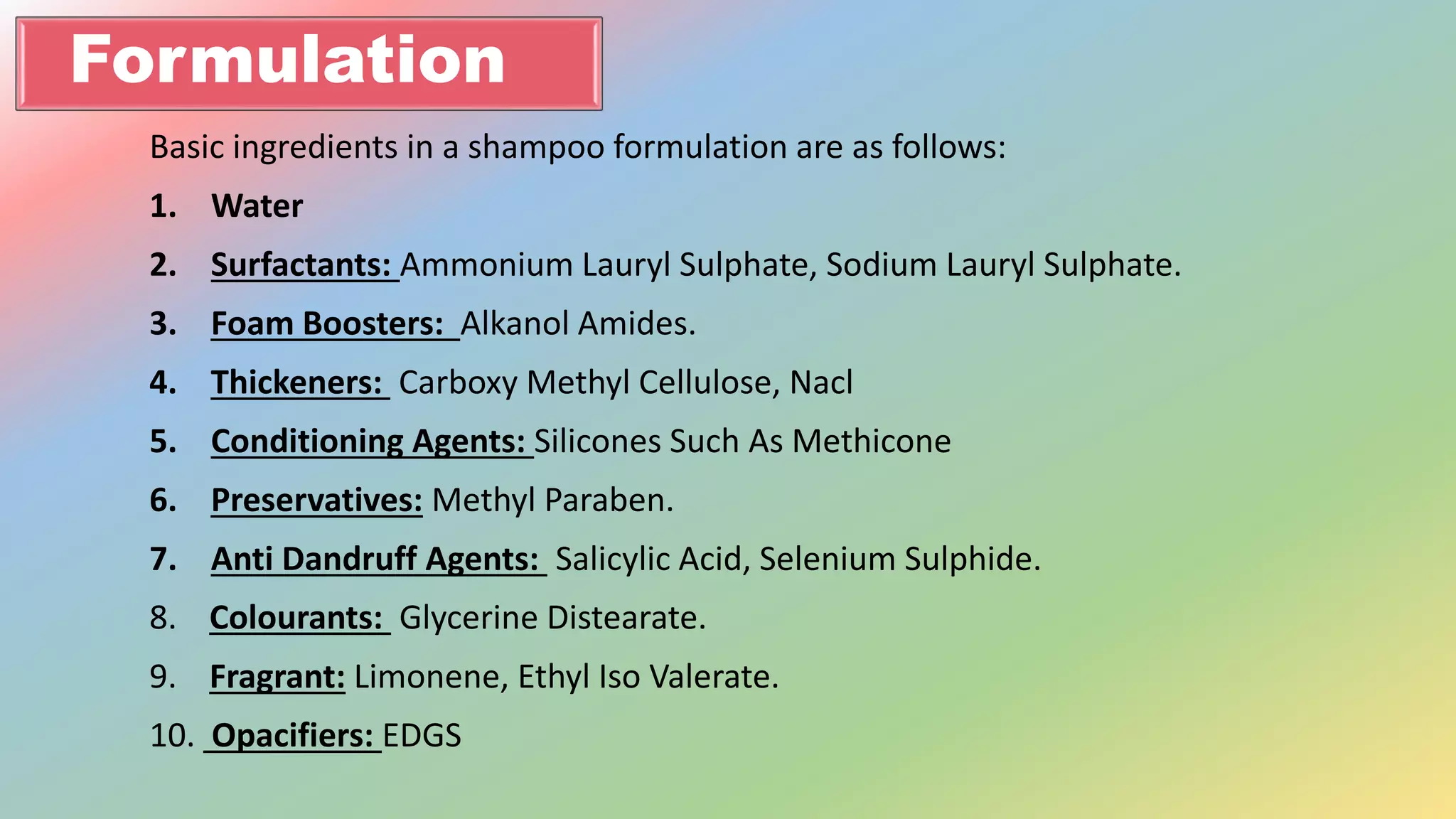
 Baby shampoo
 Balancing shampoo
 Clarifying shampoo
Etc….
Formulation
Basic ingredients in a shampoo formulation are as follows:
1. Water
2. Surfactants: Ammonium Lauryl Sulphate, Sodium Lauryl Sulphate.
3. Foam Boosters: Alkanol Amides.
4. Thickeners: Carboxy Methyl Cellulose, Nacl
5. Conditioning Agents: Silicones Such As Methicone
6. Preservatives: Methyl Paraben.
7. Anti Dandruff Agents: Salicylic Acid, Selenium Sulphide.
8. Colourants: Glycerine Distearate.
9. Fragrant: Limonene, Ethyl Iso Valerate.
10. Opacifiers: EDGS
Surfactants function as surface tension disrupting
agent in shampoos . Surfactants are used to break
down and remove dirt and other impurities, due to their
ability to dissolve the barrier between dirt, oil, and water.
Foam boosters acts as a foam booster and imparts
silky smoothness to hair
The duty of thickening agents shampoos is to
plump each strand of hair to make it fuller so
that it occupies more space
Conditioning agents condition and coat the hair
to keep it moisturized and soft, and also act as a
detangler by lubricating the follicles, making them
easier to untangle. Conditioner also helps to prevent
static, which can make your hair frizzy
Preservatives help to preserve the formula and
ensure the durability of shampoo product
Anti-dandruff agents are intended to reduce the
formation of dandruff flakes
Colorants are essentially used for making
shampoos appealing and attractive and
identification
Opacifiers are additives that impart a rich, creamy,
luxurious feel and appearance to shampoos.
Fragrants are used in these products is to mask
unpleasant aromas or odours from other active
chemical ingredients
Preparation
1. Initially the detergent is converted into a solution form or a detergent solution
may be directly obtained from the manufacturer.
2. Take about half of the detergent solution into a separate container. To it, add
the total amount of secondary surfactant i.e., alkanol amide.
3. Dissolve the alkanol amide along with stirring. Sometimes, gentle heat is also
applied.
4. To the remaining half of the detergent solution add a suitable amount of
perfuming agent and dissolve it.
5. The perfume solution is then added to the alkanol amide solution.
6. Colour and preservatives are dissolved separately in a sufficient volume of
water and then added to the main solution.
Method of preparation
7. The whole solution is mixed well by gentle stirring. Excessive stirring may lead to bubble
formation.
8. Final volume of the preparation is usually adjusted by the addition of clear sterile water.
This gives clear liquid shampoo.
9. However, when the preparation contains lauryl alcohol ether sulfate. It is required to
adjust the viscosity of the shampoo.
10. Viscosity adjustment is done by using an electrolyte solution. Usually, a solution of
sodium chloride is added subsequently with constant stirring. Care must be taken to
prevent the excess addition of sodium chloride.
Quality control test
Foam stability test :-
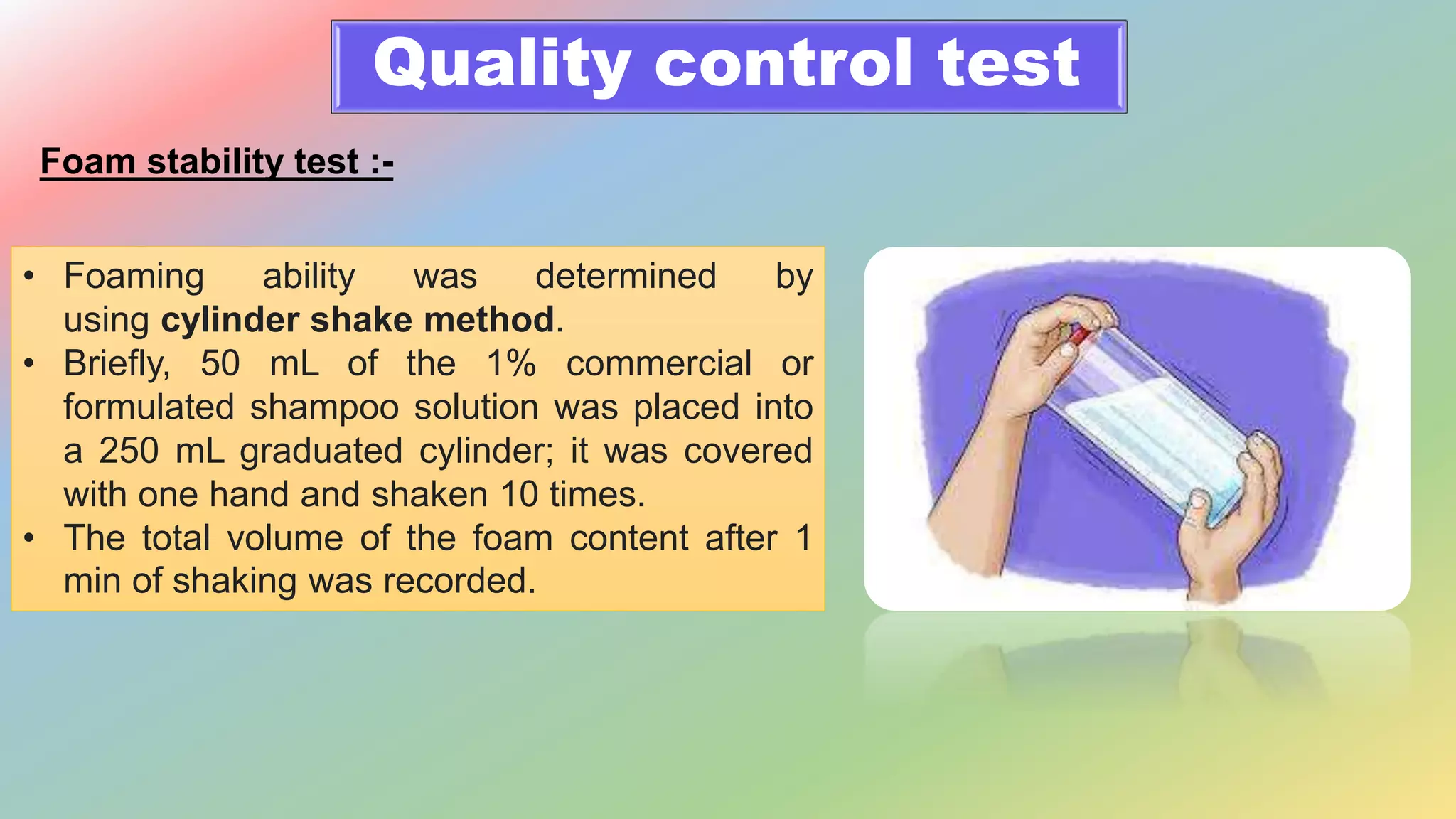
• Foaming ability was determined by
using cylinder shake method.
• Briefly, 50 mL of the 1% commercial or
formulated shampoo solution was placed into
a 250 mL graduated cylinder; it was covered
with one hand and shaken 10 times.
• The total volume of the foam content after 1
min of shaking was recorded.
Tests for safety :-
(a) Draize test : Safety is determined by using the Draize test which suggests two separate methods
for testing skin and eye toxicity. The following steps are involved in the test:
(i) Six albino rabbits were selected weighing 2 kg.
(ii) Round patch is made on each rabbit’s skin by removing hair.
(iii) Apply to dilute preparation of shampoo on each patch.
(iv) Shampoo will react for 2-3 hr and then it is removed.
(v) After washing the skin is examined for any irritation
(vi) Based on the result obtained shampoo is evaluated as
safe or toxic.
(b) Eye-toxicity test:
The following steps are involved in the test:
(i) Six adult albino rabbits are selected
(ii) One eye is considered as a test and another as a control eye.
(iii) To each eye the product is applied.
(iv) Washing is done with tap water for 20 seconds.
(v) Eye is rewashed after 5 minutes and then after 24 hours.
(vi) The control eye is also washed on the first day and then after 24 hours.
(vii) The test eyes are observed at 1, 24, 48, and 72 hours respectively.
(viii) The product is considered to be toxic if there is a development of iris
and corneal lesions which remain for more than 7 days.
Viscosity test :-
Viscosity is determined using Brookefield Viscometer….
100ml of shampoo is taken in a beaker and spindle is
dipped in it for about 5min and then reading is taken.
Viscosity test :-
Mix 1gm of shampoo with 9ml of water and determine
the pH using pH meter at 27 degree celcius
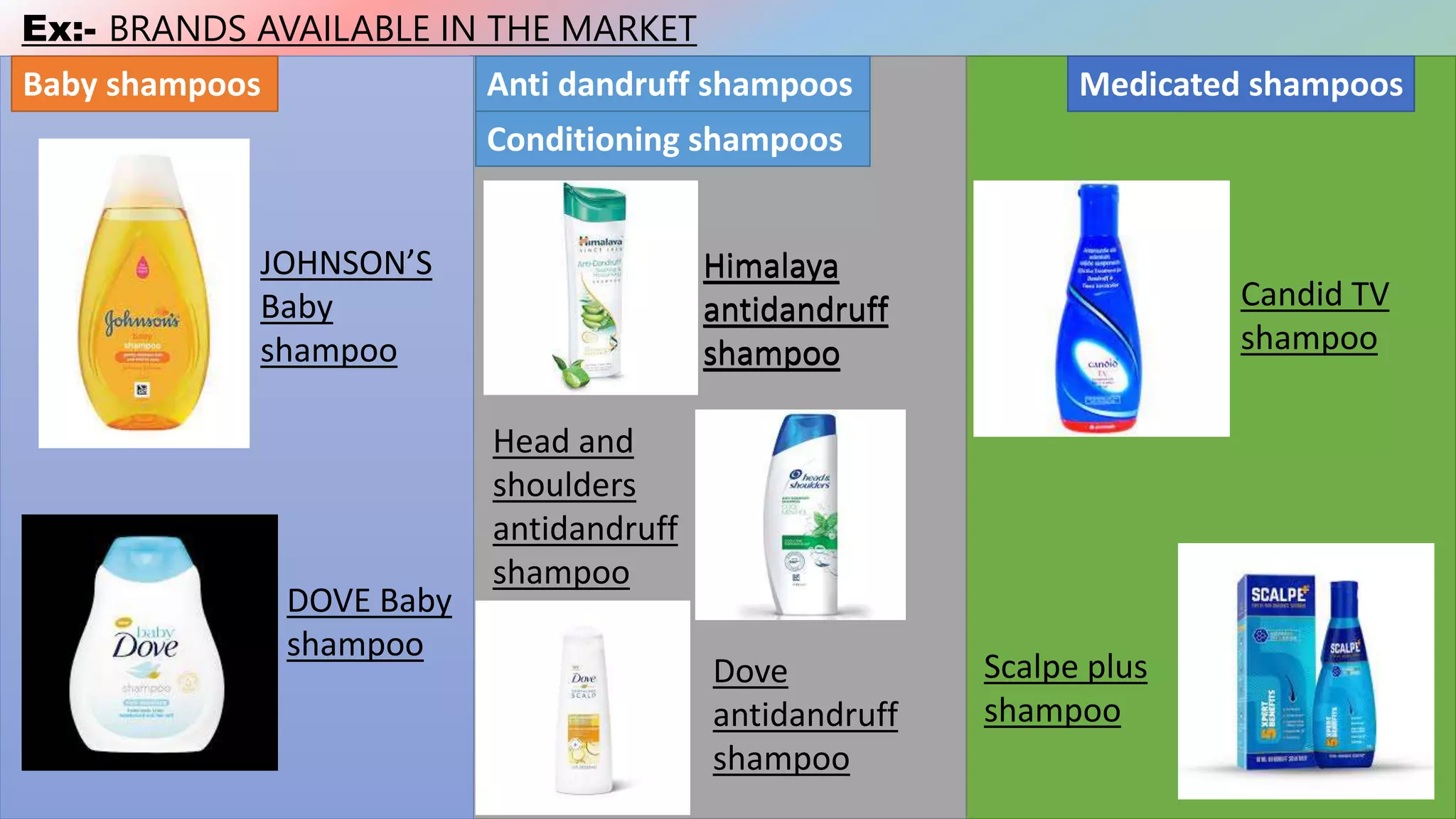
Ex:- BRANDS AVAILABLE IN THE MARKET
Anti dandruff shampoos
Conditioning shampoos
Medicated shampoos
Baby shampoos
DOVE Baby
shampoo
JOHNSON’S
Baby
shampoo
Himalaya
antidandruff
shampoo
Head and
shoulders
antidandruff
shampoo
Himalaya
antidandruff
shampoo
Dove
antidandruff
shampoo
Candid TV
shampoo
Scalpe plus
shampoo
www.slideshare.net/nukalapavan
REFERENCES:
A handbook of cosmetics B.M.Mithal and R.N.Sana.
A Book of Cosmetics by PP sharma.

Shampoo ppt by pavan

  • 1.
    BY: N J VS PAVAN 3RD B.PHARM L20PH02101 Hindu College of Pharmacy , Guntur.,
  • 2.
    1. Definition 2.Advantages &dis advantages 3.Ideal properties 4.Classification
  • 3.
    Definition A shampoo isa hair cleansing preparation made of a surfactant (i.e. surface active material) in a suitable form – liquid, solid or powder – which when used under the specified conditions will remove surface grease, dirt, and skin debris from the hair shaft and scalp without adversely affecting the user.
  • 4.
    Advantages Dis-Advantages • Itkeeps hair silky and smooth. • Shampoo foam is pleasing. • It is less toxic. • Keeps dirt , pollutant , dust and oil away. • Shampoo is easy to rinse. • There is minimum skin and eye irritation. • Free from side effects. • It repairs damaged hair & • causes less damage to hair. • Continuous expose to the shampoo, causes headache. • It may also causes sourness in eyes,nose,throat and lungs. • Sodium laurate sulphate is commonly used in shampoo which may harm skin, eyes and even may be carcinogenic.
  • 5.
    Ideal properties 1. Tomake the hair smooth and shiny. 2. Produce good amount of foam. 3. Should not cause irritation to scalp, skin and eye. 4. Impart pleasant fragrance to hair. 5. Low toxicity.
  • 6.
    Classification Powder shampoo Liquid shampoo Gelshampoo Cream shampoo Oil shampoo Medicated shampoo Etc….  Conditioning shampoo  Anti-dandruff shampoo  Baby shampoo  Balancing shampoo  Clarifying shampoo Etc….
  • 7.
    Formulation Basic ingredients ina shampoo formulation are as follows: 1. Water 2. Surfactants: Ammonium Lauryl Sulphate, Sodium Lauryl Sulphate. 3. Foam Boosters: Alkanol Amides. 4. Thickeners: Carboxy Methyl Cellulose, Nacl 5. Conditioning Agents: Silicones Such As Methicone 6. Preservatives: Methyl Paraben. 7. Anti Dandruff Agents: Salicylic Acid, Selenium Sulphide. 8. Colourants: Glycerine Distearate. 9. Fragrant: Limonene, Ethyl Iso Valerate. 10. Opacifiers: EDGS
  • 8.
    Surfactants function assurface tension disrupting agent in shampoos . Surfactants are used to break down and remove dirt and other impurities, due to their ability to dissolve the barrier between dirt, oil, and water. Foam boosters acts as a foam booster and imparts silky smoothness to hair The duty of thickening agents shampoos is to plump each strand of hair to make it fuller so that it occupies more space Conditioning agents condition and coat the hair to keep it moisturized and soft, and also act as a detangler by lubricating the follicles, making them easier to untangle. Conditioner also helps to prevent static, which can make your hair frizzy
  • 9.
    Preservatives help topreserve the formula and ensure the durability of shampoo product Anti-dandruff agents are intended to reduce the formation of dandruff flakes Colorants are essentially used for making shampoos appealing and attractive and identification Opacifiers are additives that impart a rich, creamy, luxurious feel and appearance to shampoos. Fragrants are used in these products is to mask unpleasant aromas or odours from other active chemical ingredients
  • 10.
  • 11.
    1. Initially thedetergent is converted into a solution form or a detergent solution may be directly obtained from the manufacturer. 2. Take about half of the detergent solution into a separate container. To it, add the total amount of secondary surfactant i.e., alkanol amide. 3. Dissolve the alkanol amide along with stirring. Sometimes, gentle heat is also applied. 4. To the remaining half of the detergent solution add a suitable amount of perfuming agent and dissolve it. 5. The perfume solution is then added to the alkanol amide solution. 6. Colour and preservatives are dissolved separately in a sufficient volume of water and then added to the main solution. Method of preparation
  • 12.
    7. The wholesolution is mixed well by gentle stirring. Excessive stirring may lead to bubble formation. 8. Final volume of the preparation is usually adjusted by the addition of clear sterile water. This gives clear liquid shampoo. 9. However, when the preparation contains lauryl alcohol ether sulfate. It is required to adjust the viscosity of the shampoo. 10. Viscosity adjustment is done by using an electrolyte solution. Usually, a solution of sodium chloride is added subsequently with constant stirring. Care must be taken to prevent the excess addition of sodium chloride.
  • 13.
    Quality control test Foamstability test :- • Foaming ability was determined by using cylinder shake method. • Briefly, 50 mL of the 1% commercial or formulated shampoo solution was placed into a 250 mL graduated cylinder; it was covered with one hand and shaken 10 times. • The total volume of the foam content after 1 min of shaking was recorded.
  • 14.
    Tests for safety:- (a) Draize test : Safety is determined by using the Draize test which suggests two separate methods for testing skin and eye toxicity. The following steps are involved in the test: (i) Six albino rabbits were selected weighing 2 kg. (ii) Round patch is made on each rabbit’s skin by removing hair. (iii) Apply to dilute preparation of shampoo on each patch. (iv) Shampoo will react for 2-3 hr and then it is removed. (v) After washing the skin is examined for any irritation (vi) Based on the result obtained shampoo is evaluated as safe or toxic.
  • 15.
    (b) Eye-toxicity test: Thefollowing steps are involved in the test: (i) Six adult albino rabbits are selected (ii) One eye is considered as a test and another as a control eye. (iii) To each eye the product is applied. (iv) Washing is done with tap water for 20 seconds. (v) Eye is rewashed after 5 minutes and then after 24 hours. (vi) The control eye is also washed on the first day and then after 24 hours. (vii) The test eyes are observed at 1, 24, 48, and 72 hours respectively. (viii) The product is considered to be toxic if there is a development of iris and corneal lesions which remain for more than 7 days.
  • 16.
    Viscosity test :- Viscosityis determined using Brookefield Viscometer…. 100ml of shampoo is taken in a beaker and spindle is dipped in it for about 5min and then reading is taken. Viscosity test :- Mix 1gm of shampoo with 9ml of water and determine the pH using pH meter at 27 degree celcius
  • 17.
    Ex:- BRANDS AVAILABLEIN THE MARKET Anti dandruff shampoos Conditioning shampoos Medicated shampoos Baby shampoos DOVE Baby shampoo JOHNSON’S Baby shampoo Himalaya antidandruff shampoo Head and shoulders antidandruff shampoo Himalaya antidandruff shampoo Dove antidandruff shampoo Candid TV shampoo Scalpe plus shampoo
  • 18.
    www.slideshare.net/nukalapavan REFERENCES: A handbook ofcosmetics B.M.Mithal and R.N.Sana. A Book of Cosmetics by PP sharma.