RAGAVENDRA
INSTITUTE OF
PHARMACEUTICAL
EDUCATION AND
RESEARCH
INTRODUCTION:
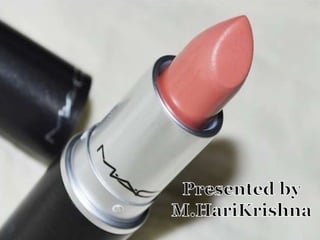
• Lipstick are basically dispersions of colouring
matter in a base containing a suitable blend of
oils, fats and waxes suitably perfume, flavoured
and moulded in the form of stick and enclosed in
a case.
• Base – emollient action
CHARACTERISTICS:
• It should be smooth and easy to apply leaving a
thin film on lips.
• It should have a good degree of indelibility.
• It should have high retention of colour intensity.
• It should be free from grittiness and should be
non-drying.
• It should have required plasticity.
• It should be innocuous externally as well as
internally.
• It should have pleasant odour/flavour.
• It should not lose its smooth and shiny appearance
during storage.
• Is should remain free from bloom or sweating during
storage.
• It should remain firm within reasonable variation of
climatic temperature.
COMPOSITION:
• Wax mixture,
• Oil mixture,
• Bromo mixture,
• Colours,
• Preservatives
• Fragrance,
• Antioxidants,
• Surfactants and other additives
Formulation:
Carnauba wax – 10g
Bees wax – 15g
Lanolin – 5g
Cetyl alcohol – 4g
Castor oil – 62g
Candelilla wax – 2g
Ozokerite wax – 2g
Dye – q.s
Perfume – q.s
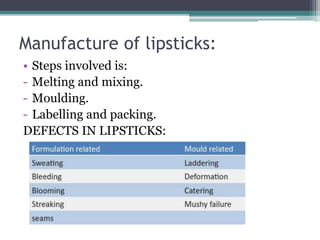
Manufacture of lipsticks:
• Steps involved is:
- Melting and mixing.
- Moulding.
- Labelling and packing.
DEFECTS IN LIPSTICKS:
EVALUATION OF LIPSTICK:
• Colour control,
• Determination of melting point(heat test),
• Softening point,
• Microbial testing,
• Rancidity,
• Rupture test,
• Breaking load test.
Colour control:
• Colour control of lipstick is critical ,
manufacture to be aware of this.
• Colorimetric equipment is used to provide some
control on the shades of lipstick.
• This equipment gives a numerical reading of the
shade, when mixed, so it can identically match
previous batches.
DETERMINATION OF MELTING POINT:
• The lipstick base
should have a M.P.
between 55 – 75°C
SOFTENING POINT:
• A lipstick should withstand the range of
conditions to which it will subjected in the
consumers handbag.
• It should be resistant to varying temp & be just
as easy to apply in the hot as in cold weather.
• Softening point range 50-550C.
• Method: Ring and Ball method Second Method.
Microbial testing:
• Contamination from raw materials, moulds,
storage kettles or lipstick container can lead to
microbial growth.
• The test consist of plating a known mass of the
sample on two selected culture media
specifically suitable for the growth of bacteria
fungi incubating them for a specified period to
permit the development of visual colonies for
counting.
• The limit is, not more than 100 µo/gm
Rancidity:
• Rancidification is the decomposition of fats, oils
and other lipids by hydrolysis or oxidation.
• It leads to obnoxious odour, bad taste & sticky
product & sometimes change of colour of the
product.
• Testing of rancidity can be done by determining
its peroxide number
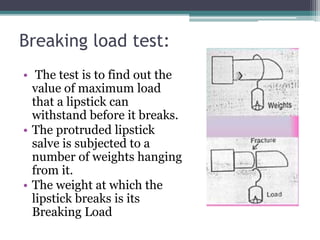
Breaking load test:
• The test is to find out the
value of maximum load
that a lipstick can
withstand before it breaks.
• The protruded lipstick
salve is subjected to a
number of weights hanging
from it.
• The weight at which the
lipstick breaks is its
Breaking Load
FACTS:
• First manmade lipsticks appeared around four to five
thousand years ago in Ancient Mesopotamia.
• 80% of the American women regularly wear lipstick and
over 25% won’t leave house without wearing it.
• Lipsticks can contain fish scales, and castor oil that
provides lips with shiny film that can’t be smeared easily.
• During dark and middle ages in Europe, lipsticks were
often viewed as a fashion accessory of prostitutes and
lower class women.
• One of the most expensive lipsticks in the world is
Guerlain’s KissKiss Gold and Diamonds Lipstick, which
will set you back $62,000.
www.facebook.com/pharmaeducation
https://ultrapharmacy.blogspot.in

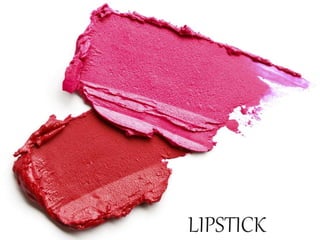
Lipstick

  • 1.
  • 4.
    INTRODUCTION: • Lipstick arebasically dispersions of colouring matter in a base containing a suitable blend of oils, fats and waxes suitably perfume, flavoured and moulded in the form of stick and enclosed in a case. • Base – emollient action
  • 5.
    CHARACTERISTICS: • It shouldbe smooth and easy to apply leaving a thin film on lips. • It should have a good degree of indelibility. • It should have high retention of colour intensity. • It should be free from grittiness and should be non-drying. • It should have required plasticity. • It should be innocuous externally as well as internally.
  • 6.
    • It shouldhave pleasant odour/flavour. • It should not lose its smooth and shiny appearance during storage. • Is should remain free from bloom or sweating during storage. • It should remain firm within reasonable variation of climatic temperature.
  • 7.
    COMPOSITION: • Wax mixture, •Oil mixture, • Bromo mixture, • Colours, • Preservatives • Fragrance, • Antioxidants, • Surfactants and other additives
  • 8.
    Formulation: Carnauba wax –10g Bees wax – 15g Lanolin – 5g Cetyl alcohol – 4g Castor oil – 62g Candelilla wax – 2g Ozokerite wax – 2g Dye – q.s Perfume – q.s
  • 9.
    Manufacture of lipsticks: •Steps involved is: - Melting and mixing. - Moulding. - Labelling and packing. DEFECTS IN LIPSTICKS:
  • 10.
    EVALUATION OF LIPSTICK: •Colour control, • Determination of melting point(heat test), • Softening point, • Microbial testing, • Rancidity, • Rupture test, • Breaking load test.
  • 11.
    Colour control: • Colourcontrol of lipstick is critical , manufacture to be aware of this. • Colorimetric equipment is used to provide some control on the shades of lipstick. • This equipment gives a numerical reading of the shade, when mixed, so it can identically match previous batches.
  • 12.
    DETERMINATION OF MELTINGPOINT: • The lipstick base should have a M.P. between 55 – 75°C
  • 13.
    SOFTENING POINT: • Alipstick should withstand the range of conditions to which it will subjected in the consumers handbag. • It should be resistant to varying temp & be just as easy to apply in the hot as in cold weather. • Softening point range 50-550C. • Method: Ring and Ball method Second Method.
  • 14.
    Microbial testing: • Contaminationfrom raw materials, moulds, storage kettles or lipstick container can lead to microbial growth. • The test consist of plating a known mass of the sample on two selected culture media specifically suitable for the growth of bacteria fungi incubating them for a specified period to permit the development of visual colonies for counting. • The limit is, not more than 100 µo/gm
  • 15.
    Rancidity: • Rancidification isthe decomposition of fats, oils and other lipids by hydrolysis or oxidation. • It leads to obnoxious odour, bad taste & sticky product & sometimes change of colour of the product. • Testing of rancidity can be done by determining its peroxide number
  • 16.
    Breaking load test: •The test is to find out the value of maximum load that a lipstick can withstand before it breaks. • The protruded lipstick salve is subjected to a number of weights hanging from it. • The weight at which the lipstick breaks is its Breaking Load
  • 17.
    FACTS: • First manmadelipsticks appeared around four to five thousand years ago in Ancient Mesopotamia. • 80% of the American women regularly wear lipstick and over 25% won’t leave house without wearing it. • Lipsticks can contain fish scales, and castor oil that provides lips with shiny film that can’t be smeared easily. • During dark and middle ages in Europe, lipsticks were often viewed as a fashion accessory of prostitutes and lower class women. • One of the most expensive lipsticks in the world is Guerlain’s KissKiss Gold and Diamonds Lipstick, which will set you back $62,000.
  • 19.