Cosmetics
 The word 'cosmetics' arises from a Greek word
'kosmeticos' which means to adorn.
 Any material used for beautification or
improvement of appearance is known as cosmetic
 The cosmetics in general are external preparations
and are meant to be applied to external parts of
the body.
 In other words they may be applied to skin, hair
and nails for the purposes of covering, colouring,
softening, cleansing, nourishing, waving,
setting, mollification, preservation, removal
and protection.
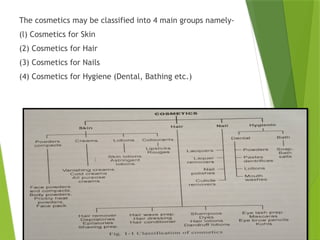
The cosmetics may be classified into 4 main groups namely-
(l) Cosmetics for Skin
(2) Cosmetics for Hair
(3) Cosmetics for Nails
(4) Cosmetics for Hygiene (Dental, Bathing etc.)
HAIR CARE PREPARATIONS
 To of hair and also for decorative or Beautification
purposes.
(l) Hair cleansers: Various shampoos like clear
liquids, liquid creams, solid creams or gels, anti-
dandruff shampoos, oil shampoos, powders, dry
shampoos, etc.
(ll) Hair dressings : Anhydrous brilliantines, pomades,
hair oils, hair creams, gum based hair dressings,
hair lacquers, alcohol-based hair lotions, resin
lotions, sprays.
lII) Hair wavers, curlers and straighteners :
Hot waving, cold waxing, tepid waves,
roller and pin perms, instant perms.
(IV) Hair tonics: Preparations containing
various substances like sulphur
derivatives, vitamins, etc.
(V) Hair removers: Depilatories, Epilatories.
(VI) Hair dyes and bleaches (hair colorants) :
Various dyes and bleaching preparations.
(VII) Shaving preparations: Soaps, cream
HAIR CLEANSING PREPARATIONS - SHAMPOOS
Composition of Shampoos
 Surfactants are the main component of shampoos. Mainly
anionic surfactants are used.
 Cationic, non-ionic and ampholytic surfactants have also
some use.
 Raw materials used in manufacture of shampoos are
classified as:
1. Principal surfactants-which provide detergency and foam.
2. Secondary surfactants-which improve detergency foam and
hair condition.
3. Other additives-which impart other characteristics to the
shampoo products.
Principal Surfactants
 Anionic surfactants are mostly used as principal
surfactants.
 They have very good foaming properties.
 Non-ionic surfactants have good cleansing activity but not
have sufficient foaming power. So not used as principal
surfactants.
 Cationic surfactants have good foaming character as well
as some cleansing power but toxic and cause damage to
the eye. At non-toxic low concentration they are used in
hair conditioners.
 Soaps are not preferred as their solutions
are alkaline and make hair dull. In hard
water, they leave a deposit of calcium and
magnesium salts on the hair shaft. They
are cheap and therefore are used in low-
priced shampoos.
 Ampholytics are generally not as good as
anionics and more expensive. Used as
secondary surfactants and as good hair
conditioners
Alkyl sulphates :
 Alkyl sulphates - widely used anionic detergents -
lauryl and myristyl sulphates.
 They are sulphated derivatives of long chain fatty
alcohols, C12 or above, obtained by catalytic
reduction of fatty acids of coconut and palm
kernel oils.
 Normally both of them are taken together as
lauryl gives a greater volume of lather and
myristyl gives greater richness.
 Various salts of lauryl sulphates like sodium lauryl
sulphate, triethanol lauryl sulphate, monoethanol
lauryl sulphate and ammonium lauryl sulphate are
used.
 As magnesium lauryl sulphate is less hygroscopic it
is preferably used in powder shampoos
 Sodium lauryl sulphate, the most commonly used
alkyl sulphate salt, has poor solubility in cold
water but solubility increases with temperature
and has good solubility at normal temperature of
35-40'C.
 Triethanolamine alkyl sulphate is present in most
of the present day shampoo
Alkyl polyethylene glycol sulphates (alkyl ether sulphates)
 Sulphate derivatives of lauryl alcohol ether with polyethylene
glycol or similar substances are good cleansers.
 Normally a chain of 2-3 ethylene oxide molecules is
condensed.
 Sodium salts of these alkyl ether sulphates are more water
soluble than sodium lauryl sulphate and thus a concentrated,
product can be made.
 They also have high foaming power.
 They can also act as solvents for non-polar additives normally
required to be incorporated in shampoos.
 Though these substances are not good hair conditioners but
as they are cheap additional conditioners can be easily added
to compensate deficiency
Others
 Other anionic surfactants occasionally used
are sodium salt of alkyl benzene sulphonates,
paraffin sulphonates, fatty acid soaps.
 As fatty acid soaps have problem with hard
water due to presence of calcium and
magnesium, addition of sequestering agents
like salts of EDTA or polyphosphates is
required for stabilization.
Secondary Surfactants
 Added to produce more foam and to improve the
condition of the hair.
 Mostly anionic or ampholytic detergents.
 Include dialkyl sulphosuccinates, monoalkyl
sulphosuccinates, methyl taurides, fatty acid
alkanolamides, acyl amino acids, acyl peptides, acyl
sarcosins, monoglyceride sulphates, turkey red oil,
and secondary alkyl sulphates.
 Monoalkyl sulphosuccinates - non-irritant to the
eyes - used in body shampoos.
 Dialkyl derivatives like sodium di
(ethylhexyl) sulphosuccinate and the di
(tertiary) nonyl sulphosuccinate - very good
wetting agents
 Methyl taurides, amides of methyl taurine,
are amphoteric – conditions the hair
because of the presence of amide group.
 Fatty acid alkanolamides, particularly
monoalkanolamides such as
monoalkanolamides and isopropanolamides
- increase the solubility of lauryl sulphate -
increase lather
 Acyl amino acids are ampholytic – best foaming activity
 Acyl peptides are acyl polyamino acids - have excellent hair
conditioning power. They are costly and have less foaming power.
 Acyl sarcosins - have good hair conditioning effects.
 Turkey red oils form a light coating over hair and are preferably
used in oil shampoos. Good cleansers but very low foaming effect.
 The important turkey red oils are sulphonated castor oil and
sulphonated olive oil. Normally they are used in combination.
 Alkyl phosphates - have low foaming power - milder effects on
hair.
 Some other anionic surfactants are also occasionally - good
cleansers but not a good foaming agent.
Other Additives
 Several additives are incorporated in shampoo products to achieve
specialized characters and other purposes.
 (a) Germicides and anti-dandruff agents
 (b) Conditioning agents
 (c) Pearlscent agents
 (d) Sequestrants
 (e) Thickening agents
 (f) Colours
 (g) Perfumes
 (h) Preservatives
Germicides and anti-dandruff agents
 Germicides - Prevent microbial infection of scalp and to treat dandruff
respectively.
Quaternary ammonium compounds - benzalkonium chloride, cetrimide etc,
Phenol derivatives, Tetramethyl thiuram disulphide
 Anti-dandruff agents - selenium sulphide, cadmium sulphide, zinc
pyridinium-thiol-N-oxide, zinc undecylenate, sodium sulphacetamide etc.
Conditioning agents
 Fatty substances like lanolin, oils; natural products like herbal extracts,
egg, amino acids, lecithin and polymeric substances.
 These substances give a special conditioning effect to the hair.
 If amino acids are incorporated into shampoos, after washing amino acid
remains deposited on hair and scalp and produces a good conditioning
effect on the hair
Pearlscent agents
 Used to give special conditioning to hair
 They brighten the hair.
 Substituted 4-methyl coumarins particularly 4-methyl-7-
diethylaminocoumarin and 4-methyl-5,7-dihydrocoumarin (0.2 – l%)
 They act better at pH between 4.5 - 6.
 These substances reflect light.
 Fluorescent materials are also occasionally used.
Sequestrants
 They form a water soluble complex with Ca and Mg and prevent formation
of insoluble salts of soaps or detergents by these two divalent ions present
in water.
 Sodium salt of EDTA
Thickening agents
 To make shampoo preparations viscous, for easy handling and minimize wastage
while pouring
 Alginates, polyvinyl alcohol, methyl cellulose, colloidal silicates, polyethylene glycol
esters etc.
 Combination are also used - Sulphated castor oil and sulphated olive oil
Colours
 Certified colours can be incorporated to produce a visually attractive impact.
 The colours should be water soluble.
Perfumes
 To have an after-use fragrance on the hair.
 Mask the odour of the other ingredients, particularly detergents.
 Perfumes are used in 0.3-1.0%.
Preservatives
 Prevent microbial contamination.
 Water-soluble preservatives used
 p-hydroxy benzoic acid and its methyl ester, phenyl mercuric compounds,
formaldehyde
TYPES OF PREPARATIONS
 Powder shampoos
 Clear liquid shampoos
 Liquid cream or lotion shampoos
 Solid cream/gel shampoos
 Oil shampoos
 Miscellaneous including anti-dandruff medicated
shampoos
General Preparations
 They are prepared by simple mixing process.
 In powder shampoos the ingredients are simply mixed and the perfume is added
last.
 In case of clear liquid shampoos the detergents are first dissolved in half of the
water with little heat if necessary. Other ingredients are added to other part of
the water and then mixed with the first part. The perfume is added last.
 Other preparations can be made by simple mixing in a gradual manner, taking
different ingredients at different stages.
HAIR DYES AND BLEACHES (HAIR
COLORANTS)
 An ideal hair dye should have the following characteristics:
(1) It should not be toxic to the skin or hair and should not impair the natural gloss
and texture of the hair.
(2) It should not be dermatitic sensitizer.
(3) The colour that it imparts to the hair must be stable to air, light, water and
shampoo
(4) Should be easy to apply.
Hair colorants may be classified as;
(1) Temporary colorants
(2) Semi-permanent colorants
(3) Permanent colorants
(4) Lighteners or bleaches
TEMPORARY COLORANTS
 Impart colour to the hair for a short time and washed off during the first shampoo
 Early examples – vinegar/lemon
 Shampoo based on synthetic detergents - Soap gives dulling effect and rinse -
neutralize the alkali
 Same effect was obtained when rinsed solution of citric or tartaric acid
 Now temporary colorants consist of a mixture of a suitable dyestuff with an acid
either in powders or in liquid forms
 Powder products are simple mixture of dyestuff with citric acid or tartaric acid in
a sachet or capsule
 Dissolve in about half a pint of warm water and pour the solution repeatedly over
the wet hair immediately after shampooing
 Absorption takes place from the solution on to the hair cuticle but no penetration
to the cortex or medulla and easily removed by shampooing
 Various shades can be created by like blue, pink, light golden or auburn
shades
 May also be applied as sprays and can be formulated with soaps,
shampoos, waxes and used as crayons for temporary colouring
 pH of the preparation is adjusted at about 5.0
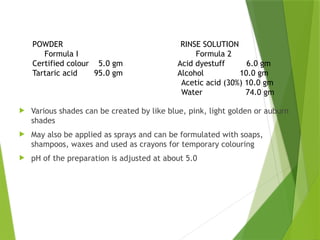
POWDER RINSE SOLUTION
Formula I Formula 2
Certified colour 5.0 gm Acid dyestuff 6.0 gm
Tartaric acid 95.0 gm Alcohol 10.0 gm
Acetic acid (30%) 10.0 gm
Water 74.0 gm
SEMI-PERMANENT COLORANTS
 These colorants give a stronger coloration to the hairs and can withstand
six to eight subsequent shampoos although some of the color is removed
during each shampoo.
 These are made of dyes having smaller molecules which penetrate the
hair easily
 Easy to apply and have less risk of damage to hair and skin in comparison
to permanent dyeing process.
 These colorants are mainly based on basic dyestuffs of nitro-amino dyes.
 The most important nitro dyes are picramic acid (2,4-dinitro-6 -
aminophenol) and 4-nitro-1-2-phenylene diamine. These dyes are usually
red or yellow.
 Brown dyes are normally larger in size and do not penetrate easily.
Therefore, in order to get a brown shade, blue is mixed with red and
yellow.
 Anthraquinones, e.g. 1,4-diamino anthraquinone give blue colour and are
sufficiently small in size.
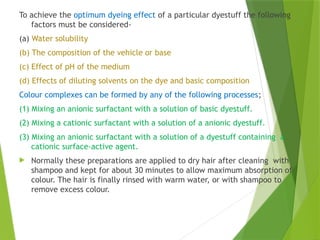
To achieve the optimum dyeing effect of a particular dyestuff the following
factors must be considered-
(a) Water solubility
(b) The composition of the vehicle or base
(c) Effect of pH of the medium
(d) Effects of diluting solvents on the dye and basic composition
Colour complexes can be formed by any of the following processes;
(1) Mixing an anionic surfactant with a solution of basic dyestuff.
(2) Mixing a cationic surfactant with a solution of a anionic dyestuff.
(3) Mixing an anionic surfactant with a solution of a dyestuff containing a
cationic surface-active agent.
 Normally these preparations are applied to dry hair after cleaning with
shampoo and kept for about 30 minutes to allow maximum absorption of
colour. The hair is finally rinsed with warm water, or with shampoo to
remove excess colour.
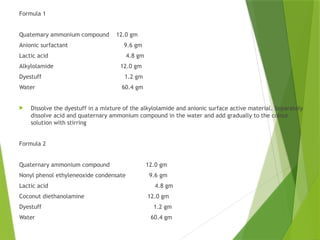
Formula 1
Quatemary ammonium compound 12.0 gm
Anionic surfactant 9.6 gm
Lactic acid 4.8 gm
Alkylolamide 12.0 gm
Dyestuff 1.2 gm
Water 60.4 gm
 Dissolve the dyestuff in a mixture of the alkylolamide and anionic surface active material. Separately
dissolve acid and quaternary ammonium compound in the water and add gradually to the colour
solution with stirring
Formula 2
Quaternary ammonium compound 12.0 gm
Nonyl phenol ethyleneoxide condensate 9.6 gm
Lactic acid 4.8 gm
Coconut diethanolamine 12.0 gm
Dyestuff 1.2 gm
Water 60.4 gm
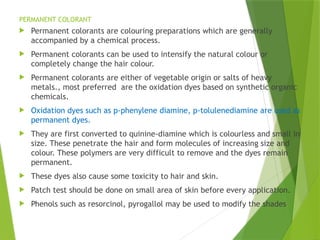
PERMANENT COLORANT
 Permanent colorants are colouring preparations which are generally
accompanied by a chemical process.
 Permanent colorants can be used to intensify the natural colour or
completely change the hair colour.
 Permanent colorants are either of vegetable origin or salts of heavy
metals., most preferred are the oxidation dyes based on synthetic organic
chemicals.
 Oxidation dyes such as p-phenylene diamine, p-tolulenediamine are used as
permanent dyes.
 They are first converted to quinine-diamine which is colourless and small in
size. These penetrate the hair and form molecules of increasing size and
colour. These polymers are very difficult to remove and the dyes remain
permanent.
 These dyes also cause some toxicity to hair and skin.
 Patch test should be done on small area of skin before every application.
 Phenols such as resorcinol, pyrogallol may be used to modify the shades
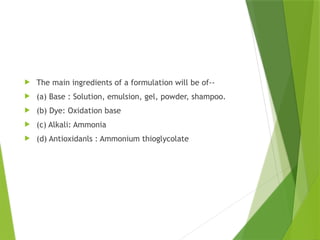
 The main ingredients of a formulation will be of--
 (a) Base : Solution, emulsion, gel, powder, shampoo.
 (b) Dye: Oxidation base
 (c) Alkali: Ammonia
 (d) Antioxidanls : Ammonium thioglycolate
A. VEGETABLE DYES
 Henna‘ - dried powdered leaves of Lawsonia
 Lawsone (2-hydroxy-1,4-naphthaquinonet,h e main ingredient)i s soluble
in hot water and in a pH of 5.5 acts as an effective dye.
 The powdered henna is made into a paste with hot water, suitably
acidified and applied on the head. It is kept for the required amount of
time"
 No local or systemic toxicity and shows no sensitization'
 Color is dcposited in the hair shaft
 Disadvantage - messy, dyes the finger nails also.
Example:
 LIGHT BROWN DARK BROWN BLACK
 Henna powder
 Pyrogallol
 Copper sulphate
 CAMOMILE - consists of the flowers of Anthemis nobilis and Matricania
 The active ingredient is 1'3,4-trihydroxyflavone or
 T.h e flower heads are applied in the form of a paste in hot water along with
kaolin. It may alsobe used as hair brightening rins.',,
Formula I
 Camomile flowers
 Alcohol
 Water
 Perfume
Formula II
 Powdered henna leaves
 Powdered camomile flowers
 Pyrogallic acid
 Citric acid
 Alcohol
 Glycerine
 Water
B.METALLIC HAIR DYES
 Colours caused by metallic compounds such as lead acetate are either due to sulphides formed
by sulphur in the keratin or due to metallic oxide formed by reduction. The hair shaft is coated
with a dull, metallic sheen, leaving the hair brittle. The main compounds used for their;
purpose are lead acetate, bismuth citrate, silver nitrate.
 (a) Lead dyes : Lead dyes are generally based on solutions of leacl acetate and it is considered
that the reducing action of keratin forms the insoluble lead salts. The coloration process is
slow and gives an illusion of restoring of natural colour. The rate of colouring is dependent on
concentration of lead and influenced by air and light. Lead acetate is normally used in
combination with precipitated sulphur or sodium thiosulphate.
 (b) Silver dyes: The hair is first treated with an aqueous ammonia r',o f silver nitrate. After a
short while, a solution of pyrogallol proportion of silver may be reduced for lighter shades.
 (c ) Bismuth dyes – produces range of colors from blond o dark chestnut
Formula 1
 A. Bismuth citrate B. Sodium thiosulphate
Water Water
Ammonium hydroxide
Formula 2
 Precipitated sulphur , Lead acetate, Glycerine , Water
Formula 3
 Solution 1 Solution 2
 Silver nitrate Ammonium hydroxide
 Ammonium nitrate Pyrogallol
 Water Alcohol, Water
Cosmetics b pharm fifth semester formulative pharmacy

  • 1.
  • 2.
     The word'cosmetics' arises from a Greek word 'kosmeticos' which means to adorn.  Any material used for beautification or improvement of appearance is known as cosmetic  The cosmetics in general are external preparations and are meant to be applied to external parts of the body.  In other words they may be applied to skin, hair and nails for the purposes of covering, colouring, softening, cleansing, nourishing, waving, setting, mollification, preservation, removal and protection.
  • 3.
    The cosmetics maybe classified into 4 main groups namely- (l) Cosmetics for Skin (2) Cosmetics for Hair (3) Cosmetics for Nails (4) Cosmetics for Hygiene (Dental, Bathing etc.)
  • 4.
    HAIR CARE PREPARATIONS To of hair and also for decorative or Beautification purposes. (l) Hair cleansers: Various shampoos like clear liquids, liquid creams, solid creams or gels, anti- dandruff shampoos, oil shampoos, powders, dry shampoos, etc. (ll) Hair dressings : Anhydrous brilliantines, pomades, hair oils, hair creams, gum based hair dressings, hair lacquers, alcohol-based hair lotions, resin lotions, sprays.
  • 5.
    lII) Hair wavers,curlers and straighteners : Hot waving, cold waxing, tepid waves, roller and pin perms, instant perms. (IV) Hair tonics: Preparations containing various substances like sulphur derivatives, vitamins, etc. (V) Hair removers: Depilatories, Epilatories. (VI) Hair dyes and bleaches (hair colorants) : Various dyes and bleaching preparations. (VII) Shaving preparations: Soaps, cream
  • 6.
    HAIR CLEANSING PREPARATIONS- SHAMPOOS Composition of Shampoos  Surfactants are the main component of shampoos. Mainly anionic surfactants are used.  Cationic, non-ionic and ampholytic surfactants have also some use.  Raw materials used in manufacture of shampoos are classified as: 1. Principal surfactants-which provide detergency and foam. 2. Secondary surfactants-which improve detergency foam and hair condition. 3. Other additives-which impart other characteristics to the shampoo products.
  • 7.
    Principal Surfactants  Anionicsurfactants are mostly used as principal surfactants.  They have very good foaming properties.  Non-ionic surfactants have good cleansing activity but not have sufficient foaming power. So not used as principal surfactants.  Cationic surfactants have good foaming character as well as some cleansing power but toxic and cause damage to the eye. At non-toxic low concentration they are used in hair conditioners.
  • 8.
     Soaps arenot preferred as their solutions are alkaline and make hair dull. In hard water, they leave a deposit of calcium and magnesium salts on the hair shaft. They are cheap and therefore are used in low- priced shampoos.  Ampholytics are generally not as good as anionics and more expensive. Used as secondary surfactants and as good hair conditioners
  • 9.
    Alkyl sulphates : Alkyl sulphates - widely used anionic detergents - lauryl and myristyl sulphates.  They are sulphated derivatives of long chain fatty alcohols, C12 or above, obtained by catalytic reduction of fatty acids of coconut and palm kernel oils.  Normally both of them are taken together as lauryl gives a greater volume of lather and myristyl gives greater richness.
  • 10.
     Various saltsof lauryl sulphates like sodium lauryl sulphate, triethanol lauryl sulphate, monoethanol lauryl sulphate and ammonium lauryl sulphate are used.  As magnesium lauryl sulphate is less hygroscopic it is preferably used in powder shampoos  Sodium lauryl sulphate, the most commonly used alkyl sulphate salt, has poor solubility in cold water but solubility increases with temperature and has good solubility at normal temperature of 35-40'C.  Triethanolamine alkyl sulphate is present in most of the present day shampoo
  • 11.
    Alkyl polyethylene glycolsulphates (alkyl ether sulphates)  Sulphate derivatives of lauryl alcohol ether with polyethylene glycol or similar substances are good cleansers.  Normally a chain of 2-3 ethylene oxide molecules is condensed.  Sodium salts of these alkyl ether sulphates are more water soluble than sodium lauryl sulphate and thus a concentrated, product can be made.  They also have high foaming power.  They can also act as solvents for non-polar additives normally required to be incorporated in shampoos.  Though these substances are not good hair conditioners but as they are cheap additional conditioners can be easily added to compensate deficiency
  • 12.
    Others  Other anionicsurfactants occasionally used are sodium salt of alkyl benzene sulphonates, paraffin sulphonates, fatty acid soaps.  As fatty acid soaps have problem with hard water due to presence of calcium and magnesium, addition of sequestering agents like salts of EDTA or polyphosphates is required for stabilization.
  • 13.
    Secondary Surfactants  Addedto produce more foam and to improve the condition of the hair.  Mostly anionic or ampholytic detergents.  Include dialkyl sulphosuccinates, monoalkyl sulphosuccinates, methyl taurides, fatty acid alkanolamides, acyl amino acids, acyl peptides, acyl sarcosins, monoglyceride sulphates, turkey red oil, and secondary alkyl sulphates.  Monoalkyl sulphosuccinates - non-irritant to the eyes - used in body shampoos.
  • 14.
     Dialkyl derivativeslike sodium di (ethylhexyl) sulphosuccinate and the di (tertiary) nonyl sulphosuccinate - very good wetting agents  Methyl taurides, amides of methyl taurine, are amphoteric – conditions the hair because of the presence of amide group.  Fatty acid alkanolamides, particularly monoalkanolamides such as monoalkanolamides and isopropanolamides - increase the solubility of lauryl sulphate - increase lather
  • 15.
     Acyl aminoacids are ampholytic – best foaming activity  Acyl peptides are acyl polyamino acids - have excellent hair conditioning power. They are costly and have less foaming power.  Acyl sarcosins - have good hair conditioning effects.  Turkey red oils form a light coating over hair and are preferably used in oil shampoos. Good cleansers but very low foaming effect.  The important turkey red oils are sulphonated castor oil and sulphonated olive oil. Normally they are used in combination.  Alkyl phosphates - have low foaming power - milder effects on hair.  Some other anionic surfactants are also occasionally - good cleansers but not a good foaming agent.
  • 16.
    Other Additives  Severaladditives are incorporated in shampoo products to achieve specialized characters and other purposes.  (a) Germicides and anti-dandruff agents  (b) Conditioning agents  (c) Pearlscent agents  (d) Sequestrants  (e) Thickening agents  (f) Colours  (g) Perfumes  (h) Preservatives
  • 17.
    Germicides and anti-dandruffagents  Germicides - Prevent microbial infection of scalp and to treat dandruff respectively. Quaternary ammonium compounds - benzalkonium chloride, cetrimide etc, Phenol derivatives, Tetramethyl thiuram disulphide  Anti-dandruff agents - selenium sulphide, cadmium sulphide, zinc pyridinium-thiol-N-oxide, zinc undecylenate, sodium sulphacetamide etc. Conditioning agents  Fatty substances like lanolin, oils; natural products like herbal extracts, egg, amino acids, lecithin and polymeric substances.  These substances give a special conditioning effect to the hair.  If amino acids are incorporated into shampoos, after washing amino acid remains deposited on hair and scalp and produces a good conditioning effect on the hair
  • 18.
    Pearlscent agents  Usedto give special conditioning to hair  They brighten the hair.  Substituted 4-methyl coumarins particularly 4-methyl-7- diethylaminocoumarin and 4-methyl-5,7-dihydrocoumarin (0.2 – l%)  They act better at pH between 4.5 - 6.  These substances reflect light.  Fluorescent materials are also occasionally used. Sequestrants  They form a water soluble complex with Ca and Mg and prevent formation of insoluble salts of soaps or detergents by these two divalent ions present in water.  Sodium salt of EDTA
  • 19.
    Thickening agents  Tomake shampoo preparations viscous, for easy handling and minimize wastage while pouring  Alginates, polyvinyl alcohol, methyl cellulose, colloidal silicates, polyethylene glycol esters etc.  Combination are also used - Sulphated castor oil and sulphated olive oil Colours  Certified colours can be incorporated to produce a visually attractive impact.  The colours should be water soluble. Perfumes  To have an after-use fragrance on the hair.  Mask the odour of the other ingredients, particularly detergents.  Perfumes are used in 0.3-1.0%. Preservatives  Prevent microbial contamination.  Water-soluble preservatives used  p-hydroxy benzoic acid and its methyl ester, phenyl mercuric compounds, formaldehyde
  • 20.
    TYPES OF PREPARATIONS Powder shampoos  Clear liquid shampoos  Liquid cream or lotion shampoos  Solid cream/gel shampoos  Oil shampoos  Miscellaneous including anti-dandruff medicated shampoos
  • 21.
    General Preparations  Theyare prepared by simple mixing process.  In powder shampoos the ingredients are simply mixed and the perfume is added last.  In case of clear liquid shampoos the detergents are first dissolved in half of the water with little heat if necessary. Other ingredients are added to other part of the water and then mixed with the first part. The perfume is added last.  Other preparations can be made by simple mixing in a gradual manner, taking different ingredients at different stages.
  • 22.
    HAIR DYES ANDBLEACHES (HAIR COLORANTS)  An ideal hair dye should have the following characteristics: (1) It should not be toxic to the skin or hair and should not impair the natural gloss and texture of the hair. (2) It should not be dermatitic sensitizer. (3) The colour that it imparts to the hair must be stable to air, light, water and shampoo (4) Should be easy to apply. Hair colorants may be classified as; (1) Temporary colorants (2) Semi-permanent colorants (3) Permanent colorants (4) Lighteners or bleaches
  • 23.
    TEMPORARY COLORANTS  Impartcolour to the hair for a short time and washed off during the first shampoo  Early examples – vinegar/lemon  Shampoo based on synthetic detergents - Soap gives dulling effect and rinse - neutralize the alkali  Same effect was obtained when rinsed solution of citric or tartaric acid  Now temporary colorants consist of a mixture of a suitable dyestuff with an acid either in powders or in liquid forms  Powder products are simple mixture of dyestuff with citric acid or tartaric acid in a sachet or capsule  Dissolve in about half a pint of warm water and pour the solution repeatedly over the wet hair immediately after shampooing  Absorption takes place from the solution on to the hair cuticle but no penetration to the cortex or medulla and easily removed by shampooing
  • 24.
     Various shadescan be created by like blue, pink, light golden or auburn shades  May also be applied as sprays and can be formulated with soaps, shampoos, waxes and used as crayons for temporary colouring  pH of the preparation is adjusted at about 5.0 POWDER RINSE SOLUTION Formula I Formula 2 Certified colour 5.0 gm Acid dyestuff 6.0 gm Tartaric acid 95.0 gm Alcohol 10.0 gm Acetic acid (30%) 10.0 gm Water 74.0 gm
  • 25.
    SEMI-PERMANENT COLORANTS  Thesecolorants give a stronger coloration to the hairs and can withstand six to eight subsequent shampoos although some of the color is removed during each shampoo.  These are made of dyes having smaller molecules which penetrate the hair easily  Easy to apply and have less risk of damage to hair and skin in comparison to permanent dyeing process.  These colorants are mainly based on basic dyestuffs of nitro-amino dyes.  The most important nitro dyes are picramic acid (2,4-dinitro-6 - aminophenol) and 4-nitro-1-2-phenylene diamine. These dyes are usually red or yellow.  Brown dyes are normally larger in size and do not penetrate easily. Therefore, in order to get a brown shade, blue is mixed with red and yellow.  Anthraquinones, e.g. 1,4-diamino anthraquinone give blue colour and are sufficiently small in size.
  • 26.
    To achieve theoptimum dyeing effect of a particular dyestuff the following factors must be considered- (a) Water solubility (b) The composition of the vehicle or base (c) Effect of pH of the medium (d) Effects of diluting solvents on the dye and basic composition Colour complexes can be formed by any of the following processes; (1) Mixing an anionic surfactant with a solution of basic dyestuff. (2) Mixing a cationic surfactant with a solution of a anionic dyestuff. (3) Mixing an anionic surfactant with a solution of a dyestuff containing a cationic surface-active agent.  Normally these preparations are applied to dry hair after cleaning with shampoo and kept for about 30 minutes to allow maximum absorption of colour. The hair is finally rinsed with warm water, or with shampoo to remove excess colour.
  • 27.
    Formula 1 Quatemary ammoniumcompound 12.0 gm Anionic surfactant 9.6 gm Lactic acid 4.8 gm Alkylolamide 12.0 gm Dyestuff 1.2 gm Water 60.4 gm  Dissolve the dyestuff in a mixture of the alkylolamide and anionic surface active material. Separately dissolve acid and quaternary ammonium compound in the water and add gradually to the colour solution with stirring Formula 2 Quaternary ammonium compound 12.0 gm Nonyl phenol ethyleneoxide condensate 9.6 gm Lactic acid 4.8 gm Coconut diethanolamine 12.0 gm Dyestuff 1.2 gm Water 60.4 gm
  • 28.
    PERMANENT COLORANT  Permanentcolorants are colouring preparations which are generally accompanied by a chemical process.  Permanent colorants can be used to intensify the natural colour or completely change the hair colour.  Permanent colorants are either of vegetable origin or salts of heavy metals., most preferred are the oxidation dyes based on synthetic organic chemicals.  Oxidation dyes such as p-phenylene diamine, p-tolulenediamine are used as permanent dyes.  They are first converted to quinine-diamine which is colourless and small in size. These penetrate the hair and form molecules of increasing size and colour. These polymers are very difficult to remove and the dyes remain permanent.  These dyes also cause some toxicity to hair and skin.  Patch test should be done on small area of skin before every application.  Phenols such as resorcinol, pyrogallol may be used to modify the shades
  • 29.
     The mainingredients of a formulation will be of--  (a) Base : Solution, emulsion, gel, powder, shampoo.  (b) Dye: Oxidation base  (c) Alkali: Ammonia  (d) Antioxidanls : Ammonium thioglycolate
  • 30.
    A. VEGETABLE DYES Henna‘ - dried powdered leaves of Lawsonia  Lawsone (2-hydroxy-1,4-naphthaquinonet,h e main ingredient)i s soluble in hot water and in a pH of 5.5 acts as an effective dye.  The powdered henna is made into a paste with hot water, suitably acidified and applied on the head. It is kept for the required amount of time"  No local or systemic toxicity and shows no sensitization'  Color is dcposited in the hair shaft  Disadvantage - messy, dyes the finger nails also. Example:  LIGHT BROWN DARK BROWN BLACK  Henna powder  Pyrogallol  Copper sulphate
  • 31.
     CAMOMILE -consists of the flowers of Anthemis nobilis and Matricania  The active ingredient is 1'3,4-trihydroxyflavone or  T.h e flower heads are applied in the form of a paste in hot water along with kaolin. It may alsobe used as hair brightening rins.',, Formula I  Camomile flowers  Alcohol  Water  Perfume Formula II  Powdered henna leaves  Powdered camomile flowers  Pyrogallic acid  Citric acid  Alcohol  Glycerine  Water
  • 32.
    B.METALLIC HAIR DYES Colours caused by metallic compounds such as lead acetate are either due to sulphides formed by sulphur in the keratin or due to metallic oxide formed by reduction. The hair shaft is coated with a dull, metallic sheen, leaving the hair brittle. The main compounds used for their; purpose are lead acetate, bismuth citrate, silver nitrate.  (a) Lead dyes : Lead dyes are generally based on solutions of leacl acetate and it is considered that the reducing action of keratin forms the insoluble lead salts. The coloration process is slow and gives an illusion of restoring of natural colour. The rate of colouring is dependent on concentration of lead and influenced by air and light. Lead acetate is normally used in combination with precipitated sulphur or sodium thiosulphate.  (b) Silver dyes: The hair is first treated with an aqueous ammonia r',o f silver nitrate. After a short while, a solution of pyrogallol proportion of silver may be reduced for lighter shades.  (c ) Bismuth dyes – produces range of colors from blond o dark chestnut Formula 1  A. Bismuth citrate B. Sodium thiosulphate Water Water Ammonium hydroxide Formula 2  Precipitated sulphur , Lead acetate, Glycerine , Water Formula 3  Solution 1 Solution 2  Silver nitrate Ammonium hydroxide  Ammonium nitrate Pyrogallol  Water Alcohol, Water