LIPSTICKS
By:
Hindu College
of
Pharmacy ,
Guntur.,
LIPSTICKS
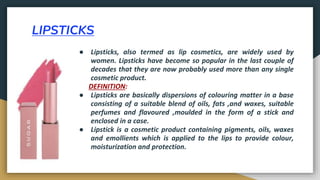
● Lipsticks, also termed as lip cosmetics, are widely used by
women. Lipsticks have become so popular in the last couple of
decades that they are now probably used more than any single
cosmetic product.
DEFINITION:
● Lipsticks are basically dispersions of colouring matter in a base
consisting of a suitable blend of oils, fats ,and waxes, suitable
perfumes and flavoured ,moulded in the form of a stick and
enclosed in a case.
● Lipstick is a cosmetic product containing pigments, oils, waxes
and emollients which is applied to the lips to provide colour,
moisturization and protection.
Advantages
● Keeps your lips moisturizing
● Enhances hydration to the
lips
● Keep the lips same even at
the time of eating
● Gives protection to your lips
from climatic changes
● Gets your facial appearance
increase and make you
GORGEOUS
● The user may get habituated
● It may cause greasiness to
the lips
● It may make the lips more
sensitive
● Continuous use of lipsticks
can result in darkened lips
● May cause dry lips and may
result in skin diseases at that
area
Dis-advantages
IDEAL CHARACTERS
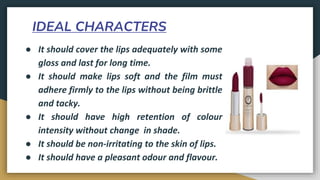
● It should cover the lips adequately with some
gloss and last for long time.
● It should make lips soft and the film must
adhere firmly to the lips without being brittle
and tacky.
● It should have high retention of colour
intensity without change in shade.
● It should be non-irritating to the skin of lips.
● It should have a pleasant odour and flavour.
COMPOSITION
● The stick mainly consists of a colour material dispersed and
suspended in a suitable base made by blending oils and
waxes in various proportions to yield the desired melting
point and viscosity.
● The temperature of human body varies between 36°C to 38°C
with lips having the higher side. The base of the lipstick must
have a melting point between 55°C to 75°C preferably about
62°C , for the product to withstand exposure to hot climates.
The basic raw materials required for formulating lipsticks can be classified as:
1) Wax mixture
2) Oil mixture
3) Bromo mixture
4) Colours
5) Preservatives ,fragrances, surfactants and other additives.
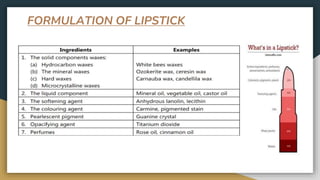
Waxes: Gloss and hardness of lipsticks are largely dependent on the
characteristics and quantity of the waxes used. Various waxy materials are
used in lipsticks.
a) White beeswax: It is an important and useful component of lipstick base
with melting point of 62-64 °C . It usefully binds oils and high melting point
waxes. It is used in 3 to 10% of the total formula.
b) Candelilla wax: It has a melting point of 65-69°C and is used in 5-10%.A
mixture of candelilla wax and beeswax is very good for making lipstick.
c) Carnauba wax: It increases the melting point of the base and hardens
the lipstick. It needs to be used in small amounts.
d) Ozokerite wax: It is also mainly used to increase the melting point of the
base.
e) Ceresin wax: It is also called paraffin wax or mineral wax. It's melting
point is 60-75°C.
f) Cetyl alcohol and cetostearyl alcohol: These two substances are used in
small amounts, in 2-3 %,in the lipstick for emollient action on the lip skin.
Oils: The oil mixture is required to blend properly with the waxes to
provide a suitable film on the applied lip skin. It also acts as a solvent for
eosin dyestuffs or as a dispersing agent for insoluble pigments.
Examples: Castor oil, Paraffin oil, fatty acid alkyl amides.
Bromo mixture: The dyestuff of bromo mixture, known as bromo acids,
consists of fluoresceins , halogenated fluoresceins and related water
insoluble dyes.
Colour : The colour of the lipstick is most important from commercial and
appealing points of view . Up to 1920 carmine was widely used as a lipstick
pigment.
Preservatives , Fragrances , Surfactants and Other Additives:
It is very much essential to include a preservative in the product to
prevent microbial growth. 0.1% propyl Para hydroxy benzoate is used
for this purpose.
Perfumes are an essential component to impart an attractive flavour.
Perfumes are used in the concentration range of 2-4%.
FORMULATION OF LIPSTICK
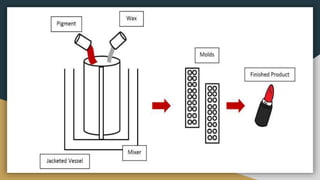
MANUFACTURING PROCESS OF LIPSTICKS
PREPARATION STEPS INCLUDE:
1) Colour grinding
2) Melting and Mixing
3) Mouldings
4) Flaming
5) Packaging
Colour grinding:
Pigments and dyes are available in amorphous forms so we have to convert into powder
form.
Equipments used for grinding are
▪ Roller mill
▪ Colloidal mill
Melting & Mixing:
▪ First raw materials like solvents, oils and waxy material are melted in separate stainless
steel container.
▪ the solvents and oils are mixed with colour pigment
▪ Then the mixture is passed through roller mill grinding the pigments to avoid grainy feel
in lipsticks.
▪ After the pigment mass is grounded and mixed it is added to hot wax until uniform
colour and consistency is obtained.
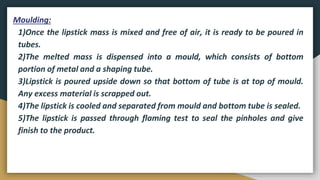
Moulding:
1)Once the lipstick mass is mixed and free of air, it is ready to be poured in
tubes.
2)The melted mass is dispensed into a mould, which consists of bottom
portion of metal and a shaping tube.
3)Lipstick is poured upside down so that bottom of tube is at top of mould.
Any excess material is scrapped out.
4)The lipstick is cooled and separated from mould and bottom tube is sealed.
5)The lipstick is passed through flaming test to seal the pinholes and give
finish to the product.
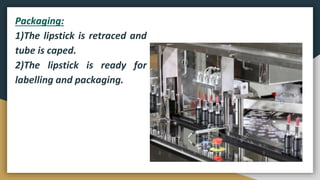
Packaging:
1)The lipstick is retraced and
tube is caped.
2)The lipstick is ready for
labelling and packaging.
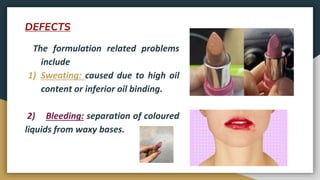
DEFECTS
The formulation related problems
include
1) Sweating: caused due to high oil
content or inferior oil binding.
2) Bleeding: separation of coloured
liquids from waxy bases.
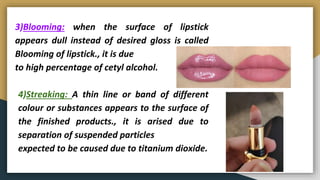
3)Blooming: when the surface of lipstick
appears dull instead of desired gloss is called
Blooming of lipstick., it is due
to high percentage of cetyl alcohol.
4)Streaking: A thin line or band of different
colour or substances appears to the surface of
the finished products., it is arised due to
separation of suspended particles
expected to be caused due to titanium dioxide.
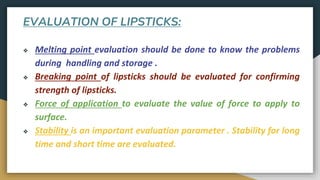
EVALUATION OF LIPSTICKS:
❖ Melting point evaluation should be done to know the problems
during handling and storage .
❖ Breaking point of lipsticks should be evaluated for confirming
strength of lipsticks.
❖ Force of application to evaluate the value of force to apply to
surface.
❖ Stability is an important evaluation parameter . Stability for long
time and short time are evaluated.
REFERENCES:
● A handbook of cosmetics B.M.Mithal and
R.N.Sana.
● A Book of Cosmetics by PP sharma.
Lipsticks ppt by champ

Lipsticks ppt by champ

  • 1.
  • 2.
    LIPSTICKS ● Lipsticks, alsotermed as lip cosmetics, are widely used by women. Lipsticks have become so popular in the last couple of decades that they are now probably used more than any single cosmetic product. DEFINITION: ● Lipsticks are basically dispersions of colouring matter in a base consisting of a suitable blend of oils, fats ,and waxes, suitable perfumes and flavoured ,moulded in the form of a stick and enclosed in a case. ● Lipstick is a cosmetic product containing pigments, oils, waxes and emollients which is applied to the lips to provide colour, moisturization and protection.
  • 3.
    Advantages ● Keeps yourlips moisturizing ● Enhances hydration to the lips ● Keep the lips same even at the time of eating ● Gives protection to your lips from climatic changes ● Gets your facial appearance increase and make you GORGEOUS ● The user may get habituated ● It may cause greasiness to the lips ● It may make the lips more sensitive ● Continuous use of lipsticks can result in darkened lips ● May cause dry lips and may result in skin diseases at that area Dis-advantages
  • 4.
    IDEAL CHARACTERS ● Itshould cover the lips adequately with some gloss and last for long time. ● It should make lips soft and the film must adhere firmly to the lips without being brittle and tacky. ● It should have high retention of colour intensity without change in shade. ● It should be non-irritating to the skin of lips. ● It should have a pleasant odour and flavour.
  • 5.
    COMPOSITION ● The stickmainly consists of a colour material dispersed and suspended in a suitable base made by blending oils and waxes in various proportions to yield the desired melting point and viscosity. ● The temperature of human body varies between 36°C to 38°C with lips having the higher side. The base of the lipstick must have a melting point between 55°C to 75°C preferably about 62°C , for the product to withstand exposure to hot climates.
  • 6.
    The basic rawmaterials required for formulating lipsticks can be classified as: 1) Wax mixture 2) Oil mixture 3) Bromo mixture 4) Colours 5) Preservatives ,fragrances, surfactants and other additives. Waxes: Gloss and hardness of lipsticks are largely dependent on the characteristics and quantity of the waxes used. Various waxy materials are used in lipsticks. a) White beeswax: It is an important and useful component of lipstick base with melting point of 62-64 °C . It usefully binds oils and high melting point waxes. It is used in 3 to 10% of the total formula.
  • 7.
    b) Candelilla wax:It has a melting point of 65-69°C and is used in 5-10%.A mixture of candelilla wax and beeswax is very good for making lipstick. c) Carnauba wax: It increases the melting point of the base and hardens the lipstick. It needs to be used in small amounts. d) Ozokerite wax: It is also mainly used to increase the melting point of the base. e) Ceresin wax: It is also called paraffin wax or mineral wax. It's melting point is 60-75°C. f) Cetyl alcohol and cetostearyl alcohol: These two substances are used in small amounts, in 2-3 %,in the lipstick for emollient action on the lip skin.
  • 8.
    Oils: The oilmixture is required to blend properly with the waxes to provide a suitable film on the applied lip skin. It also acts as a solvent for eosin dyestuffs or as a dispersing agent for insoluble pigments. Examples: Castor oil, Paraffin oil, fatty acid alkyl amides. Bromo mixture: The dyestuff of bromo mixture, known as bromo acids, consists of fluoresceins , halogenated fluoresceins and related water insoluble dyes. Colour : The colour of the lipstick is most important from commercial and appealing points of view . Up to 1920 carmine was widely used as a lipstick pigment.
  • 9.
    Preservatives , Fragrances, Surfactants and Other Additives: It is very much essential to include a preservative in the product to prevent microbial growth. 0.1% propyl Para hydroxy benzoate is used for this purpose. Perfumes are an essential component to impart an attractive flavour. Perfumes are used in the concentration range of 2-4%.
  • 10.
  • 11.
    MANUFACTURING PROCESS OFLIPSTICKS PREPARATION STEPS INCLUDE: 1) Colour grinding 2) Melting and Mixing 3) Mouldings 4) Flaming 5) Packaging
  • 13.
    Colour grinding: Pigments anddyes are available in amorphous forms so we have to convert into powder form. Equipments used for grinding are ▪ Roller mill ▪ Colloidal mill Melting & Mixing: ▪ First raw materials like solvents, oils and waxy material are melted in separate stainless steel container. ▪ the solvents and oils are mixed with colour pigment ▪ Then the mixture is passed through roller mill grinding the pigments to avoid grainy feel in lipsticks. ▪ After the pigment mass is grounded and mixed it is added to hot wax until uniform colour and consistency is obtained.
  • 14.
    Moulding: 1)Once the lipstickmass is mixed and free of air, it is ready to be poured in tubes. 2)The melted mass is dispensed into a mould, which consists of bottom portion of metal and a shaping tube. 3)Lipstick is poured upside down so that bottom of tube is at top of mould. Any excess material is scrapped out. 4)The lipstick is cooled and separated from mould and bottom tube is sealed. 5)The lipstick is passed through flaming test to seal the pinholes and give finish to the product.
  • 15.
    Packaging: 1)The lipstick isretraced and tube is caped. 2)The lipstick is ready for labelling and packaging.
  • 16.
    DEFECTS The formulation relatedproblems include 1) Sweating: caused due to high oil content or inferior oil binding. 2) Bleeding: separation of coloured liquids from waxy bases.
  • 17.
    3)Blooming: when thesurface of lipstick appears dull instead of desired gloss is called Blooming of lipstick., it is due to high percentage of cetyl alcohol. 4)Streaking: A thin line or band of different colour or substances appears to the surface of the finished products., it is arised due to separation of suspended particles expected to be caused due to titanium dioxide.
  • 18.
    EVALUATION OF LIPSTICKS: ❖Melting point evaluation should be done to know the problems during handling and storage . ❖ Breaking point of lipsticks should be evaluated for confirming strength of lipsticks. ❖ Force of application to evaluate the value of force to apply to surface. ❖ Stability is an important evaluation parameter . Stability for long time and short time are evaluated.
  • 19.
    REFERENCES: ● A handbookof cosmetics B.M.Mithal and R.N.Sana. ● A Book of Cosmetics by PP sharma.