PRESENTED BY:
SACHIN SHARMA
COLD CREAM AND
VANISHING CREAM
INTRODUCTION
• In USPXVIII ,creams are defined as
• “ semisolid emulsions of either oil in water or water in oil type.”
• “semisolid emulsions usually medicated, intended for external application.”.
THE SKIN CARE CREAMS CAN BE
CLASSIFIED ON THE FOLLOWING BASIS:
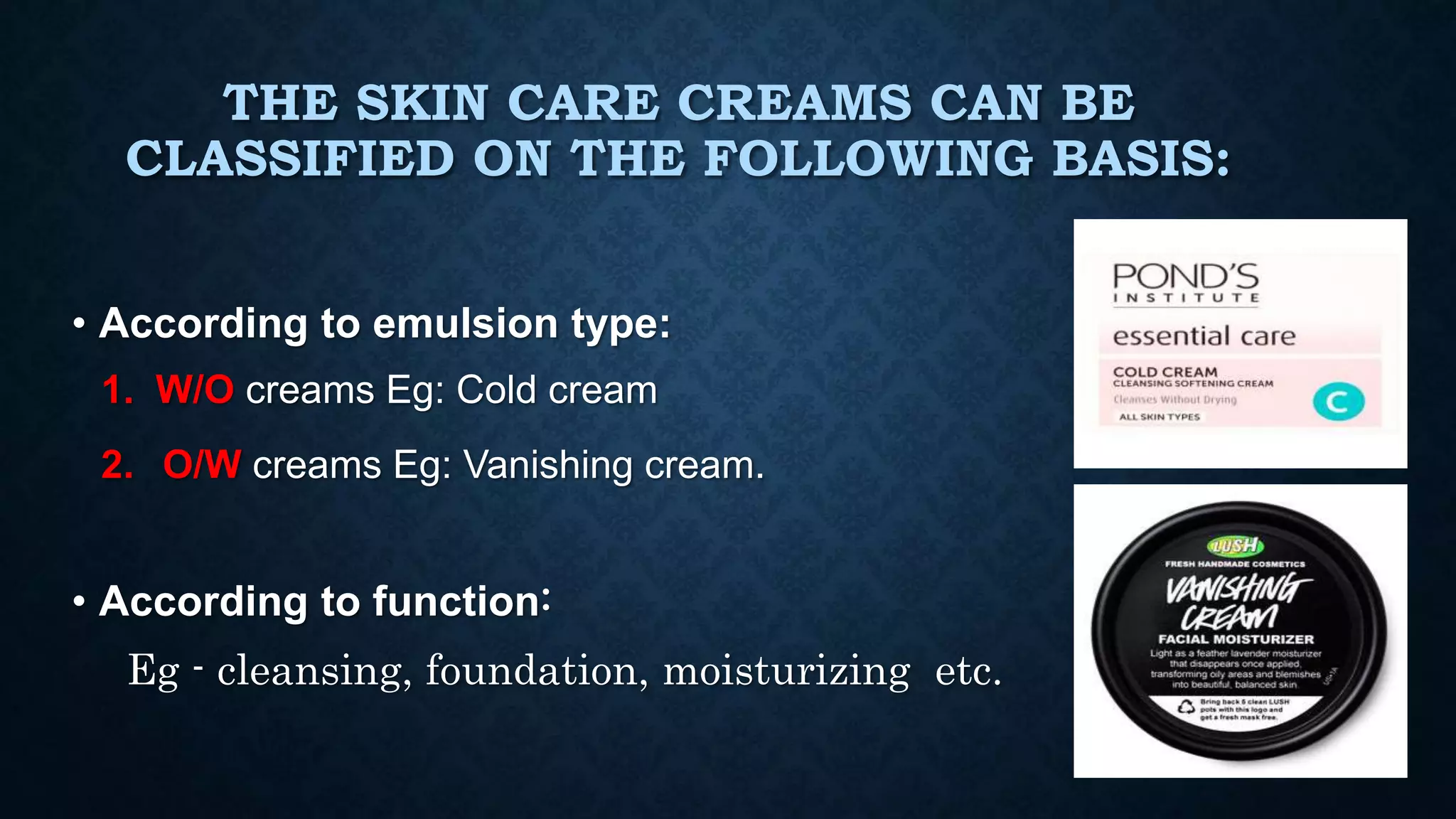
• According to emulsion type:
1. W/O creams Eg: Cold cream
2. O/W creams Eg: Vanishing cream.
• According to function:
Eg - cleansing, foundation, moisturizing etc.
VANISHING CREAM
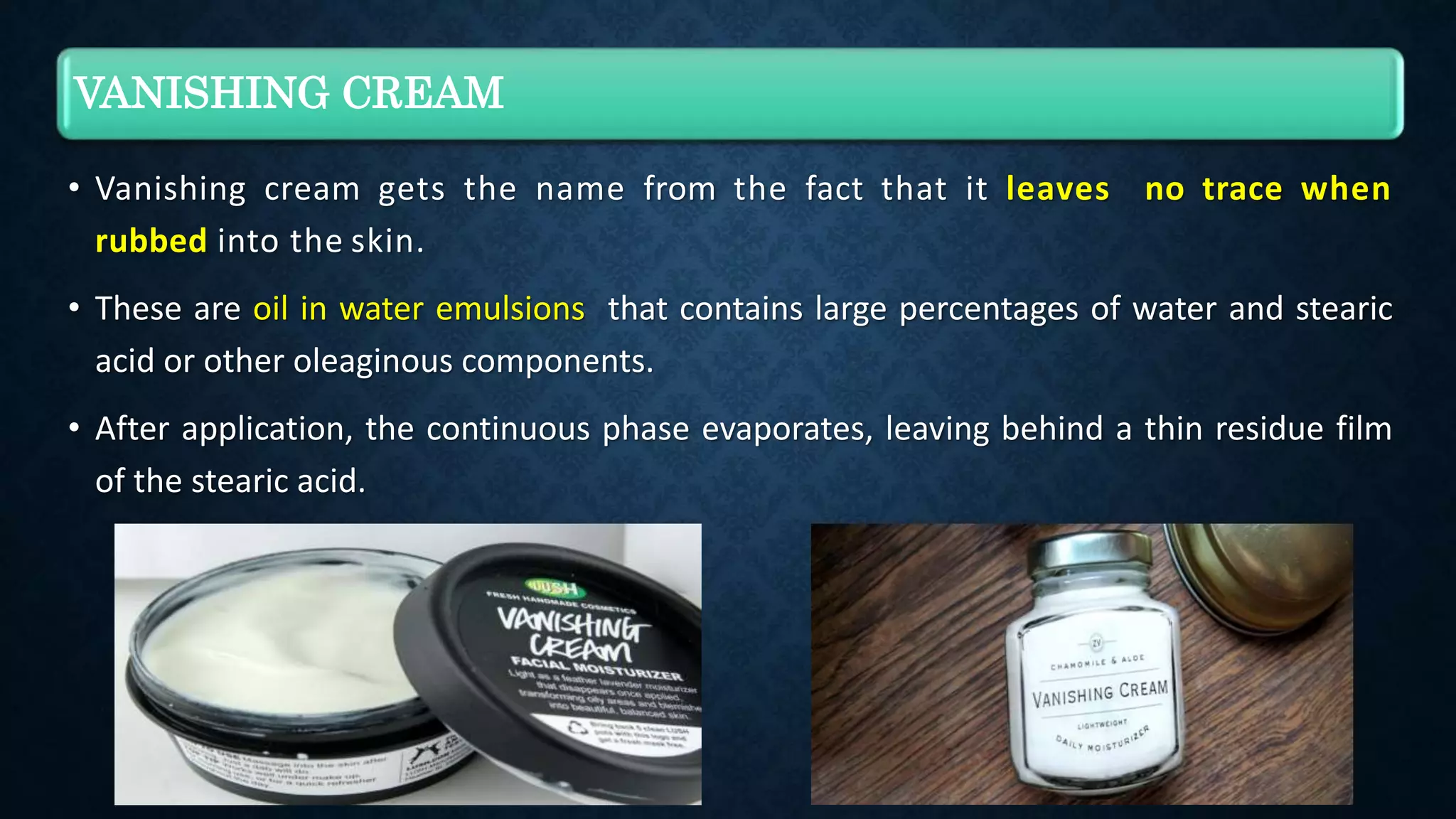
• Vanishing cream gets the name from the fact that it leaves no trace when
rubbed into the skin.
• These are oil in water emulsions that contains large percentages of water and stearic
acid or other oleaginous components.
• After application, the continuous phase evaporates, leaving behind a thin residue film
of the stearic acid.
VANISHING CREAM
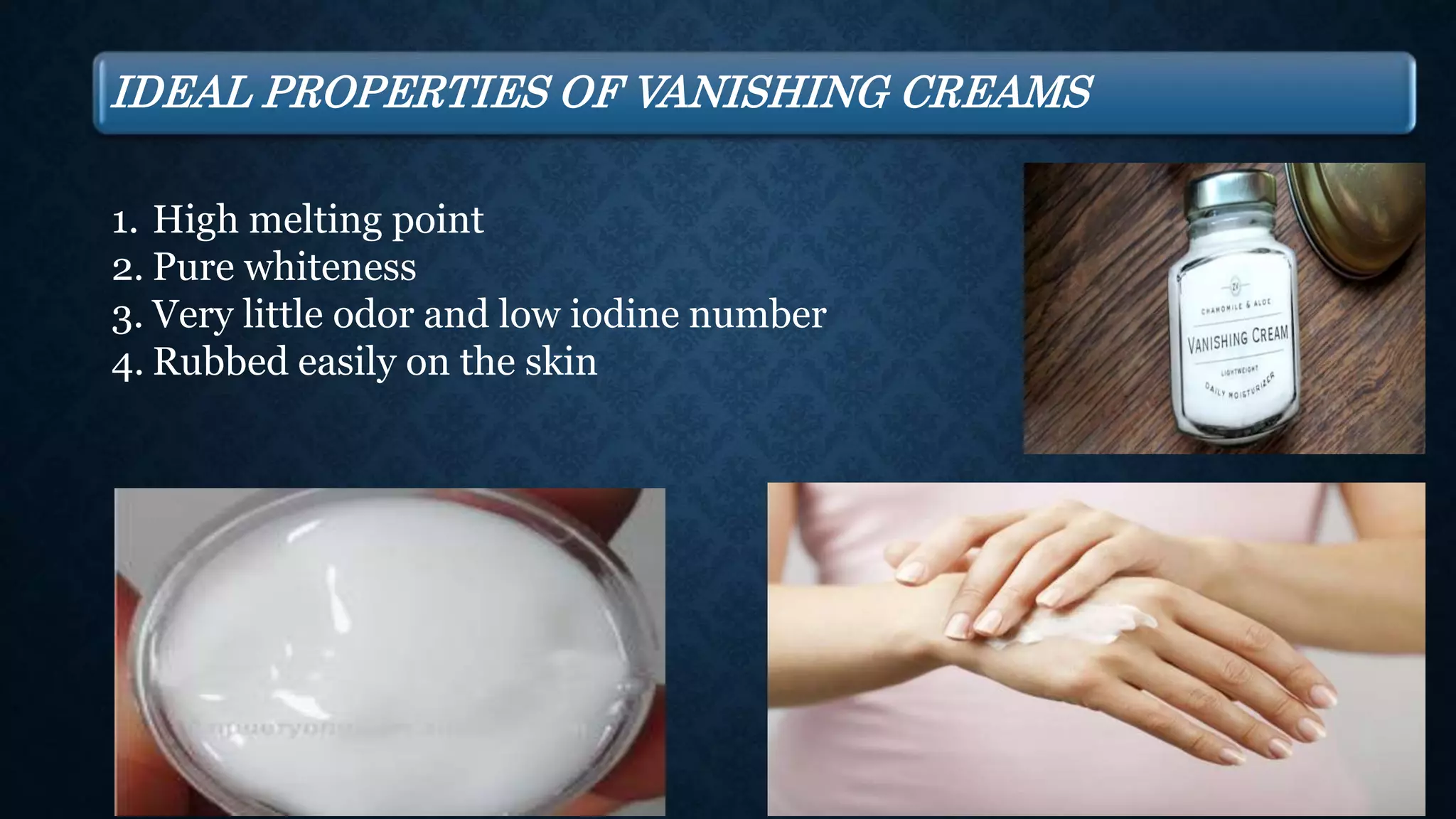
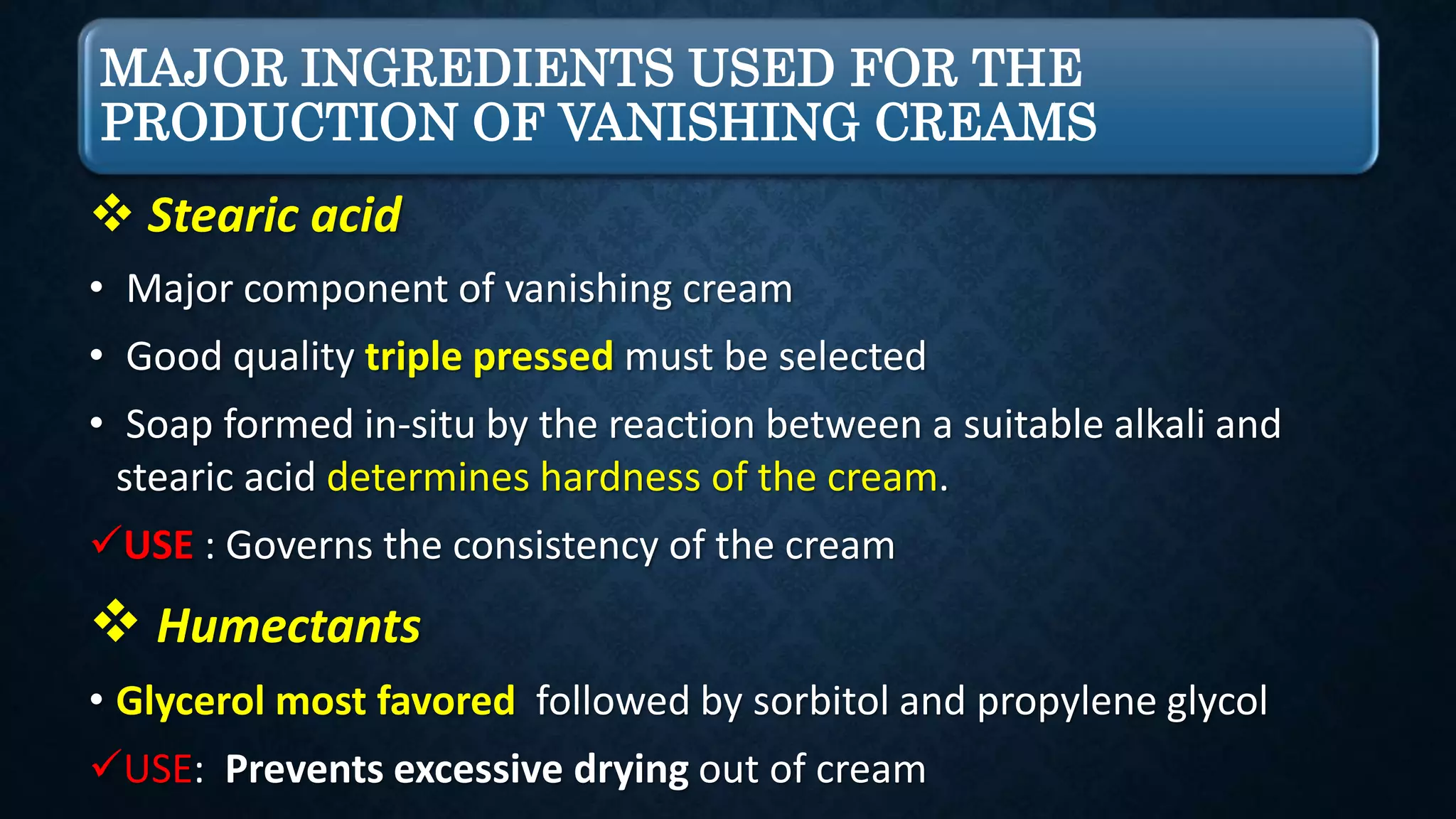
1. High melting point
2. Pure whiteness
3. Very little odor and low iodine number
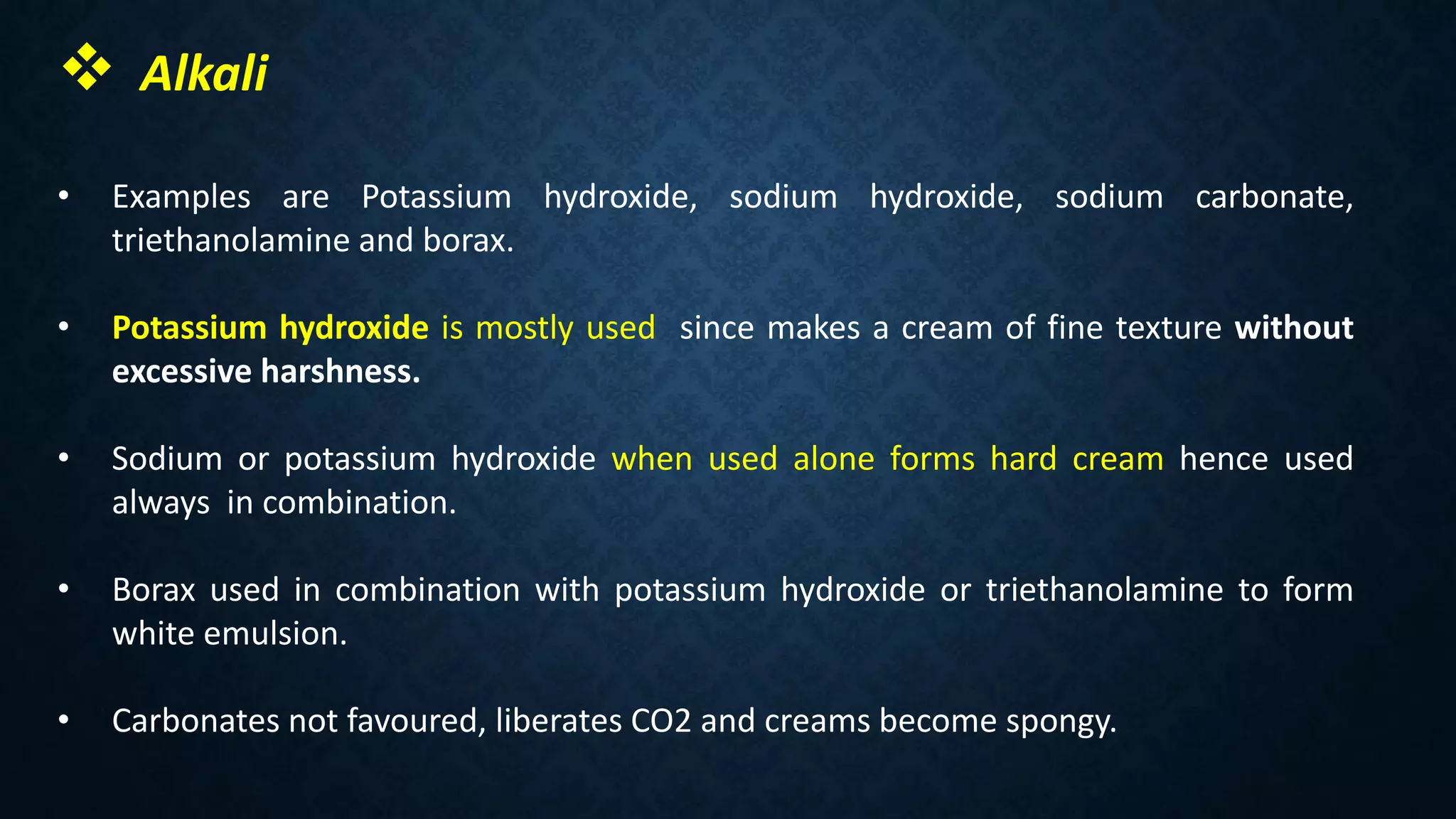
4. Rubbed easily on the skin
IDEAL PROPERTIES OF VANISHING CREAMS
MAJOR INGREDIENTS USED FOR THE
PRODUCTION OF VANISHING CREAMS
 Stearic acid
• Major component of vanishing cream
• Good quality triple pressed must be selected
• Soap formed in-situ by the reaction between a suitable alkali and
stearic acid determines hardness of the cream.
USE : Governs the consistency of the cream
 Humectants
• Glycerol most favored followed by sorbitol and propylene glycol
USE: Prevents excessive drying out of cream
 Alkali
• Examples are Potassium hydroxide, sodium hydroxide, sodium carbonate,
triethanolamine and borax.
• Potassium hydroxide is mostly used since makes a cream of fine texture without
excessive harshness.
• Sodium or potassium hydroxide when used alone forms hard cream hence used
always in combination.
• Borax used in combination with potassium hydroxide or triethanolamine to form
white emulsion.
• Carbonates not favoured, liberates CO2 and creams become spongy.
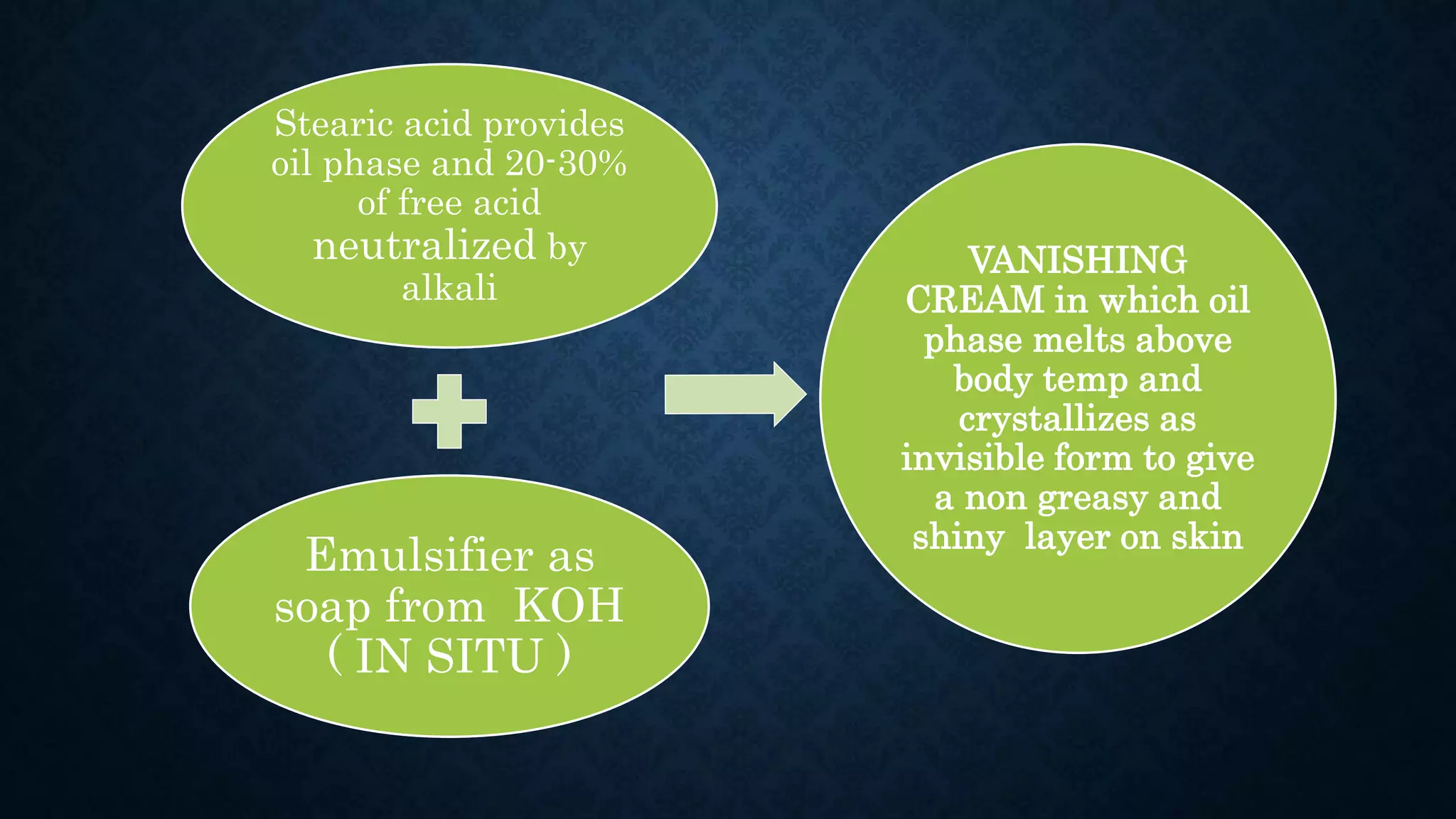
Stearic acid provides
oil phase and 20-30%
of free acid
neutralized by
alkali
Emulsifier as
soap from KOH
( IN SITU )
VANISHING
CREAM in which oil
phase melts above
body temp and
crystallizes as
invisible form to give
a non greasy and
shiny layer on skin
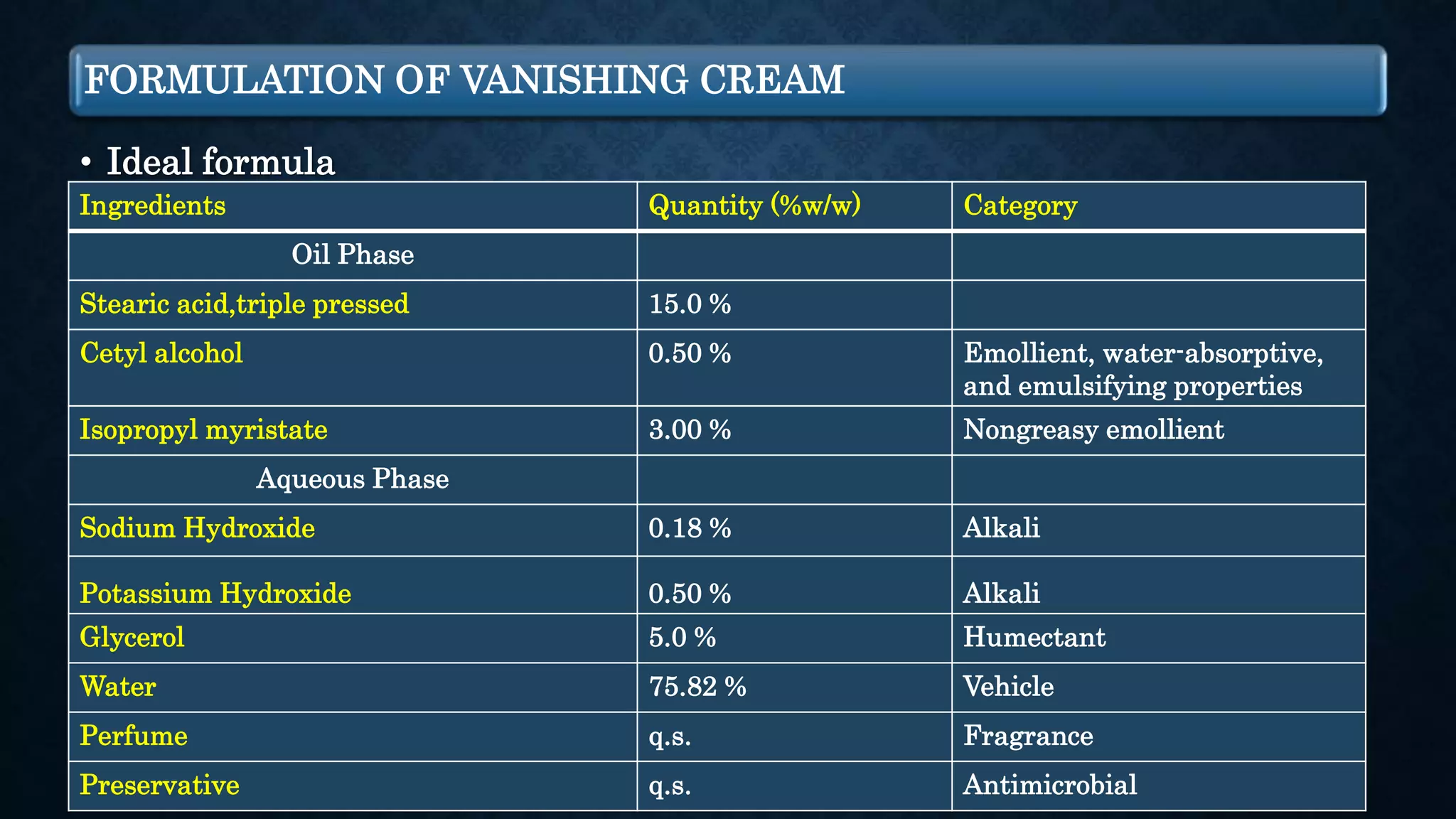
FORMULATION OF VANISHING CREAM
• Ideal formula
Ingredients Quantity (%w/w) Category
Oil Phase
Stearic acid,triple pressed 15.0 %
Cetyl alcohol 0.50 % Emollient, water-absorptive,
and emulsifying properties
Isopropyl myristate 3.00 % Nongreasy emollient
Aqueous Phase
Sodium Hydroxide
Potassium Hydroxide
0.18 %
0.50 %
Alkali
Alkali
Glycerol 5.0 % Humectant
Water 75.82 % Vehicle
Perfume q.s. Fragrance
Preservative q.s. Antimicrobial
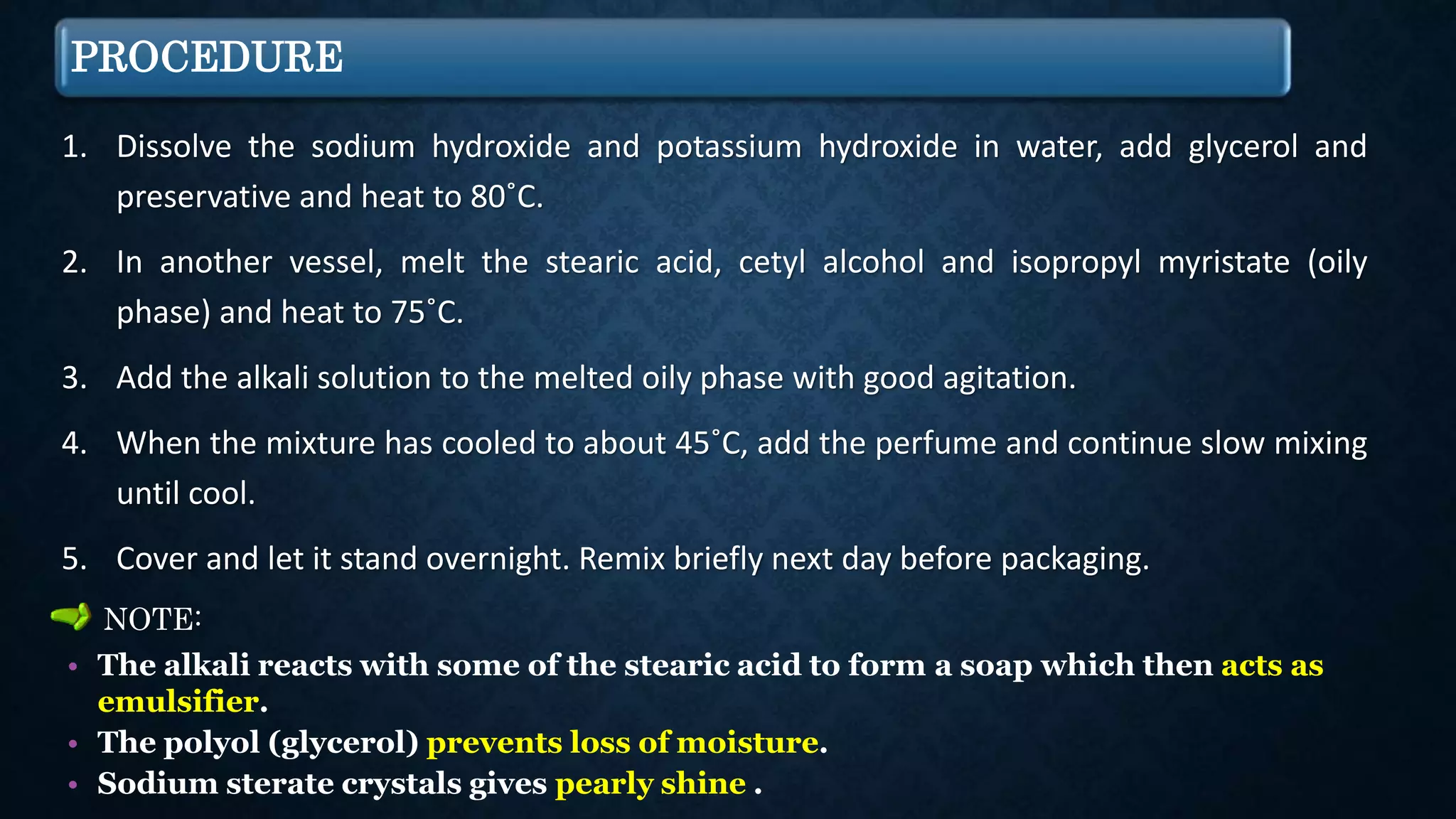
PROCEDURE
1. Dissolve the sodium hydroxide and potassium hydroxide in water, add glycerol and
preservative and heat to 80˚C.
2. In another vessel, melt the stearic acid, cetyl alcohol and isopropyl myristate (oily
phase) and heat to 75˚C.
3. Add the alkali solution to the melted oily phase with good agitation.
4. When the mixture has cooled to about 45˚C, add the perfume and continue slow mixing
until cool.
5. Cover and let it stand overnight. Remix briefly next day before packaging.
NOTE:
• The alkali reacts with some of the stearic acid to form a soap which then acts as
emulsifier.
• The polyol (glycerol) prevents loss of moisture.
• Sodium sterate crystals gives pearly shine .
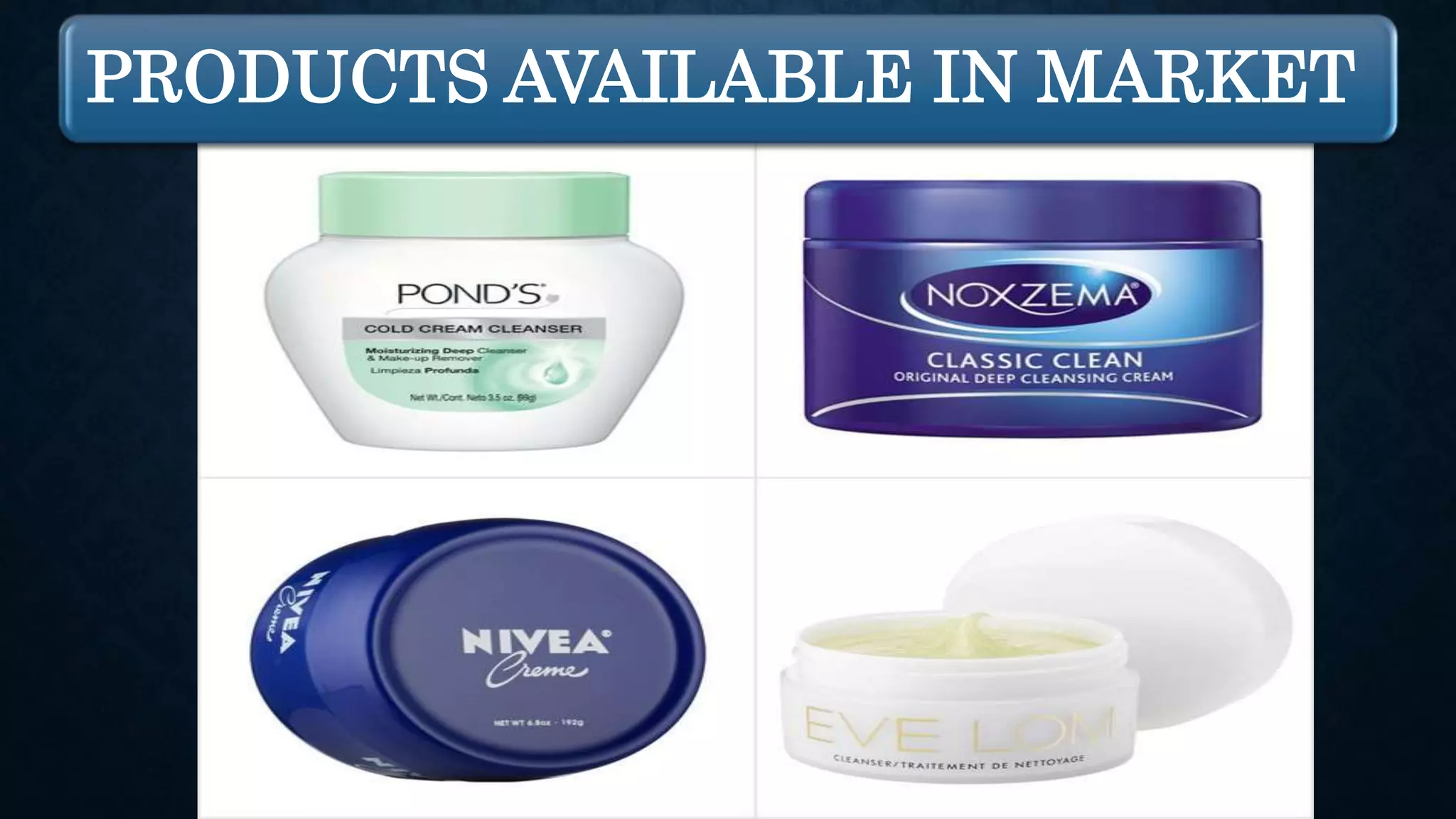
PRODUCTS AVAILABLE IN MARKET
COLD CREAM
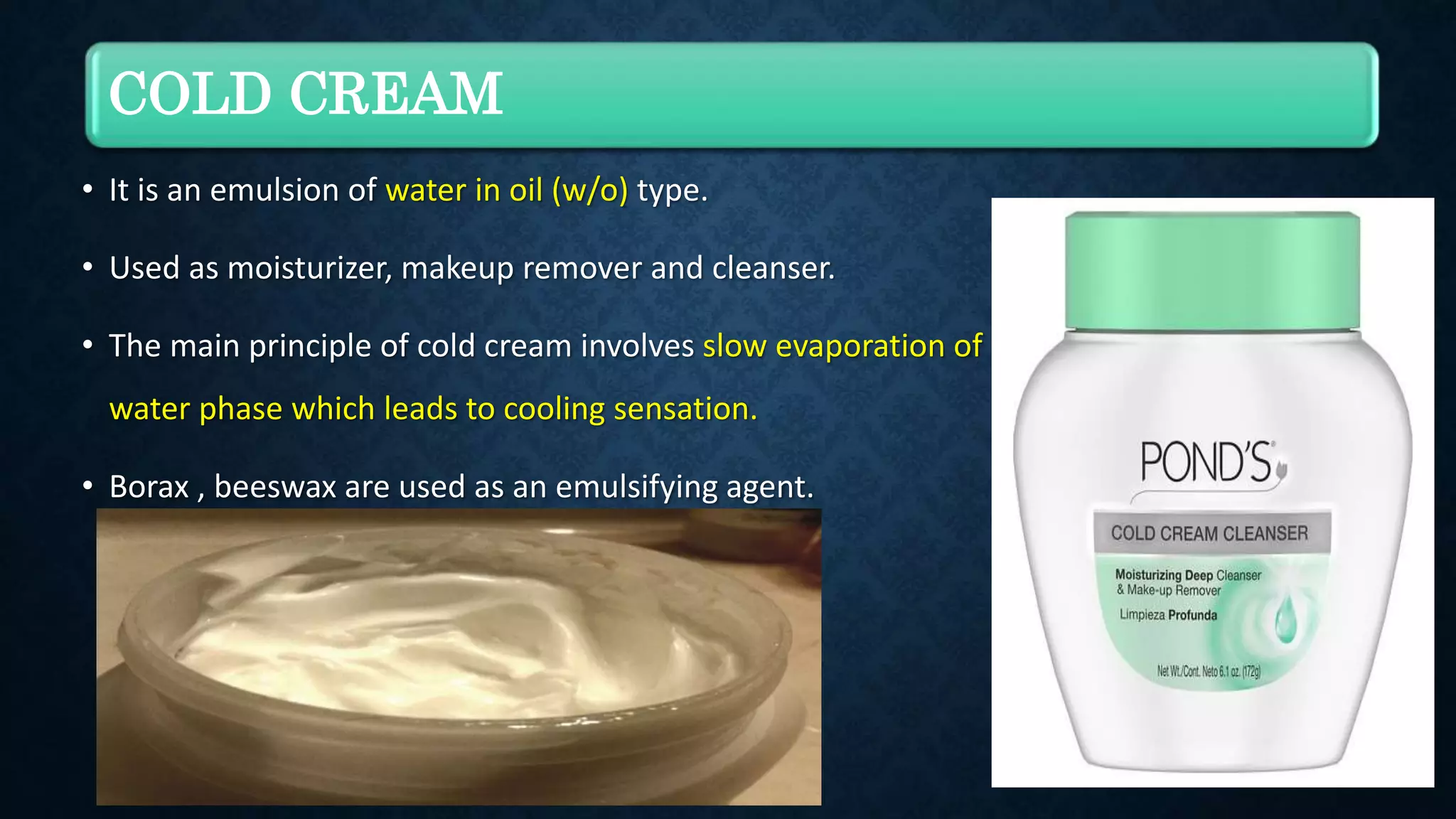
COLD CREAM
• It is an emulsion of water in oil (w/o) type.
• Used as moisturizer, makeup remover and cleanser.
• The main principle of cold cream involves slow evaporation of
water phase which leads to cooling sensation.
• Borax , beeswax are used as an emulsifying agent.
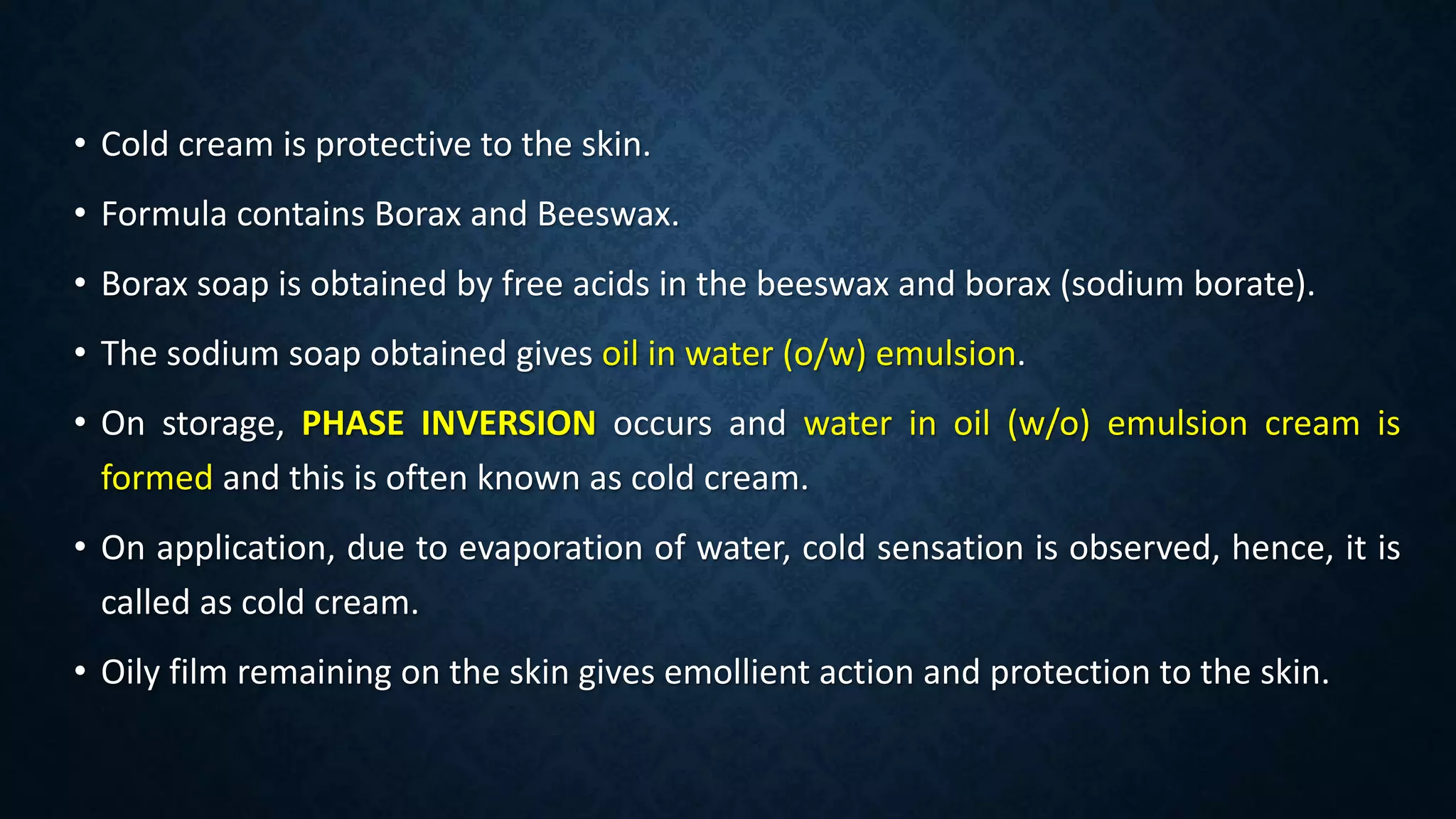
• Cold cream is protective to the skin.
• Formula contains Borax and Beeswax.
• Borax soap is obtained by free acids in the beeswax and borax (sodium borate).
• The sodium soap obtained gives oil in water (o/w) emulsion.
• On storage, PHASE INVERSION occurs and water in oil (w/o) emulsion cream is
formed and this is often known as cold cream.
• On application, due to evaporation of water, cold sensation is observed, hence, it is
called as cold cream.
• Oily film remaining on the skin gives emollient action and protection to the skin.
IDEAL CHARACTERISTICS OF COLD CREAM
• Should have optimum pH (4.6-6).
• Consistency should be optimum
• Should not be sticky
• Should be attractive in appearance
• Penetration through epidermis of skin should be desirable.
• Must be non-irritant and non-inflammatory.
• Should give cooling effects.
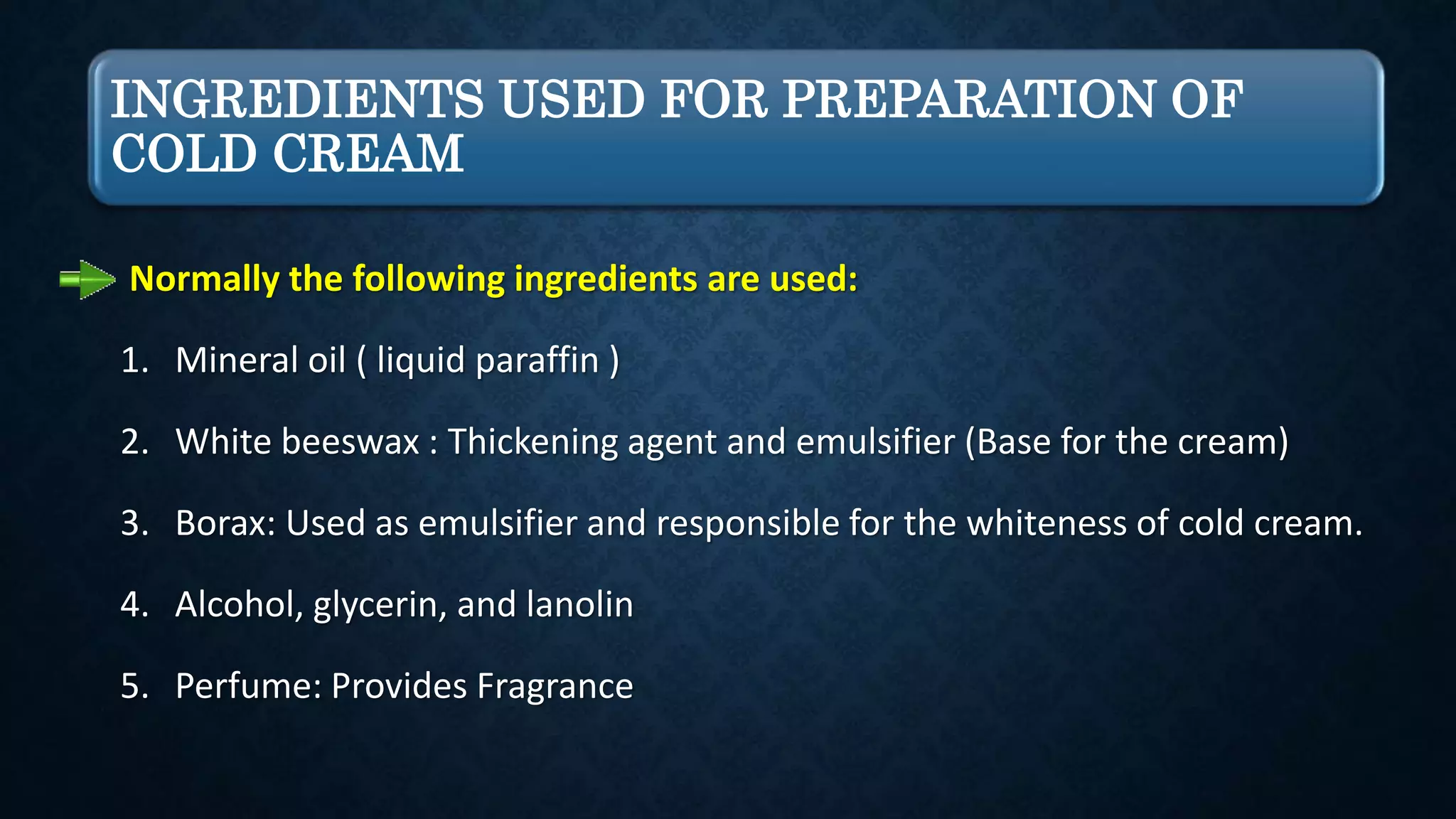
INGREDIENTS USED FOR PREPARATION OF
COLD CREAM
Normally the following ingredients are used:
1. Mineral oil ( liquid paraffin )
2. White beeswax : Thickening agent and emulsifier (Base for the cream)
3. Borax: Used as emulsifier and responsible for the whiteness of cold cream.
4. Alcohol, glycerin, and lanolin
5. Perfume: Provides Fragrance
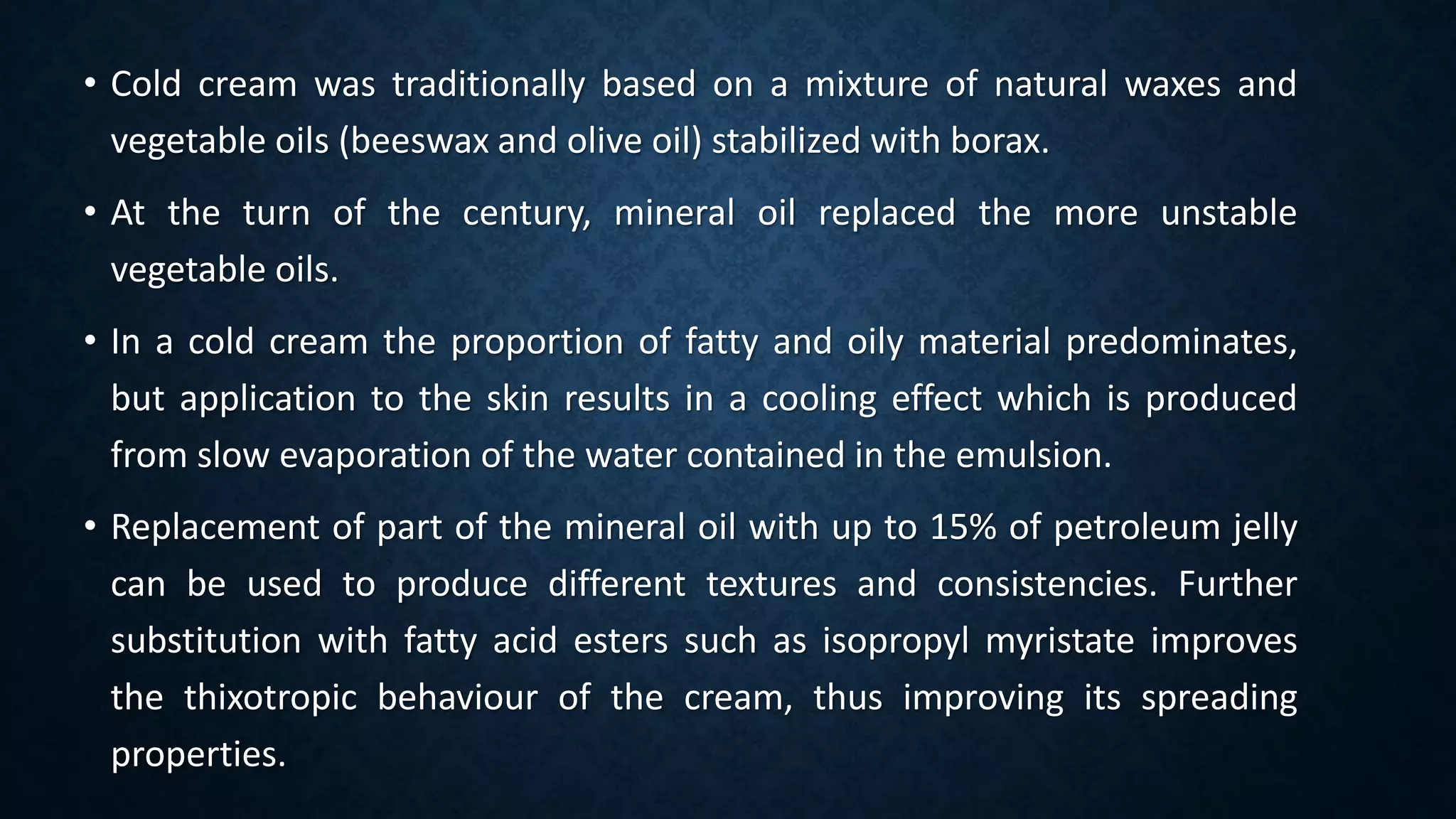
• Cold cream was traditionally based on a mixture of natural waxes and
vegetable oils (beeswax and olive oil) stabilized with borax.
• At the turn of the century, mineral oil replaced the more unstable
vegetable oils.
• In a cold cream the proportion of fatty and oily material predominates,
but application to the skin results in a cooling effect which is produced
from slow evaporation of the water contained in the emulsion.
• Replacement of part of the mineral oil with up to 15% of petroleum jelly
can be used to produce different textures and consistencies. Further
substitution with fatty acid esters such as isopropyl myristate improves
the thixotropic behaviour of the cream, thus improving its spreading
properties.
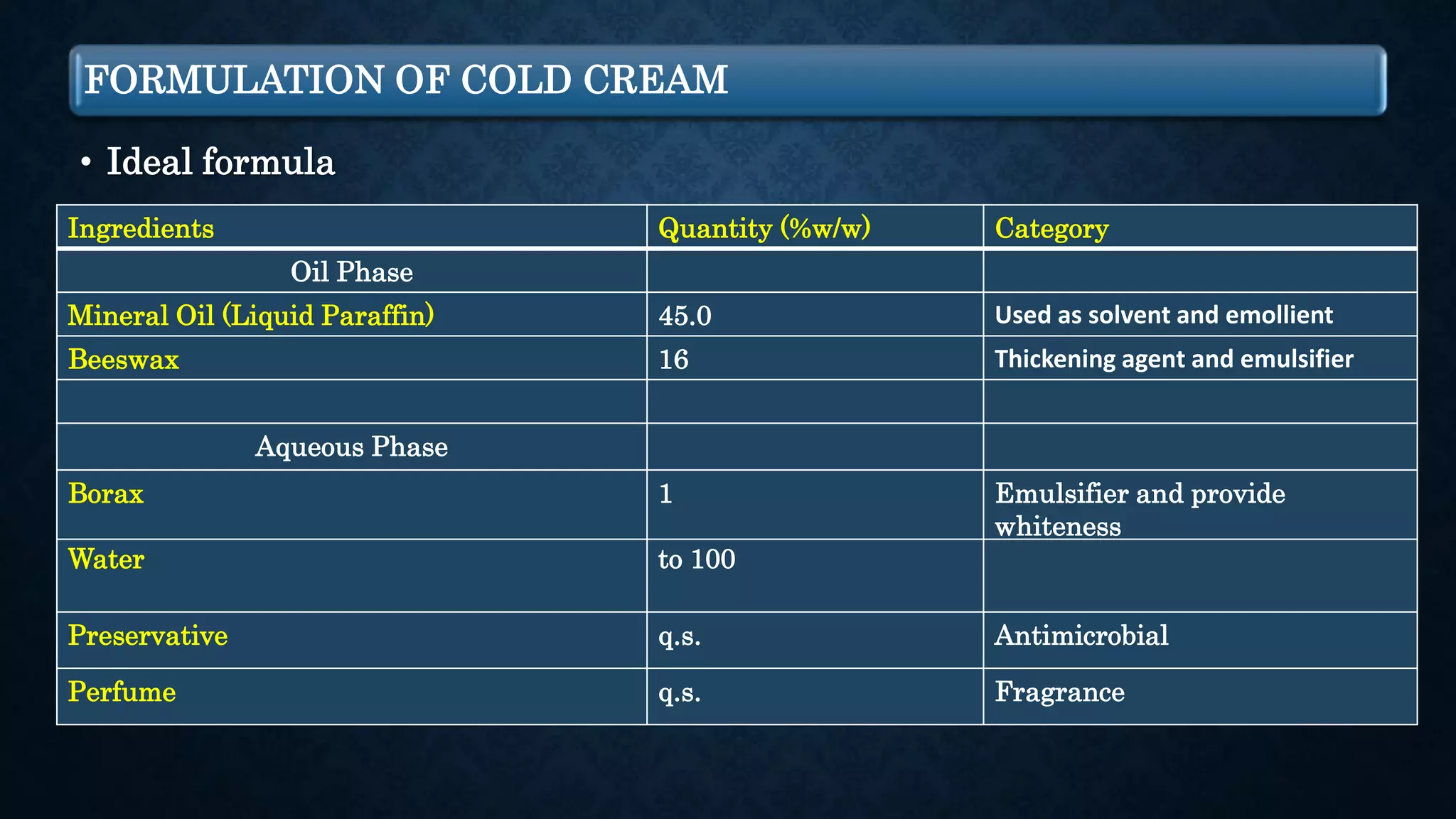
FORMULATION OF COLD CREAM
• Ideal formula
Ingredients Quantity (%w/w) Category
Oil Phase
Mineral Oil (Liquid Paraffin) 45.0 Used as solvent and emollient
Beeswax 16 Thickening agent and emulsifier
Aqueous Phase
Borax
Water
1
to 100
Emulsifier and provide
whiteness
Preservative q.s. Antimicrobial
Perfume q.s. Fragrance
PROCEDURE
• Heat the mineral oil and beeswax in a jacketed vessel at 75˚C and maintain
heat.
• In another container, dissolve borax and preservative in water and heat to
75˚C (Aqueous phase).
• Slowly add this aqueous phase to the mineral oil-beeswax heated oily phase.
• Cool to 35˚C and add perfume.
PRODUCTS AVAILABLE IN MARKET
USES
For Vanishing cream
• Used as adhesive for makeup
powders.
• Reduces loss of moisture from
dry skin.
• Smoothens the skin and keeps it
soft.
• Prevents skin from roughening
and chapping.
For Cold cream
• Typically used to cleanse the face
off makeup
• Heavily moisturises dry skin.
• Can also be used as a balm for dry
cracked lips.
• It can also be used as a shaving
cream alternative for men.
Cold cream vanishing cream

Cold cream vanishing cream

  • 1.
    PRESENTED BY: SACHIN SHARMA COLDCREAM AND VANISHING CREAM
  • 2.
    INTRODUCTION • In USPXVIII,creams are defined as • “ semisolid emulsions of either oil in water or water in oil type.” • “semisolid emulsions usually medicated, intended for external application.”.
  • 3.
    THE SKIN CARECREAMS CAN BE CLASSIFIED ON THE FOLLOWING BASIS: • According to emulsion type: 1. W/O creams Eg: Cold cream 2. O/W creams Eg: Vanishing cream. • According to function: Eg - cleansing, foundation, moisturizing etc.
  • 4.
  • 5.
    • Vanishing creamgets the name from the fact that it leaves no trace when rubbed into the skin. • These are oil in water emulsions that contains large percentages of water and stearic acid or other oleaginous components. • After application, the continuous phase evaporates, leaving behind a thin residue film of the stearic acid. VANISHING CREAM
  • 6.
    1. High meltingpoint 2. Pure whiteness 3. Very little odor and low iodine number 4. Rubbed easily on the skin IDEAL PROPERTIES OF VANISHING CREAMS
  • 7.
    MAJOR INGREDIENTS USEDFOR THE PRODUCTION OF VANISHING CREAMS  Stearic acid • Major component of vanishing cream • Good quality triple pressed must be selected • Soap formed in-situ by the reaction between a suitable alkali and stearic acid determines hardness of the cream. USE : Governs the consistency of the cream  Humectants • Glycerol most favored followed by sorbitol and propylene glycol USE: Prevents excessive drying out of cream
  • 8.
     Alkali • Examplesare Potassium hydroxide, sodium hydroxide, sodium carbonate, triethanolamine and borax. • Potassium hydroxide is mostly used since makes a cream of fine texture without excessive harshness. • Sodium or potassium hydroxide when used alone forms hard cream hence used always in combination. • Borax used in combination with potassium hydroxide or triethanolamine to form white emulsion. • Carbonates not favoured, liberates CO2 and creams become spongy.
  • 9.
    Stearic acid provides oilphase and 20-30% of free acid neutralized by alkali Emulsifier as soap from KOH ( IN SITU ) VANISHING CREAM in which oil phase melts above body temp and crystallizes as invisible form to give a non greasy and shiny layer on skin
  • 10.
    FORMULATION OF VANISHINGCREAM • Ideal formula Ingredients Quantity (%w/w) Category Oil Phase Stearic acid,triple pressed 15.0 % Cetyl alcohol 0.50 % Emollient, water-absorptive, and emulsifying properties Isopropyl myristate 3.00 % Nongreasy emollient Aqueous Phase Sodium Hydroxide Potassium Hydroxide 0.18 % 0.50 % Alkali Alkali Glycerol 5.0 % Humectant Water 75.82 % Vehicle Perfume q.s. Fragrance Preservative q.s. Antimicrobial
  • 11.
    PROCEDURE 1. Dissolve thesodium hydroxide and potassium hydroxide in water, add glycerol and preservative and heat to 80˚C. 2. In another vessel, melt the stearic acid, cetyl alcohol and isopropyl myristate (oily phase) and heat to 75˚C. 3. Add the alkali solution to the melted oily phase with good agitation. 4. When the mixture has cooled to about 45˚C, add the perfume and continue slow mixing until cool. 5. Cover and let it stand overnight. Remix briefly next day before packaging. NOTE: • The alkali reacts with some of the stearic acid to form a soap which then acts as emulsifier. • The polyol (glycerol) prevents loss of moisture. • Sodium sterate crystals gives pearly shine .
  • 12.
  • 13.
  • 14.
    COLD CREAM • Itis an emulsion of water in oil (w/o) type. • Used as moisturizer, makeup remover and cleanser. • The main principle of cold cream involves slow evaporation of water phase which leads to cooling sensation. • Borax , beeswax are used as an emulsifying agent.
  • 15.
    • Cold creamis protective to the skin. • Formula contains Borax and Beeswax. • Borax soap is obtained by free acids in the beeswax and borax (sodium borate). • The sodium soap obtained gives oil in water (o/w) emulsion. • On storage, PHASE INVERSION occurs and water in oil (w/o) emulsion cream is formed and this is often known as cold cream. • On application, due to evaporation of water, cold sensation is observed, hence, it is called as cold cream. • Oily film remaining on the skin gives emollient action and protection to the skin.
  • 16.
    IDEAL CHARACTERISTICS OFCOLD CREAM • Should have optimum pH (4.6-6). • Consistency should be optimum • Should not be sticky • Should be attractive in appearance • Penetration through epidermis of skin should be desirable. • Must be non-irritant and non-inflammatory. • Should give cooling effects.
  • 17.
    INGREDIENTS USED FORPREPARATION OF COLD CREAM Normally the following ingredients are used: 1. Mineral oil ( liquid paraffin ) 2. White beeswax : Thickening agent and emulsifier (Base for the cream) 3. Borax: Used as emulsifier and responsible for the whiteness of cold cream. 4. Alcohol, glycerin, and lanolin 5. Perfume: Provides Fragrance
  • 18.
    • Cold creamwas traditionally based on a mixture of natural waxes and vegetable oils (beeswax and olive oil) stabilized with borax. • At the turn of the century, mineral oil replaced the more unstable vegetable oils. • In a cold cream the proportion of fatty and oily material predominates, but application to the skin results in a cooling effect which is produced from slow evaporation of the water contained in the emulsion. • Replacement of part of the mineral oil with up to 15% of petroleum jelly can be used to produce different textures and consistencies. Further substitution with fatty acid esters such as isopropyl myristate improves the thixotropic behaviour of the cream, thus improving its spreading properties.
  • 19.
    FORMULATION OF COLDCREAM • Ideal formula Ingredients Quantity (%w/w) Category Oil Phase Mineral Oil (Liquid Paraffin) 45.0 Used as solvent and emollient Beeswax 16 Thickening agent and emulsifier Aqueous Phase Borax Water 1 to 100 Emulsifier and provide whiteness Preservative q.s. Antimicrobial Perfume q.s. Fragrance
  • 20.
    PROCEDURE • Heat themineral oil and beeswax in a jacketed vessel at 75˚C and maintain heat. • In another container, dissolve borax and preservative in water and heat to 75˚C (Aqueous phase). • Slowly add this aqueous phase to the mineral oil-beeswax heated oily phase. • Cool to 35˚C and add perfume.
  • 21.
  • 22.
    USES For Vanishing cream •Used as adhesive for makeup powders. • Reduces loss of moisture from dry skin. • Smoothens the skin and keeps it soft. • Prevents skin from roughening and chapping. For Cold cream • Typically used to cleanse the face off makeup • Heavily moisturises dry skin. • Can also be used as a balm for dry cracked lips. • It can also be used as a shaving cream alternative for men.