PHARMACEUTICS
FORMULATION OF HAIRCARE PRODUCTS
CONTENTS
1. AIM
2. INTRODUCTION
3. PURPOSE
4. IMPORTANCE OF
SHAMPOO
5. CONDITIONING
SHAMPOO
6. ANTI DANDRUFF
SHAMPOO
7. HAIR CONDITIONER
8. HAIR OILS
9. CONCLUSION
10. REFERENCE
AIM
 To study and design formulation of hair care preparation .
 it is verymuch essential to have knowledgeof hair. We surely have
adapted ourselvesto the busy routines. Often, we forget to take care of
our hair. It is very importantto take proper care of your hair for
maintaining their health and strength.
 Shampoo are primarily been products aimed at cleansing the hair and
scalp. Now a days most of the people can use the conditioner for
smoothing the hair and protect their hair from hair damages.
Anti dandruff shampoo treat dandruff and a certain scalp infection. It
reduces itching, flacking, irritation and redness of the scalp.
Hair oil for nourishment, hair growthand care of hair.
INTRODUCTION
Hair care is an overallterm for hygiene and cosmetologyinvolvingthe
hair which grows forms the human scalp and to a lesser extent facial, pubic and
other body hair. There are about 50,00,000 hairs on the human body and 98% of
them are on general body surface and about 1,00,000- 1,20,000 are on the head.
Hair is primarily composed of a protein called keratin which is formed due to the
compression of dead cells the keratin t are forced along the follicle towards scalp
during new cell division keratin is made up of 18 Amino acids including cysteine and
others.
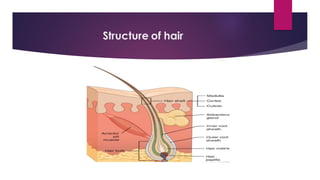
Structure of hair
Hair and it’s parts
Cuticle
• The external layer of the shaft
which consist of thin cells
known as cuticle scales.
• It servesas the casing for the
cortex.
• Works as a protectivescale.
Cortex
• The thickest section of the
shaft.
• Which contains the pigment
that giveshair its color.
• Providesstrength,moisture,
color and texture.
Medulla
• Core of hair.
• May not be present in Every
case.
PURPOSE
The purpose statement is fulfilling the needs of its target market
by offering smart product, help people feel good, look good and get
more out of life we are trying to providing self satisfaction and
confidence.
Our vision is sharing beauty and confidence with all !
Importance of shampoos:
Disadvantages
Advantages
1. The characteristics of a good
shampoo are fairly obvious.
2. It keep hair silky and smooth.
3. Shampoo foam is pleasing.
4. It is less toxic.
5. Repair damaged hair and causes less
damage to hair.
6. It’s slightly acidic.
1. Sodium lauryl sulfate Is commonly
used in shampoo which may harm
skin, eyes, and may even be
carcinogenic.
2. Continous expose to this can cause
headache and vertigo.
3. May also cause sourness in eyes, nose
and throat and lungs.
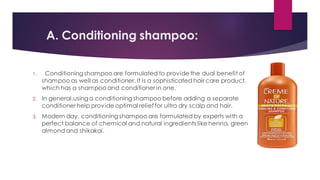
A. Conditioning shampoo:
1. Conditioning shampoo are formulated to provide the dual benefit of
shampoo as well as conditioner. It is a sophisticated hair care product,
which has a shampoo and conditioner in one.
2. In general,using a conditioning shampoo before adding a separate
conditioner help provide optimal relieffor ultra dry scalp and hair.
3. Modern day, conditioning shampoo are formulated by experts with a
perfect balance of chemical and natural ingredients like henna, green
almondand shikakai.
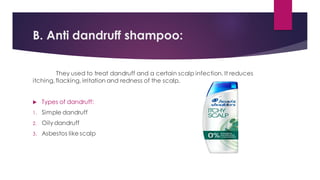
B. Anti dandruff shampoo:
They used to treat dandruff and a certain scalp infection. It reduces
itching,flacking, irritation and redness of the scalp.
 Types of dandruff:
1. Simple dandruff
2. Oily dandruff
3. Asbestos like scalp
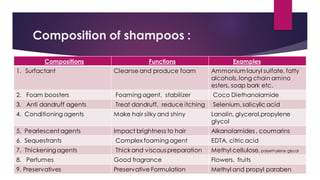
Composition of shampoos :
Compositions Functions Examples
1. Surfactant Cleanse and produce foam Ammonium lauryl sulfate, fatty
alcohols,long chain amino
esters, soap bark etc.
2. Foam boosters Foaming agent, stabilizer Coco Diethanolamide
3. Anti dandruff agents Treat dandruff, reduce itching Selenium, salicylic acid
4. Conditioning agents Make hair silky and shiny Lanolin, glycerol,propylene
glycol
5. Pearlescent agents Impact brightness to hair Alkanolamides , coumarins
6. Sequestrants Complex foaming agent EDTA, citric acid
7. Thickening agents Thick and viscous preparation Methyl cellulose, polyethylene glycol
8. Perfumes Good fragrance Flowers, fruits
9. Preservatives Preservative Formulation Methyl and propyl paraben
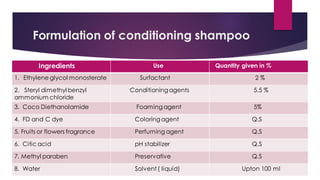
Formulation of conditioning shampoo
Ingredients Use Quantity given in %
1. Ethylene glycol monosterate Surfactant 2 %
2. Steryl dimethyl benzyl
ammonium chloride
Conditioning agents 5.5 %
3. Coco Diethanolamide Foaming agent 5%
4. FD and C dye Coloring agent Q.S
5. Fruits or flowers fragrance Perfuming agent Q.S
6. Citic acid pH stabilizer Q.S
7. Methyl paraben Preservative Q.S
8. Water Solvent ( liquid) Upton 100 ml
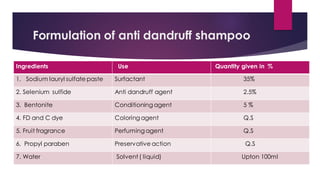
Formulation of anti dandruff shampoo
Ingredients Use Quantity given in %
1. Sodium lauryl sulfate paste Surfactant 35%
2. Selenium sulfide Anti dandruff agent 2.5%
3. Bentonite Conditioning agent 5 %
4. FD and C dye Coloring agent Q.S
5. Fruit fragrance Perfuming agent Q.S
6. Propyl paraben Preservative action Q.S
7. Water Solvent ( liquid) Upton 100ml
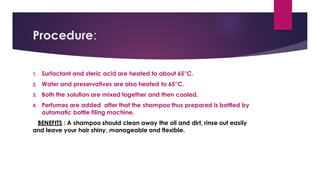
Procedure:
1. Surfactant and steric acid are heated to about 65°C.
2. Water and preservatives are also heated to 65°C.
3. Both the solution are mixed together and then cooled.
4. Perfumes are added after that the shampoo thus prepared is bottled by
automatic bottle filing machine.
BENEFITS : A shampoo should clean away the oil and dirt, rinse out easily
and leave your hair shiny, manageable and flexible.
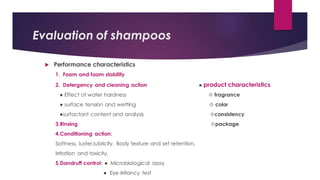
Evaluation of shampoos
 Performance characteristics
1. Foam and foam stability
2. Detergency and cleaning action ● product characteristics
● Effect of water hardness ◇ fragrance
● surface tension and wetting ◇ color
●surfactant content and analysis ◇consistency
3.Rinsing ◇package
4.Conditioning action:
Softness, luster,lubricity, Body texture and set retention,
Irritation and toxicity.
5.Dandruff control: ● Microbiological asssy
● Eye irritancy test
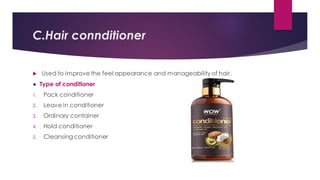
C.Hair connditioner
 Used to improve the feel appearance and manageability of hair.
● Type of conditioner
1. Pack conditioner
2. Leave in conditioner
3. Ordinary container
4. Hold conditioner
5. Cleansing conditioner
Composition of conditioner :
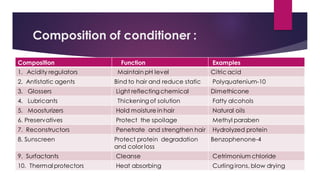
Composition Function Examples
1. Acidity regulators Maintain pH level Citric acid
2. Antistatic agents Bind to hair and reduce static Polyquatenium-10
3. Glossers Light reflecting chemical Dimethicone
4. Lubricants Thickening of solution Fatty alcohols
5. Moosturizers Hold moisture in hair Natural oils
6. Preservatives Protect the spoilage Methyl paraben
7. Reconstructors Penetrate and strengthen hair Hydrolyzed protein
8. Sunscreen Protect protein degradation
and color loss
Benzophenone-4
9. Surfactants Cleanse Cetrimonium chloride
10. Thermal protectors Heat absorbing Curling irons, blow drying
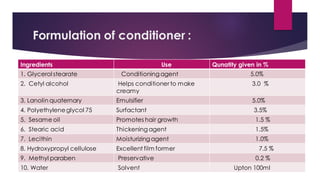
Formulation of conditioner :
Ingredients Use Qunatity given in %
1. Glycerol stearate Conditioning agent 5.0%
2. Cetyl alcohol Helps conditioner to make
creamy
3.0 %
3. Lanolin quaternary Emulsifier 5.0%
4. Polyethyleneglycol 75 Surfactant 3.5%
5. Sesame oil Promotes hair growth 1.5 %
6. Stearic acid Thickening agent 1.5%
7. Lecithin Moisturizing agent 1.0%
8. Hydroxypropyl cellulose Excellent film former 7.5 %
9. Methyl paraben Preservative 0.2 %
10. Water Solvent Upton 100ml
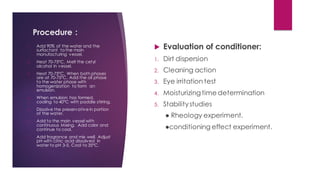
Procedure :
 Evaluation of conditioner:
1. Dirt dispersion
2. Cleaning action
3. Eye irritation test
4. Moisturizingtime determination
5. Stabilitystudies
● Rheology experiment.
●conditioning effect experiment.
1. Add 90% of the water and the
surfactant to the main
manufacturing vessel.
2. Heat 70-75°C. Melt the cetyl
alcohol in vessel.
3. Heat 70-75°C. When both phases
are at 70-75°C. Add the oil phase
to the water phase with
homogenization to form an
emulsion.
4. When emulsion has formed,
cooling to 40°C with paddle stirring.
5. Dissolve the preservative in portion
of the water.
6. Add to the main vessel with
continuous Mixing. Add color and
continue to cool.
7. Add fragrance and mix well. Adjust
pH with citric acid dissolved in
water to pH 3-5. Cool to 35°C.
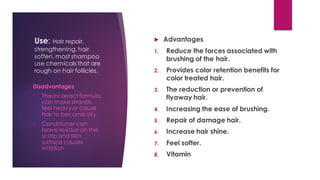
Use: Hair repair,
strengthening, hair
soften, most shampoo
use chemicals that are
rough on hair follicles.
 Advantages
1. Reduce the forces associated with
brushing of the hair.
2. Provides color retention benefits for
color treated hair.
3. The reduction or prevention of
flyaway hair.
4. Increasing the ease of brushing.
5. Repair of damage hair.
6. Increase hair shine.
7. Feel softer.
8. Vitamin
Disadvantages
1. The incorrect formula
can make strands
feel heavy or cause
hair to become oily
2. Conditioner can
leave residue on the
scalp and skin
surface causes
irritation
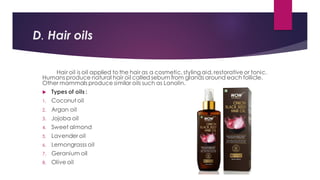
D. Hair oils
Hair oil is oil applied to the hair as a cosmetic, styling aid, restorative or tonic.
Humans produce natural hair oil called sebum from glands around each follicle.
Other mammals produce similar oils such as Lanolin.
 Types of oils :
1. Coconut oil
2. Argan oil
3. Jojoba oil
4. Sweet almond
5. Lavender oil
6. Lemongrasss oil
7. Geranium oil
8. Olive oil
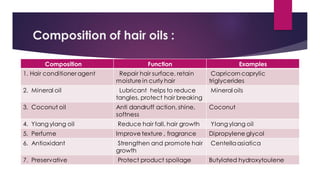
Composition of hair oils :
Composition Function Examples
1. Hair conditioner agent Repair hair surface, retain
moisture in curly hair
Capricorn caprylic
triglycerides
2. Mineral oil Lubricant helps to reduce
tangles, protect hair breaking
Mineral oils
3. Coconut oil Anti dandruff action, shine,
softness
Coconut
4. Ylang ylang oil Reduce hair fall, hair growth Ylang ylang oil
5. Perfume Improve texture , fragrance Dipropylene glycol
6. Antioxidant Strengthen and promote hair
growth
Centellaasiatica
7. Preservative Protect product spoilage Butylated hydroxytoulene
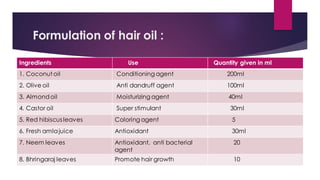
Formulation of hair oil :
Ingredients Use Quantity given in ml
1. Coconut oil Conditioning agent 200ml
2. Olive oil Anti dandruff agent 100ml
3. Almondoil Moisturizing agent 40ml
4. Castor oil Super stimulant 30ml
5. Red hibiscus leaves Coloring agent 5
6. Fresh amlajuice Antioxidant 30ml
7. Neem leaves Antioxidant, anti bacterial
agent
20
8. Bhringaraj leaves Promote hair growth 10
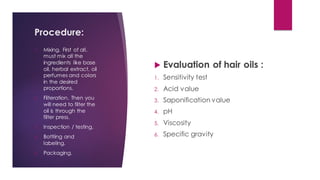
Procedure:
 Evaluation of hair oils :
1. Sensitivity test
2. Acid value
3. Saponification value
4. pH
5. Viscosity
6. Specific gravity
1. Mixing. First of all,
must mix all the
ingredients like base
oil, herbal extract, oil
perfumes and colors
in the desired
proportions.
2. Filteration. Then you
will need to filter the
oil is through the
filter press.
3. Inspection / testing.
4. Bottling and
labeling.
5. Packaging.
Use:
1. Stimulate hair growth
2. Add shine
3. Helps prevent and
remedy heat and styling
damage.
4. Nourishes hair.
5. Combats dry scalp
and dandruff.
 Advantages:
1. Form improving dry scalp and hair
loss issues to adding shine and
protectingagainst damage.
2. Hair conditioning.
3. Increase hair growth.
4. Slow downhair loss.
5. Hair strong and lustrous.
Disadvantages:
1. oil gathersthe
pollutants and dust
in the air.
2. Over oiling can
create greasy
looking hair
3. Heavyoil can weigh
hair down.
Conclusion :
• Because hair loss is so distressing, patients are willing to try just about
everything.
• There are countless products that claim to regrow hair, but there is not
enough rigorous science behind most of them.
• Patients often ask question about hair care and we tell them that in most
cases frequency of shampoos, shampoos themselves, hair coloring are
irrelevant in the process of hair loss and that they can feel comfortable
using any regular products.
Reference:
1. B.M.Mithal, R.N.Shah. A handbook of cosmetics. First edition 2000, page
no.105- 121.
2. Martin M. Reiger, Ph. D., Harry’s Cosmeticology 8th edition volume I-II page
no. 2.1 – 2.6.
3. Meghraj ashok patil, journal of Pharmacognocy and Phytochemistry
2019:8(0):35-39.
4. Google images.
THANK YOU !

null.pdf

  • 1.
  • 2.
    CONTENTS 1. AIM 2. INTRODUCTION 3.PURPOSE 4. IMPORTANCE OF SHAMPOO 5. CONDITIONING SHAMPOO 6. ANTI DANDRUFF SHAMPOO 7. HAIR CONDITIONER 8. HAIR OILS 9. CONCLUSION 10. REFERENCE
  • 3.
    AIM  To studyand design formulation of hair care preparation .  it is verymuch essential to have knowledgeof hair. We surely have adapted ourselvesto the busy routines. Often, we forget to take care of our hair. It is very importantto take proper care of your hair for maintaining their health and strength.  Shampoo are primarily been products aimed at cleansing the hair and scalp. Now a days most of the people can use the conditioner for smoothing the hair and protect their hair from hair damages. Anti dandruff shampoo treat dandruff and a certain scalp infection. It reduces itching, flacking, irritation and redness of the scalp. Hair oil for nourishment, hair growthand care of hair.
  • 4.
    INTRODUCTION Hair care isan overallterm for hygiene and cosmetologyinvolvingthe hair which grows forms the human scalp and to a lesser extent facial, pubic and other body hair. There are about 50,00,000 hairs on the human body and 98% of them are on general body surface and about 1,00,000- 1,20,000 are on the head. Hair is primarily composed of a protein called keratin which is formed due to the compression of dead cells the keratin t are forced along the follicle towards scalp during new cell division keratin is made up of 18 Amino acids including cysteine and others.
  • 5.
  • 6.
    Hair and it’sparts Cuticle • The external layer of the shaft which consist of thin cells known as cuticle scales. • It servesas the casing for the cortex. • Works as a protectivescale. Cortex • The thickest section of the shaft. • Which contains the pigment that giveshair its color. • Providesstrength,moisture, color and texture. Medulla • Core of hair. • May not be present in Every case.
  • 7.
    PURPOSE The purpose statementis fulfilling the needs of its target market by offering smart product, help people feel good, look good and get more out of life we are trying to providing self satisfaction and confidence. Our vision is sharing beauty and confidence with all !
  • 8.
    Importance of shampoos: Disadvantages Advantages 1.The characteristics of a good shampoo are fairly obvious. 2. It keep hair silky and smooth. 3. Shampoo foam is pleasing. 4. It is less toxic. 5. Repair damaged hair and causes less damage to hair. 6. It’s slightly acidic. 1. Sodium lauryl sulfate Is commonly used in shampoo which may harm skin, eyes, and may even be carcinogenic. 2. Continous expose to this can cause headache and vertigo. 3. May also cause sourness in eyes, nose and throat and lungs.
  • 9.
    A. Conditioning shampoo: 1.Conditioning shampoo are formulated to provide the dual benefit of shampoo as well as conditioner. It is a sophisticated hair care product, which has a shampoo and conditioner in one. 2. In general,using a conditioning shampoo before adding a separate conditioner help provide optimal relieffor ultra dry scalp and hair. 3. Modern day, conditioning shampoo are formulated by experts with a perfect balance of chemical and natural ingredients like henna, green almondand shikakai.
  • 10.
    B. Anti dandruffshampoo: They used to treat dandruff and a certain scalp infection. It reduces itching,flacking, irritation and redness of the scalp.  Types of dandruff: 1. Simple dandruff 2. Oily dandruff 3. Asbestos like scalp
  • 11.
    Composition of shampoos: Compositions Functions Examples 1. Surfactant Cleanse and produce foam Ammonium lauryl sulfate, fatty alcohols,long chain amino esters, soap bark etc. 2. Foam boosters Foaming agent, stabilizer Coco Diethanolamide 3. Anti dandruff agents Treat dandruff, reduce itching Selenium, salicylic acid 4. Conditioning agents Make hair silky and shiny Lanolin, glycerol,propylene glycol 5. Pearlescent agents Impact brightness to hair Alkanolamides , coumarins 6. Sequestrants Complex foaming agent EDTA, citric acid 7. Thickening agents Thick and viscous preparation Methyl cellulose, polyethylene glycol 8. Perfumes Good fragrance Flowers, fruits 9. Preservatives Preservative Formulation Methyl and propyl paraben
  • 12.
    Formulation of conditioningshampoo Ingredients Use Quantity given in % 1. Ethylene glycol monosterate Surfactant 2 % 2. Steryl dimethyl benzyl ammonium chloride Conditioning agents 5.5 % 3. Coco Diethanolamide Foaming agent 5% 4. FD and C dye Coloring agent Q.S 5. Fruits or flowers fragrance Perfuming agent Q.S 6. Citic acid pH stabilizer Q.S 7. Methyl paraben Preservative Q.S 8. Water Solvent ( liquid) Upton 100 ml
  • 13.
    Formulation of antidandruff shampoo Ingredients Use Quantity given in % 1. Sodium lauryl sulfate paste Surfactant 35% 2. Selenium sulfide Anti dandruff agent 2.5% 3. Bentonite Conditioning agent 5 % 4. FD and C dye Coloring agent Q.S 5. Fruit fragrance Perfuming agent Q.S 6. Propyl paraben Preservative action Q.S 7. Water Solvent ( liquid) Upton 100ml
  • 14.
    Procedure: 1. Surfactant andsteric acid are heated to about 65°C. 2. Water and preservatives are also heated to 65°C. 3. Both the solution are mixed together and then cooled. 4. Perfumes are added after that the shampoo thus prepared is bottled by automatic bottle filing machine. BENEFITS : A shampoo should clean away the oil and dirt, rinse out easily and leave your hair shiny, manageable and flexible.
  • 15.
    Evaluation of shampoos Performance characteristics 1. Foam and foam stability 2. Detergency and cleaning action ● product characteristics ● Effect of water hardness ◇ fragrance ● surface tension and wetting ◇ color ●surfactant content and analysis ◇consistency 3.Rinsing ◇package 4.Conditioning action: Softness, luster,lubricity, Body texture and set retention, Irritation and toxicity. 5.Dandruff control: ● Microbiological asssy ● Eye irritancy test
  • 16.
    C.Hair connditioner  Usedto improve the feel appearance and manageability of hair. ● Type of conditioner 1. Pack conditioner 2. Leave in conditioner 3. Ordinary container 4. Hold conditioner 5. Cleansing conditioner
  • 17.
    Composition of conditioner: Composition Function Examples 1. Acidity regulators Maintain pH level Citric acid 2. Antistatic agents Bind to hair and reduce static Polyquatenium-10 3. Glossers Light reflecting chemical Dimethicone 4. Lubricants Thickening of solution Fatty alcohols 5. Moosturizers Hold moisture in hair Natural oils 6. Preservatives Protect the spoilage Methyl paraben 7. Reconstructors Penetrate and strengthen hair Hydrolyzed protein 8. Sunscreen Protect protein degradation and color loss Benzophenone-4 9. Surfactants Cleanse Cetrimonium chloride 10. Thermal protectors Heat absorbing Curling irons, blow drying
  • 18.
    Formulation of conditioner: Ingredients Use Qunatity given in % 1. Glycerol stearate Conditioning agent 5.0% 2. Cetyl alcohol Helps conditioner to make creamy 3.0 % 3. Lanolin quaternary Emulsifier 5.0% 4. Polyethyleneglycol 75 Surfactant 3.5% 5. Sesame oil Promotes hair growth 1.5 % 6. Stearic acid Thickening agent 1.5% 7. Lecithin Moisturizing agent 1.0% 8. Hydroxypropyl cellulose Excellent film former 7.5 % 9. Methyl paraben Preservative 0.2 % 10. Water Solvent Upton 100ml
  • 19.
    Procedure :  Evaluationof conditioner: 1. Dirt dispersion 2. Cleaning action 3. Eye irritation test 4. Moisturizingtime determination 5. Stabilitystudies ● Rheology experiment. ●conditioning effect experiment. 1. Add 90% of the water and the surfactant to the main manufacturing vessel. 2. Heat 70-75°C. Melt the cetyl alcohol in vessel. 3. Heat 70-75°C. When both phases are at 70-75°C. Add the oil phase to the water phase with homogenization to form an emulsion. 4. When emulsion has formed, cooling to 40°C with paddle stirring. 5. Dissolve the preservative in portion of the water. 6. Add to the main vessel with continuous Mixing. Add color and continue to cool. 7. Add fragrance and mix well. Adjust pH with citric acid dissolved in water to pH 3-5. Cool to 35°C.
  • 20.
    Use: Hair repair, strengthening,hair soften, most shampoo use chemicals that are rough on hair follicles.  Advantages 1. Reduce the forces associated with brushing of the hair. 2. Provides color retention benefits for color treated hair. 3. The reduction or prevention of flyaway hair. 4. Increasing the ease of brushing. 5. Repair of damage hair. 6. Increase hair shine. 7. Feel softer. 8. Vitamin Disadvantages 1. The incorrect formula can make strands feel heavy or cause hair to become oily 2. Conditioner can leave residue on the scalp and skin surface causes irritation
  • 21.
    D. Hair oils Hairoil is oil applied to the hair as a cosmetic, styling aid, restorative or tonic. Humans produce natural hair oil called sebum from glands around each follicle. Other mammals produce similar oils such as Lanolin.  Types of oils : 1. Coconut oil 2. Argan oil 3. Jojoba oil 4. Sweet almond 5. Lavender oil 6. Lemongrasss oil 7. Geranium oil 8. Olive oil
  • 22.
    Composition of hairoils : Composition Function Examples 1. Hair conditioner agent Repair hair surface, retain moisture in curly hair Capricorn caprylic triglycerides 2. Mineral oil Lubricant helps to reduce tangles, protect hair breaking Mineral oils 3. Coconut oil Anti dandruff action, shine, softness Coconut 4. Ylang ylang oil Reduce hair fall, hair growth Ylang ylang oil 5. Perfume Improve texture , fragrance Dipropylene glycol 6. Antioxidant Strengthen and promote hair growth Centellaasiatica 7. Preservative Protect product spoilage Butylated hydroxytoulene
  • 23.
    Formulation of hairoil : Ingredients Use Quantity given in ml 1. Coconut oil Conditioning agent 200ml 2. Olive oil Anti dandruff agent 100ml 3. Almondoil Moisturizing agent 40ml 4. Castor oil Super stimulant 30ml 5. Red hibiscus leaves Coloring agent 5 6. Fresh amlajuice Antioxidant 30ml 7. Neem leaves Antioxidant, anti bacterial agent 20 8. Bhringaraj leaves Promote hair growth 10
  • 24.
    Procedure:  Evaluation ofhair oils : 1. Sensitivity test 2. Acid value 3. Saponification value 4. pH 5. Viscosity 6. Specific gravity 1. Mixing. First of all, must mix all the ingredients like base oil, herbal extract, oil perfumes and colors in the desired proportions. 2. Filteration. Then you will need to filter the oil is through the filter press. 3. Inspection / testing. 4. Bottling and labeling. 5. Packaging.
  • 25.
    Use: 1. Stimulate hairgrowth 2. Add shine 3. Helps prevent and remedy heat and styling damage. 4. Nourishes hair. 5. Combats dry scalp and dandruff.  Advantages: 1. Form improving dry scalp and hair loss issues to adding shine and protectingagainst damage. 2. Hair conditioning. 3. Increase hair growth. 4. Slow downhair loss. 5. Hair strong and lustrous. Disadvantages: 1. oil gathersthe pollutants and dust in the air. 2. Over oiling can create greasy looking hair 3. Heavyoil can weigh hair down.
  • 26.
    Conclusion : • Becausehair loss is so distressing, patients are willing to try just about everything. • There are countless products that claim to regrow hair, but there is not enough rigorous science behind most of them. • Patients often ask question about hair care and we tell them that in most cases frequency of shampoos, shampoos themselves, hair coloring are irrelevant in the process of hair loss and that they can feel comfortable using any regular products.
  • 27.
    Reference: 1. B.M.Mithal, R.N.Shah.A handbook of cosmetics. First edition 2000, page no.105- 121. 2. Martin M. Reiger, Ph. D., Harry’s Cosmeticology 8th edition volume I-II page no. 2.1 – 2.6. 3. Meghraj ashok patil, journal of Pharmacognocy and Phytochemistry 2019:8(0):35-39. 4. Google images.
  • 28.