Author
MD. Waliulah Wali
waliseu31@gmail.com
https://www.facebook.com/pages/Warinas
Pharmaceuticals/245690832271163?ref=hl
1
2/9/2015 2
Introduction
Compositions
Classification
Ideal Properties
Functions of Shampoo
Manufacturing Process
Quality Control Test
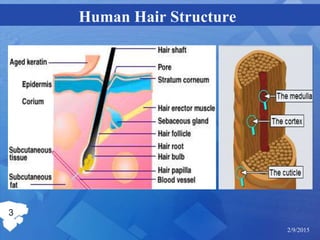
Human Hair Structure
3
2/9/2015
Introduction
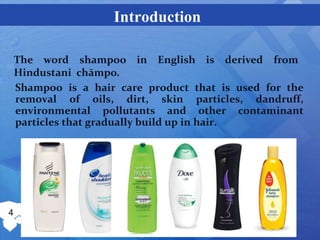
Shampoo is a hair care product that is used for the
removal of oils, dirt, skin particles, dandruff,
environmental pollutants and other contaminant
particles that gradually build up in hair.
4
The word shampoo in English is derived from
Hindustani chāmpo.
Introduction
2/9/2015
5
viscous liquids
clear or opaque
viscosities 500–1500 centipoise
pH 5.5
Containing 20–40% solids
Shampoo
Ideal Properties
6
2/9/2015
1. Smooth and shiny
2. Produce Foam
3. No irritation
4. remove dirt completely
5. Impart fragrance
6. readily removed
Functions of Shampoo
7
2/9/2015
1. Completely remove dirt
2. Protect the Hair
3. Cleaning of hair
4. Soothe the scalp skin
5. Nourishment of hair
6. Treating dandruff, lice or other
scalp problems
Classification
8
2/9/2015
I. Based on Appearance
II. Based on Use or Function
III. Based on Origin
Classification
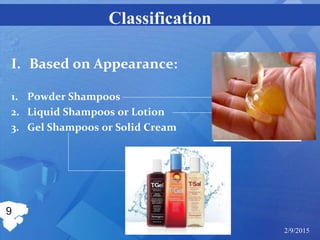
I. Based on Appearance:
1. Powder Shampoos
2. Liquid Shampoos or Lotion
3. Gel Shampoos or Solid Cream
9
2/9/2015
Classification
10
2/9/2015
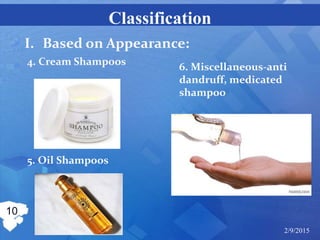
6. Miscellaneous-anti
dandruff, medicated
shampoo
4. Cream Shampoos
5. Oil Shampoos
I. Based on Appearance:
Classification
II. Based on Use or Function:
1. Conditioning Shampoos
2. Antidandruff and Therapeutic
3. Baby
4. Balancing
5. Clarifying
11
2/9/2015
Classification
III. Based on Origin:
12
2/9/2015
2. Egg1. Herbal
Compositions
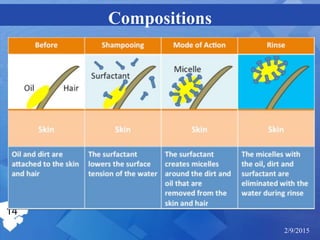
Shampoos are typically composed of 10 to 30
ingredients.
Several types of ingredients are particularly important,
including “Surfactants" that aid in cleansing and
lathering.
“Conditioners" and “Active ingredients" that affect the
hair and scalp.
“Additives" that stabilize the product.
13
2/9/2015
Compositions
14
2/9/2015
b)Surfactants
a) Water
c)Foam Boosters and
Stabilizers
RawMaterials
Compositions
15
2/9/2015
e)Clarifying Agents
d)Opacifiers
f)Anti-dandruff Agents
RawMaterials
Compositions
16
2/9/2015
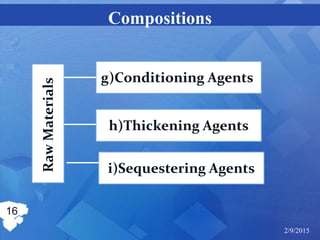
h)Thickening Agents
g)Conditioning Agents
i)Sequestering Agents
RawMaterials
Compositions
17
2/9/2015
k)Colors
j)Perfumes
L)Preservatives
RawMaterials
Manufacturing Process
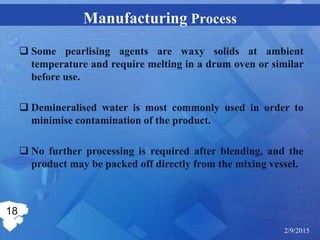
 Some pearlising agents are waxy solids at ambient
temperature and require melting in a drum oven or similar
before use.
 Demineralised water is most commonly used in order to
minimise contamination of the product.
 No further processing is required after blending, and the
product may be packed off directly from the mixing vessel.
18
2/9/2015
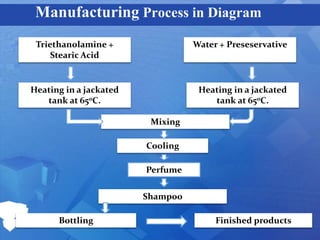
Manufacturing Process
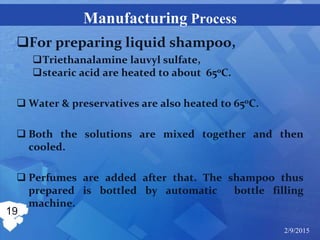
For preparing liquid shampoo,
Triethanalamine lauvyl sulfate,
stearic acid are heated to about 650C.
 Water & preservatives are also heated to 650C.
 Both the solutions are mixed together and then
cooled.
 Perfumes are added after that. The shampoo thus
prepared is bottled by automatic bottle filling
machine.
19
2/9/2015
Triethanolamine +
Stearic Acid
Perfume
Heating in a jackated
tank at 650C.
Water + Preseservative
Bottling
Mixing
Finished products
Cooling
Heating in a jackated
tank at 650C.
Shampoo
Manufacturing Process in Diagram
Quality Control Tests
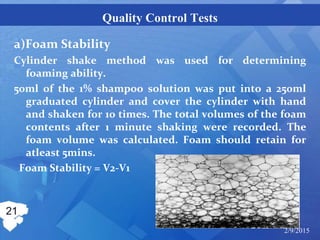
a)Foam Stability
Cylinder shake method was used for determining
foaming ability.
50ml of the 1% shampoo solution was put into a 250ml
graduated cylinder and cover the cylinder with hand
and shaken for 10 times. The total volumes of the foam
contents after 1 minute shaking were recorded. The
foam volume was calculated. Foam should retain for
atleast 5mins.
Foam Stability = V2-V1
21
2/9/2015
b)Skin – irritation Test:
Draize test in Rabbits where a patch test technique
is used on the intact skin of Albino Rabbits.
A set of 6Rabbits used for testing each material.
Shampoos should be tested only for a short
duration thatis,not more than(NMT)4hours as
these products come in contact with skin only for a
short duration.
These preparations are diluted between
concentrations of 8 to 10%.
2/9/2015
22
Quality Control Tests
c)Wetting Action:
Canvas disk is used, is one inch in diameter is
floated on the surface of a solution and the time
required for it to sink is measured accurately.
23
2/9/2015
Quality Control Tests
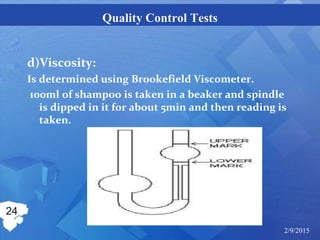
d)Viscosity:
Is determined using Brookefield Viscometer.
100ml of shampoo is taken in a beaker and spindle
is dipped in it for about 5min and then reading is
taken.
24
2/9/2015
Quality Control Tests
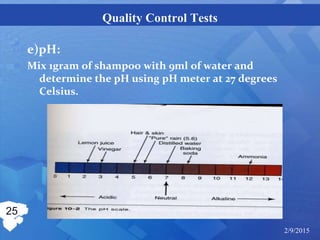
e)pH:
Mix 1gram of shampoo with 9ml of water and
determine the pH using pH meter at 27 degrees
Celsius.
25
2/9/2015
Reference
 http://en.wikipedia.org/wiki/Shampoo
 http://us.arcanatura.com/cat-healthcare/how-does-shampoo-
work/
 http://www.sulfatefreeshampoobrandsinfo.com/chemical-
free-shampoo/
 www.thefreedictionary.com/shampoo
 http://smallb.in/sites/default/files/knowledge_base/shampoo.
pdf
2/9/201526
Shampoo

Shampoo