Building Blocks For Shampoos
1
Presented By – Khandelwal Harshada R.
Roll No -10
M-Pharm (1st year) 2019-2020
Dept. of Pharmaceutics
CONTENTS
SHAMPOO
PROPERTIES OF SHAMPOO
INGRIDIENTS FOR SHAMPOO
TYPES OF SHAMPOO
EVALUATION OF SHAMPOO
LABELLING AND PACKAGING
REFERENCES
2
According to D&C act…
Any article intended to be rubbed, poured, sprinkled or sprayed on or
introduced into, or otherwise applied to human body or any part there
of for cleansing, beautifying, promoting attractiveness or altering the
appearance.
COSMETICS
3
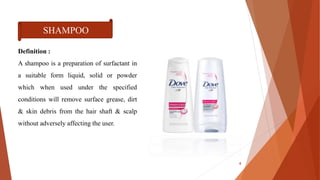
Definition :
A shampoo is a preparation of surfactant in
a suitable form liquid, solid or powder
which when used under the specified
conditions will remove surface grease, dirt
& skin debris from the hair shaft & scalp
without adversely affecting the user.
SHAMPOO
4
 It should produce a good amount of foam.
 It should be easily removed on rinsing with water.
 It should impart a pleasant fragrance to the hair.
 It should not cause any side effects / irritation to the skin or eye.
 It should effectively or completely remove dust or soil.
 It should not make the hand rough.
PROPERTIES OF SHAMPOO
5
INGRIDIENTS FOR SHAMPOO
 Surfactants
Surfactants are the main component of shampoo. Mainly anionic surfactants are used.
Anionic Surfactants:
Anionic surfactants are mostly used (good foaming properties). The hydrophilic portion carries
a negative charge which result in superior foaming & cleaning. e.g. Lauric acid, stearic acid.
Non-ionic Surfactants:
Non-ionic Surfactant have good cleansing properties but do not have sufficient foaming power.
e.g. Sorbitol esters (TWEENS), Ethoxylated fatty alcohols, Lauric monoethanolamide.
Amphoteric Surfactant:
Amphoteric surfactants carry positive and negative charge they are mainly used as secondary
surfactant & good hair conditioners. e.g. β – amino acid derivatives, Asparagine derivatives.
6
 Conditioning agents
They are intended to improve manageability, feel & lusture of hair.
e.g. Lanolin, Mineral oil, Polypeptides, Egg derivatives, Herbal extracts
 Viscosity modifier
They are used to improve the thickness of compounds.
(a) Electrolytes : Ammonium chloride, Sodium chloride
(b) Natural gums : Gum Tragacanth, Gum karaya, Alginates
(c) Cellulose derivatives : Hydroxyethyl cellulose, Hydroxypropyl cellulose
(d) Carboxyvinyl polymers : Polymer of acrylic acid cross-linked with
polyfunctional agent
 Opacifying & Clarifying agents
Stearyl alcohol, Propylene glycol, Phosphates, Finely dispersed zinc oxide
Milky emulsions of vinyl polymers. 7
 Preservatives
Bacterial growth in shampoo can lead to breakdown of detergent i.e.
resulting in discoloration of product hence preservative are important in
product.
e.g. Formaldehyde , Esters of para hydroxy benzoic acid
 Perfumes
There are two important aspects before final selection of fragrance for
shampoos.
a) Fragrance must be soluble in shampoo
b) It must be compatible with shampoo i.e. not affect the viscosity &
stability.
e.g. Herbal, fruity & floral fragrance.
8
TYPES OF SHAMPOO
Shampoos are of the following types:
 Powder shampoo
 Liquid shampoo
 Lotion shampoo
 Cream shampoo
 Specialized shampoo
 Conditioning shampoo
 Anti-dandruff shampoo
9
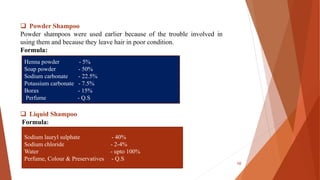
 Powder Shampoo
Powder shampoos were used earlier because of the trouble involved in
using them and because they leave hair in poor condition.
Formula:
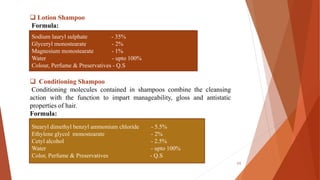
 Liquid Shampoo
Formula:
Henna powder - 5%
Soap powder - 50%
Sodium carbonate - 22.5%
Potassium carbonate - 7.5%
Borax - 15%
Perfume - Q.S
Sodium lauryl sulphate - 40%
Sodium chloride - 2-4%
Water - upto 100%
Perfume, Colour & Preservatives - Q.S
10
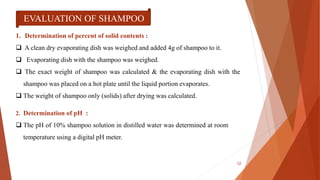
 Lotion Shampoo
Formula:
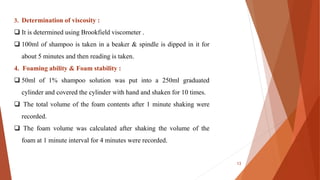
 Conditioning Shampoo
Conditioning molecules contained in shampoos combine the cleansing
action with the function to impart manageability, gloss and antistatic
properties of hair.
Formula:
Sodium lauryl sulphate - 35%
Glyceryl monostearate - 2%
Magnesium monostearate - 1%
Water - upto 100%
Colour, Perfume & Preservatives - Q.S
Stearyl dimethyl benzyl ammonium chloride - 5.5%
Ethylene glycol monostearate - 2%
Cetyl alcohol - 2.5%
Water - upto 100%
Color, Perfume & Preservatives - Q.S
11
EVALUATION OF SHAMPOO
1. Determination of percent of solid contents :
 A clean dry evaporating dish was weighed and added 4g of shampoo to it.
 Evaporating dish with the shampoo was weighed.
 The exact weight of shampoo was calculated & the evaporating dish with the
shampoo was placed on a hot plate until the liquid portion evaporates.
 The weight of shampoo only (solids) after drying was calculated.
2. Determination of pH :
 The pH of 10% shampoo solution in distilled water was determined at room
temperature using a digital pH meter.
12
13
3. Determination of viscosity :
 It is determined using Brookfield viscometer .
 100ml of shampoo is taken in a beaker & spindle is dipped in it for
about 5 minutes and then reading is taken.
4. Foaming ability & Foam stability :
 50ml of 1% shampoo solution was put into a 250ml graduated
cylinder and covered the cylinder with hand and shaken for 10 times.
 The total volume of the foam contents after 1 minute shaking were
recorded.
 The foam volume was calculated after shaking the volume of the
foam at 1 minute interval for 4 minutes were recorded.
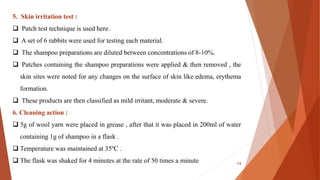
5. Skin irritation test :
 Patch test technique is used here.
 A set of 6 rabbits were used for testing each material.
 The shampoo preparations are diluted between concentrations of 8-10%.
 Patches containing the shampoo preparations were applied & then removed , the
skin sites were noted for any changes on the surface of skin like edema, erythema
formation.
 These products are then classified as mild irritant, moderate & severe.
6. Cleaning action :
 5g of wool yarn were placed in grease , after that it was placed in 200ml of water
containing 1g of shampoo in a flask .
 Temperature was maintained at 35ºC .
 The flask was shaked for 4 minutes at the rate of 50 times a minute 14
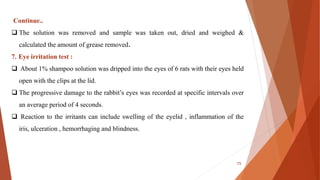
Continue..
 The solution was removed and sample was taken out, dried and weighed &
calculated the amount of grease removed.
7. Eye irritation test :
 About 1% shampoo solution was dripped into the eyes of 6 rats with their eyes held
open with the clips at the lid.
 The progressive damage to the rabbit’s eyes was recorded at specific intervals over
an average period of 4 seconds.
 Reaction to the irritants can include swelling of the eyelid , inflammation of the
iris, ulceration , hemorrhaging and blindness.
15
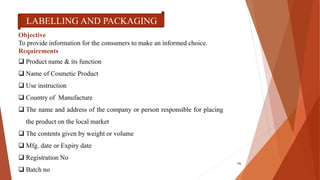
LABELLING AND PACKAGING
Objective
To provide information for the consumers to make an informed choice.
Requirements
 Product name & its function
 Name of Cosmetic Product
 Use instruction
 Country of Manufacture
 The name and address of the company or person responsible for placing
the product on the local market
 The contents given by weight or volume
 Mfg. date or Expiry date
 Registration No
 Batch no
16
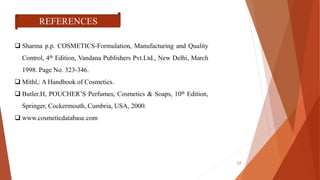
REFERENCES
 Sharma p.p. COSMETICS‐Formulation, Manufacturing and Quality
Control, 4th Edition, Vandana Publishers Pvt.Ltd., New Delhi, March
1998. Page No. 323-346.
 Mithl,: A Handbook of Cosmetics.
 Butler.H, POUCHER’S Perfumes, Cosmetics & Soaps, 10th Edition,
Springer, Cockermouth, Cumbria, USA, 2000.
 www.cosmeticdatabase.com
17
18

building blocks for shampoo

  • 1.
    Building Blocks ForShampoos 1 Presented By – Khandelwal Harshada R. Roll No -10 M-Pharm (1st year) 2019-2020 Dept. of Pharmaceutics
  • 2.
    CONTENTS SHAMPOO PROPERTIES OF SHAMPOO INGRIDIENTSFOR SHAMPOO TYPES OF SHAMPOO EVALUATION OF SHAMPOO LABELLING AND PACKAGING REFERENCES 2
  • 3.
    According to D&Cact… Any article intended to be rubbed, poured, sprinkled or sprayed on or introduced into, or otherwise applied to human body or any part there of for cleansing, beautifying, promoting attractiveness or altering the appearance. COSMETICS 3
  • 4.
    Definition : A shampoois a preparation of surfactant in a suitable form liquid, solid or powder which when used under the specified conditions will remove surface grease, dirt & skin debris from the hair shaft & scalp without adversely affecting the user. SHAMPOO 4
  • 5.
     It shouldproduce a good amount of foam.  It should be easily removed on rinsing with water.  It should impart a pleasant fragrance to the hair.  It should not cause any side effects / irritation to the skin or eye.  It should effectively or completely remove dust or soil.  It should not make the hand rough. PROPERTIES OF SHAMPOO 5
  • 6.
    INGRIDIENTS FOR SHAMPOO Surfactants Surfactants are the main component of shampoo. Mainly anionic surfactants are used. Anionic Surfactants: Anionic surfactants are mostly used (good foaming properties). The hydrophilic portion carries a negative charge which result in superior foaming & cleaning. e.g. Lauric acid, stearic acid. Non-ionic Surfactants: Non-ionic Surfactant have good cleansing properties but do not have sufficient foaming power. e.g. Sorbitol esters (TWEENS), Ethoxylated fatty alcohols, Lauric monoethanolamide. Amphoteric Surfactant: Amphoteric surfactants carry positive and negative charge they are mainly used as secondary surfactant & good hair conditioners. e.g. β – amino acid derivatives, Asparagine derivatives. 6
  • 7.
     Conditioning agents Theyare intended to improve manageability, feel & lusture of hair. e.g. Lanolin, Mineral oil, Polypeptides, Egg derivatives, Herbal extracts  Viscosity modifier They are used to improve the thickness of compounds. (a) Electrolytes : Ammonium chloride, Sodium chloride (b) Natural gums : Gum Tragacanth, Gum karaya, Alginates (c) Cellulose derivatives : Hydroxyethyl cellulose, Hydroxypropyl cellulose (d) Carboxyvinyl polymers : Polymer of acrylic acid cross-linked with polyfunctional agent  Opacifying & Clarifying agents Stearyl alcohol, Propylene glycol, Phosphates, Finely dispersed zinc oxide Milky emulsions of vinyl polymers. 7
  • 8.
     Preservatives Bacterial growthin shampoo can lead to breakdown of detergent i.e. resulting in discoloration of product hence preservative are important in product. e.g. Formaldehyde , Esters of para hydroxy benzoic acid  Perfumes There are two important aspects before final selection of fragrance for shampoos. a) Fragrance must be soluble in shampoo b) It must be compatible with shampoo i.e. not affect the viscosity & stability. e.g. Herbal, fruity & floral fragrance. 8
  • 9.
    TYPES OF SHAMPOO Shampoosare of the following types:  Powder shampoo  Liquid shampoo  Lotion shampoo  Cream shampoo  Specialized shampoo  Conditioning shampoo  Anti-dandruff shampoo 9
  • 10.
     Powder Shampoo Powdershampoos were used earlier because of the trouble involved in using them and because they leave hair in poor condition. Formula:  Liquid Shampoo Formula: Henna powder - 5% Soap powder - 50% Sodium carbonate - 22.5% Potassium carbonate - 7.5% Borax - 15% Perfume - Q.S Sodium lauryl sulphate - 40% Sodium chloride - 2-4% Water - upto 100% Perfume, Colour & Preservatives - Q.S 10
  • 11.
     Lotion Shampoo Formula: Conditioning Shampoo Conditioning molecules contained in shampoos combine the cleansing action with the function to impart manageability, gloss and antistatic properties of hair. Formula: Sodium lauryl sulphate - 35% Glyceryl monostearate - 2% Magnesium monostearate - 1% Water - upto 100% Colour, Perfume & Preservatives - Q.S Stearyl dimethyl benzyl ammonium chloride - 5.5% Ethylene glycol monostearate - 2% Cetyl alcohol - 2.5% Water - upto 100% Color, Perfume & Preservatives - Q.S 11
  • 12.
    EVALUATION OF SHAMPOO 1.Determination of percent of solid contents :  A clean dry evaporating dish was weighed and added 4g of shampoo to it.  Evaporating dish with the shampoo was weighed.  The exact weight of shampoo was calculated & the evaporating dish with the shampoo was placed on a hot plate until the liquid portion evaporates.  The weight of shampoo only (solids) after drying was calculated. 2. Determination of pH :  The pH of 10% shampoo solution in distilled water was determined at room temperature using a digital pH meter. 12
  • 13.
    13 3. Determination ofviscosity :  It is determined using Brookfield viscometer .  100ml of shampoo is taken in a beaker & spindle is dipped in it for about 5 minutes and then reading is taken. 4. Foaming ability & Foam stability :  50ml of 1% shampoo solution was put into a 250ml graduated cylinder and covered the cylinder with hand and shaken for 10 times.  The total volume of the foam contents after 1 minute shaking were recorded.  The foam volume was calculated after shaking the volume of the foam at 1 minute interval for 4 minutes were recorded.
  • 14.
    5. Skin irritationtest :  Patch test technique is used here.  A set of 6 rabbits were used for testing each material.  The shampoo preparations are diluted between concentrations of 8-10%.  Patches containing the shampoo preparations were applied & then removed , the skin sites were noted for any changes on the surface of skin like edema, erythema formation.  These products are then classified as mild irritant, moderate & severe. 6. Cleaning action :  5g of wool yarn were placed in grease , after that it was placed in 200ml of water containing 1g of shampoo in a flask .  Temperature was maintained at 35ºC .  The flask was shaked for 4 minutes at the rate of 50 times a minute 14
  • 15.
    Continue..  The solutionwas removed and sample was taken out, dried and weighed & calculated the amount of grease removed. 7. Eye irritation test :  About 1% shampoo solution was dripped into the eyes of 6 rats with their eyes held open with the clips at the lid.  The progressive damage to the rabbit’s eyes was recorded at specific intervals over an average period of 4 seconds.  Reaction to the irritants can include swelling of the eyelid , inflammation of the iris, ulceration , hemorrhaging and blindness. 15
  • 16.
    LABELLING AND PACKAGING Objective Toprovide information for the consumers to make an informed choice. Requirements  Product name & its function  Name of Cosmetic Product  Use instruction  Country of Manufacture  The name and address of the company or person responsible for placing the product on the local market  The contents given by weight or volume  Mfg. date or Expiry date  Registration No  Batch no 16
  • 17.
    REFERENCES  Sharma p.p.COSMETICS‐Formulation, Manufacturing and Quality Control, 4th Edition, Vandana Publishers Pvt.Ltd., New Delhi, March 1998. Page No. 323-346.  Mithl,: A Handbook of Cosmetics.  Butler.H, POUCHER’S Perfumes, Cosmetics & Soaps, 10th Edition, Springer, Cockermouth, Cumbria, USA, 2000.  www.cosmeticdatabase.com 17
  • 18.