Session 6 NAT Network Design
Features offered by routing are Internal network invisibility Existing network integration Internet and internal network traffic restriction Encryption and authentication add more security through Routing and Remote Access Static and dynamic routing are the two types of routing strategies Windows operating system offers certain TCP/IP tools that enable to troubleshoot routing problems:  Ping.exe Tracert.exe Pathping.exe Review
Objectives Explain different types of NAT Describe NAT features  Implement NAT Design the NAT Network Secure the NAT Network Enhance the NAT Network Design
Types of NAT NAT is a protocol that connects computers on the internal network to other networks and to the Internet Different types of NAT are: Static NAT :  Translates unregistered IP addresses to an equal number of registered addresses so that each client uses the same address Dynamic NAT : Translates each unregistered computer to a registered one Masquerading : Translates all the unregistered IP addresses on the network to a single registered IP address
NAT features Internal IP Address and Public IP Address - Hides the internal network IP address from the Internet  IP Address Configuration - Provides automatic IP address configuration to the clients in the internal network Name Resolution - Provides a name resolution feature that forwards the name queries  Secure Internal Resources - Uses a specific port for each specific internal IP address
NAT implementation NAT features can be used effectively to meet a Network Design  Main consideration while designing NAT Network are: Size of the network Kind of security needed by the organization
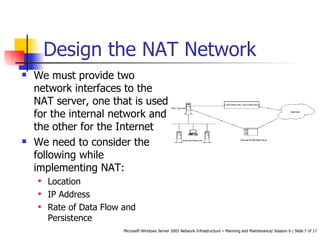
Design the NAT Network We must provide two network interfaces to the NAT server, one that is used for the internal network and the other for the Internet  We need to consider the following while implementing NAT: Location  IP Address Rate of Data Flow and Persistence
Automatic IP Address Configuration NAT provides automatic IP address configuration to all the DHCP compliant clients in the internal network  This feature is utilized under the following conditions: DHCP provides the IP address in the network Only one single non-routed subnet  NAT clients have to be configured to receive their IP addresses from the NAT server
Securing the NAT Network NAT implementations mostly depend on the Masquerading technique for security NAT provides security to the internal resources of the organization by default The number of registered IP addresses are minimized
Securing the NAT Network Contd… Security can be improved by using: Routing and Remote Access Filters Address pools and special ports to permit internal resource access VPN connections
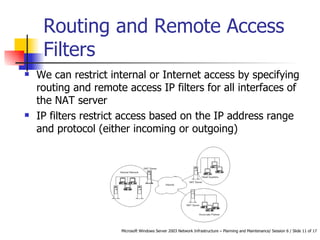
Routing and Remote Access Filters We can restrict internal or Internet access by specifying routing and remote access IP filters for all interfaces of the NAT server IP filters restrict access based on the IP address range and protocol (either incoming or outgoing)
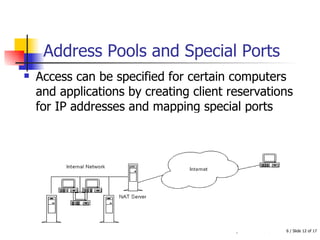
Address Pools and Special Ports Access can be specified for certain computers and applications by creating client reservations for IP addresses and mapping special ports
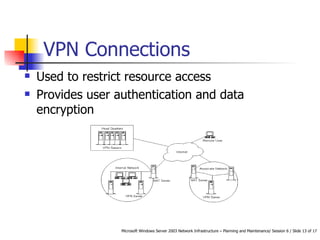
VPN Connections Used to restrict resource access Provides user authentication and data encryption
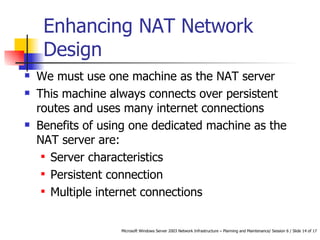
Enhancing NAT Network Design We must use one machine as the NAT server This machine always connects over persistent routes and uses many internet connections Benefits of using one dedicated machine as the NAT server are: Server characteristics Persistent connection Multiple internet connections
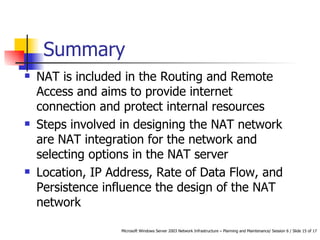
Summary NAT is included in the Routing and Remote Access and aims to provide internet connection and protect internal resources Steps involved in designing the NAT network are NAT integration for the network and selecting options in the NAT server Location, IP Address, Rate of Data Flow, and Persistence influence the design of the NAT network
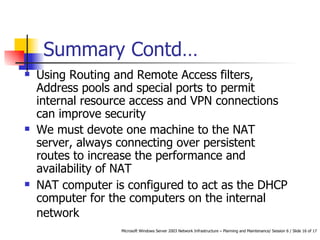
Summary Contd… Using Routing and Remote Access filters, Address pools and special ports to permit internal resource access and VPN connections can improve security We must devote one machine to the NAT server, always connecting over persistent routes to increase the performance and availability of NAT  NAT computer is configured to act as the DHCP computer for the computers on the internal network
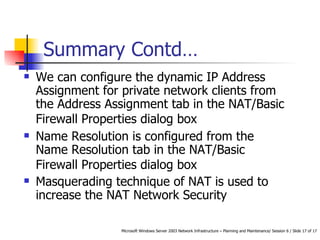
Summary Contd… We can configure the dynamic IP Address Assignment for private network clients from the Address Assignment tab in the NAT/Basic Firewall Properties dialog box   Name Resolution is configured from the Name Resolution tab in the NAT/Basic Firewall Properties dialog box   Masquerading technique of NAT is used to increase the NAT Network Security

Session 6 Tp 6

  • 1.
    Session 6 NATNetwork Design
  • 2.
    Features offered byrouting are Internal network invisibility Existing network integration Internet and internal network traffic restriction Encryption and authentication add more security through Routing and Remote Access Static and dynamic routing are the two types of routing strategies Windows operating system offers certain TCP/IP tools that enable to troubleshoot routing problems: Ping.exe Tracert.exe Pathping.exe Review
  • 3.
    Objectives Explain differenttypes of NAT Describe NAT features Implement NAT Design the NAT Network Secure the NAT Network Enhance the NAT Network Design
  • 4.
    Types of NATNAT is a protocol that connects computers on the internal network to other networks and to the Internet Different types of NAT are: Static NAT : Translates unregistered IP addresses to an equal number of registered addresses so that each client uses the same address Dynamic NAT : Translates each unregistered computer to a registered one Masquerading : Translates all the unregistered IP addresses on the network to a single registered IP address
  • 5.
    NAT features InternalIP Address and Public IP Address - Hides the internal network IP address from the Internet IP Address Configuration - Provides automatic IP address configuration to the clients in the internal network Name Resolution - Provides a name resolution feature that forwards the name queries Secure Internal Resources - Uses a specific port for each specific internal IP address
  • 6.
    NAT implementation NATfeatures can be used effectively to meet a Network Design Main consideration while designing NAT Network are: Size of the network Kind of security needed by the organization
  • 7.
    Design the NATNetwork We must provide two network interfaces to the NAT server, one that is used for the internal network and the other for the Internet We need to consider the following while implementing NAT: Location IP Address Rate of Data Flow and Persistence
  • 8.
    Automatic IP AddressConfiguration NAT provides automatic IP address configuration to all the DHCP compliant clients in the internal network This feature is utilized under the following conditions: DHCP provides the IP address in the network Only one single non-routed subnet NAT clients have to be configured to receive their IP addresses from the NAT server
  • 9.
    Securing the NATNetwork NAT implementations mostly depend on the Masquerading technique for security NAT provides security to the internal resources of the organization by default The number of registered IP addresses are minimized
  • 10.
    Securing the NATNetwork Contd… Security can be improved by using: Routing and Remote Access Filters Address pools and special ports to permit internal resource access VPN connections
  • 11.
    Routing and RemoteAccess Filters We can restrict internal or Internet access by specifying routing and remote access IP filters for all interfaces of the NAT server IP filters restrict access based on the IP address range and protocol (either incoming or outgoing)
  • 12.
    Address Pools andSpecial Ports Access can be specified for certain computers and applications by creating client reservations for IP addresses and mapping special ports
  • 13.
    VPN Connections Usedto restrict resource access Provides user authentication and data encryption
  • 14.
    Enhancing NAT NetworkDesign We must use one machine as the NAT server This machine always connects over persistent routes and uses many internet connections Benefits of using one dedicated machine as the NAT server are: Server characteristics Persistent connection Multiple internet connections
  • 15.
    Summary NAT isincluded in the Routing and Remote Access and aims to provide internet connection and protect internal resources Steps involved in designing the NAT network are NAT integration for the network and selecting options in the NAT server Location, IP Address, Rate of Data Flow, and Persistence influence the design of the NAT network
  • 16.
    Summary Contd… UsingRouting and Remote Access filters, Address pools and special ports to permit internal resource access and VPN connections can improve security We must devote one machine to the NAT server, always connecting over persistent routes to increase the performance and availability of NAT NAT computer is configured to act as the DHCP computer for the computers on the internal network
  • 17.
    Summary Contd… Wecan configure the dynamic IP Address Assignment for private network clients from the Address Assignment tab in the NAT/Basic Firewall Properties dialog box Name Resolution is configured from the Name Resolution tab in the NAT/Basic Firewall Properties dialog box Masquerading technique of NAT is used to increase the NAT Network Security