Unit07:
Networking with Remote
Clients and Servers
Overview
• Remote Node
• Remote Control
• Configuring a Connection
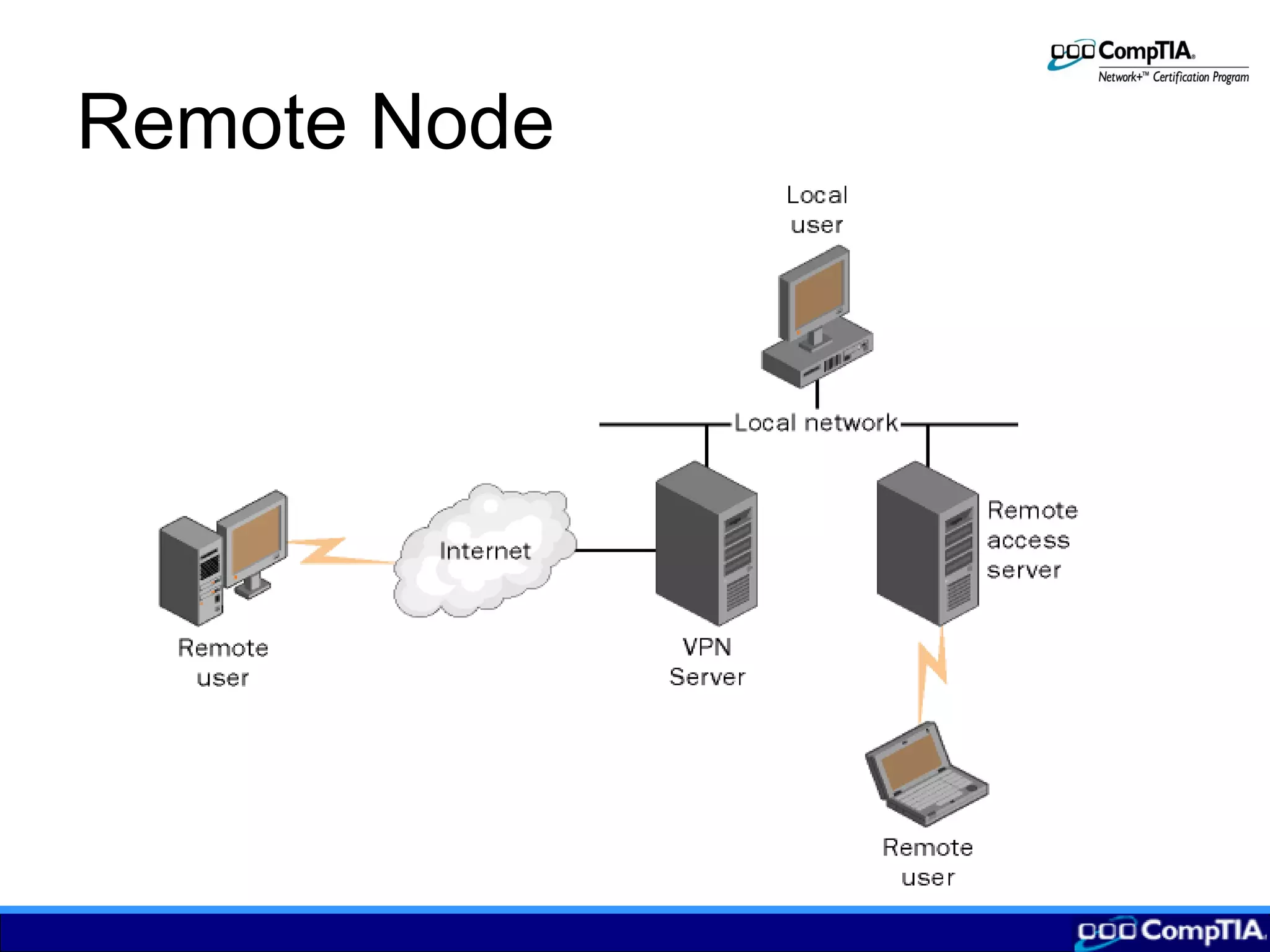
Remote Node
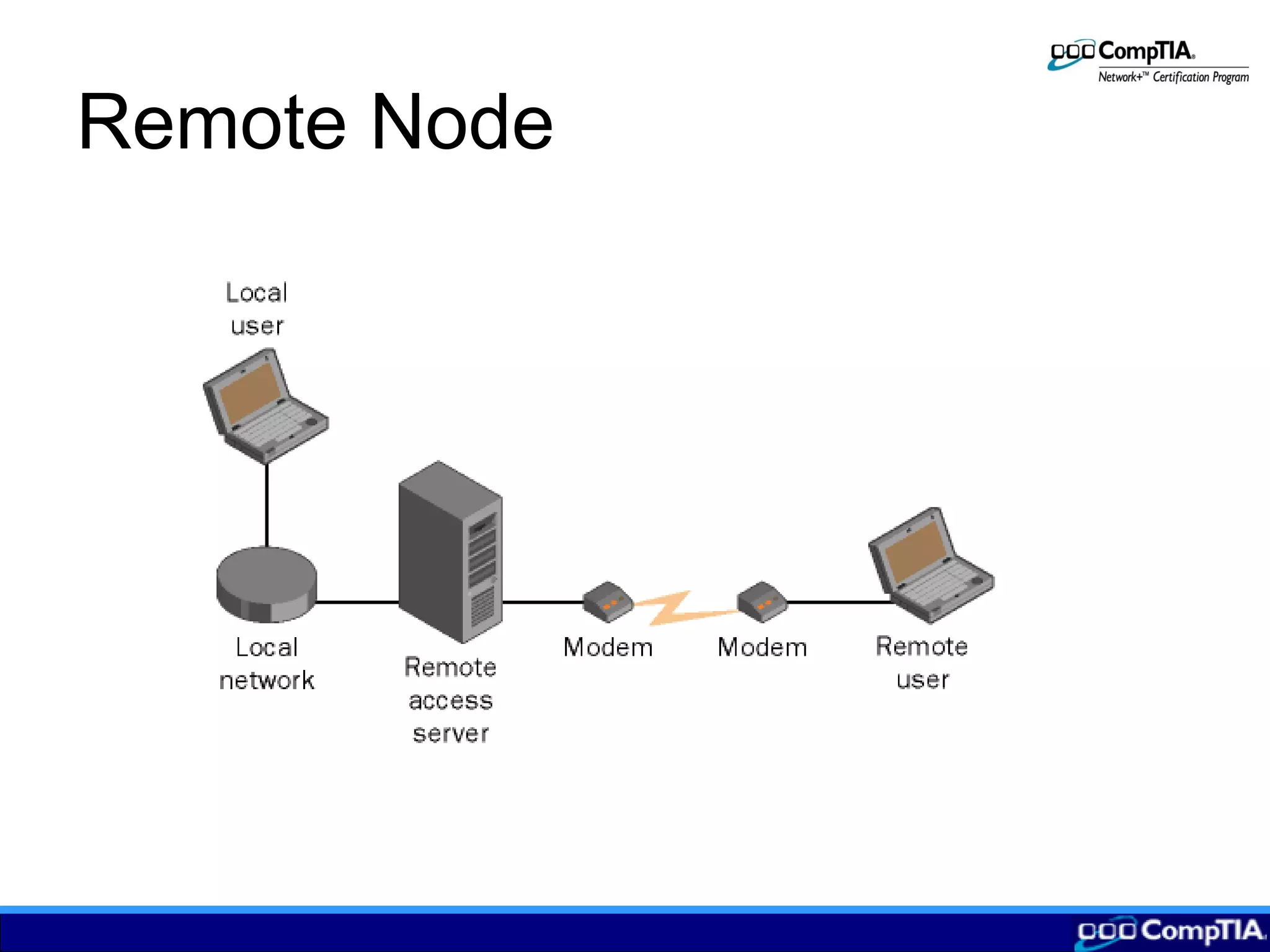
• Remote nodes were computers that connected to a
network via a dialup line
• Nodes connect via ISDN, DSL, cable modem, and
Virtual Private Networking (VPN) across the Internet
• Remote node computing is notoriously slow, primarily
because dialup
• the remote node is not much different from a local node
on the network
Remote Node
Remote Node
Advantages of Remote Node
Computing
• ease of configuration
• it can be run across any dialup line, cable, DSL and so
on
• wide variety of operating systems natively support
remote access
• there are no graphics restrictions
Disadvantages of Remote Node
Computing
• Issue of slow speed
• Driven by the need to use certain
applications
• Problem for network administrators arises
—licensing
• Support issues can be horrendous
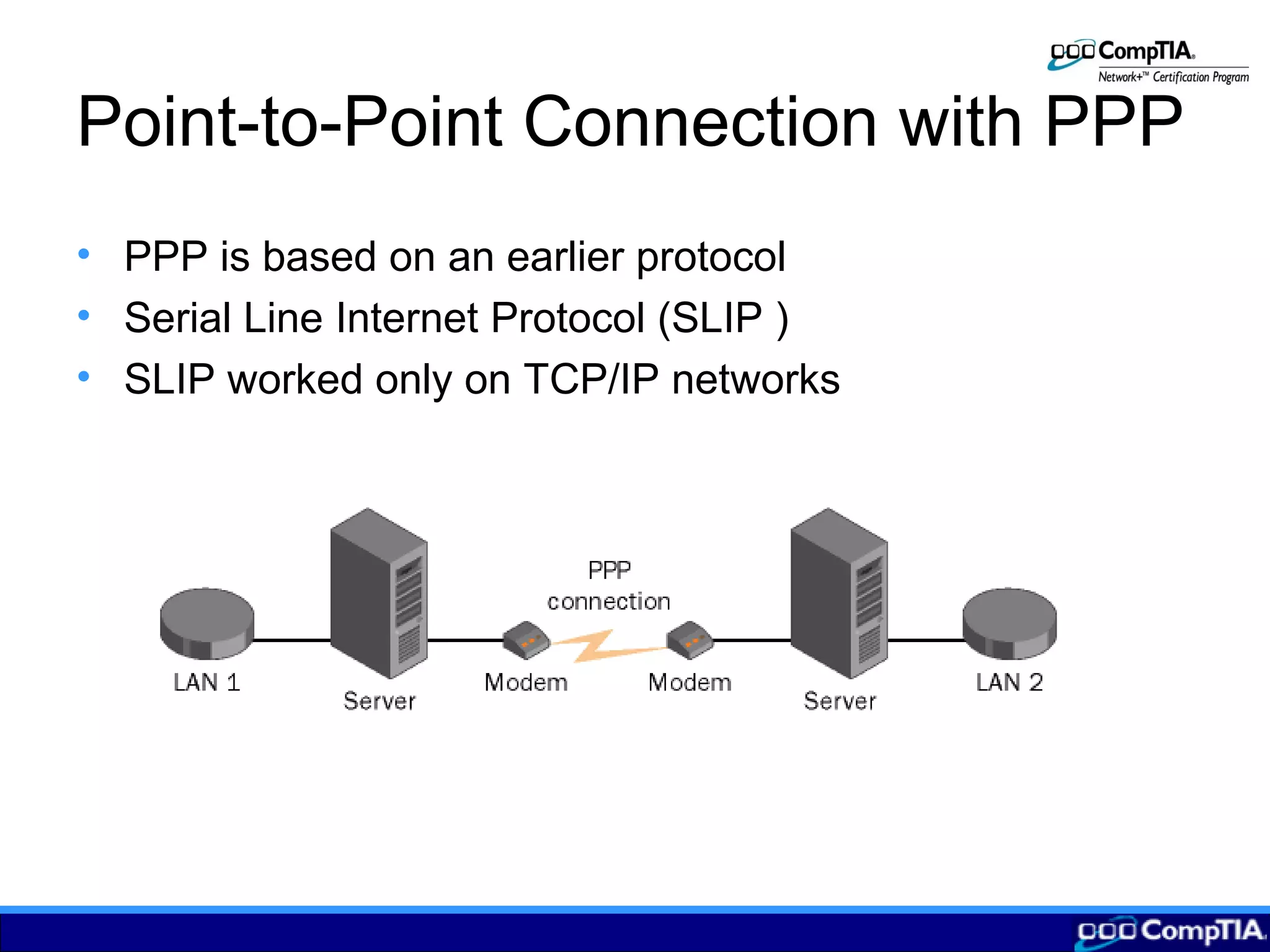
Point-to-Point Connection with PPP
• PPP is based on an earlier protocol
• Serial Line Internet Protocol (SLIP )
• SLIP worked only on TCP/IP networks
Using DSL for Remote Node
• Digital Subscriber Line (DSL) is growing
as a dialup technology for remote node
• DSL uses the same lines as regular
telephone calls
– ADSL
– G.Lite
– HDSL
– VDSL
Remote Access Service (RAS)
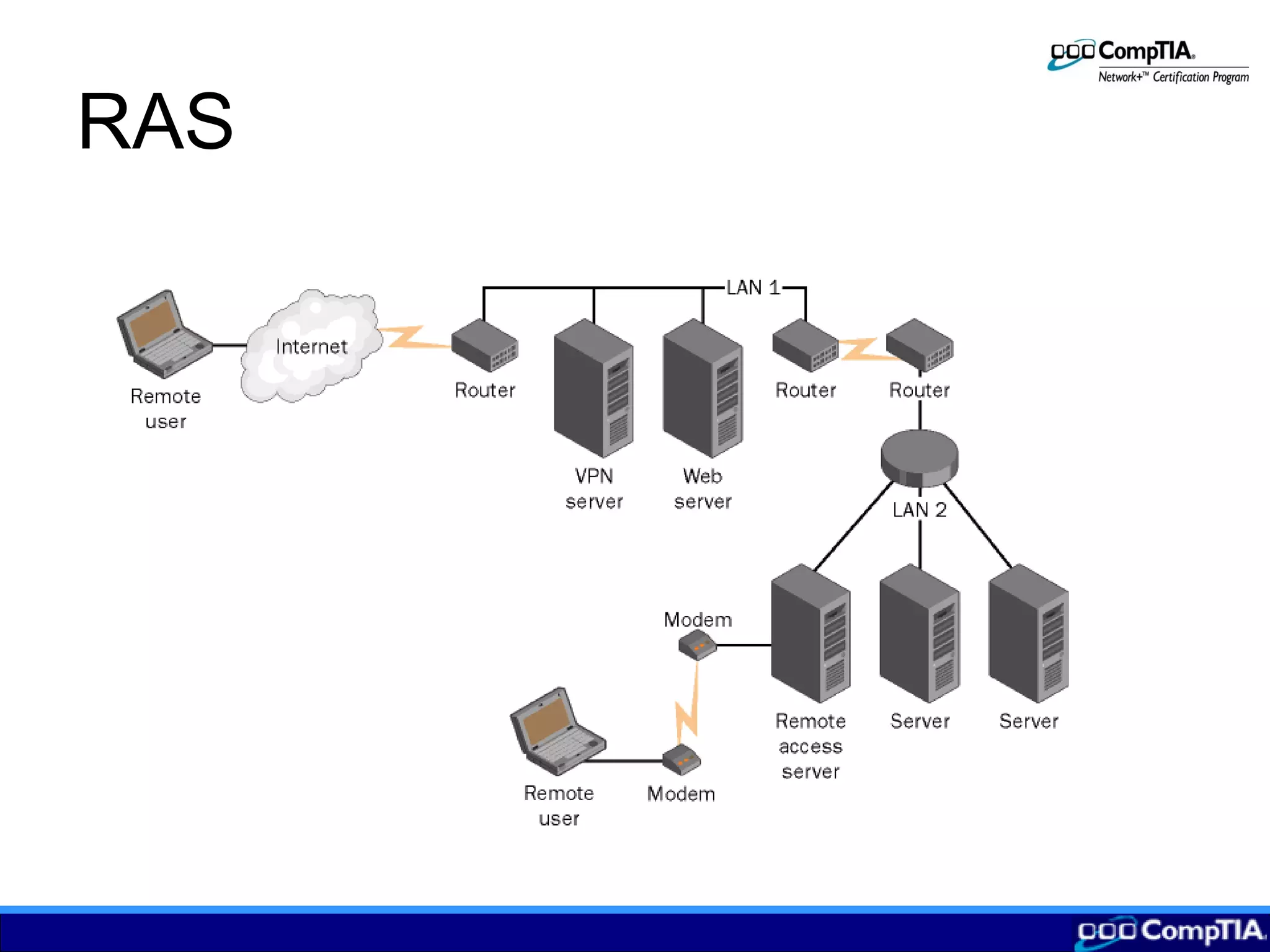
• When you dial into a network as a remote node, you log
into a remote access server
• A variety of remote access servers is available
• RAS server placement is key to performance
RAS
Tunneling to a Virtual Private
Network
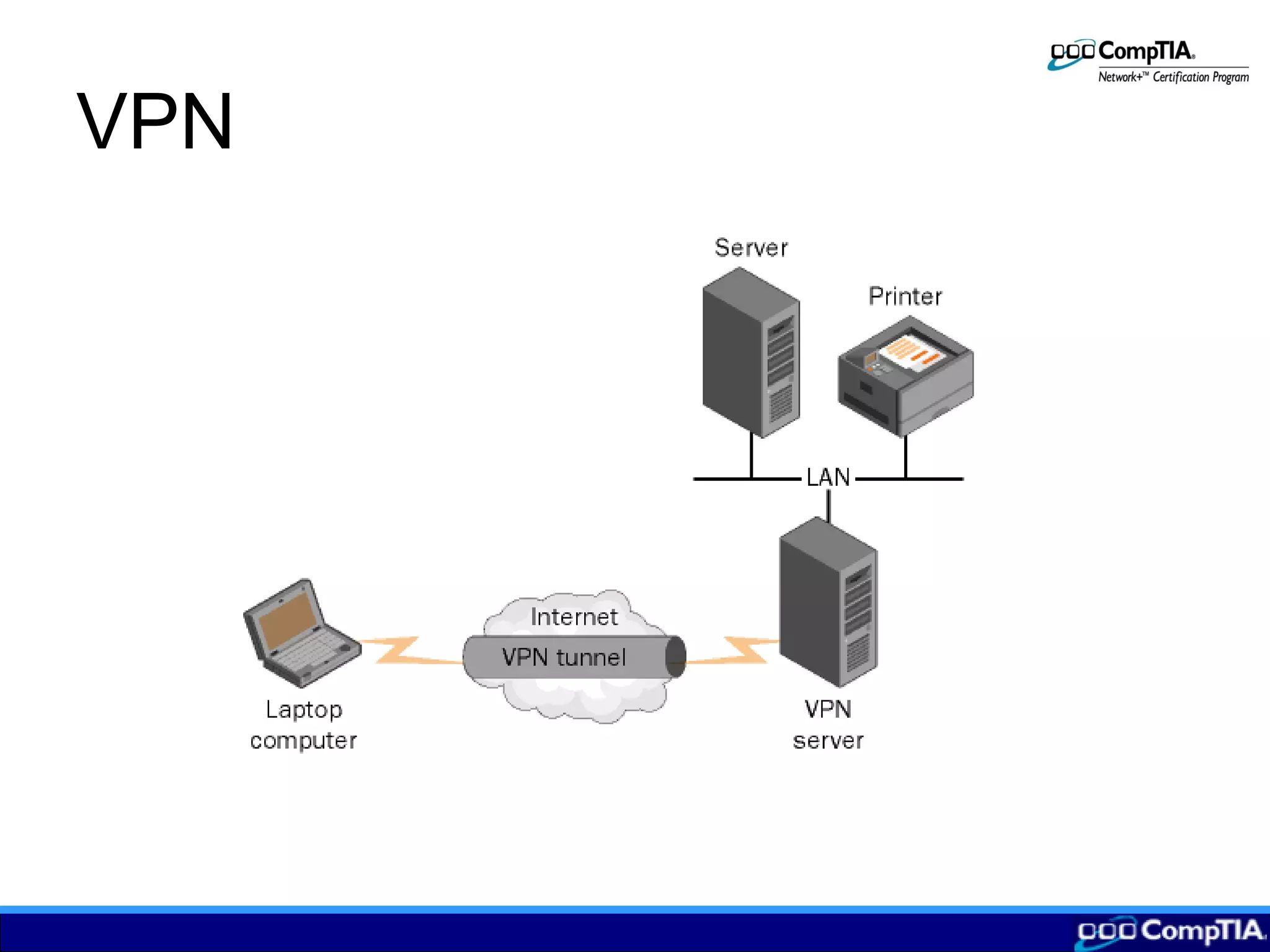
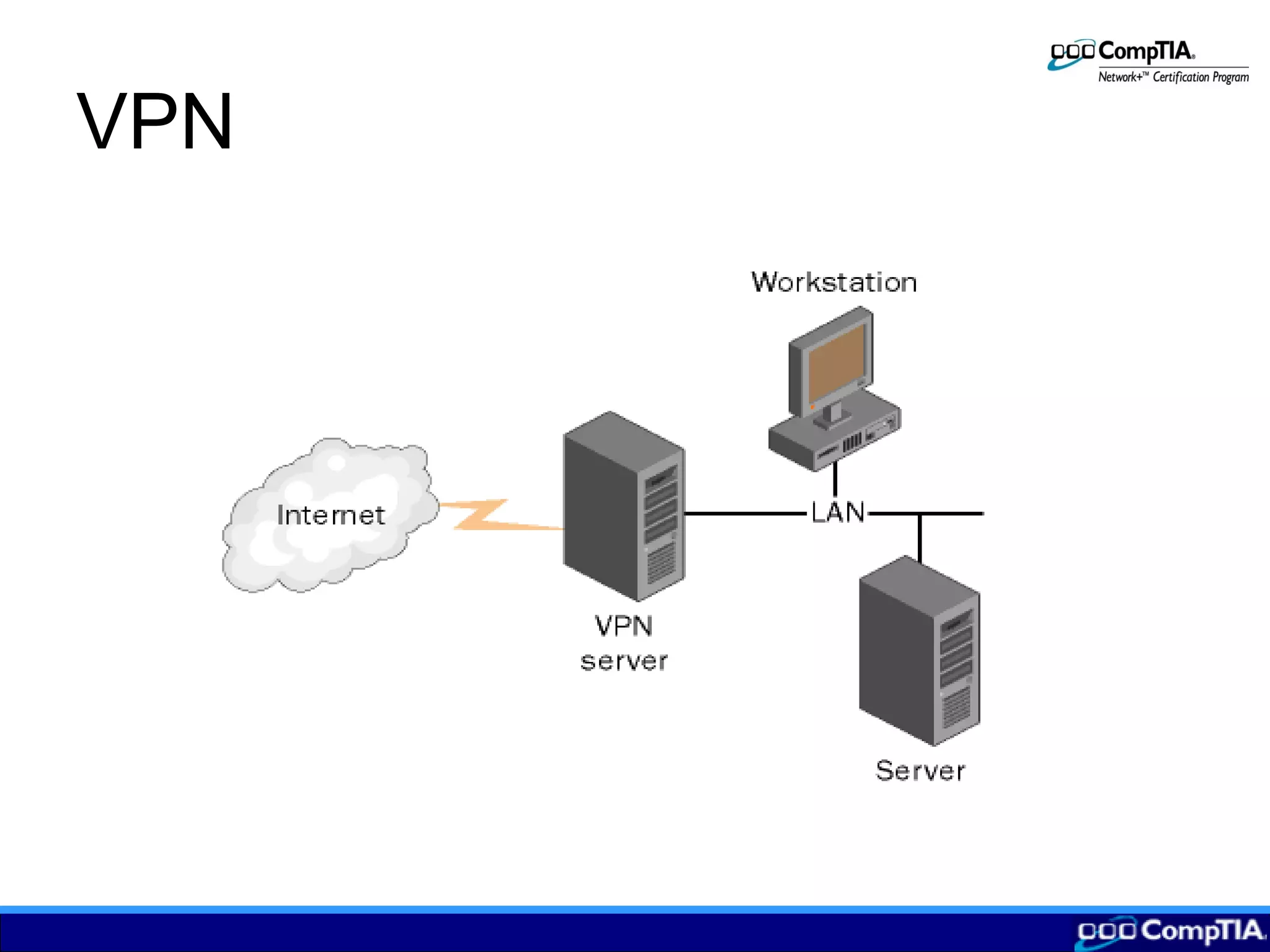
• Virtual Private Networking (VPN) describes remote nodes that
access a network via the Internet in a secure fashion
• Many encryption schemes can encode data with strengths up to 128
bits
• VPN is available to clients who connect to the Internet through
nearly any type of link
• VPN creates a virtual point-to-point connection to the RAS
• Tunneling is driven by the need to protect that virtual point-to-point
link from being interrupted or eavesdropped upon
VPN
Tunneling Protocol
• Point-to-Point Tunneling Protocol
– Point-to-Point Tunneling Protocol (PPTP) takes its
name from PPP because it uses PPP
– PPTP encapsulates PPP frames within IP datagram
• Layer 2 Tunneling Protocol
– The Layer 2 Tunneling Protocol (L2TP) was
developed to establish a viable alternative to PPTP
– Like PPTP, L2TP is an extension of PPP that
supports multiple protocols
– L2TP clients follow a similar process to PPTP
Remote Control
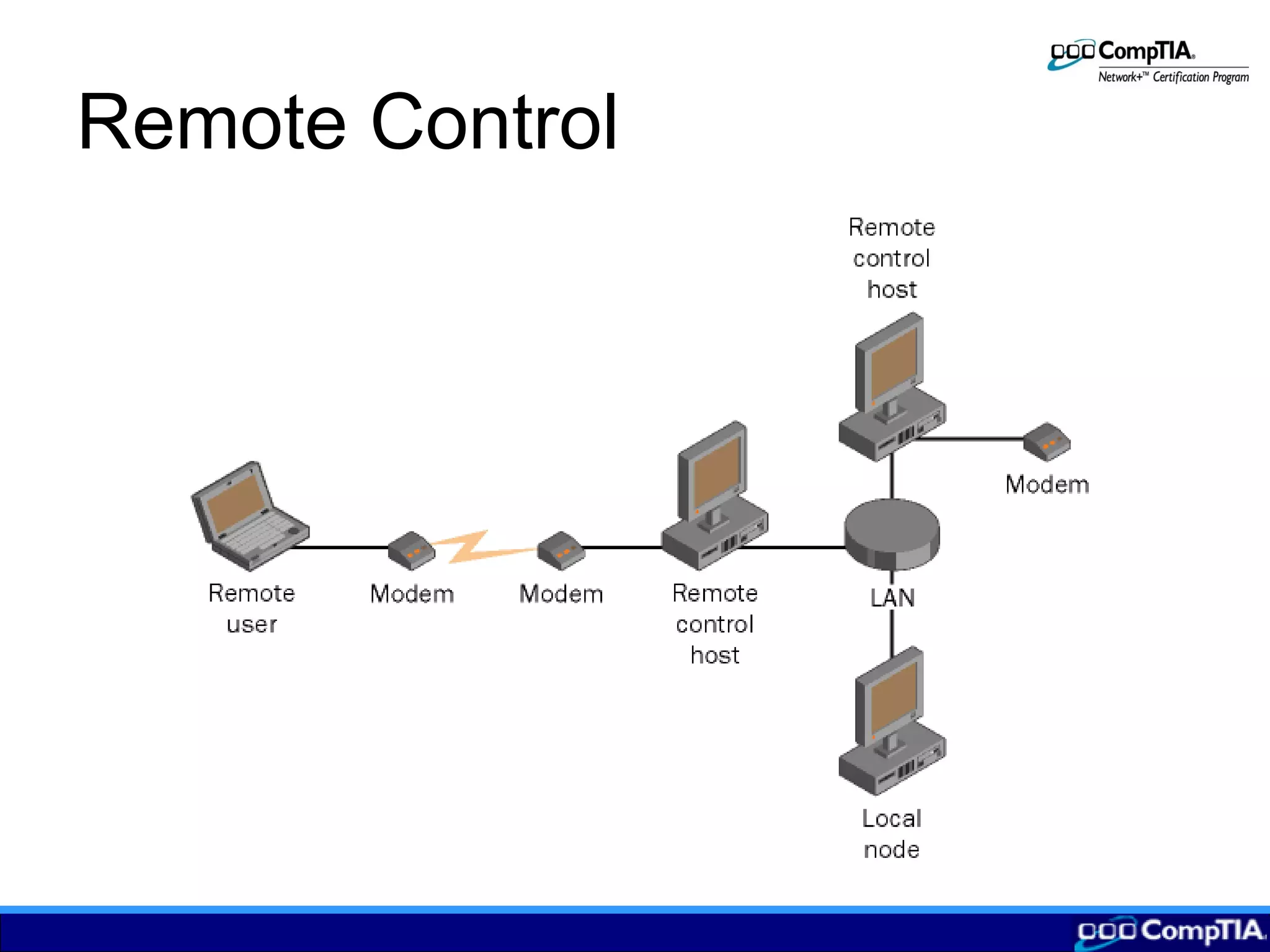
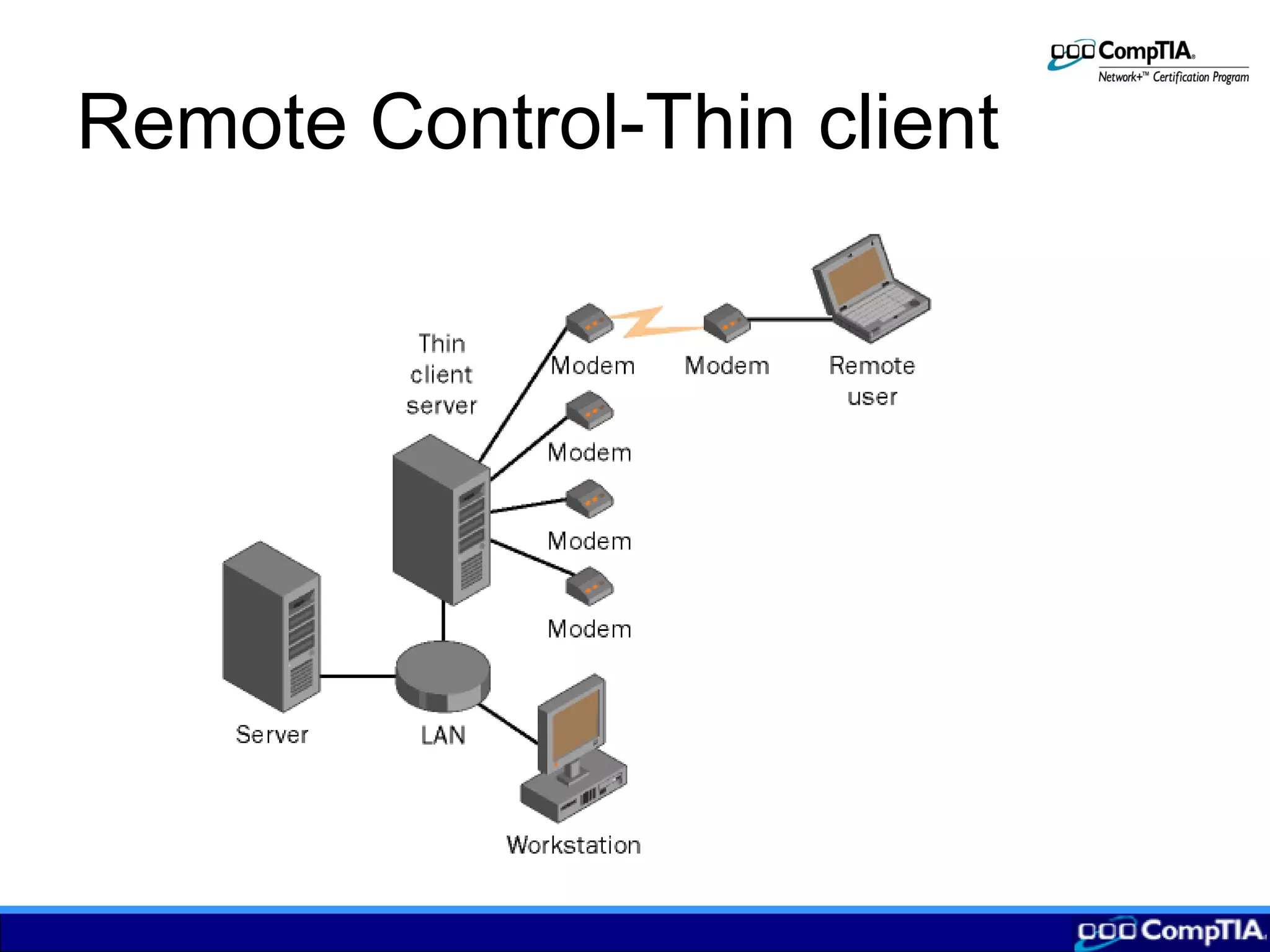
• On the remote computer, a window would appear with
the remote computer’s desktop within it
• All application processing and data remained on the LAN
• the only data that traveled to the LAN from the remote
computer were keyboard and mouse clicks
• Remote control computing overcame some of the issues
with remote node computing
• the remote computer didn’t need to be compatible with
the network applications
• little data had to traverse the connection between the
remote computer and the local node
• no issues with licensing because the application ran on
the local node
Remote Control
Remote Control-Thin client
Independent Computing
Architecture from Citrix
• Citrix developed its ICA protocol to facilitate remote control
sessions
• The protocol runs within the upper layers of the OSI
reference model, including the application, presentation,
and session layers
• During the session, ICA carries keystrokes, mouse clicks,
and graphical data in the form of compressed draw
commands
• ICA is supported by the latest Web browsers
• ICA client can dial directly into a Citrix MetaFrame server
and run a pure ICA session across the direct connection
Microsoft Remote Desktop Protocol
• Remote Desktop Protocol (RDP) offers much the same
type of service as ICA
• original protocol used by Windows NT 4.0 Terminal
Services Edition
• RDP clients will operate only across a TCP/IP network
• RDP is also the protocol used in Windows XP’s two
native remote applications
– Remote Desktop Connection application, which
provides a single remote control session to a
Windows XP computer.
– Remote Assistance application
Configuring a Connection
• A typical VPN deployment begins with a remote client
that needs to access the local network that is already
connected to the Internet
• the client must make a second call across the Internet
over the existing PPP connection
• The call connects to a RAS providing PPTP or L2TP
services and creates a tunnel
Server-Side Configuration
• Ras
• Windows 2000 Servers Are Equipped With Routing And
Remote Access Service (Rras )
• Windows 2000 Rras Is Able To Authenticate Directly To
The Active Directory Service
• Distribute Dialup Rras Servers Throughout The Network
To Reduce Dialup Telephone Costs
VPN

Unit07

  • 1.
  • 2.
    Overview • Remote Node •Remote Control • Configuring a Connection
  • 3.
    Remote Node • Remotenodes were computers that connected to a network via a dialup line • Nodes connect via ISDN, DSL, cable modem, and Virtual Private Networking (VPN) across the Internet • Remote node computing is notoriously slow, primarily because dialup • the remote node is not much different from a local node on the network
  • 4.
  • 5.
  • 6.
    Advantages of RemoteNode Computing • ease of configuration • it can be run across any dialup line, cable, DSL and so on • wide variety of operating systems natively support remote access • there are no graphics restrictions
  • 7.
    Disadvantages of RemoteNode Computing • Issue of slow speed • Driven by the need to use certain applications • Problem for network administrators arises —licensing • Support issues can be horrendous
  • 8.
    Point-to-Point Connection withPPP • PPP is based on an earlier protocol • Serial Line Internet Protocol (SLIP ) • SLIP worked only on TCP/IP networks
  • 9.
    Using DSL forRemote Node • Digital Subscriber Line (DSL) is growing as a dialup technology for remote node • DSL uses the same lines as regular telephone calls – ADSL – G.Lite – HDSL – VDSL
  • 10.
    Remote Access Service(RAS) • When you dial into a network as a remote node, you log into a remote access server • A variety of remote access servers is available • RAS server placement is key to performance
  • 11.
  • 12.
    Tunneling to aVirtual Private Network • Virtual Private Networking (VPN) describes remote nodes that access a network via the Internet in a secure fashion • Many encryption schemes can encode data with strengths up to 128 bits • VPN is available to clients who connect to the Internet through nearly any type of link • VPN creates a virtual point-to-point connection to the RAS • Tunneling is driven by the need to protect that virtual point-to-point link from being interrupted or eavesdropped upon
  • 13.
  • 14.
    Tunneling Protocol • Point-to-PointTunneling Protocol – Point-to-Point Tunneling Protocol (PPTP) takes its name from PPP because it uses PPP – PPTP encapsulates PPP frames within IP datagram • Layer 2 Tunneling Protocol – The Layer 2 Tunneling Protocol (L2TP) was developed to establish a viable alternative to PPTP – Like PPTP, L2TP is an extension of PPP that supports multiple protocols – L2TP clients follow a similar process to PPTP
  • 15.
    Remote Control • Onthe remote computer, a window would appear with the remote computer’s desktop within it • All application processing and data remained on the LAN • the only data that traveled to the LAN from the remote computer were keyboard and mouse clicks • Remote control computing overcame some of the issues with remote node computing • the remote computer didn’t need to be compatible with the network applications • little data had to traverse the connection between the remote computer and the local node • no issues with licensing because the application ran on the local node
  • 16.
  • 17.
  • 18.
    Independent Computing Architecture fromCitrix • Citrix developed its ICA protocol to facilitate remote control sessions • The protocol runs within the upper layers of the OSI reference model, including the application, presentation, and session layers • During the session, ICA carries keystrokes, mouse clicks, and graphical data in the form of compressed draw commands • ICA is supported by the latest Web browsers • ICA client can dial directly into a Citrix MetaFrame server and run a pure ICA session across the direct connection
  • 19.
    Microsoft Remote DesktopProtocol • Remote Desktop Protocol (RDP) offers much the same type of service as ICA • original protocol used by Windows NT 4.0 Terminal Services Edition • RDP clients will operate only across a TCP/IP network • RDP is also the protocol used in Windows XP’s two native remote applications – Remote Desktop Connection application, which provides a single remote control session to a Windows XP computer. – Remote Assistance application
  • 20.
    Configuring a Connection •A typical VPN deployment begins with a remote client that needs to access the local network that is already connected to the Internet • the client must make a second call across the Internet over the existing PPP connection • The call connects to a RAS providing PPTP or L2TP services and creates a tunnel
  • 21.
    Server-Side Configuration • Ras •Windows 2000 Servers Are Equipped With Routing And Remote Access Service (Rras ) • Windows 2000 Rras Is Able To Authenticate Directly To The Active Directory Service • Distribute Dialup Rras Servers Throughout The Network To Reduce Dialup Telephone Costs
  • 22.