Session 2 Network Design Solution with Microsoft TCP/IP
Network Services Infrastructure design depends on the execution of three phases that are plan, implement, maintain. The Open Systems Interconnection (OSI) reference model defines a networking framework for implementing protocols. Network services include TCP/IP, DHCP, DNS, and WINS. The Data-Link layer protocol is a main decision taken while designing the network infrastructure. Review
Objectives Explain the basics of TCP/IP Define IP address, subnet mask and default gateway Plan IP addresses Plan an IP Routing Solution Identify subnetting Identify a TCP/IP solution Identify security required for a TCP/IP solution
Transmission Control Protocol / Internet Protocol IP addressing is the main tool that enables two computers to talk to each other.  TCP/IP Suite Architecture consists of: Network Interface Layer Internet Layer Transport Layer Application Layer
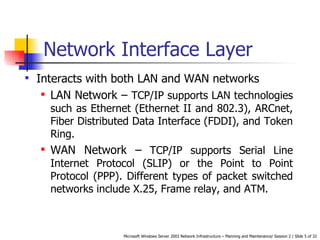
Network Interface Layer Interacts with both LAN and WAN networks LAN Network –  TCP/IP supports LAN technologies such as  Ethernet (Ethernet II and 802.3), ARCnet, Fiber Distributed Data Interface (FDDI), and Token Ring. WAN Network –  TCP/IP supports  Serial Line Internet Protocol (SLIP) or the Point to Point Protocol (PPP). Different types of packet switched networks include X.25, Frame relay, and ATM.
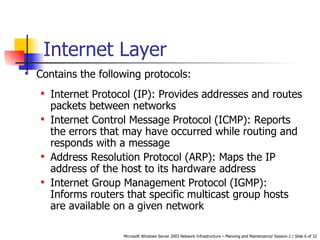
Internet Layer Contains the following protocols: Internet Protocol (IP): Provides addresses and routes packets between networks Internet Control Message Protocol (ICMP): Reports the errors that may have occurred while routing and responds with a message  Address Resolution Protocol (ARP): Maps the IP address of the host to its hardware address Internet Group Management Protocol (IGMP): Informs routers that specific multicast group hosts are available on a given network
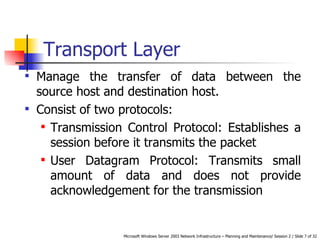
Transport Layer Manage the transfer of data between the source host and destination host.  Consist of two protocols: Transmission Control Protocol: Establishes a session before it transmits the packet User Datagram Protocol: Transmits small amount of data and does not provide acknowledgement for the transmission
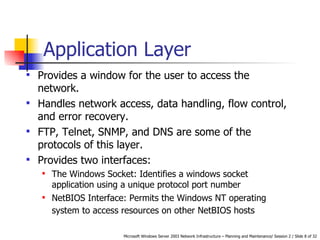
Application Layer  Provides a window for the user to access the network.  Handles network access, data handling, flow control, and error recovery.  FTP, Telnet, SNMP, and DNS are some of the protocols of this layer. Provides two interfaces: The Windows Socket:  Identifies a windows socket application using a unique protocol port number   NetBIOS Interface:  Permits the Windows NT operating system to access resources on other NetBIOS hosts
IP Addressing Each host in a TCP/IP network is assigned a unique parameter called IP address to identify itself on network There are two rules of IP addressing: The network ID must be unique to the Internetwork. Every machine on the same network must have the same network ID.  The host ID must be unique in a particular network.
Classes of IP Address There are five classes of IP Addresses: Class A -  Only the first octet of the IP address is used to define the network ID. The remaining three octets are used to define the host IDs Class B -  The first two octets of the IP address are used to define the network ID. The remaining two octets are used to define the host Ids Class C - T he first three octet of the IP address is used to define the network ID. The remaining only one last octet is used to define the host IDs
Classes of IP Address Contd… There are five classes of IP Addresses: Class D –  Used for multicast purpose Class E - Reserved by the IETF (Internet Engineering Task Force). They use these addresses to conduct experiments. This address is used to carry research to enhance Internet and related technologies.
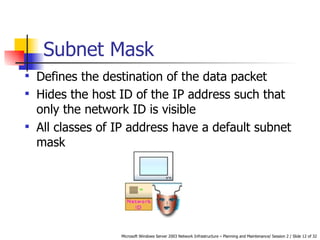
Subnet Mask Defines the destination of the data packet   Hides the host ID of the IP address such that only the network ID is visible   All classes of IP address have a default subnet mask
Default Gateway Address Packets meant for a remote network, are first sent to the local host's default gateway   The default gateway is the IP address of a router to which all the packets that are meant for a remote network are sent.  The packets are then sent from the router to other networks till they reach the destination network.
Implementing IP Addressing Consider the following while configuring IP addresses: All the machines in one physical network must have the same network ID   A WAN connection to connect to the Internet requires a unique network ID for each wide area connection   The host ID represents a TCP/IP host in a network and the host ID must be unique to the network ID
Planning IP Addresses Unregistered IP addresses along with a NAT router or a proxy server is a best option for Internet Clients.   Registered IP address is preferred for users that must function as Internet servers. A large organization would have to acquire its own network address and assign host as required.
Planning an IP Routing Solution Planning an IP Routing solution involves: Creating LAN’s Broadcast Domain Collision Domain Creating WAN’s Using Routers Using Switches Private Network IP Addressing
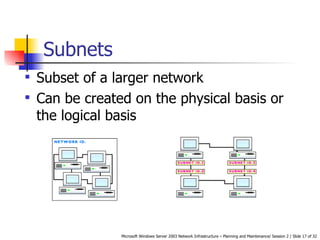
Subnets Subset of a larger network Can be created on the physical basis or the logical basis
Implementing Subnetting Enables to create subnets in a network  Before creating subnets for our network, consider the following: Determine the number of required subnets  Determine the number of hosts per subnet  We need to calculate: Subnet Mask  Unique subnet ID for each physical segment  Valid range of Host IDs for each subnet
IP Addressing Configuration  We use the following methods to configure IP addressing: Manual Configuration  Manual Configuration using DHCP  Automatic Configuration using DHCP  Automatic IP addressing
TCP/IP Security Design We can protect the data on the network by using: IP packet filtering   Data encryption   Authentication   IPSec Internet Key Exchange
IP Packet Filtering Prevents protocols and ports from entering the network to minimize the threat of unauthorized access TCP/IP filtering enables to: Manage traffic on servers Prevent inbound traffic completely Apply filtering at the application level
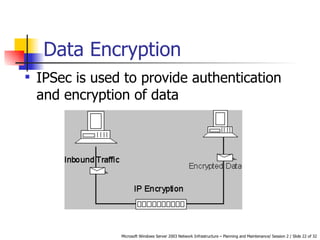
Data Encryption IPSec is used to provide authentication and encryption of data
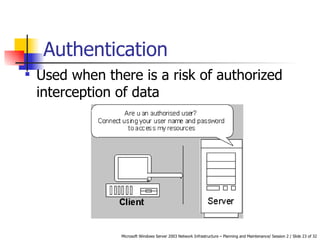
Authentication Used when there is a risk of authorized interception of data
IPSec Internet Key Exchange Authenticated and encrypted data exchange between users that use IPSec requires trading of security keys.  This trade between users takes place in two phases and is called Internet Key Exchange (IKE).
Optimize TCP/IP Design We can create a base line for the design by optimizing the following: Subnet Design IP Performance Remote Subnets Quality of Service (QoS) QoS connections
Subnet Design Subnet Design can be optimized by: Using variable length subnetting to divide IP ranges   Using supernetting to combine ranges
IP Performance  TCP/IP performance is influenced by: Receive window size - When the network delay is too high, increase the window size by editing the registry  High bandwidth requirement - When the network delay is too high, select the largest vailable bandwidth to increase performance over links  Packet loss over the network - Error and congestion at the routers cause packet loss
Remote Subnet We must have an estimate of the number of subnets and host addresses required to design an effective IP addressing scheme   Appropriate routes and Internet access must be configured with care for networks that contain subnets in remote locations
QOS Connections Allocates bandwidth to specific users or applications or services   Provides bandwidth depending on the user requirement   Divides the bandwidth to enable priority traffic and first come first server traffic   Prevents overuse of network resources by non adaptive protocols such as UDP
QOS Connections Contd… Includes the following protocols   QoS Administration Control Service (QoS ACS)   Subnet Bandwidth Management (SBM)   Resource Reservation Protocol (RSVP)   Traffic Control
Summary TCP/IP protocol suite is mapped to a four-layered model with network Interface layer Internet layer Transport layer Application layer There are five classes of IP Addresses, namely, Class A, B, C, D, and E.  The subnet mask hides the host IP address such that only the network ID is visible. The destination of the packet is decided by comparing the subnet masks of the destination and the host subnet masks .
Summary Contd… Default gateway is the IP Address of a router, to which all the packets are sent to the remote network. The packets are then sent from the router to other networks till they reach the destination network. Subnets can be created either on the physical basis or logical basis.  IP packet filtering, data encryption, authentication, and IPSec Internet Key Exchange can protect data on a network. We must create a base line by optimizing subnet design IP performance, remote subnets, Quality of Service (QoS), and QoS connections to create an effective network infrastructure.

Session 2 Tp 2

  • 1.
    Session 2 NetworkDesign Solution with Microsoft TCP/IP
  • 2.
    Network Services Infrastructuredesign depends on the execution of three phases that are plan, implement, maintain. The Open Systems Interconnection (OSI) reference model defines a networking framework for implementing protocols. Network services include TCP/IP, DHCP, DNS, and WINS. The Data-Link layer protocol is a main decision taken while designing the network infrastructure. Review
  • 3.
    Objectives Explain thebasics of TCP/IP Define IP address, subnet mask and default gateway Plan IP addresses Plan an IP Routing Solution Identify subnetting Identify a TCP/IP solution Identify security required for a TCP/IP solution
  • 4.
    Transmission Control Protocol/ Internet Protocol IP addressing is the main tool that enables two computers to talk to each other. TCP/IP Suite Architecture consists of: Network Interface Layer Internet Layer Transport Layer Application Layer
  • 5.
    Network Interface LayerInteracts with both LAN and WAN networks LAN Network – TCP/IP supports LAN technologies such as Ethernet (Ethernet II and 802.3), ARCnet, Fiber Distributed Data Interface (FDDI), and Token Ring. WAN Network – TCP/IP supports Serial Line Internet Protocol (SLIP) or the Point to Point Protocol (PPP). Different types of packet switched networks include X.25, Frame relay, and ATM.
  • 6.
    Internet Layer Containsthe following protocols: Internet Protocol (IP): Provides addresses and routes packets between networks Internet Control Message Protocol (ICMP): Reports the errors that may have occurred while routing and responds with a message Address Resolution Protocol (ARP): Maps the IP address of the host to its hardware address Internet Group Management Protocol (IGMP): Informs routers that specific multicast group hosts are available on a given network
  • 7.
    Transport Layer Managethe transfer of data between the source host and destination host. Consist of two protocols: Transmission Control Protocol: Establishes a session before it transmits the packet User Datagram Protocol: Transmits small amount of data and does not provide acknowledgement for the transmission
  • 8.
    Application Layer Provides a window for the user to access the network. Handles network access, data handling, flow control, and error recovery. FTP, Telnet, SNMP, and DNS are some of the protocols of this layer. Provides two interfaces: The Windows Socket: Identifies a windows socket application using a unique protocol port number NetBIOS Interface: Permits the Windows NT operating system to access resources on other NetBIOS hosts
  • 9.
    IP Addressing Eachhost in a TCP/IP network is assigned a unique parameter called IP address to identify itself on network There are two rules of IP addressing: The network ID must be unique to the Internetwork. Every machine on the same network must have the same network ID. The host ID must be unique in a particular network.
  • 10.
    Classes of IPAddress There are five classes of IP Addresses: Class A - Only the first octet of the IP address is used to define the network ID. The remaining three octets are used to define the host IDs Class B - The first two octets of the IP address are used to define the network ID. The remaining two octets are used to define the host Ids Class C - T he first three octet of the IP address is used to define the network ID. The remaining only one last octet is used to define the host IDs
  • 11.
    Classes of IPAddress Contd… There are five classes of IP Addresses: Class D – Used for multicast purpose Class E - Reserved by the IETF (Internet Engineering Task Force). They use these addresses to conduct experiments. This address is used to carry research to enhance Internet and related technologies.
  • 12.
    Subnet Mask Definesthe destination of the data packet Hides the host ID of the IP address such that only the network ID is visible All classes of IP address have a default subnet mask
  • 13.
    Default Gateway AddressPackets meant for a remote network, are first sent to the local host's default gateway The default gateway is the IP address of a router to which all the packets that are meant for a remote network are sent. The packets are then sent from the router to other networks till they reach the destination network.
  • 14.
    Implementing IP AddressingConsider the following while configuring IP addresses: All the machines in one physical network must have the same network ID A WAN connection to connect to the Internet requires a unique network ID for each wide area connection The host ID represents a TCP/IP host in a network and the host ID must be unique to the network ID
  • 15.
    Planning IP AddressesUnregistered IP addresses along with a NAT router or a proxy server is a best option for Internet Clients. Registered IP address is preferred for users that must function as Internet servers. A large organization would have to acquire its own network address and assign host as required.
  • 16.
    Planning an IPRouting Solution Planning an IP Routing solution involves: Creating LAN’s Broadcast Domain Collision Domain Creating WAN’s Using Routers Using Switches Private Network IP Addressing
  • 17.
    Subnets Subset ofa larger network Can be created on the physical basis or the logical basis
  • 18.
    Implementing Subnetting Enablesto create subnets in a network Before creating subnets for our network, consider the following: Determine the number of required subnets Determine the number of hosts per subnet We need to calculate: Subnet Mask Unique subnet ID for each physical segment Valid range of Host IDs for each subnet
  • 19.
    IP Addressing Configuration We use the following methods to configure IP addressing: Manual Configuration Manual Configuration using DHCP Automatic Configuration using DHCP Automatic IP addressing
  • 20.
    TCP/IP Security DesignWe can protect the data on the network by using: IP packet filtering Data encryption Authentication IPSec Internet Key Exchange
  • 21.
    IP Packet FilteringPrevents protocols and ports from entering the network to minimize the threat of unauthorized access TCP/IP filtering enables to: Manage traffic on servers Prevent inbound traffic completely Apply filtering at the application level
  • 22.
    Data Encryption IPSecis used to provide authentication and encryption of data
  • 23.
    Authentication Used whenthere is a risk of authorized interception of data
  • 24.
    IPSec Internet KeyExchange Authenticated and encrypted data exchange between users that use IPSec requires trading of security keys. This trade between users takes place in two phases and is called Internet Key Exchange (IKE).
  • 25.
    Optimize TCP/IP DesignWe can create a base line for the design by optimizing the following: Subnet Design IP Performance Remote Subnets Quality of Service (QoS) QoS connections
  • 26.
    Subnet Design SubnetDesign can be optimized by: Using variable length subnetting to divide IP ranges Using supernetting to combine ranges
  • 27.
    IP Performance TCP/IP performance is influenced by: Receive window size - When the network delay is too high, increase the window size by editing the registry High bandwidth requirement - When the network delay is too high, select the largest vailable bandwidth to increase performance over links Packet loss over the network - Error and congestion at the routers cause packet loss
  • 28.
    Remote Subnet Wemust have an estimate of the number of subnets and host addresses required to design an effective IP addressing scheme Appropriate routes and Internet access must be configured with care for networks that contain subnets in remote locations
  • 29.
    QOS Connections Allocatesbandwidth to specific users or applications or services Provides bandwidth depending on the user requirement Divides the bandwidth to enable priority traffic and first come first server traffic Prevents overuse of network resources by non adaptive protocols such as UDP
  • 30.
    QOS Connections Contd…Includes the following protocols QoS Administration Control Service (QoS ACS) Subnet Bandwidth Management (SBM) Resource Reservation Protocol (RSVP) Traffic Control
  • 31.
    Summary TCP/IP protocolsuite is mapped to a four-layered model with network Interface layer Internet layer Transport layer Application layer There are five classes of IP Addresses, namely, Class A, B, C, D, and E. The subnet mask hides the host IP address such that only the network ID is visible. The destination of the packet is decided by comparing the subnet masks of the destination and the host subnet masks .
  • 32.
    Summary Contd… Defaultgateway is the IP Address of a router, to which all the packets are sent to the remote network. The packets are then sent from the router to other networks till they reach the destination network. Subnets can be created either on the physical basis or logical basis. IP packet filtering, data encryption, authentication, and IPSec Internet Key Exchange can protect data on a network. We must create a base line by optimizing subnet design IP performance, remote subnets, Quality of Service (QoS), and QoS connections to create an effective network infrastructure.