IIPPSSeecc -- OOvveerrvviieeww 
Mr. Rupesh Mishra 
St. Francis Institute of Tech 
1
OOuuttlliinnee 
• Introduction 
• IPSec Architecture 
• Internet Key Exchange (IKE) 
• IPSec Policy 
• Discussion 
2
IIPP iiss nnoott SSeeccuurree!! 
• IP protocol was designed in the late 70s to 
early 80s 
o Part of DARPA Internet Project 
o Very small network 
• All hosts are known! 
• So are the users! 
• Therefore, security was not an issue 
3
SSeeccuurriittyy IIssssuueess iinn IIPP 
• source spoofing - DOS Attack 
• replay packets - Replay Attack 
• No data integrity - Modification 
• No confidentiality - Spying 
4
WWhhaatt iiss IIPPSSeecc 
• A set of protocol and algorithm used to secure IP 
data and network layer 
• Open standard for VPN implementation 
• Inbuilt in IPV6 and compatible with IPV4 
5
GGooaallss ooff IIPPSSeecc 
• to verify sources of IP packets 
o authentication 
• to prevent replaying of old packets 
• to protect integrity and/or confidentiality of packets 
o data Integrity/Data Encryption 
6
OOuuttlliinnee 
• Why IPsec? 
• IPSec Architecture 
• Internet Key Exchange (IKE) 
• IPsec Policy 
• Discussion 
7
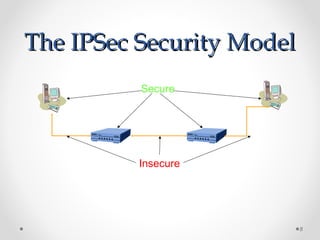
TThhee IIPPSSeecc SSeeccuurriittyy MMooddeell 
8 
Secure 
Insecure
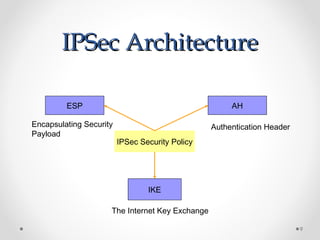
IIPPSSeecc AArrcchhiitteeccttuurree 
9 
ESP AH 
IPSec Security Policy 
IKE 
Encapsulating Security 
Payload 
Authentication Header 
The Internet Key Exchange
IIPPSSeecc AArrcchhiitteeccttuurree 
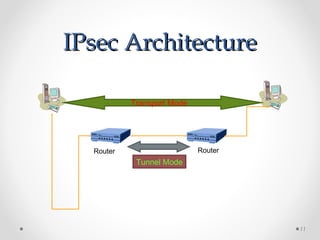
• IPSec provides security in three situations: 
o Host-to-host, host-to-gateway and gateway-to-gateway 
• IPSec operates in two modes: 
o Transport mode (for end-to-end) 
o Tunnel mode (for VPN) 
10
IIPPsseecc AArrcchhiitteeccttuurree 
11 
Transport Mode 
Router Router 
Tunnel Mode
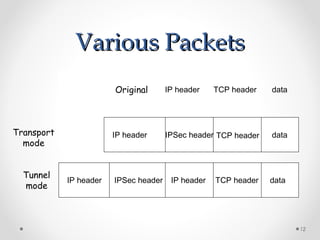
VVaarriioouuss PPaacckkeettss 
12 
IP header 
Original 
IP header 
IP header 
TCP header 
TCP header 
TCP header 
data 
data 
data 
IPSec header 
IPSec header IP header 
Transport 
mode 
Tunnel 
mode
SSeeccuurriittyy AAssssoocciiaattiioonn ((SSAA)) 
13 
• Specification of security for the communication 
• Specification of key , algorithm , policy , etc 
• Unidirectional 
• SADB
IISSAAKKMMPP 
14 
• Defines the procedure for security association 
• SA and Key Management
IIPPSSeecc 
• A collection of protocols (RFC 2401) 
o Authentication Header (AH) 
• RFC 2402 
o Encapsulating Security Payload (ESP) 
• RFC 2406 
o Internet Key Exchange (IKE) 
• RFC 2409 
o IP Payload Compression (IPcomp) 
• RFC 3137 
15
AAuutthheennttiiccaattiioonn HHeeaaddeerr 
((AAHH)) 
• Provides source authentication 
o Protects against source spoofing 
• Provides data integrity 
• Protects against replay attacks 
o Use monotonically increasing sequence numbers 
o Protects against denial of service attacks 
• NO protection for confidentiality! 
16
AAHH DDeettaaiillss 
• Use 32-bit monotonically increasing sequence 
number to avoid replay attacks 
• Use cryptographically strong hash algorithms to 
protect data integrity (96-bit) 
o Use symmetric key cryptography 
o HMAC-SHA-96, HMAC-MD5-96 
17
AAHH PPaacckkeett DDeettaaiillss 
18 
New IP header 
Security Parameters Index (SPI) 
Sequence Number 
Authentication Data 
Next 
header 
Payload 
length Reserved 
Old IP header (only in Tunnel mode) 
TCP header 
Authenticated 
Data 
Encapsulated 
TCP or IP packet 
Hash of everything 
else
EEnnccaappssuullaattiinngg SSeeccuurriittyy 
PPaayyllooaadd ((EESSPP)) 
• Provides all that AH offers, and 
• in addition provides data confidentiality 
o Uses symmetric key encryption 
19
EESSPP DDeettaaiillss 
• Same as AH: 
o Use 32-bit sequence number to counter replaying attacks 
o Use integrity check algorithms 
• Only in ESP: 
o Data confidentiality: 
• Uses symmetric key encryption algorithms to encrypt packets 
20
EESSPP PPaacckkeett DDeettaaiillss 
21 
Security Parameters Index (SPI) 
Sequence Number 
Authentication Data 
Next 
header 
Payload 
length Reserved 
TCP header 
Authenticated 
IP header 
Initialization vector 
Data 
Pad Pad length Next 
Encrypted TCP 
packet
OOuuttlliinnee 
• Why IPsec? 
• IPsec Architecture 
• Internet Key Exchange (IKE) 
• IPsec Policy 
• Discussion 
22
IInntteerrnneett KKeeyy EExxcchhaannggee 
((IIKKEE)) 
• Exchange and negotiate security policies 
• Establish security sessions 
o Identified as Security Associations 
• Key exchange 
• Key management 
• Can be used outside IPsec as well 
23
HHooww IItt WWoorrkkss 
• IKE operates in two phases 
o Phase 1: negotiate and establish an auxiliary 
end-to-end secure channel 
• Used by subsequent phase 2 negotiations 
• Only established once between two end points! 
o Phase 2: negotiate and establish custom secure 
channels 
• Occurs multiple times 
o Both phases use Diffie-Hellman key exchange to 
establish a shared key 
24
IIKKEE PPhhaassee 11 
• Goal: to establish a secure channel between two 
end points 
o This channel provides basic security features: 
• Source authentication 
• Data integrity and data confidentiality 
• Protection against replay attacks 
25
IIKKEE PPhhaassee 11 
• Rationale: each application has different security 
requirements 
• But they all need to negotiate policies and 
exchange keys! 
• So, provide the basic security features and allow 
application to establish custom sessions 
26
EExxaammpplleess 
• All packets sent to address mybank.com must be 
encrypted using 3DES with HMAC-MD5 integrity 
check 
• All packets sent to address www.forum.com must 
use integrity check with HMAC-SHA1 (no encryption 
is required) 
27
PPhhaassee 11 EExxcchhaannggee 
• Can operate in two modes: 
o Main mode 
• Six messages in three round trips 
• More options 
o Quick mode 
• Four messages in two round trips 
• Less options 
28
PPhhaassee 11 ((MMaaiinn MMooddee)) 
29 
Initiator Responder 
[Header, SA1]
PPhhaassee 11 ((MMaaiinn MMooddee)) 
30 
Initiator Responder 
[Header, SA1] 
[Header, SA2] 
Establish vocabulary for further communication
PPhhaassee 11 ((MMaaiinn MMooddee)) 
31 
Initiator Responder 
[Header, SA1] 
[Header, SA2] 
[Header, KE, Ni, {Cert_Reg} ]
PPhhaassee 11 ((MMaaiinn MMooddee)) 
32 
Initiator Responder 
Header, SA1 
[Header, SA1] 
[Header, KE, Ni { , Cert_Req} ] 
[Header, KE, Nr {, Cert_Req}] 
Establish secret key using Diffie-Hellman key exchange 
Use nonces to prevent replay attacks
PPhhaassee 11 ((MMaaiinn MMooddee)) 
33 
Initiator Responder 
[Header, SA1] 
[Header, SA1] 
[Header, KE, Ni {,Cert_Req} ] 
[Header, KE, Nr {,Cert_Req}] 
[Header, IDi, {CERT} sig]
PPhhaassee 11 ((MMaaiinn MMooddee)) 
34 
Initiator Responder 
[Header, SA1] 
[Header, SA1] 
[Header, KE, Ni {, Cert_req}] 
[Header, KE, Nr {, Cert_req}] 
[Header, IDi, {CERT} sig] 
[Header, IDr, {CERT} sig] 
Signed hash of IDi (without Cert_req , just send the hash)
PPhhaassee 11 ((QQuuiicckk MMooddee)) 
35 
Initiator Responder 
[Header, SA1, KE, Ni, IDi]
PPhhaassee 11 ((QQuuiicckk MMooddee)) 
36 
Initiator Responder 
[Header, SA1, KE, Ni, IDi] 
[Header, SA2, KE, Nr, 
IDr, [Cert]sig] 
[Header, [Cert]sig] 
First two messages combined into one 
(combine Hello and DH key exchange)
IIPPSSeecc ((PPhhaassee 11)) 
• Four different way to authenticate (either 
mode) 
o Digital signature 
o Two forms of authentication with public key encryption 
o Pre-shared key 
• NOTE: IKE does use public-key based 
cryptography for encryption 
37
IIPPSSeecc ((PPhhaassee 22)) 
• Goal: to establish custom secure channels 
between two end points 
o End points are identified by <IP, port>: 
• e.g. <www.mybank.com, 8000> 
o Or by packet: 
• e.g. All packets going to 128.124.100.0/24 
o Use the secure channel established in Phase 1 for communication 
38
IIPPSSeecc ((PPhhaassee 22)) 
• Only one mode: Quick Mode 
• Multiple quick mode exchanges can be 
multiplexed 
• Generate SAs for two end points 
• Can use secure channel established in phase 1 
39
IIPP PPaayyllooaadd CCoommpprreessssiioonn 
• Used for compression 
• Can be specified as part of the IPSec policy 
40
OOuuttlliinnee 
• Why IPsec? 
• IPsec Architecture 
• Internet Key Exchange (IKE) 
• IPSec Policy 
• Discussion 
41
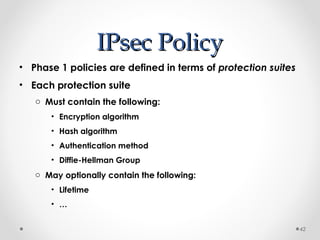
IIPPsseecc PPoolliiccyy 
• Phase 1 policies are defined in terms of protection suites 
• Each protection suite 
o Must contain the following: 
• Encryption algorithm 
• Hash algorithm 
• Authentication method 
• Diffie-Hellman Group 
o May optionally contain the following: 
• Lifetime 
• … 
42
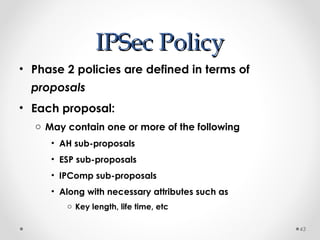
IIPPSSeecc PPoolliiccyy 
• Phase 2 policies are defined in terms of 
proposals 
• Each proposal: 
o May contain one or more of the following 
• AH sub-proposals 
• ESP sub-proposals 
• IPComp sub-proposals 
• Along with necessary attributes such as 
o Key length, life time, etc 
43
IIPPSSeecc PPoolliiccyy EExxaammppllee 
• In English: 
o All traffic to 128.104.120.0/24 must be: 
• Use pre-hashed key authentication 
• DH group is MODP with 1024-bit modulus 
• Hash algorithm is HMAC-SHA (128 bit key) 
• Encryption using 3DES 
• In IPSec: 
o [Auth=Pre-Hash; 
DH=MODP(1024-bit); 
HASH=HMAC-SHA; 
ENC=3DES] 
44
IIPPsseecc PPoolliiccyy EExxaammppllee 
• In English: 
o All traffic to 128.104.120.0/24 must use one of the 
following: 
• AH with HMAC-SHA or, 
• ESP with 3DES as encryption algorithm and 
(HMAC-MD5 or HMAC-SHA as hashing algorithm) 
• In IPsec: 
o [AH: HMAC-SHA] or, 
o [ESP: (3DES and HMAC-MD5) or 
(3DES and HMAC-SHA)] 
45
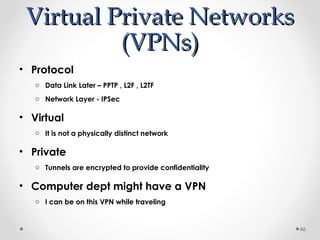
VViirrttuuaall PPrriivvaattee NNeettwwoorrkkss 
((VVPPNNss)) 
• Protocol 
o Data Link Later – PPTP , L2F , L2TF 
o Network Layer - IPSec 
• Virtual 
o It is not a physically distinct network 
• Private 
o Tunnels are encrypted to provide confidentiality 
• Computer dept might have a VPN 
o I can be on this VPN while traveling 
46
OOuuttlliinnee 
• Why IPsec? 
• IPsec Architecture 
• Internet Key Exchange (IKE) 
• IPsec Policy 
• Discussion 
47
DDiissccuussssiioonn 
• IPSec is not the only solution! 
o Security features can be added on top of IP! 
• e.g. Kerberos, SSL 
o IP, IPSec protocols are very complex! 
• Two modes, three sub protocols 
o Complexity is the biggest enemy of security 
48
DDiissccuussssiioonn 
• Has it been used? 
o Yes—primarily used by some VPN vendors 
• But not all routers support it 
o No—it is not really an end-to-end solution 
• Authentication is too coarse (host based) 
• Default encryption algorithm too weak (DES) 
• Too complex for applications to use 
49
RReessoouurrcceess 
• IP, IPsec and related RFCs: 
o http://www.ietf.org/html.charters/ipsec-charter.html 
o IPsec: RFC 2401, IKE: RFC 2409 
o www.freeswan.org 
• Google search 
50

Ipsec

  • 1.
    IIPPSSeecc -- OOvveerrvviieeww Mr. Rupesh Mishra St. Francis Institute of Tech 1
  • 2.
    OOuuttlliinnee • Introduction • IPSec Architecture • Internet Key Exchange (IKE) • IPSec Policy • Discussion 2
  • 3.
    IIPP iiss nnoottSSeeccuurree!! • IP protocol was designed in the late 70s to early 80s o Part of DARPA Internet Project o Very small network • All hosts are known! • So are the users! • Therefore, security was not an issue 3
  • 4.
    SSeeccuurriittyy IIssssuueess iinnIIPP • source spoofing - DOS Attack • replay packets - Replay Attack • No data integrity - Modification • No confidentiality - Spying 4
  • 5.
    WWhhaatt iiss IIPPSSeecc • A set of protocol and algorithm used to secure IP data and network layer • Open standard for VPN implementation • Inbuilt in IPV6 and compatible with IPV4 5
  • 6.
    GGooaallss ooff IIPPSSeecc • to verify sources of IP packets o authentication • to prevent replaying of old packets • to protect integrity and/or confidentiality of packets o data Integrity/Data Encryption 6
  • 7.
    OOuuttlliinnee • WhyIPsec? • IPSec Architecture • Internet Key Exchange (IKE) • IPsec Policy • Discussion 7
  • 8.
    TThhee IIPPSSeecc SSeeccuurriittyyMMooddeell 8 Secure Insecure
  • 9.
    IIPPSSeecc AArrcchhiitteeccttuurree 9 ESP AH IPSec Security Policy IKE Encapsulating Security Payload Authentication Header The Internet Key Exchange
  • 10.
    IIPPSSeecc AArrcchhiitteeccttuurree •IPSec provides security in three situations: o Host-to-host, host-to-gateway and gateway-to-gateway • IPSec operates in two modes: o Transport mode (for end-to-end) o Tunnel mode (for VPN) 10
  • 11.
    IIPPsseecc AArrcchhiitteeccttuurree 11 Transport Mode Router Router Tunnel Mode
  • 12.
    VVaarriioouuss PPaacckkeettss 12 IP header Original IP header IP header TCP header TCP header TCP header data data data IPSec header IPSec header IP header Transport mode Tunnel mode
  • 13.
    SSeeccuurriittyy AAssssoocciiaattiioonn ((SSAA)) 13 • Specification of security for the communication • Specification of key , algorithm , policy , etc • Unidirectional • SADB
  • 14.
    IISSAAKKMMPP 14 •Defines the procedure for security association • SA and Key Management
  • 15.
    IIPPSSeecc • Acollection of protocols (RFC 2401) o Authentication Header (AH) • RFC 2402 o Encapsulating Security Payload (ESP) • RFC 2406 o Internet Key Exchange (IKE) • RFC 2409 o IP Payload Compression (IPcomp) • RFC 3137 15
  • 16.
    AAuutthheennttiiccaattiioonn HHeeaaddeerr ((AAHH)) • Provides source authentication o Protects against source spoofing • Provides data integrity • Protects against replay attacks o Use monotonically increasing sequence numbers o Protects against denial of service attacks • NO protection for confidentiality! 16
  • 17.
    AAHH DDeettaaiillss •Use 32-bit monotonically increasing sequence number to avoid replay attacks • Use cryptographically strong hash algorithms to protect data integrity (96-bit) o Use symmetric key cryptography o HMAC-SHA-96, HMAC-MD5-96 17
  • 18.
    AAHH PPaacckkeett DDeettaaiillss 18 New IP header Security Parameters Index (SPI) Sequence Number Authentication Data Next header Payload length Reserved Old IP header (only in Tunnel mode) TCP header Authenticated Data Encapsulated TCP or IP packet Hash of everything else
  • 19.
    EEnnccaappssuullaattiinngg SSeeccuurriittyy PPaayyllooaadd((EESSPP)) • Provides all that AH offers, and • in addition provides data confidentiality o Uses symmetric key encryption 19
  • 20.
    EESSPP DDeettaaiillss •Same as AH: o Use 32-bit sequence number to counter replaying attacks o Use integrity check algorithms • Only in ESP: o Data confidentiality: • Uses symmetric key encryption algorithms to encrypt packets 20
  • 21.
    EESSPP PPaacckkeett DDeettaaiillss 21 Security Parameters Index (SPI) Sequence Number Authentication Data Next header Payload length Reserved TCP header Authenticated IP header Initialization vector Data Pad Pad length Next Encrypted TCP packet
  • 22.
    OOuuttlliinnee • WhyIPsec? • IPsec Architecture • Internet Key Exchange (IKE) • IPsec Policy • Discussion 22
  • 23.
    IInntteerrnneett KKeeyy EExxcchhaannggee ((IIKKEE)) • Exchange and negotiate security policies • Establish security sessions o Identified as Security Associations • Key exchange • Key management • Can be used outside IPsec as well 23
  • 24.
    HHooww IItt WWoorrkkss • IKE operates in two phases o Phase 1: negotiate and establish an auxiliary end-to-end secure channel • Used by subsequent phase 2 negotiations • Only established once between two end points! o Phase 2: negotiate and establish custom secure channels • Occurs multiple times o Both phases use Diffie-Hellman key exchange to establish a shared key 24
  • 25.
    IIKKEE PPhhaassee 11 • Goal: to establish a secure channel between two end points o This channel provides basic security features: • Source authentication • Data integrity and data confidentiality • Protection against replay attacks 25
  • 26.
    IIKKEE PPhhaassee 11 • Rationale: each application has different security requirements • But they all need to negotiate policies and exchange keys! • So, provide the basic security features and allow application to establish custom sessions 26
  • 27.
    EExxaammpplleess • Allpackets sent to address mybank.com must be encrypted using 3DES with HMAC-MD5 integrity check • All packets sent to address www.forum.com must use integrity check with HMAC-SHA1 (no encryption is required) 27
  • 28.
    PPhhaassee 11 EExxcchhaannggee • Can operate in two modes: o Main mode • Six messages in three round trips • More options o Quick mode • Four messages in two round trips • Less options 28
  • 29.
    PPhhaassee 11 ((MMaaiinnMMooddee)) 29 Initiator Responder [Header, SA1]
  • 30.
    PPhhaassee 11 ((MMaaiinnMMooddee)) 30 Initiator Responder [Header, SA1] [Header, SA2] Establish vocabulary for further communication
  • 31.
    PPhhaassee 11 ((MMaaiinnMMooddee)) 31 Initiator Responder [Header, SA1] [Header, SA2] [Header, KE, Ni, {Cert_Reg} ]
  • 32.
    PPhhaassee 11 ((MMaaiinnMMooddee)) 32 Initiator Responder Header, SA1 [Header, SA1] [Header, KE, Ni { , Cert_Req} ] [Header, KE, Nr {, Cert_Req}] Establish secret key using Diffie-Hellman key exchange Use nonces to prevent replay attacks
  • 33.
    PPhhaassee 11 ((MMaaiinnMMooddee)) 33 Initiator Responder [Header, SA1] [Header, SA1] [Header, KE, Ni {,Cert_Req} ] [Header, KE, Nr {,Cert_Req}] [Header, IDi, {CERT} sig]
  • 34.
    PPhhaassee 11 ((MMaaiinnMMooddee)) 34 Initiator Responder [Header, SA1] [Header, SA1] [Header, KE, Ni {, Cert_req}] [Header, KE, Nr {, Cert_req}] [Header, IDi, {CERT} sig] [Header, IDr, {CERT} sig] Signed hash of IDi (without Cert_req , just send the hash)
  • 35.
    PPhhaassee 11 ((QQuuiicckkMMooddee)) 35 Initiator Responder [Header, SA1, KE, Ni, IDi]
  • 36.
    PPhhaassee 11 ((QQuuiicckkMMooddee)) 36 Initiator Responder [Header, SA1, KE, Ni, IDi] [Header, SA2, KE, Nr, IDr, [Cert]sig] [Header, [Cert]sig] First two messages combined into one (combine Hello and DH key exchange)
  • 37.
    IIPPSSeecc ((PPhhaassee 11)) • Four different way to authenticate (either mode) o Digital signature o Two forms of authentication with public key encryption o Pre-shared key • NOTE: IKE does use public-key based cryptography for encryption 37
  • 38.
    IIPPSSeecc ((PPhhaassee 22)) • Goal: to establish custom secure channels between two end points o End points are identified by <IP, port>: • e.g. <www.mybank.com, 8000> o Or by packet: • e.g. All packets going to 128.124.100.0/24 o Use the secure channel established in Phase 1 for communication 38
  • 39.
    IIPPSSeecc ((PPhhaassee 22)) • Only one mode: Quick Mode • Multiple quick mode exchanges can be multiplexed • Generate SAs for two end points • Can use secure channel established in phase 1 39
  • 40.
    IIPP PPaayyllooaadd CCoommpprreessssiioonn • Used for compression • Can be specified as part of the IPSec policy 40
  • 41.
    OOuuttlliinnee • WhyIPsec? • IPsec Architecture • Internet Key Exchange (IKE) • IPSec Policy • Discussion 41
  • 42.
    IIPPsseecc PPoolliiccyy •Phase 1 policies are defined in terms of protection suites • Each protection suite o Must contain the following: • Encryption algorithm • Hash algorithm • Authentication method • Diffie-Hellman Group o May optionally contain the following: • Lifetime • … 42
  • 43.
    IIPPSSeecc PPoolliiccyy •Phase 2 policies are defined in terms of proposals • Each proposal: o May contain one or more of the following • AH sub-proposals • ESP sub-proposals • IPComp sub-proposals • Along with necessary attributes such as o Key length, life time, etc 43
  • 44.
    IIPPSSeecc PPoolliiccyy EExxaammppllee • In English: o All traffic to 128.104.120.0/24 must be: • Use pre-hashed key authentication • DH group is MODP with 1024-bit modulus • Hash algorithm is HMAC-SHA (128 bit key) • Encryption using 3DES • In IPSec: o [Auth=Pre-Hash; DH=MODP(1024-bit); HASH=HMAC-SHA; ENC=3DES] 44
  • 45.
    IIPPsseecc PPoolliiccyy EExxaammppllee • In English: o All traffic to 128.104.120.0/24 must use one of the following: • AH with HMAC-SHA or, • ESP with 3DES as encryption algorithm and (HMAC-MD5 or HMAC-SHA as hashing algorithm) • In IPsec: o [AH: HMAC-SHA] or, o [ESP: (3DES and HMAC-MD5) or (3DES and HMAC-SHA)] 45
  • 46.
    VViirrttuuaall PPrriivvaattee NNeettwwoorrkkss ((VVPPNNss)) • Protocol o Data Link Later – PPTP , L2F , L2TF o Network Layer - IPSec • Virtual o It is not a physically distinct network • Private o Tunnels are encrypted to provide confidentiality • Computer dept might have a VPN o I can be on this VPN while traveling 46
  • 47.
    OOuuttlliinnee • WhyIPsec? • IPsec Architecture • Internet Key Exchange (IKE) • IPsec Policy • Discussion 47
  • 48.
    DDiissccuussssiioonn • IPSecis not the only solution! o Security features can be added on top of IP! • e.g. Kerberos, SSL o IP, IPSec protocols are very complex! • Two modes, three sub protocols o Complexity is the biggest enemy of security 48
  • 49.
    DDiissccuussssiioonn • Hasit been used? o Yes—primarily used by some VPN vendors • But not all routers support it o No—it is not really an end-to-end solution • Authentication is too coarse (host based) • Default encryption algorithm too weak (DES) • Too complex for applications to use 49
  • 50.
    RReessoouurrcceess • IP,IPsec and related RFCs: o http://www.ietf.org/html.charters/ipsec-charter.html o IPsec: RFC 2401, IKE: RFC 2409 o www.freeswan.org • Google search 50

Editor's Notes

  • #15 Many security associations are passed in VPN, ISAKMP manages it.