
FIREWALL BASICS
• AGENDA
§ INTRODUCTION
§ FIREWALL DEPLOYMENT MODES
§ ACCESS CONTROL
§ HIGH AVAILABILITY FEATURES
§ UNDERSTANDING NAT
CISCO FIREWALL BASICS
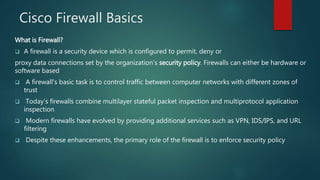
What is Firewall?
 A firewall is a security device which is configured to permit, deny or
proxy data connections set by the organization's security policy. Firewalls can either be hardware or software
based
 A firewall's basic task is to control traffic between computer networks with different zones of trust
 Today’s firewalls combine multilayer stateful packet inspection and multiprotocol application inspection
 Modern firewalls have evolved by providing additional services such as VPN, IDS/IPS, and URL filtering
 Despite these enhancements, the primary role of the firewall is to enforce security policy
FIREWALL DESIGN
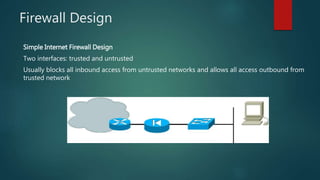
Simple Internet Firewall Design
Two interfaces: trusted and untrusted
Usually blocks all inbound access from untrusted networks and allows all access outbound from trusted
network
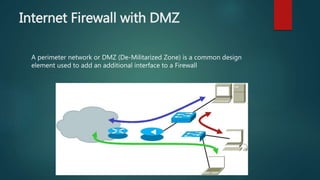
INTERNET FIREWALL WITH DMZ
A perimeter network or DMZ (De-Militarized Zone) is a common design
element used to add an additional interface to a Firewall
FIREWALL DESIGN – MODES
OF OPERATION
 Routed Mode is the traditional mode of the firewall. Two or more interfaces
that separate L3 domains
 Transparent Mode is where the firewall acts as a bridge functioning mostly at
L2
 Multi-context mode involves the use of virtual firewalls, which can be either
routed or transparent mode
 Mixed mode is the concept of using virtualization to combine routed and
transparent mode virtual firewalls
FIREWALL SECURITY LEVELS
 A security level is a number between 0 and 100 that determines how firewall rules are
processed for the data plane
 Security levels are tied to an interface: the inside or private side interface is always 100
(most trusted) and the outside or public interface is always 0 (least trusted)
 DMZ interfaces, if used, may be assigned numbers between 1 and 99
 Traffic on the ASA is allowed by default from a higher security level interface to a lower
security level interface
 An ACL must explicitly permit traffic from a lower security level interface to a higher (e.g.
outside to in)
ACCESS CONTROL LISTS
Type Description
Standard Used for routing protocol, not firewall rules
Extended Source/Dest. port and protocol
Ethertype Used with transparent mode
Webtype Used for clientless SSL VPN
 Like Cisco IOS, ACLs are processed from top down, sequentially with an implicit deny all at the bottom
 A criteria match will cause the ACL to be exited
 ACLs are made up of Access Control Entries (ACE)
 ACLs can be enabled/disabled based on time ranges
NAT AND FIREWALL
 NAT is simply a means of address translation; commonly this is a privately addressed source
into a globally routed address pool (typically 1x1 mapping)
 Port Address Translation (PAT) is the idea of mapping multiple source addresses into one
“outside” address, commonly the interface address of the firewall (1 to many mapping)
 NAT is available in both routed mode and transparent mode
NAT CONTROL
 NAT control is the concept that a packet from a high security interface (e.g.
“inside”) must match a NAT policy when traversing a lower level security interface
(e.g. “outside”)
 If the packet does not match a NAT policy, then it is dropped
DYNAMIC NAT
 Dynamic NAT is the most common application of NAT on the Cisco firewall
 It allocates addresses from a specified pool for hosts as they establish connections to meet
the NAT policy
 There is no relationship between a host and the it’s translated address, hence it’s
“dynamic” (vs. static)
PORT ADDRESS TRANSLATION (PAT)
 PAT is best used in small networks where a global address pool isn’t available
 Commonly the firewall interface address is used
 Best way to conserve addresses as translates all addresses into one address and uses
port numbers for tracking
OPTIONS FOR BYPASSING NAT
 Identity NAT (Nat 0) – limits NAT on all interfaces, very little granularity, will not allow outside
to inside connections even if permitted by ACL
 Static Identity NAT – based on interface, a host can be translated on one interface and not
translated on another. Works with Policy NAT
 NAT exemption (Nat 0 with Access Control List) – more granular than Identity NAT as it allows
bidirectional communication between inside and outside hosts. The ACL allows for very
specific NAT policies to be created
 NAT exemption is the most common method for bypassing NAT today
POLICY NAT
 In some cases it may be necessary to have a NAT policy that translates based on source
AND destination
 While dynamic NAT only considers the source address, policy NAT looks at both source
and destination including port numbers
 Very useful when an application (e.g. FTP, VoIP) has secondary channels that need a
specific policy
 The source, destination and all relevant ports are assigned via an ACL
 Policy NAT does not support time-based ACLs
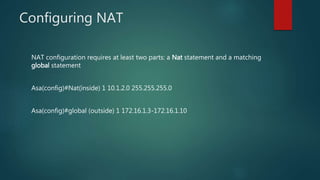
CONFIGURING NAT
NAT configuration requires at least two parts: a Nat statement and a matching
global statement
Asa(config)#Nat(inside) 1 10.1.2.0 255.255.255.0
Asa(config)#global (outside) 1 172.16.1.3-172.16.1.10
HIGH AVAILABILITY – INTERFACE
REDUNDANCY
 Up to 8 redundant interface pairs are allowed.
 Compatible with all firewall modes (routed/transparent and single/multiple) and all HA
deployments (A/A and A/S)
 When the active physical interface fails, traffic fails to the standby physical interface and
routing adjacencies, connection, and auth state won’t need to be relearned.

Firewall basics

  • 1.
  • 2.
    • AGENDA § INTRODUCTION §FIREWALL DEPLOYMENT MODES § ACCESS CONTROL § HIGH AVAILABILITY FEATURES § UNDERSTANDING NAT
  • 3.
    CISCO FIREWALL BASICS Whatis Firewall?  A firewall is a security device which is configured to permit, deny or proxy data connections set by the organization's security policy. Firewalls can either be hardware or software based  A firewall's basic task is to control traffic between computer networks with different zones of trust  Today’s firewalls combine multilayer stateful packet inspection and multiprotocol application inspection  Modern firewalls have evolved by providing additional services such as VPN, IDS/IPS, and URL filtering  Despite these enhancements, the primary role of the firewall is to enforce security policy
  • 4.
    FIREWALL DESIGN Simple InternetFirewall Design Two interfaces: trusted and untrusted Usually blocks all inbound access from untrusted networks and allows all access outbound from trusted network
  • 5.
    INTERNET FIREWALL WITHDMZ A perimeter network or DMZ (De-Militarized Zone) is a common design element used to add an additional interface to a Firewall
  • 6.
    FIREWALL DESIGN –MODES OF OPERATION  Routed Mode is the traditional mode of the firewall. Two or more interfaces that separate L3 domains  Transparent Mode is where the firewall acts as a bridge functioning mostly at L2  Multi-context mode involves the use of virtual firewalls, which can be either routed or transparent mode  Mixed mode is the concept of using virtualization to combine routed and transparent mode virtual firewalls
  • 7.
    FIREWALL SECURITY LEVELS A security level is a number between 0 and 100 that determines how firewall rules are processed for the data plane  Security levels are tied to an interface: the inside or private side interface is always 100 (most trusted) and the outside or public interface is always 0 (least trusted)  DMZ interfaces, if used, may be assigned numbers between 1 and 99  Traffic on the ASA is allowed by default from a higher security level interface to a lower security level interface  An ACL must explicitly permit traffic from a lower security level interface to a higher (e.g. outside to in)
  • 8.
    ACCESS CONTROL LISTS TypeDescription Standard Used for routing protocol, not firewall rules Extended Source/Dest. port and protocol Ethertype Used with transparent mode Webtype Used for clientless SSL VPN  Like Cisco IOS, ACLs are processed from top down, sequentially with an implicit deny all at the bottom  A criteria match will cause the ACL to be exited  ACLs are made up of Access Control Entries (ACE)  ACLs can be enabled/disabled based on time ranges
  • 9.
    NAT AND FIREWALL NAT is simply a means of address translation; commonly this is a privately addressed source into a globally routed address pool (typically 1x1 mapping)  Port Address Translation (PAT) is the idea of mapping multiple source addresses into one “outside” address, commonly the interface address of the firewall (1 to many mapping)  NAT is available in both routed mode and transparent mode
  • 10.
    NAT CONTROL  NATcontrol is the concept that a packet from a high security interface (e.g. “inside”) must match a NAT policy when traversing a lower level security interface (e.g. “outside”)  If the packet does not match a NAT policy, then it is dropped
  • 11.
    DYNAMIC NAT  DynamicNAT is the most common application of NAT on the Cisco firewall  It allocates addresses from a specified pool for hosts as they establish connections to meet the NAT policy  There is no relationship between a host and the it’s translated address, hence it’s “dynamic” (vs. static)
  • 12.
    PORT ADDRESS TRANSLATION(PAT)  PAT is best used in small networks where a global address pool isn’t available  Commonly the firewall interface address is used  Best way to conserve addresses as translates all addresses into one address and uses port numbers for tracking
  • 13.
    OPTIONS FOR BYPASSINGNAT  Identity NAT (Nat 0) – limits NAT on all interfaces, very little granularity, will not allow outside to inside connections even if permitted by ACL  Static Identity NAT – based on interface, a host can be translated on one interface and not translated on another. Works with Policy NAT  NAT exemption (Nat 0 with Access Control List) – more granular than Identity NAT as it allows bidirectional communication between inside and outside hosts. The ACL allows for very specific NAT policies to be created  NAT exemption is the most common method for bypassing NAT today
  • 14.
    POLICY NAT  Insome cases it may be necessary to have a NAT policy that translates based on source AND destination  While dynamic NAT only considers the source address, policy NAT looks at both source and destination including port numbers  Very useful when an application (e.g. FTP, VoIP) has secondary channels that need a specific policy  The source, destination and all relevant ports are assigned via an ACL  Policy NAT does not support time-based ACLs
  • 15.
    CONFIGURING NAT NAT configurationrequires at least two parts: a Nat statement and a matching global statement Asa(config)#Nat(inside) 1 10.1.2.0 255.255.255.0 Asa(config)#global (outside) 1 172.16.1.3-172.16.1.10
  • 16.
    HIGH AVAILABILITY –INTERFACE REDUNDANCY  Up to 8 redundant interface pairs are allowed.  Compatible with all firewall modes (routed/transparent and single/multiple) and all HA deployments (A/A and A/S)  When the active physical interface fails, traffic fails to the standby physical interface and routing adjacencies, connection, and auth state won’t need to be relearned.