IMS Signaling 2
Sebastian Schumann
schumann@ktl.elf.stuba.sk
http://www.ngnlab.eu
Outline
• Recapitulation
• IMS Registration
• IMS Session Establishment
• IMS Application Layer
– Interaction with IMS core
– Interaction with User Equipment (UE)
The slides only summarize the lecture. Take
notes!
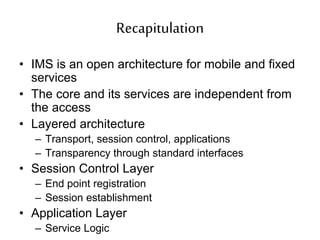
Recapitulation
• IMS is an open architecture for mobile and fixed
services
• The core and its services are independent from
the access
• Layered architecture
– Transport, session control, applications
– Transparency through standard interfaces
• Session Control Layer
– End point registration
– Session establishment
• Application Layer
– Service Logic
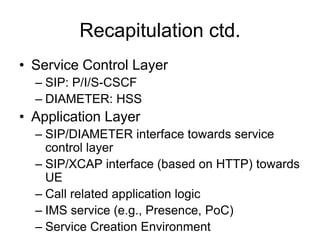
Recapitulation ctd.
• Service Control Layer
– SIP: P/I/S-CSCF
– DIAMETER: HSS
• Application Layer
– SIP/DIAMETER interface towards service
control layer
– SIP/XCAP interface (based on HTTP) towards
UE
– Call related application logic
– IMS service (e.g., Presence, PoC)
– Service Creation Environment
IMS Core
• CSCF components separate logical
functionality
– P-CSCF eq. SIP Proxy. It acts as access point
for UE towards the IMS core.
– I-CSCF placed on the borders of two IMS
domains. Entry point for served home users
from visited networks.
– S-CSCF eq. SIP Registrar. It also acts as an
anchor point for IMS service control (ISC) and
service invocation (based on iFCs).
• HSS contains all subscriber and service
User Identities
• User identities
– Private User Identity (user@realm)
• Authentication and Subscription identification
• Not used for routing
– Public User Identity (sip:user@domain.tld or
tel:+1234567890)
• Contact to be reached by others
• SIP URI or tel URI
• Implicit set of public user identities for grouping
registration
• Services and other network entities can be
addressed using a SIP URI
• User identities are part of the user profile
Relations between Identities
IMS
Subscriber
Private
UID 2
Private
UID 1
Public
UID 1
Public
UID 3
Public
UID 2
Public
UID n
.
.
.
}Implicit Set
IMS Registration
• Required before a user can access services or
perform calls
• Precondition: UE has IP address and knows IMS
entry point
• All CSCF are used
– P-CSCF (home/visited): Entry point, determines I-
CSCF
– I-CSCF (home): Determines S-CSCF
– S-CSCF (home): Authenticates the subscriber,
registers IMS subscriber, interacts with service layer
• User assigned to one S-CSCF after successful
registration
Registration
(simplified)
P-CSCF
DNS
UE
Please see “Architektúra NGN, SSW a IMS” from Tomas Kovacik for details.
This is a follow-up of slides 21-24.
Domain Name Service
• Link IP addresses with domain names
• Support in locating SIP servers
– NAPTR lookup
– SRV lookup
– A/AAAA lookup
• NAPTR resolves the preferred protocol and the DNS
string to locate the service
– ngnlab.eu. 7200 IN NAPTR 10 50 "s“ "SIP+D2T“
_sip._udp.ngnlab.eu.
• SRV look-up for a NAPTR given address indicates the
domain and port the service listens on
– _sip._udp.ngnlab.eu. 7200 IN SRV 0 0 5060 icscf.ngnlab.eu.
• A/AAAA to find the IP address of the domain name
– icscf.ngnlab.eu. 7200 IN A 147.175.103.213
Registration
(simplified)
P-CSCF I-CSCF S-CSCF
DNS
UE
HSS
Please see “Architektúra NGN, SSW a IMS” from Tomas Kovacik for details.
This is a follow-up of slides 21-24.
Important SIP “additions”
• P-Access-Network-Info includes port
location/cell
• From/To eq. IMPU
• Path inform S-CSCF about routing
destination for terminating requests
• Authorization contains IMPI and other
values
• 200 OK Service-Route to populate S-
CSCF address to P-CSCF for originating
requests
Important SIP “additions” – ctd.
• P-Associated-URI informs client about reg.
IMPUs
• P-Preferred-Identity (UE-P), P-Asserted-
Identity (P-) to choose a registered IMPU
for session establishment
• Event: reg after registration to inform UE
about events on S-CSCF (e.g., HSS-
initiated deregistration)
IMS SessionEstablishment
• After registration, subscriber is reachable
through
public user identity for communication
• IMS subscriber can access services now or
perform calls
• P-CSCF (home or local)
– Proxy, contacts assigned S-CSCF for the calling
subscriber
• S-CSCF (home)
– Service control and logic
– Contacts application or other party
• I-CSCF
Session establishment outgoing
(simplified)
P-CSCF I-CSCFS-CSCF
DNS
UE
Please see “Architektúra NGN, SSW a IMS” from Tomas Kovacik for details.
Please take notes to understand and follow the process.
Session establishment incoming
(simplified)
P-CSCFI-CSCF S-CSCF
HSS
UE
To simplify matters ,DNS is omitted in these slides.
Applicationlayerinteraction
• User profile contains also service profile
• Service Profile
– Public Identification (assigned subscribers)
– Initial Filter Criteria (triggering AS interaction)
• Initial Filter Criteria (iFC)
– Trigger points with service point triggers
(conditions when to interact)
– Application server (SIP URI for interaction)
Service Profile
Service Profile ctd.
Triggering
Triggering ctd.
Filtering
• Only initial SIP requests
• Initial filter criteria (iFC) retrieved from
HSS
during registration
• Subsequent filter criteria (sFC) provided
by application server (beyond 3GPP R8)
– Allow dynamic definition of trigger points
during application runtime
ApplicationRouting
• I/S-CSCF are interaction points with the
service layer
– I-CSCF for public service identities (PSI)
– S-CSCF for services (of served users)
• Applications have interface towards HSS
– User profile information
– Location information, service information
• Complexity of security, authorization,
access interaction etc. all handled by the
core
Application Routing ctd.
• Application server (AS) can have different
functions
– Terminating AS (e.g., acting as user agent)
– Originating AS (e.g., wake up service, click to
dial)
– SIP Proxy server (e.g., for SIP header
manipulation)
– Back-to-back user agent (e.g., for deeper
modifications in SIP dialog as supplementary
service enabler)
Questions?
Now, I want answers :-)
• Alice from IMS @atlanta.comwants to
subscribe presence of Bob from IMS
@biloxy.com
• Alice is currently in Chicago, Bob is at
home
– Is it possible?
– Where does Bob have to publish?
– Where does Alice have to subscribe?
– Which components are involved?
– How is the call flow?
Summary – what I tried to
achieve
• Deepen understanding of CSCF/HSS roles
– Function of components
– Routing within control layer and towards applications
• Understanding IMS user identities
• Service control, routing, application layer
interaction
• Many things omitted in this presentation
– Network access layer, IMS reference points names
– S-CSCF assignments in detail, SLF/HSS separation
– QoS resource reservation
– PSTN Breakout
– Charging
• Get ready to deploy and integrate applications
and understand the underlying core
Backup
Example: Presence call flow
• Service profile
– assigned to users that
want to use presence
• IFC
– AS: Presence Server
– TP: CNF (&)
• Method and
– PUBLISH or
– SUBSCRIBE
• Event
– Header: Event
– Content: .*presence.*
P-CSCF
Presence
Server
S-CSCF
SUBSCRIBE
200 OK
200 OK
NOTIFY
SUBSCRIBE
200 OK
200 OK
NOTIFY
SUBSCRIBE
200OK
200OK
NOTIFY
UE
eXtensible Configuration Access
Protocol
• XCAP allows clients to read, write and
modify data stored in XML format on
server
– Hard state presence information
– Watcher authorization
– Resource Lists
• XML document sub-trees and element
attributes are mapped into HTTP URIs 
direct access via XPath
• Various selections (e.g., one or more
• Client/Server architecture like HTTP
• Application Usage for certain application
needs
• HTTP primitives ‘Get’, ‘Put’ and ‘Delete’
are used
• Body contains XML data to be
added/modified
eXtensible Configuration Access
Protocol
Message flow
• Interface exposed by
XML Document
Management Server
• XDMS is located on
application layer
• Direct communication
between UE and
XDMS
• Use cases
– Store resource list
– Authorize buddies
XDMS
UE
XCAP

IMS Signaling Details

  • 1.
    IMS Signaling 2 SebastianSchumann schumann@ktl.elf.stuba.sk http://www.ngnlab.eu
  • 2.
    Outline • Recapitulation • IMSRegistration • IMS Session Establishment • IMS Application Layer – Interaction with IMS core – Interaction with User Equipment (UE) The slides only summarize the lecture. Take notes!
  • 3.
    Recapitulation • IMS isan open architecture for mobile and fixed services • The core and its services are independent from the access • Layered architecture – Transport, session control, applications – Transparency through standard interfaces • Session Control Layer – End point registration – Session establishment • Application Layer – Service Logic
  • 4.
    Recapitulation ctd. • ServiceControl Layer – SIP: P/I/S-CSCF – DIAMETER: HSS • Application Layer – SIP/DIAMETER interface towards service control layer – SIP/XCAP interface (based on HTTP) towards UE – Call related application logic – IMS service (e.g., Presence, PoC) – Service Creation Environment
  • 5.
    IMS Core • CSCFcomponents separate logical functionality – P-CSCF eq. SIP Proxy. It acts as access point for UE towards the IMS core. – I-CSCF placed on the borders of two IMS domains. Entry point for served home users from visited networks. – S-CSCF eq. SIP Registrar. It also acts as an anchor point for IMS service control (ISC) and service invocation (based on iFCs). • HSS contains all subscriber and service
  • 6.
    User Identities • Useridentities – Private User Identity (user@realm) • Authentication and Subscription identification • Not used for routing – Public User Identity (sip:user@domain.tld or tel:+1234567890) • Contact to be reached by others • SIP URI or tel URI • Implicit set of public user identities for grouping registration • Services and other network entities can be addressed using a SIP URI • User identities are part of the user profile
  • 7.
    Relations between Identities IMS Subscriber Private UID2 Private UID 1 Public UID 1 Public UID 3 Public UID 2 Public UID n . . . }Implicit Set
  • 8.
    IMS Registration • Requiredbefore a user can access services or perform calls • Precondition: UE has IP address and knows IMS entry point • All CSCF are used – P-CSCF (home/visited): Entry point, determines I- CSCF – I-CSCF (home): Determines S-CSCF – S-CSCF (home): Authenticates the subscriber, registers IMS subscriber, interacts with service layer • User assigned to one S-CSCF after successful registration
  • 9.
    Registration (simplified) P-CSCF DNS UE Please see “ArchitektúraNGN, SSW a IMS” from Tomas Kovacik for details. This is a follow-up of slides 21-24.
  • 10.
    Domain Name Service •Link IP addresses with domain names • Support in locating SIP servers – NAPTR lookup – SRV lookup – A/AAAA lookup • NAPTR resolves the preferred protocol and the DNS string to locate the service – ngnlab.eu. 7200 IN NAPTR 10 50 "s“ "SIP+D2T“ _sip._udp.ngnlab.eu. • SRV look-up for a NAPTR given address indicates the domain and port the service listens on – _sip._udp.ngnlab.eu. 7200 IN SRV 0 0 5060 icscf.ngnlab.eu. • A/AAAA to find the IP address of the domain name – icscf.ngnlab.eu. 7200 IN A 147.175.103.213
  • 11.
    Registration (simplified) P-CSCF I-CSCF S-CSCF DNS UE HSS Pleasesee “Architektúra NGN, SSW a IMS” from Tomas Kovacik for details. This is a follow-up of slides 21-24.
  • 12.
    Important SIP “additions” •P-Access-Network-Info includes port location/cell • From/To eq. IMPU • Path inform S-CSCF about routing destination for terminating requests • Authorization contains IMPI and other values • 200 OK Service-Route to populate S- CSCF address to P-CSCF for originating requests
  • 13.
    Important SIP “additions”– ctd. • P-Associated-URI informs client about reg. IMPUs • P-Preferred-Identity (UE-P), P-Asserted- Identity (P-) to choose a registered IMPU for session establishment • Event: reg after registration to inform UE about events on S-CSCF (e.g., HSS- initiated deregistration)
  • 14.
    IMS SessionEstablishment • Afterregistration, subscriber is reachable through public user identity for communication • IMS subscriber can access services now or perform calls • P-CSCF (home or local) – Proxy, contacts assigned S-CSCF for the calling subscriber • S-CSCF (home) – Service control and logic – Contacts application or other party • I-CSCF
  • 15.
    Session establishment outgoing (simplified) P-CSCFI-CSCFS-CSCF DNS UE Please see “Architektúra NGN, SSW a IMS” from Tomas Kovacik for details. Please take notes to understand and follow the process.
  • 16.
    Session establishment incoming (simplified) P-CSCFI-CSCFS-CSCF HSS UE To simplify matters ,DNS is omitted in these slides.
  • 17.
    Applicationlayerinteraction • User profilecontains also service profile • Service Profile – Public Identification (assigned subscribers) – Initial Filter Criteria (triggering AS interaction) • Initial Filter Criteria (iFC) – Trigger points with service point triggers (conditions when to interact) – Application server (SIP URI for interaction)
  • 18.
  • 19.
  • 20.
  • 21.
  • 22.
    Filtering • Only initialSIP requests • Initial filter criteria (iFC) retrieved from HSS during registration • Subsequent filter criteria (sFC) provided by application server (beyond 3GPP R8) – Allow dynamic definition of trigger points during application runtime
  • 23.
    ApplicationRouting • I/S-CSCF areinteraction points with the service layer – I-CSCF for public service identities (PSI) – S-CSCF for services (of served users) • Applications have interface towards HSS – User profile information – Location information, service information • Complexity of security, authorization, access interaction etc. all handled by the core
  • 24.
    Application Routing ctd. •Application server (AS) can have different functions – Terminating AS (e.g., acting as user agent) – Originating AS (e.g., wake up service, click to dial) – SIP Proxy server (e.g., for SIP header manipulation) – Back-to-back user agent (e.g., for deeper modifications in SIP dialog as supplementary service enabler)
  • 25.
  • 26.
    Now, I wantanswers :-) • Alice from IMS @atlanta.comwants to subscribe presence of Bob from IMS @biloxy.com • Alice is currently in Chicago, Bob is at home – Is it possible? – Where does Bob have to publish? – Where does Alice have to subscribe? – Which components are involved? – How is the call flow?
  • 27.
    Summary – whatI tried to achieve • Deepen understanding of CSCF/HSS roles – Function of components – Routing within control layer and towards applications • Understanding IMS user identities • Service control, routing, application layer interaction • Many things omitted in this presentation – Network access layer, IMS reference points names – S-CSCF assignments in detail, SLF/HSS separation – QoS resource reservation – PSTN Breakout – Charging • Get ready to deploy and integrate applications and understand the underlying core
  • 28.
  • 29.
    Example: Presence callflow • Service profile – assigned to users that want to use presence • IFC – AS: Presence Server – TP: CNF (&) • Method and – PUBLISH or – SUBSCRIBE • Event – Header: Event – Content: .*presence.* P-CSCF Presence Server S-CSCF SUBSCRIBE 200 OK 200 OK NOTIFY SUBSCRIBE 200 OK 200 OK NOTIFY SUBSCRIBE 200OK 200OK NOTIFY UE
  • 30.
    eXtensible Configuration Access Protocol •XCAP allows clients to read, write and modify data stored in XML format on server – Hard state presence information – Watcher authorization – Resource Lists • XML document sub-trees and element attributes are mapped into HTTP URIs  direct access via XPath • Various selections (e.g., one or more
  • 31.
    • Client/Server architecturelike HTTP • Application Usage for certain application needs • HTTP primitives ‘Get’, ‘Put’ and ‘Delete’ are used • Body contains XML data to be added/modified eXtensible Configuration Access Protocol
  • 32.
    Message flow • Interfaceexposed by XML Document Management Server • XDMS is located on application layer • Direct communication between UE and XDMS • Use cases – Store resource list – Authorize buddies XDMS UE XCAP