Overview of     Fluids,   Electrolytes     Balance MOHAMMED ALHABSI INDANAN,RN Clinical Instructor King Abdul Aziz Specialist Hospital-Taif
sketch out of  my talks Concept of Fluid & Electrolyte Balance: Properties & components of Electrolytes Description & Measurement of Electrolytes Body Fluid Compartments Third Spacing Edema  Description & Constituent of Body Fluids Body Fluid Transport Movement of Body Fluid Body Fluid Excretion
Surah  AL- MURSALAT  (Those Sent Forth) ”  ألم نخلقكم من ماء مهين“ سورة المرسلات آيه  20 “ Have We not created You from a fluid (Held) despicable?”  Holy Qur’an
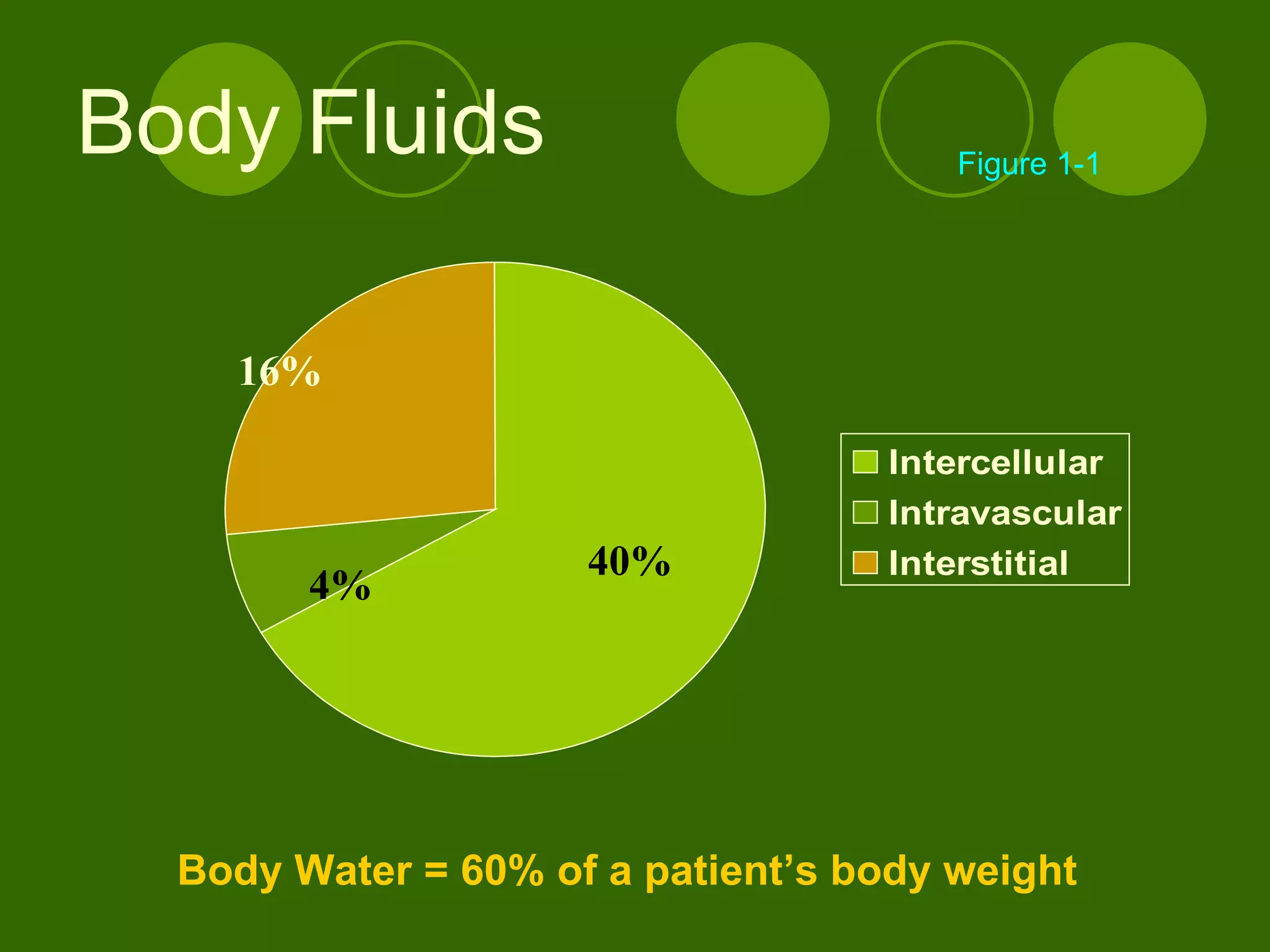
Body Fluids Body Water = 60% of a patient’s body weight 16% 4% 40% Figure 1-1
Fluid Compartments Intracellular space Extracellular space Interstitial Intravascular
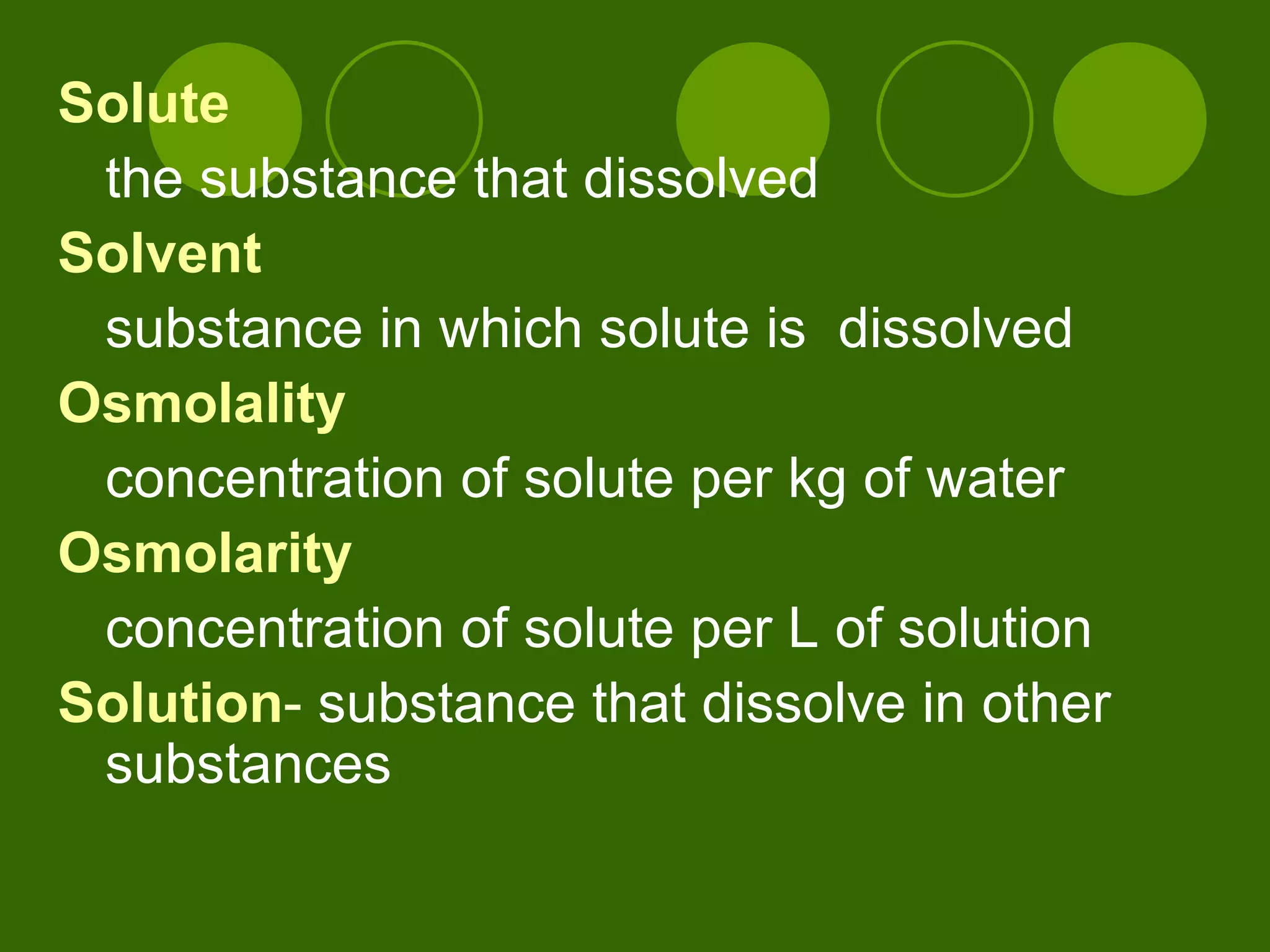
Solute the substance that dissolved Solvent substance in which solute is  dissolved Osmolality concentration of solute per kg of water Osmolarity concentration of solute per L of solution Solution -  substance that dissolve in other substances
Composition of the Body Fluids The fluids circulating throughout the body in ECF & ICF spaces contain: Electrolytes Minerals Cells
Movement of BODY FLUIDS Diffusion Osmosis Active Transport Filtration
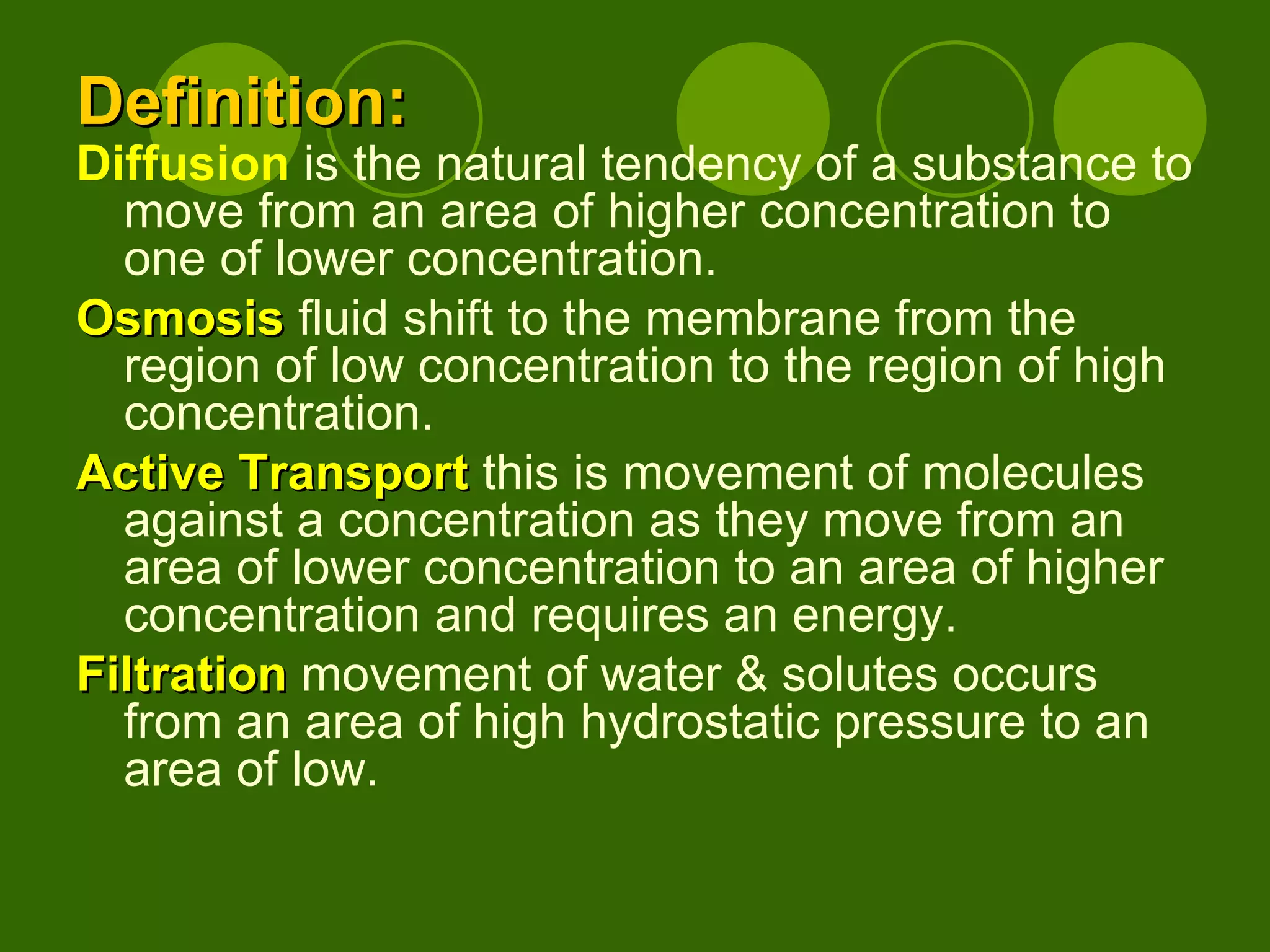
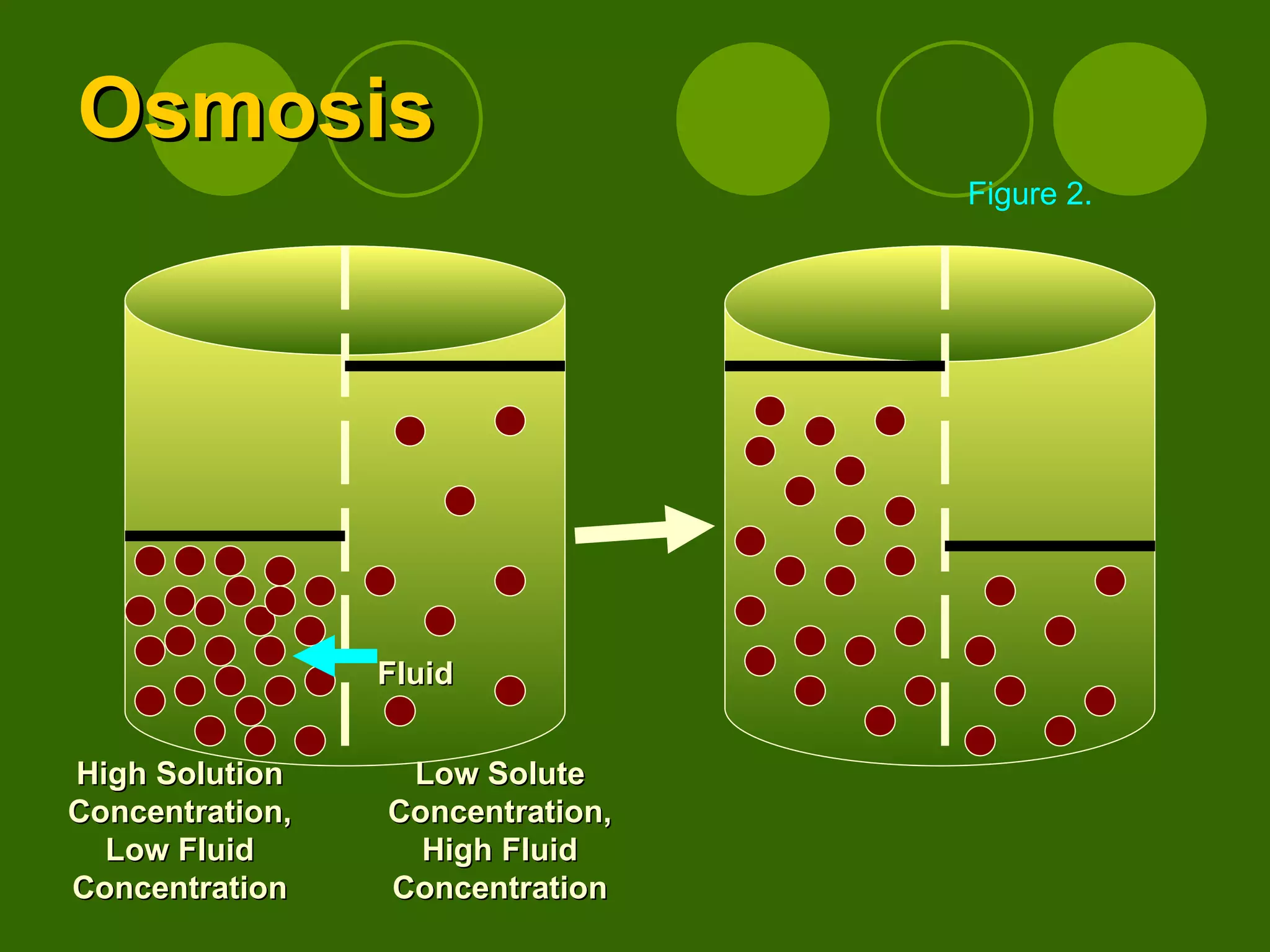
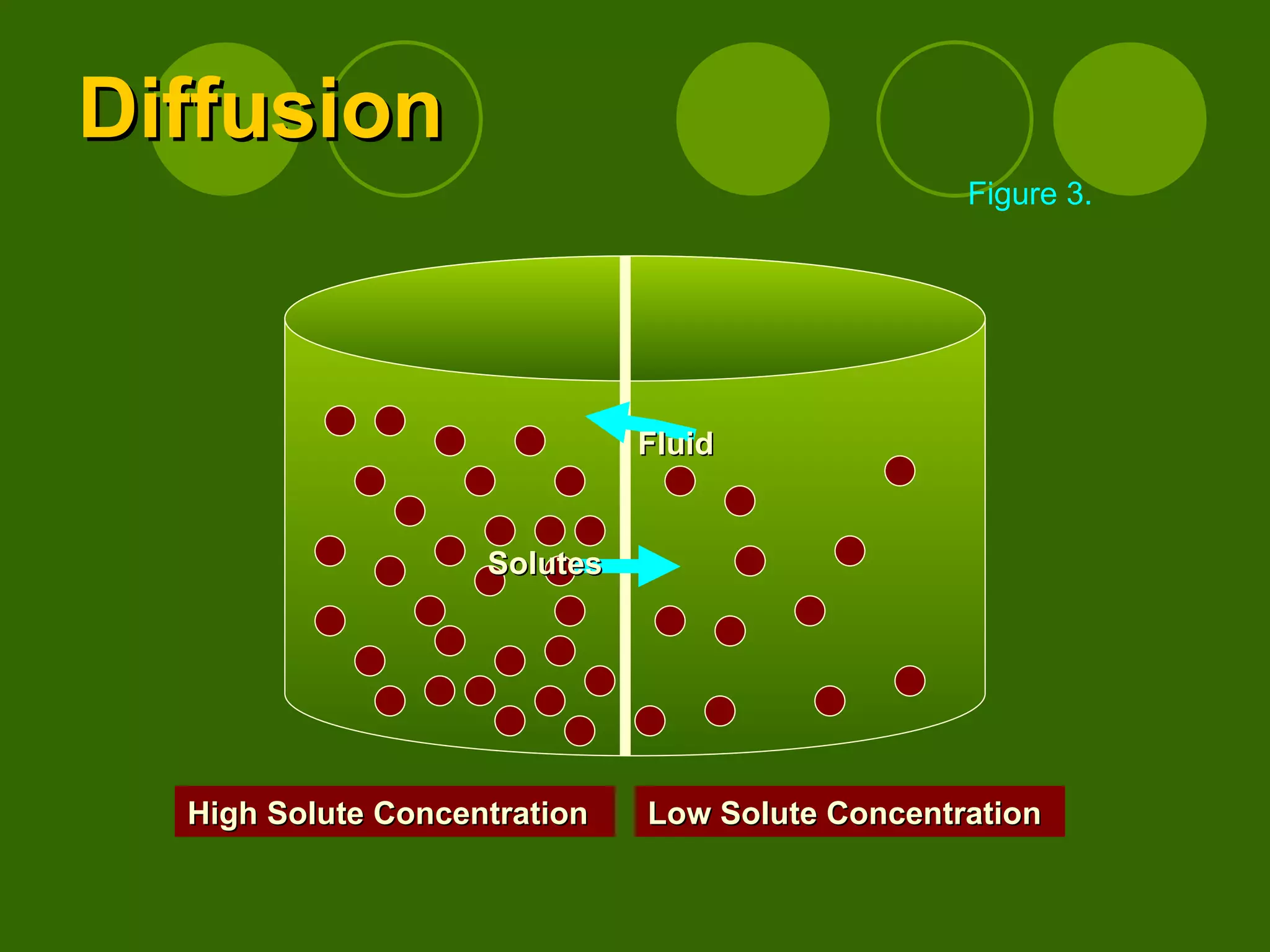
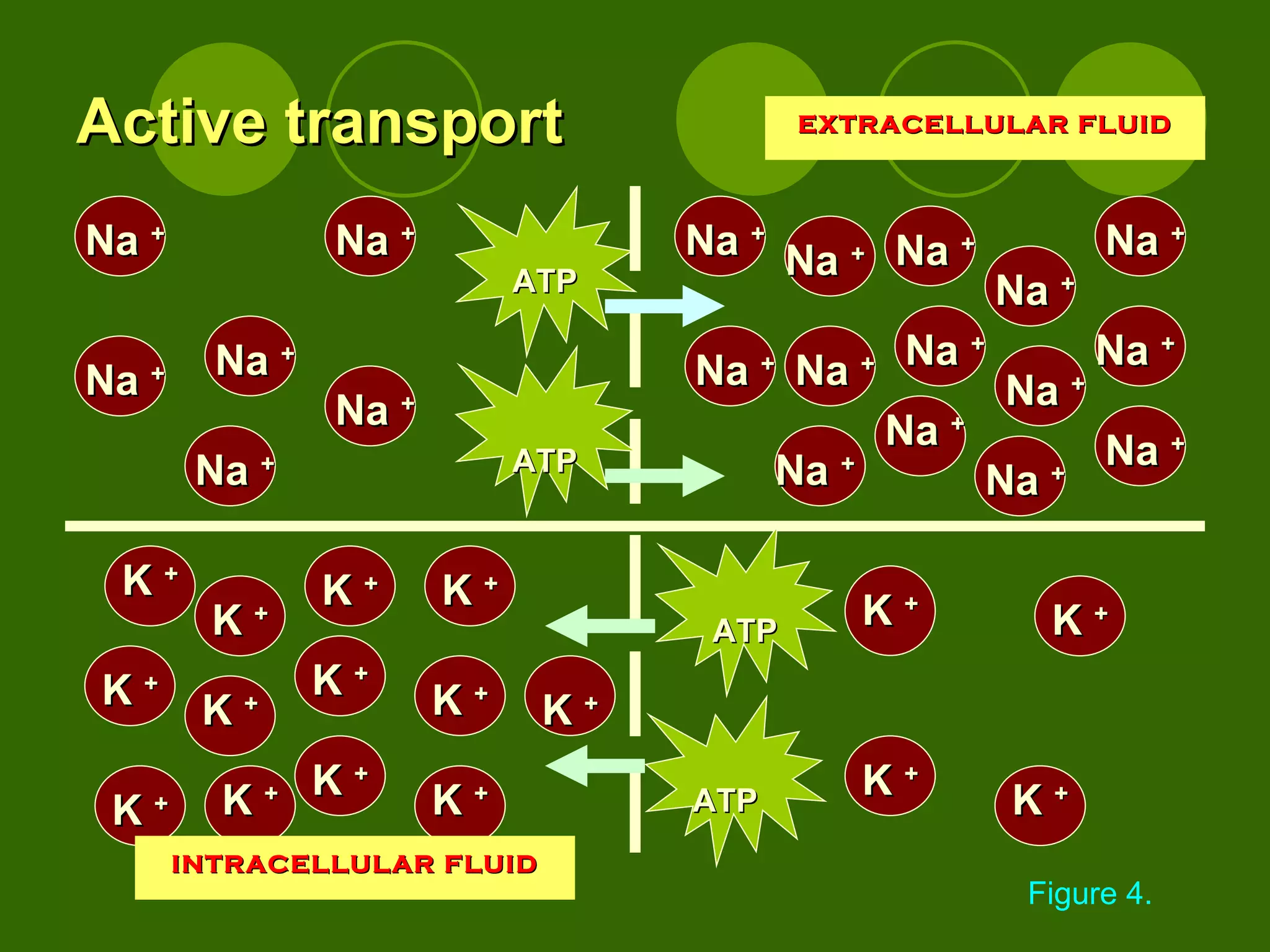
Definition: Diffusion  is the natural tendency of a substance to move from an area of higher concentration to one of lower concentration. Osmosis  fluid shift to the membrane from the region of low concentration to the region of high concentration.  Active Transport  this is movement of molecules against a concentration as they move from an area of lower concentration to an area of higher concentration and requires an energy. Filtration  movement of water & solutes occurs from an area of high hydrostatic pressure to an area of low.
Osmosis Figure 2. Fluid High Solution Concentration, Low Fluid Concentration Low Solute Concentration, High Fluid Concentration
Diffusion High Solute Concentration Low Solute Concentration Fluid Solutes Figure 3.
Active transport K  + K  + K  + K  + K  + K  + K  + K  + K  + K  + K  + K  + K  + K  + K  + K  + K  + ATP ATP ATP ATP Na  + Na  + Na  + Na  + Na  + Na  + Na  + Na  + Na  + Na  + Na  + Na  + Na  + Na  + Na  + Na  + Na  + Na  + Na  + Na  + Figure 4. INTRACELLULAR FLUID EXTRACELLULAR FLUID
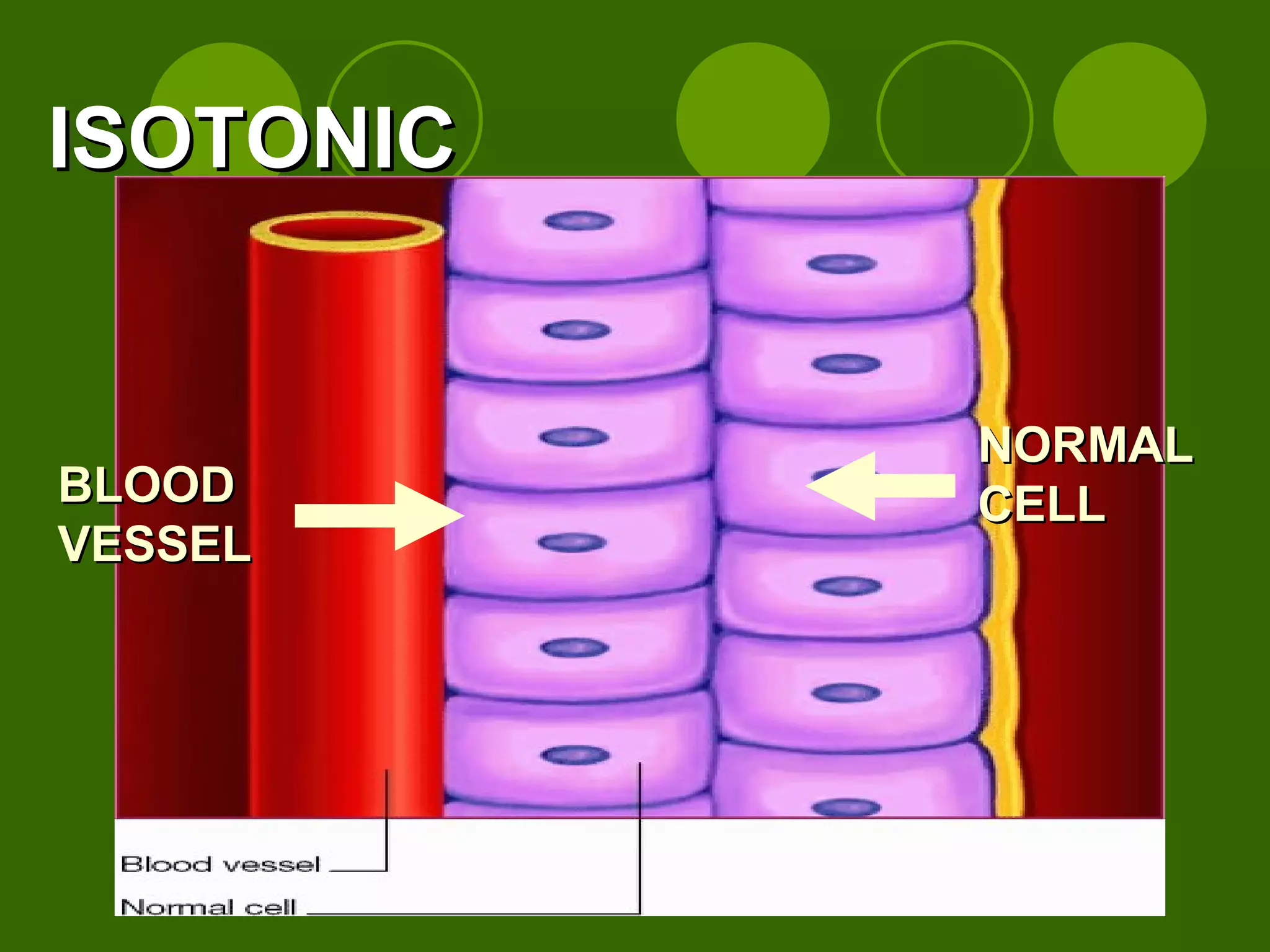
BLOOD VESSEL NORMAL CELL ISOTONIC
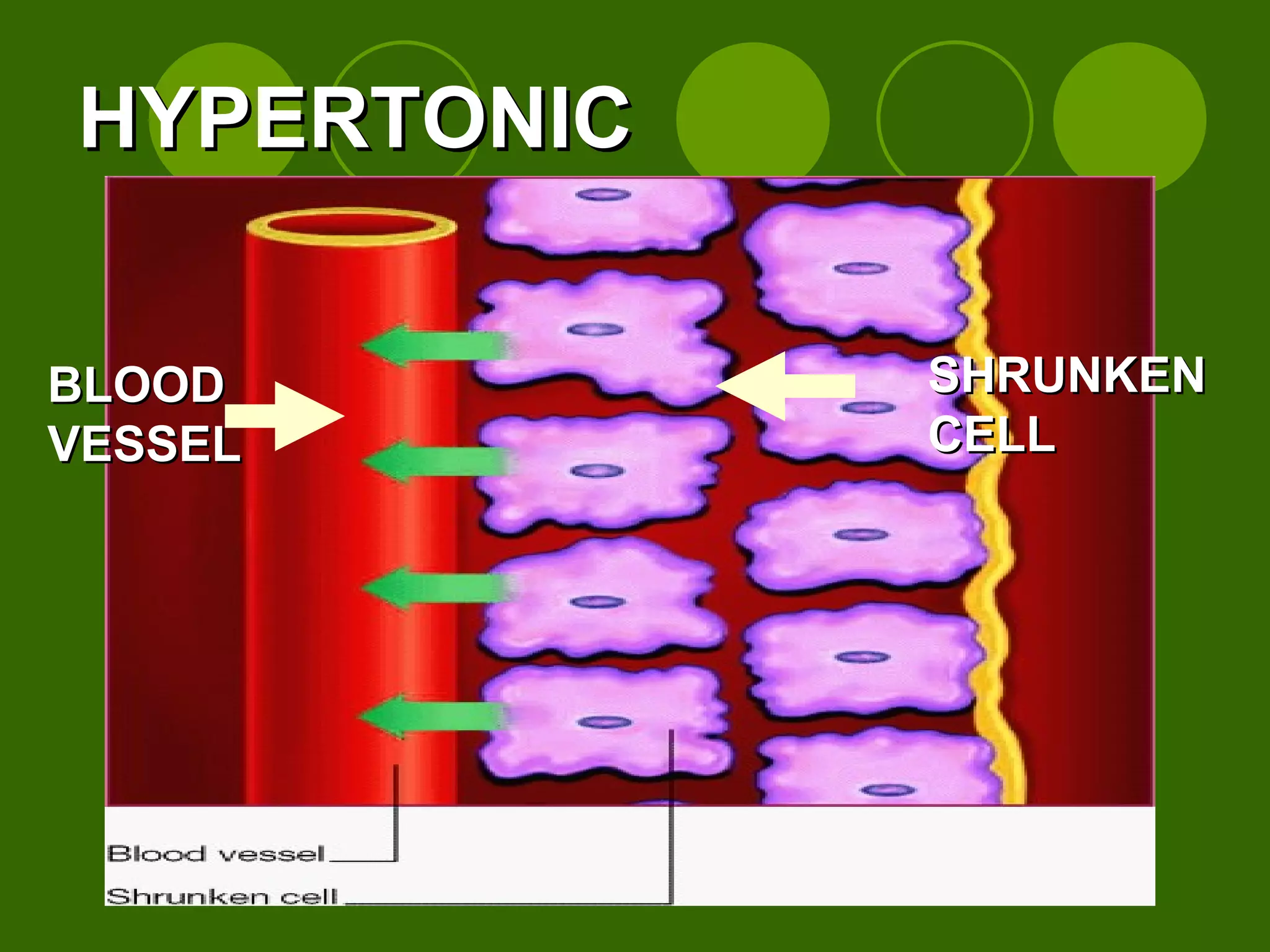
BLOOD VESSEL SHRUNKEN CELL HYPERTONIC
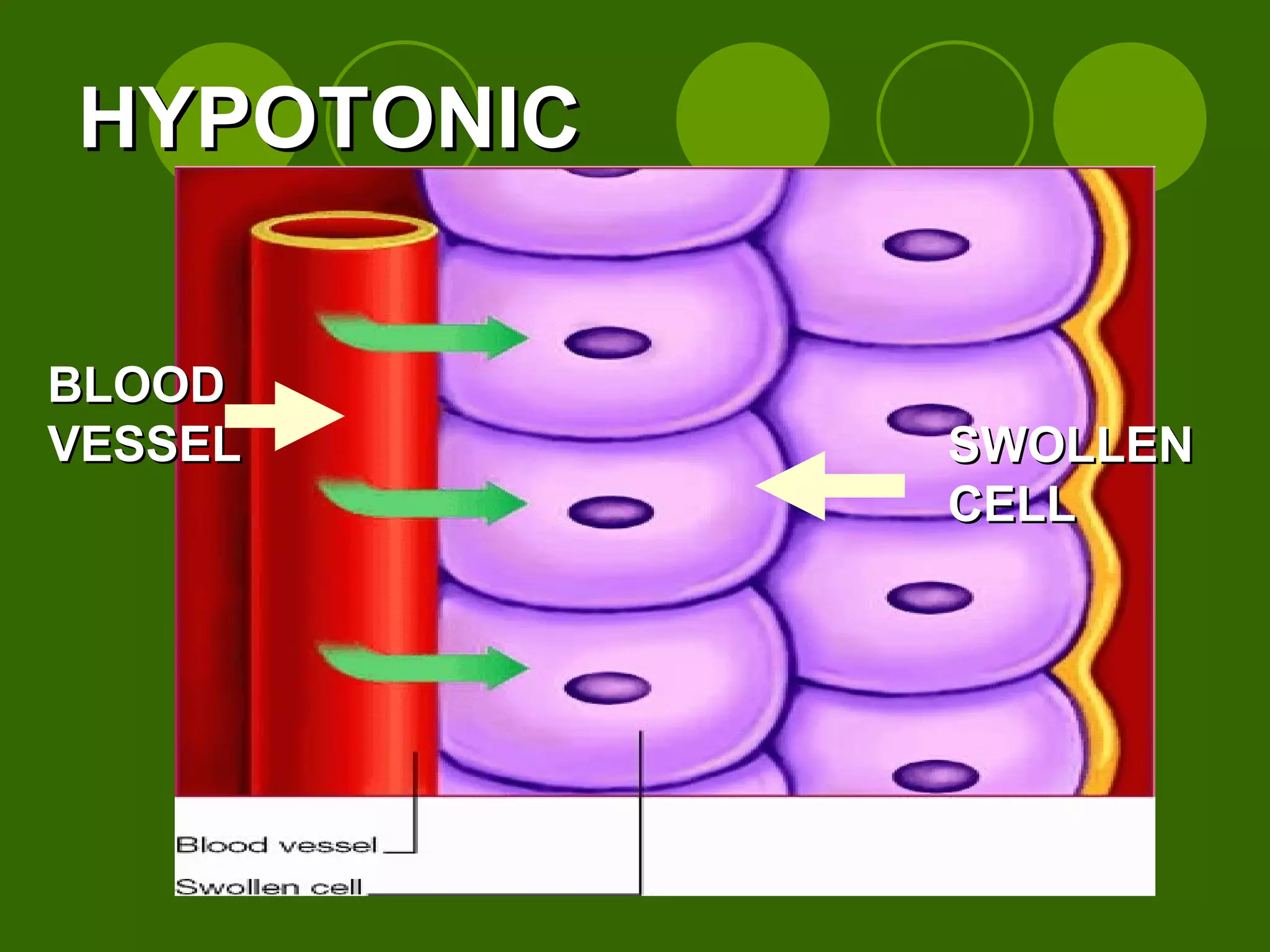
HYPOTONIC BLOOD VESSEL SWOLLEN CELL
Electrolytes Chemically, electrolytes are substances that become ions in solution & acquire the capacity to conduct electricity.  Essential for normal function of the cells & our organs. Sodium, Potassium, chloride, & Bicarbonate
Sodium (Na) 135 to 145 mEq/L (135-145 mmol/L) Major positive ion in fluid outside the cells. Regulates the total amount of water in the body & the transmission of into & out of  cells.
Potassium (K+) 3.5 to 5.0 mEq/L (3.5 to 5.0 mmol/L) Major positive ion found inside the cells. Regulation of the heartbeat & function of the muscles.
Chloride (Cl-) 98 to 108 mmol/L Major anion (negatively charged ion) found outside the cells & in the blood. Helping the body maintain a normal balance of fluids
Bicarbonate (HCO3) 22 to 30 mmol/L Acts a buffer to maintain the normal level of pH in the blood & other fluids in the body. Measured to monitor the acidity of the blood & body fluids.
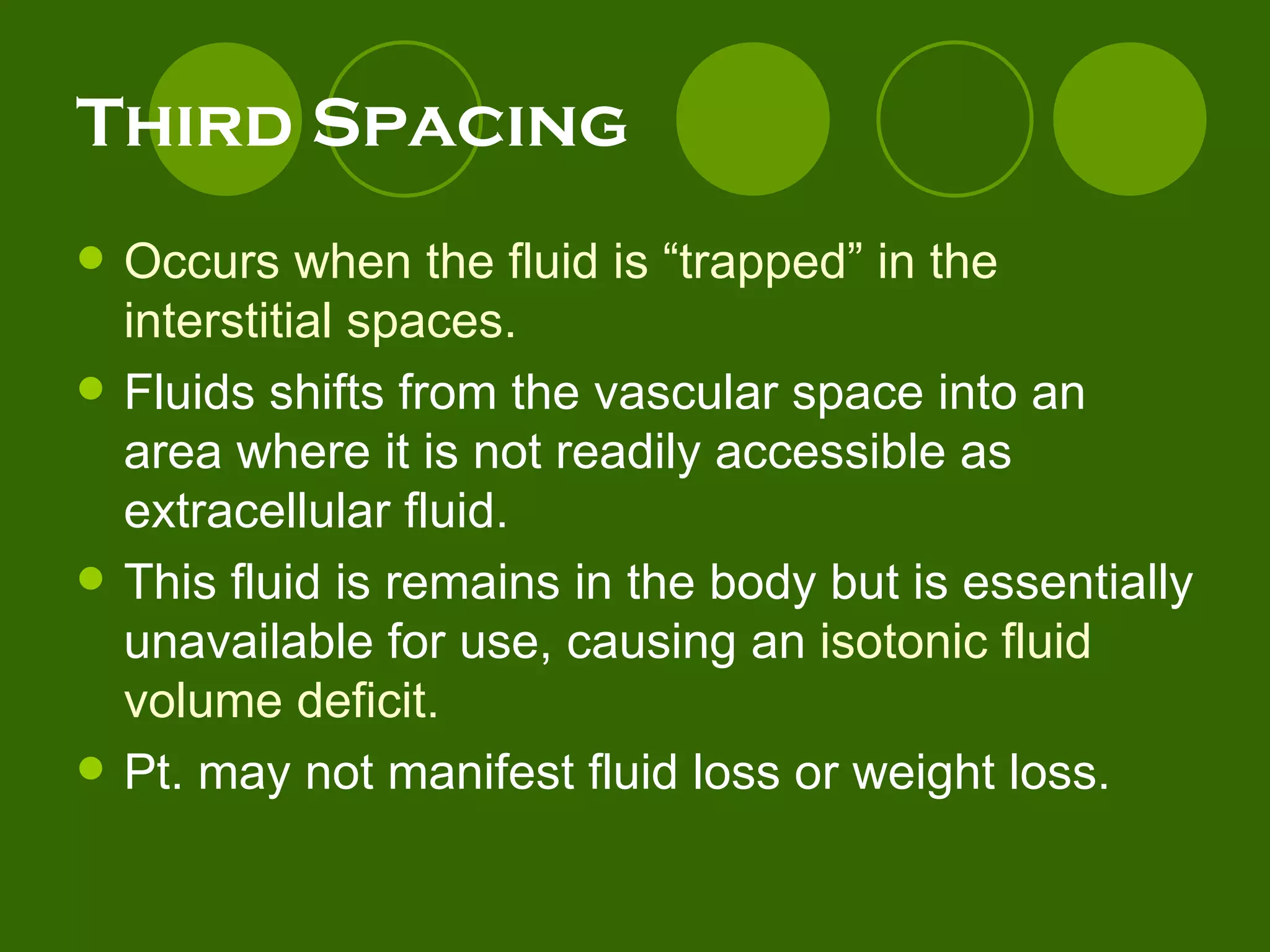
Third Spacing Occurs when the fluid is “trapped” in the interstitial spaces. Fluids shifts from the vascular space into an area where it is not readily accessible as extracellular fluid.  This fluid is remains in the body but is essentially unavailable for use, causing an  isotonic fluid volume deficit. Pt. may not manifest fluid loss or weight loss.
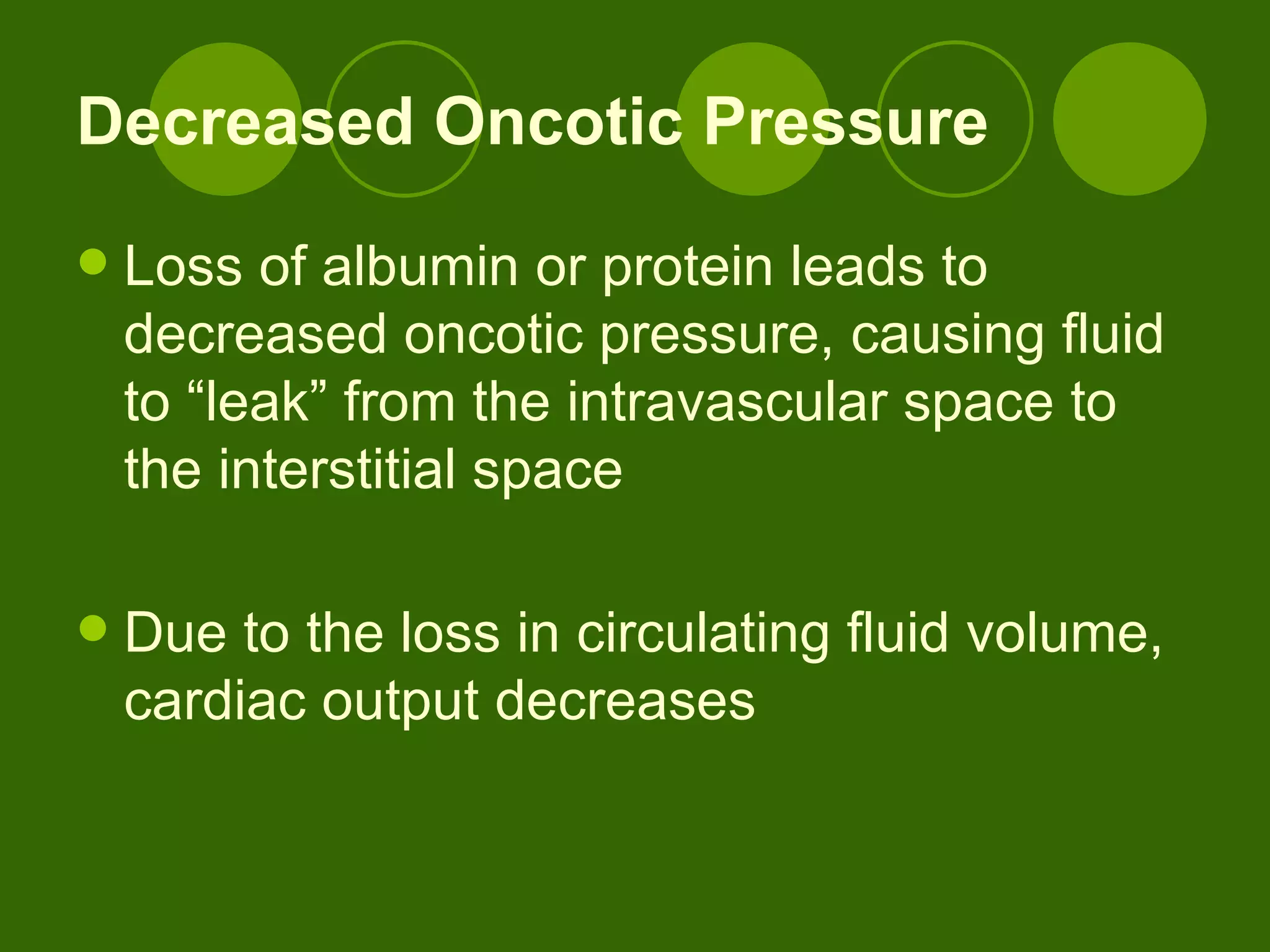
Decreased Oncotic Pressure Loss of albumin or protein leads to decreased oncotic pressure, causing fluid to “leak” from the intravascular space to the interstitial space Due to the loss in circulating fluid volume, cardiac output decreases
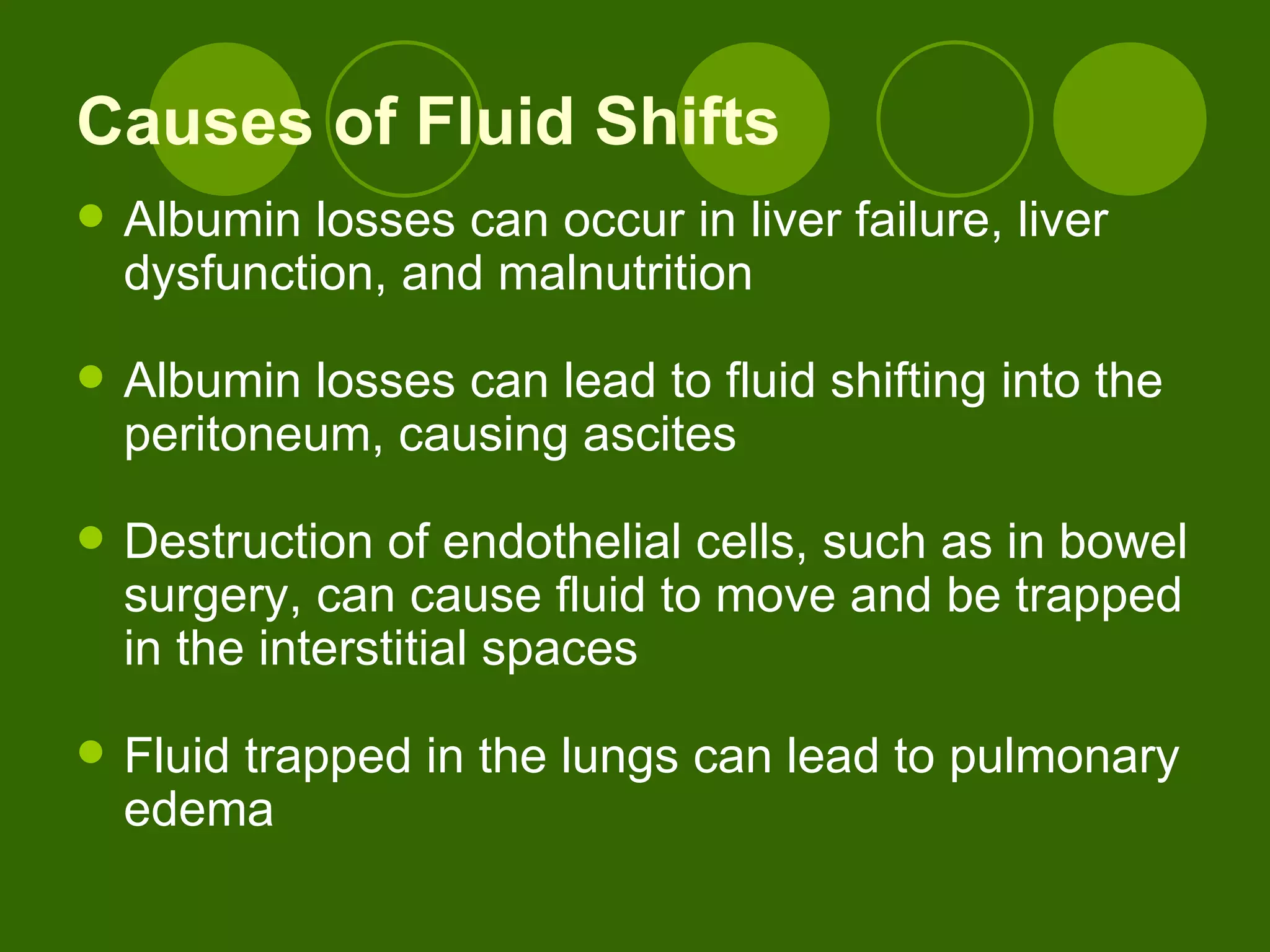
Causes of Fluid Shifts Albumin losses can occur in liver failure, liver dysfunction, and malnutrition Albumin losses can lead to fluid shifting into the peritoneum, causing ascites Destruction of endothelial cells, such as in bowel surgery, can cause fluid to move and be trapped in the interstitial spaces Fluid trapped in the lungs can lead to pulmonary edema
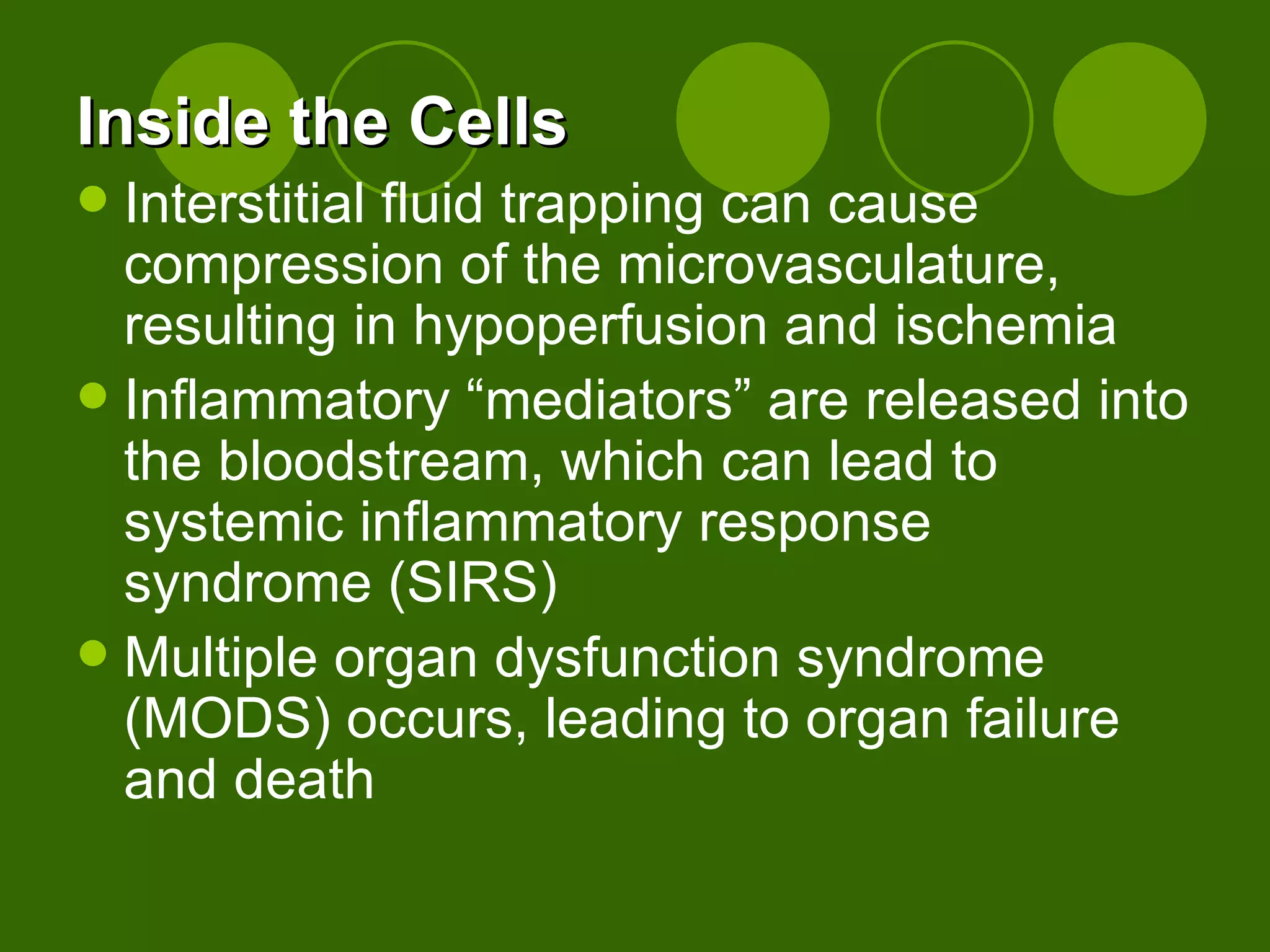
Inside the Cells Interstitial fluid trapping can cause compression of the microvasculature, resulting in hypoperfusion and ischemia Inflammatory “mediators” are released into the bloodstream, which can lead to systemic inflammatory response syndrome (SIRS) Multiple organ dysfunction syndrome (MODS) occurs, leading to organ failure and death
What Happens When Fluids Shift? With decreased circulating volume, baroreceptors in the aorta are activated Sympathetic nervous system releases epinephrine and norepinephrine, causing vasoconstriction and an increased heart rate Kidneys launch the renin-angiotensin-aldosterone system in response to a lower glomerular filtration rate All this happens with the goal of increasing circulating volume, blood pressure, and cardiac output
Fluid Shift in the Bowel Causes abdominal distention Measure bladder pressure and abdominal girth at least every 4 to 8 hours while signs are abnormal.
Monitoring the Patient Fluid shift will either resolve over the next several hours (up to 48 hours) or the patient will continue to develop bowel edema and, eventually, ischemia Closely monitor vital signs, urine output, peripheral perfusion, mental status, ventilation/perfusion status, hematocrit/hemoglobin, serum electrolytes (elevated lactate may indicate bowel ischemia)
Fluid Resuscitation Administer maintenance I.V. isotonic fluid plus intermittent colloids (i.e., albumin); pulls fluid from the interstitial spaces into the intravascular space Small dose of a loop diuretic, such as furosemide (Lasix) may be ordered if kidneys can’t get rid of the excess fluid  If hemoglobin is low, infuse blood products, such as packed red blood cells, as ordered to help increase oxygen and pull fluid from the interstitial space
EDEMA In fluid volume excess, both intravascular & interstitial spaces have an increased water & Na content. Excess interstitial fluid Most apparent areas where the tissue pressure is low like around the eye. Dependent tissues known as dependent edema , where hydrostatic capillary pressure is high.
3 MAIN MACHANISM OF EDEMA Increase capillary hydrostatic pressure Decrease plasma oncotic pressure Increase capillary permeability
Due to FVE that increase capillary hydrostatic pressure, pushing fluids into the interstitial tissues. This type of edema seen in dependent tissue such as feet, ankles, & sacrum. Low level of plasma proteins from malnutrition or liver or kidney disease can reduce the plasma oncotic pressure.  With tissue trauma & some disorders like allergic reactions, capillaries becomes more permeable, allowing fluid to escape into interstitial tissues.
Pitting Edema That leaves a small depression or pit after finger pressure is applied to the swollen area. The pit is caused by movement of fluid to adjacent tissue, away from the point of pressure. Within 10 to 30 seconds the pit normally disappears.
Magsukul

Fluid & Electrolytes Balance

  • 1.
    Overview of Fluids, Electrolytes Balance MOHAMMED ALHABSI INDANAN,RN Clinical Instructor King Abdul Aziz Specialist Hospital-Taif
  • 2.
    sketch out of my talks Concept of Fluid & Electrolyte Balance: Properties & components of Electrolytes Description & Measurement of Electrolytes Body Fluid Compartments Third Spacing Edema Description & Constituent of Body Fluids Body Fluid Transport Movement of Body Fluid Body Fluid Excretion
  • 3.
    Surah AL-MURSALAT (Those Sent Forth) ” ألم نخلقكم من ماء مهين“ سورة المرسلات آيه 20 “ Have We not created You from a fluid (Held) despicable?” Holy Qur’an
  • 4.
    Body Fluids BodyWater = 60% of a patient’s body weight 16% 4% 40% Figure 1-1
  • 5.
    Fluid Compartments Intracellularspace Extracellular space Interstitial Intravascular
  • 6.
    Solute the substancethat dissolved Solvent substance in which solute is dissolved Osmolality concentration of solute per kg of water Osmolarity concentration of solute per L of solution Solution - substance that dissolve in other substances
  • 7.
    Composition of theBody Fluids The fluids circulating throughout the body in ECF & ICF spaces contain: Electrolytes Minerals Cells
  • 8.
    Movement of BODYFLUIDS Diffusion Osmosis Active Transport Filtration
  • 9.
    Definition: Diffusion is the natural tendency of a substance to move from an area of higher concentration to one of lower concentration. Osmosis fluid shift to the membrane from the region of low concentration to the region of high concentration. Active Transport this is movement of molecules against a concentration as they move from an area of lower concentration to an area of higher concentration and requires an energy. Filtration movement of water & solutes occurs from an area of high hydrostatic pressure to an area of low.
  • 10.
    Osmosis Figure 2.Fluid High Solution Concentration, Low Fluid Concentration Low Solute Concentration, High Fluid Concentration
  • 11.
    Diffusion High SoluteConcentration Low Solute Concentration Fluid Solutes Figure 3.
  • 12.
    Active transport K + K + K + K + K + K + K + K + K + K + K + K + K + K + K + K + K + ATP ATP ATP ATP Na + Na + Na + Na + Na + Na + Na + Na + Na + Na + Na + Na + Na + Na + Na + Na + Na + Na + Na + Na + Figure 4. INTRACELLULAR FLUID EXTRACELLULAR FLUID
  • 13.
    BLOOD VESSEL NORMALCELL ISOTONIC
  • 14.
    BLOOD VESSEL SHRUNKENCELL HYPERTONIC
  • 15.
  • 16.
    Electrolytes Chemically, electrolytesare substances that become ions in solution & acquire the capacity to conduct electricity. Essential for normal function of the cells & our organs. Sodium, Potassium, chloride, & Bicarbonate
  • 17.
    Sodium (Na) 135to 145 mEq/L (135-145 mmol/L) Major positive ion in fluid outside the cells. Regulates the total amount of water in the body & the transmission of into & out of cells.
  • 18.
    Potassium (K+) 3.5to 5.0 mEq/L (3.5 to 5.0 mmol/L) Major positive ion found inside the cells. Regulation of the heartbeat & function of the muscles.
  • 19.
    Chloride (Cl-) 98to 108 mmol/L Major anion (negatively charged ion) found outside the cells & in the blood. Helping the body maintain a normal balance of fluids
  • 20.
    Bicarbonate (HCO3) 22to 30 mmol/L Acts a buffer to maintain the normal level of pH in the blood & other fluids in the body. Measured to monitor the acidity of the blood & body fluids.
  • 21.
    Third Spacing Occurswhen the fluid is “trapped” in the interstitial spaces. Fluids shifts from the vascular space into an area where it is not readily accessible as extracellular fluid. This fluid is remains in the body but is essentially unavailable for use, causing an isotonic fluid volume deficit. Pt. may not manifest fluid loss or weight loss.
  • 22.
    Decreased Oncotic PressureLoss of albumin or protein leads to decreased oncotic pressure, causing fluid to “leak” from the intravascular space to the interstitial space Due to the loss in circulating fluid volume, cardiac output decreases
  • 23.
    Causes of FluidShifts Albumin losses can occur in liver failure, liver dysfunction, and malnutrition Albumin losses can lead to fluid shifting into the peritoneum, causing ascites Destruction of endothelial cells, such as in bowel surgery, can cause fluid to move and be trapped in the interstitial spaces Fluid trapped in the lungs can lead to pulmonary edema
  • 24.
    Inside the CellsInterstitial fluid trapping can cause compression of the microvasculature, resulting in hypoperfusion and ischemia Inflammatory “mediators” are released into the bloodstream, which can lead to systemic inflammatory response syndrome (SIRS) Multiple organ dysfunction syndrome (MODS) occurs, leading to organ failure and death
  • 25.
    What Happens WhenFluids Shift? With decreased circulating volume, baroreceptors in the aorta are activated Sympathetic nervous system releases epinephrine and norepinephrine, causing vasoconstriction and an increased heart rate Kidneys launch the renin-angiotensin-aldosterone system in response to a lower glomerular filtration rate All this happens with the goal of increasing circulating volume, blood pressure, and cardiac output
  • 26.
    Fluid Shift inthe Bowel Causes abdominal distention Measure bladder pressure and abdominal girth at least every 4 to 8 hours while signs are abnormal.
  • 27.
    Monitoring the PatientFluid shift will either resolve over the next several hours (up to 48 hours) or the patient will continue to develop bowel edema and, eventually, ischemia Closely monitor vital signs, urine output, peripheral perfusion, mental status, ventilation/perfusion status, hematocrit/hemoglobin, serum electrolytes (elevated lactate may indicate bowel ischemia)
  • 28.
    Fluid Resuscitation Administermaintenance I.V. isotonic fluid plus intermittent colloids (i.e., albumin); pulls fluid from the interstitial spaces into the intravascular space Small dose of a loop diuretic, such as furosemide (Lasix) may be ordered if kidneys can’t get rid of the excess fluid If hemoglobin is low, infuse blood products, such as packed red blood cells, as ordered to help increase oxygen and pull fluid from the interstitial space
  • 29.
    EDEMA In fluidvolume excess, both intravascular & interstitial spaces have an increased water & Na content. Excess interstitial fluid Most apparent areas where the tissue pressure is low like around the eye. Dependent tissues known as dependent edema , where hydrostatic capillary pressure is high.
  • 30.
    3 MAIN MACHANISMOF EDEMA Increase capillary hydrostatic pressure Decrease plasma oncotic pressure Increase capillary permeability
  • 31.
    Due to FVEthat increase capillary hydrostatic pressure, pushing fluids into the interstitial tissues. This type of edema seen in dependent tissue such as feet, ankles, & sacrum. Low level of plasma proteins from malnutrition or liver or kidney disease can reduce the plasma oncotic pressure. With tissue trauma & some disorders like allergic reactions, capillaries becomes more permeable, allowing fluid to escape into interstitial tissues.
  • 32.
    Pitting Edema Thatleaves a small depression or pit after finger pressure is applied to the swollen area. The pit is caused by movement of fluid to adjacent tissue, away from the point of pressure. Within 10 to 30 seconds the pit normally disappears.
  • 33.