Fluid & electrolyte imbalance
Sodium, Potassium, Calcium
Water distribution
 Water constitutes
 60% total body weight
 40% intracellular (2/3rd
of total)
 20% extracellular (1/3rd
of total)
 15% interstitial (3/4th
of ECF)
 5% intravascular ( 1/4th
of ECF)
 Major electrolytes
 Extracellular- Na, Cl, HCO3
 Intracellular- K, Mg, Ca, proteins
 ICF & ECF are in osmotic equilibrium
 Water follows sodium
Electrolytes
 Help maintain homeostasis
 Regulate
 Cardiac & neurological function
 Oxygen delivery
 Acid-base balance etc.
 Common etiology
 Increased or decreased ingestion
 Increased or decreased excretion
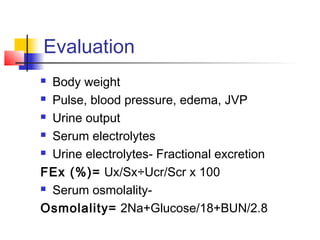
Evaluation
 Body weight
 Pulse, blood pressure, edema, JVP
 Urine output
 Serum electrolytes
 Urine electrolytes- Fractional excretion
FEx (%)= Ux/Sx÷Ucr/Scr x 100
 Serum osmolality-
Osmolality= 2Na+Glucose/18+BUN/2.8
Na & water homeostasis
 Blood osmolality-
 Osmoreceptors in hypothalamus- control thirst
 Release of AVP from hypothalamus/pituitary- acts on
V1 receptor- on vascular smooth muscle cells
V2 receptors- in collecting duct- water reabsorption
 Blood pressure & volume-
 Decrease- JG apparatus in kidney- releases renin, that leads to
production of angiotensin II- vasoconstriction, aldosterone
release (Na reabsorption), cardiac contractility, stimulates thirst
 Increase- ANP/BNP- act on kidneys to reduce renin /AT-II-
cause vasodilation & inhibit aldosterone release
Hyponatremia
 Serum Na < 135 mEq/l.
 Mostly due to abnormal water handling,
causing defective urinary dilution
 Basic causes-
 Unregulated release of ADH
 Reduced GFR
 Impaired tubular reabsorption/transport/permeability
Causes
 Isotonic (280-295)- severe hyperlipidemia or
hyperproteinemia
 Hypertonic (>295)- hyperglycemia, mannitol
 Hypotonic (<280)-
 Hypervolemic- CHF, CLD, CRF/NS
 Euvolemic- SIADH, thyroid/cortisol deficiency, postoperative,
marked free water intake (beer/psychogenic)
 Hypovolemic-
 Extrarenal loss- UNa<10- diarrhea/vomiting, sweating/burn
 Renal loss- UNa>20- diuretics, renal disease, mineralocorticoid
deficiency/Addison’s disease, cerebral salt wasting
Evaluation
 Symptoms of hyponatremia
 Primarily CNS
 Related to severity & rapidity
 History- to elicit cause
 Examination- for volume status
 Investigation
 Serum & urine electrolytes
 Serum & urine osmolality
Treatment
 Water restriction, loop diuretics, oral salt in
hypervolemic hyponatremia
 Normal saline- 0.9%- in hypovolemic hyponatremia
 Vasopressin antagonists- Vaptans-
for hyper/euvolemic hyponatremia
 Correction depends on severity & rapidity of
hyponatremia
 If severe/rapid, 3% hypertonic saline
 Rate of correction- 0.5-1 mEq/L/Hr
 Rapid correction may cause CPM or
osmotic demyelination syndrome characterized by
flaccid paralysis, dysarthria, dysphagia
Hypernatremia
>145 mEq/L
Caused by a relative deficit of free water
Primary defense- thirst
Causes
 Hypovolemic- Uosm.>400
 Inadequate intake of water
 Extreme sweating
 DM, osmotic diuretics
 Severe watery diarrhea
 Euvolemic- Uosm.<250
 Diabetes insipidus- central or nephrogenic
 Hypervolemic- mild

Mineralocorticoid excess- Conn’s or Cushing’s
Management
 Symptoms-
 Lethargy, irritability, seizures, coma
 Examination- volume status
 Investigation- S & U- elec. & osm.
 Treatment- free water- oral /IV
 Rate of correction- ~1 mEq/L/hr.
Hypokalemia
<3.5 mEq/L
Aldosterone- facilitates K excretion at
distal renal tubules
Most important regulator of K
Causes
 Inadequate intake
 GI loss
 Renal-
 Diuretics- thiazides, loop diuretics, Amphotericin, Cisplatin
 Excessive mineralo/glucocorticoids
 Tubular defect- RTA type I/II
 Low Mg
 Intracellular shift-
 Alkalosis
 Insulin
 Periodic paralysis
Evaluation
 Symptoms-
 Muscular weakness, myalgia, cramps, constipation
 Flaccid paralysis, hyporeflexia, tetany
 Rhabdomyolysis, respiratory depression
 Serum K
 Urine K- >40 with urinary loss &
<20 with extrarenal loss
 ECG changes-
 Flat T-wave, U-wave, prolonged QT-interval
 Arrythmias
Treatment
 Address the cause
 Deficit- 4-5 mEq/kg for each 1 mEq/L
decrease in serum K
 Mild deficiency- oral K
 IV K- 40 mEq/L @ 40 mEq/L/h max.
 K sparing diuretics- Spironolactone
 Correct Mg deficit
 Frequent K monitoring
Hyperkalemia
>5 mEq/L
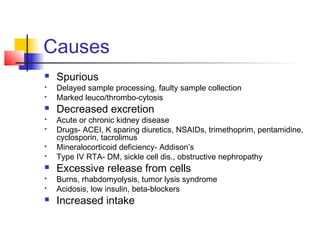
Causes
 Spurious
 Delayed sample processing, faulty sample collection
 Marked leuco/thrombo-cytosis
 Decreased excretion
 Acute or chronic kidney disease
 Drugs- ACEI, K sparing diuretics, NSAIDs, trimethoprim, pentamidine,
cyclosporin, tacrolimus
 Mineralocorticoid deficiency- Addison’s
 Type IV RTA- DM, sickle cell dis., obstructive nephropathy
 Excessive release from cells
 Burns, rhabdomyolysis, tumor lysis syndrome
 Acidosis, low insulin, beta-blockers
 Increased intake
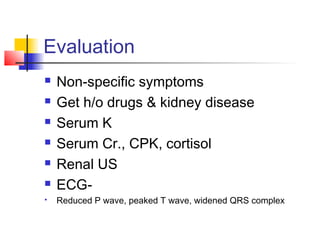
Evaluation
 Non-specific symptoms
 Get h/o drugs & kidney disease
 Serum K
 Serum Cr., CPK, cortisol
 Renal US
 ECG-
 Reduced P wave, peaked T wave, widened QRS complex
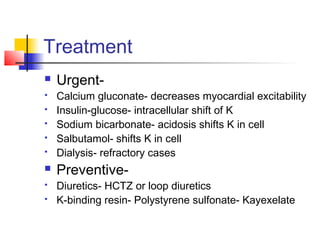
Treatment
 Urgent-
 Calcium gluconate- decreases myocardial excitability
 Insulin-glucose- intracellular shift of K
 Sodium bicarbonate- acidosis shifts K in cell
 Salbutamol- shifts K in cell
 Dialysis- refractory cases
 Preventive-
 Diuretics- HCTZ or loop diuretics
 K-binding resin- Polystyrene sulfonate- Kayexelate
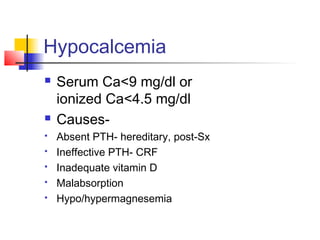
Hypocalcemia
 Serum Ca<9 mg/dl or
ionized Ca<4.5 mg/dl
 Causes-
 Absent PTH- hereditary, post-Sx
 Ineffective PTH- CRF
 Inadequate vitamin D
 Malabsorption
 Hypo/hypermagnesemia
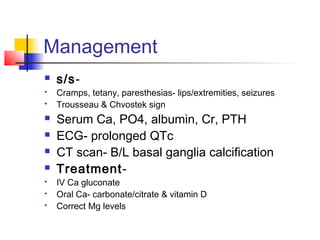
Management
 s/s-
 Cramps, tetany, paresthesias- lips/extremities, seizures
 Trousseau & Chvostek sign
 Serum Ca, PO4, albumin, Cr, PTH
 ECG- prolonged QTc
 CT scan- B/L basal ganglia calcification
 Treatment-
 IV Ca gluconate
 Oral Ca- carbonate/citrate & vitamin D
 Correct Mg levels
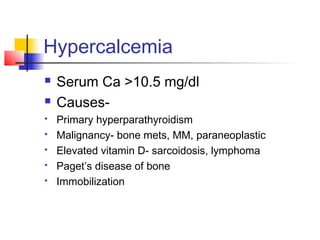
Hypercalcemia
 Serum Ca >10.5 mg/dl
 Causes-
 Primary hyperparathyroidism
 Malignancy- bone mets, MM, paraneoplastic
 Elevated vitamin D- sarcoidosis, lymphoma
 Paget’s disease of bone
 Immobilization
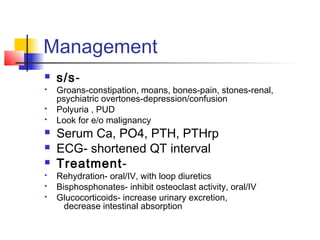
Management
 s/s-
 Groans-constipation, moans, bones-pain, stones-renal,
psychiatric overtones-depression/confusion
 Polyuria , PUD
 Look for e/o malignancy
 Serum Ca, PO4, PTH, PTHrp
 ECG- shortened QT interval
 Treatment-
 Rehydration- oral/IV, with loop diuretics
 Bisphosphonates- inhibit osteoclast activity, oral/IV
 Glucocorticoids- increase urinary excretion,
decrease intestinal absorption

Fluid & electrolyte imbalance

  • 1.
    Fluid & electrolyteimbalance Sodium, Potassium, Calcium
  • 2.
    Water distribution  Waterconstitutes  60% total body weight  40% intracellular (2/3rd of total)  20% extracellular (1/3rd of total)  15% interstitial (3/4th of ECF)  5% intravascular ( 1/4th of ECF)  Major electrolytes  Extracellular- Na, Cl, HCO3  Intracellular- K, Mg, Ca, proteins  ICF & ECF are in osmotic equilibrium  Water follows sodium
  • 3.
    Electrolytes  Help maintainhomeostasis  Regulate  Cardiac & neurological function  Oxygen delivery  Acid-base balance etc.  Common etiology  Increased or decreased ingestion  Increased or decreased excretion
  • 4.
    Evaluation  Body weight Pulse, blood pressure, edema, JVP  Urine output  Serum electrolytes  Urine electrolytes- Fractional excretion FEx (%)= Ux/Sx÷Ucr/Scr x 100  Serum osmolality- Osmolality= 2Na+Glucose/18+BUN/2.8
  • 5.
    Na & waterhomeostasis  Blood osmolality-  Osmoreceptors in hypothalamus- control thirst  Release of AVP from hypothalamus/pituitary- acts on V1 receptor- on vascular smooth muscle cells V2 receptors- in collecting duct- water reabsorption  Blood pressure & volume-  Decrease- JG apparatus in kidney- releases renin, that leads to production of angiotensin II- vasoconstriction, aldosterone release (Na reabsorption), cardiac contractility, stimulates thirst  Increase- ANP/BNP- act on kidneys to reduce renin /AT-II- cause vasodilation & inhibit aldosterone release
  • 6.
    Hyponatremia  Serum Na< 135 mEq/l.  Mostly due to abnormal water handling, causing defective urinary dilution  Basic causes-  Unregulated release of ADH  Reduced GFR  Impaired tubular reabsorption/transport/permeability
  • 7.
    Causes  Isotonic (280-295)-severe hyperlipidemia or hyperproteinemia  Hypertonic (>295)- hyperglycemia, mannitol  Hypotonic (<280)-  Hypervolemic- CHF, CLD, CRF/NS  Euvolemic- SIADH, thyroid/cortisol deficiency, postoperative, marked free water intake (beer/psychogenic)  Hypovolemic-  Extrarenal loss- UNa<10- diarrhea/vomiting, sweating/burn  Renal loss- UNa>20- diuretics, renal disease, mineralocorticoid deficiency/Addison’s disease, cerebral salt wasting
  • 8.
    Evaluation  Symptoms ofhyponatremia  Primarily CNS  Related to severity & rapidity  History- to elicit cause  Examination- for volume status  Investigation  Serum & urine electrolytes  Serum & urine osmolality
  • 9.
    Treatment  Water restriction,loop diuretics, oral salt in hypervolemic hyponatremia  Normal saline- 0.9%- in hypovolemic hyponatremia  Vasopressin antagonists- Vaptans- for hyper/euvolemic hyponatremia  Correction depends on severity & rapidity of hyponatremia  If severe/rapid, 3% hypertonic saline  Rate of correction- 0.5-1 mEq/L/Hr  Rapid correction may cause CPM or osmotic demyelination syndrome characterized by flaccid paralysis, dysarthria, dysphagia
  • 10.
    Hypernatremia >145 mEq/L Caused bya relative deficit of free water Primary defense- thirst
  • 11.
    Causes  Hypovolemic- Uosm.>400 Inadequate intake of water  Extreme sweating  DM, osmotic diuretics  Severe watery diarrhea  Euvolemic- Uosm.<250  Diabetes insipidus- central or nephrogenic  Hypervolemic- mild  Mineralocorticoid excess- Conn’s or Cushing’s
  • 12.
    Management  Symptoms-  Lethargy,irritability, seizures, coma  Examination- volume status  Investigation- S & U- elec. & osm.  Treatment- free water- oral /IV  Rate of correction- ~1 mEq/L/hr.
  • 13.
    Hypokalemia <3.5 mEq/L Aldosterone- facilitatesK excretion at distal renal tubules Most important regulator of K
  • 14.
    Causes  Inadequate intake GI loss  Renal-  Diuretics- thiazides, loop diuretics, Amphotericin, Cisplatin  Excessive mineralo/glucocorticoids  Tubular defect- RTA type I/II  Low Mg  Intracellular shift-  Alkalosis  Insulin  Periodic paralysis
  • 15.
    Evaluation  Symptoms-  Muscularweakness, myalgia, cramps, constipation  Flaccid paralysis, hyporeflexia, tetany  Rhabdomyolysis, respiratory depression  Serum K  Urine K- >40 with urinary loss & <20 with extrarenal loss  ECG changes-  Flat T-wave, U-wave, prolonged QT-interval  Arrythmias
  • 16.
    Treatment  Address thecause  Deficit- 4-5 mEq/kg for each 1 mEq/L decrease in serum K  Mild deficiency- oral K  IV K- 40 mEq/L @ 40 mEq/L/h max.  K sparing diuretics- Spironolactone  Correct Mg deficit  Frequent K monitoring
  • 17.
  • 18.
    Causes  Spurious  Delayedsample processing, faulty sample collection  Marked leuco/thrombo-cytosis  Decreased excretion  Acute or chronic kidney disease  Drugs- ACEI, K sparing diuretics, NSAIDs, trimethoprim, pentamidine, cyclosporin, tacrolimus  Mineralocorticoid deficiency- Addison’s  Type IV RTA- DM, sickle cell dis., obstructive nephropathy  Excessive release from cells  Burns, rhabdomyolysis, tumor lysis syndrome  Acidosis, low insulin, beta-blockers  Increased intake
  • 19.
    Evaluation  Non-specific symptoms Get h/o drugs & kidney disease  Serum K  Serum Cr., CPK, cortisol  Renal US  ECG-  Reduced P wave, peaked T wave, widened QRS complex
  • 20.
    Treatment  Urgent-  Calciumgluconate- decreases myocardial excitability  Insulin-glucose- intracellular shift of K  Sodium bicarbonate- acidosis shifts K in cell  Salbutamol- shifts K in cell  Dialysis- refractory cases  Preventive-  Diuretics- HCTZ or loop diuretics  K-binding resin- Polystyrene sulfonate- Kayexelate
  • 21.
    Hypocalcemia  Serum Ca<9mg/dl or ionized Ca<4.5 mg/dl  Causes-  Absent PTH- hereditary, post-Sx  Ineffective PTH- CRF  Inadequate vitamin D  Malabsorption  Hypo/hypermagnesemia
  • 22.
    Management  s/s-  Cramps,tetany, paresthesias- lips/extremities, seizures  Trousseau & Chvostek sign  Serum Ca, PO4, albumin, Cr, PTH  ECG- prolonged QTc  CT scan- B/L basal ganglia calcification  Treatment-  IV Ca gluconate  Oral Ca- carbonate/citrate & vitamin D  Correct Mg levels
  • 23.
    Hypercalcemia  Serum Ca>10.5 mg/dl  Causes-  Primary hyperparathyroidism  Malignancy- bone mets, MM, paraneoplastic  Elevated vitamin D- sarcoidosis, lymphoma  Paget’s disease of bone  Immobilization
  • 24.
    Management  s/s-  Groans-constipation,moans, bones-pain, stones-renal, psychiatric overtones-depression/confusion  Polyuria , PUD  Look for e/o malignancy  Serum Ca, PO4, PTH, PTHrp  ECG- shortened QT interval  Treatment-  Rehydration- oral/IV, with loop diuretics  Bisphosphonates- inhibit osteoclast activity, oral/IV  Glucocorticoids- increase urinary excretion, decrease intestinal absorption