
B a l a n c e
cl-
Na+
H+
-
HCO
3
Mr. Abhay
Rajpoot
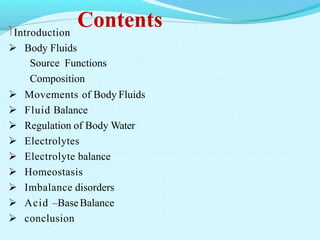
ContentsIntroduction
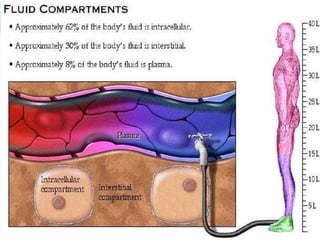
 Body Fluids
Source Functions
Composition
 Movements of Body Fluids
 Fluid Balance
 Regulation of Body Water
 Electrolytes
 Electrolyte balance
 Homeostasis
 Imbalance disorders
 Acid –BaseBalance
 conclusion
Introduction
 To achieve homeostasis, the body maintains strict control of
water and electrolyte distribution and of acid-base balance.
 This control is a function of the complex interplay of cellular
membrane forces, specific organ activities and systemic and
local hormone actions.
5
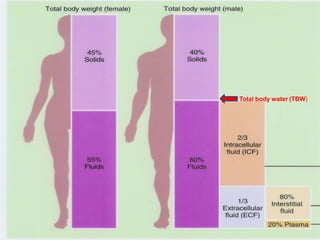
Total body water (TBW)
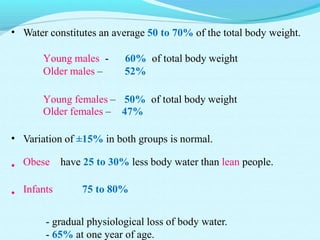
• Water constitutes an average 50 to 70% of the total body weight.
Young males - 60% of total body weight
Older males – 52%
Young females – 50% of total body weight
Older females – 47%
•
•
•
Variation of ±15% in both groups is normal.
Obese have 25 to 30% less body water than lean people.
Infants 75 to 80%
- gradual physiological loss of body water.
- 65% at one year of age.
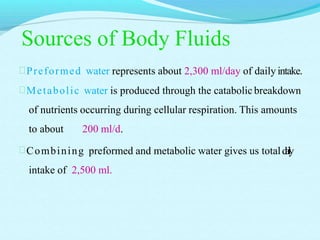
Sources of Body Fluids
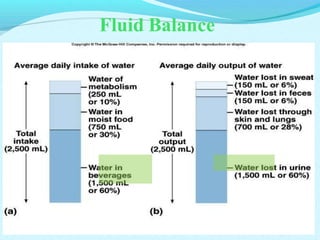
Preformed water represents about 2,300 ml/day of daily intake.
Metabolic water is produced through the catabolic breakdown
of nutrients occurring during cellular respiration. This amounts
to about 200 ml/d.
Combining preformed and metabolic water gives us totaldaily
intake of 2,500 ml.
Functions
All chemical reactions occur in liquid medium.
It is crucial in regulating chemical and bioelectrical
distributions within cells.
Transports substances such as hormones and nutrients.
1
2
3
4
5
6
7
O2 transport from lungs to body cells.
CO2 transport in the opposite direction.
Dilutes toxic substances and waste products and transports
them to the kidneys and the liver.
Distributes heat around the body.
Composition of Body Fluids




Nonelectrolytes include most organic molecules, do not dissociate in
water, and carry no net electrical charge.
Electrolytes dissociate in water to ions, and include inorganic salts,
acids and bases, and some proteins.
The major cation in extracellular fluids is sodium, and the major
anion is chloride; in intracellular fluid the major cation is potassium,
and the major anion is phosphate.
Electrolytes are the most abundant solutes in body fluids, but
proteins and some nonelectrolytes account for 60-–97% of dissolved
solutes.
Principles of Body Water Distribution



Body control systems regulate ingestion and excretion:
- constant total body water
- constant total body osmolarity
Homeostatic mechanisms respond to changes in ECF.
No receptors directly monitor fluid or electrolyte
balance.
- Respond to changes in plasma volume or osmotic
concentrations
Fluid Movements
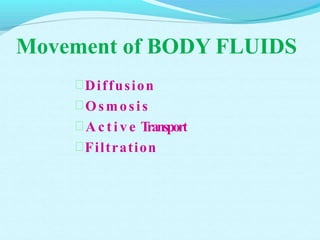
Movement of BODY FLUIDS
Diffusion
Osmosis
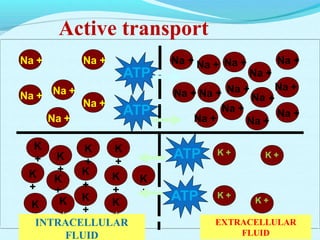
 A c t i v e Transport
Filtration
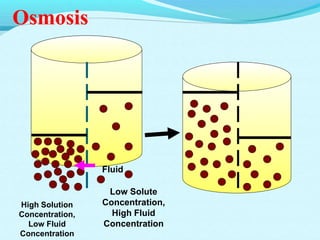
Osmosis
Fluid
High Solution
Concentration,
Low Fluid
Concentration
Low Solute
Concentration,
High Fluid
Concentration
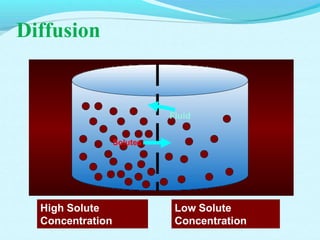
Diffusion
High Solute
Concentration
Low Solute
Concentration
Fluid
Solutes
Active transport
K +K
+
K
+
K
K
+
K
+
K
+
K
+
++ ++ ++
K
+
K
+
K
K
+
K
+
K
K +
K +
K +ATP
ATP
ATP
ATP Na +
Na +
Na +
Na +
Na +
+
Na +
Na + Na + Na +
Na
Na +
Na + Na + Na + Na +
Na +
Na +
Na +
Na +Na +
INTRACELLULAR
FLUID
EXTRACELLULAR
FLUID
Filtration
Filtration is the transport of water anddissolved
materials through a membrane from an area of higher pressure
to an area of lower pressure
Water —
 T w o liters of water per day are generally sufficient for adults.
 M o s t of this minimum intake is usually derived from the water
content of food and the water of oxidation, therefore.
 i t has been estimated that only 500ml of water needs be imbibed
given normal diet and no increased losses.
 T h e s e sources of water are markedly reduced in patients who
arenot eating and so must be replaced by maintenance fluids.
 w a t e r requirements increase with:
fever, sweating, burns, tachypnea, surgical
drains, polyuria, or ongoing significant
gastrointestinal losses.
23
Fluid Balance
Fluid Balance
The body tries to maintain homeostasis of fluids and
electrolytes by regulating:
Volumes
Solutecharge and osmotic load
Fluid balance
Normally, there is a balance achieved between our totaldaily
intake and output of water.
 To t a l fluid intake is modified by the induction of thesensation
of thirst.
 T h i s is produced by a reaction of cells in Hypothalamus
to theincreased osmotic pressure of the blood passing through
this region.
Another stimulus of thirst would be the degree ofdryness
of the oral mucosa.
Regulation of body water
Any of the following:
• Decreased amount of water in body
• Increased amount of Na+ in the body
• Increased blood osmolality
• Decreased circulating blood volume
Results in:
• Stimulation of osmoreceptors in hypothalamus
• Release of ADH from the posterior pituitary
• Increased thirst
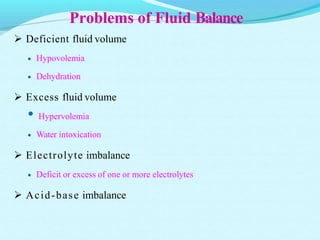
Problems of Fluid Balance
 Deficient fluid volume
 Hypovolemia
 Dehydration
 Excess fluid volume
• Hypervolemia
 Water intoxication
 Electrolyte imbalance
 Deficit or excess of one or more electrolytes
 Acid-base imbalance
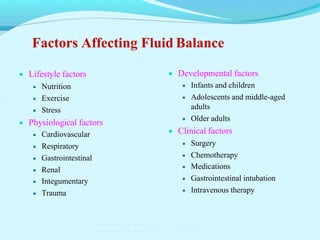
Factors Affecting Fluid Balance
 Lifestyle factors
 Nutrition
 Exercise
 Stress
 Physiological factors
 Cardiovascular
 Respiratory
 Gastrointestinal
 Renal
 Integumentary
 Trauma
 Developmental factors
 Infants and children
 Adolescents and middle-aged
adults
 Older adults
 Clinical factors
 Surgery
 Chemotherapy
 Medications
 Gastrointestinal intubation
 Intravenous therapy
Elsevier items and derived items © 2007 by Saunders,
an imprint of Elsevier Inc.
Electrolytes
33
Electrolyte balance
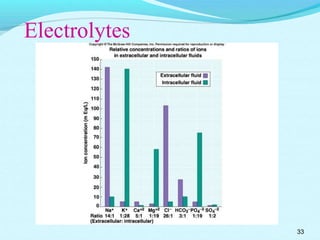
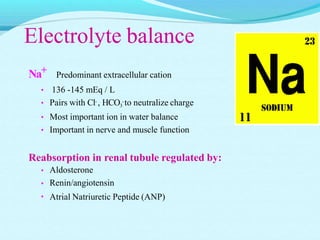
Na+ Predominant extracellular cation
• 136 -145 mEq / L
• Pairs with Cl- , HCO3
-to neutralize charge
• Most important ion in water balance
• Important in nerve and muscle function
Reabsorption in renal tubule regulated by:
•
•
•
Aldosterone
Renin/angiotensin
Atrial Natriuretic Peptide (ANP)
Electrolyte balance
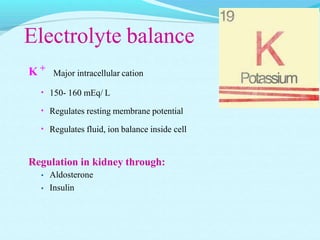
K +
Major intracellular cation
• 150- 160 mEq/ L
• Regulates resting membrane potential
• Regulates fluid, ion balance inside cell
Regulation in kidney through:
•
•
Aldosterone
Insulin
Electrolyte balance
Cl ˉ (Chloride)
•
•
•
• Major extracellular anion
105 mEq/ L
Regulates tonicity
Reabsorbed in the kidney with sodium
Regulation in kidney through:
•
•
Reabsorption with sodium
Reciprocal relationship with bicarbonate
SODIUM HOMEOSTASIS
 N o r m a l dietary intake is6-15g/day.
 S o d i u m is excreted in urine, stool, andsweat.
Urinary losses are tightly regulated by renalmechanisms.
Sodium abnormalities
Hypernatremia:
Defined as a serum sodium concentration thatexceeds
150mEq/L.
 A l w a y s accompanied byhyperosmolarity.
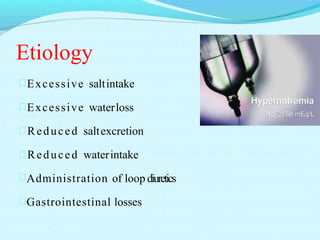
Etiology
Excessive saltintake
Excessive waterloss
Reduced saltexcretion
Reduced waterintake
Administration of loop diuretics
Gastrointestinal losses
Treatment:
Restore circulating volume with isotonic salinesolution
 A f t e r intravascular vol. correctionhypernatremia
is corrected using free water.
Hyponatremia
 Serum sodium concentration less than 135mEq/L .
 R e n a l losses caused by diuretic excess, osmotic diuresis, salt-
wasting nephropathy, adrenal insufficiency, proximal renal
tubular acidosis, metabolic alkalosis, and
pseudohypoaldosteronism result in a urine sodium concentration
greater than 20 mEq/L
Extrarenal losses caused by vomiting, diarrhea, sweat, and third
spacing result in a urine sodium concentration less than 20
mEq/L
Etiology
Excessive waterintake
Impaired renal waterexcretion
 L o s s of renal diluting capacity
Treatment of Hyponatremia
Correct serum Na by1mEq/L/hr
 U s e 3% saline in severe hyponatremia.
 G o a l is serum Na 130.
43
Hypochloremia
 M o s t commonly from gastric losses
 O f t e n presents as a contraction alkalosis with
paradoxical aciduria (Na+ retained and H+ wasted in the
kidney)
Treatment : resuscitation with normalsaline.
Hyperchloremia
 M o s t commonly from over-resuscitation with normal
saline.
 O f t e n presents as a hyperchloremic acidemia with
paradoxical alkaluria.
 R x : stop normal saline and replace with hypotonic
crystalloid.
Hypokalemia
 S e r u m K+< 3.5
mEq /L
Causes of Hypokalemia
Decreased intake ofK+
Increased K+loss
Chronic diuretics
 Severe vomiting/diarrhea
Acid/base imbalance
 Trauma andstress
Increased aldosterone
Redistribution between ICF and ECF
47
Hyperkalemia
 S e r u m K+ > 5.5 mEq /
L
48
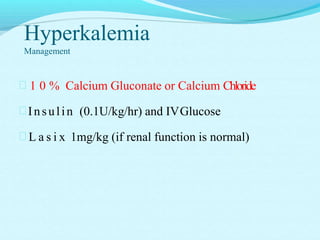
Hyperkalemia
Management
 1 0 % Calcium Gluconate or Calcium Chloride
 Insulin (0.1U/kg/hr) and IVGlucose
 L a s i x 1mg/kg (if renal function is normal)
Hypokalemia:
Serum potassium level<3.5mEq/L
Etiology:
 G I losses from vomiting, diarrhea, or fistula and use of
diuretics
Treatment:
Correction of the underlyingcondition
 K should be given orally unless severe(<2.5mEq/L),
patient is symptomatic or the enteral route is
contraindicated
 O r a l K supplements (60-80mEq/L) coupled with normal
diet is sufficient.
 E C G monitoring along with frequent assessment of serum
K level is reqiured
Calcium homeostasis
 B o d y contains approx. 1400gm of calcium
Reduction in calcium level leads to increasescalcium
reabsorption from the bone.
 It increases calcium reabsorption and stimulates the
formation of the active metabolite of vit. D that increases
gut reabsorption of elemental calcium and facilitates the
action on the bone.
Calcium abnormalities:
Hypercalcemia:
Ionized calcium conc. >5.3mg/dL
Etiology:
 Hyperparathyroidis
m
 C a n c e r
Paget's disease
 P heochromacyto
ma
Hyperthyroidism
Thiazide diuretics
Treatment:
 S e v e r e hypercalcemia-
Initial supportive therapy includes furosamide toincrease
calcium excretion.
Calcitonin reduces bone resorption and has an immediate
effect and lasts for 48 hrs. prolongation can be done by
using corticosteroids
Hypocalcemia:
Ionized calcium conc. <4.4mg/dL
Etiology:
Parathyroid or thyroidsurgery
 S e v e r e pancreatitis
Magnesium deficiency
Massive bloodtransfusion
Treatment:
Asymptomatic
Calcium supplementation is notrequired
Symptomatic
 I V calcium therapy- initially 100mg elemental calcium over
a period of 5-10mins.susequently, a calcium infusion of 0.5-
2mg/kg/hr is given.
Phosphate homeostasis
Dietary intake-800-1200mg/day.
Reabsorbed in thejejunum.
 K i d n e y acts as the principleregulator.
 N o r m a l serum P conc. Is 2.5-4.5mg/dL.
Phosphate abnormalities:
Hyperphosphatemia:
 S e r u m phosphate level>4.5mg/dL
Etiology:
 R e n a l insufficiency
Thyrotoxicosis
Malignant hyperthermia
Hypoparathyroidism
Treatment:
Treatment of the underlying renalfailure.
Chronic- phosphate binding antacids areeffective.
 A c u t e - end stage renal disease. Dialysis isrequired.
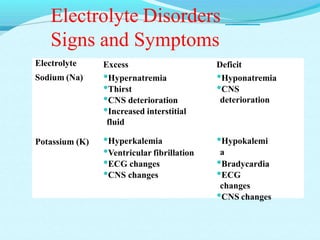
Electrolyte Disorders
Signs and Symptoms
Electrolyte
Sodium (Na)
Excess
•Hypernatremia
•Thirst
•CNS deterioration
•Increased interstitial
fluid
Deficit
•Hyponatremia
•CNS
deterioration
Potassium (K) •Hyperkalemia
•Ventricular fibrillation
•ECG changes
•CNS changes
•Hypokalemi
a
•Bradycardia
•ECG
changes
•CNS changes
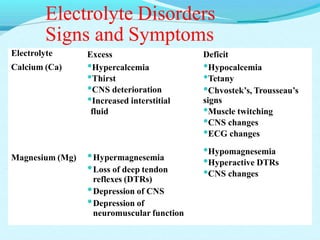
Electrolyte Disorders
Signs and Symptoms
Electrolyte
Calcium (Ca)
Excess
•Hypercalcemia
•Thirst
•CNS deterioration
•Increased interstitial
fluid
Magnesium (Mg) •Hypermagnesemia
•Loss of deep tendon
reflexes (DTRs)
•Depression of CNS
•Depression of
neuromuscular function
Deficit
•Hypocalcemia
•Tetany
•Chvostek’s, Trousseau’s
signs
•Muscle twitching
•CNS changes
•ECG changes
•Hypomagnesemia
•Hyperactive DTRs
•CNS changes
References – Text Books
• Oral and maxillofacial surgery-Daniel M Laskin
 Essentials of surgery-Becker and Stucchi
 Human physiology Mahabatra
 General surgery - Shenoy
 Human physiology(from cells to system – lauralee Sherwood.
 Human physiology – Vanders
 Principles of Surgery – Das
 Principles of Human Anatomy & Physiology – Tortora
Grabowski
 Human Physiology – Shembulingam
References - Articles
• Adrogue H, madias N: management of life threatening acid
base disorders. N Engl J Med 338:26-34, 2008
• Gennari F:serum osmolality, N Engl J Med 310:102-105, 2004
• Kobrin S, goldfarb s: hypocalcemia and hypercalcemia. In
adrogue H acid base and electrolyte disorders. Newyork,
churchill, livingstone, 1999, pp69-96
• Pestana C:fluids and electolytes in surgical patients, 2nded
Baltimore, williams and wilkins, 2001 pp 101-144
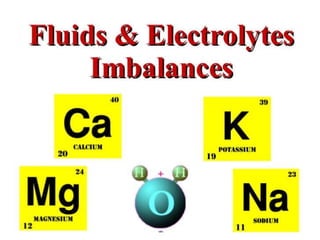
Fluids and Electrolytes

Fluids and Electrolytes

  • 2.
    B a la n c e cl- Na+ H+ - HCO 3 Mr. Abhay Rajpoot
  • 3.
    ContentsIntroduction  Body Fluids SourceFunctions Composition  Movements of Body Fluids  Fluid Balance  Regulation of Body Water  Electrolytes  Electrolyte balance  Homeostasis  Imbalance disorders  Acid –BaseBalance  conclusion
  • 4.
    Introduction  To achievehomeostasis, the body maintains strict control of water and electrolyte distribution and of acid-base balance.  This control is a function of the complex interplay of cellular membrane forces, specific organ activities and systemic and local hormone actions.
  • 5.
  • 6.
    • Water constitutesan average 50 to 70% of the total body weight. Young males - 60% of total body weight Older males – 52% Young females – 50% of total body weight Older females – 47% • • • Variation of ±15% in both groups is normal. Obese have 25 to 30% less body water than lean people. Infants 75 to 80% - gradual physiological loss of body water. - 65% at one year of age.
  • 7.
    Sources of BodyFluids Preformed water represents about 2,300 ml/day of daily intake. Metabolic water is produced through the catabolic breakdown of nutrients occurring during cellular respiration. This amounts to about 200 ml/d. Combining preformed and metabolic water gives us totaldaily intake of 2,500 ml.
  • 9.
    Functions All chemical reactionsoccur in liquid medium. It is crucial in regulating chemical and bioelectrical distributions within cells. Transports substances such as hormones and nutrients. 1 2 3 4 5 6 7 O2 transport from lungs to body cells. CO2 transport in the opposite direction. Dilutes toxic substances and waste products and transports them to the kidneys and the liver. Distributes heat around the body.
  • 11.
    Composition of BodyFluids     Nonelectrolytes include most organic molecules, do not dissociate in water, and carry no net electrical charge. Electrolytes dissociate in water to ions, and include inorganic salts, acids and bases, and some proteins. The major cation in extracellular fluids is sodium, and the major anion is chloride; in intracellular fluid the major cation is potassium, and the major anion is phosphate. Electrolytes are the most abundant solutes in body fluids, but proteins and some nonelectrolytes account for 60-–97% of dissolved solutes.
  • 12.
    Principles of BodyWater Distribution    Body control systems regulate ingestion and excretion: - constant total body water - constant total body osmolarity Homeostatic mechanisms respond to changes in ECF. No receptors directly monitor fluid or electrolyte balance. - Respond to changes in plasma volume or osmotic concentrations
  • 13.
  • 14.
    Movement of BODYFLUIDS Diffusion Osmosis  A c t i v e Transport Filtration
  • 15.
    Osmosis Fluid High Solution Concentration, Low Fluid Concentration LowSolute Concentration, High Fluid Concentration
  • 16.
  • 17.
    Active transport K +K + K + K K + K + K + K + ++++ ++ K + K + K K + K + K K + K + K +ATP ATP ATP ATP Na + Na + Na + Na + Na + + Na + Na + Na + Na + Na Na + Na + Na + Na + Na + Na + Na + Na + Na +Na + INTRACELLULAR FLUID EXTRACELLULAR FLUID
  • 18.
    Filtration Filtration is thetransport of water anddissolved materials through a membrane from an area of higher pressure to an area of lower pressure
  • 19.
    Water —  Tw o liters of water per day are generally sufficient for adults.  M o s t of this minimum intake is usually derived from the water content of food and the water of oxidation, therefore.  i t has been estimated that only 500ml of water needs be imbibed given normal diet and no increased losses.  T h e s e sources of water are markedly reduced in patients who arenot eating and so must be replaced by maintenance fluids.
  • 20.
     w at e r requirements increase with: fever, sweating, burns, tachypnea, surgical drains, polyuria, or ongoing significant gastrointestinal losses.
  • 21.
  • 22.
    Fluid Balance The bodytries to maintain homeostasis of fluids and electrolytes by regulating: Volumes Solutecharge and osmotic load
  • 23.
    Fluid balance Normally, thereis a balance achieved between our totaldaily intake and output of water.  To t a l fluid intake is modified by the induction of thesensation of thirst.  T h i s is produced by a reaction of cells in Hypothalamus to theincreased osmotic pressure of the blood passing through this region. Another stimulus of thirst would be the degree ofdryness of the oral mucosa.
  • 24.
    Regulation of bodywater Any of the following: • Decreased amount of water in body • Increased amount of Na+ in the body • Increased blood osmolality • Decreased circulating blood volume Results in: • Stimulation of osmoreceptors in hypothalamus • Release of ADH from the posterior pituitary • Increased thirst
  • 25.
    Problems of FluidBalance  Deficient fluid volume  Hypovolemia  Dehydration  Excess fluid volume • Hypervolemia  Water intoxication  Electrolyte imbalance  Deficit or excess of one or more electrolytes  Acid-base imbalance
  • 26.
    Factors Affecting FluidBalance  Lifestyle factors  Nutrition  Exercise  Stress  Physiological factors  Cardiovascular  Respiratory  Gastrointestinal  Renal  Integumentary  Trauma  Developmental factors  Infants and children  Adolescents and middle-aged adults  Older adults  Clinical factors  Surgery  Chemotherapy  Medications  Gastrointestinal intubation  Intravenous therapy Elsevier items and derived items © 2007 by Saunders, an imprint of Elsevier Inc.
  • 28.
  • 29.
    Electrolyte balance Na+ Predominantextracellular cation • 136 -145 mEq / L • Pairs with Cl- , HCO3 -to neutralize charge • Most important ion in water balance • Important in nerve and muscle function Reabsorption in renal tubule regulated by: • • • Aldosterone Renin/angiotensin Atrial Natriuretic Peptide (ANP)
  • 30.
    Electrolyte balance K + Majorintracellular cation • 150- 160 mEq/ L • Regulates resting membrane potential • Regulates fluid, ion balance inside cell Regulation in kidney through: • • Aldosterone Insulin
  • 31.
    Electrolyte balance Cl ˉ(Chloride) • • • • Major extracellular anion 105 mEq/ L Regulates tonicity Reabsorbed in the kidney with sodium Regulation in kidney through: • • Reabsorption with sodium Reciprocal relationship with bicarbonate
  • 32.
    SODIUM HOMEOSTASIS  No r m a l dietary intake is6-15g/day.  S o d i u m is excreted in urine, stool, andsweat. Urinary losses are tightly regulated by renalmechanisms.
  • 33.
    Sodium abnormalities Hypernatremia: Defined asa serum sodium concentration thatexceeds 150mEq/L.  A l w a y s accompanied byhyperosmolarity.
  • 34.
    Etiology Excessive saltintake Excessive waterloss Reducedsaltexcretion Reduced waterintake Administration of loop diuretics Gastrointestinal losses
  • 35.
    Treatment: Restore circulating volumewith isotonic salinesolution  A f t e r intravascular vol. correctionhypernatremia is corrected using free water.
  • 36.
    Hyponatremia  Serum sodiumconcentration less than 135mEq/L .  R e n a l losses caused by diuretic excess, osmotic diuresis, salt- wasting nephropathy, adrenal insufficiency, proximal renal tubular acidosis, metabolic alkalosis, and pseudohypoaldosteronism result in a urine sodium concentration greater than 20 mEq/L Extrarenal losses caused by vomiting, diarrhea, sweat, and third spacing result in a urine sodium concentration less than 20 mEq/L
  • 37.
    Etiology Excessive waterintake Impaired renalwaterexcretion  L o s s of renal diluting capacity
  • 38.
    Treatment of Hyponatremia Correctserum Na by1mEq/L/hr  U s e 3% saline in severe hyponatremia.  G o a l is serum Na 130. 43
  • 39.
    Hypochloremia  M os t commonly from gastric losses  O f t e n presents as a contraction alkalosis with paradoxical aciduria (Na+ retained and H+ wasted in the kidney) Treatment : resuscitation with normalsaline.
  • 40.
    Hyperchloremia  M os t commonly from over-resuscitation with normal saline.  O f t e n presents as a hyperchloremic acidemia with paradoxical alkaluria.  R x : stop normal saline and replace with hypotonic crystalloid.
  • 41.
    Hypokalemia  S er u m K+< 3.5 mEq /L
  • 42.
    Causes of Hypokalemia Decreasedintake ofK+ Increased K+loss Chronic diuretics  Severe vomiting/diarrhea Acid/base imbalance  Trauma andstress Increased aldosterone Redistribution between ICF and ECF 47
  • 43.
    Hyperkalemia  S er u m K+ > 5.5 mEq / L 48
  • 44.
    Hyperkalemia Management  1 0% Calcium Gluconate or Calcium Chloride  Insulin (0.1U/kg/hr) and IVGlucose  L a s i x 1mg/kg (if renal function is normal)
  • 45.
    Hypokalemia: Serum potassium level<3.5mEq/L Etiology: G I losses from vomiting, diarrhea, or fistula and use of diuretics
  • 46.
    Treatment: Correction of theunderlyingcondition  K should be given orally unless severe(<2.5mEq/L), patient is symptomatic or the enteral route is contraindicated  O r a l K supplements (60-80mEq/L) coupled with normal diet is sufficient.  E C G monitoring along with frequent assessment of serum K level is reqiured
  • 47.
    Calcium homeostasis  Bo d y contains approx. 1400gm of calcium Reduction in calcium level leads to increasescalcium reabsorption from the bone.  It increases calcium reabsorption and stimulates the formation of the active metabolite of vit. D that increases gut reabsorption of elemental calcium and facilitates the action on the bone.
  • 48.
  • 49.
    Etiology:  Hyperparathyroidis m  Ca n c e r Paget's disease  P heochromacyto ma Hyperthyroidism Thiazide diuretics
  • 50.
    Treatment:  S ev e r e hypercalcemia- Initial supportive therapy includes furosamide toincrease calcium excretion. Calcitonin reduces bone resorption and has an immediate effect and lasts for 48 hrs. prolongation can be done by using corticosteroids
  • 51.
  • 52.
    Etiology: Parathyroid or thyroidsurgery S e v e r e pancreatitis Magnesium deficiency Massive bloodtransfusion
  • 53.
    Treatment: Asymptomatic Calcium supplementation isnotrequired Symptomatic  I V calcium therapy- initially 100mg elemental calcium over a period of 5-10mins.susequently, a calcium infusion of 0.5- 2mg/kg/hr is given.
  • 54.
    Phosphate homeostasis Dietary intake-800-1200mg/day. Reabsorbedin thejejunum.  K i d n e y acts as the principleregulator.  N o r m a l serum P conc. Is 2.5-4.5mg/dL.
  • 55.
    Phosphate abnormalities: Hyperphosphatemia:  Se r u m phosphate level>4.5mg/dL
  • 56.
    Etiology:  R en a l insufficiency Thyrotoxicosis Malignant hyperthermia Hypoparathyroidism
  • 57.
    Treatment: Treatment of theunderlying renalfailure. Chronic- phosphate binding antacids areeffective.  A c u t e - end stage renal disease. Dialysis isrequired.
  • 58.
    Electrolyte Disorders Signs andSymptoms Electrolyte Sodium (Na) Excess •Hypernatremia •Thirst •CNS deterioration •Increased interstitial fluid Deficit •Hyponatremia •CNS deterioration Potassium (K) •Hyperkalemia •Ventricular fibrillation •ECG changes •CNS changes •Hypokalemi a •Bradycardia •ECG changes •CNS changes
  • 59.
    Electrolyte Disorders Signs andSymptoms Electrolyte Calcium (Ca) Excess •Hypercalcemia •Thirst •CNS deterioration •Increased interstitial fluid Magnesium (Mg) •Hypermagnesemia •Loss of deep tendon reflexes (DTRs) •Depression of CNS •Depression of neuromuscular function Deficit •Hypocalcemia •Tetany •Chvostek’s, Trousseau’s signs •Muscle twitching •CNS changes •ECG changes •Hypomagnesemia •Hyperactive DTRs •CNS changes
  • 60.
    References – TextBooks • Oral and maxillofacial surgery-Daniel M Laskin  Essentials of surgery-Becker and Stucchi  Human physiology Mahabatra  General surgery - Shenoy  Human physiology(from cells to system – lauralee Sherwood.  Human physiology – Vanders  Principles of Surgery – Das  Principles of Human Anatomy & Physiology – Tortora Grabowski  Human Physiology – Shembulingam
  • 61.
    References - Articles •Adrogue H, madias N: management of life threatening acid base disorders. N Engl J Med 338:26-34, 2008 • Gennari F:serum osmolality, N Engl J Med 310:102-105, 2004 • Kobrin S, goldfarb s: hypocalcemia and hypercalcemia. In adrogue H acid base and electrolyte disorders. Newyork, churchill, livingstone, 1999, pp69-96 • Pestana C:fluids and electolytes in surgical patients, 2nded Baltimore, williams and wilkins, 2001 pp 101-144