Fluid and Electrolytes,
Balance and Disturbances

              By:
              Ms. katherina
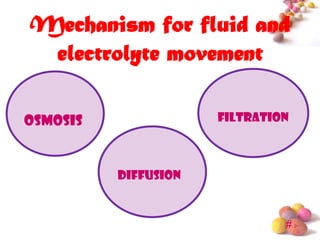
Mechanism for fluid and
 electrolyte movement

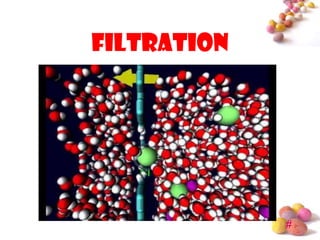
osmosis               filtration


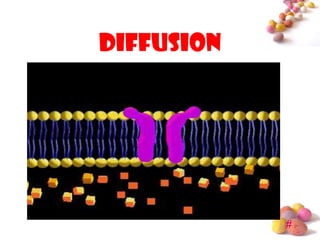
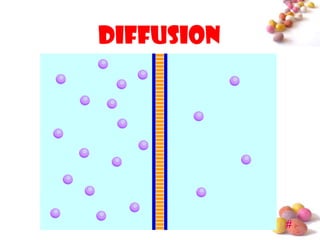
          diffusion


                               #
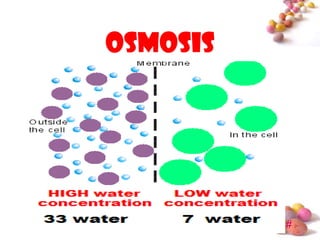
osmosis


          #
diffusion


            #
diffusion


            #
filtration


             #
Fluid and electrolyte
      balances


                        #
cations


          #
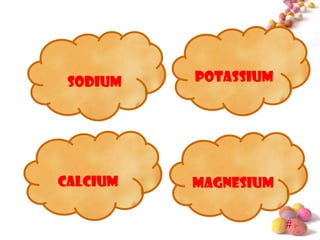
sodium   potassium


calcium   magnesium

                      #
Electrolytes are measured
 milliequivalent per litre
         of water
        (mEq / L)
                         #
Equivalent refers to the chemical
combining power of a substance or
the power of cations to unite with
anions to form molecules


                                #
#
 most abundant cat        ion   in   the
 extracellular fluid
 sodium is regulated by


Salt intake     Aldosterone

                 Urinary output


                                      #
functions
Maintain balance of extracellular fluid, thereby
it controls the movements of the water between
               fluid compartments


        Transmission of nerve impulses


   Neuro muscular and myocardial impulse
               transmission
                                              #
Normal concentration
     of sodium

    135 to 145
      mEq/L
                       #
#
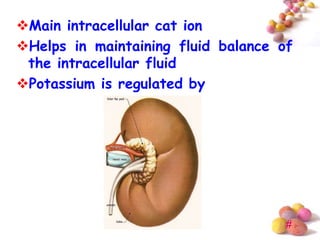
Main intracellular cat ion
Helps in maintaining fluid balance of
 the intracellular fluid
Potassium is regulated by


                                     #
functions
Regulates neuromuscular excitability and muscle
                 contraction


  Needed for glycogen formation and protein
                  sunthesis


 Correction of acid base imbalances. Potassium
 ion can be exchanged with hydrogen ion (H+)
                                                 #
Normal concentration
    of potassium

    3.5 to 5.3
     mEq/L
                       #
#
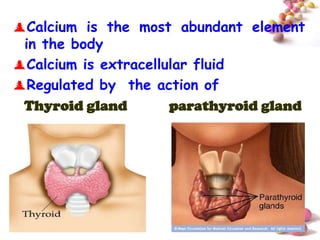
Calcium is the most abundant element
 in the body
Calcium is extracellular fluid
Regulated by the action of
 Thyroid gland        parathyroid gland


                                    #
Parathyroid hormone (PTH) controls
 the balance among bone calcium,
 gastrointestinal   absorption and
 kidney excretion of calcium.

Thyrocalcitonin from the thyroid
 gland inhibits the release of calcium
 from bones, thus playing a minor
 role in determining serum calcium
 levels.
                                     #
functions
Maintenance of cell membrane, its integrity and
                   structure


  Conduction of nerve impulses in the skeletal
                    muscle


Stimulation and depolarization and contraction
              of cardiac muscles
                                                 #
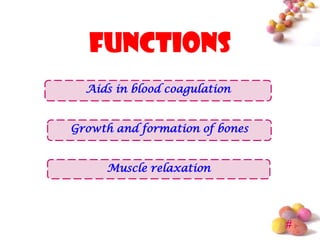
functions
  Aids in blood coagulation


Growth and formation of bones


     Muscle relaxation


                                #
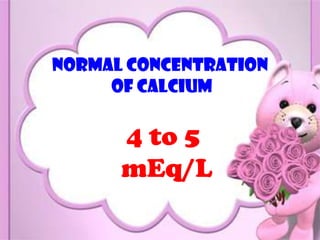
Normal concentration
     of calcium

      4 to 5
      mEq/L
                       #
#
Magnesium is the second      most
 important      cat  ion in    the
 intracellular fluid

It has an inhibitory   effect   on
 skeletal muscles.


                                  #
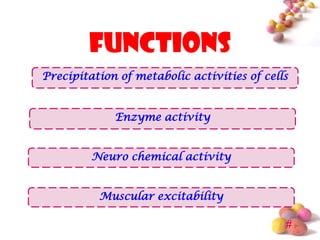
functions
Precipitation of metabolic activities of cells


             Enzyme activity


         Neuro chemical activity


          Muscular excitability

                                             #
Normal concentration
    of magnesium

    1.5 to 2.4
     mEq/L
                       #
anions


         #
chloride
phosphate


       bicarbonate


                                #
#
Phosphate is a buffer anion                   in
 extracellular and intracellular fluid

Phosphate     absorption     is   through
 gastrointestinal tract in a range of 3 to
 12 mg/100 ml

Calcium and     phosphate    are     inversely
 proportional.

    When one rises the other falls
                                           #
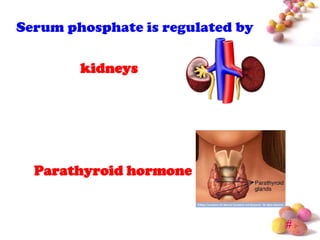
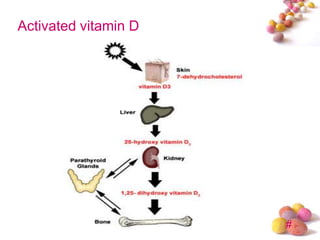
Serum phosphate is regulated by

        kidneys


  Parathyroid hormone


                                  #
Activated vitamin D


                      #
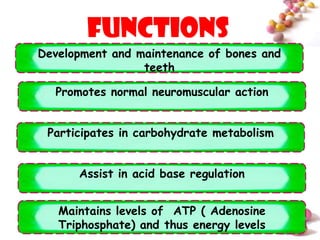
functions
Development and maintenance of bones and
                 teeth

  Promotes normal neuromuscular action


 Participates in carbohydrate metabolism


      Assist in acid base regulation


   Maintains levels of ATP ( Adenosine
   Triphosphate) and thus energy levels    #
Normal concentration
    of phosphate

    2.5 to 4.5
     mEq/L
                       #
#
Chlorides are found in extracellular and
 intracellular fluids

The chloride ion balances the cations
 within the extracellular fluid

The ion exchange helps to maintain the
 electrical neutrality


                                      #
Chloride   is   regulated   through
 kidneys

The dietary intake of chloride and
 the amount excreted in urine are
 closely related


                                   #
Normal concentration
    of chloride

   100 to 106
     mEq/L
                       #
#
Bicarbonate is found in extracellular
 and intracellular fluids

It is a major chemical buffer in the
 body

Regulation is through kidneys

It is an essential component of the
 carbonic acid-bicarbonate buffering
 system essential to acid base balance
                                   #
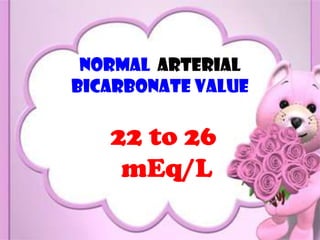
Normal arterial
bicarbonate value

   22 to 26
    mEq/L
                    #
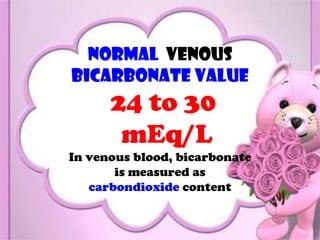
Normal venous
bicarbonate value
      24 to 30
       mEq/L
In venous blood, bicarbonate
       is measured as
   carbondioxide content

                               #
FLUID VOLUME
DISTURBANCES


               #
Fluid
volume deficit


            hypovolemia
                          #
Fluid Volume Deficit
Mild – 2% of body weight loss


Moderate – 5% of body weight loss


Severe – 8% or more of body
 weight loss

                                     #
Pathophysiology
  results from loss of
body fluids and occurs
more rapidly when coupled
with    decreased    fluid
intake

                         #
Clinical manifestations

Acute Weight loss


Decreased skin turgor


                             #
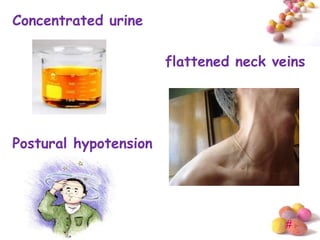
Concentrated urine

                       flattened neck veins


Postural hypotension


                                        #
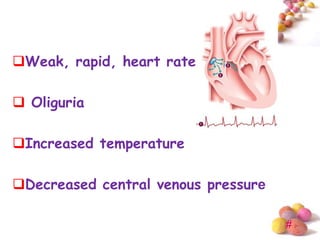
Weak, rapid, heart rate

 Oliguria

Increased temperature

Decreased central venous pressure

                                     #
Nursing Diagnosis
Fluid volume Deficit r/t
Insufficient intake, vomiting, diarrhea,
hemorrage, m/b dry mucous membranes


                                       #
Nursing management
Restore fluids by oral or IV
Treat underlying cause
Monitor I & O at least every 8
 hours
Daily weight
Vital signs
Skin turgor
Urine concentration
                              #
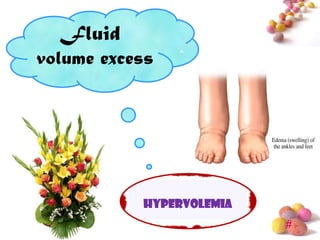
Fluid
volume excess


           hypervolemia
                          #
Pathophysiology
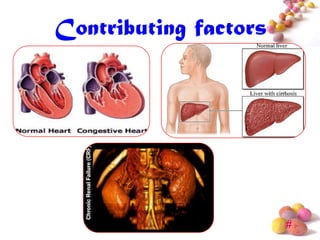
       may be related to
fluid      overload     or
diminished function of the
homeostatic     mechanisms
responsible for regulating
fluid balance
                         #
Contributing factors


                       #
Clinical manifestations


    Edema


Distended neck veins


                                #
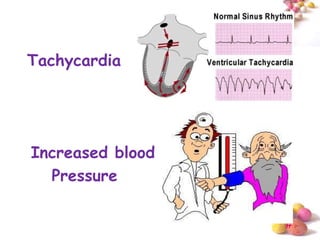
Tachycardia


Increased blood
  Pressure

                  #
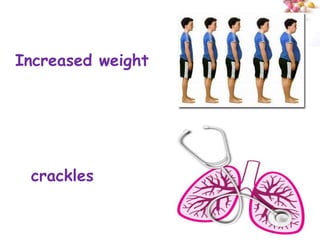
Increased weight


 crackles

                   #
Nursing Diagnosis
Fluid volume excess r/t
         CHF, excess sodium intake,
 renal failure


                                      #
Nursing management
Preventing FVE

Detecting and Controlling FVE

Teaching patients about edema


                                 #
Electrolyte Imbalances


                         #
SODIUM


         #
Sodium
Normal range – 135 to 145 mEq/L

         Primary regulator of ECF
 volume (a loss or gain of sodium is
 usually accompanied by a loss or
 gain of water)


                                       #
HYPONATREMIA


          Sodium level less
           than 135 mEq/L

                              #
causes
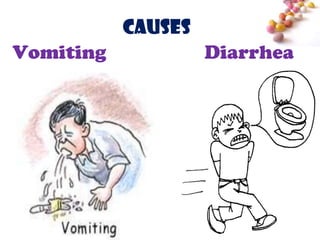
Vomiting            Diarrhea


                           #
Sweating   Diuretics


                   #
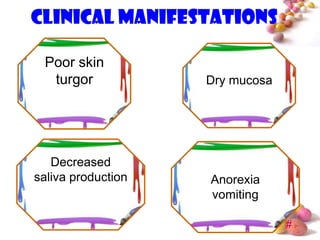
Clinical manifestations

 Poor skin
  turgor            Dry mucosa


   Decreased
saliva production   Anorexia
                    vomiting

                                 #
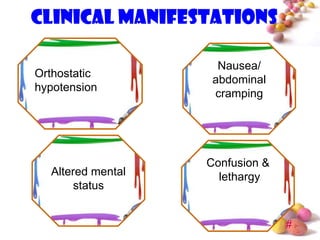
Clinical manifestations

                     Nausea/
Orthostatic
                    abdominal
hypotension
                    cramping


                   Confusion &
  Altered mental     lethargy
       status


                                 #
Nursing interventions
 Assess clinical manifestations

 Monitor fluid intake and output, vital
  signs and lab data.

 Encourage food and fluids high in Na

 Limit water intake.

                                       #
HYPERNATREMIA


         Sodium level more
          than 145 mEq/L

                             #
CAUSES
Loss of fluids


  Water deprivation


        Excessive salt intake

        Conditions like Diabetes insipidus,
                    heatstroke
                                        #
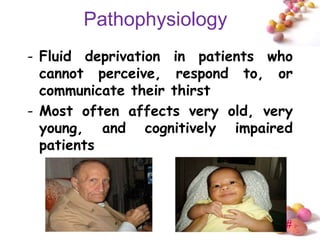
Pathophysiology
- Fluid deprivation in patients who
  cannot perceive, respond to, or
  communicate their thirst
- Most often affects very old, very
  young, and cognitively impaired
  patients


                                  #
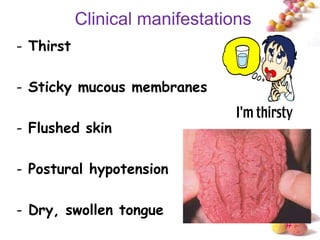
Clinical manifestations
- Thirst

- Sticky mucous membranes

- Flushed skin

- Postural hypotension

- Dry, swollen tongue
                                     #
Nursing interventions
Monitor intake and output

Monitor behavioural changes

Monitor lab findings

Encourage fluids

Monitor      diet   as   ordered(salt
 restriction)
                                     #
POTASSIUM


            #
Normal serum potassium
concentration is 3.5 to 5.5 mEq/L

   Major Intracellular electrolyte
and 98% of the body’s potassium is
inside the cells


                               #
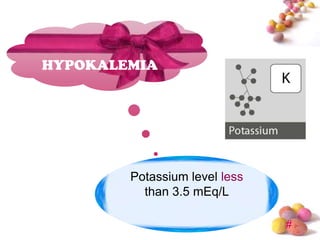
HYPOKALEMIA


        Potassium level less
          than 3.5 mEq/L

                               #
CAUSES
Loss of K+ in the form of
  vomittings ,GI suction

         poor K intake


                 diuretics


                steroid administration

                                         #
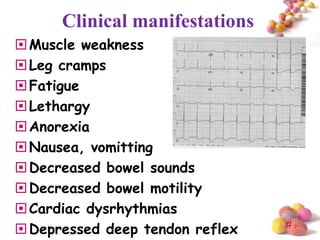
Clinical manifestations
 Muscle weakness
 Leg cramps
 Fatigue
 Lethargy
 Anorexia
 Nausea, vomitting
 Decreased bowel sounds
 Decreased bowel motility
 Cardiac dysrhythmias
 Depressed deep tendon reflex   #
Nursing interventions

Monitor heart rate and rhythm
Monitor clients receiving DIGITALIS
Administer oral K+ as ordered with
 food /fluids
Administer IV K+ as ordered ,flow
 rate not more than 10-20 meq/hr
Teach patients about potassium rich
 diet and to reduce potassium wastage
                                    #
HYPERKALEMIA


        Potassium level more
           than 5.5 mEq/L

                               #
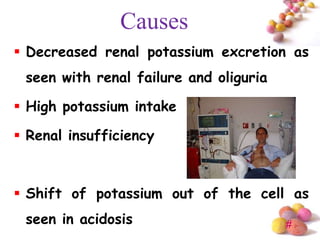
Causes
 Decreased renal potassium excretion as
 seen with renal failure and oliguria

 High potassium intake

 Renal insufficiency


 Shift of potassium out of the cell as
 seen in acidosis                       #
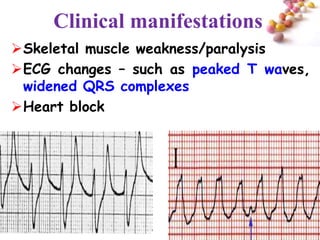
Clinical manifestations
Skeletal muscle weakness/paralysis
ECG changes – such as peaked T waves,
 widened QRS complexes
Heart block


                                  #
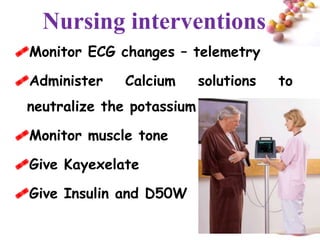
Nursing interventions
Monitor ECG changes – telemetry

Administer   Calcium       solutions   to
 neutralize the potassium

Monitor muscle tone

Give Kayexelate

Give Insulin and D50W

                                         #
CALCIUM


          #
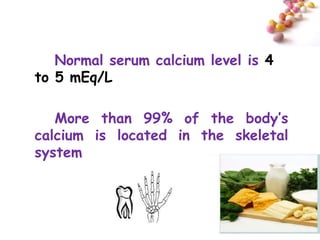
Normal serum calcium level is 4
to 5 mEq/L

   More than 99% of the body’s
calcium is located in the skeletal
system


                                     #
HYPOCALCEMIA


        Calcium level less
          than 4 mEq/L

                             #
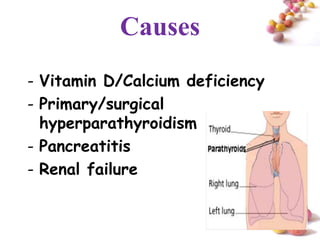
Causes
- Vitamin D/Calcium deficiency
- Primary/surgical
  hyperparathyroidism
- Pancreatitis
- Renal failure


                                 #
Clinical Manifestations

   Tetany and cramps in muscles of
extremities


                                 #
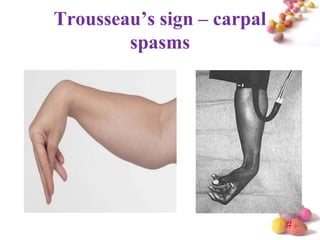
Trousseau’s sign – carpal
        spasms


                            #
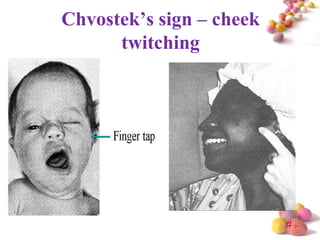
Chvostek’s sign – cheek
      twitching


                          #
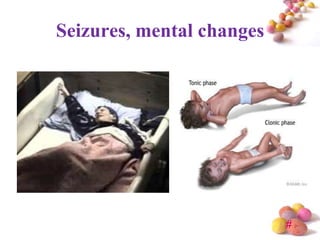
Seizures, mental changes


                           #
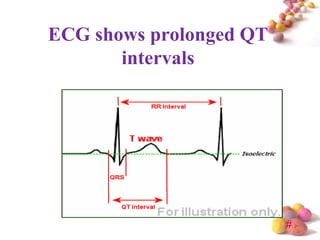
ECG shows prolonged QT
       intervals


                         #
Nursing interventions
- IV/PO Calcium Carbonate or Calcium
 Gluconate

- Encourage increased dietary intake
 of Calcium

- Monitor neurlogical status

- Establish seizure precautions
                                       #
HYPERCALCEMIA


        Calcium level more
           than 5 mEq/L

                             #
Causes
- Hyperparathyroidism

- Prolonged immobilization

- Thiazide diuretics

- Large doses of Vitamin A and D


                                   #
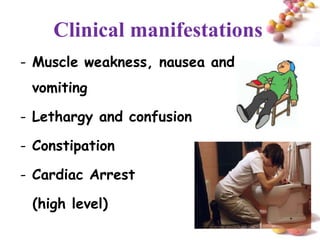
Clinical manifestations
- Muscle weakness, nausea and
 vomiting

- Lethargy and confusion

- Constipation

- Cardiac Arrest

 (high level)
                                #
Nursing interventions

- Eliminate Calcium from diet

- Monitor neurological status

- Increase fluids (IV or PO)

- Calcitonin


                                #
MAGNESIUM


            #
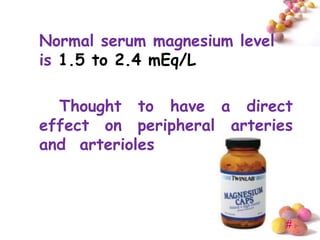
Normal serum magnesium level
is 1.5 to 2.4 mEq/L

  Thought to have a direct
effect on peripheral arteries
and arterioles


                               #
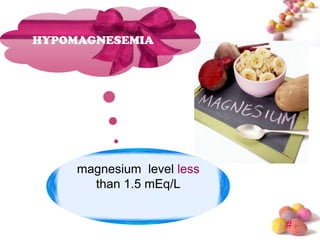
HYPOMAGNESEMIA


     magnesium level less
       than 1.5 mEq/L


                            #
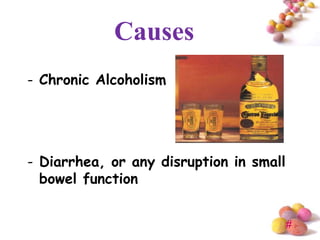
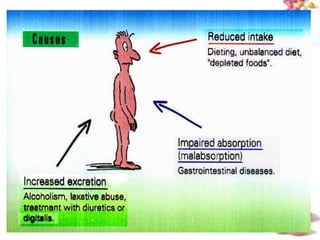
Causes
- Chronic Alcoholism


- Diarrhea, or any disruption in small
  bowel function


                                         #
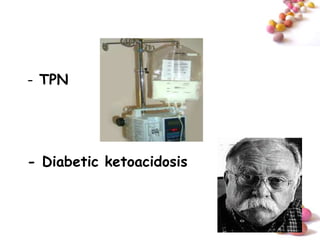
- TPN


- Diabetic ketoacidosis


                          #
#
Clinical manifestations
- Neuromuscular irritability
- Positive Chvostek’s and Trousseau’s
  sign
- EKG changes with prolonged QRS,
  depressed ST segment, and cardiac
  dysrhythmias
- May occur with hypocalcemia and
  hypokalemia

                                    #
• Starved – possible cause of
  hypomagnesemia
• Seizures
• Tetany
• Anorexia and arrhythmias
• Rapid heart rate
• Vomiting
• Emotional lability
• Deep tendon reflexes increased


                                   #
Nursing interventions
- IV/PO Magnesium replacement,
  including Magnesium Sulfate
- Give Calcium Gluconate if
  accompanied by hypocalcemia
- Monitor for dysphagia, give soft
  foods
- Measure vital signs closely

                                     #
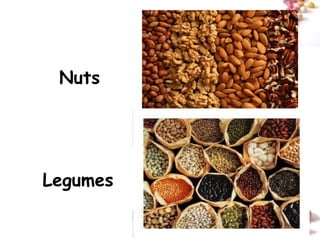
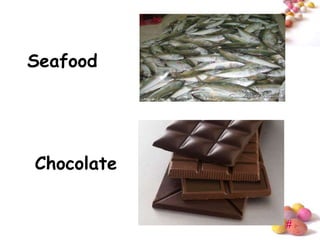
Foods high in Magnesium:
Green leafy vegetables


                            #
Nuts


Legumes
          #
Seafood


Chocolate


            #
HYPERMAGNESEMIA


      magnesium level
     more than 2.4 mEq/L


                           #
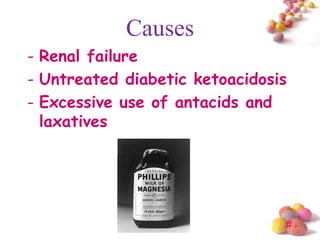
Causes
- Renal failure
- Untreated diabetic ketoacidosis
- Excessive use of antacids and
  laxatives


                                #
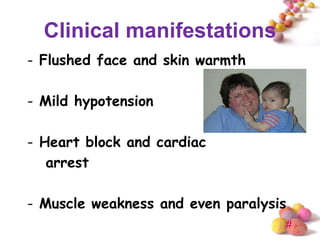
Clinical manifestations
- Flushed face and skin warmth

- Mild hypotension

- Heart block and cardiac
   arrest

- Muscle weakness and even paralysis
                                   #
RENAL
• Reflexes decreased (plus weakness
  and paralysis)
• ECG changes (bradycardia and
  hypotension)
• Nausea and vomiting
• Appearance flushed
• Lethargy (plus drowsiness and
   coma)
                                      #
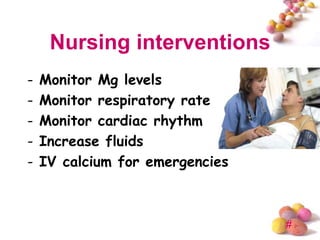
Nursing interventions
-   Monitor Mg levels
-   Monitor respiratory rate
-   Monitor cardiac rhythm
-   Increase fluids
-   IV calcium for emergencies


                                 #
PHOSPHORUS


             #
Normal serum phosphorus
 level is 2.5 to 4.5 mg/100 ml

- Phosphate levels vary inversely
  to calcium levels

- High Calcium = Low Phosphate

                                    #
HYPO
PHOSPHOTEMIA


      Phosphorus level
     less than 2.5 mEq/L


                           #
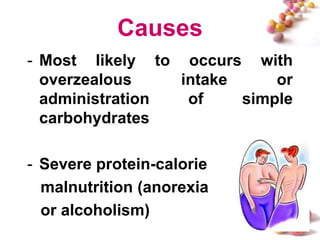
Causes
- Most likely to occurs with
  overzealous    intake     or
  administration  of    simple
  carbohydrates

- Severe protein-calorie
  malnutrition (anorexia
  or alcoholism)
                             #
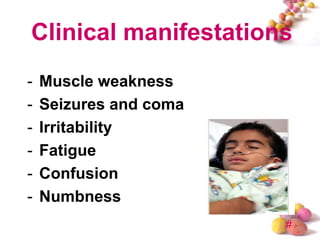
Clinical manifestations
-   Muscle weakness
-   Seizures and coma
-   Irritability
-   Fatigue
-   Confusion
-   Numbness
                        #
Nursing interventions
-   Prevention is the goal
-   IV Phosphorus for severe
-   Prevention of infection
-   Monitor phosphorus levels
-   Increase     oral    intake   of
    phosphorus rich foods
                                   #
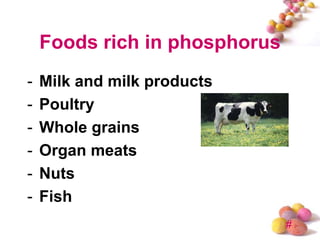
Foods rich in phosphorus
-   Milk and milk products
-   Poultry
-   Whole grains
-   Organ meats
-   Nuts
-   Fish
                               #
HYPER
PHOSPHOTEMIA


     Phosphorus level
    more than 4.5 mEq/L


                          #
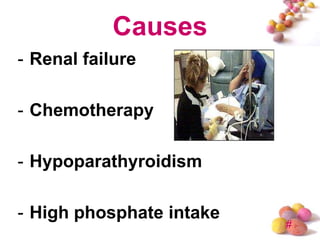
Causes
- Renal failure

- Chemotherapy

- Hypoparathyroidism

- High phosphate intake
                          #
Clinical manifestations

- Tetany
- Muscle weakness
- Similar to Hypocalcemia because
  of reciprocal relationship


                                #
Nursing interventions
- Treat underlying cause

- Avoid phosphorus rich foods


                                #
#
#

Fluid and electrolyte balances and imbalances