Abstract Algebra, Saracino
Second Edition
Section 9
Equivalence
Relations and
Cosets
Lehman College, Department of Mathematics
Relations (Definitions) (1 of 2)
Let 𝐴 and 𝐵 be two nonempty sets, then a relation (or
binary relation) ℛ from 𝐴 into 𝐵 is a set of ordered
pairs (𝑥, 𝑦), where 𝑥 ∈ 𝐴 and 𝑦 ∈ 𝐵. Recall the
Cartesian Product of 𝐴 and 𝐵, defined as the set:
𝐴 × 𝐵 = 𝑎, 𝑏 𝑎 ∈ 𝐴, 𝑏 ∈ 𝐵
Example: The set
ℛ1 = 1, 2 , 2, 5 , 3, −4 , 5, 2
is a relation from ℤ into ℤ, but it is not all of ℤ × ℤ.
Lehman College, Department of Mathematics
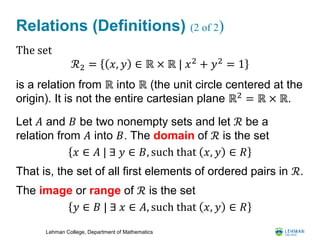
Relations (Definitions) (2 of 2)
The set
ℛ2 = 𝑥, 𝑦 ∈ ℝ × ℝ | 𝑥2
+ 𝑦2
= 1
is a relation from ℝ into ℝ (the unit circle centered at the
origin). It is not the entire cartesian plane ℝ2
= ℝ × ℝ.
Let 𝐴 and 𝐵 be two nonempty sets and let ℛ be a
relation from 𝐴 into 𝐵. The domain of ℛ is the set
𝑥 ∈ 𝐴 | ∃ 𝑦 ∈ 𝐵, such that 𝑥, 𝑦 ∈ 𝑅
That is, the set of all first elements of ordered pairs in ℛ.
The image or range of ℛ is the set
𝑦 ∈ 𝐵 | ∃ 𝑥 ∈ 𝐴, such that 𝑥, 𝑦 ∈ 𝑅
Lehman College, Department of Mathematics
Equivalence Relations (1 of 3)
A relation ℛ on a set 𝑆 is a relation from 𝑆 to itself. We will
define a special relation from 𝑆 to itself.
If 𝑎, 𝑏 ∈ 𝑆 such that 𝑎, 𝑏 ∈ ℛ, we write 𝑎 ∼ 𝑏
ℛ is an Equivalence Relation on the set 𝑆 if the following
three conditions hold
(1) Reflexivity:
(2) Symmetry:
(3) Transitivity:
For every 𝑎 ∈ 𝑆, we have 𝑎 ∼ 𝑎
For every 𝑎, 𝑏 ∈ 𝑆, if 𝑎 ∼ 𝑏, then 𝑏 ∼ 𝑎
For every 𝑎, 𝑏, 𝑐 ∈ 𝑆, if 𝑎 ∼ 𝑏 and 𝑏 ∼ 𝑐,
then 𝑎 ∼ 𝑐
Lehman College, Department of Mathematics
Equivalence Relations (2 of 3)
We have already seen an example of an equivalence
relation in Homework 5 Question 5. Let 𝐺 be a group
with identity element 𝑒., and let 𝑎, 𝑏, 𝑐 ∈ 𝐺. If there exists
𝑥 ∈ 𝐺, such that 𝑎 = 𝑥𝑏𝑥−1
, we say 𝑎 is conjugate to 𝑏.
Reflexivity.
Symmetry:
For every 𝑎 ∈ 𝑆, we have 𝑎 ∼ 𝑎 since
For every 𝑎, 𝑏 ∈ 𝑆, if 𝑎 ∼ 𝑏, then 𝑏 ∼ 𝑎
𝑎 = 𝑒𝑎𝑒−1
with 𝑒 ∈ 𝐺
Since 𝑎 ∼ 𝑏 means there exists 𝑥 ∈ 𝐺 such that
𝑎 = 𝑥𝑏𝑥−1
. It follows that
𝑥−1 𝑎𝑥 = 𝑥−1 𝑥𝑏𝑥−1 𝑥 and 𝑏 = 𝑥−1 𝑎𝑥 = 𝑥−1 𝑎 𝑥−1 −1
Lehman College, Department of Mathematics
Equivalence Relations (3 of 3)
From the last statement of the preceding slide, 𝑏 ∼ 𝑎.
Transitivity.
It follows that
For every 𝑎, 𝑏, 𝑐 ∈ 𝑆, if 𝑎 ∼ 𝑏 and 𝑏 ∼ 𝑐,
then 𝑎 ∼ 𝑐
Since 𝑎 ∼ 𝑏 means there exists 𝑥 ∈ 𝐺 such that
𝑎 = 𝑥𝑏𝑥−1
. And 𝑏 ∼ 𝑐 means there exists 𝑦 ∈ 𝐺
such that 𝑏 = 𝑦𝑐𝑦−1
𝑎 = 𝑥𝑏𝑥−1 = 𝑥 𝑦𝑐𝑦−1 𝑥−1 = 𝑥𝑦𝑐𝑦−1 𝑥−1
= (𝑥𝑦)𝑐 𝑥𝑦 −1
Lehman College, Department of Mathematics
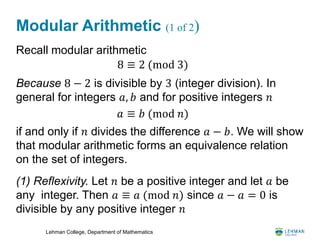
Modular Arithmetic (1 of 2)
Recall modular arithmetic
Because 8 − 2 is divisible by 3 (integer division). In
general for integers 𝑎, 𝑏 and for positive integers 𝑛
if and only if 𝑛 divides the difference 𝑎 − 𝑏. We will show
that modular arithmetic forms an equivalence relation
on the set of integers.
(1) Reflexivity. Let 𝑛 be a positive integer and let 𝑎 be
any integer. Then 𝑎 ≡ 𝑎 (mod 𝑛) since 𝑎 − 𝑎 = 0 is
divisible by any positive integer 𝑛
8 ≡ 2 (mod 3)
𝑎 ≡ 𝑏 (mod 𝑛)
Lehman College, Department of Mathematics
Modular Arithmetic (2 of 2)
(2) Symmetry. Let 𝑛 be a positive integer and let 𝑎 and
𝑏 be integers, such that 𝑎 ≡ 𝑏 (mod 𝑛). Then 𝑎 − 𝑏 is
divisible by 𝑛. It follows that 𝑏 − 𝑎 is also divisible by 𝑛
and
(2) Transitivity. Let 𝑛 be a positive integer and let 𝑎, 𝑏
and 𝑐 be integers, such that 𝑎 ≡ 𝑏 (mod 𝑛) and 𝑏 ≡
𝑐 (mod 𝑛). Then both 𝑎 − 𝑏 and 𝑏 − 𝑐 are divisible by 𝑛.
It follows their sum is also divisible by 𝑛. That is
Since 𝑎 − 𝑐 is divisible by 𝑛, then by definition
𝑏 ≡ 𝑎 (mod 𝑛)
𝑎 − 𝑏 + 𝑏 − 𝑐 = 𝑎 − 𝑐
𝑎 ≡ 𝑐 (mod 𝑛)
Lehman College, Department of Mathematics
Equivalence Classes (1 of 5)
Let 𝑆 be a set and let ∼ be an equivalence relation on 𝑆.
Then the set of all 𝑥 ∈ 𝑆, such that 𝑥 ∼ 𝑎 is called the
equivalence class of the element 𝑎, and denoted 𝑎 or
sometimes 𝑎 . In set notation:
Theorem 9.1 (textbook): Let 𝑆 be a set and let ∼ be an
equivalence relation 𝑆. Then every element of 𝑆 is in
exactly one equivalence class under ∼. That is, the
equivalence classes partition 𝑆 into a family of mutually
disjoint, nonempty subsets. Conversely, given any
partition of a set 𝑆 into mutually disjoint, nonempty
subsets, then there is an equivalence relation on
𝑎 = 𝑥 ∈ 𝑆 | 𝑥 ∼ 𝑎
Lehman College, Department of Mathematics
Equivalence Classes (2 of 5)
Theorem 9.1 (cont’d): Conversely, given any partition
of a set 𝑆 into mutually disjoint, nonempty subsets, then
there is an equivalence relation on 𝑆 whose equivalence
classes are precisely the subsets in the given partition
of 𝑆.
Proof. By reflexivity 𝑎 ∈ 𝑎 for any 𝑎 ∈ 𝑆. So, we see that
every element of 𝑆 is contained in some equivalence
class and that each equivalence class is nonempty. We
will now show that if 𝑎 ∼ 𝑏, then 𝑎 = 𝑏, otherwise their
respective equivalence classes are disjoint. Recall
From 𝑎 ∼ 𝑏 then 𝑎 ∈ 𝑏. Now, let 𝑦 ∈ 𝑎 then 𝑦 ∼ 𝑎, and
𝑏 = 𝑥 ∈ 𝑆 | 𝑥 ∼ 𝑏
Lehman College, Department of Mathematics
Equivalence Classes (3 of 5)
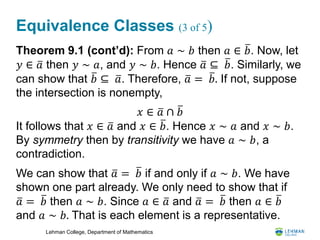
Theorem 9.1 (cont’d): From 𝑎 ∼ 𝑏 then 𝑎 ∈ 𝑏. Now, let
𝑦 ∈ 𝑎 then 𝑦 ∼ 𝑎, and 𝑦 ∼ 𝑏. Hence 𝑎 ⊆ 𝑏. Similarly, we
can show that 𝑏 ⊆ 𝑎. Therefore, 𝑎 = 𝑏. If not, suppose
the intersection is nonempty,
It follows that 𝑥 ∈ 𝑎 and 𝑥 ∈ 𝑏. Hence 𝑥 ∼ 𝑎 and 𝑥 ∼ 𝑏.
By symmetry then by transitivity we have 𝑎 ∼ 𝑏, a
contradiction.
We can show that 𝑎 = 𝑏 if and only if 𝑎 ∼ 𝑏. We have
shown one part already. We only need to show that if
𝑎 = 𝑏 then 𝑎 ∼ 𝑏. Since 𝑎 ∈ 𝑎 and 𝑎 = 𝑏 then 𝑎 ∈ 𝑏
and 𝑎 ∼ 𝑏. That is each element is a representative.
𝑥 ∈ 𝑎 ∩ 𝑏
Lehman College, Department of Mathematics
Equivalence Classes (4 of 5)
Recall congruence modulo 𝑛as an equivalence class.
There 𝑎 ≡ 𝑏 (mod 𝑛) if and only if 𝑛 divides 𝑎 − 𝑏. By
analogy in groups 𝑎 − 𝑏 would be 𝑎𝑏−1
.
Theorem 9.2. Let 𝐺 be a group and let 𝐻 be a subgroup
of 𝐺. Define a relation ≡ 𝐻 on 𝐺 by the following
Then ≡ 𝐻 is an equivalence operation.
(1) Reflexivity. 𝑎 ≡ 𝐻 𝑎 for all 𝑎 ∈ 𝐺 since 𝑎𝑎−1
= 𝑒 ∈ 𝐻.
2) Symmetry. Let 𝑎, 𝑏 ∈ 𝐺, such that 𝑎 ≡ 𝐻 𝑏. That is
𝑎𝑏−1
∈ 𝐻. But 𝐻 is closed under inverses, so
𝑥 ≡ 𝐻 𝑦 if and only if 𝑥𝑦−1
∈ 𝐻
𝑎𝑏−1 −1
= 𝑏−1 −1
𝑎−1
= 𝑏𝑎−1
∈ 𝐻
Lehman College, Department of Mathematics
Equivalence Classes (5 of 5)
(2) Symmetry. Let 𝑎, 𝑏 ∈ 𝐺, such that 𝑎 ≡ 𝐻 𝑏. That is
𝑎𝑏−1
∈ 𝐻. But 𝐻 is closed under inverses, so
It follows that 𝑏 ≡ 𝐻 𝑎.
2) Transitivity. Let 𝑎, 𝑏, 𝑐 ∈ 𝐺, such that 𝑎 ≡ 𝐻 𝑏 and
𝑏 ≡ 𝐻 𝑐. That is 𝑎𝑏−1
∈ 𝐻 and 𝑏𝑐−1
∈ 𝐻. But 𝐻 is closed
under products, so
It follows that 𝑎 ≡ 𝐻 𝑐
𝑎𝑏−1 −1
= 𝑏−1 −1
𝑎−1
= 𝑏𝑎−1
∈ 𝐻
𝑎𝑏−1
𝑏𝑐−1
= 𝑎 𝑏−1
𝑏 𝑐−1
= 𝑎𝑐−1
Lehman College, Department of Mathematics
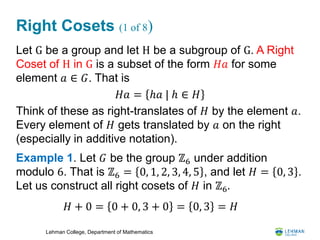
Right Cosets (1 of 8)
Let G be a group and let H be a subgroup of G. A Right
Coset of H in G is a subset of the form 𝐻𝑎 for some
element 𝑎 ∈ 𝐺. That is
Think of these as right-translates of 𝐻 by the element 𝑎.
Every element of 𝐻 gets translated by 𝑎 on the right
(especially in additive notation).
Example 1. Let 𝐺 be the group ℤ6 under addition
modulo 6. That is ℤ6 = 0, 1, 2, 3, 4, 5 , and let 𝐻 = 0, 3 .
Let us construct all right cosets of 𝐻 in ℤ6.
𝐻𝑎 = ℎ𝑎 | ℎ ∈ 𝐻
𝐻 + 0 = 0 + 0, 3 + 0 = 0, 3 = 𝐻
Lehman College, Department of Mathematics
Right Cosets (2 of 8)
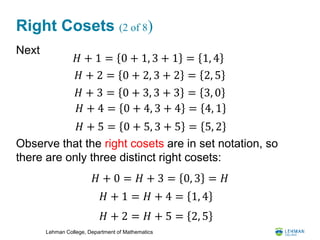
Next
Observe that the right cosets are in set notation, so
there are only three distinct right cosets:
𝐻 + 1 = 0 + 1, 3 + 1 = 1, 4
𝐻 + 2 = 0 + 2, 3 + 2 = 2, 5
𝐻 + 3 = 0 + 3, 3 + 3 = 3, 0
𝐻 + 4 = 0 + 4, 3 + 4 = 4, 1
𝐻 + 5 = 0 + 5, 3 + 5 = 5, 2
𝐻 + 0 = 𝐻 + 3 = 0, 3 = 𝐻
𝐻 + 1 = 𝐻 + 4 = 1, 4
𝐻 + 2 = 𝐻 + 5 = 2, 5
Lehman College, Department of Mathematics
Right Cosets (3 of 8)
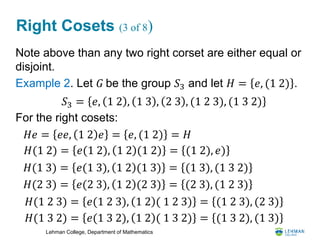
Note above than any two right corset are either equal or
disjoint.
Example 2. Let 𝐺 be the group 𝑆3 and let 𝐻 = 𝑒, (1 2) .
For the right cosets:
𝑆3 = 𝑒, 1 2 , 1 3 , 2 3 , (1 2 3), (1 3 2)
𝐻𝑒 = 𝑒𝑒, 1 2 𝑒 = 𝑒, (1 2) = 𝐻
𝐻(1 2) = 𝑒(1 2), 1 2 (1 2) = (1 2), 𝑒)
𝐻(1 3) = 𝑒(1 3), 1 2 (1 3) = (1 3), (1 3 2)
𝐻(2 3) = 𝑒(2 3), 1 2 (2 3) = (2 3), (1 2 3)
𝐻(1 2 3) = 𝑒(1 2 3), 1 2 ( 1 2 3) = (1 2 3), (2 3)
𝐻(1 3 2) = 𝑒(1 3 2), 1 2 ( 1 3 2) = (1 3 2), (1 3)
Lehman College, Department of Mathematics
Right Cosets (4 of 8)
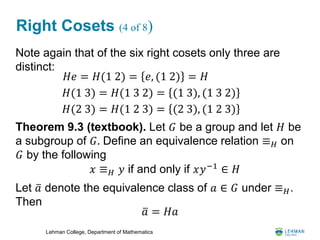
Note again that of the six right cosets only three are
distinct:
Theorem 9.3 (textbook). Let 𝐺 be a group and let 𝐻 be
a subgroup of 𝐺. Define an equivalence relation ≡ 𝐻 on
𝐺 by the following
Let 𝑎 denote the equivalence class of 𝑎 ∈ 𝐺 under ≡ 𝐻.
Then
𝐻𝑒 = 𝐻(1 2) = 𝑒, (1 2) = 𝐻
𝐻(1 3) = 𝐻(1 3 2) = (1 3), (1 3 2)
𝐻(2 3) = 𝐻(1 2 3) = (2 3), (1 2 3)
𝑥 ≡ 𝐻 𝑦 if and only if 𝑥𝑦−1
∈ 𝐻
𝑎 = 𝐻𝑎
Lehman College, Department of Mathematics
Right Cosets (5 of 8)
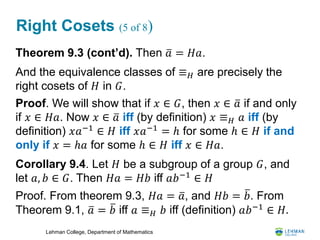
Theorem 9.3 (cont’d). Then 𝑎 = 𝐻𝑎.
And the equivalence classes of ≡ 𝐻 are precisely the
right cosets of 𝐻 in 𝐺.
Proof. We will show that if 𝑥 ∈ 𝐺, then 𝑥 ∈ 𝑎 if and only
if 𝑥 ∈ 𝐻𝑎. Now 𝑥 ∈ 𝑎 iff (by definition) 𝑥 ≡ 𝐻 𝑎 iff (by
definition) 𝑥𝑎−1
∈ 𝐻 iff 𝑥𝑎−1
= ℎ for some ℎ ∈ 𝐻 if and
only if 𝑥 = ℎ𝑎 for some ℎ ∈ 𝐻 iff 𝑥 ∈ 𝐻𝑎.
Corollary 9.4. Let 𝐻 be a subgroup of a group 𝐺, and
let 𝑎, 𝑏 ∈ 𝐺. Then 𝐻𝑎 = 𝐻𝑏 iff 𝑎𝑏−1 ∈ 𝐻
Proof. From theorem 9.3, 𝐻𝑎 = 𝑎, and 𝐻𝑏 = 𝑏. From
Theorem 9.1, 𝑎 = 𝑏 iff 𝑎 ≡ 𝐻 𝑏 iff (definition) 𝑎𝑏−1
∈ 𝐻.
Lehman College, Department of Mathematics
Right Cosets (6 of 8)
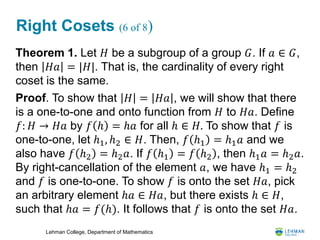
Theorem 1. Let 𝐻 be a subgroup of a group 𝐺. If 𝑎 ∈ 𝐺,
then 𝐻𝑎 = |𝐻|. That is, the cardinality of every right
coset is the same.
Proof. To show that 𝐻 = 𝐻𝑎 , we will show that there
is a one-to-one and onto function from 𝐻 to 𝐻𝑎. Define
𝑓: 𝐻 → 𝐻𝑎 by 𝑓 ℎ = ℎ𝑎 for all ℎ ∈ 𝐻. To show that 𝑓 is
one-to-one, let ℎ1, ℎ2 ∈ 𝐻. Then, 𝑓 ℎ1 = ℎ1 𝑎 and we
also have 𝑓 ℎ2 = ℎ2 𝑎. If 𝑓 ℎ1 = 𝑓 ℎ2 , then ℎ1 𝑎 = ℎ2 𝑎.
By right-cancellation of the element 𝑎, we have ℎ1 = ℎ2
and 𝑓 is one-to-one. To show 𝑓 is onto the set 𝐻𝑎, pick
an arbitrary element ℎ𝑎 ∈ 𝐻𝑎, but there exists ℎ ∈ 𝐻,
such that ℎ𝑎 = 𝑓(ℎ). It follows that 𝑓 is onto the set 𝐻𝑎.
Lehman College, Department of Mathematics
Right Cosets (7 of 8)
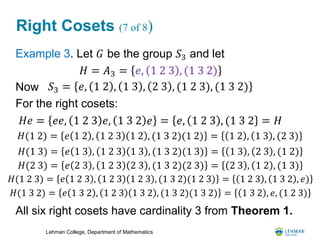
Example 3. Let 𝐺 be the group 𝑆3 and let
Now
For the right cosets:
All six right cosets have cardinality 3 from Theorem 1.
𝐻 = 𝐴3 = 𝑒, 1 2 3 , (1 3 2)
𝑆3 = 𝑒, 1 2 , 1 3 , 2 3 , (1 2 3), (1 3 2)
𝐻𝑒 = 𝑒𝑒, 1 2 3 𝑒, 1 3 2 𝑒 = 𝑒, 1 2 3 , (1 3 2 = 𝐻
𝐻(1 2) = 𝑒 1 2 , 1 2 3 1 2 , (1 3 2)(1 2) = 1 2 , 1 3 , (2 3)
𝐻(1 3) = 𝑒 1 3 , 1 2 3 1 3 , (1 3 2)(1 3) = 1 3 , 2 3 , (1 2)
𝐻(2 3) = 𝑒 2 3 , 1 2 3 2 3 , (1 3 2)(2 3) = 2 3 , 1 2 , (1 3)
𝐻(1 2 3) = 𝑒 1 2 3 , 1 2 3 1 2 3 , (1 3 2)(1 2 3) = 1 2 3 , 1 3 2 , 𝑒)
𝐻(1 3 2) = 𝑒 1 3 2 , 1 2 3 1 3 2 , (1 3 2)(1 3 2) = 1 3 2 , 𝑒, (1 2 3)
Lehman College, Department of Mathematics
Right Cosets (8 of 8)
Note that of the six right cosets only two are distinct:
Let us check on Corollary 9.4. Let 𝐻 be a subgroup of
a group 𝐺, and let 𝑎, 𝑏 ∈ 𝐺. Then 𝐻𝑎 = 𝐻𝑏 iff 𝑎𝑏−1 ∈ 𝐻
We see that 𝐻(1 2) = 𝐻(1 3), so 𝑎 = (1 2) and 𝑏 = (1 3)
Then 𝑎𝑏−1
= 1 2 1 3 −1
= 1 2 1 3 =
1
3
2
1
3
2
= (1 3 2)
and 1 3 2 ∈ 𝐴3 = 𝐻.
𝐻𝑒 = 𝐻(1 2 3) = 𝐻(1 3 2) = 𝑒, 1 2 3 , (1 3 2 = 𝐻
𝐻(1 2) = 𝐻(1 3) = 𝐻(2 3) = 1 2 , 1 3 , (2 3)
Lehman College, Department of Mathematics
Left Cosets (1 of 6)
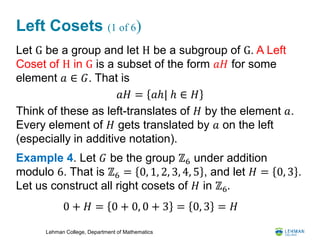
Let G be a group and let H be a subgroup of G. A Left
Coset of H in G is a subset of the form 𝑎𝐻 for some
element 𝑎 ∈ 𝐺. That is
Think of these as left-translates of 𝐻 by the element 𝑎.
Every element of 𝐻 gets translated by 𝑎 on the left
(especially in additive notation).
Example 4. Let 𝐺 be the group ℤ6 under addition
modulo 6. That is ℤ6 = 0, 1, 2, 3, 4, 5 , and let 𝐻 = 0, 3 .
Let us construct all right cosets of 𝐻 in ℤ6.
𝑎𝐻 = 𝑎ℎ| ℎ ∈ 𝐻
0 + 𝐻 = 0 + 0, 0 + 3 = 0, 3 = 𝐻
Lehman College, Department of Mathematics
Left Cosets (2 of 6)
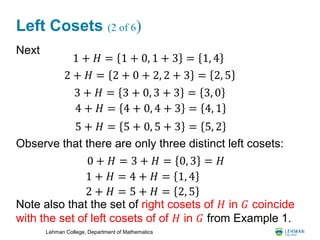
Next
Observe that there are only three distinct left cosets:
Note also that the set of right cosets of 𝐻 in 𝐺 coincide
with the set of left cosets of of 𝐻 in 𝐺 from Example 1.
1 + 𝐻 = 1 + 0, 1 + 3 = 1, 4
2 + 𝐻 = 2 + 0 + 2, 2 + 3 = 2, 5
3 + 𝐻 = 3 + 0, 3 + 3 = 3, 0
4 + 𝐻 = 4 + 0, 4 + 3 = 4, 1
5 + 𝐻 = 5 + 0, 5 + 3 = 5, 2
0 + 𝐻 = 3 + 𝐻 = 0, 3 = 𝐻
1 + 𝐻 = 4 + 𝐻 = 1, 4
2 + 𝐻 = 5 + 𝐻 = 2, 5
Lehman College, Department of Mathematics
Left Cosets (3 of 6)
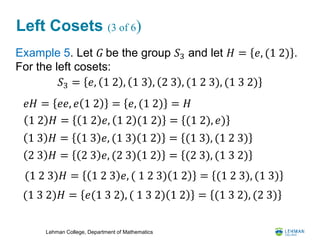
Example 5. Let 𝐺 be the group 𝑆3 and let 𝐻 = 𝑒, (1 2) .
For the left cosets:
𝑆3 = 𝑒, 1 2 , 1 3 , 2 3 , (1 2 3), (1 3 2)
𝑒𝐻 = 𝑒𝑒, 𝑒 1 2 = 𝑒, (1 2) = 𝐻
1 2 𝐻 = 1 2 𝑒, 1 2 (1 2) = (1 2), 𝑒)
1 3 𝐻 = 1 3 𝑒, (1 3) 1 2 = (1 3), (1 2 3)
2 3 𝐻 = 2 3 𝑒, (2 3) 1 2 = (2 3), (1 3 2)
(1 2 3)𝐻 = 1 2 3 𝑒, ( 1 2 3) 1 2 = (1 2 3), (1 3)
(1 3 2)𝐻 = 𝑒(1 3 2), ( 1 3 2) 1 2 = (1 3 2), (2 3)
Lehman College, Department of Mathematics
Left Cosets (4 of 6)
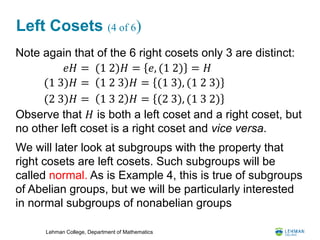
Note again that of the 6 right cosets only 3 are distinct:
Observe that 𝐻 is both a left coset and a right coset, but
no other left coset is a right coset and vice versa.
We will later look at subgroups with the property that
right cosets are left cosets. Such subgroups will be
called normal. As is Example 4, this is true of subgroups
of Abelian groups, but we will be particularly interested
in normal subgroups of nonabelian groups
𝑒𝐻 = (1 2)𝐻 = 𝑒, (1 2) = 𝐻
(1 3)𝐻 = 1 2 3 𝐻 = (1 3), (1 2 3)
(2 3)𝐻 = 1 3 2 𝐻 = (2 3), (1 3 2)
Lehman College, Department of Mathematics
Left Cosets (5 of 6)
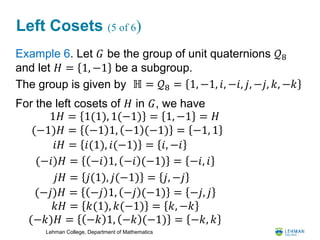
Example 6. Let 𝐺 be the group of unit quaternions 𝒬8
and let 𝐻 = 1, −1 be a subgroup.
The group is given by
For the left cosets of 𝐻 in 𝐺, we have
ℍ = 𝒬8 = 1, −1, 𝑖, −𝑖, 𝑗, −𝑗, 𝑘, −𝑘
1𝐻 = 1(1), 1(−1) = 1, −1 = 𝐻
(−1)𝐻 = −1 1, −1 (−1) = −1, 1
𝑗𝐻 = 𝑗(1), 𝑗(−1) = 𝑗, −𝑗
(−𝑖)𝐻 = −𝑖 1, −𝑖 (−1) = −𝑖, 𝑖
𝑖𝐻 = 𝑖(1), 𝑖(−1) = 𝑖, −𝑖
(−𝑗)𝐻 = −𝑗 1, −𝑗 (−1) = −𝑗, 𝑗
𝑘𝐻 = 𝑘(1), 𝑘(−1) = 𝑘, −𝑘
(−𝑘)𝐻 = −𝑘 1, −𝑘 (−1) = −𝑘, 𝑘
Lehman College, Department of Mathematics
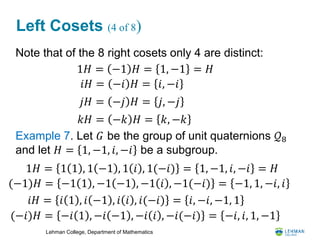
Left Cosets (4 of 8)
Note that of the 8 right cosets only 4 are distinct:
Example 7. Let 𝐺 be the group of unit quaternions 𝒬8
and let 𝐻 = 1, −1, 𝑖, −𝑖 be a subgroup.
1𝐻 = −1 𝐻 = 1, −1 = 𝐻
𝑖𝐻 = −𝑖 𝐻 = 𝑖, −𝑖
𝑗𝐻 = −𝑗 𝐻 = 𝑗, −𝑗
𝑘𝐻 = −𝑘 𝐻 = 𝑘, −𝑘
1𝐻 = 1 1 , 1 −1 , 1 𝑖 , 1(−𝑖) = 1, −1, 𝑖, −𝑖 = 𝐻
𝑖𝐻 = 𝑖 1 , 𝑖 −1 , 𝑖 𝑖 , 𝑖(−𝑖) = 𝑖, −𝑖, −1, 1
(−𝑖)𝐻 = −𝑖 1 , −𝑖 −1 , −𝑖 𝑖 , −𝑖(−𝑖) = −𝑖, 𝑖, 1, −1
(−1)𝐻 = −1 1 , −1 −1 , −1 𝑖 , −1(−𝑖) = −1, 1, −𝑖, 𝑖
Lehman College, Department of Mathematics
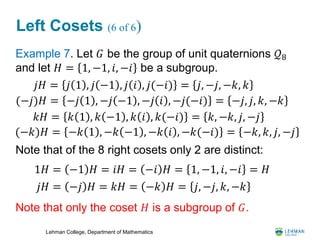
Left Cosets (6 of 6)
Example 7. Let 𝐺 be the group of unit quaternions 𝒬8
and let 𝐻 = 1, −1, 𝑖, −𝑖 be a subgroup.
Note that of the 8 right cosets only 2 are distinct:
Note that only the coset 𝐻 is a subgroup of 𝐺.
𝑗𝐻 = 𝑗 1 , 𝑗 −1 , 𝑗 𝑖 , 𝑗(−𝑖) = 𝑗, −𝑗, −𝑘, 𝑘
(−𝑗)𝐻 = −𝑗 1 , −𝑗 −1 , −𝑗 𝑖 , −𝑗(−𝑖) = −𝑗, 𝑗, 𝑘, −𝑘
𝑘𝐻 = 𝑘 1 , 𝑘 −1 , 𝑘 𝑖 , 𝑘(−𝑖) = 𝑘, −𝑘, 𝑗, −𝑗
(−𝑘)𝐻 = −𝑘 1 , −𝑘 −1 , −𝑘 𝑖 , −𝑘(−𝑖) = −𝑘, 𝑘, 𝑗, −𝑗
1𝐻 = −1 𝐻 = 𝑖𝐻 = −𝑖 𝐻 = 1, −1, 𝑖, −𝑖 = 𝐻
𝑗𝐻 = −𝑗 𝐻 = 𝑘𝐻 = −𝑘 𝐻 = 𝑗, −𝑗, 𝑘, −𝑘

Section 9: Equivalence Relations & Cosets

  • 1.
    Abstract Algebra, Saracino SecondEdition Section 9 Equivalence Relations and Cosets
  • 2.
    Lehman College, Departmentof Mathematics Relations (Definitions) (1 of 2) Let 𝐴 and 𝐵 be two nonempty sets, then a relation (or binary relation) ℛ from 𝐴 into 𝐵 is a set of ordered pairs (𝑥, 𝑦), where 𝑥 ∈ 𝐴 and 𝑦 ∈ 𝐵. Recall the Cartesian Product of 𝐴 and 𝐵, defined as the set: 𝐴 × 𝐵 = 𝑎, 𝑏 𝑎 ∈ 𝐴, 𝑏 ∈ 𝐵 Example: The set ℛ1 = 1, 2 , 2, 5 , 3, −4 , 5, 2 is a relation from ℤ into ℤ, but it is not all of ℤ × ℤ.
  • 3.
    Lehman College, Departmentof Mathematics Relations (Definitions) (2 of 2) The set ℛ2 = 𝑥, 𝑦 ∈ ℝ × ℝ | 𝑥2 + 𝑦2 = 1 is a relation from ℝ into ℝ (the unit circle centered at the origin). It is not the entire cartesian plane ℝ2 = ℝ × ℝ. Let 𝐴 and 𝐵 be two nonempty sets and let ℛ be a relation from 𝐴 into 𝐵. The domain of ℛ is the set 𝑥 ∈ 𝐴 | ∃ 𝑦 ∈ 𝐵, such that 𝑥, 𝑦 ∈ 𝑅 That is, the set of all first elements of ordered pairs in ℛ. The image or range of ℛ is the set 𝑦 ∈ 𝐵 | ∃ 𝑥 ∈ 𝐴, such that 𝑥, 𝑦 ∈ 𝑅
  • 4.
    Lehman College, Departmentof Mathematics Equivalence Relations (1 of 3) A relation ℛ on a set 𝑆 is a relation from 𝑆 to itself. We will define a special relation from 𝑆 to itself. If 𝑎, 𝑏 ∈ 𝑆 such that 𝑎, 𝑏 ∈ ℛ, we write 𝑎 ∼ 𝑏 ℛ is an Equivalence Relation on the set 𝑆 if the following three conditions hold (1) Reflexivity: (2) Symmetry: (3) Transitivity: For every 𝑎 ∈ 𝑆, we have 𝑎 ∼ 𝑎 For every 𝑎, 𝑏 ∈ 𝑆, if 𝑎 ∼ 𝑏, then 𝑏 ∼ 𝑎 For every 𝑎, 𝑏, 𝑐 ∈ 𝑆, if 𝑎 ∼ 𝑏 and 𝑏 ∼ 𝑐, then 𝑎 ∼ 𝑐
  • 5.
    Lehman College, Departmentof Mathematics Equivalence Relations (2 of 3) We have already seen an example of an equivalence relation in Homework 5 Question 5. Let 𝐺 be a group with identity element 𝑒., and let 𝑎, 𝑏, 𝑐 ∈ 𝐺. If there exists 𝑥 ∈ 𝐺, such that 𝑎 = 𝑥𝑏𝑥−1 , we say 𝑎 is conjugate to 𝑏. Reflexivity. Symmetry: For every 𝑎 ∈ 𝑆, we have 𝑎 ∼ 𝑎 since For every 𝑎, 𝑏 ∈ 𝑆, if 𝑎 ∼ 𝑏, then 𝑏 ∼ 𝑎 𝑎 = 𝑒𝑎𝑒−1 with 𝑒 ∈ 𝐺 Since 𝑎 ∼ 𝑏 means there exists 𝑥 ∈ 𝐺 such that 𝑎 = 𝑥𝑏𝑥−1 . It follows that 𝑥−1 𝑎𝑥 = 𝑥−1 𝑥𝑏𝑥−1 𝑥 and 𝑏 = 𝑥−1 𝑎𝑥 = 𝑥−1 𝑎 𝑥−1 −1
  • 6.
    Lehman College, Departmentof Mathematics Equivalence Relations (3 of 3) From the last statement of the preceding slide, 𝑏 ∼ 𝑎. Transitivity. It follows that For every 𝑎, 𝑏, 𝑐 ∈ 𝑆, if 𝑎 ∼ 𝑏 and 𝑏 ∼ 𝑐, then 𝑎 ∼ 𝑐 Since 𝑎 ∼ 𝑏 means there exists 𝑥 ∈ 𝐺 such that 𝑎 = 𝑥𝑏𝑥−1 . And 𝑏 ∼ 𝑐 means there exists 𝑦 ∈ 𝐺 such that 𝑏 = 𝑦𝑐𝑦−1 𝑎 = 𝑥𝑏𝑥−1 = 𝑥 𝑦𝑐𝑦−1 𝑥−1 = 𝑥𝑦𝑐𝑦−1 𝑥−1 = (𝑥𝑦)𝑐 𝑥𝑦 −1
  • 7.
    Lehman College, Departmentof Mathematics Modular Arithmetic (1 of 2) Recall modular arithmetic Because 8 − 2 is divisible by 3 (integer division). In general for integers 𝑎, 𝑏 and for positive integers 𝑛 if and only if 𝑛 divides the difference 𝑎 − 𝑏. We will show that modular arithmetic forms an equivalence relation on the set of integers. (1) Reflexivity. Let 𝑛 be a positive integer and let 𝑎 be any integer. Then 𝑎 ≡ 𝑎 (mod 𝑛) since 𝑎 − 𝑎 = 0 is divisible by any positive integer 𝑛 8 ≡ 2 (mod 3) 𝑎 ≡ 𝑏 (mod 𝑛)
  • 8.
    Lehman College, Departmentof Mathematics Modular Arithmetic (2 of 2) (2) Symmetry. Let 𝑛 be a positive integer and let 𝑎 and 𝑏 be integers, such that 𝑎 ≡ 𝑏 (mod 𝑛). Then 𝑎 − 𝑏 is divisible by 𝑛. It follows that 𝑏 − 𝑎 is also divisible by 𝑛 and (2) Transitivity. Let 𝑛 be a positive integer and let 𝑎, 𝑏 and 𝑐 be integers, such that 𝑎 ≡ 𝑏 (mod 𝑛) and 𝑏 ≡ 𝑐 (mod 𝑛). Then both 𝑎 − 𝑏 and 𝑏 − 𝑐 are divisible by 𝑛. It follows their sum is also divisible by 𝑛. That is Since 𝑎 − 𝑐 is divisible by 𝑛, then by definition 𝑏 ≡ 𝑎 (mod 𝑛) 𝑎 − 𝑏 + 𝑏 − 𝑐 = 𝑎 − 𝑐 𝑎 ≡ 𝑐 (mod 𝑛)
  • 9.
    Lehman College, Departmentof Mathematics Equivalence Classes (1 of 5) Let 𝑆 be a set and let ∼ be an equivalence relation on 𝑆. Then the set of all 𝑥 ∈ 𝑆, such that 𝑥 ∼ 𝑎 is called the equivalence class of the element 𝑎, and denoted 𝑎 or sometimes 𝑎 . In set notation: Theorem 9.1 (textbook): Let 𝑆 be a set and let ∼ be an equivalence relation 𝑆. Then every element of 𝑆 is in exactly one equivalence class under ∼. That is, the equivalence classes partition 𝑆 into a family of mutually disjoint, nonempty subsets. Conversely, given any partition of a set 𝑆 into mutually disjoint, nonempty subsets, then there is an equivalence relation on 𝑎 = 𝑥 ∈ 𝑆 | 𝑥 ∼ 𝑎
  • 10.
    Lehman College, Departmentof Mathematics Equivalence Classes (2 of 5) Theorem 9.1 (cont’d): Conversely, given any partition of a set 𝑆 into mutually disjoint, nonempty subsets, then there is an equivalence relation on 𝑆 whose equivalence classes are precisely the subsets in the given partition of 𝑆. Proof. By reflexivity 𝑎 ∈ 𝑎 for any 𝑎 ∈ 𝑆. So, we see that every element of 𝑆 is contained in some equivalence class and that each equivalence class is nonempty. We will now show that if 𝑎 ∼ 𝑏, then 𝑎 = 𝑏, otherwise their respective equivalence classes are disjoint. Recall From 𝑎 ∼ 𝑏 then 𝑎 ∈ 𝑏. Now, let 𝑦 ∈ 𝑎 then 𝑦 ∼ 𝑎, and 𝑏 = 𝑥 ∈ 𝑆 | 𝑥 ∼ 𝑏
  • 11.
    Lehman College, Departmentof Mathematics Equivalence Classes (3 of 5) Theorem 9.1 (cont’d): From 𝑎 ∼ 𝑏 then 𝑎 ∈ 𝑏. Now, let 𝑦 ∈ 𝑎 then 𝑦 ∼ 𝑎, and 𝑦 ∼ 𝑏. Hence 𝑎 ⊆ 𝑏. Similarly, we can show that 𝑏 ⊆ 𝑎. Therefore, 𝑎 = 𝑏. If not, suppose the intersection is nonempty, It follows that 𝑥 ∈ 𝑎 and 𝑥 ∈ 𝑏. Hence 𝑥 ∼ 𝑎 and 𝑥 ∼ 𝑏. By symmetry then by transitivity we have 𝑎 ∼ 𝑏, a contradiction. We can show that 𝑎 = 𝑏 if and only if 𝑎 ∼ 𝑏. We have shown one part already. We only need to show that if 𝑎 = 𝑏 then 𝑎 ∼ 𝑏. Since 𝑎 ∈ 𝑎 and 𝑎 = 𝑏 then 𝑎 ∈ 𝑏 and 𝑎 ∼ 𝑏. That is each element is a representative. 𝑥 ∈ 𝑎 ∩ 𝑏
  • 12.
    Lehman College, Departmentof Mathematics Equivalence Classes (4 of 5) Recall congruence modulo 𝑛as an equivalence class. There 𝑎 ≡ 𝑏 (mod 𝑛) if and only if 𝑛 divides 𝑎 − 𝑏. By analogy in groups 𝑎 − 𝑏 would be 𝑎𝑏−1 . Theorem 9.2. Let 𝐺 be a group and let 𝐻 be a subgroup of 𝐺. Define a relation ≡ 𝐻 on 𝐺 by the following Then ≡ 𝐻 is an equivalence operation. (1) Reflexivity. 𝑎 ≡ 𝐻 𝑎 for all 𝑎 ∈ 𝐺 since 𝑎𝑎−1 = 𝑒 ∈ 𝐻. 2) Symmetry. Let 𝑎, 𝑏 ∈ 𝐺, such that 𝑎 ≡ 𝐻 𝑏. That is 𝑎𝑏−1 ∈ 𝐻. But 𝐻 is closed under inverses, so 𝑥 ≡ 𝐻 𝑦 if and only if 𝑥𝑦−1 ∈ 𝐻 𝑎𝑏−1 −1 = 𝑏−1 −1 𝑎−1 = 𝑏𝑎−1 ∈ 𝐻
  • 13.
    Lehman College, Departmentof Mathematics Equivalence Classes (5 of 5) (2) Symmetry. Let 𝑎, 𝑏 ∈ 𝐺, such that 𝑎 ≡ 𝐻 𝑏. That is 𝑎𝑏−1 ∈ 𝐻. But 𝐻 is closed under inverses, so It follows that 𝑏 ≡ 𝐻 𝑎. 2) Transitivity. Let 𝑎, 𝑏, 𝑐 ∈ 𝐺, such that 𝑎 ≡ 𝐻 𝑏 and 𝑏 ≡ 𝐻 𝑐. That is 𝑎𝑏−1 ∈ 𝐻 and 𝑏𝑐−1 ∈ 𝐻. But 𝐻 is closed under products, so It follows that 𝑎 ≡ 𝐻 𝑐 𝑎𝑏−1 −1 = 𝑏−1 −1 𝑎−1 = 𝑏𝑎−1 ∈ 𝐻 𝑎𝑏−1 𝑏𝑐−1 = 𝑎 𝑏−1 𝑏 𝑐−1 = 𝑎𝑐−1
  • 14.
    Lehman College, Departmentof Mathematics Right Cosets (1 of 8) Let G be a group and let H be a subgroup of G. A Right Coset of H in G is a subset of the form 𝐻𝑎 for some element 𝑎 ∈ 𝐺. That is Think of these as right-translates of 𝐻 by the element 𝑎. Every element of 𝐻 gets translated by 𝑎 on the right (especially in additive notation). Example 1. Let 𝐺 be the group ℤ6 under addition modulo 6. That is ℤ6 = 0, 1, 2, 3, 4, 5 , and let 𝐻 = 0, 3 . Let us construct all right cosets of 𝐻 in ℤ6. 𝐻𝑎 = ℎ𝑎 | ℎ ∈ 𝐻 𝐻 + 0 = 0 + 0, 3 + 0 = 0, 3 = 𝐻
  • 15.
    Lehman College, Departmentof Mathematics Right Cosets (2 of 8) Next Observe that the right cosets are in set notation, so there are only three distinct right cosets: 𝐻 + 1 = 0 + 1, 3 + 1 = 1, 4 𝐻 + 2 = 0 + 2, 3 + 2 = 2, 5 𝐻 + 3 = 0 + 3, 3 + 3 = 3, 0 𝐻 + 4 = 0 + 4, 3 + 4 = 4, 1 𝐻 + 5 = 0 + 5, 3 + 5 = 5, 2 𝐻 + 0 = 𝐻 + 3 = 0, 3 = 𝐻 𝐻 + 1 = 𝐻 + 4 = 1, 4 𝐻 + 2 = 𝐻 + 5 = 2, 5
  • 16.
    Lehman College, Departmentof Mathematics Right Cosets (3 of 8) Note above than any two right corset are either equal or disjoint. Example 2. Let 𝐺 be the group 𝑆3 and let 𝐻 = 𝑒, (1 2) . For the right cosets: 𝑆3 = 𝑒, 1 2 , 1 3 , 2 3 , (1 2 3), (1 3 2) 𝐻𝑒 = 𝑒𝑒, 1 2 𝑒 = 𝑒, (1 2) = 𝐻 𝐻(1 2) = 𝑒(1 2), 1 2 (1 2) = (1 2), 𝑒) 𝐻(1 3) = 𝑒(1 3), 1 2 (1 3) = (1 3), (1 3 2) 𝐻(2 3) = 𝑒(2 3), 1 2 (2 3) = (2 3), (1 2 3) 𝐻(1 2 3) = 𝑒(1 2 3), 1 2 ( 1 2 3) = (1 2 3), (2 3) 𝐻(1 3 2) = 𝑒(1 3 2), 1 2 ( 1 3 2) = (1 3 2), (1 3)
  • 17.
    Lehman College, Departmentof Mathematics Right Cosets (4 of 8) Note again that of the six right cosets only three are distinct: Theorem 9.3 (textbook). Let 𝐺 be a group and let 𝐻 be a subgroup of 𝐺. Define an equivalence relation ≡ 𝐻 on 𝐺 by the following Let 𝑎 denote the equivalence class of 𝑎 ∈ 𝐺 under ≡ 𝐻. Then 𝐻𝑒 = 𝐻(1 2) = 𝑒, (1 2) = 𝐻 𝐻(1 3) = 𝐻(1 3 2) = (1 3), (1 3 2) 𝐻(2 3) = 𝐻(1 2 3) = (2 3), (1 2 3) 𝑥 ≡ 𝐻 𝑦 if and only if 𝑥𝑦−1 ∈ 𝐻 𝑎 = 𝐻𝑎
  • 18.
    Lehman College, Departmentof Mathematics Right Cosets (5 of 8) Theorem 9.3 (cont’d). Then 𝑎 = 𝐻𝑎. And the equivalence classes of ≡ 𝐻 are precisely the right cosets of 𝐻 in 𝐺. Proof. We will show that if 𝑥 ∈ 𝐺, then 𝑥 ∈ 𝑎 if and only if 𝑥 ∈ 𝐻𝑎. Now 𝑥 ∈ 𝑎 iff (by definition) 𝑥 ≡ 𝐻 𝑎 iff (by definition) 𝑥𝑎−1 ∈ 𝐻 iff 𝑥𝑎−1 = ℎ for some ℎ ∈ 𝐻 if and only if 𝑥 = ℎ𝑎 for some ℎ ∈ 𝐻 iff 𝑥 ∈ 𝐻𝑎. Corollary 9.4. Let 𝐻 be a subgroup of a group 𝐺, and let 𝑎, 𝑏 ∈ 𝐺. Then 𝐻𝑎 = 𝐻𝑏 iff 𝑎𝑏−1 ∈ 𝐻 Proof. From theorem 9.3, 𝐻𝑎 = 𝑎, and 𝐻𝑏 = 𝑏. From Theorem 9.1, 𝑎 = 𝑏 iff 𝑎 ≡ 𝐻 𝑏 iff (definition) 𝑎𝑏−1 ∈ 𝐻.
  • 19.
    Lehman College, Departmentof Mathematics Right Cosets (6 of 8) Theorem 1. Let 𝐻 be a subgroup of a group 𝐺. If 𝑎 ∈ 𝐺, then 𝐻𝑎 = |𝐻|. That is, the cardinality of every right coset is the same. Proof. To show that 𝐻 = 𝐻𝑎 , we will show that there is a one-to-one and onto function from 𝐻 to 𝐻𝑎. Define 𝑓: 𝐻 → 𝐻𝑎 by 𝑓 ℎ = ℎ𝑎 for all ℎ ∈ 𝐻. To show that 𝑓 is one-to-one, let ℎ1, ℎ2 ∈ 𝐻. Then, 𝑓 ℎ1 = ℎ1 𝑎 and we also have 𝑓 ℎ2 = ℎ2 𝑎. If 𝑓 ℎ1 = 𝑓 ℎ2 , then ℎ1 𝑎 = ℎ2 𝑎. By right-cancellation of the element 𝑎, we have ℎ1 = ℎ2 and 𝑓 is one-to-one. To show 𝑓 is onto the set 𝐻𝑎, pick an arbitrary element ℎ𝑎 ∈ 𝐻𝑎, but there exists ℎ ∈ 𝐻, such that ℎ𝑎 = 𝑓(ℎ). It follows that 𝑓 is onto the set 𝐻𝑎.
  • 20.
    Lehman College, Departmentof Mathematics Right Cosets (7 of 8) Example 3. Let 𝐺 be the group 𝑆3 and let Now For the right cosets: All six right cosets have cardinality 3 from Theorem 1. 𝐻 = 𝐴3 = 𝑒, 1 2 3 , (1 3 2) 𝑆3 = 𝑒, 1 2 , 1 3 , 2 3 , (1 2 3), (1 3 2) 𝐻𝑒 = 𝑒𝑒, 1 2 3 𝑒, 1 3 2 𝑒 = 𝑒, 1 2 3 , (1 3 2 = 𝐻 𝐻(1 2) = 𝑒 1 2 , 1 2 3 1 2 , (1 3 2)(1 2) = 1 2 , 1 3 , (2 3) 𝐻(1 3) = 𝑒 1 3 , 1 2 3 1 3 , (1 3 2)(1 3) = 1 3 , 2 3 , (1 2) 𝐻(2 3) = 𝑒 2 3 , 1 2 3 2 3 , (1 3 2)(2 3) = 2 3 , 1 2 , (1 3) 𝐻(1 2 3) = 𝑒 1 2 3 , 1 2 3 1 2 3 , (1 3 2)(1 2 3) = 1 2 3 , 1 3 2 , 𝑒) 𝐻(1 3 2) = 𝑒 1 3 2 , 1 2 3 1 3 2 , (1 3 2)(1 3 2) = 1 3 2 , 𝑒, (1 2 3)
  • 21.
    Lehman College, Departmentof Mathematics Right Cosets (8 of 8) Note that of the six right cosets only two are distinct: Let us check on Corollary 9.4. Let 𝐻 be a subgroup of a group 𝐺, and let 𝑎, 𝑏 ∈ 𝐺. Then 𝐻𝑎 = 𝐻𝑏 iff 𝑎𝑏−1 ∈ 𝐻 We see that 𝐻(1 2) = 𝐻(1 3), so 𝑎 = (1 2) and 𝑏 = (1 3) Then 𝑎𝑏−1 = 1 2 1 3 −1 = 1 2 1 3 = 1 3 2 1 3 2 = (1 3 2) and 1 3 2 ∈ 𝐴3 = 𝐻. 𝐻𝑒 = 𝐻(1 2 3) = 𝐻(1 3 2) = 𝑒, 1 2 3 , (1 3 2 = 𝐻 𝐻(1 2) = 𝐻(1 3) = 𝐻(2 3) = 1 2 , 1 3 , (2 3)
  • 22.
    Lehman College, Departmentof Mathematics Left Cosets (1 of 6) Let G be a group and let H be a subgroup of G. A Left Coset of H in G is a subset of the form 𝑎𝐻 for some element 𝑎 ∈ 𝐺. That is Think of these as left-translates of 𝐻 by the element 𝑎. Every element of 𝐻 gets translated by 𝑎 on the left (especially in additive notation). Example 4. Let 𝐺 be the group ℤ6 under addition modulo 6. That is ℤ6 = 0, 1, 2, 3, 4, 5 , and let 𝐻 = 0, 3 . Let us construct all right cosets of 𝐻 in ℤ6. 𝑎𝐻 = 𝑎ℎ| ℎ ∈ 𝐻 0 + 𝐻 = 0 + 0, 0 + 3 = 0, 3 = 𝐻
  • 23.
    Lehman College, Departmentof Mathematics Left Cosets (2 of 6) Next Observe that there are only three distinct left cosets: Note also that the set of right cosets of 𝐻 in 𝐺 coincide with the set of left cosets of of 𝐻 in 𝐺 from Example 1. 1 + 𝐻 = 1 + 0, 1 + 3 = 1, 4 2 + 𝐻 = 2 + 0 + 2, 2 + 3 = 2, 5 3 + 𝐻 = 3 + 0, 3 + 3 = 3, 0 4 + 𝐻 = 4 + 0, 4 + 3 = 4, 1 5 + 𝐻 = 5 + 0, 5 + 3 = 5, 2 0 + 𝐻 = 3 + 𝐻 = 0, 3 = 𝐻 1 + 𝐻 = 4 + 𝐻 = 1, 4 2 + 𝐻 = 5 + 𝐻 = 2, 5
  • 24.
    Lehman College, Departmentof Mathematics Left Cosets (3 of 6) Example 5. Let 𝐺 be the group 𝑆3 and let 𝐻 = 𝑒, (1 2) . For the left cosets: 𝑆3 = 𝑒, 1 2 , 1 3 , 2 3 , (1 2 3), (1 3 2) 𝑒𝐻 = 𝑒𝑒, 𝑒 1 2 = 𝑒, (1 2) = 𝐻 1 2 𝐻 = 1 2 𝑒, 1 2 (1 2) = (1 2), 𝑒) 1 3 𝐻 = 1 3 𝑒, (1 3) 1 2 = (1 3), (1 2 3) 2 3 𝐻 = 2 3 𝑒, (2 3) 1 2 = (2 3), (1 3 2) (1 2 3)𝐻 = 1 2 3 𝑒, ( 1 2 3) 1 2 = (1 2 3), (1 3) (1 3 2)𝐻 = 𝑒(1 3 2), ( 1 3 2) 1 2 = (1 3 2), (2 3)
  • 25.
    Lehman College, Departmentof Mathematics Left Cosets (4 of 6) Note again that of the 6 right cosets only 3 are distinct: Observe that 𝐻 is both a left coset and a right coset, but no other left coset is a right coset and vice versa. We will later look at subgroups with the property that right cosets are left cosets. Such subgroups will be called normal. As is Example 4, this is true of subgroups of Abelian groups, but we will be particularly interested in normal subgroups of nonabelian groups 𝑒𝐻 = (1 2)𝐻 = 𝑒, (1 2) = 𝐻 (1 3)𝐻 = 1 2 3 𝐻 = (1 3), (1 2 3) (2 3)𝐻 = 1 3 2 𝐻 = (2 3), (1 3 2)
  • 26.
    Lehman College, Departmentof Mathematics Left Cosets (5 of 6) Example 6. Let 𝐺 be the group of unit quaternions 𝒬8 and let 𝐻 = 1, −1 be a subgroup. The group is given by For the left cosets of 𝐻 in 𝐺, we have ℍ = 𝒬8 = 1, −1, 𝑖, −𝑖, 𝑗, −𝑗, 𝑘, −𝑘 1𝐻 = 1(1), 1(−1) = 1, −1 = 𝐻 (−1)𝐻 = −1 1, −1 (−1) = −1, 1 𝑗𝐻 = 𝑗(1), 𝑗(−1) = 𝑗, −𝑗 (−𝑖)𝐻 = −𝑖 1, −𝑖 (−1) = −𝑖, 𝑖 𝑖𝐻 = 𝑖(1), 𝑖(−1) = 𝑖, −𝑖 (−𝑗)𝐻 = −𝑗 1, −𝑗 (−1) = −𝑗, 𝑗 𝑘𝐻 = 𝑘(1), 𝑘(−1) = 𝑘, −𝑘 (−𝑘)𝐻 = −𝑘 1, −𝑘 (−1) = −𝑘, 𝑘
  • 27.
    Lehman College, Departmentof Mathematics Left Cosets (4 of 8) Note that of the 8 right cosets only 4 are distinct: Example 7. Let 𝐺 be the group of unit quaternions 𝒬8 and let 𝐻 = 1, −1, 𝑖, −𝑖 be a subgroup. 1𝐻 = −1 𝐻 = 1, −1 = 𝐻 𝑖𝐻 = −𝑖 𝐻 = 𝑖, −𝑖 𝑗𝐻 = −𝑗 𝐻 = 𝑗, −𝑗 𝑘𝐻 = −𝑘 𝐻 = 𝑘, −𝑘 1𝐻 = 1 1 , 1 −1 , 1 𝑖 , 1(−𝑖) = 1, −1, 𝑖, −𝑖 = 𝐻 𝑖𝐻 = 𝑖 1 , 𝑖 −1 , 𝑖 𝑖 , 𝑖(−𝑖) = 𝑖, −𝑖, −1, 1 (−𝑖)𝐻 = −𝑖 1 , −𝑖 −1 , −𝑖 𝑖 , −𝑖(−𝑖) = −𝑖, 𝑖, 1, −1 (−1)𝐻 = −1 1 , −1 −1 , −1 𝑖 , −1(−𝑖) = −1, 1, −𝑖, 𝑖
  • 28.
    Lehman College, Departmentof Mathematics Left Cosets (6 of 6) Example 7. Let 𝐺 be the group of unit quaternions 𝒬8 and let 𝐻 = 1, −1, 𝑖, −𝑖 be a subgroup. Note that of the 8 right cosets only 2 are distinct: Note that only the coset 𝐻 is a subgroup of 𝐺. 𝑗𝐻 = 𝑗 1 , 𝑗 −1 , 𝑗 𝑖 , 𝑗(−𝑖) = 𝑗, −𝑗, −𝑘, 𝑘 (−𝑗)𝐻 = −𝑗 1 , −𝑗 −1 , −𝑗 𝑖 , −𝑗(−𝑖) = −𝑗, 𝑗, 𝑘, −𝑘 𝑘𝐻 = 𝑘 1 , 𝑘 −1 , 𝑘 𝑖 , 𝑘(−𝑖) = 𝑘, −𝑘, 𝑗, −𝑗 (−𝑘)𝐻 = −𝑘 1 , −𝑘 −1 , −𝑘 𝑖 , −𝑘(−𝑖) = −𝑘, 𝑘, 𝑗, −𝑗 1𝐻 = −1 𝐻 = 𝑖𝐻 = −𝑖 𝐻 = 1, −1, 𝑖, −𝑖 = 𝐻 𝑗𝐻 = −𝑗 𝐻 = 𝑘𝐻 = −𝑘 𝐻 = 𝑗, −𝑗, 𝑘, −𝑘