𝐏𝐓𝐒 𝟑
Bridge to Calculus Workshop
Summer 2020
Lesson 22
Polynomial Long
Division
"Perfect numbers like perfect men
are very rare.“ – Descartes -
Lehman College, Department of Mathematics
Factoring Binomials (1 of 1)
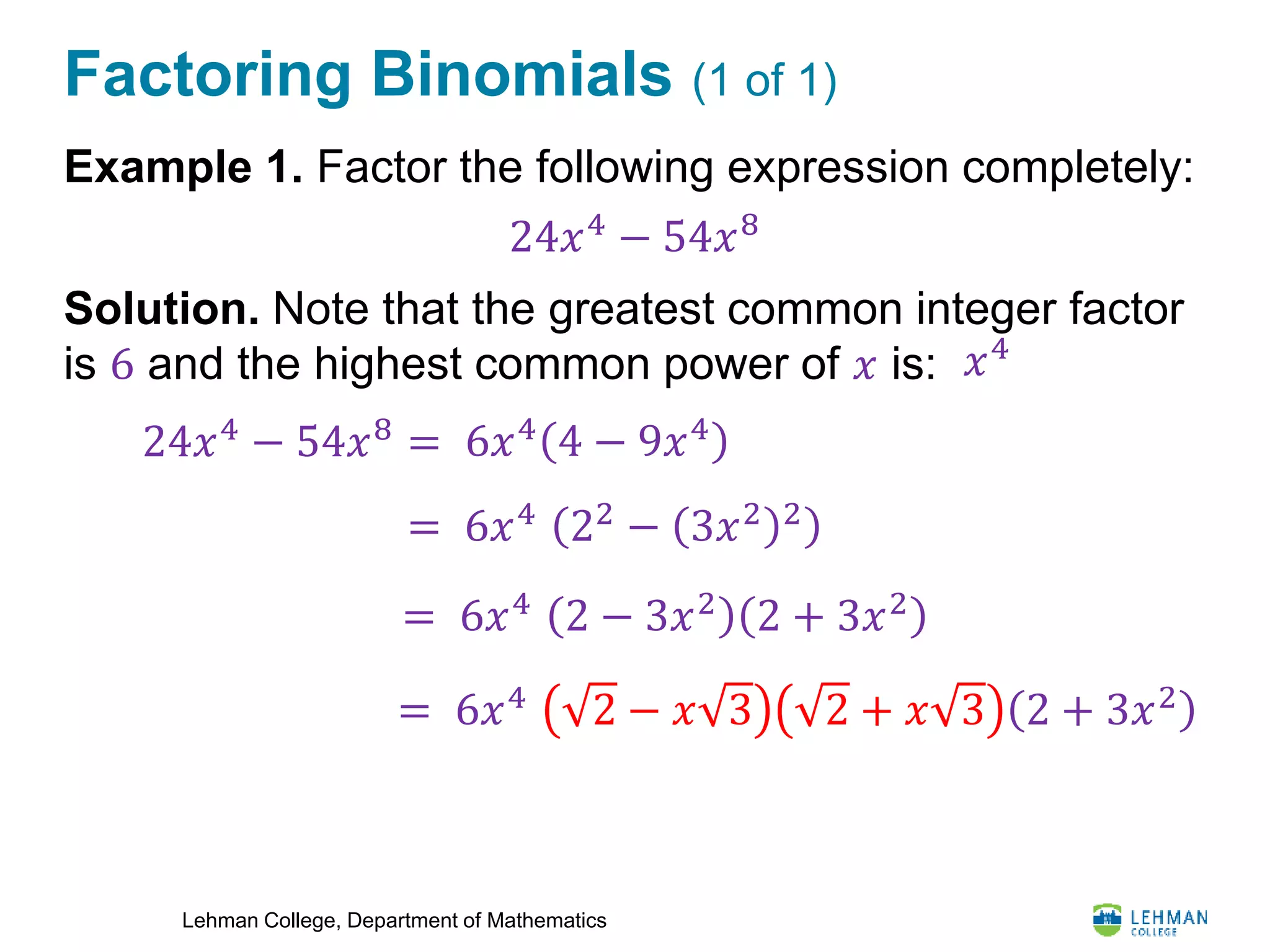
Example 1. Factor the following expression completely:
Solution. Note that the greatest common integer factor
is 6 and the highest common power of 𝑥 is:
24𝑥4
− 54𝑥8
𝑥4
24𝑥4
− 54𝑥8
= 6𝑥4
4 − 9𝑥4
= 6𝑥4
22
− 3𝑥2 2
= 6𝑥4
2 − 3𝑥2
2 + 3𝑥2
= 6𝑥4
2 − 𝑥 3 2 + 𝑥 3 2 + 3𝑥2
Lehman College, Department of Mathematics
Factoring Binomials (1 of 1)
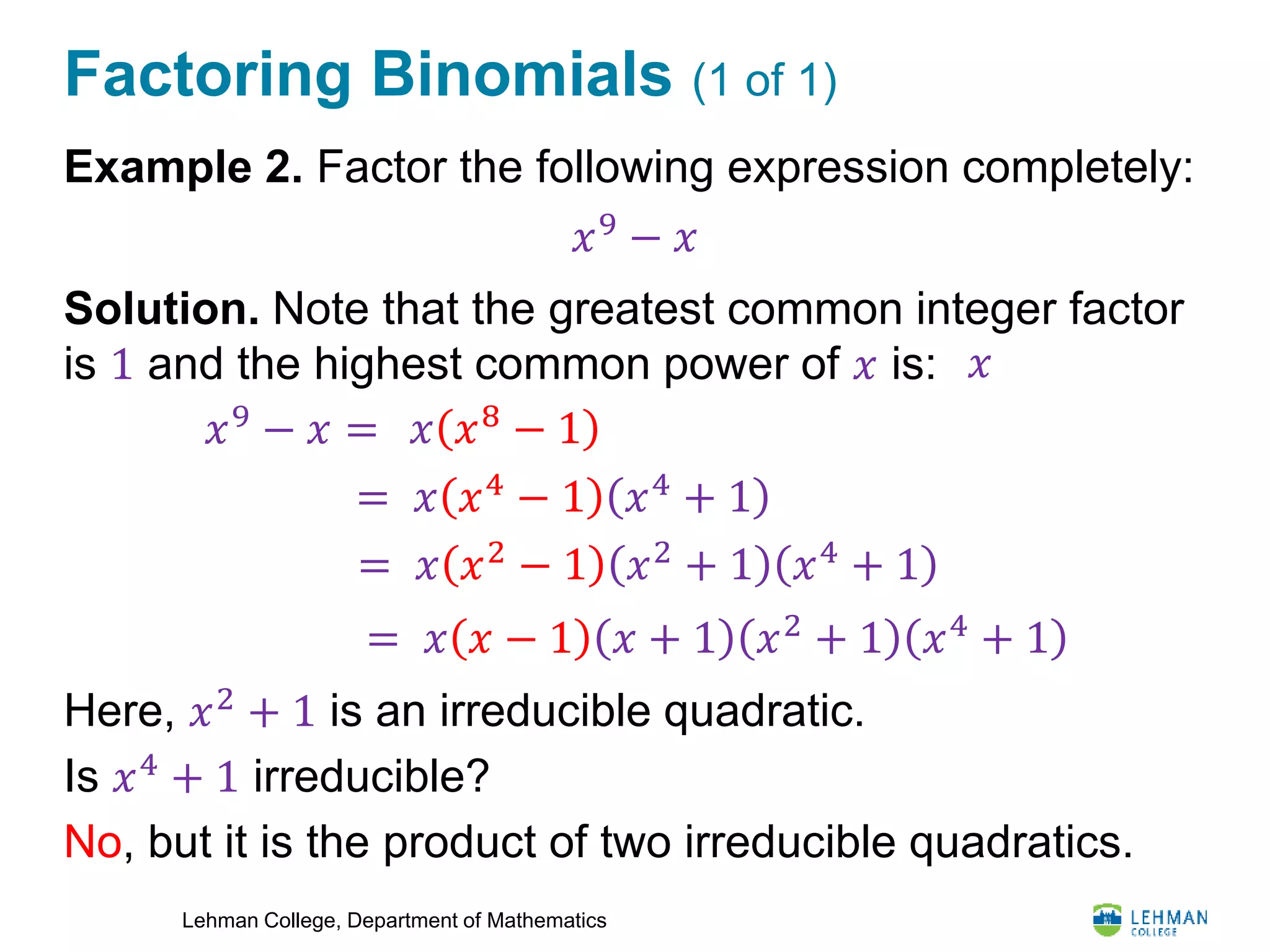
Example 2. Factor the following expression completely:
Solution. Note that the greatest common integer factor
is 1 and the highest common power of 𝑥 is:
Here, 𝑥2
+ 1 is an irreducible quadratic.
Is 𝑥4 + 1 irreducible?
No, but it is the product of two irreducible quadratics.
𝑥9
− 𝑥
𝑥
𝑥9
− 𝑥 = 𝑥 𝑥8 − 1
= 𝑥 𝑥4
− 1 𝑥4
+ 1
= 𝑥 𝑥2
− 1 𝑥2
+ 1 𝑥4
+ 1
= 𝑥 𝑥 − 1 𝑥 + 1 𝑥2 + 1 𝑥4 + 1
Lehman College, Department of Mathematics
Rational Numbers (1 of 2)
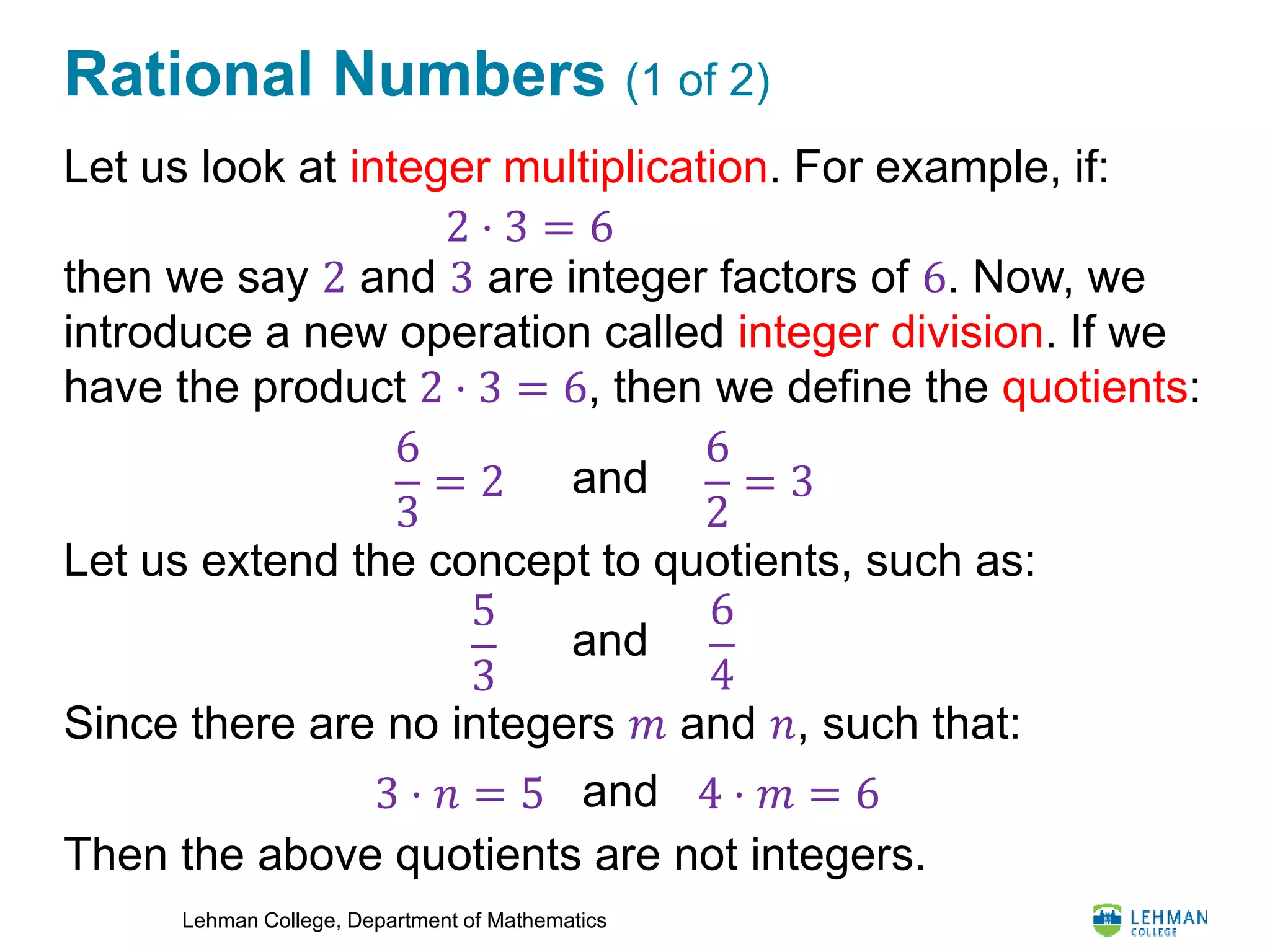
Let us look at integer multiplication. For example, if:
then we say 2 and 3 are integer factors of 6. Now, we
introduce a new operation called integer division. If we
have the product 2 ⋅ 3 = 6, then we define the quotients:
Let us extend the concept to quotients, such as:
Since there are no integers 𝑚 and 𝑛, such that:
Then the above quotients are not integers.
2 ⋅ 3 = 6
6
3
= 2
6
2
= 3and
5
3
6
4
and
3 ⋅ 𝑛 = 5 4 ⋅ 𝑚 = 6and
Lehman College, Department of Mathematics
Rational Numbers (2 of 2)
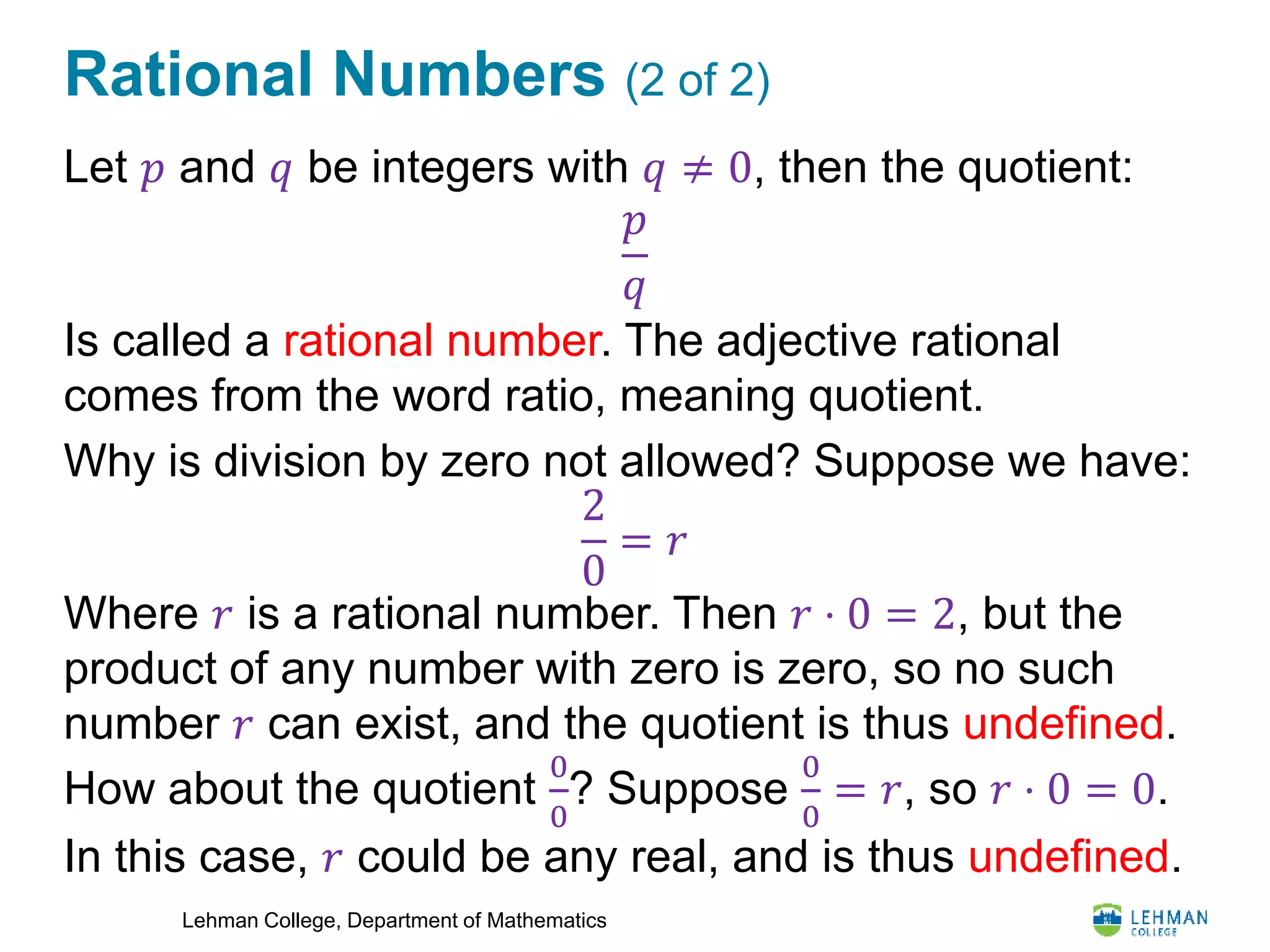
Let 𝑝 and 𝑞 be integers with 𝑞 ≠ 0, then the quotient:
Is called a rational number. The adjective rational
comes from the word ratio, meaning quotient.
Why is division by zero not allowed? Suppose we have:
Where 𝑟 is a rational number. Then 𝑟 ⋅ 0 = 2, but the
product of any number with zero is zero, so no such
number 𝑟 can exist, and the quotient is thus undefined.
How about the quotient
0
0
? Suppose
0
0
= 𝑟, so 𝑟 ⋅ 0 = 0.
In this case, 𝑟 could be any real, and is thus undefined.
𝑝
𝑞
2
0
= 𝑟
Lehman College, Department of Mathematics
Integer Division (1 of 6)
Example 1. Perform the following operation:
Solution. Since:
Then:
The number 1 is called the quotient, and 2 is the
remainder of integer division.
5
3
3 ⋅ 1 = 3 3 ⋅ 2 = 6and< 5 > 5
5
3
=
3 + 2
3
=
3
3
+
2
3
= 1 +
2
3
Lehman College, Department of Mathematics
Rational Function Definition (1 of 1)
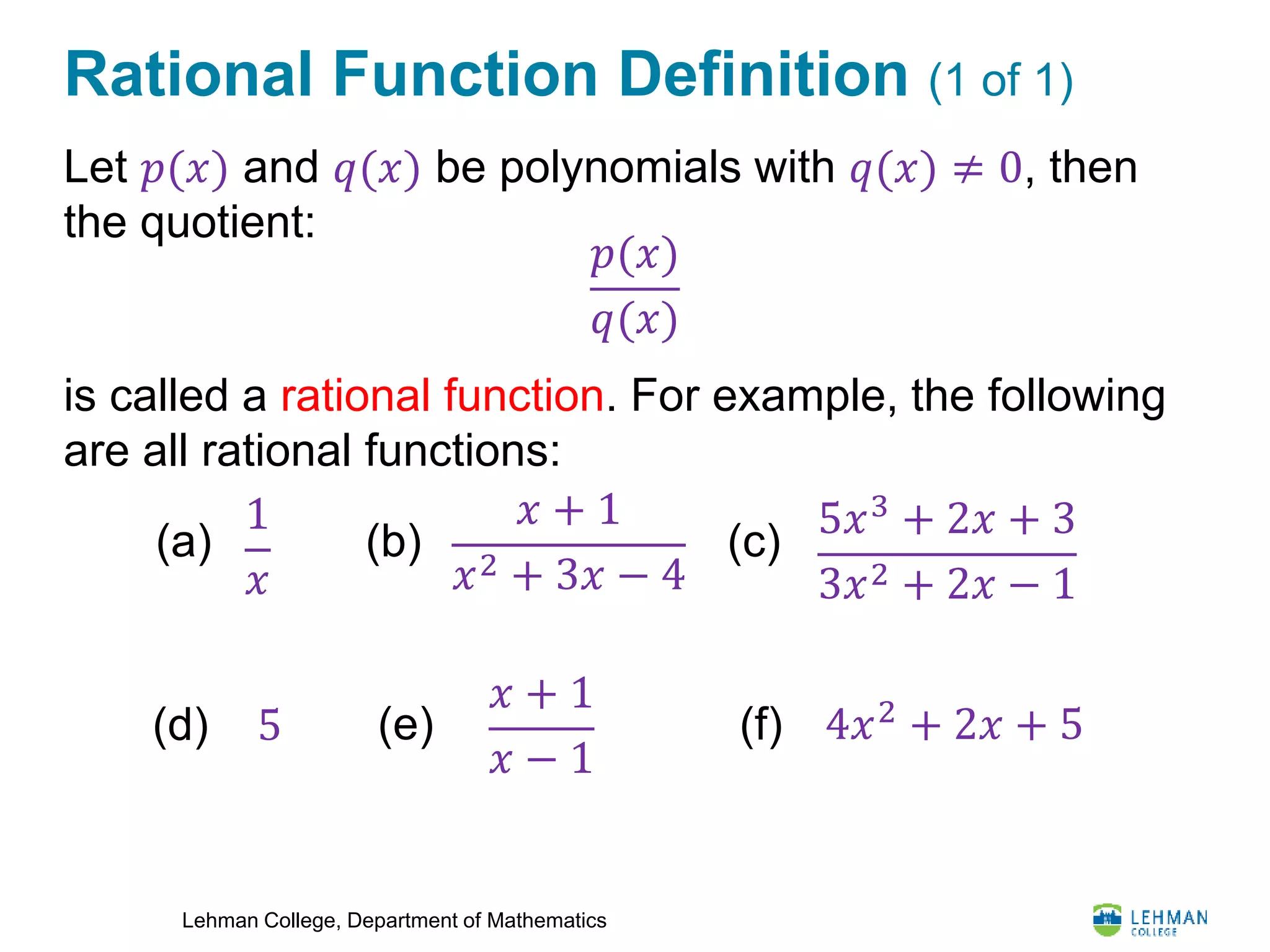
Let 𝑝(𝑥) and 𝑞(𝑥) be polynomials with 𝑞(𝑥) ≠ 0, then
the quotient:
is called a rational function. For example, the following
are all rational functions:
𝑝(𝑥)
𝑞(𝑥)
1
𝑥
𝑥 + 1
𝑥2 + 3𝑥 − 4
5𝑥3
+ 2𝑥 + 3
3𝑥2 + 2𝑥 − 1
(a) (b) (c)
5(d)
𝑥 + 1
𝑥 − 1
(e) 4𝑥2 + 2𝑥 + 5(f)
Lehman College, Department of Mathematics
Polynomial Long Division (1 of 8)
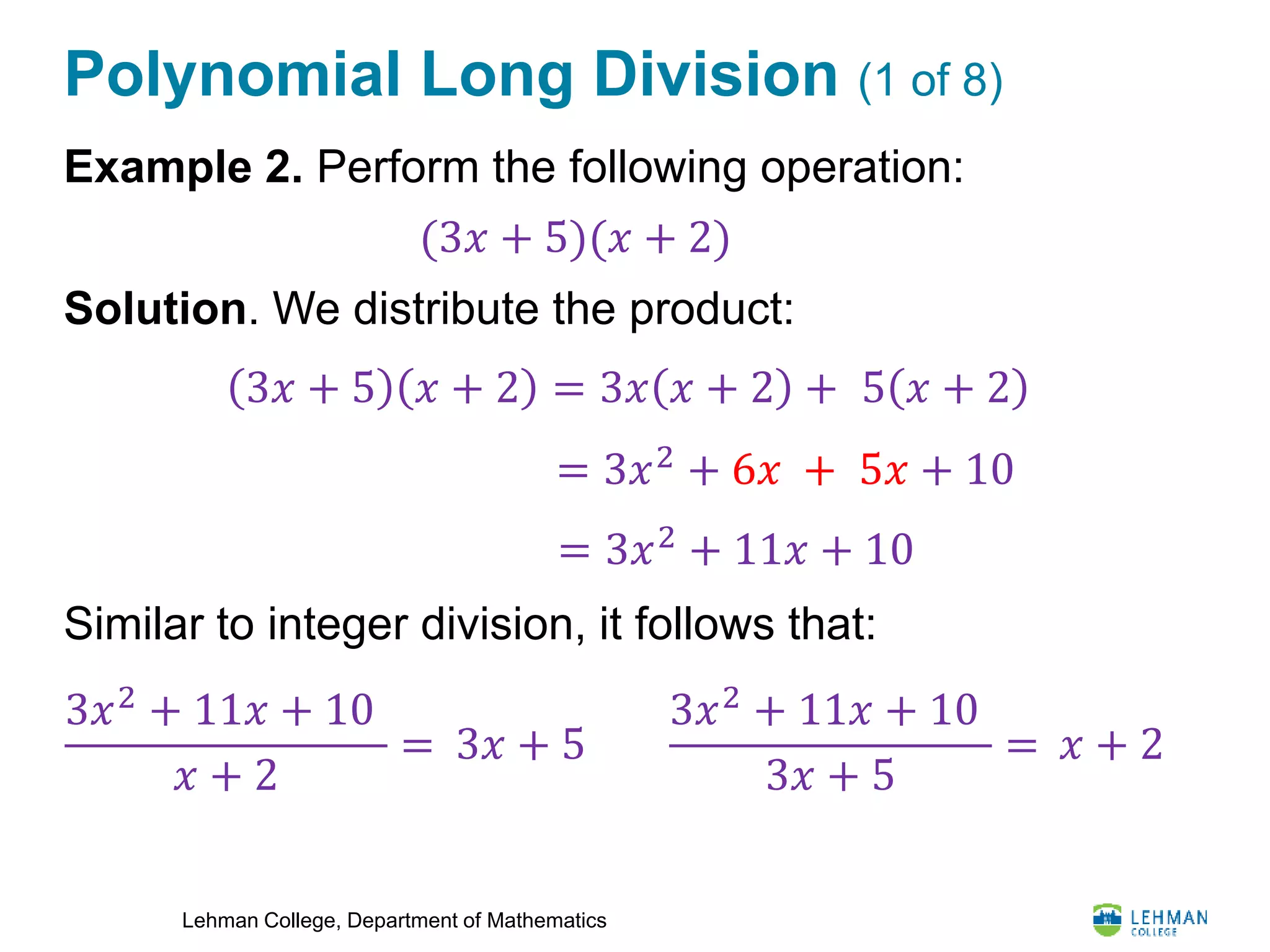
Example 2. Perform the following operation:
Solution. We distribute the product:
Similar to integer division, it follows that:
(3𝑥 + 5)(𝑥 + 2)
3𝑥 + 5 𝑥 + 2 = 3𝑥 𝑥 + 2 + 5 𝑥 + 2
= 3𝑥2 + 6𝑥 + 5𝑥 + 10
= 3𝑥2
+ 11𝑥 + 10
3𝑥2
+ 11𝑥 + 10
𝑥 + 2
= 3𝑥 + 5
3𝑥2
+ 11𝑥 + 10
3𝑥 + 5
= 𝑥 + 2
Lehman College, Department of Mathematics
Polynomial Long Division (2 of 8)
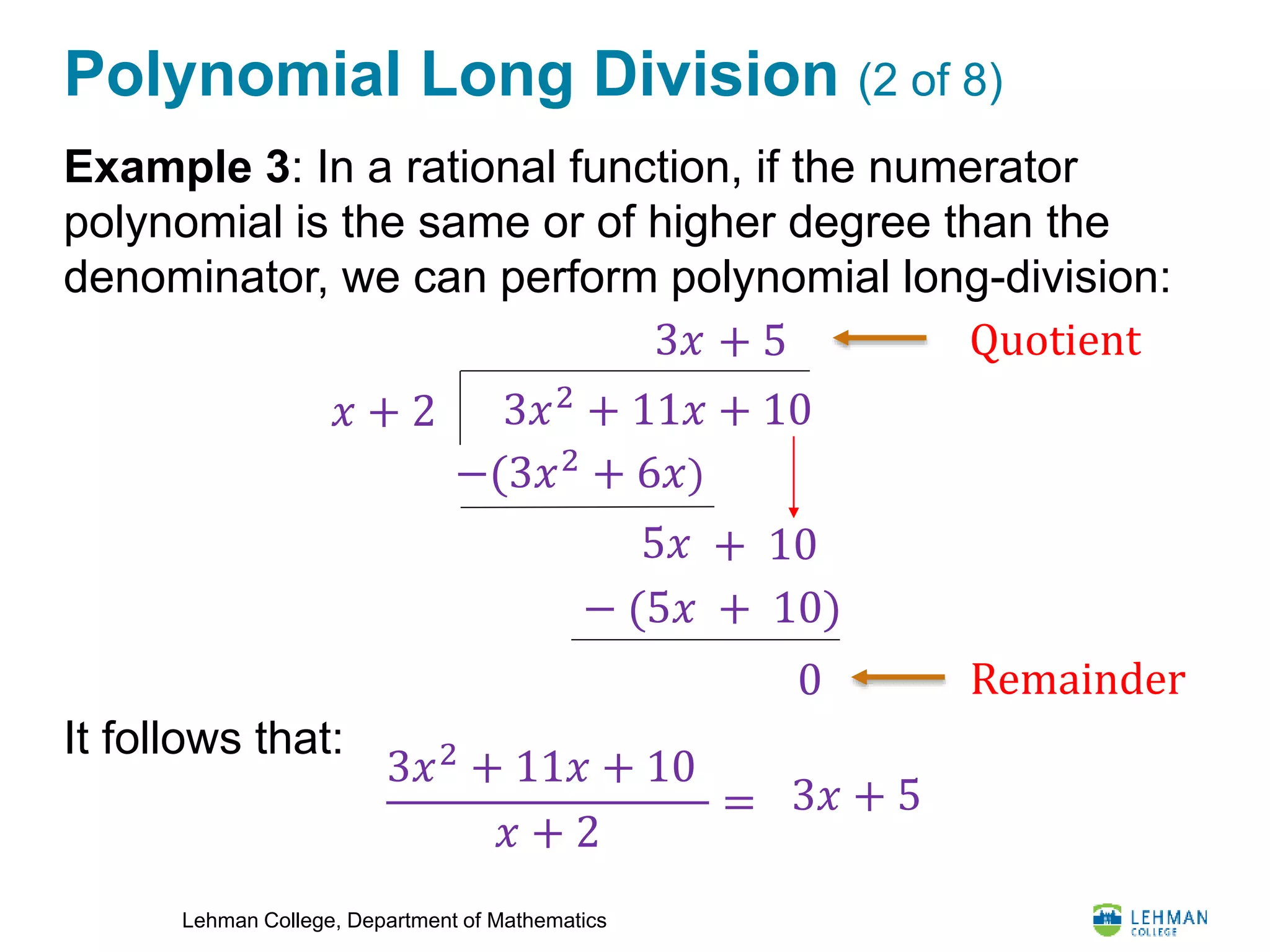
Example 3: In a rational function, if the numerator
polynomial is the same or of higher degree than the
denominator, we can perform polynomial long-division:
It follows that:
3𝑥2
+ 11𝑥 + 10𝑥 + 2
−(3𝑥2 + 6𝑥)
5𝑥
3𝑥
− (5𝑥 + 10)
0
+ 5
+ 10
3𝑥2 + 11𝑥 + 10
𝑥 + 2
= 3𝑥 + 5
Quotient
Remainder
Lehman College, Department of Mathematics
Polynomial Long Division (3 of 8)
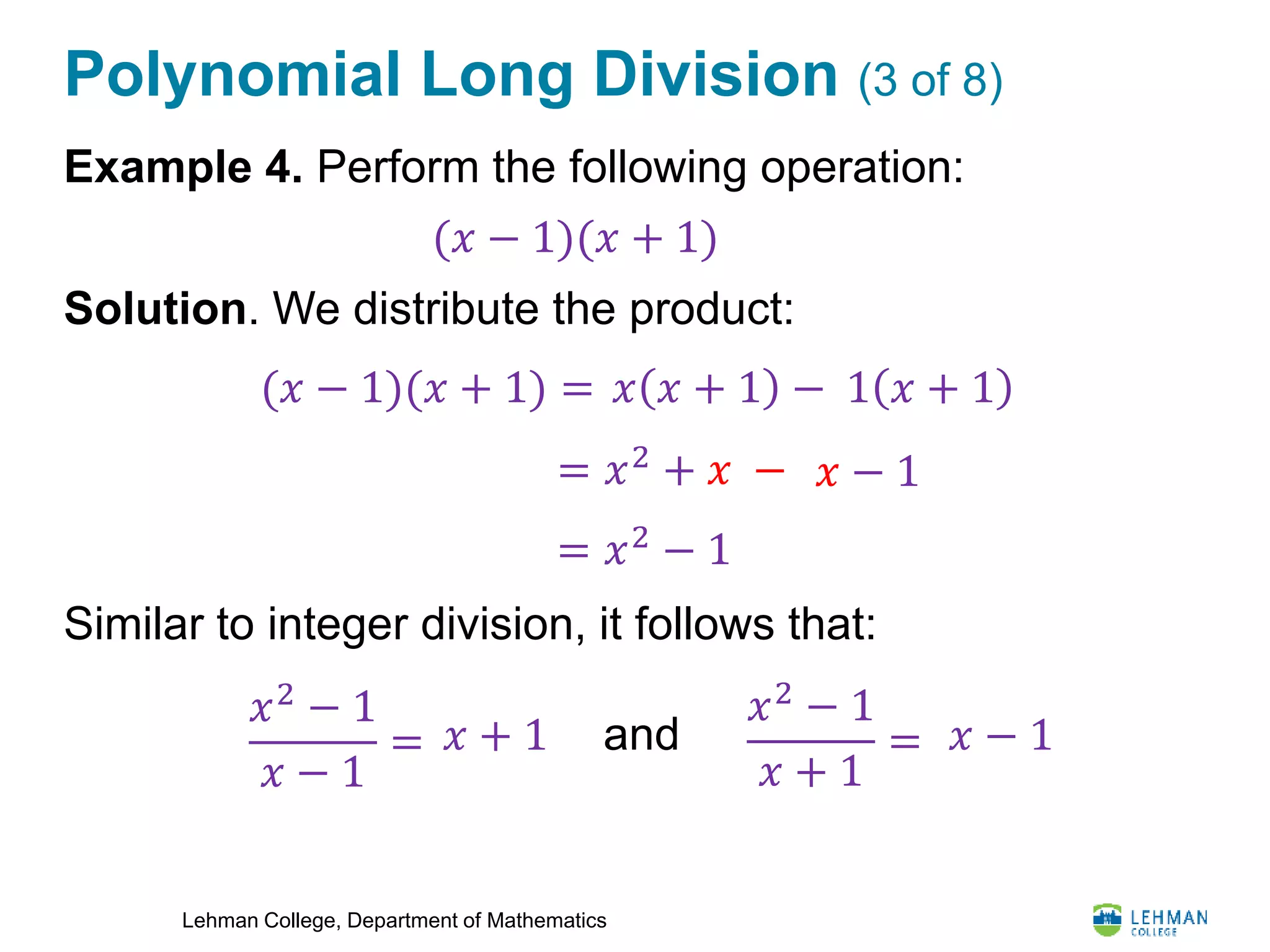
Example 4. Perform the following operation:
Solution. We distribute the product:
Similar to integer division, it follows that:
(𝑥 − 1)(𝑥 + 1)
(𝑥 − 1)(𝑥 + 1) = 𝑥 𝑥 + 1 − 1 𝑥 + 1
= 𝑥2 + 𝑥 − 𝑥 − 1
= 𝑥2
− 1
𝑥2 − 1
𝑥 − 1
= 𝑥 + 1
𝑥2 − 1
𝑥 + 1
= 𝑥 − 1and
Lehman College, Department of Mathematics
Polynomial Long Division (4 of 8)
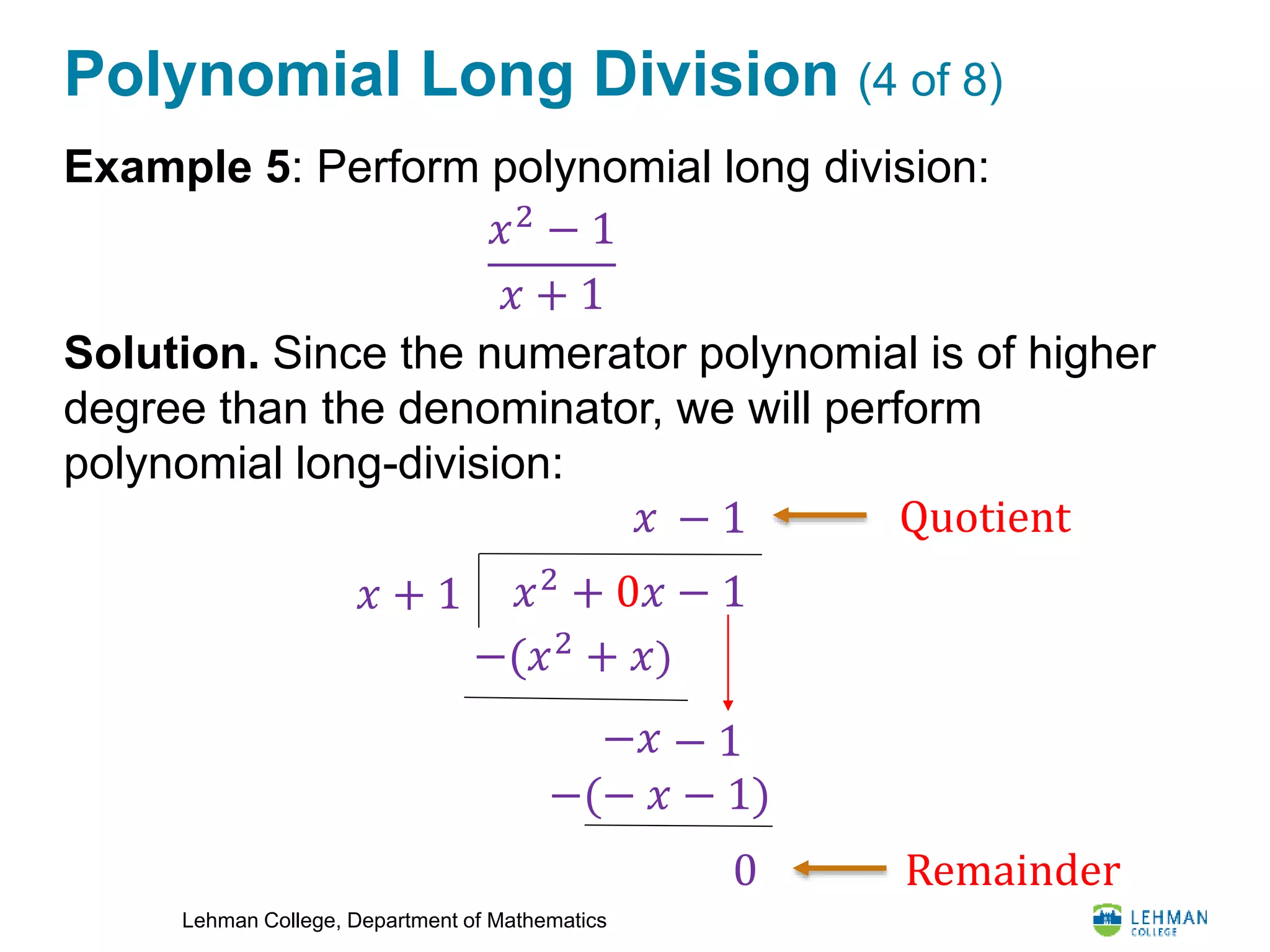
Example 5: Perform polynomial long division:
Solution. Since the numerator polynomial is of higher
degree than the denominator, we will perform
polynomial long-division:
𝑥2
− 1
𝑥 + 1
𝑥2
+ 0𝑥 − 1𝑥 + 1
−(𝑥2
+ 𝑥)
𝑥
−(− 𝑥 − 1)
0
− 1
− 1−𝑥
Quotient
Remainder
Lehman College, Department of Mathematics
Erdős and Tao (1 of 2)
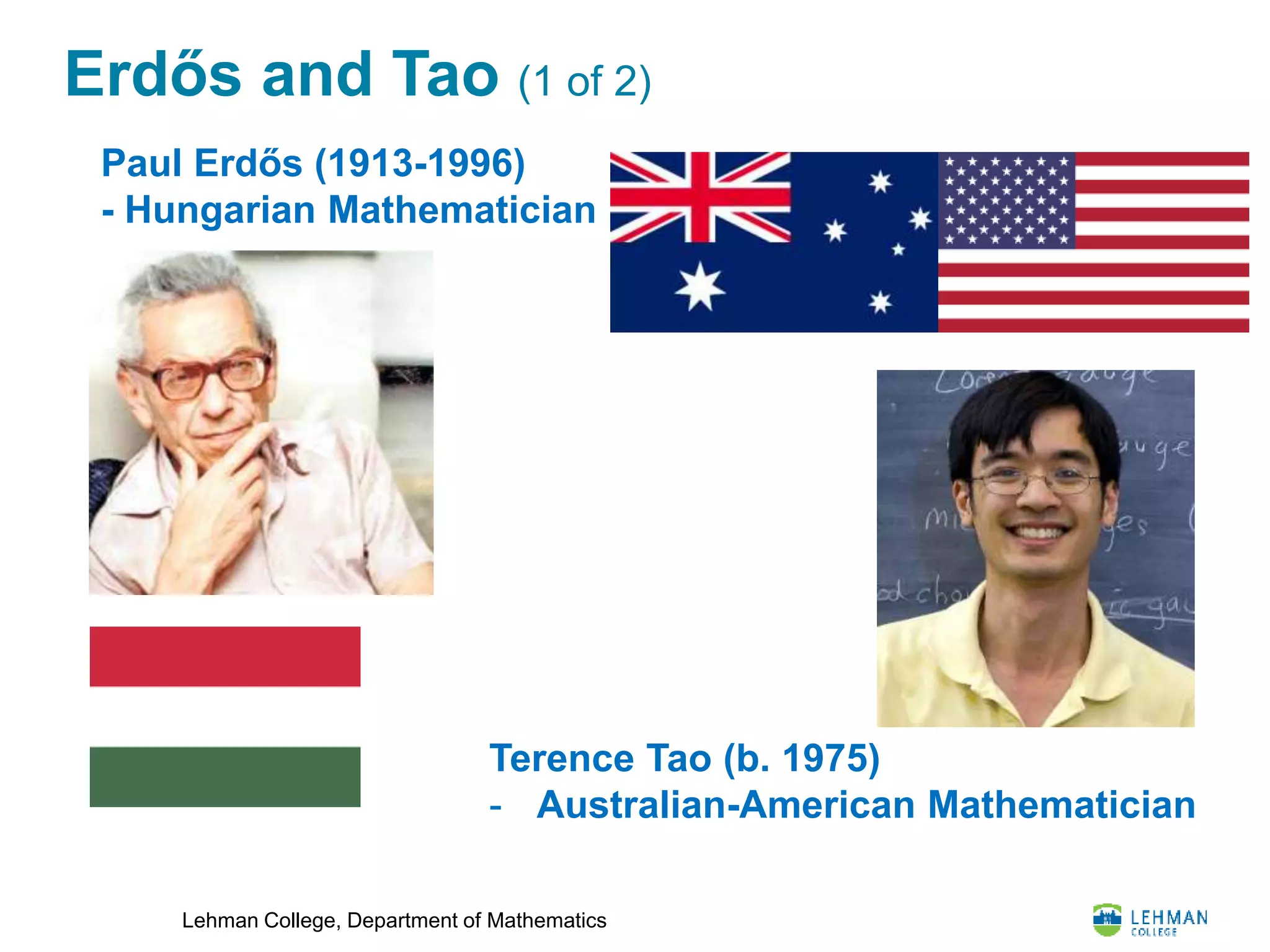
Terence Tao (b. 1975)
- Australian-American Mathematician
Paul Erdős (1913-1996)
- Hungarian Mathematician
Lehman College, Department of Mathematics
Erdős and Tao (2 of 2)
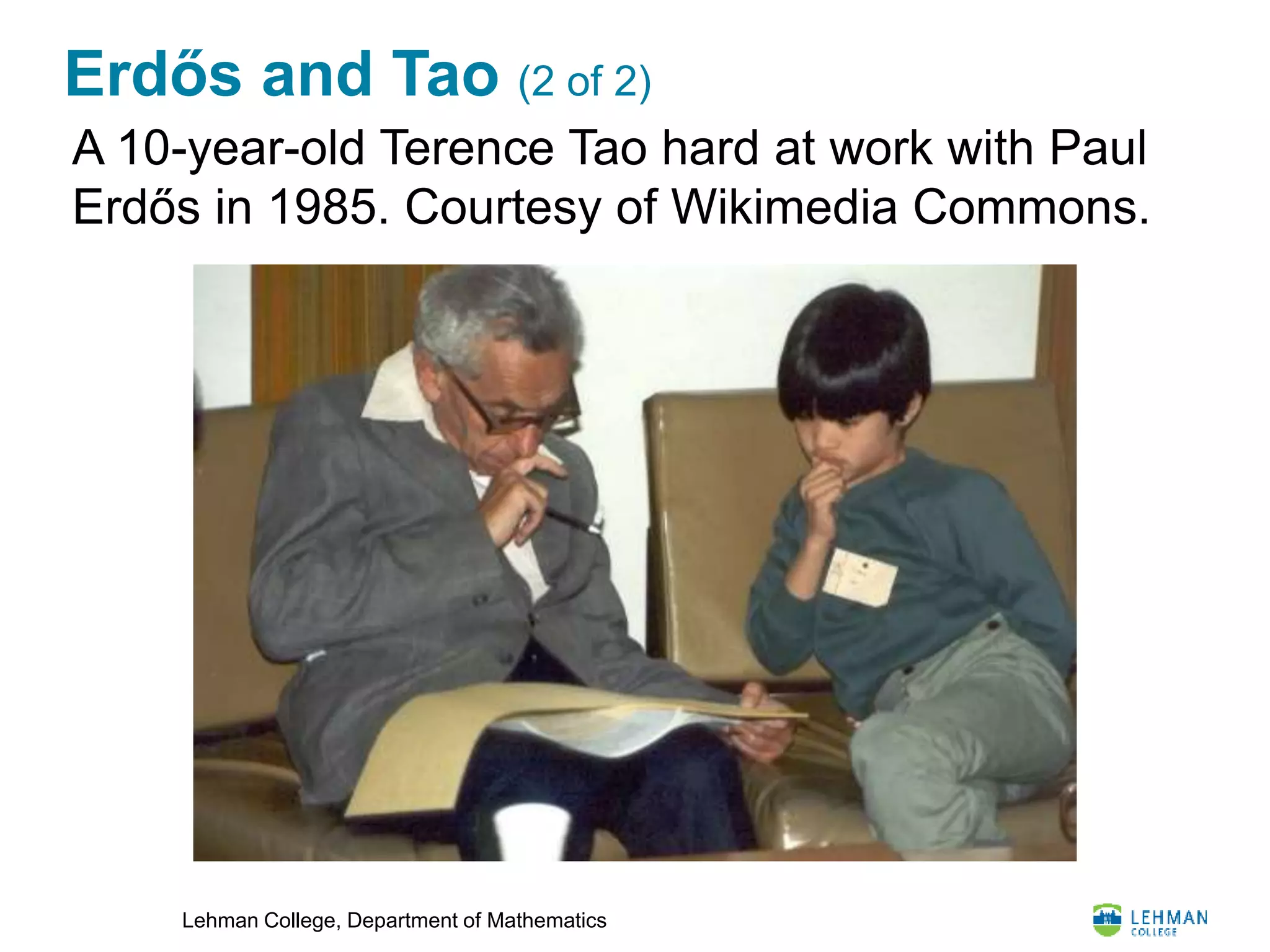
A 10-year-old Terence Tao hard at work with Paul
Erdős in 1985. Courtesy of Wikimedia Commons.
Lehman College, Department of Mathematics
Polynomial Long Division (5 of 8)
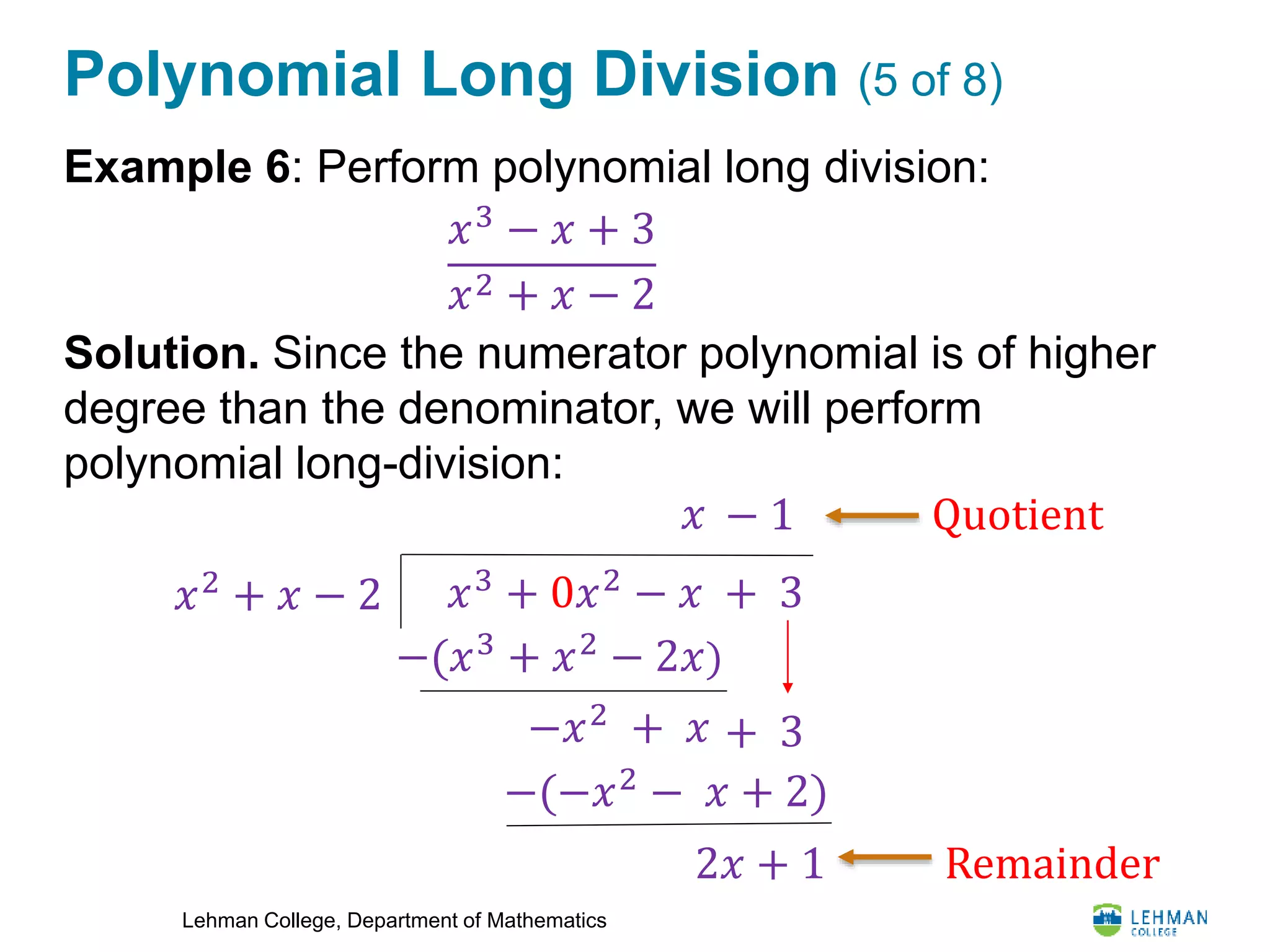
Example 6: Perform polynomial long division:
Solution. Since the numerator polynomial is of higher
degree than the denominator, we will perform
polynomial long-division:
𝑥3
− 𝑥 + 3
𝑥2 + 𝑥 − 2
𝑥3 + 0𝑥2 − 𝑥 + 3𝑥2
+ 𝑥 − 2
−(𝑥3
+ 𝑥2
− 2𝑥)
−𝑥2 + 𝑥
𝑥
−(−𝑥2 − 𝑥 + 2)
2𝑥 + 1
− 1
+ 3
Quotient
Remainder
Lehman College, Department of Mathematics
Polynomial Long Division (6 of 8)
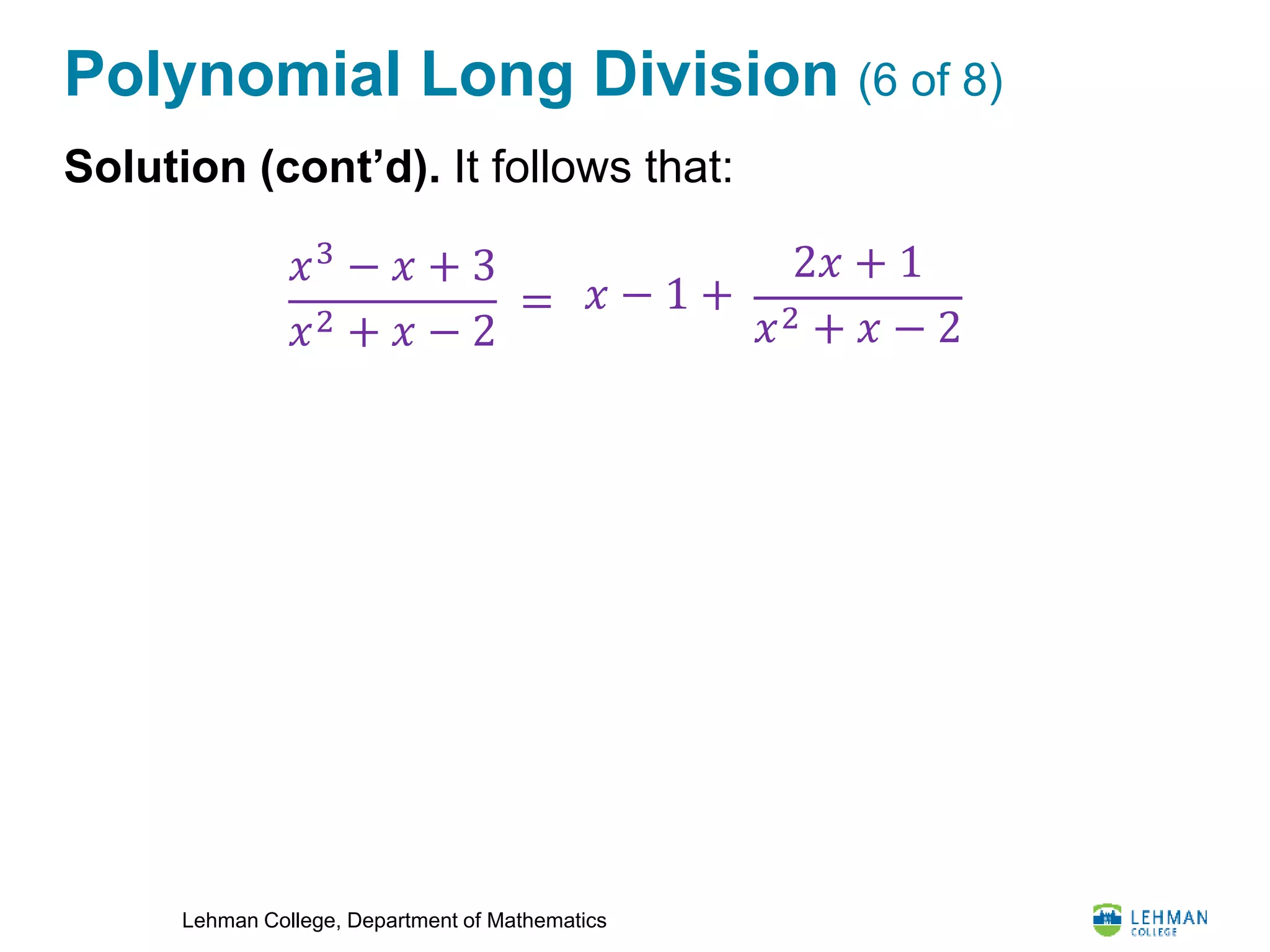
Solution (cont’d). It follows that:
𝑥3
− 𝑥 + 3
𝑥2 + 𝑥 − 2
= 𝑥 − 1 +
2𝑥 + 1
𝑥2 + 𝑥 − 2
Lehman College, Department of Mathematics
Polynomial Long Division (7 of 8)
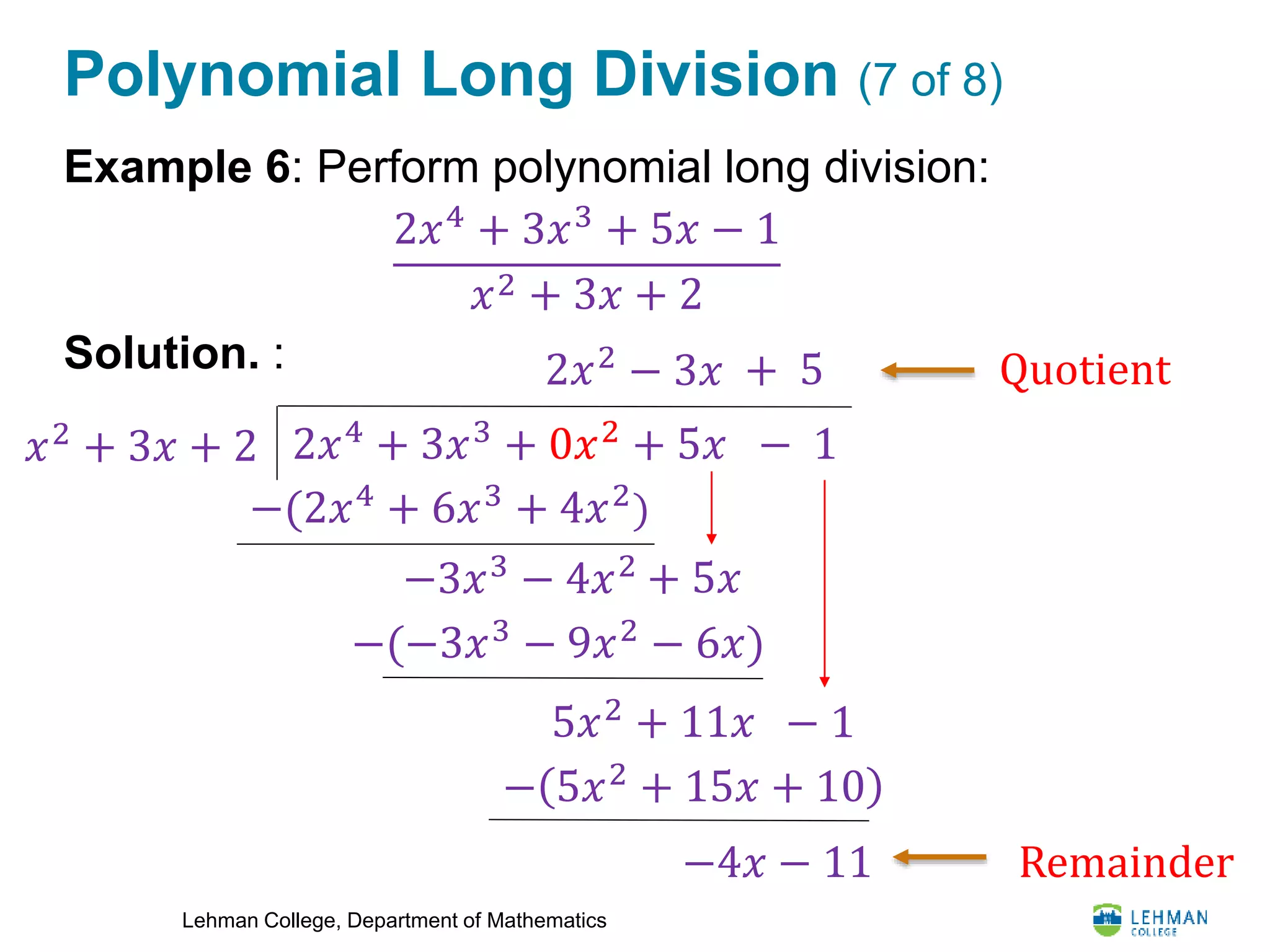
Example 6: Perform polynomial long division:
Solution. :
2𝑥4
+ 3𝑥3
+ 5𝑥 − 1
𝑥2 + 3𝑥 + 2
2𝑥4
+ 3𝑥3
+ 0𝑥2
+ 5𝑥 − 1𝑥2
+ 3𝑥 + 2
−(2𝑥4
+ 6𝑥3
+ 4𝑥2
)
−3𝑥3
− 4𝑥2
2𝑥2
−(−3𝑥3
− 9𝑥2
− 6𝑥)
5𝑥2 + 11𝑥
− 3𝑥
+ 5𝑥
Quotient
Remainder
− 1
+ 5
− 5𝑥2
+ 15𝑥 + 10
−4𝑥 − 11
Lehman College, Department of Mathematics
Polynomial Long Division (8 of 8)
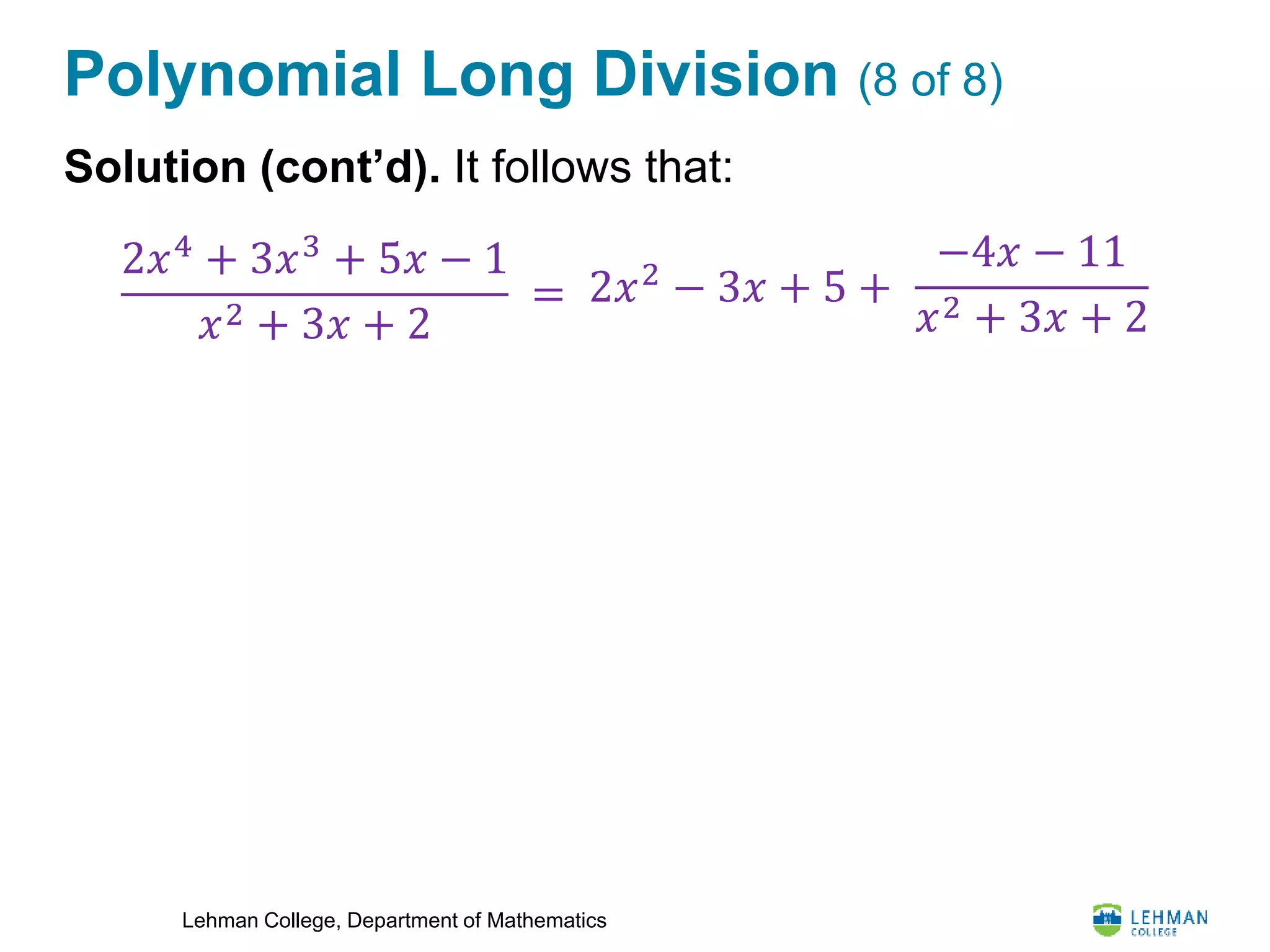
Solution (cont’d). It follows that:
2𝑥4
+ 3𝑥3
+ 5𝑥 − 1
𝑥2 + 3𝑥 + 2
= 2𝑥2
− 3𝑥 + 5 +
−4𝑥 − 11
𝑥2 + 3𝑥 + 2
Lehman College, Department of Mathematics
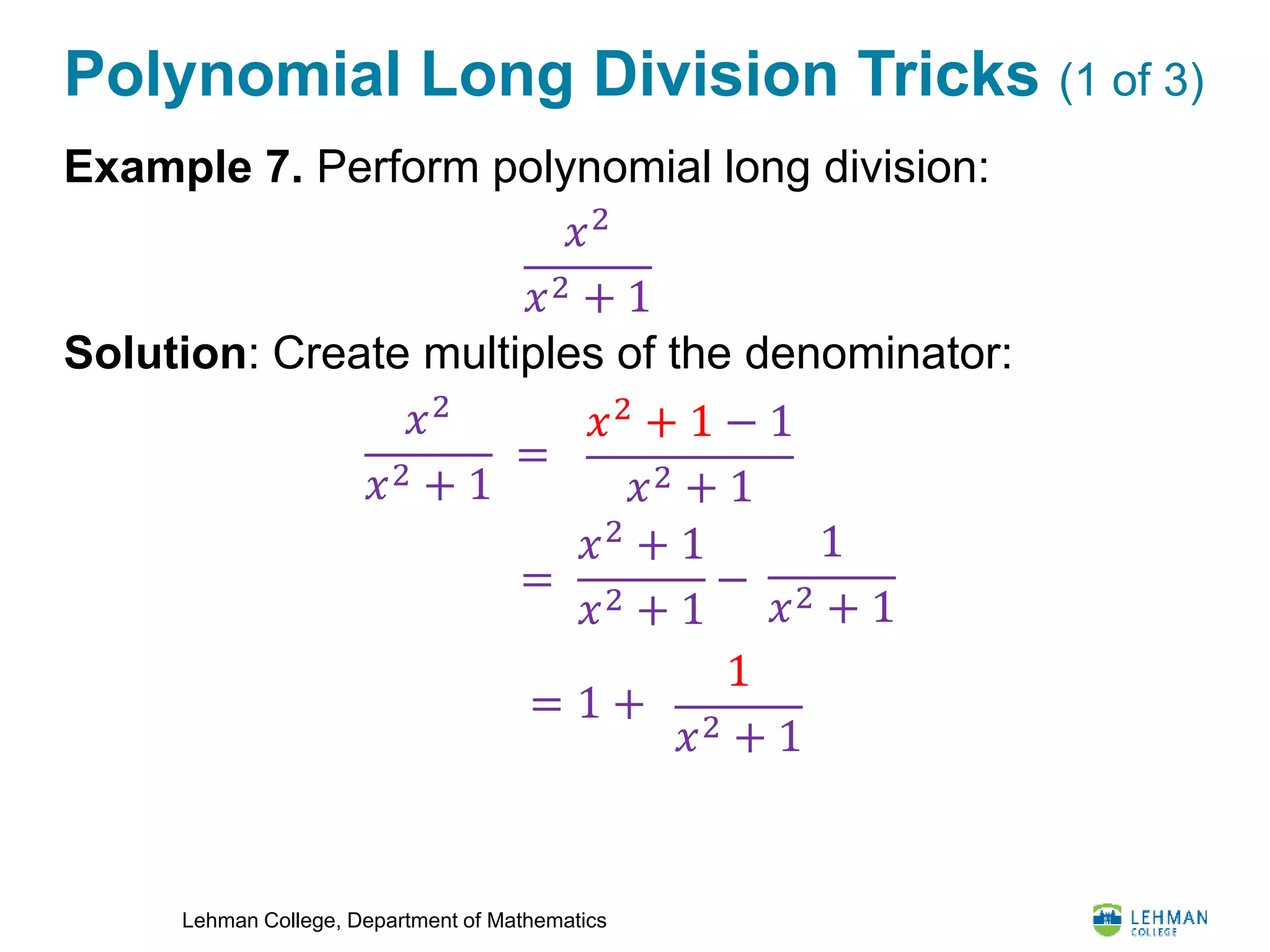
Polynomial Long Division Tricks (1 of 3)
Example 7. Perform polynomial long division:
Solution: Create multiples of the denominator:
𝑥2
𝑥2 + 1
𝑥2
𝑥2 + 1
=
𝑥2
+ 1 − 1
𝑥2 + 1
=
𝑥2
+ 1
𝑥2 + 1
−
1
𝑥2 + 1
= 1 +
1
𝑥2 + 1
Lehman College, Department of Mathematics
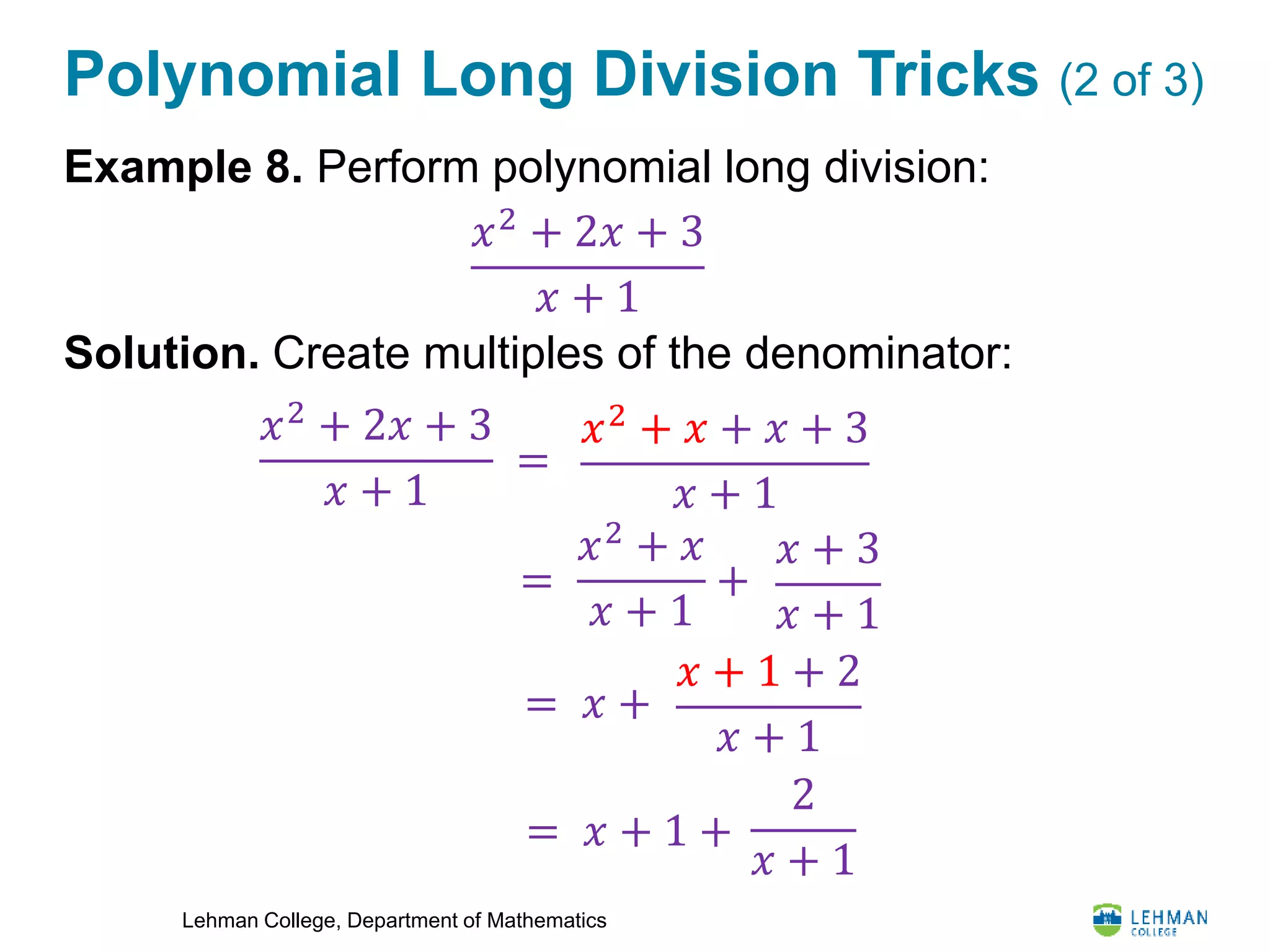
Polynomial Long Division Tricks (2 of 3)
Example 8. Perform polynomial long division:
Solution. Create multiples of the denominator:
𝑥2
+ 2𝑥 + 3
𝑥 + 1
𝑥2 + 2𝑥 + 3
𝑥 + 1
=
𝑥2
+ 𝑥 + 𝑥 + 3
𝑥 + 1
=
𝑥2 + 𝑥
𝑥 + 1
+
𝑥 + 3
𝑥 + 1
= 𝑥 +
𝑥 + 1 + 2
𝑥 + 1
= 𝑥 + 1 +
2
𝑥 + 1

Lesson 22: Polynomial Long Division

  • 1.
    𝐏𝐓𝐒 𝟑 Bridge toCalculus Workshop Summer 2020 Lesson 22 Polynomial Long Division "Perfect numbers like perfect men are very rare.“ – Descartes -
  • 2.
    Lehman College, Departmentof Mathematics Factoring Binomials (1 of 1) Example 1. Factor the following expression completely: Solution. Note that the greatest common integer factor is 6 and the highest common power of 𝑥 is: 24𝑥4 − 54𝑥8 𝑥4 24𝑥4 − 54𝑥8 = 6𝑥4 4 − 9𝑥4 = 6𝑥4 22 − 3𝑥2 2 = 6𝑥4 2 − 3𝑥2 2 + 3𝑥2 = 6𝑥4 2 − 𝑥 3 2 + 𝑥 3 2 + 3𝑥2
  • 3.
    Lehman College, Departmentof Mathematics Factoring Binomials (1 of 1) Example 2. Factor the following expression completely: Solution. Note that the greatest common integer factor is 1 and the highest common power of 𝑥 is: Here, 𝑥2 + 1 is an irreducible quadratic. Is 𝑥4 + 1 irreducible? No, but it is the product of two irreducible quadratics. 𝑥9 − 𝑥 𝑥 𝑥9 − 𝑥 = 𝑥 𝑥8 − 1 = 𝑥 𝑥4 − 1 𝑥4 + 1 = 𝑥 𝑥2 − 1 𝑥2 + 1 𝑥4 + 1 = 𝑥 𝑥 − 1 𝑥 + 1 𝑥2 + 1 𝑥4 + 1
  • 4.
    Lehman College, Departmentof Mathematics Rational Numbers (1 of 2) Let us look at integer multiplication. For example, if: then we say 2 and 3 are integer factors of 6. Now, we introduce a new operation called integer division. If we have the product 2 ⋅ 3 = 6, then we define the quotients: Let us extend the concept to quotients, such as: Since there are no integers 𝑚 and 𝑛, such that: Then the above quotients are not integers. 2 ⋅ 3 = 6 6 3 = 2 6 2 = 3and 5 3 6 4 and 3 ⋅ 𝑛 = 5 4 ⋅ 𝑚 = 6and
  • 5.
    Lehman College, Departmentof Mathematics Rational Numbers (2 of 2) Let 𝑝 and 𝑞 be integers with 𝑞 ≠ 0, then the quotient: Is called a rational number. The adjective rational comes from the word ratio, meaning quotient. Why is division by zero not allowed? Suppose we have: Where 𝑟 is a rational number. Then 𝑟 ⋅ 0 = 2, but the product of any number with zero is zero, so no such number 𝑟 can exist, and the quotient is thus undefined. How about the quotient 0 0 ? Suppose 0 0 = 𝑟, so 𝑟 ⋅ 0 = 0. In this case, 𝑟 could be any real, and is thus undefined. 𝑝 𝑞 2 0 = 𝑟
  • 6.
    Lehman College, Departmentof Mathematics Integer Division (1 of 6) Example 1. Perform the following operation: Solution. Since: Then: The number 1 is called the quotient, and 2 is the remainder of integer division. 5 3 3 ⋅ 1 = 3 3 ⋅ 2 = 6and< 5 > 5 5 3 = 3 + 2 3 = 3 3 + 2 3 = 1 + 2 3
  • 7.
    Lehman College, Departmentof Mathematics Rational Function Definition (1 of 1) Let 𝑝(𝑥) and 𝑞(𝑥) be polynomials with 𝑞(𝑥) ≠ 0, then the quotient: is called a rational function. For example, the following are all rational functions: 𝑝(𝑥) 𝑞(𝑥) 1 𝑥 𝑥 + 1 𝑥2 + 3𝑥 − 4 5𝑥3 + 2𝑥 + 3 3𝑥2 + 2𝑥 − 1 (a) (b) (c) 5(d) 𝑥 + 1 𝑥 − 1 (e) 4𝑥2 + 2𝑥 + 5(f)
  • 8.
    Lehman College, Departmentof Mathematics Polynomial Long Division (1 of 8) Example 2. Perform the following operation: Solution. We distribute the product: Similar to integer division, it follows that: (3𝑥 + 5)(𝑥 + 2) 3𝑥 + 5 𝑥 + 2 = 3𝑥 𝑥 + 2 + 5 𝑥 + 2 = 3𝑥2 + 6𝑥 + 5𝑥 + 10 = 3𝑥2 + 11𝑥 + 10 3𝑥2 + 11𝑥 + 10 𝑥 + 2 = 3𝑥 + 5 3𝑥2 + 11𝑥 + 10 3𝑥 + 5 = 𝑥 + 2
  • 9.
    Lehman College, Departmentof Mathematics Polynomial Long Division (2 of 8) Example 3: In a rational function, if the numerator polynomial is the same or of higher degree than the denominator, we can perform polynomial long-division: It follows that: 3𝑥2 + 11𝑥 + 10𝑥 + 2 −(3𝑥2 + 6𝑥) 5𝑥 3𝑥 − (5𝑥 + 10) 0 + 5 + 10 3𝑥2 + 11𝑥 + 10 𝑥 + 2 = 3𝑥 + 5 Quotient Remainder
  • 10.
    Lehman College, Departmentof Mathematics Polynomial Long Division (3 of 8) Example 4. Perform the following operation: Solution. We distribute the product: Similar to integer division, it follows that: (𝑥 − 1)(𝑥 + 1) (𝑥 − 1)(𝑥 + 1) = 𝑥 𝑥 + 1 − 1 𝑥 + 1 = 𝑥2 + 𝑥 − 𝑥 − 1 = 𝑥2 − 1 𝑥2 − 1 𝑥 − 1 = 𝑥 + 1 𝑥2 − 1 𝑥 + 1 = 𝑥 − 1and
  • 11.
    Lehman College, Departmentof Mathematics Polynomial Long Division (4 of 8) Example 5: Perform polynomial long division: Solution. Since the numerator polynomial is of higher degree than the denominator, we will perform polynomial long-division: 𝑥2 − 1 𝑥 + 1 𝑥2 + 0𝑥 − 1𝑥 + 1 −(𝑥2 + 𝑥) 𝑥 −(− 𝑥 − 1) 0 − 1 − 1−𝑥 Quotient Remainder
  • 12.
    Lehman College, Departmentof Mathematics Erdős and Tao (1 of 2) Terence Tao (b. 1975) - Australian-American Mathematician Paul Erdős (1913-1996) - Hungarian Mathematician
  • 13.
    Lehman College, Departmentof Mathematics Erdős and Tao (2 of 2) A 10-year-old Terence Tao hard at work with Paul Erdős in 1985. Courtesy of Wikimedia Commons.
  • 14.
    Lehman College, Departmentof Mathematics Polynomial Long Division (5 of 8) Example 6: Perform polynomial long division: Solution. Since the numerator polynomial is of higher degree than the denominator, we will perform polynomial long-division: 𝑥3 − 𝑥 + 3 𝑥2 + 𝑥 − 2 𝑥3 + 0𝑥2 − 𝑥 + 3𝑥2 + 𝑥 − 2 −(𝑥3 + 𝑥2 − 2𝑥) −𝑥2 + 𝑥 𝑥 −(−𝑥2 − 𝑥 + 2) 2𝑥 + 1 − 1 + 3 Quotient Remainder
  • 15.
    Lehman College, Departmentof Mathematics Polynomial Long Division (6 of 8) Solution (cont’d). It follows that: 𝑥3 − 𝑥 + 3 𝑥2 + 𝑥 − 2 = 𝑥 − 1 + 2𝑥 + 1 𝑥2 + 𝑥 − 2
  • 16.
    Lehman College, Departmentof Mathematics Polynomial Long Division (7 of 8) Example 6: Perform polynomial long division: Solution. : 2𝑥4 + 3𝑥3 + 5𝑥 − 1 𝑥2 + 3𝑥 + 2 2𝑥4 + 3𝑥3 + 0𝑥2 + 5𝑥 − 1𝑥2 + 3𝑥 + 2 −(2𝑥4 + 6𝑥3 + 4𝑥2 ) −3𝑥3 − 4𝑥2 2𝑥2 −(−3𝑥3 − 9𝑥2 − 6𝑥) 5𝑥2 + 11𝑥 − 3𝑥 + 5𝑥 Quotient Remainder − 1 + 5 − 5𝑥2 + 15𝑥 + 10 −4𝑥 − 11
  • 17.
    Lehman College, Departmentof Mathematics Polynomial Long Division (8 of 8) Solution (cont’d). It follows that: 2𝑥4 + 3𝑥3 + 5𝑥 − 1 𝑥2 + 3𝑥 + 2 = 2𝑥2 − 3𝑥 + 5 + −4𝑥 − 11 𝑥2 + 3𝑥 + 2
  • 18.
    Lehman College, Departmentof Mathematics Polynomial Long Division Tricks (1 of 3) Example 7. Perform polynomial long division: Solution: Create multiples of the denominator: 𝑥2 𝑥2 + 1 𝑥2 𝑥2 + 1 = 𝑥2 + 1 − 1 𝑥2 + 1 = 𝑥2 + 1 𝑥2 + 1 − 1 𝑥2 + 1 = 1 + 1 𝑥2 + 1
  • 19.
    Lehman College, Departmentof Mathematics Polynomial Long Division Tricks (2 of 3) Example 8. Perform polynomial long division: Solution. Create multiples of the denominator: 𝑥2 + 2𝑥 + 3 𝑥 + 1 𝑥2 + 2𝑥 + 3 𝑥 + 1 = 𝑥2 + 𝑥 + 𝑥 + 3 𝑥 + 1 = 𝑥2 + 𝑥 𝑥 + 1 + 𝑥 + 3 𝑥 + 1 = 𝑥 + 𝑥 + 1 + 2 𝑥 + 1 = 𝑥 + 1 + 2 𝑥 + 1