𝐏𝐓𝐒 𝟑
Bridge to Calculus Workshop
Summer 2020
Lesson 17
Quadratic Functions
“A mathematician is a device for
turning coffee into theorems.”
- Paul Erdős -
Lehman College, Department of Mathematics
Quadratic Functions (1 of 4)
A quadratic function is any function of the form:
where 𝑎, 𝑏, and 𝑐 are real numbers, with 𝑎 ≠ 0. A
quadratic function is a polynomial function of degree 2.
The graph of a quadratic function is called a parabola.
Example 1. Graph the function 𝑓 𝑥 = 𝑥2
:
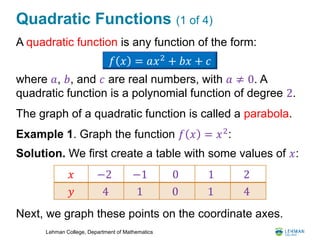
Solution. We first create a table with some values of 𝑥:
Next, we graph these points on the coordinate axes.
𝑥 −2 −1 0 1 2
𝑦
𝑓 𝑥 = 𝑎𝑥2
+ 𝑏𝑥 + 𝑐
0 11 44
Lehman College, Department of Mathematics
Quadratic Functions (2 of 4)
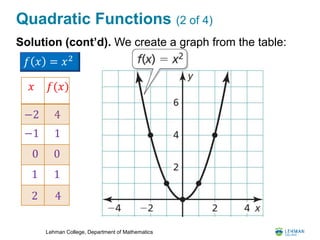
Solution (cont’d). We create a graph from the table:
4
𝑥 𝑓(𝑥)
1
1
4
00
−1
−2
1
2
𝑓 𝑥 = 𝑥2
Lehman College, Department of Mathematics
Quadratic Functions (3 of 4)
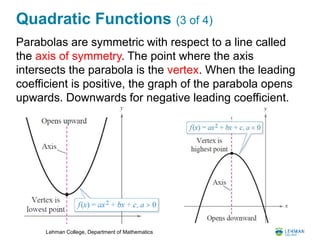
Parabolas are symmetric with respect to a line called
the axis of symmetry. The point where the axis
intersects the parabola is the vertex. When the leading
coefficient is positive, the graph of the parabola opens
upwards. Downwards for negative leading coefficient.
Lehman College, Department of Mathematics
Quadratic Functions (4 of 4)
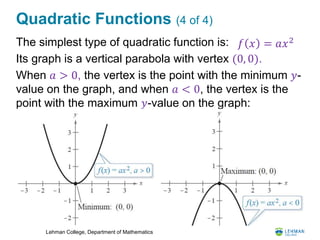
The simplest type of quadratic function is:
Its graph is a vertical parabola with vertex (0, 0).
When 𝑎 > 0, the vertex is the point with the minimum 𝑦-
value on the graph, and when 𝑎 < 0, the vertex is the
point with the maximum 𝑦-value on the graph:
𝑓 𝑥 = 𝑎𝑥2
Lehman College, Department of Mathematics
Standard and Vertex Form (1 of 7)
The standard form of a quadratic function is given by:
The vertex form of a quadratic function is given by:
here 𝑎 ≠ 0, and ℎ, 𝑘 are the coordinates of the vertex.
Example 2. Find the vertex and axis of the parabola:
Solution. We complete the square in the formula:
𝑓 𝑥 = 𝑎𝑥2
+ 𝑏𝑥 + 𝑐
𝑓 𝑥 = 𝑎 𝑥 − ℎ 2
+ 𝑘
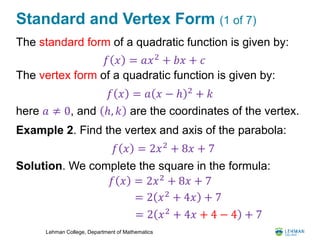
𝑓 𝑥 = 2𝑥2
+ 8𝑥 + 7
𝑓 𝑥 = 2𝑥2 + 8𝑥 + 7
= 2 𝑥2
+ 4𝑥 + 7
= 2 𝑥2
+ 4𝑥 + 4 − 4 + 7
Lehman College, Department of Mathematics
Standard and Vertex Form (2 of 7)
Solution (cont’d). From the previous slide:
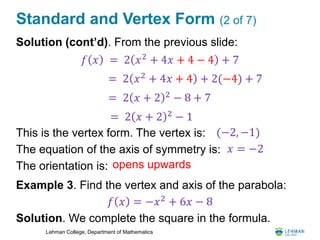
This is the vertex form. The vertex is:
The equation of the axis of symmetry is:
The orientation is:
Example 3. Find the vertex and axis of the parabola:
Solution. We complete the square in the formula.
𝑓 𝑥 = 2 𝑥2
+ 4𝑥 + 4 − 4 + 7
= 2 𝑥2
+ 4𝑥 + 4 + 2(−4) + 7
= 2 𝑥 + 2 2
− 8 + 7
= 2 𝑥 + 2 2
− 1
(−2, −1)
𝑥 = −2
𝑓 𝑥 = −𝑥2
+ 6𝑥 − 8
opens upwards
Lehman College, Department of Mathematics
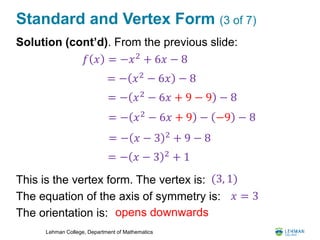
Standard and Vertex Form (3 of 7)
Solution (cont’d). From the previous slide:
This is the vertex form. The vertex is:
The equation of the axis of symmetry is:
The orientation is:
= − 𝑥2 − 6𝑥 + 9 − 9 − 8
= − 𝑥2
− 6𝑥 + 9 − −9 − 8
= − 𝑥 − 3 2
+ 9 − 8
= − 𝑥 − 3 2 + 1
(3, 1)
𝑥 = 3
𝑓 𝑥 = −𝑥2
+ 6𝑥 − 8
= − 𝑥2
− 6𝑥 − 8
opens downwards
Lehman College, Department of Mathematics
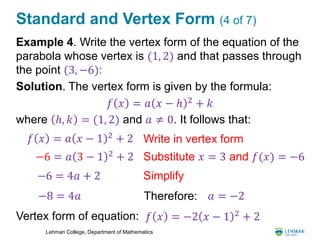
Standard and Vertex Form (4 of 7)
Example 4. Write the vertex form of the equation of the
parabola whose vertex is (1, 2) and that passes through
the point (3, −6):
Solution. The vertex form is given by the formula:
where ℎ, 𝑘 = (1, 2) and 𝑎 ≠ 0. It follows that:
Vertex form of equation:
𝑓 𝑥 = 𝑎 𝑥 − ℎ 2
+ 𝑘
𝑓 𝑥 = 𝑎 𝑥 − 1 2
+ 2 Write in vertex form
Substitute 𝑥 = 3 and 𝑓(𝑥) = −6−6 = 𝑎 3 − 1 2
+ 2
−6 = 4𝑎 + 2
−8 = 4𝑎
Simplify
Therefore: 𝑎 = −2
𝑓 𝑥 = −2 𝑥 − 1 2
+ 2
Lehman College, Department of Mathematics
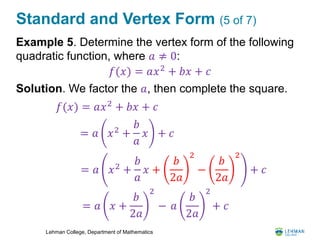
Standard and Vertex Form (5 of 7)
Example 5. Determine the vertex form of the following
quadratic function, where 𝑎 ≠ 0:
Solution. We factor the 𝑎, then complete the square.
𝑓(𝑥) = 𝑎𝑥2
+ 𝑏𝑥 + 𝑐
= 𝑎 𝑥2
+
𝑏
𝑎
𝑥 +
𝑏
2𝑎
2
−
𝑏
2𝑎
2
+ 𝑐
= 𝑎 𝑥 +
𝑏
2𝑎
2
− 𝑎
𝑏
2𝑎
2
+ 𝑐
= 𝑎 𝑥2
+
𝑏
𝑎
𝑥 + 𝑐
𝑓(𝑥) = 𝑎𝑥2
+ 𝑏𝑥 + 𝑐
Lehman College, Department of Mathematics
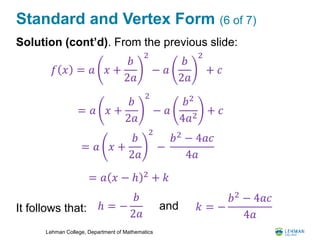
Standard and Vertex Form (6 of 7)
Solution (cont’d). From the previous slide:
It follows that:
𝑓 𝑥 = 𝑎 𝑥 +
𝑏
2𝑎
2
− 𝑎
𝑏
2𝑎
2
+ 𝑐
= 𝑎 𝑥 +
𝑏
2𝑎
2
− 𝑎
𝑏2
4𝑎2
+ 𝑐
= 𝑎 𝑥 +
𝑏
2𝑎
2
−
𝑏2
− 4𝑎𝑐
4𝑎
= 𝑎 𝑥 − ℎ 2 + 𝑘
ℎ = −
𝑏
2𝑎
𝑘 = −
𝑏2
− 4𝑎𝑐
4𝑎
and
Lehman College, Department of Mathematics
Standard and Vertex Form (7 of 7)
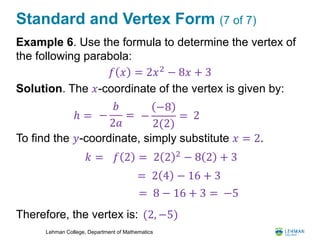
Example 6. Use the formula to determine the vertex of
the following parabola:
Solution. The 𝑥-coordinate of the vertex is given by:
To find the 𝑦-coordinate, simply substitute 𝑥 = 2.
Therefore, the vertex is:
𝑓 𝑥 = 2𝑥2
− 8𝑥 + 3
ℎ = −
𝑏
2𝑎
= −
−8
2(2)
= 2
2 2 2
− 8 2 + 3𝑘 = 𝑓 2 =
= 2 4 − 16 + 3
= 8 − 16 + 3 = −5
(2, −5)
Lehman College, Department of Mathematics
Graphs of Parabolas (1 of 8)
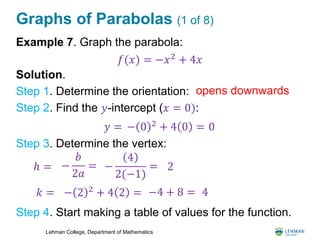
Example 7. Graph the parabola:
Solution.
Step 1. Determine the orientation:
Step 2. Find the 𝑦-intercept (𝑥 = 0):
Step 3. Determine the vertex:
Step 4. Start making a table of values for the function.
𝑓(𝑥) = −𝑥2
+ 4𝑥
opens downwards
𝑦 = − 0 2 + 4 0 = 0
ℎ = −
𝑏
2𝑎
= −
4
2(−1)
= 2
− 2 2 + 4 2 =𝑘 = −4 + 8 = 4
Lehman College, Department of Mathematics
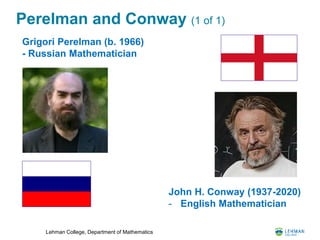
Perelman and Conway (1 of 1)
John H. Conway (1937-2020)
- English Mathematician
Grigori Perelman (b. 1966)
- Russian Mathematician
Lehman College, Department of Mathematics
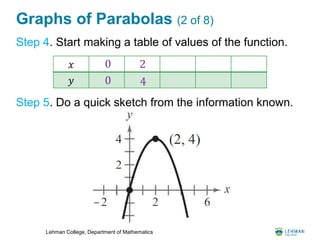
Graphs of Parabolas (2 of 8)
Step 4. Start making a table of values of the function.
Step 5. Do a quick sketch from the information known.
𝑥
𝑦
0
0
2
4
Lehman College, Department of Mathematics
Graphs of Parabolas (3 of 8)
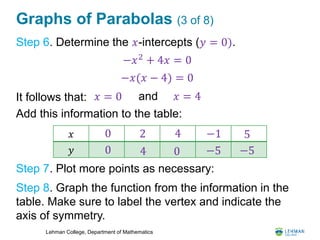
Step 6. Determine the 𝑥-intercepts (𝑦 = 0).
It follows that:
Add this information to the table:
Step 7. Plot more points as necessary:
Step 8. Graph the function from the information in the
table. Make sure to label the vertex and indicate the
axis of symmetry.
𝑥
𝑦
0
0
2
4
−𝑥2
+ 4𝑥 = 0
−𝑥(𝑥 − 4) = 0
𝑥 = 0 and 𝑥 = 4
0
4 −1
−5
5
−5
Lehman College, Department of Mathematics
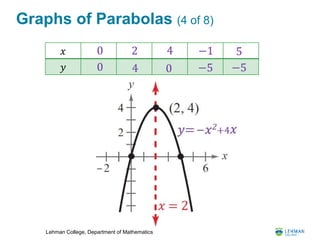
Graphs of Parabolas (4 of 8)
𝑥
𝑦
0
0
2
4 0
4 −1
−5
5
−5
Lehman College, Department of Mathematics
Graphs of Parabolas (5 of 8)
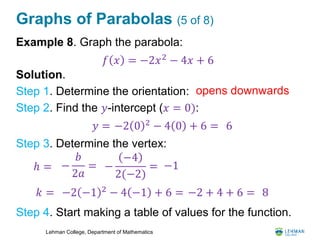
Example 8. Graph the parabola:
Solution.
Step 1. Determine the orientation:
Step 2. Find the 𝑦-intercept (𝑥 = 0):
Step 3. Determine the vertex:
Step 4. Start making a table of values for the function.
𝑓 𝑥 = −2𝑥2
− 4𝑥 + 6
opens downwards
𝑦 = −2 0 2
− 4 0 + 6 = 6
ℎ = −
𝑏
2𝑎
= −
−4
2(−2)
= −1
−2 −1 2 − 4 −1 + 6 =𝑘 = −2 + 4 + 6 = 8
Lehman College, Department of Mathematics
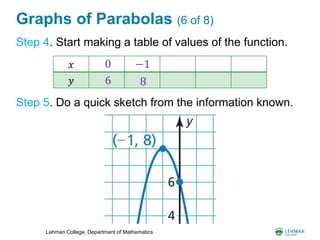
Graphs of Parabolas (6 of 8)
Step 4. Start making a table of values of the function.
Step 5. Do a quick sketch from the information known.
𝑥
𝑦
0
6
−1
8
Lehman College, Department of Mathematics
Graphs of Parabolas (7 of 8)
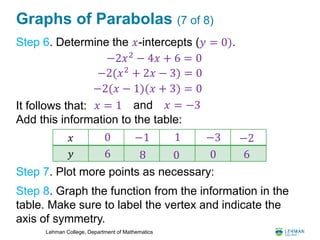
Step 6. Determine the 𝑥-intercepts (𝑦 = 0).
It follows that:
Add this information to the table:
Step 7. Plot more points as necessary:
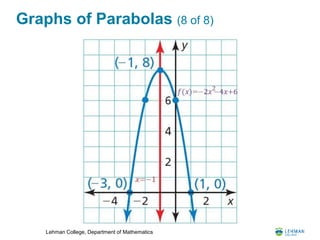
Step 8. Graph the function from the information in the
table. Make sure to label the vertex and indicate the
axis of symmetry.
𝑥
𝑦
0
6
−1
8
−2𝑥2
− 4𝑥 + 6 = 0
−2(𝑥2 + 2𝑥 − 3) = 0
𝑥 = 1 and 𝑥 = −3
0
1 −3
0
−2
6
−2(𝑥 − 1)(𝑥 + 3) = 0
Lehman College, Department of Mathematics
Graphs of Parabolas (8 of 8)
Lehman College, Department of Mathematics
Equations from Graphs (1 of 4)
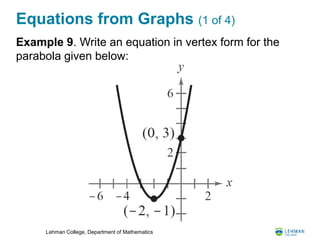
Example 9. Write an equation in vertex form for the
parabola given below:
Lehman College, Department of Mathematics
Equations from Graphs (2 of 4)
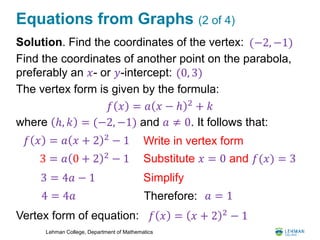
Solution. Find the coordinates of the vertex:
Find the coordinates of another point on the parabola,
preferably an 𝑥- or 𝑦-intercept:
The vertex form is given by the formula:
where ℎ, 𝑘 = (−2, −1) and 𝑎 ≠ 0. It follows that:
Vertex form of equation:
𝑓 𝑥 = 𝑎 𝑥 − ℎ 2
+ 𝑘
𝑓 𝑥 = 𝑎 𝑥 + 2 2
− 1 Write in vertex form
Substitute 𝑥 = 0 and 𝑓(𝑥) = 33 = 𝑎 0 + 2 2 − 1
3 = 4𝑎 − 1
4 = 4𝑎
Simplify
Therefore: 𝑎 = 1
𝑓 𝑥 = 𝑥 + 2 2
− 1
(−2, −1)
(0, 3)
Lehman College, Department of Mathematics
Equations from Graphs (3 of 4)
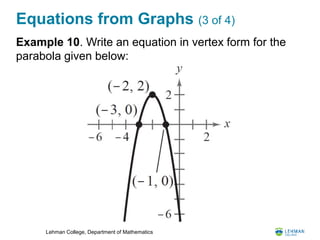
Example 10. Write an equation in vertex form for the
parabola given below:
Lehman College, Department of Mathematics
Equations from Graphs (4 of 4)
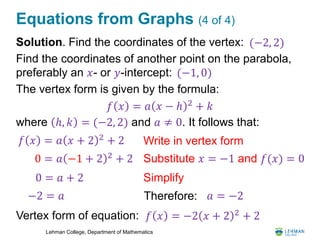
Solution. Find the coordinates of the vertex:
Find the coordinates of another point on the parabola,
preferably an 𝑥- or 𝑦-intercept:
The vertex form is given by the formula:
where ℎ, 𝑘 = (−2, 2) and 𝑎 ≠ 0. It follows that:
Vertex form of equation:
𝑓 𝑥 = 𝑎 𝑥 − ℎ 2
+ 𝑘
𝑓 𝑥 = 𝑎 𝑥 + 2 2
+ 2 Write in vertex form
Substitute 𝑥 = −1 and 𝑓(𝑥) = 00 = 𝑎 −1 + 2 2 + 2
0 = 𝑎 + 2
−2 = 𝑎
Simplify
Therefore: 𝑎 = −2
𝑓 𝑥 = −2 𝑥 + 2 2
+ 2
(−2, 2)
(−1, 0)
Lehman College, Department of Mathematics
Range of a Quadratic Function (1 of 1)
Let 𝑓 𝑥 = 𝑎 𝑥 − ℎ 2
+ 𝑘 be a quadratic function in
vertex form. Then the domain of the function is all ℝ and
the range is given by:
Example 11. Find the range of 𝑓 𝑥 = −2𝑥2
+ 4𝑥 − 5.
Solution. Complete the square in the function formula:
Range:
[𝑘, ∞) if 𝑎 is positive
(−∞, 𝑘] if 𝑎 is negative
𝑓 𝑥 = −2𝑥2 + 4𝑥 − 5
= −2 𝑥2
− 2𝑥 − 5
= −2 𝑥2 − 2𝑥 + 1 − 1 − 5
= −2 𝑥 − 1 2
− 3
(−∞, −3] since: 𝑎 = −2 < 0 and 𝑘 = −3

Lesson 17: Quadratic Functions

  • 1.
    𝐏𝐓𝐒 𝟑 Bridge toCalculus Workshop Summer 2020 Lesson 17 Quadratic Functions “A mathematician is a device for turning coffee into theorems.” - Paul Erdős -
  • 2.
    Lehman College, Departmentof Mathematics Quadratic Functions (1 of 4) A quadratic function is any function of the form: where 𝑎, 𝑏, and 𝑐 are real numbers, with 𝑎 ≠ 0. A quadratic function is a polynomial function of degree 2. The graph of a quadratic function is called a parabola. Example 1. Graph the function 𝑓 𝑥 = 𝑥2 : Solution. We first create a table with some values of 𝑥: Next, we graph these points on the coordinate axes. 𝑥 −2 −1 0 1 2 𝑦 𝑓 𝑥 = 𝑎𝑥2 + 𝑏𝑥 + 𝑐 0 11 44
  • 3.
    Lehman College, Departmentof Mathematics Quadratic Functions (2 of 4) Solution (cont’d). We create a graph from the table: 4 𝑥 𝑓(𝑥) 1 1 4 00 −1 −2 1 2 𝑓 𝑥 = 𝑥2
  • 4.
    Lehman College, Departmentof Mathematics Quadratic Functions (3 of 4) Parabolas are symmetric with respect to a line called the axis of symmetry. The point where the axis intersects the parabola is the vertex. When the leading coefficient is positive, the graph of the parabola opens upwards. Downwards for negative leading coefficient.
  • 5.
    Lehman College, Departmentof Mathematics Quadratic Functions (4 of 4) The simplest type of quadratic function is: Its graph is a vertical parabola with vertex (0, 0). When 𝑎 > 0, the vertex is the point with the minimum 𝑦- value on the graph, and when 𝑎 < 0, the vertex is the point with the maximum 𝑦-value on the graph: 𝑓 𝑥 = 𝑎𝑥2
  • 6.
    Lehman College, Departmentof Mathematics Standard and Vertex Form (1 of 7) The standard form of a quadratic function is given by: The vertex form of a quadratic function is given by: here 𝑎 ≠ 0, and ℎ, 𝑘 are the coordinates of the vertex. Example 2. Find the vertex and axis of the parabola: Solution. We complete the square in the formula: 𝑓 𝑥 = 𝑎𝑥2 + 𝑏𝑥 + 𝑐 𝑓 𝑥 = 𝑎 𝑥 − ℎ 2 + 𝑘 𝑓 𝑥 = 2𝑥2 + 8𝑥 + 7 𝑓 𝑥 = 2𝑥2 + 8𝑥 + 7 = 2 𝑥2 + 4𝑥 + 7 = 2 𝑥2 + 4𝑥 + 4 − 4 + 7
  • 7.
    Lehman College, Departmentof Mathematics Standard and Vertex Form (2 of 7) Solution (cont’d). From the previous slide: This is the vertex form. The vertex is: The equation of the axis of symmetry is: The orientation is: Example 3. Find the vertex and axis of the parabola: Solution. We complete the square in the formula. 𝑓 𝑥 = 2 𝑥2 + 4𝑥 + 4 − 4 + 7 = 2 𝑥2 + 4𝑥 + 4 + 2(−4) + 7 = 2 𝑥 + 2 2 − 8 + 7 = 2 𝑥 + 2 2 − 1 (−2, −1) 𝑥 = −2 𝑓 𝑥 = −𝑥2 + 6𝑥 − 8 opens upwards
  • 8.
    Lehman College, Departmentof Mathematics Standard and Vertex Form (3 of 7) Solution (cont’d). From the previous slide: This is the vertex form. The vertex is: The equation of the axis of symmetry is: The orientation is: = − 𝑥2 − 6𝑥 + 9 − 9 − 8 = − 𝑥2 − 6𝑥 + 9 − −9 − 8 = − 𝑥 − 3 2 + 9 − 8 = − 𝑥 − 3 2 + 1 (3, 1) 𝑥 = 3 𝑓 𝑥 = −𝑥2 + 6𝑥 − 8 = − 𝑥2 − 6𝑥 − 8 opens downwards
  • 9.
    Lehman College, Departmentof Mathematics Standard and Vertex Form (4 of 7) Example 4. Write the vertex form of the equation of the parabola whose vertex is (1, 2) and that passes through the point (3, −6): Solution. The vertex form is given by the formula: where ℎ, 𝑘 = (1, 2) and 𝑎 ≠ 0. It follows that: Vertex form of equation: 𝑓 𝑥 = 𝑎 𝑥 − ℎ 2 + 𝑘 𝑓 𝑥 = 𝑎 𝑥 − 1 2 + 2 Write in vertex form Substitute 𝑥 = 3 and 𝑓(𝑥) = −6−6 = 𝑎 3 − 1 2 + 2 −6 = 4𝑎 + 2 −8 = 4𝑎 Simplify Therefore: 𝑎 = −2 𝑓 𝑥 = −2 𝑥 − 1 2 + 2
  • 10.
    Lehman College, Departmentof Mathematics Standard and Vertex Form (5 of 7) Example 5. Determine the vertex form of the following quadratic function, where 𝑎 ≠ 0: Solution. We factor the 𝑎, then complete the square. 𝑓(𝑥) = 𝑎𝑥2 + 𝑏𝑥 + 𝑐 = 𝑎 𝑥2 + 𝑏 𝑎 𝑥 + 𝑏 2𝑎 2 − 𝑏 2𝑎 2 + 𝑐 = 𝑎 𝑥 + 𝑏 2𝑎 2 − 𝑎 𝑏 2𝑎 2 + 𝑐 = 𝑎 𝑥2 + 𝑏 𝑎 𝑥 + 𝑐 𝑓(𝑥) = 𝑎𝑥2 + 𝑏𝑥 + 𝑐
  • 11.
    Lehman College, Departmentof Mathematics Standard and Vertex Form (6 of 7) Solution (cont’d). From the previous slide: It follows that: 𝑓 𝑥 = 𝑎 𝑥 + 𝑏 2𝑎 2 − 𝑎 𝑏 2𝑎 2 + 𝑐 = 𝑎 𝑥 + 𝑏 2𝑎 2 − 𝑎 𝑏2 4𝑎2 + 𝑐 = 𝑎 𝑥 + 𝑏 2𝑎 2 − 𝑏2 − 4𝑎𝑐 4𝑎 = 𝑎 𝑥 − ℎ 2 + 𝑘 ℎ = − 𝑏 2𝑎 𝑘 = − 𝑏2 − 4𝑎𝑐 4𝑎 and
  • 12.
    Lehman College, Departmentof Mathematics Standard and Vertex Form (7 of 7) Example 6. Use the formula to determine the vertex of the following parabola: Solution. The 𝑥-coordinate of the vertex is given by: To find the 𝑦-coordinate, simply substitute 𝑥 = 2. Therefore, the vertex is: 𝑓 𝑥 = 2𝑥2 − 8𝑥 + 3 ℎ = − 𝑏 2𝑎 = − −8 2(2) = 2 2 2 2 − 8 2 + 3𝑘 = 𝑓 2 = = 2 4 − 16 + 3 = 8 − 16 + 3 = −5 (2, −5)
  • 13.
    Lehman College, Departmentof Mathematics Graphs of Parabolas (1 of 8) Example 7. Graph the parabola: Solution. Step 1. Determine the orientation: Step 2. Find the 𝑦-intercept (𝑥 = 0): Step 3. Determine the vertex: Step 4. Start making a table of values for the function. 𝑓(𝑥) = −𝑥2 + 4𝑥 opens downwards 𝑦 = − 0 2 + 4 0 = 0 ℎ = − 𝑏 2𝑎 = − 4 2(−1) = 2 − 2 2 + 4 2 =𝑘 = −4 + 8 = 4
  • 14.
    Lehman College, Departmentof Mathematics Perelman and Conway (1 of 1) John H. Conway (1937-2020) - English Mathematician Grigori Perelman (b. 1966) - Russian Mathematician
  • 15.
    Lehman College, Departmentof Mathematics Graphs of Parabolas (2 of 8) Step 4. Start making a table of values of the function. Step 5. Do a quick sketch from the information known. 𝑥 𝑦 0 0 2 4
  • 16.
    Lehman College, Departmentof Mathematics Graphs of Parabolas (3 of 8) Step 6. Determine the 𝑥-intercepts (𝑦 = 0). It follows that: Add this information to the table: Step 7. Plot more points as necessary: Step 8. Graph the function from the information in the table. Make sure to label the vertex and indicate the axis of symmetry. 𝑥 𝑦 0 0 2 4 −𝑥2 + 4𝑥 = 0 −𝑥(𝑥 − 4) = 0 𝑥 = 0 and 𝑥 = 4 0 4 −1 −5 5 −5
  • 17.
    Lehman College, Departmentof Mathematics Graphs of Parabolas (4 of 8) 𝑥 𝑦 0 0 2 4 0 4 −1 −5 5 −5
  • 18.
    Lehman College, Departmentof Mathematics Graphs of Parabolas (5 of 8) Example 8. Graph the parabola: Solution. Step 1. Determine the orientation: Step 2. Find the 𝑦-intercept (𝑥 = 0): Step 3. Determine the vertex: Step 4. Start making a table of values for the function. 𝑓 𝑥 = −2𝑥2 − 4𝑥 + 6 opens downwards 𝑦 = −2 0 2 − 4 0 + 6 = 6 ℎ = − 𝑏 2𝑎 = − −4 2(−2) = −1 −2 −1 2 − 4 −1 + 6 =𝑘 = −2 + 4 + 6 = 8
  • 19.
    Lehman College, Departmentof Mathematics Graphs of Parabolas (6 of 8) Step 4. Start making a table of values of the function. Step 5. Do a quick sketch from the information known. 𝑥 𝑦 0 6 −1 8
  • 20.
    Lehman College, Departmentof Mathematics Graphs of Parabolas (7 of 8) Step 6. Determine the 𝑥-intercepts (𝑦 = 0). It follows that: Add this information to the table: Step 7. Plot more points as necessary: Step 8. Graph the function from the information in the table. Make sure to label the vertex and indicate the axis of symmetry. 𝑥 𝑦 0 6 −1 8 −2𝑥2 − 4𝑥 + 6 = 0 −2(𝑥2 + 2𝑥 − 3) = 0 𝑥 = 1 and 𝑥 = −3 0 1 −3 0 −2 6 −2(𝑥 − 1)(𝑥 + 3) = 0
  • 21.
    Lehman College, Departmentof Mathematics Graphs of Parabolas (8 of 8)
  • 22.
    Lehman College, Departmentof Mathematics Equations from Graphs (1 of 4) Example 9. Write an equation in vertex form for the parabola given below:
  • 23.
    Lehman College, Departmentof Mathematics Equations from Graphs (2 of 4) Solution. Find the coordinates of the vertex: Find the coordinates of another point on the parabola, preferably an 𝑥- or 𝑦-intercept: The vertex form is given by the formula: where ℎ, 𝑘 = (−2, −1) and 𝑎 ≠ 0. It follows that: Vertex form of equation: 𝑓 𝑥 = 𝑎 𝑥 − ℎ 2 + 𝑘 𝑓 𝑥 = 𝑎 𝑥 + 2 2 − 1 Write in vertex form Substitute 𝑥 = 0 and 𝑓(𝑥) = 33 = 𝑎 0 + 2 2 − 1 3 = 4𝑎 − 1 4 = 4𝑎 Simplify Therefore: 𝑎 = 1 𝑓 𝑥 = 𝑥 + 2 2 − 1 (−2, −1) (0, 3)
  • 24.
    Lehman College, Departmentof Mathematics Equations from Graphs (3 of 4) Example 10. Write an equation in vertex form for the parabola given below:
  • 25.
    Lehman College, Departmentof Mathematics Equations from Graphs (4 of 4) Solution. Find the coordinates of the vertex: Find the coordinates of another point on the parabola, preferably an 𝑥- or 𝑦-intercept: The vertex form is given by the formula: where ℎ, 𝑘 = (−2, 2) and 𝑎 ≠ 0. It follows that: Vertex form of equation: 𝑓 𝑥 = 𝑎 𝑥 − ℎ 2 + 𝑘 𝑓 𝑥 = 𝑎 𝑥 + 2 2 + 2 Write in vertex form Substitute 𝑥 = −1 and 𝑓(𝑥) = 00 = 𝑎 −1 + 2 2 + 2 0 = 𝑎 + 2 −2 = 𝑎 Simplify Therefore: 𝑎 = −2 𝑓 𝑥 = −2 𝑥 + 2 2 + 2 (−2, 2) (−1, 0)
  • 26.
    Lehman College, Departmentof Mathematics Range of a Quadratic Function (1 of 1) Let 𝑓 𝑥 = 𝑎 𝑥 − ℎ 2 + 𝑘 be a quadratic function in vertex form. Then the domain of the function is all ℝ and the range is given by: Example 11. Find the range of 𝑓 𝑥 = −2𝑥2 + 4𝑥 − 5. Solution. Complete the square in the function formula: Range: [𝑘, ∞) if 𝑎 is positive (−∞, 𝑘] if 𝑎 is negative 𝑓 𝑥 = −2𝑥2 + 4𝑥 − 5 = −2 𝑥2 − 2𝑥 − 5 = −2 𝑥2 − 2𝑥 + 1 − 1 − 5 = −2 𝑥 − 1 2 − 3 (−∞, −3] since: 𝑎 = −2 < 0 and 𝑘 = −3