Lecture # 1: Introduction to Real Analysis
1.1 Introduction to Set Theory
Basic Definition of Set and Element
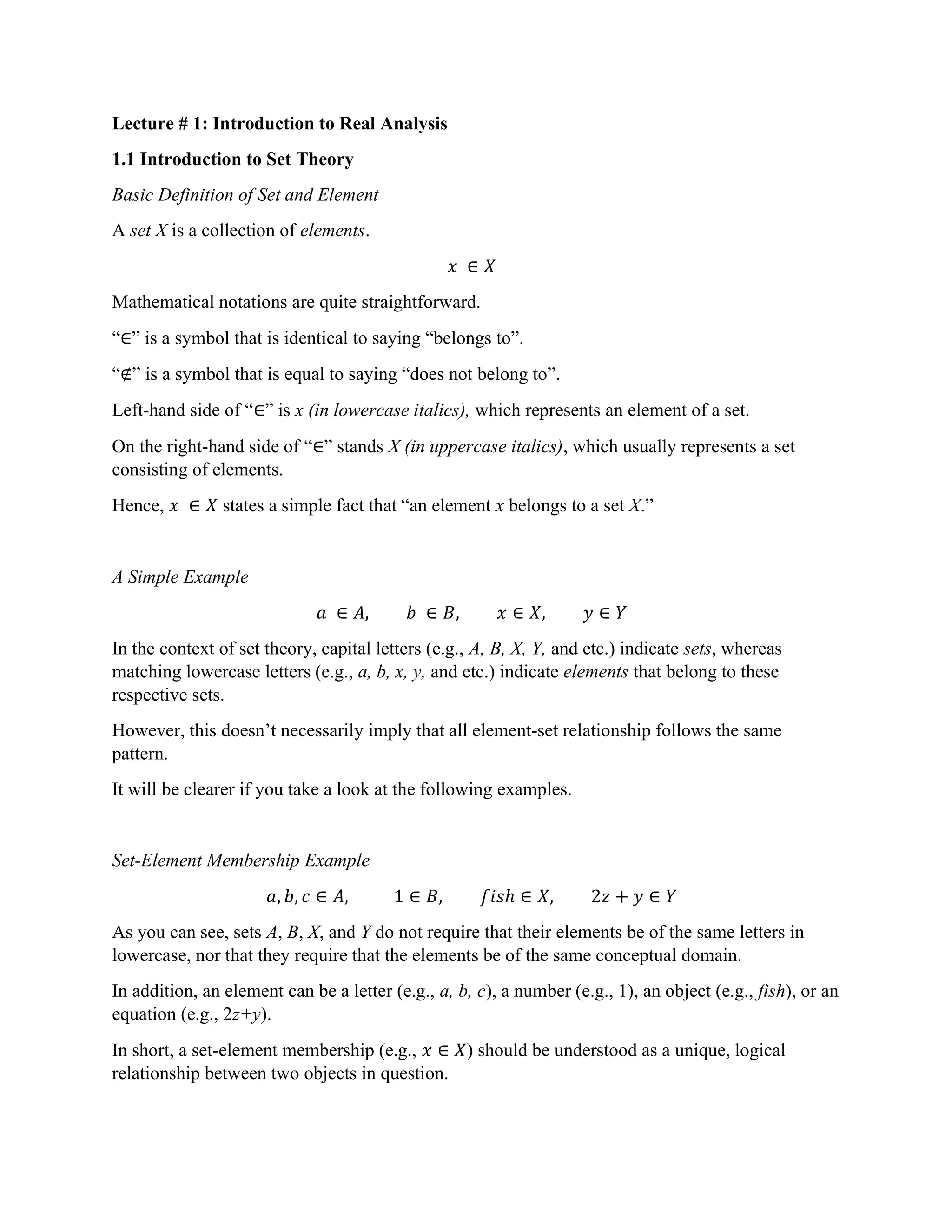
A set X is a collection of elements.
𝑥 ∈ 𝑋
Mathematical notations are quite straightforward.
“∈” is a symbol that is identical to saying “belongs to”.
“∉” is a symbol that is equal to saying “does not belong to”.
Left-hand side of “∈” is x (in lowercase italics), which represents an element of a set.
On the right-hand side of “∈” stands X (in uppercase italics), which usually represents a set
consisting of elements.
Hence, 𝑥 ∈ 𝑋 states a simple fact that “an element x belongs to a set X.”
A Simple Example
𝑎 ∈ 𝐴, 𝑏 ∈ 𝐵, 𝑥 ∈ 𝑋, 𝑦 ∈ 𝑌
In the context of set theory, capital letters (e.g., A, B, X, Y, and etc.) indicate sets, whereas
matching lowercase letters (e.g., a, b, x, y, and etc.) indicate elements that belong to these
respective sets.
However, this doesn’t necessarily imply that all element-set relationship follows the same
pattern.
It will be clearer if you take a look at the following examples.
Set-Element Membership Example
𝑎, 𝑏, 𝑐 ∈ 𝐴, 1 ∈ 𝐵, 𝑓𝑖𝑠ℎ ∈ 𝑋, 2𝑧 + 𝑦 ∈ 𝑌
As you can see, sets A, B, X, and Y do not require that their elements be of the same letters in
lowercase, nor that they require that the elements be of the same conceptual domain.
In addition, an element can be a letter (e.g., a, b, c), a number (e.g., 1), an object (e.g., fish), or an
equation (e.g., 2z+y).
In short, a set-element membership (e.g., 𝑥 ∈ 𝑋) should be understood as a unique, logical
relationship between two objects in question.
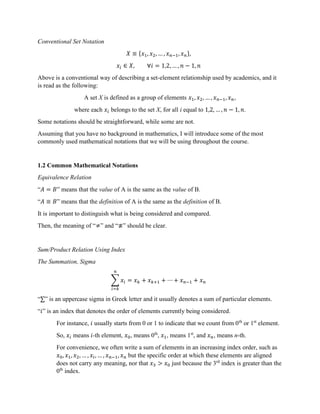
Conventional Set Notation
𝑋 ≡ {𝑥 , 𝑥 , … , 𝑥 , 𝑥 },
𝑥 ∈ 𝑋, ∀𝑖 = 1,2, … , 𝑛 − 1, 𝑛
Above is a conventional way of describing a set-element relationship used by academics, and it
is read as the following:
A set X is defined as a group of elements 𝑥 , 𝑥 , … , 𝑥 , 𝑥 ,
where each 𝑥 belongs to the set X, for all i equal to 1,2, … , 𝑛 − 1, 𝑛.
Some notations should be straightforward, while some are not.
Assuming that you have no background in mathematics, I will introduce some of the most
commonly used mathematical notations that we will be using throughout the course.
1.2 Common Mathematical Notations
Equivalence Relation
“𝐴 = 𝐵” means that the value of A is the same as the value of B.
“𝐴 ≡ 𝐵” means that the definition of A is the same as the definition of B.
It is important to distinguish what is being considered and compared.
Then, the meaning of “≠” and “≢” should be clear.
Sum/Product Relation Using Index
The Summation, Sigma
𝑥 = 𝑥 + 𝑥 + ⋯ + 𝑥 + 𝑥
“∑” is an uppercase sigma in Greek letter and it usually denotes a sum of particular elements.
“𝑖” is an index that denotes the order of elements currently being considered.
For instance, 𝑖 usually starts from 0 or 1 to indicate that we count from 0th
or 1st
element.
So, 𝑥 means 𝑖-th element, 𝑥 , means 0th
, 𝑥 , means 1st
, and 𝑥 , means n-th.
For convenience, we often write a sum of elements in an increasing index order, such as
𝑥 , 𝑥 , 𝑥 , … , 𝑥 , … , 𝑥 , 𝑥 but the specific order at which these elements are aligned
does not carry any meaning, nor that 𝑥 > 𝑥 just because the 3rd
index is greater than the
0th
index.
In sum, index is just a way of counting/showing which things are being considered.
Note that in some case, index itself can be a variable.
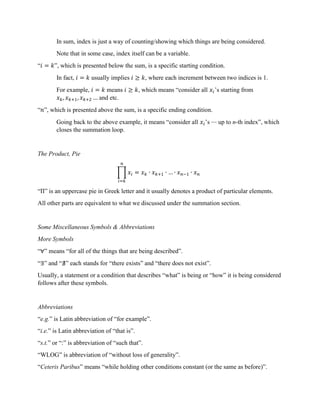
“𝑖 = 𝑘”, which is presented below the sum, is a specific starting condition.
In fact, 𝑖 = 𝑘 usually implies 𝑖 ≥ 𝑘, where each increment between two indices is 1.
For example, 𝑖 = 𝑘 means 𝑖 ≥ 𝑘, which means “consider all 𝑥 ’s starting from
𝑥 , 𝑥 , 𝑥 … and etc.
“𝑛”, which is presented above the sum, is a specific ending condition.
Going back to the above example, it means “consider all 𝑥 ’s ⋯ up to n-th index”, which
closes the summation loop.
The Product, Pie
𝑥 = 𝑥 ∙ 𝑥 ∙ … ∙ 𝑥 ∙ 𝑥
“Π” is an uppercase pie in Greek letter and it usually denotes a product of particular elements.
All other parts are equivalent to what we discussed under the summation section.
Some Miscellaneous Symbols & Abbreviations
More Symbols
“∀” means “for all of the things that are being described”.
“∃” and “∄” each stands for “there exists” and “there does not exist”.
Usually, a statement or a condition that describes “what” is being or “how” it is being considered
follows after these symbols.
Abbreviations
“e.g.” is Latin abbreviation of “for example”.
“i.e.” is Latin abbreviation of “that is”.
“s.t.” or “:” is abbreviation of “such that”.
“WLOG” is abbreviation of “without loss of generality”.
“Ceteris Paribus” means “while holding other conditions constant (or the same as before)”.
Non-Equivalence (or Inequivalence) Relation in Set Theory Context
A lot of analogies (in terms of both properties and meanings) with inequalities can be drawn.
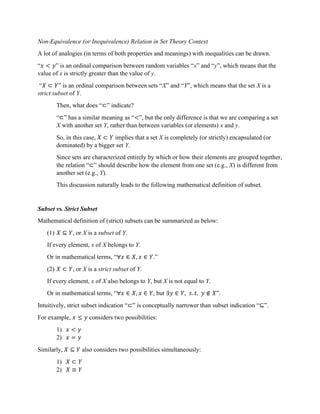
“𝑥 < 𝑦” is an ordinal comparison between random variables “x” and “y”, which means that the
value of x is strictly greater than the value of y.
“𝑋 ⊂ 𝑌” is an ordinal comparison between sets “X” and “Y”, which means that the set X is a
strict subset of Y.
Then, what does “⊂” indicate?
“⊂” has a similar meaning as “<”, but the only difference is that we are comparing a set
X with another set Y, rather than between variables (or elements) x and y.
So, in this case, 𝑋 ⊂ 𝑌 implies that a set X is completely (or strictly) encapsulated (or
dominated) by a bigger set Y.
Since sets are characterized entirely by which or how their elements are grouped together,
the relation “⊂” should describe how the element from one set (e.g., X) is different from
another set (e.g., Y).
This discussion naturally leads to the following mathematical definition of subset.
Subset vs. Strict Subset
Mathematical definition of (strict) subsets can be summarized as below:
(1) 𝑋 ⊆ 𝑌, or X is a subset of Y.
If every element, x of X belongs to Y.
Or in mathematical terms, “∀𝑥 ∈ 𝑋, 𝑥 ∈ 𝑌.”
(2) 𝑋 ⊂ 𝑌, or X is a strict subset of Y.
If every element, x of X also belongs to Y, but X is not equal to Y.
Or in mathematical terms, “∀𝑥 ∈ 𝑋, 𝑥 ∈ 𝑌, but ∃𝑦 ∈ 𝑌, 𝑠. 𝑡. 𝑦 ∉ 𝑋”.
Intuitively, strict subset indication “⊂” is conceptually narrower than subset indication “⊆”.
For example, 𝑥 ≤ 𝑦 considers two possibilities:
1) 𝑥 < 𝑦
2) 𝑥 = 𝑦
Similarly, 𝑋 ⊆ 𝑌 also considers two possibilities simultaneously:
1) 𝑋 ⊂ 𝑌
2) 𝑋 ≡ 𝑌
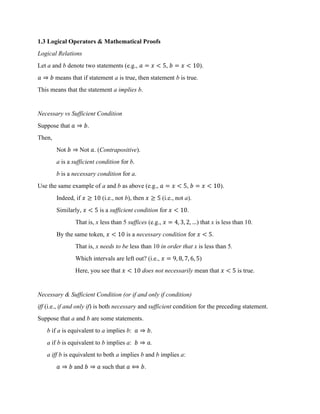
1.3 Logical Operators & Mathematical Proofs
Logical Relations
Let a and b denote two statements (e.g., 𝑎 = 𝑥 < 5, 𝑏 = 𝑥 < 10).
𝑎 ⇒ 𝑏 means that if statement a is true, then statement b is true.
This means that the statement a implies b.
Necessary vs Sufficient Condition
Suppose that 𝑎 ⇒ 𝑏.
Then,
Not 𝑏 ⇒ Not 𝑎. (Contrapositive).
a is a sufficient condition for b.
b is a necessary condition for a.
Use the same example of a and b as above (e.g., 𝑎 = 𝑥 < 5, 𝑏 = 𝑥 < 10).
Indeed, if 𝑥 ≥ 10 (i.e., not b), then 𝑥 ≥ 5 (i.e., not a).
Similarly, 𝑥 < 5 is a sufficient condition for 𝑥 < 10.
That is, x less than 5 suffices (e.g., 𝑥 = 4, 3, 2, …) that x is less than 10.
By the same token, 𝑥 < 10 is a necessary condition for 𝑥 < 5.
That is, x needs to be less than 10 in order that x is less than 5.
Which intervals are left out? (i.e., 𝑥 = 9, 8, 7, 6, 5)
Here, you see that 𝑥 < 10 does not necessarily mean that 𝑥 < 5 is true.
Necessary & Sufficient Condition (or if and only if condition)
iff (i.e., if and only if) is both necessary and sufficient condition for the preceding statement.
Suppose that a and b are some statements.
b if a is equivalent to a implies b: 𝑎 ⇒ 𝑏.
a if b is equivalent to b implies a: 𝑏 ⇒ 𝑎.
a iff b is equivalent to both a implies b and b implies a:
𝑎 ⇒ 𝑏 and 𝑏 ⇒ 𝑎 such that 𝑎 ⟺ 𝑏.
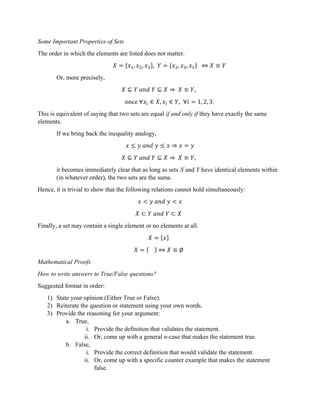
Some Important Properties of Sets
The order in which the elements are listed does not matter.
𝑋 = {𝑥 , 𝑥 , 𝑥 }, 𝑌 = {𝑥 , 𝑥 , 𝑥 } ⇔ 𝑋 ≡ 𝑌
Or, more precisely,
𝑋 ⊆ 𝑌 𝑎𝑛𝑑 𝑌 ⊆ 𝑋 ⇒ 𝑋 ≡ 𝑌,
since ∀𝑥 ∈ 𝑋, 𝑥 ∈ 𝑌, ∀𝑖 = 1, 2, 3.
This is equivalent of saying that two sets are equal if and only if they have exactly the same
elements.
If we bring back the inequality analogy,
𝑥 ≤ 𝑦 𝑎𝑛𝑑 𝑦 ≤ 𝑥 ⇒ 𝑥 = 𝑦
𝑋 ⊆ 𝑌 𝑎𝑛𝑑 𝑌 ⊆ 𝑋 ⇒ 𝑋 ≡ 𝑌,
it becomes immediately clear that as long as sets X and Y have identical elements within
(in whatever order), the two sets are the same.
Hence, it is trivial to show that the following relations cannot hold simultaneously:
𝑥 < 𝑦 𝑎𝑛𝑑 𝑦 < 𝑥
𝑋 ⊂ 𝑌 𝑎𝑛𝑑 𝑌 ⊂ 𝑋
Finally, a set may contain a single element or no elements at all.
𝑋 = {𝑥}
𝑋 = { } ⇔ 𝑋 ≡ ∅
Mathematical Proofs
How to write answers to True/False questions?
Suggested format in order:
1) State your opinion (Either True or False).
2) Reiterate the question or statement using your own words.
3) Provide the reasoning for your argument:
a. True,
i. Provide the definition that validates the statement.
ii. Or, come up with a general n-case that makes the statement true.
b. False,
i. Provide the correct definition that would validate the statement.
ii. Or, come up with a specific counter example that makes the statement
false.
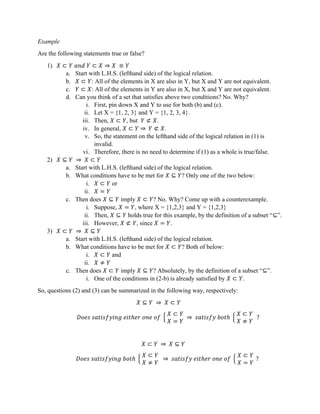
Example
Are the following statements true or false?
1) 𝑋 ⊂ 𝑌 𝑎𝑛𝑑 𝑌 ⊂ 𝑋 ⇒ 𝑋 ≡ 𝑌
a. Start with L.H.S. (lefthand side) of the logical relation.
b. 𝑋 ⊂ 𝑌: All of the elements in X are also in Y, but X and Y are not equivalent.
c. 𝑌 ⊂ 𝑋: All of the elements in Y are also in X, but X and Y are not equivalent.
d. Can you think of a set that satisfies above two conditions? No. Why?
i. First, pin down X and Y to use for both (b) and (c).
ii. Let X = {1, 2, 3} and Y = {1, 2, 3, 4}.
iii. Then, 𝑋 ⊂ 𝑌, but 𝑌 ⊄ 𝑋.
iv. In general, 𝑋 ⊂ 𝑌 ⇒ 𝑌 ⊄ 𝑋.
v. So, the statement on the lefthand side of the logical relation in (1) is
invalid.
vi. Therefore, there is no need to determine if (1) as a whole is true/false.
2) 𝑋 ⊆ 𝑌 ⇒ 𝑋 ⊂ 𝑌
a. Start with L.H.S. (lefthand side) of the logical relation.
b. What conditions have to be met for 𝑋 ⊆ 𝑌? Only one of the two below:
i. 𝑋 ⊂ 𝑌 or
ii. 𝑋 = 𝑌
c. Then does 𝑋 ⊆ 𝑌 imply 𝑋 ⊂ 𝑌? No. Why? Come up with a counterexample.
i. Suppose, 𝑋 = 𝑌, where X = {1,2,3} and Y = {1,2,3}
ii. Then, 𝑋 ⊆ 𝑌 holds true for this example, by the definition of a subset “⊆”.
iii. However, 𝑋 ⊄ 𝑌, since 𝑋 = 𝑌.
3) 𝑋 ⊂ 𝑌 ⇒ 𝑋 ⊆ 𝑌
a. Start with L.H.S. (lefthand side) of the logical relation.
b. What conditions have to be met for 𝑋 ⊂ 𝑌? Both of below:
i. 𝑋 ⊂ 𝑌 and
ii. 𝑋 ≠ 𝑌
c. Then does 𝑋 ⊂ 𝑌 imply 𝑋 ⊆ 𝑌? Absolutely, by the definition of a subset “⊆”.
i. One of the conditions in (2-b) is already satisfied by 𝑋 ⊂ 𝑌.
So, questions (2) and (3) can be summarized in the following way, respectively:
𝑋 ⊆ 𝑌 ⇒ 𝑋 ⊂ 𝑌
𝐷𝑜𝑒𝑠 𝑠𝑎𝑡𝑖𝑠𝑓𝑦𝑖𝑛𝑔 𝑒𝑖𝑡ℎ𝑒𝑟 𝑜𝑛𝑒 𝑜𝑓
𝑋 ⊂ 𝑌
𝑋 = 𝑌
⇒ 𝑠𝑎𝑡𝑖𝑠𝑓𝑦 𝑏𝑜𝑡ℎ
𝑋 ⊂ 𝑌
𝑋 ≠ 𝑌
?
𝑋 ⊂ 𝑌 ⇒ 𝑋 ⊆ 𝑌
𝐷𝑜𝑒𝑠 𝑠𝑎𝑡𝑖𝑠𝑓𝑦𝑖𝑛𝑔 𝑏𝑜𝑡ℎ
𝑋 ⊂ 𝑌
𝑋 ≠ 𝑌
⇒ 𝑠𝑎𝑡𝑖𝑠𝑓𝑦 𝑒𝑖𝑡ℎ𝑒𝑟 𝑜𝑛𝑒 𝑜𝑓
𝑋 ⊂ 𝑌
𝑋 = 𝑌
?
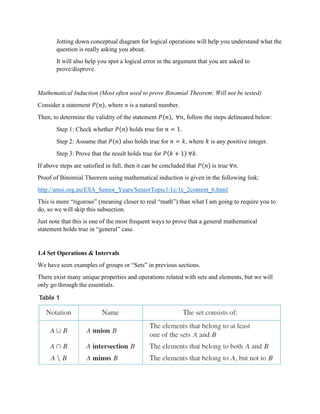
Jotting down conceptual diagram for logical operations will help you understand what the
question is really asking you about.
It will also help you spot a logical error in the argument that you are asked to
prove/disprove.
Mathematical Induction (Most often used to prove Binomial Theorem; Will not be tested)
Consider a statement 𝑃(𝑛), where n is a natural number.
Then, to determine the validity of the statement 𝑃(𝑛), ∀𝑛, follow the steps delineated below:
Step 1: Check whether 𝑃(𝑛) holds true for 𝑛 = 1.
Step 2: Assume that 𝑃(𝑛) also holds true for 𝑛 = 𝑘, where 𝑘 is any positive integer.
Step 3: Prove that the result holds true for 𝑃(𝑘 + 1) ∀𝑘.
If above steps are satisfied in full, then it can be concluded that 𝑃(𝑛) is true ∀𝑛.
Proof of Binomial Theorem using mathematical induction is given in the following link:
http://amsi.org.au/ESA_Senior_Years/SeniorTopic1/1c/1c_2content_6.html
This is more “rigorous” (meaning closer to real “math”) than what I am going to require you to
do, so we will skip this subsection.
Just note that this is one of the most frequent ways to prove that a general mathematical
statement holds true in “general” case.
1.4 Set Operations & Intervals
We have seen examples of groups or “Sets” in previous sections.
There exist many unique properties and operations related with sets and elements, but we will
only go through the essentials.
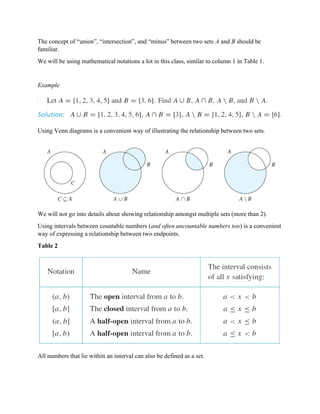
The concept of “union”, “intersection”, and “minus” between two sets A and B should be
familiar.
We will be using mathematical notations a lot in this class, similar to column 1 in Table 1.
Example
Using Venn diagrams is a convenient way of illustrating the relationship between two sets.
We will not go into details about showing relationship amongst multiple sets (more than 2).
Using intervals between countable numbers (and often uncountable numbers too) is a convenient
way of expressing a relationship between two endpoints.
Table 2
All numbers that lie within an interval can also be defined as a set.
Example
Consider a half-open interval X = (a, b] and a random variable x.
Let us define 𝑎 = −∞ and 𝑏 = 0.
If 𝑥 ∈ 𝑋 and x is any real number, then is 𝑋 a set of all real numbers?
Solution
False. By definition, the set of all real numbers is R = (−∞, ∞).
Since, 𝑥 ∈ 𝑋 and 𝑋 = (−∞, 0], 𝑋 cannot be a set of all real numbers.
In fact, X is a (strict) subset of R. Or equivalently, 𝑋 ⊆ 𝑅 and 𝑋 ⊂ 𝑅, but 𝑋 ≠ 𝑅.
1.5 Set Theory & Real Analysis
Using the mathematical notations that we learned so far, we are able to define explicitly (and
rigorously) numbers using set theory notations.
But first, let’s look at definitions of different types of “numbers” using conversational English
and simple examples.
As you can see above, numbers can be defined into different categories (but not necessarily
distinct; for example, a number 1 is an integer, but at the same time, it’s a counting number,
whole number, and etc.), depending on the characteristics they exhibit.
Imaginary numbers are beyond the scope of this course, so they are excluded from examination.
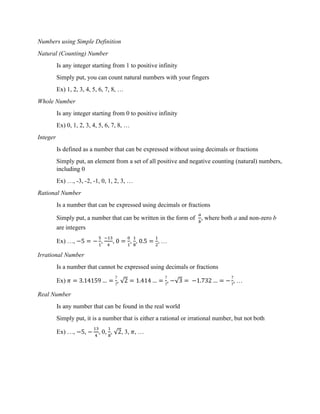
Numbers using Simple Definition
Natural (Counting) Number
Is any integer starting from 1 to positive infinity
Simply put, you can count natural numbers with your fingers
Ex) 1, 2, 3, 4, 5, 6, 7, 8, …
Whole Number
Is any integer starting from 0 to positive infinity
Ex) 0, 1, 2, 3, 4, 5, 6, 7, 8, …
Integer
Is defined as a number that can be expressed without using decimals or fractions
Simply put, an element from a set of all positive and negative counting (natural) numbers,
including 0
Ex) …, -3, -2, -1, 0, 1, 2, 3, …
Rational Number
Is a number that can be expressed using decimals or fractions
Simply put, a number that can be written in the form of , where both a and non-zero b
are integers
Ex) …, −5 = − , , 0 = , , 0.5 = , …
Irrational Number
Is a number that cannot be expressed using decimals or fractions
Ex) 𝜋 = 3.14159 … =
?
?
, √2 = 1.414 … =
?
?
, −√3 = −1.732 … = −
?
?
, …
Real Number
Is any number that can be found in the real world
Simply put, it is a number that is either a rational or irrational number, but not both
Ex) …, −5, − , 0, , √2, 3, 𝜋, …
Numbers using Mathematical Notations
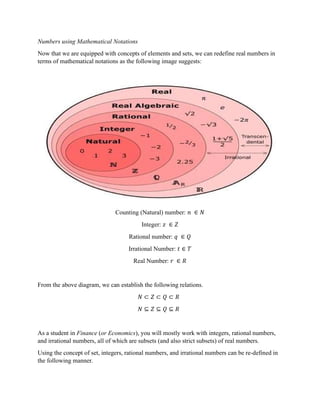
Now that we are equipped with concepts of elements and sets, we can redefine real numbers in
terms of mathematical notations as the following image suggests:
Counting (Natural) number: 𝑛 ∈ 𝑁
Integer: 𝑧 ∈ 𝑍
Rational number: 𝑞 ∈ 𝑄
Irrational Number: 𝑡 ∈ 𝑇
Real Number: 𝑟 ∈ 𝑅
From the above diagram, we can establish the following relations.
𝑁 ⊂ 𝑍 ⊂ 𝑄 ⊂ 𝑅
𝑁 ⊆ 𝑍 ⊆ 𝑄 ⊆ 𝑅
As a student in Finance (or Economics), you will mostly work with integers, rational numbers,
and irrational numbers, all of which are subsets (and also strict subsets) of real numbers.
Using the concept of set, integers, rational numbers, and irrational numbers can be re-defined in
the following manner.
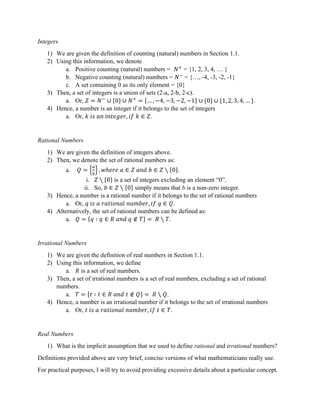
Integers
1) We are given the definition of counting (natural) numbers in Section 1.1.
2) Using this information, we denote
a. Positive counting (natural) numbers = 𝑁 = {1, 2, 3, 4, … }
b. Negative counting (natural) numbers = 𝑁 = {…, -4, -3, -2, -1}
c. A set containing 0 as its only element = {0}
3) Then, a set of integers is a union of sets (2-a, 2-b, 2-c).
a. Or, 𝑍 = 𝑁 ∪ {0} ∪ 𝑁 = {… , −4, −3, −2, −1} ∪ {0} ∪ {1, 2, 3, 4, … }.
4) Hence, a number is an integer if it belongs to the set of integers
a. Or, 𝑘 𝑖𝑠 𝑎𝑛 𝑖𝑛𝑡𝑒𝑔𝑒𝑟, 𝑖𝑓 𝑘 ∈ 𝑍.
Rational Numbers
1) We are given the definition of integers above.
2) Then, we denote the set of rational numbers as:
a. 𝑄 = , 𝑤ℎ𝑒𝑟𝑒 𝑎 ∈ 𝑍 𝑎𝑛𝑑 𝑏 ∈ 𝑍 ∖ {0}.
i. 𝑍 ∖ {0} is a set of integers excluding an element “0”.
ii. So, 𝑏 ∈ 𝑍 ∖ {0} simply means that b is a non-zero integer.
3) Hence, a number is a rational number if it belongs to the set of rational numbers
a. Or, 𝑞 𝑖𝑠 𝑎 𝑟𝑎𝑡𝑖𝑜𝑛𝑎𝑙 𝑛𝑢𝑚𝑏𝑒𝑟, 𝑖𝑓 𝑞 ∈ 𝑄.
4) Alternatively, the set of rational numbers can be defined as:
a. 𝑄 = {𝑞 ∶ 𝑞 ∈ 𝑅 𝑎𝑛𝑑 𝑞 ∉ 𝑇} = 𝑅 ∖ 𝑇.
Irrational Numbers
1) We are given the definition of real numbers in Section 1.1.
2) Using this information, we define
a. 𝑅 is a set of real numbers.
3) Then, a set of irrational numbers is a set of real numbers, excluding a set of rational
numbers.
a. 𝑇 = {𝑡 ∶ 𝑡 ∈ 𝑅 𝑎𝑛𝑑 𝑡 ∉ 𝑄} = 𝑅 ∖ 𝑄.
4) Hence, a number is an irrational number if it belongs to the set of irrational numbers
a. Or, 𝑡 𝑖𝑠 𝑎 𝑟𝑎𝑡𝑖𝑜𝑛𝑎𝑙 𝑛𝑢𝑚𝑏𝑒𝑟, 𝑖𝑓 𝑡 ∈ 𝑇.
Real Numbers
1) What is the implicit assumption that we used to define rational and irrational numbers?
Definitions provided above are very brief, concise versions of what mathematicians really use.
For practical purposes, I will try to avoid providing excessive details about a particular concept.
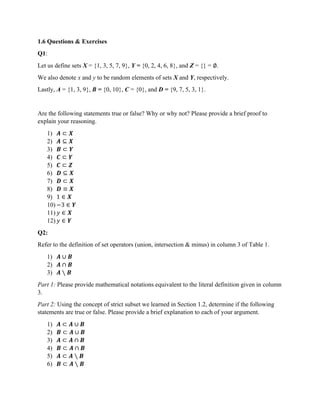
1.6 Questions & Exercises
Q1:
Let us define sets X = {1, 3, 5, 7, 9}, Y = {0, 2, 4, 6, 8}, and Z = {} = ∅.
We also denote x and y to be random elements of sets X and Y, respectively.
Lastly, A = {1, 3, 9}, B = {0, 10}, C = {0}, and D = {9, 7, 5, 3, 1}.
Are the following statements true or false? Why or why not? Please provide a brief proof to
explain your reasoning.
1) 𝑨 ⊂ 𝑿
2) 𝑨 ⊆ 𝑿
3) 𝑩 ⊂ 𝒀
4) 𝑪 ⊂ 𝒀
5) 𝑪 ⊂ 𝒁
6) 𝑫 ⊆ 𝑿
7) 𝑫 ⊂ 𝑿
8) 𝑫 ≡ 𝑿
9) 1 ∈ 𝑿
10) −3 ∈ 𝒀
11) 𝑦 ∈ 𝑿
12) 𝑦 ∈ 𝒀
Q2:
Refer to the definition of set operators (union, intersection & minus) in column 3 of Table 1.
1) 𝑨 ∪ 𝑩
2) 𝑨 ∩ 𝑩
3) 𝑨 ∖ 𝑩
Part 1: Please provide mathematical notations equivalent to the literal definition given in column
3.
Part 2: Using the concept of strict subset we learned in Section 1.2, determine if the following
statements are true or false. Please provide a brief explanation to each of your argument.
1) 𝑨 ⊂ 𝑨 ∪ 𝑩
2) 𝑩 ⊂ 𝑨 ∪ 𝑩
3) 𝑨 ⊂ 𝑨 ∩ 𝑩
4) 𝑩 ⊂ 𝑨 ∩ 𝑩
5) 𝑨 ⊂ 𝑨 ∖ 𝑩
6) 𝑩 ⊂ 𝑨 ∖ 𝑩
Q3:
Are the following statements true or false? Please provide a brief proof to bolster your claim.
1) 𝑻 ⊂ 𝑹
2) 𝑻 ⊆ 𝑹
3) 𝑵 ⊆ 𝒁 ⊆ 𝑸 ⊆ 𝑻 ⊆ 𝑹
4) 𝑵 ⊆ 𝒁 ⊆ 𝑸 ⊆ 𝑹 𝑎𝑛𝑑 𝑻 ⊆ 𝑹
5) 𝑵 ⊂ 𝒁 ⊂ 𝑸 ⊂ 𝑹 𝑎𝑛𝑑 𝑻 ⊂ 𝑹
Q4:
Let us define 𝑟𝑎𝑡𝑖𝑜𝑛𝑎𝑙 𝑥 ∈ 𝑿 and X = (-1, 4]. Are the following statements true? Why or why
not?
1) 𝑥 = −1
2) 𝑥 = 𝜋
3) 𝑥 =
4) 𝑥 = 0
Q5:
Consider a closed interval [a, b] where 𝑎, 𝑏 ∈ 𝑹 and 𝑎 ≤ 𝑏.
We also define real 𝑥 ∈ 𝑿 and X = [a, b].
Part 1:Please provide a concise mathematical definition of X using the set notation “{}” and
inequalities.
Hint: X = [a, b] ≡ {𝑥 ∈ ? : "𝑑𝑒𝑠𝑐𝑟𝑖𝑏𝑒 𝑡ℎ𝑒 𝑖𝑛𝑡𝑒𝑟𝑣𝑎𝑙𝑠 𝑢𝑠𝑖𝑛𝑔 𝑥 𝑎𝑛𝑑 𝑖𝑛𝑒𝑞𝑢𝑎𝑙𝑖𝑡𝑖𝑒𝑠"}
Part 2: Which values of 𝑎 and 𝑏 would make the set X contain only one element in it?
Hint: Providing any numerical example of 𝑎 and 𝑏 is sufficient.
Part 3: Can you think of a specific relationship between 𝑎 and 𝑏 that would make X have only
one element without the loss of generality?
References:
Figure 1: https://www.youtube.com/watch?v=L5pMN4iA96E
Figure 2: https://www.quora.com/Are-natural-numbers-an-element-of-real-numbers
Tables are from Essential Mathematics for Economic Analysis 4th
Edition, by Sydsaeter,
Hammond, and Strom. Much of the materials that I used in this lecture were excerpted from
Professor Charles Wilson’s lecture notes in ECON-UA06 in 2012 at NYU. Any errors and
inaccuracies due to the recreation of their publishments are my sole responsibility.

mathematics Lecture I______________________________

  • 1.
    Lecture # 1:Introduction to Real Analysis 1.1 Introduction to Set Theory Basic Definition of Set and Element A set X is a collection of elements. 𝑥 ∈ 𝑋 Mathematical notations are quite straightforward. “∈” is a symbol that is identical to saying “belongs to”. “∉” is a symbol that is equal to saying “does not belong to”. Left-hand side of “∈” is x (in lowercase italics), which represents an element of a set. On the right-hand side of “∈” stands X (in uppercase italics), which usually represents a set consisting of elements. Hence, 𝑥 ∈ 𝑋 states a simple fact that “an element x belongs to a set X.” A Simple Example 𝑎 ∈ 𝐴, 𝑏 ∈ 𝐵, 𝑥 ∈ 𝑋, 𝑦 ∈ 𝑌 In the context of set theory, capital letters (e.g., A, B, X, Y, and etc.) indicate sets, whereas matching lowercase letters (e.g., a, b, x, y, and etc.) indicate elements that belong to these respective sets. However, this doesn’t necessarily imply that all element-set relationship follows the same pattern. It will be clearer if you take a look at the following examples. Set-Element Membership Example 𝑎, 𝑏, 𝑐 ∈ 𝐴, 1 ∈ 𝐵, 𝑓𝑖𝑠ℎ ∈ 𝑋, 2𝑧 + 𝑦 ∈ 𝑌 As you can see, sets A, B, X, and Y do not require that their elements be of the same letters in lowercase, nor that they require that the elements be of the same conceptual domain. In addition, an element can be a letter (e.g., a, b, c), a number (e.g., 1), an object (e.g., fish), or an equation (e.g., 2z+y). In short, a set-element membership (e.g., 𝑥 ∈ 𝑋) should be understood as a unique, logical relationship between two objects in question.
  • 2.
    Conventional Set Notation 𝑋≡ {𝑥 , 𝑥 , … , 𝑥 , 𝑥 }, 𝑥 ∈ 𝑋, ∀𝑖 = 1,2, … , 𝑛 − 1, 𝑛 Above is a conventional way of describing a set-element relationship used by academics, and it is read as the following: A set X is defined as a group of elements 𝑥 , 𝑥 , … , 𝑥 , 𝑥 , where each 𝑥 belongs to the set X, for all i equal to 1,2, … , 𝑛 − 1, 𝑛. Some notations should be straightforward, while some are not. Assuming that you have no background in mathematics, I will introduce some of the most commonly used mathematical notations that we will be using throughout the course. 1.2 Common Mathematical Notations Equivalence Relation “𝐴 = 𝐵” means that the value of A is the same as the value of B. “𝐴 ≡ 𝐵” means that the definition of A is the same as the definition of B. It is important to distinguish what is being considered and compared. Then, the meaning of “≠” and “≢” should be clear. Sum/Product Relation Using Index The Summation, Sigma 𝑥 = 𝑥 + 𝑥 + ⋯ + 𝑥 + 𝑥 “∑” is an uppercase sigma in Greek letter and it usually denotes a sum of particular elements. “𝑖” is an index that denotes the order of elements currently being considered. For instance, 𝑖 usually starts from 0 or 1 to indicate that we count from 0th or 1st element. So, 𝑥 means 𝑖-th element, 𝑥 , means 0th , 𝑥 , means 1st , and 𝑥 , means n-th. For convenience, we often write a sum of elements in an increasing index order, such as 𝑥 , 𝑥 , 𝑥 , … , 𝑥 , … , 𝑥 , 𝑥 but the specific order at which these elements are aligned does not carry any meaning, nor that 𝑥 > 𝑥 just because the 3rd index is greater than the 0th index.
  • 3.
    In sum, indexis just a way of counting/showing which things are being considered. Note that in some case, index itself can be a variable. “𝑖 = 𝑘”, which is presented below the sum, is a specific starting condition. In fact, 𝑖 = 𝑘 usually implies 𝑖 ≥ 𝑘, where each increment between two indices is 1. For example, 𝑖 = 𝑘 means 𝑖 ≥ 𝑘, which means “consider all 𝑥 ’s starting from 𝑥 , 𝑥 , 𝑥 … and etc. “𝑛”, which is presented above the sum, is a specific ending condition. Going back to the above example, it means “consider all 𝑥 ’s ⋯ up to n-th index”, which closes the summation loop. The Product, Pie 𝑥 = 𝑥 ∙ 𝑥 ∙ … ∙ 𝑥 ∙ 𝑥 “Π” is an uppercase pie in Greek letter and it usually denotes a product of particular elements. All other parts are equivalent to what we discussed under the summation section. Some Miscellaneous Symbols & Abbreviations More Symbols “∀” means “for all of the things that are being described”. “∃” and “∄” each stands for “there exists” and “there does not exist”. Usually, a statement or a condition that describes “what” is being or “how” it is being considered follows after these symbols. Abbreviations “e.g.” is Latin abbreviation of “for example”. “i.e.” is Latin abbreviation of “that is”. “s.t.” or “:” is abbreviation of “such that”. “WLOG” is abbreviation of “without loss of generality”. “Ceteris Paribus” means “while holding other conditions constant (or the same as before)”.
  • 4.
    Non-Equivalence (or Inequivalence)Relation in Set Theory Context A lot of analogies (in terms of both properties and meanings) with inequalities can be drawn. “𝑥 < 𝑦” is an ordinal comparison between random variables “x” and “y”, which means that the value of x is strictly greater than the value of y. “𝑋 ⊂ 𝑌” is an ordinal comparison between sets “X” and “Y”, which means that the set X is a strict subset of Y. Then, what does “⊂” indicate? “⊂” has a similar meaning as “<”, but the only difference is that we are comparing a set X with another set Y, rather than between variables (or elements) x and y. So, in this case, 𝑋 ⊂ 𝑌 implies that a set X is completely (or strictly) encapsulated (or dominated) by a bigger set Y. Since sets are characterized entirely by which or how their elements are grouped together, the relation “⊂” should describe how the element from one set (e.g., X) is different from another set (e.g., Y). This discussion naturally leads to the following mathematical definition of subset. Subset vs. Strict Subset Mathematical definition of (strict) subsets can be summarized as below: (1) 𝑋 ⊆ 𝑌, or X is a subset of Y. If every element, x of X belongs to Y. Or in mathematical terms, “∀𝑥 ∈ 𝑋, 𝑥 ∈ 𝑌.” (2) 𝑋 ⊂ 𝑌, or X is a strict subset of Y. If every element, x of X also belongs to Y, but X is not equal to Y. Or in mathematical terms, “∀𝑥 ∈ 𝑋, 𝑥 ∈ 𝑌, but ∃𝑦 ∈ 𝑌, 𝑠. 𝑡. 𝑦 ∉ 𝑋”. Intuitively, strict subset indication “⊂” is conceptually narrower than subset indication “⊆”. For example, 𝑥 ≤ 𝑦 considers two possibilities: 1) 𝑥 < 𝑦 2) 𝑥 = 𝑦 Similarly, 𝑋 ⊆ 𝑌 also considers two possibilities simultaneously: 1) 𝑋 ⊂ 𝑌 2) 𝑋 ≡ 𝑌
  • 5.
    1.3 Logical Operators& Mathematical Proofs Logical Relations Let a and b denote two statements (e.g., 𝑎 = 𝑥 < 5, 𝑏 = 𝑥 < 10). 𝑎 ⇒ 𝑏 means that if statement a is true, then statement b is true. This means that the statement a implies b. Necessary vs Sufficient Condition Suppose that 𝑎 ⇒ 𝑏. Then, Not 𝑏 ⇒ Not 𝑎. (Contrapositive). a is a sufficient condition for b. b is a necessary condition for a. Use the same example of a and b as above (e.g., 𝑎 = 𝑥 < 5, 𝑏 = 𝑥 < 10). Indeed, if 𝑥 ≥ 10 (i.e., not b), then 𝑥 ≥ 5 (i.e., not a). Similarly, 𝑥 < 5 is a sufficient condition for 𝑥 < 10. That is, x less than 5 suffices (e.g., 𝑥 = 4, 3, 2, …) that x is less than 10. By the same token, 𝑥 < 10 is a necessary condition for 𝑥 < 5. That is, x needs to be less than 10 in order that x is less than 5. Which intervals are left out? (i.e., 𝑥 = 9, 8, 7, 6, 5) Here, you see that 𝑥 < 10 does not necessarily mean that 𝑥 < 5 is true. Necessary & Sufficient Condition (or if and only if condition) iff (i.e., if and only if) is both necessary and sufficient condition for the preceding statement. Suppose that a and b are some statements. b if a is equivalent to a implies b: 𝑎 ⇒ 𝑏. a if b is equivalent to b implies a: 𝑏 ⇒ 𝑎. a iff b is equivalent to both a implies b and b implies a: 𝑎 ⇒ 𝑏 and 𝑏 ⇒ 𝑎 such that 𝑎 ⟺ 𝑏.
  • 6.
    Some Important Propertiesof Sets The order in which the elements are listed does not matter. 𝑋 = {𝑥 , 𝑥 , 𝑥 }, 𝑌 = {𝑥 , 𝑥 , 𝑥 } ⇔ 𝑋 ≡ 𝑌 Or, more precisely, 𝑋 ⊆ 𝑌 𝑎𝑛𝑑 𝑌 ⊆ 𝑋 ⇒ 𝑋 ≡ 𝑌, since ∀𝑥 ∈ 𝑋, 𝑥 ∈ 𝑌, ∀𝑖 = 1, 2, 3. This is equivalent of saying that two sets are equal if and only if they have exactly the same elements. If we bring back the inequality analogy, 𝑥 ≤ 𝑦 𝑎𝑛𝑑 𝑦 ≤ 𝑥 ⇒ 𝑥 = 𝑦 𝑋 ⊆ 𝑌 𝑎𝑛𝑑 𝑌 ⊆ 𝑋 ⇒ 𝑋 ≡ 𝑌, it becomes immediately clear that as long as sets X and Y have identical elements within (in whatever order), the two sets are the same. Hence, it is trivial to show that the following relations cannot hold simultaneously: 𝑥 < 𝑦 𝑎𝑛𝑑 𝑦 < 𝑥 𝑋 ⊂ 𝑌 𝑎𝑛𝑑 𝑌 ⊂ 𝑋 Finally, a set may contain a single element or no elements at all. 𝑋 = {𝑥} 𝑋 = { } ⇔ 𝑋 ≡ ∅ Mathematical Proofs How to write answers to True/False questions? Suggested format in order: 1) State your opinion (Either True or False). 2) Reiterate the question or statement using your own words. 3) Provide the reasoning for your argument: a. True, i. Provide the definition that validates the statement. ii. Or, come up with a general n-case that makes the statement true. b. False, i. Provide the correct definition that would validate the statement. ii. Or, come up with a specific counter example that makes the statement false.
  • 7.
    Example Are the followingstatements true or false? 1) 𝑋 ⊂ 𝑌 𝑎𝑛𝑑 𝑌 ⊂ 𝑋 ⇒ 𝑋 ≡ 𝑌 a. Start with L.H.S. (lefthand side) of the logical relation. b. 𝑋 ⊂ 𝑌: All of the elements in X are also in Y, but X and Y are not equivalent. c. 𝑌 ⊂ 𝑋: All of the elements in Y are also in X, but X and Y are not equivalent. d. Can you think of a set that satisfies above two conditions? No. Why? i. First, pin down X and Y to use for both (b) and (c). ii. Let X = {1, 2, 3} and Y = {1, 2, 3, 4}. iii. Then, 𝑋 ⊂ 𝑌, but 𝑌 ⊄ 𝑋. iv. In general, 𝑋 ⊂ 𝑌 ⇒ 𝑌 ⊄ 𝑋. v. So, the statement on the lefthand side of the logical relation in (1) is invalid. vi. Therefore, there is no need to determine if (1) as a whole is true/false. 2) 𝑋 ⊆ 𝑌 ⇒ 𝑋 ⊂ 𝑌 a. Start with L.H.S. (lefthand side) of the logical relation. b. What conditions have to be met for 𝑋 ⊆ 𝑌? Only one of the two below: i. 𝑋 ⊂ 𝑌 or ii. 𝑋 = 𝑌 c. Then does 𝑋 ⊆ 𝑌 imply 𝑋 ⊂ 𝑌? No. Why? Come up with a counterexample. i. Suppose, 𝑋 = 𝑌, where X = {1,2,3} and Y = {1,2,3} ii. Then, 𝑋 ⊆ 𝑌 holds true for this example, by the definition of a subset “⊆”. iii. However, 𝑋 ⊄ 𝑌, since 𝑋 = 𝑌. 3) 𝑋 ⊂ 𝑌 ⇒ 𝑋 ⊆ 𝑌 a. Start with L.H.S. (lefthand side) of the logical relation. b. What conditions have to be met for 𝑋 ⊂ 𝑌? Both of below: i. 𝑋 ⊂ 𝑌 and ii. 𝑋 ≠ 𝑌 c. Then does 𝑋 ⊂ 𝑌 imply 𝑋 ⊆ 𝑌? Absolutely, by the definition of a subset “⊆”. i. One of the conditions in (2-b) is already satisfied by 𝑋 ⊂ 𝑌. So, questions (2) and (3) can be summarized in the following way, respectively: 𝑋 ⊆ 𝑌 ⇒ 𝑋 ⊂ 𝑌 𝐷𝑜𝑒𝑠 𝑠𝑎𝑡𝑖𝑠𝑓𝑦𝑖𝑛𝑔 𝑒𝑖𝑡ℎ𝑒𝑟 𝑜𝑛𝑒 𝑜𝑓 𝑋 ⊂ 𝑌 𝑋 = 𝑌 ⇒ 𝑠𝑎𝑡𝑖𝑠𝑓𝑦 𝑏𝑜𝑡ℎ 𝑋 ⊂ 𝑌 𝑋 ≠ 𝑌 ? 𝑋 ⊂ 𝑌 ⇒ 𝑋 ⊆ 𝑌 𝐷𝑜𝑒𝑠 𝑠𝑎𝑡𝑖𝑠𝑓𝑦𝑖𝑛𝑔 𝑏𝑜𝑡ℎ 𝑋 ⊂ 𝑌 𝑋 ≠ 𝑌 ⇒ 𝑠𝑎𝑡𝑖𝑠𝑓𝑦 𝑒𝑖𝑡ℎ𝑒𝑟 𝑜𝑛𝑒 𝑜𝑓 𝑋 ⊂ 𝑌 𝑋 = 𝑌 ?
  • 8.
    Jotting down conceptualdiagram for logical operations will help you understand what the question is really asking you about. It will also help you spot a logical error in the argument that you are asked to prove/disprove. Mathematical Induction (Most often used to prove Binomial Theorem; Will not be tested) Consider a statement 𝑃(𝑛), where n is a natural number. Then, to determine the validity of the statement 𝑃(𝑛), ∀𝑛, follow the steps delineated below: Step 1: Check whether 𝑃(𝑛) holds true for 𝑛 = 1. Step 2: Assume that 𝑃(𝑛) also holds true for 𝑛 = 𝑘, where 𝑘 is any positive integer. Step 3: Prove that the result holds true for 𝑃(𝑘 + 1) ∀𝑘. If above steps are satisfied in full, then it can be concluded that 𝑃(𝑛) is true ∀𝑛. Proof of Binomial Theorem using mathematical induction is given in the following link: http://amsi.org.au/ESA_Senior_Years/SeniorTopic1/1c/1c_2content_6.html This is more “rigorous” (meaning closer to real “math”) than what I am going to require you to do, so we will skip this subsection. Just note that this is one of the most frequent ways to prove that a general mathematical statement holds true in “general” case. 1.4 Set Operations & Intervals We have seen examples of groups or “Sets” in previous sections. There exist many unique properties and operations related with sets and elements, but we will only go through the essentials.
  • 9.
    The concept of“union”, “intersection”, and “minus” between two sets A and B should be familiar. We will be using mathematical notations a lot in this class, similar to column 1 in Table 1. Example Using Venn diagrams is a convenient way of illustrating the relationship between two sets. We will not go into details about showing relationship amongst multiple sets (more than 2). Using intervals between countable numbers (and often uncountable numbers too) is a convenient way of expressing a relationship between two endpoints. Table 2 All numbers that lie within an interval can also be defined as a set.
  • 10.
    Example Consider a half-openinterval X = (a, b] and a random variable x. Let us define 𝑎 = −∞ and 𝑏 = 0. If 𝑥 ∈ 𝑋 and x is any real number, then is 𝑋 a set of all real numbers? Solution False. By definition, the set of all real numbers is R = (−∞, ∞). Since, 𝑥 ∈ 𝑋 and 𝑋 = (−∞, 0], 𝑋 cannot be a set of all real numbers. In fact, X is a (strict) subset of R. Or equivalently, 𝑋 ⊆ 𝑅 and 𝑋 ⊂ 𝑅, but 𝑋 ≠ 𝑅. 1.5 Set Theory & Real Analysis Using the mathematical notations that we learned so far, we are able to define explicitly (and rigorously) numbers using set theory notations. But first, let’s look at definitions of different types of “numbers” using conversational English and simple examples. As you can see above, numbers can be defined into different categories (but not necessarily distinct; for example, a number 1 is an integer, but at the same time, it’s a counting number, whole number, and etc.), depending on the characteristics they exhibit. Imaginary numbers are beyond the scope of this course, so they are excluded from examination.
  • 11.
    Numbers using SimpleDefinition Natural (Counting) Number Is any integer starting from 1 to positive infinity Simply put, you can count natural numbers with your fingers Ex) 1, 2, 3, 4, 5, 6, 7, 8, … Whole Number Is any integer starting from 0 to positive infinity Ex) 0, 1, 2, 3, 4, 5, 6, 7, 8, … Integer Is defined as a number that can be expressed without using decimals or fractions Simply put, an element from a set of all positive and negative counting (natural) numbers, including 0 Ex) …, -3, -2, -1, 0, 1, 2, 3, … Rational Number Is a number that can be expressed using decimals or fractions Simply put, a number that can be written in the form of , where both a and non-zero b are integers Ex) …, −5 = − , , 0 = , , 0.5 = , … Irrational Number Is a number that cannot be expressed using decimals or fractions Ex) 𝜋 = 3.14159 … = ? ? , √2 = 1.414 … = ? ? , −√3 = −1.732 … = − ? ? , … Real Number Is any number that can be found in the real world Simply put, it is a number that is either a rational or irrational number, but not both Ex) …, −5, − , 0, , √2, 3, 𝜋, …
  • 12.
    Numbers using MathematicalNotations Now that we are equipped with concepts of elements and sets, we can redefine real numbers in terms of mathematical notations as the following image suggests: Counting (Natural) number: 𝑛 ∈ 𝑁 Integer: 𝑧 ∈ 𝑍 Rational number: 𝑞 ∈ 𝑄 Irrational Number: 𝑡 ∈ 𝑇 Real Number: 𝑟 ∈ 𝑅 From the above diagram, we can establish the following relations. 𝑁 ⊂ 𝑍 ⊂ 𝑄 ⊂ 𝑅 𝑁 ⊆ 𝑍 ⊆ 𝑄 ⊆ 𝑅 As a student in Finance (or Economics), you will mostly work with integers, rational numbers, and irrational numbers, all of which are subsets (and also strict subsets) of real numbers. Using the concept of set, integers, rational numbers, and irrational numbers can be re-defined in the following manner.
  • 13.
    Integers 1) We aregiven the definition of counting (natural) numbers in Section 1.1. 2) Using this information, we denote a. Positive counting (natural) numbers = 𝑁 = {1, 2, 3, 4, … } b. Negative counting (natural) numbers = 𝑁 = {…, -4, -3, -2, -1} c. A set containing 0 as its only element = {0} 3) Then, a set of integers is a union of sets (2-a, 2-b, 2-c). a. Or, 𝑍 = 𝑁 ∪ {0} ∪ 𝑁 = {… , −4, −3, −2, −1} ∪ {0} ∪ {1, 2, 3, 4, … }. 4) Hence, a number is an integer if it belongs to the set of integers a. Or, 𝑘 𝑖𝑠 𝑎𝑛 𝑖𝑛𝑡𝑒𝑔𝑒𝑟, 𝑖𝑓 𝑘 ∈ 𝑍. Rational Numbers 1) We are given the definition of integers above. 2) Then, we denote the set of rational numbers as: a. 𝑄 = , 𝑤ℎ𝑒𝑟𝑒 𝑎 ∈ 𝑍 𝑎𝑛𝑑 𝑏 ∈ 𝑍 ∖ {0}. i. 𝑍 ∖ {0} is a set of integers excluding an element “0”. ii. So, 𝑏 ∈ 𝑍 ∖ {0} simply means that b is a non-zero integer. 3) Hence, a number is a rational number if it belongs to the set of rational numbers a. Or, 𝑞 𝑖𝑠 𝑎 𝑟𝑎𝑡𝑖𝑜𝑛𝑎𝑙 𝑛𝑢𝑚𝑏𝑒𝑟, 𝑖𝑓 𝑞 ∈ 𝑄. 4) Alternatively, the set of rational numbers can be defined as: a. 𝑄 = {𝑞 ∶ 𝑞 ∈ 𝑅 𝑎𝑛𝑑 𝑞 ∉ 𝑇} = 𝑅 ∖ 𝑇. Irrational Numbers 1) We are given the definition of real numbers in Section 1.1. 2) Using this information, we define a. 𝑅 is a set of real numbers. 3) Then, a set of irrational numbers is a set of real numbers, excluding a set of rational numbers. a. 𝑇 = {𝑡 ∶ 𝑡 ∈ 𝑅 𝑎𝑛𝑑 𝑡 ∉ 𝑄} = 𝑅 ∖ 𝑄. 4) Hence, a number is an irrational number if it belongs to the set of irrational numbers a. Or, 𝑡 𝑖𝑠 𝑎 𝑟𝑎𝑡𝑖𝑜𝑛𝑎𝑙 𝑛𝑢𝑚𝑏𝑒𝑟, 𝑖𝑓 𝑡 ∈ 𝑇. Real Numbers 1) What is the implicit assumption that we used to define rational and irrational numbers? Definitions provided above are very brief, concise versions of what mathematicians really use. For practical purposes, I will try to avoid providing excessive details about a particular concept.
  • 14.
    1.6 Questions &Exercises Q1: Let us define sets X = {1, 3, 5, 7, 9}, Y = {0, 2, 4, 6, 8}, and Z = {} = ∅. We also denote x and y to be random elements of sets X and Y, respectively. Lastly, A = {1, 3, 9}, B = {0, 10}, C = {0}, and D = {9, 7, 5, 3, 1}. Are the following statements true or false? Why or why not? Please provide a brief proof to explain your reasoning. 1) 𝑨 ⊂ 𝑿 2) 𝑨 ⊆ 𝑿 3) 𝑩 ⊂ 𝒀 4) 𝑪 ⊂ 𝒀 5) 𝑪 ⊂ 𝒁 6) 𝑫 ⊆ 𝑿 7) 𝑫 ⊂ 𝑿 8) 𝑫 ≡ 𝑿 9) 1 ∈ 𝑿 10) −3 ∈ 𝒀 11) 𝑦 ∈ 𝑿 12) 𝑦 ∈ 𝒀 Q2: Refer to the definition of set operators (union, intersection & minus) in column 3 of Table 1. 1) 𝑨 ∪ 𝑩 2) 𝑨 ∩ 𝑩 3) 𝑨 ∖ 𝑩 Part 1: Please provide mathematical notations equivalent to the literal definition given in column 3. Part 2: Using the concept of strict subset we learned in Section 1.2, determine if the following statements are true or false. Please provide a brief explanation to each of your argument. 1) 𝑨 ⊂ 𝑨 ∪ 𝑩 2) 𝑩 ⊂ 𝑨 ∪ 𝑩 3) 𝑨 ⊂ 𝑨 ∩ 𝑩 4) 𝑩 ⊂ 𝑨 ∩ 𝑩 5) 𝑨 ⊂ 𝑨 ∖ 𝑩 6) 𝑩 ⊂ 𝑨 ∖ 𝑩
  • 15.
    Q3: Are the followingstatements true or false? Please provide a brief proof to bolster your claim. 1) 𝑻 ⊂ 𝑹 2) 𝑻 ⊆ 𝑹 3) 𝑵 ⊆ 𝒁 ⊆ 𝑸 ⊆ 𝑻 ⊆ 𝑹 4) 𝑵 ⊆ 𝒁 ⊆ 𝑸 ⊆ 𝑹 𝑎𝑛𝑑 𝑻 ⊆ 𝑹 5) 𝑵 ⊂ 𝒁 ⊂ 𝑸 ⊂ 𝑹 𝑎𝑛𝑑 𝑻 ⊂ 𝑹 Q4: Let us define 𝑟𝑎𝑡𝑖𝑜𝑛𝑎𝑙 𝑥 ∈ 𝑿 and X = (-1, 4]. Are the following statements true? Why or why not? 1) 𝑥 = −1 2) 𝑥 = 𝜋 3) 𝑥 = 4) 𝑥 = 0 Q5: Consider a closed interval [a, b] where 𝑎, 𝑏 ∈ 𝑹 and 𝑎 ≤ 𝑏. We also define real 𝑥 ∈ 𝑿 and X = [a, b]. Part 1:Please provide a concise mathematical definition of X using the set notation “{}” and inequalities. Hint: X = [a, b] ≡ {𝑥 ∈ ? : "𝑑𝑒𝑠𝑐𝑟𝑖𝑏𝑒 𝑡ℎ𝑒 𝑖𝑛𝑡𝑒𝑟𝑣𝑎𝑙𝑠 𝑢𝑠𝑖𝑛𝑔 𝑥 𝑎𝑛𝑑 𝑖𝑛𝑒𝑞𝑢𝑎𝑙𝑖𝑡𝑖𝑒𝑠"} Part 2: Which values of 𝑎 and 𝑏 would make the set X contain only one element in it? Hint: Providing any numerical example of 𝑎 and 𝑏 is sufficient. Part 3: Can you think of a specific relationship between 𝑎 and 𝑏 that would make X have only one element without the loss of generality? References: Figure 1: https://www.youtube.com/watch?v=L5pMN4iA96E Figure 2: https://www.quora.com/Are-natural-numbers-an-element-of-real-numbers Tables are from Essential Mathematics for Economic Analysis 4th Edition, by Sydsaeter, Hammond, and Strom. Much of the materials that I used in this lecture were excerpted from Professor Charles Wilson’s lecture notes in ECON-UA06 in 2012 at NYU. Any errors and inaccuracies due to the recreation of their publishments are my sole responsibility.