COSETS AND LAGRANGE’S
THEOREM
JOHN MARIE M. NALAM
PRESENTERLAJJJJJGRANGE’S
THEOREM
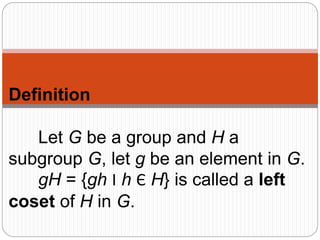
Definition
Let G be a group and H a
subgroup G, let g be an element in G.
gH = {gh Ι h Є H} is called a left
coset of H in G.
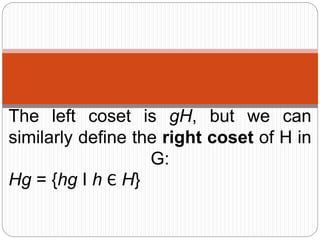
The left coset is gH, but we can
similarly define the right coset of H in
G:
Hg = {hg I h Є H}
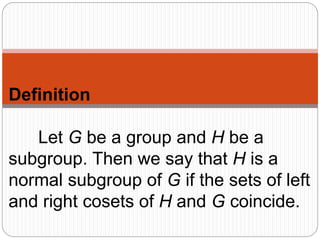
Definition
Let G be a group and H be a
subgroup. Then we say that H is a
normal subgroup of G if the sets of left
and right cosets of H and G coincide.
Examples:
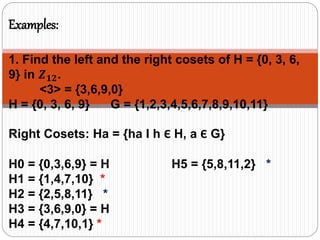
1. Find the left and the right cosets of H = {0, 3, 6,
9} in 𝒁𝟏𝟐.
<3> = {3,6,9,0}
H = {0, 3, 6, 9} G = {1,2,3,4,5,6,7,8,9,10,11}
Right Cosets: Ha = {ha I h Є H, a Є G}
H0 = {0,3,6,9} = H H5 = {5,8,11,2} *
H1 = {1,4,7,10} *
H2 = {2,5,8,11} *
H3 = {3,6,9,0} = H
H4 = {4,7,10,1} *
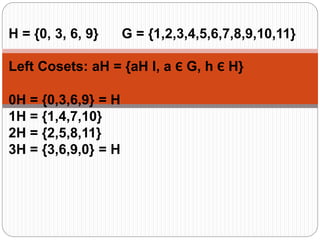
H = {0, 3, 6, 9} G = {1,2,3,4,5,6,7,8,9,10,11}
Left Cosets: aH = {aH I, a Є G, h Є H}
0H = {0,3,6,9} = H
1H = {1,4,7,10}
2H = {2,5,8,11}
3H = {3,6,9,0} = H
Examples:
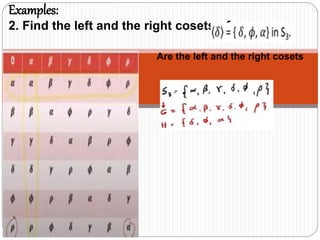
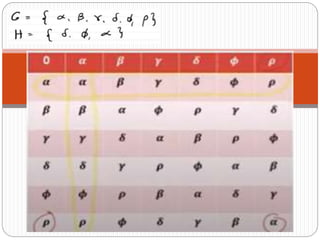
2. Find the left and the right cosets of
Are the left and the right cosets
equal?
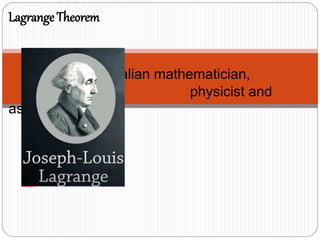
Lagrange Theorem
Italian mathematician,
physicist and
astronomer.
Lagrange’s Theorem
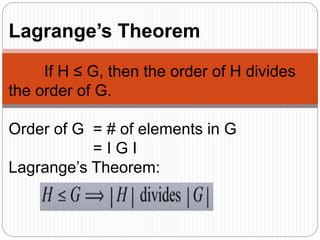
If H ≤ G, then the order of H divides
the order of G.
Order of G = # of elements in G
= I G I
Lagrange’s Theorem:
Lagrange’s Theorem
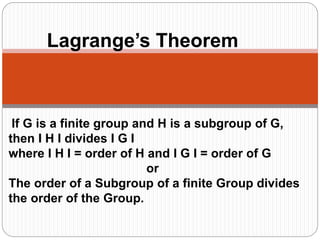
If G is a finite group and H is a subgroup of G,
then I H I divides I G I
where I H I = order of H and I G I = order of G
or
The order of a Subgroup of a finite Group divides
the order of the Group.
Lagrange’s Theorem
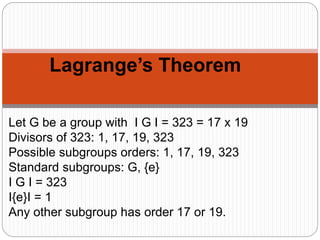
Let G be a group with I G I = 323 = 17 x 19
Divisors of 323: 1, 17, 19, 323
Possible subgroups orders: 1, 17, 19, 323
Standard subgroups: G, {e}
I G I = 323
I{e}I = 1
Any other subgroup has order 17 or 19.
Example:
Find all possible Subgroups of the Group <G, *>. Where G = {1,-1,i,-i}
Sol:
Order of subgroup G is I G I = 4 (# of elements in G)
By Lagrange Theorem, order of each subgroup of G divides the order of G.
Divisors of order of G are 1, 2, 4 [Therefore 1 divides 4, 2 divides 4, 4 divides 4]
Hence, Subgroups of G order 1, 2, 4.
(i) Subgroup of order 1: H1 = {1} = e = 1
(ii) Subgroup of order 2: H2 = {1, -1}, H3 = {1, i}, H4 = (1, -i}
Therefore H2 is a subgroup but H3, H4 are not subgroup
(iii) Subgroup of order 4: H5 = {1, -1, i, -i}
Therefore H5 is a subgroup.
THANK YOU FOR
LISTENING…

COSETS AND LAGRANGE’S THEOREM REPORT.pptx

  • 1.
    COSETS AND LAGRANGE’S THEOREM JOHNMARIE M. NALAM PRESENTERLAJJJJJGRANGE’S THEOREM
  • 2.
    Definition Let G bea group and H a subgroup G, let g be an element in G. gH = {gh Ι h Є H} is called a left coset of H in G.
  • 3.
    The left cosetis gH, but we can similarly define the right coset of H in G: Hg = {hg I h Є H}
  • 4.
    Definition Let G bea group and H be a subgroup. Then we say that H is a normal subgroup of G if the sets of left and right cosets of H and G coincide.
  • 5.
    Examples: 1. Find theleft and the right cosets of H = {0, 3, 6, 9} in 𝒁𝟏𝟐. <3> = {3,6,9,0} H = {0, 3, 6, 9} G = {1,2,3,4,5,6,7,8,9,10,11} Right Cosets: Ha = {ha I h Є H, a Є G} H0 = {0,3,6,9} = H H5 = {5,8,11,2} * H1 = {1,4,7,10} * H2 = {2,5,8,11} * H3 = {3,6,9,0} = H H4 = {4,7,10,1} *
  • 6.
    H = {0,3, 6, 9} G = {1,2,3,4,5,6,7,8,9,10,11} Left Cosets: aH = {aH I, a Є G, h Є H} 0H = {0,3,6,9} = H 1H = {1,4,7,10} 2H = {2,5,8,11} 3H = {3,6,9,0} = H
  • 7.
    Examples: 2. Find theleft and the right cosets of Are the left and the right cosets equal?
  • 9.
  • 10.
    Lagrange’s Theorem If H≤ G, then the order of H divides the order of G. Order of G = # of elements in G = I G I Lagrange’s Theorem:
  • 11.
    Lagrange’s Theorem If Gis a finite group and H is a subgroup of G, then I H I divides I G I where I H I = order of H and I G I = order of G or The order of a Subgroup of a finite Group divides the order of the Group.
  • 12.
    Lagrange’s Theorem Let Gbe a group with I G I = 323 = 17 x 19 Divisors of 323: 1, 17, 19, 323 Possible subgroups orders: 1, 17, 19, 323 Standard subgroups: G, {e} I G I = 323 I{e}I = 1 Any other subgroup has order 17 or 19.
  • 13.
    Example: Find all possibleSubgroups of the Group <G, *>. Where G = {1,-1,i,-i} Sol: Order of subgroup G is I G I = 4 (# of elements in G) By Lagrange Theorem, order of each subgroup of G divides the order of G. Divisors of order of G are 1, 2, 4 [Therefore 1 divides 4, 2 divides 4, 4 divides 4] Hence, Subgroups of G order 1, 2, 4. (i) Subgroup of order 1: H1 = {1} = e = 1 (ii) Subgroup of order 2: H2 = {1, -1}, H3 = {1, i}, H4 = (1, -i} Therefore H2 is a subgroup but H3, H4 are not subgroup (iii) Subgroup of order 4: H5 = {1, -1, i, -i} Therefore H5 is a subgroup.
  • 14.