Basic Structures: Sets,
Functions, Sequences, Sums,
and Matrices
Chapter 2
With Question/Answer Animations
© 2019 McGraw-Hill Education. All rights reserved. Authorized only for instructor use in the classroom. No reproduction or further distribution permitted without the prior written consent of McGraw-Hill Education.
© 2019 McGraw-Hill Education
Chapter Summary
Sets
• The Language of Sets
• Set Operations
• Set Identities
Functions
• Types of Functions
• Operations on Functions
• Computability
Sequences and Summations
• Types of Sequences
• Summation Formulae
Set Cardinality
• Countable Sets
Matrices
• Matrix Arithmetic
© 2019 McGraw-Hill Education
Sets
Section 2.1
© 2019 McGraw-Hill Education
Section Summary1
Definition of sets
Describing Sets
• Roster Method
• Set-Builder Notation
Some Important Sets in Mathematics
Empty Set and Universal Set
Subsets and Set Equality
Cardinality of Sets
Tuples
Cartesian Product
© 2019 McGraw-Hill Education
Introduction
Sets are one of the basic building blocks for the types of
objects considered in discrete mathematics.
• Important for counting.
• Programming languages have set operations.
Set theory is an important branch of mathematics.
• Many different systems of axioms have been used to develop
set theory.
• Here we are not concerned with a formal set of axioms for set
theory. Instead, we will use what is called naïve set theory.
© 2019 McGraw-Hill Education
Sets
A set is an unordered collection of objects.
• the students in this class
• the chairs in this room
The objects in a set are called the elements, or
members of the set. A set is said to contain its
elements.
The notation a ∈ A denotes that a is an element
of the set A.
If a is not a member of A, write a ∉ A
© 2019 McGraw-Hill Education
Describing a Set: Roster Method
S = {a,b,c,d}
Order not important
S = {a,b,c,d} = {b,c,a,d}
Each distinct object is either a member or not; listing
more than once does not change the set.
S = {a,b,c,d} = {a,b,c,b,c,d}
Elipses (…) may be used to describe a set without listing
all of the members when the pattern is clear.
S = {a,b,c,d, ……,z }
© 2019 McGraw-Hill Education
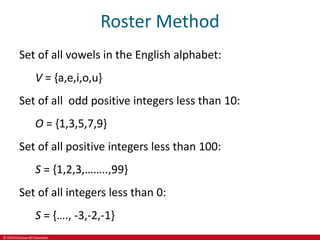
Roster Method
Set of all vowels in the English alphabet:
V = {a,e,i,o,u}
Set of all odd positive integers less than 10:
O = {1,3,5,7,9}
Set of all positive integers less than 100:
S = {1,2,3,……..,99}
Set of all integers less than 0:
S = {…., -3,-2,-1}
© 2019 McGraw-Hill Education
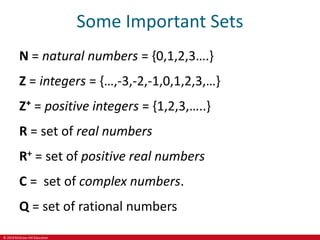
Some Important Sets
N = natural numbers = {0,1,2,3….}
Z = integers = {…,-3,-2,-1,0,1,2,3,…}
Z⁺ = positive integers = {1,2,3,…..}
R = set of real numbers
R+ = set of positive real numbers
C = set of complex numbers.
Q = set of rational numbers
© 2019 McGraw-Hill Education
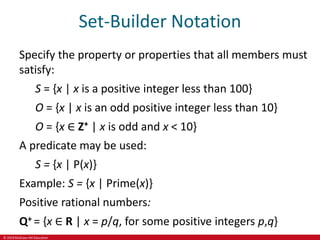
Set-Builder Notation
Specify the property or properties that all members must
satisfy:
S = {x | x is a positive integer less than 100}
O = {x | x is an odd positive integer less than 10}
O = {x ∈ Z⁺ | x is odd and x < 10}
A predicate may be used:
S = {x | P(x)}
Example: S = {x | Prime(x)}
Positive rational numbers:
Q+ = {x ∈ R | x = p/q, for some positive integers p,q}
© 2019 McGraw-Hill Education
Interval Notation
closed interval [a,b]
open interval (a,b)
   
   

  
   
|
|
|
,
,
,
, |
a b x a x b
a b x a x b
a b x a x b
a b x a x b
  
  
  
  
© 2019 McGraw-Hill Education
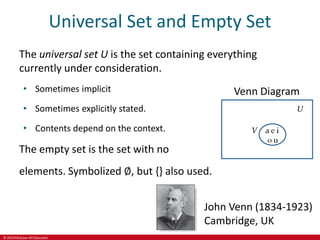
Universal Set and Empty Set
The universal set U is the set containing everything
currently under consideration.
• Sometimes implicit
• Sometimes explicitly stated.
• Contents depend on the context.
The empty set is the set with no
elements. Symbolized ∅, but {} also used.
Venn Diagram
John Venn (1834-1923)
Cambridge, UK
© 2019 McGraw-Hill Education
Russell’s Paradox
Let S be the set of all sets which are not members of
themselves. A paradox results from trying to answer
the question “Is S a member of itself?”
Related Paradox:
• Henry is a barber who shaves all people who do not shave
themselves. A paradox results from trying to answer the
question “Does Henry shave himself?”
© 2019 McGraw-Hill Education
Some things to remember
Sets can be elements of sets.
{{1,2,3},a, {b,c}}
{N,Z,Q,R}
The empty set is different from a set containing
the empty set.
∅ ≠ { ∅ }
© 2019 McGraw-Hill Education
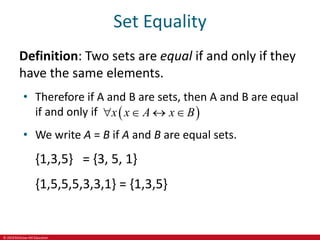
Set Equality
Definition: Two sets are equal if and only if they
have the same elements.
• Therefore if A and B are sets, then A and B are equal
if and only if  
x x A x B
   
• We write A = B if A and B are equal sets.
{1,3,5} = {3, 5, 1}
{1,5,5,5,3,3,1} = {1,3,5}
© 2019 McGraw-Hill Education
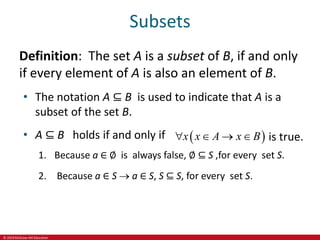
Subsets
Definition: The set A is a subset of B, if and only
if every element of A is also an element of B.
• The notation A ⊆ B is used to indicate that A is a
subset of the set B.
• A ⊆ B holds if and only if  
x x A x B
    is true.
1. Because a ∈ ∅ is always false, ∅ ⊆ S ,for every set S.
2. Because a ∈ S  a ∈ S, S ⊆ S, for every set S.
© 2019 McGraw-Hill Education
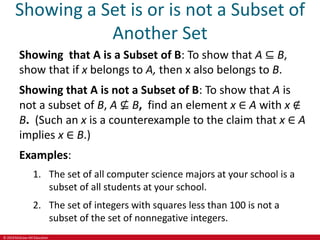
Showing a Set is or is not a Subset of
Another Set
Showing that A is a Subset of B: To show that A ⊆ B,
show that if x belongs to A, then x also belongs to B.
Showing that A is not a Subset of B: To show that A is
not a subset of B, A ⊈ B, find an element x ∈ A with x ∉
B. (Such an x is a counterexample to the claim that x ∈ A
implies x ∈ B.)
Examples:
1. The set of all computer science majors at your school is a
subset of all students at your school.
2. The set of integers with squares less than 100 is not a
subset of the set of nonnegative integers.
© 2019 McGraw-Hill Education
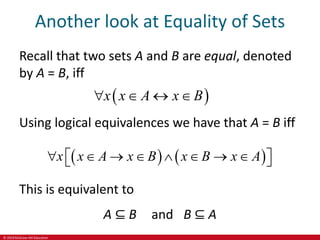
Another look at Equality of Sets
Recall that two sets A and B are equal, denoted
by A = B, iff
 
x x A x B
   
Using logical equivalences we have that A = B iff
   
x x A x B x B x A
       
 
 
This is equivalent to
A ⊆ B and B ⊆ A
© 2019 McGraw-Hill Education
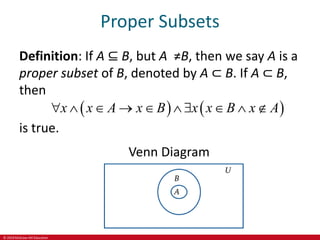
Proper Subsets
Definition: If A ⊆ B, but A ≠B, then we say A is a
proper subset of B, denoted by A ⊂ B. If A ⊂ B,
then
   
x x A x B x x B x A
         
is true.
Venn Diagram
© 2019 McGraw-Hill Education
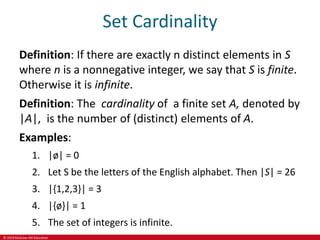
Set Cardinality
Definition: If there are exactly n distinct elements in S
where n is a nonnegative integer, we say that S is finite.
Otherwise it is infinite.
Definition: The cardinality of a finite set A, denoted by
|A|, is the number of (distinct) elements of A.
Examples:
1. |ø| = 0
2. Let S be the letters of the English alphabet. Then |S| = 26
3. |{1,2,3}| = 3
4. |{ø}| = 1
5. The set of integers is infinite.
© 2019 McGraw-Hill Education
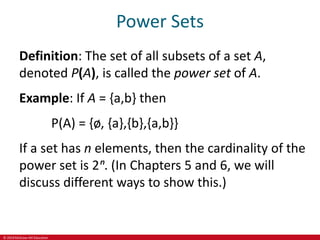
Power Sets
Definition: The set of all subsets of a set A,
denoted P(A), is called the power set of A.
Example: If A = {a,b} then
P(A) = {ø, {a},{b},{a,b}}
If a set has n elements, then the cardinality of the
power set is 2ⁿ. (In Chapters 5 and 6, we will
discuss different ways to show this.)
© 2019 McGraw-Hill Education
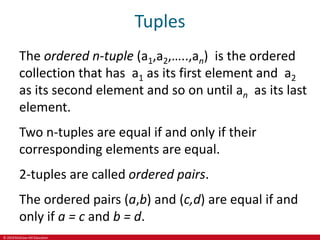
Tuples
The ordered n-tuple (a1,a2,…..,an) is the ordered
collection that has a1 as its first element and a2
as its second element and so on until an as its last
element.
Two n-tuples are equal if and only if their
corresponding elements are equal.
2-tuples are called ordered pairs.
The ordered pairs (a,b) and (c,d) are equal if and
only if a = c and b = d.
© 2019 McGraw-Hill Education
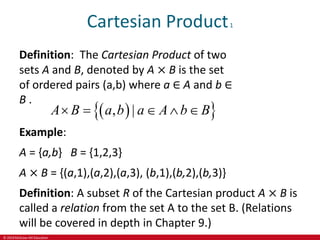
Cartesian Product1
Definition: The Cartesian Product of two
sets A and B, denoted by A × B is the set
of ordered pairs (a,b) where a ∈ A and b ∈
B .
 
 
, |
A B a b a A b B
    
Example:
A = {a,b} B = {1,2,3}
A × B = {(a,1),(a,2),(a,3), (b,1),(b,2),(b,3)}
Definition: A subset R of the Cartesian product A × B is
called a relation from the set A to the set B. (Relations
will be covered in depth in Chapter 9.)
© 2019 McGraw-Hill Education
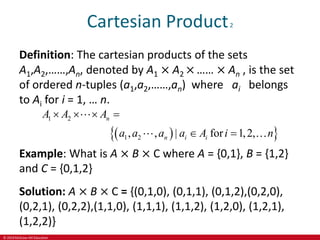
Cartesian Product2
Definition: The cartesian products of the sets
A1,A2,……,An, denoted by A1 × A2 × …… × An , is the set
of ordered n-tuples (a1,a2,……,an) where ai belongs
to Ai for i = 1, … n.
 
 
1 2
1 2
, , | for 1,2,
n
n i i
A A A
a a a a A i n
   
 
Example: What is A × B × C where A = {0,1}, B = {1,2}
and C = {0,1,2}
Solution: A × B × C = {(0,1,0), (0,1,1), (0,1,2),(0,2,0),
(0,2,1), (0,2,2),(1,1,0), (1,1,1), (1,1,2), (1,2,0), (1,2,1),
(1,2,2)}
© 2019 McGraw-Hill Education
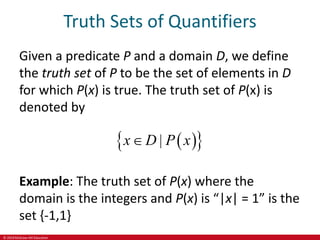
Truth Sets of Quantifiers
Given a predicate P and a domain D, we define
the truth set of P to be the set of elements in D
for which P(x) is true. The truth set of P(x) is
denoted by
 
 
|
x D P x

Example: The truth set of P(x) where the
domain is the integers and P(x) is “|x| = 1” is the
set {-1,1}
© 2019 McGraw-Hill Education
Set Operations
Section 2.2
© 2019 McGraw-Hill Education
Section Summary2
Set Operations
• Union
• Intersection
• Complementation
• Difference
More on Set Cardinality
Set Identities
Proving Identities
Membership Tables
© 2019 McGraw-Hill Education
Boolean Algebra
Propositional calculus and set theory are both
instances of an algebraic system called a Boolean
Algebra. This is discussed in Chapter 12.
The operators in set theory are analogous to the
corresponding operator in propositional calculus.
As always there must be a universal set U. All
sets are assumed to be subsets of U.
© 2019 McGraw-Hill Education
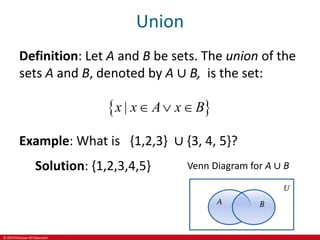
Union
Definition: Let A and B be sets. The union of the
sets A and B, denoted by A ∪ B, is the set:
 
|
x x A x B
  
Example: What is {1,2,3} ∪ {3, 4, 5}?
Solution: {1,2,3,4,5} Venn Diagram for A ∪ B
© 2019 McGraw-Hill Education
Intersection
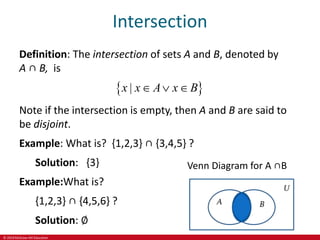
Definition: The intersection of sets A and B, denoted by
A ∩ B, is
 
|
x x A x B
  
Note if the intersection is empty, then A and B are said to
be disjoint.
Example: What is? {1,2,3} ∩ {3,4,5} ?
Solution: {3}
Example:What is?
{1,2,3} ∩ {4,5,6} ?
Solution: ∅
Venn Diagram for A ∩B
© 2019 McGraw-Hill Education
Complement
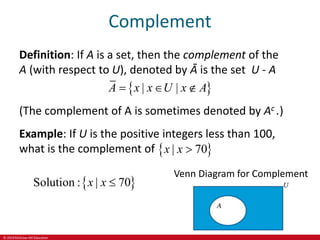
Definition: If A is a set, then the complement of the
A (with respect to U), denoted by Ā is the set U - A
 
| |
A x x U x A
  
(The complement of A is sometimes denoted by Ac .)
Example: If U is the positive integers less than 100,
what is the complement of  
| 70
x x 
 
0
Solution : | 7
x x 
Venn Diagram for Complement
© 2019 McGraw-Hill Education
Difference
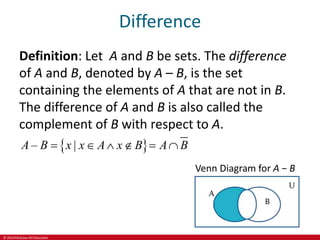
Definition: Let A and B be sets. The difference
of A and B, denoted by A – B, is the set
containing the elements of A that are not in B.
The difference of A and B is also called the
complement of B with respect to A.
 
– |
A B x x A x B A B
     
Venn Diagram for A − B
© 2019 McGraw-Hill Education
The Cardinality of the Union of Two
Sets
Inclusion-Exclusion
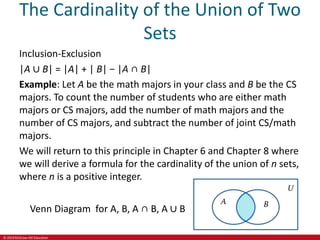
|A ∪ B| = |A| + | B| − |A ∩ B|
Example: Let A be the math majors in your class and B be the CS
majors. To count the number of students who are either math
majors or CS majors, add the number of math majors and the
number of CS majors, and subtract the number of joint CS/math
majors.
We will return to this principle in Chapter 6 and Chapter 8 where
we will derive a formula for the cardinality of the union of n sets,
where n is a positive integer.
Venn Diagram for A, B, A ∩ B, A ∪ B
© 2019 McGraw-Hill Education
Review Questions
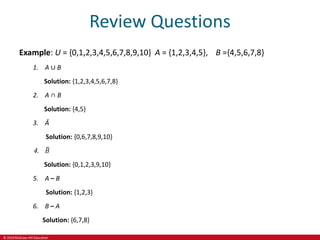
Example: U = {0,1,2,3,4,5,6,7,8,9,10} A = {1,2,3,4,5}, B ={4,5,6,7,8}
1. A ∪ B
Solution: {1,2,3,4,5,6,7,8}
2. A ∩ B
Solution: {4,5}
3. Ā
Solution: {0,6,7,8,9,10}
4. 𝐵
Solution: {0,1,2,3,9,10}
5. A – B
Solution: {1,2,3}
6. B – A
Solution: {6,7,8}
© 2019 McGraw-Hill Education
Symmetric Difference (optional)
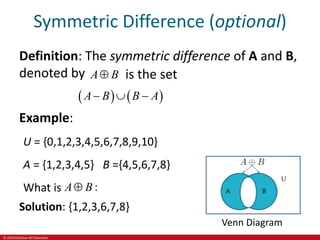
Definition: The symmetric difference of A and B,
denoted by A B
 is the set
   
A B B A
  
Example:
U = {0,1,2,3,4,5,6,7,8,9,10}
A = {1,2,3,4,5} B ={4,5,6,7,8}
What is :
A B

Solution: {1,2,3,6,7,8}
Venn Diagram
© 2019 McGraw-Hill Education
Set Identities1
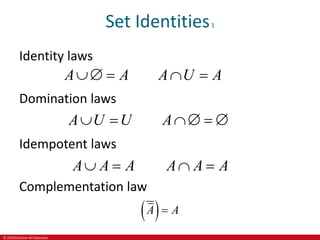
Identity laws
A A A U A
   
Domination laws
A U U A
    
Idempotent laws
A A A A A A
   
Complementation law
 
A A

© 2019 McGraw-Hill Education
Set Identities2
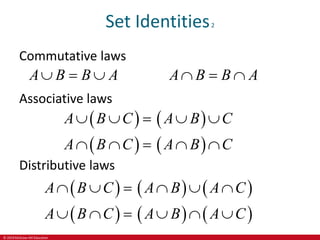
Commutative laws
A B B A A B B A
     
Associative laws
   
   
A B C A B C
A B C A B C
    
    
Distributive laws
     
     
A B C A B A C
A B C A B A C
     
     
© 2019 McGraw-Hill Education
Set Identities3
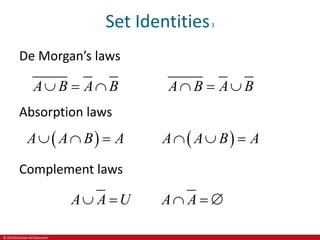
De Morgan’s laws
A B A B A B A B
     
Absorption laws
   
A A B A A A B A
     
Complement laws
A A U A A
    
© 2019 McGraw-Hill Education
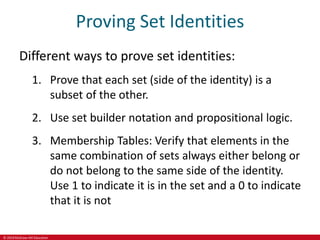
Proving Set Identities
Different ways to prove set identities:
1. Prove that each set (side of the identity) is a
subset of the other.
2. Use set builder notation and propositional logic.
3. Membership Tables: Verify that elements in the
same combination of sets always either belong or
do not belong to the same side of the identity.
Use 1 to indicate it is in the set and a 0 to indicate
that it is not
© 2019 McGraw-Hill Education
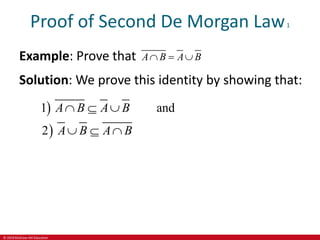
Proof of Second De Morgan Law1
Example: Prove that A B A B
  
Solution: We prove this identity by showing that:


1 and
2
A B A B
A B A B
  
  
© 2019 McGraw-Hill Education
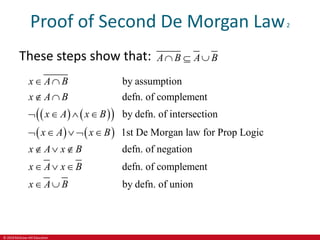
Proof of Second De Morgan Law2
These steps show that: A B A B
  
   
 
   
by assumption
defn. of complement
by defn. of intersection
1st De Morgan law for Prop Logic
defn. of negation
defn. of complement
by defn. of union
x A B
x A B
x A x B
x A x B
x A x B
x A x B
x A B
 
 
   
    
  
  
 
© 2019 McGraw-Hill Education
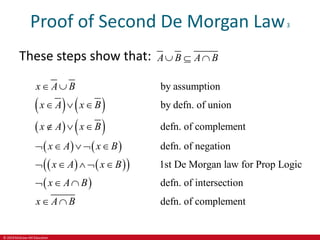
Proof of Second De Morgan Law3
These steps show that: A B A B
  
   
   
   
   
 
 
by assumption
by defn. of union
defn. of complement
defn. of negation
1st De Morgan law for Prop Logic
defn. of intersection
defn. of complement
x A B
x A x B
x A x B
x A x B
x A x B
x A B
x A B
 
  
  
    
    
  
 
© 2019 McGraw-Hill Education
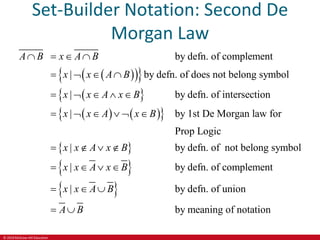
Set-Builder Notation: Second De
Morgan Law
 
 
 

 
   
 
 
by defn. of complement
| by defn. of does not belong symbol
| by defn. of intersection
| by 1st De Morgan law for
Prop Logic
| by defn. of not belong symbol
|
A B x A B
x x A B
x x A x B
x x A x B
x x A x B
x x
   
   
    
     
   
 
 
 
by defn. of complement
| by defn. of union
by meaning of notation
A x B
x x A B
A B
 
  
 
© 2019 McGraw-Hill Education
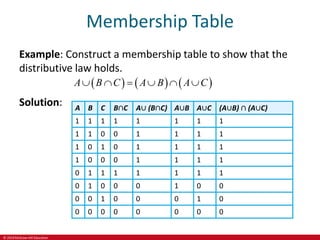
Membership Table
Example: Construct a membership table to show that the
distributive law holds.
     
A B C A B A C
     
Solution: A B C B∩C A∪ (B∩C) A∪B A∪C (A∪B) ∩ (A∪C)
1 1 1 1 1 1 1 1
1 1 0 0 1 1 1 1
1 0 1 0 1 1 1 1
1 0 0 0 1 1 1 1
0 1 1 1 1 1 1 1
0 1 0 0 0 1 0 0
0 0 1 0 0 0 1 0
0 0 0 0 0 0 0 0
© 2019 McGraw-Hill Education
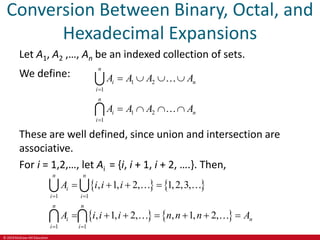
Conversion Between Binary, Octal, and
Hexadecimal Expansions
Let A1, A2 ,…, An be an indexed collection of sets.
We define:
1 2
1
1 2
1
n
i n
i
n
i n
i
A A A A
A A A A


   
   
These are well defined, since union and intersection are
associative.
For i = 1,2,…, let Ai = {i, i + 1, i + 2, ….}. Then,
   
   
1 1
1 1
, 1, 2, 1,2,3,
, 1, 2, , 1, 2,
n n
i
i i
n n
i n
i i
A i i i
A i i i n n n A
 
 
   
      
© 2019 McGraw-Hill Education
Functions
Section 2.3
© 2019 McGraw-Hill Education
Section Summary3
Definition of a Function.
• Domain, Codomain
• Image, Preimage
Injection, Surjection, Bijection
Inverse Function
Function Composition
Graphing Functions
Floor, Ceiling, Factorial
Partial Functions (optional)
© 2019 McGraw-Hill Education
Functions1
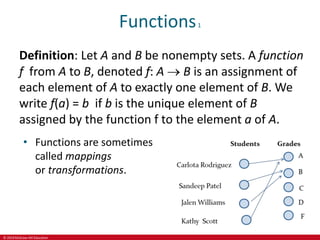
Definition: Let A and B be nonempty sets. A function
f from A to B, denoted f: A  B is an assignment of
each element of A to exactly one element of B. We
write f(a) = b if b is the unique element of B
assigned by the function f to the element a of A.
• Functions are sometimes
called mappings
or transformations.
© 2019 McGraw-Hill Education
Functions2
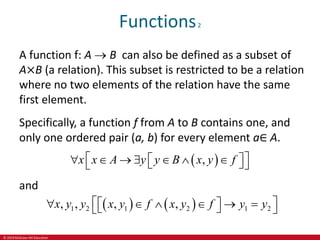
A function f: A  B can also be defined as a subset of
A×B (a relation). This subset is restricted to be a relation
where no two elements of the relation have the same
first element.
Specifically, a function f from A to B contains one, and
only one ordered pair (a, b) for every element a∈ A.
 
,
x x A y y B x y f
 
      
 
 
 
and
   
1 2 1 2 1 2
, , , ,
x y y x y f x y f y y
 
     
 
 
 
© 2019 McGraw-Hill Education
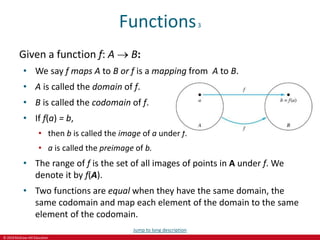
Functions3
Given a function f: A  B:
• We say f maps A to B or f is a mapping from A to B.
• A is called the domain of f.
• B is called the codomain of f.
• If f(a) = b,
• then b is called the image of a under f.
• a is called the preimage of b.
• The range of f is the set of all images of points in A under f. We
denote it by f(A).
• Two functions are equal when they have the same domain, the
same codomain and map each element of the domain to the same
element of the codomain.
Jump to long description
© 2019 McGraw-Hill Education
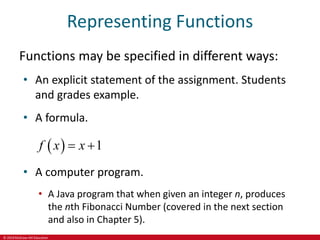
Representing Functions
Functions may be specified in different ways:
• An explicit statement of the assignment. Students
and grades example.
• A formula.
  1
f x x
 
• A computer program.
• A Java program that when given an integer n, produces
the nth Fibonacci Number (covered in the next section
and also in Chapter 5).
© 2019 McGraw-Hill Education
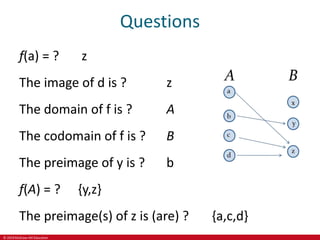
Questions
f(a) = ? z
The image of d is ? z
The domain of f is ? A
The codomain of f is ? B
The preimage of y is ? b
f(A) = ? {y,z}
The preimage(s) of z is (are) ? {a,c,d}
© 2019 McGraw-Hill Education
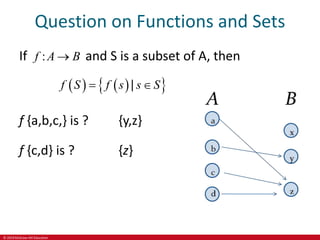
Question on Functions and Sets
If :
f A B
 and S is a subset of A, then
   
 
f S f s s S
 
|
f {a,b,c,} is ? {y,z}
f {c,d} is ? {z}
© 2019 McGraw-Hill Education
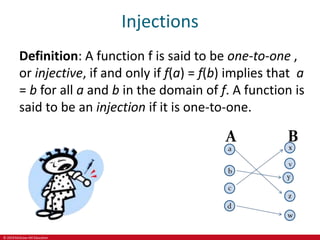
Injections
Definition: A function f is said to be one-to-one ,
or injective, if and only if f(a) = f(b) implies that a
= b for all a and b in the domain of f. A function is
said to be an injection if it is one-to-one.
© 2019 McGraw-Hill Education
Surjections
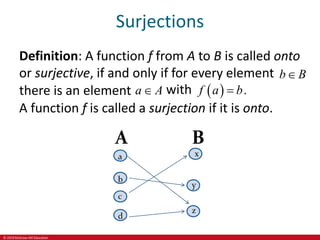
Definition: A function f from A to B is called onto
or surjective, if and only if for every element b B

there is an element a A
 with   .
f a b

A function f is called a surjection if it is onto.
© 2019 McGraw-Hill Education
Bijections
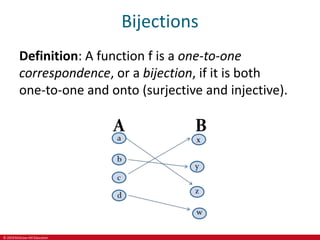
Definition: A function f is a one-to-one
correspondence, or a bijection, if it is both
one-to-one and onto (surjective and injective).
© 2019 McGraw-Hill Education
Showing that f is one-to-one or onto1
Suppose that f : A  B.
To show that f is injective Show that if f (x) = f (y) for
arbitrary x, y ∈ A, then x = y.
To show that f is not injective Find particular
elements x, y ∈ A such that x ≠ y and f (x) = f (y).
To show that f is surjective Consider an arbitrary
element y ∈ B and find an element x ∈ A such that f
(x) = y.
To show that f is not surjective Find a particular y ∈
B such that f (x) ≠ y for all x ∈ A.
© 2019 McGraw-Hill Education
Showing that f is one-to-one or onto2
Example 1: Let f be the function from {a,b,c,d} to
{1,2,3} defined by f(a) = 3, f(b) = 2, f(c) = 1, and f(d) = 3.
Is f an onto function?
Solution: Yes, f is onto since all three elements of the
codomain are images of elements in the domain. If the
codomain were changed to {1,2,3,4}, f would not be
onto.
Example 2: Is the function f(x) = x2 from the set of
integers to the set of integers onto?
Solution: No, f is not onto because there is no integer x
with x2 = −1, for example.
© 2019 McGraw-Hill Education
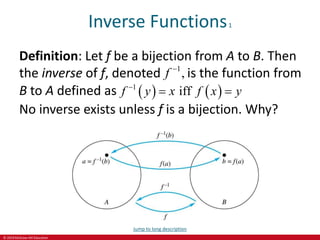
Inverse Functions1
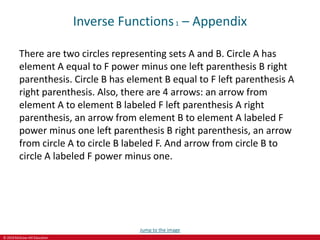
Definition: Let f be a bijection from A to B. Then
the inverse of f, denoted 1
,
f 
is the function from
B to A defined as    
1
iff
f y x f x y

 
No inverse exists unless f is a bijection. Why?
Jump to long description
© 2019 McGraw-Hill Education
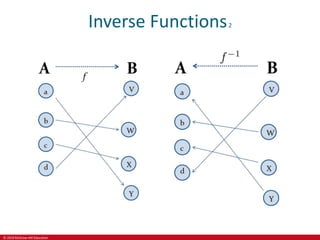
Inverse Functions2
© 2019 McGraw-Hill Education
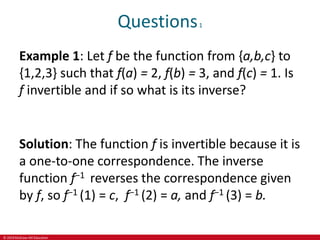
Questions1
Example 1: Let f be the function from {a,b,c} to
{1,2,3} such that f(a) = 2, f(b) = 3, and f(c) = 1. Is
f invertible and if so what is its inverse?
Solution: The function f is invertible because it is
a one-to-one correspondence. The inverse
function f−1 reverses the correspondence given
by f, so f−1 (1) = c, f−1 (2) = a, and f−1 (3) = b.
© 2019 McGraw-Hill Education
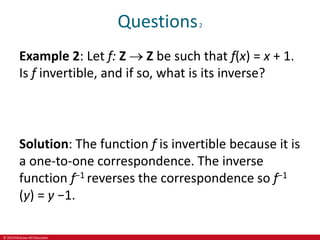
Questions2
Example 2: Let f: Z  Z be such that f(x) = x + 1.
Is f invertible, and if so, what is its inverse?
Solution: The function f is invertible because it is
a one-to-one correspondence. The inverse
function f−1 reverses the correspondence so f−1
(y) = y −1.
© 2019 McGraw-Hill Education
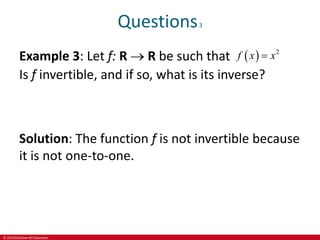
Questions3
Example 3: Let f: R  R be such that   2
f x x

Is f invertible, and if so, what is its inverse?
Solution: The function f is not invertible because
it is not one-to-one.
© 2019 McGraw-Hill Education
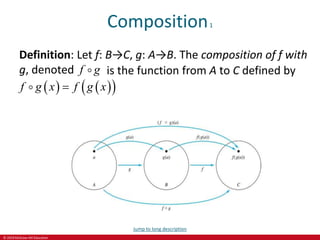
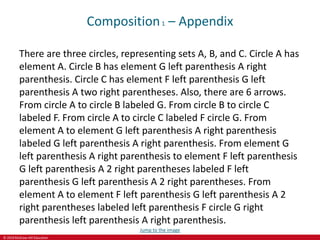
Composition1
Definition: Let f: B→C, g: A→B. The composition of f with
g, denoted f g is the function from A to C defined by
   
 
f g x f g x

Jump to long description
© 2019 McGraw-Hill Education
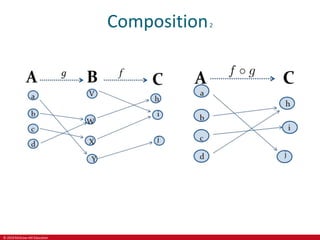
Composition2
© 2019 McGraw-Hill Education
Composition3
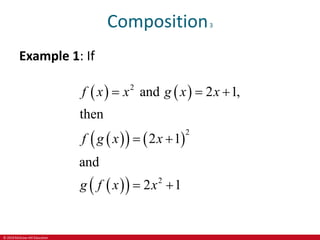
Example 1: If
   
 
   
 
 
2
2
2
and 2 1,
then
2 1
and
2 1
f x x g x x
f g x x
g f x x
  
 
 
© 2019 McGraw-Hill Education
Composition Questions1
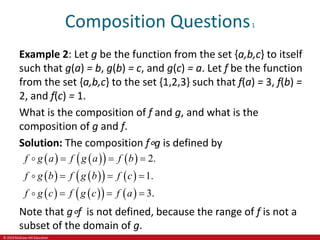
Example 2: Let g be the function from the set {a,b,c} to itself
such that g(a) = b, g(b) = c, and g(c) = a. Let f be the function
from the set {a,b,c} to the set {1,2,3} such that f(a) = 3, f(b) =
2, and f(c) = 1.
What is the composition of f and g, and what is the
composition of g and f.
Solution: The composition f∘g is defined by
   
   
   
   
   
   
2.
1.
3.
g
g
f g a f a f b
f g b f b f c
f g c f a
g c f
  
  
  
Note that g∘f is not defined, because the range of f is not a
subset of the domain of g.
© 2019 McGraw-Hill Education
Composition Questions2
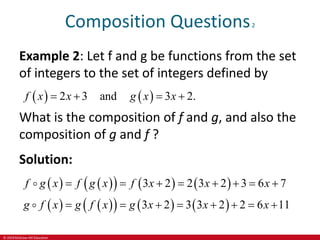
Example 2: Let f and g be functions from the set
of integers to the set of integers defined by
   
2 3 and 3 2.
f x x g x x
   
What is the composition of f and g, and also the
composition of g and f ?
Solution:
   
     
   
     
3 2 2 3 2 3 6 7
3 2 3 3 2 2 6 11
f g x f f x x x
g f x g g
g x
x
f x x x
       
       
© 2019 McGraw-Hill Education
Graphs of Functions
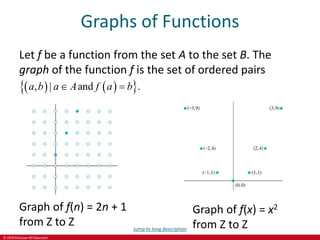
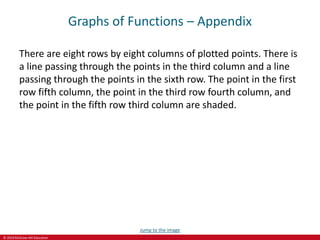
Let f be a function from the set A to the set B. The
graph of the function f is the set of ordered pairs
   
 
, and .
|
a b a A f a b
 
Graph of f(n) = 2n + 1
from Z to Z
Graph of f(x) = x2
from Z to Z
Jump to long description
© 2019 McGraw-Hill Education
Some Important Functions
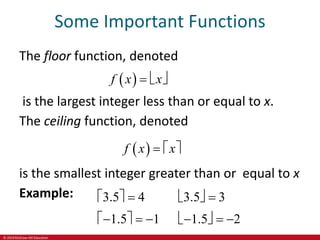
The floor function, denoted
 
f x x
  
is the largest integer less than or equal to x.
The ceiling function, denoted
 
f x x
  
is the smallest integer greater than or equal to x
Example: 3.5 3.5
1.5 1.5
       
       
© 2019 McGraw-Hill Education
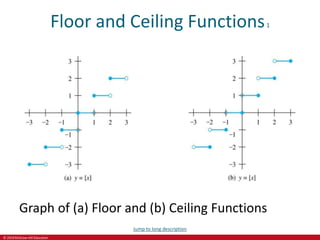
Floor and Ceiling Functions1
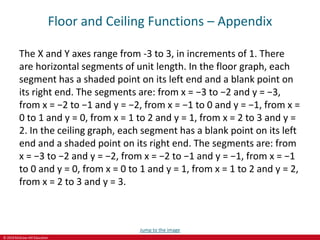
Graph of (a) Floor and (b) Ceiling Functions
Jump to long description
© 2019 McGraw-Hill Education
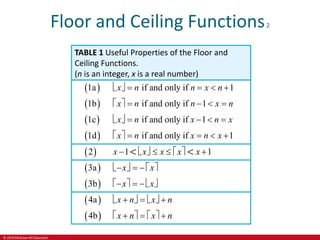
Floor and Ceiling Functions2
TABLE 1 Useful Properties of the Floor and
Ceiling Functions.
(n is an integer, x is a real number)
 
 
 
 
1a if and only if 1
1b if and only if 1
1c if and only if 1
1d if and only if 1
x n n x n
x n n x n
x n x n x
x n x n x
     
     
     
     
 
2 1 1
x x x x x
       
< <
 
 
3a
3b
x x
x x
     
     
 
 
4a
4b
x n x n
x n x n
      
      
© 2019 McGraw-Hill Education
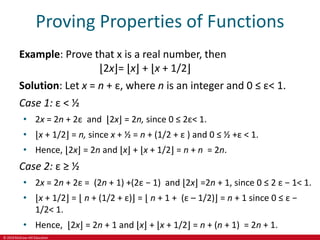
Proving Properties of Functions
Example: Prove that x is a real number, then
⌊2x⌋= ⌊x⌋ + ⌊x + 1/2⌋
Solution: Let x = n + ε, where n is an integer and 0 ≤ ε< 1.
Case 1: ε < ½
• 2x = 2n + 2ε and ⌊2x⌋ = 2n, since 0 ≤ 2ε< 1.
• ⌊x + 1/2⌋ = n, since x + ½ = n + (1/2 + ε ) and 0 ≤ ½ +ε < 1.
• Hence, ⌊2x⌋ = 2n and ⌊x⌋ + ⌊x + 1/2⌋ = n + n = 2n.
Case 2: ε ≥ ½
• 2x = 2n + 2ε = (2n + 1) +(2ε − 1) and ⌊2x⌋ =2n + 1, since 0 ≤ 2 ε − 1< 1.
• ⌊x + 1/2⌋ = ⌊ n + (1/2 + ε)⌋ = ⌊ n + 1 + (ε – 1/2)⌋ = n + 1 since 0 ≤ ε −
1/2< 1.
• Hence, ⌊2x⌋ = 2n + 1 and ⌊x⌋ + ⌊x + 1/2⌋ = n + (n + 1) = 2n + 1.
© 2019 McGraw-Hill Education
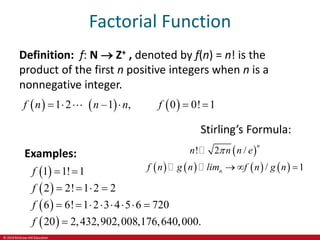
Factorial Function
Definition: f: N  Z+ , denoted by f(n) = n! is the
product of the first n positive integers when n is a
nonnegative integer.
     
1 2 –1 , 0 0! 1
f n
n n f
     
Examples:
 
 
 
 
1 1! 1
2 2! 1 2 2
6 6! 1 2 3 4 5 6 720
20 2,432,902,008,176,640,000.
f
f
f
f
 
   
       

Stirling’s Formula:
 
       
! 2 /
/ 1
n
n
n n n e
f n g n lim f n g n

  
© 2019 McGraw-Hill Education
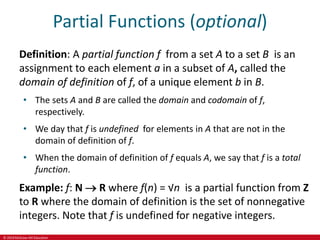
Partial Functions (optional)
Definition: A partial function f from a set A to a set B is an
assignment to each element a in a subset of A, called the
domain of definition of f, of a unique element b in B.
• The sets A and B are called the domain and codomain of f,
respectively.
• We day that f is undefined for elements in A that are not in the
domain of definition of f.
• When the domain of definition of f equals A, we say that f is a total
function.
Example: f: N  R where f(n) = √n is a partial function from Z
to R where the domain of definition is the set of nonnegative
integers. Note that f is undefined for negative integers.
© 2019 McGraw-Hill Education
Sequences and Summations
Section 2.4
© 2019 McGraw-Hill Education
Section Summary4
Sequences.
• Examples: Geometric Progression, Arithmetic
Progression
Recurrence Relations
• Example: Fibonacci Sequence
Summations
Special Integer Sequences (optional)
© 2019 McGraw-Hill Education
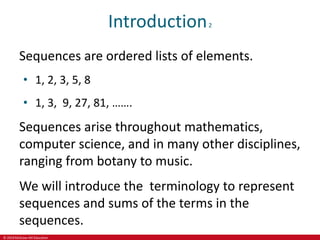
Introduction2
Sequences are ordered lists of elements.
• 1, 2, 3, 5, 8
• 1, 3, 9, 27, 81, …….
Sequences arise throughout mathematics,
computer science, and in many other disciplines,
ranging from botany to music.
We will introduce the terminology to represent
sequences and sums of the terms in the
sequences.
© 2019 McGraw-Hill Education
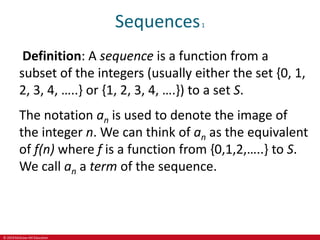
Sequences1
Definition: A sequence is a function from a
subset of the integers (usually either the set {0, 1,
2, 3, 4, …..} or {1, 2, 3, 4, ….}) to a set S.
The notation an is used to denote the image of
the integer n. We can think of an as the equivalent
of f(n) where f is a function from {0,1,2,…..} to S.
We call an a term of the sequence.
© 2019 McGraw-Hill Education
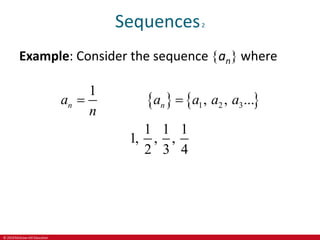
Sequences2
Example: Consider the sequence an where
   
1 2 3
1
, , ...
1 1 1
1, , ,
2 3 4
n n
a a a a a
n
 
© 2019 McGraw-Hill Education
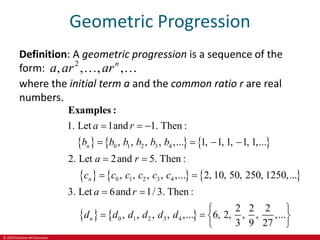
Geometric Progression
Definition: A geometric progression is a sequence of the
form: 2
, , , ,
n
a ar ar
 
where the initial term a and the common ratio r are real
numbers.
     
     
   
0 1 2 3 4
0 1 2 3 4
0 1 2 3 4
1. Let 1and 1. Then :
, , , , ,... 1, 1, 1, 1, 1,...
2. Let 2and 5. Then :
, , , , ,... 2, 10, 50, 250, 1250,...
3. Let 6and 1/ 3. Then :
2 2 2
, , , , ,... 6, 2, , , ,...
3 9 27
n
n
n
a r
b b b b b b
a r
c c c c c c
a r
d d d d d d
  
   
 
 
 
 
   

Examples :

© 2019 McGraw-Hill Education
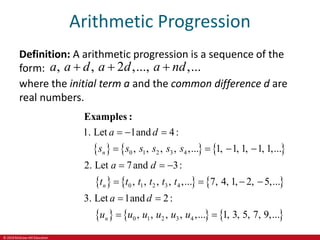
Arithmetic Progression
Definition: A arithmetic progression is a sequence of the
form: , , 2 ,..., ,...
a a d a d a nd
  
where the initial term a and the common difference d are
real numbers.
     
     
     
0 1 2 3 4
0 1 2 3 4
0 1 2 3 4
1. Let 1and 4:
, , , , ,... 1, 1, 1, 1, 1,...
2. Let 7and 3:
, , , , ,... 7, 4, 1, 2, 5,...
3. Let 1and 2:
, , , , ,... 1, 3, 5, 7, 9,...
n
n
n
a d
s s s s s s
a d
t t t t t t
a d
u u u u u u
  
   
  
   
 
 
Examples :
© 2019 McGraw-Hill Education
Strings1
Definition: A string is a finite sequence of
characters from a finite set (an alphabet).
Sequences of characters or bits are important in
computer science.
The empty string is represented by λ.
The string abcde has length 5.
© 2019 McGraw-Hill Education
Recurrence Relations
Definition: A recurrence relation for the sequence
{an} is an equation that expresses an in terms of one
or more of the previous terms of the sequence,
namely, a0, a1, …, an−1, for all integers n with n ≥ n0,
where n0 is a nonnegative integer.
A sequence is called a solution of a recurrence
relation if its terms satisfy the recurrence relation.
The initial conditions for a sequence specify the
terms that precede the first term where the
recurrence relation takes effect.
© 2019 McGraw-Hill Education
Questions about Recurrence Relations1
Example 1: Let {an} be a sequence that satisfies the
recurrence relation an = an−1 + 3 for n = 1,2,3,4,….
and suppose that a0 = 2. What are a1 , a2 and a3?
[Here a0 = 2 is the initial condition.]
Solution: We see from the recurrence relation that
1 0
2
3
3 2 3 5
5 3 8
8 3 11
a a
a
a
    
  
  
© 2019 McGraw-Hill Education
Questions about Recurrence Relations2
Example 2: Let {an} be a sequence that satisfies
the recurrence relation an = an-1 – an-2 for n =
2,3,4,…. and suppose that a0 = 3 and a1 = 5. What
are a2 and a3?
[Here the initial conditions are a0 = 3 and a1 = 5. ]
Solution: We see from the recurrence relation
that
2 1 0
3 2 1
5 3 2
2 5 3
a a a
a a a
    
     
© 2019 McGraw-Hill Education
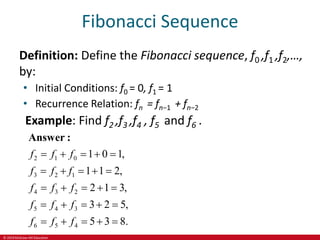
Fibonacci Sequence
Definition: Define the Fibonacci sequence, f0 ,f1 ,f2,…,
by:
• Initial Conditions: f0 = 0, f1 = 1
• Recurrence Relation: fn = fn−1 + fn−2
Example: Find f2 ,f3 ,f4 , f5 and f6 .
2 1 0
3 2 1
4 3 2
5 4 3
6 5 4
1 0 1,
1 1 2,
2 1 3,
3 2 5,
5 3 8.
f f f
f f f
f f f
f f f
f f f
    
    
    
    
    
Answer :
© 2019 McGraw-Hill Education
Solving Recurrence Relations
Finding a formula for the nth term of the sequence
generated by a recurrence relation is called solving the
recurrence relation.
Such a formula is called a closed formula.
Various methods for solving recurrence relations will be
covered in Chapter 8 where recurrence relations will be
studied in greater depth.
Here we illustrate by example the method of iteration in
which we need to guess the formula. The guess can be
proved correct by the method of induction (Chapter 5).
© 2019 McGraw-Hill Education
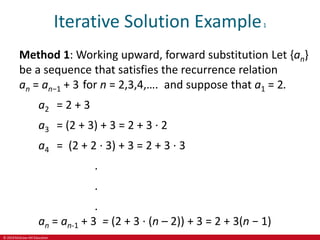
Iterative Solution Example1
Method 1: Working upward, forward substitution Let {an}
be a sequence that satisfies the recurrence relation
an = an−1 + 3 for n = 2,3,4,…. and suppose that a1 = 2.
a2 = 2 + 3
a3 = (2 + 3) + 3 = 2 + 3 ∙ 2
a4 = (2 + 2 ∙ 3) + 3 = 2 + 3 ∙ 3
.
.
.
an = an-1 + 3 = (2 + 3 ∙ (n – 2)) + 3 = 2 + 3(n − 1)
© 2019 McGraw-Hill Education
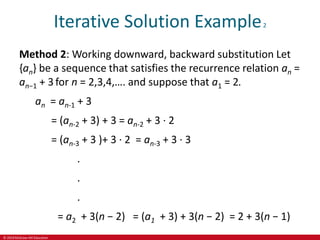
Iterative Solution Example2
Method 2: Working downward, backward substitution Let
{an} be a sequence that satisfies the recurrence relation an =
an−1 + 3for n = 2,3,4,…. and suppose that a1 = 2.
an = an-1 + 3
= (an-2 + 3) + 3 = an-2 + 3 ∙ 2
= (an-3 + 3 )+ 3 ∙ 2 = an-3 + 3 ∙ 3
.
.
.
= a2 + 3(n − 2) = (a1 + 3) + 3(n − 2) = 2 + 3(n − 1)
© 2019 McGraw-Hill Education
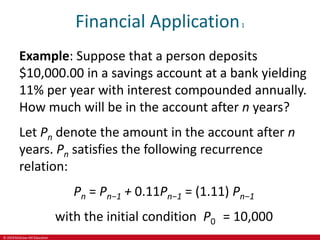
Financial Application1
Example: Suppose that a person deposits
$10,000.00 in a savings account at a bank yielding
11% per year with interest compounded annually.
How much will be in the account after n years?
Let Pn denote the amount in the account after n
years. Pn satisfies the following recurrence
relation:
Pn = Pn−1 + 0.11Pn−1 = (1.11) Pn−1
with the initial condition P0 = 10,000
© 2019 McGraw-Hill Education
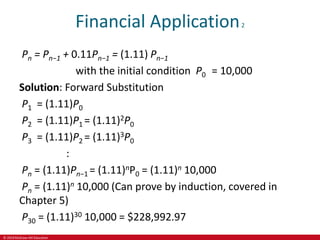
Financial Application2
Pn = Pn−1 + 0.11Pn−1 = (1.11) Pn−1
with the initial condition P0 = 10,000
Solution: Forward Substitution
P1 = (1.11)P0
P2 = (1.11)P1 = (1.11)2P0
P3 = (1.11)P2 = (1.11)3P0
:
Pn = (1.11)Pn−1 = (1.11)nP0 = (1.11)n 10,000
Pn = (1.11)n 10,000 (Can prove by induction, covered in
Chapter 5)
P30 = (1.11)30 10,000 = $228,992.97
© 2019 McGraw-Hill Education
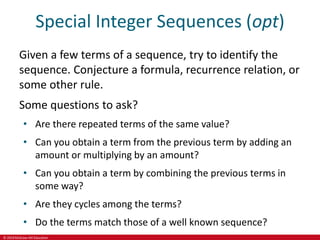
Special Integer Sequences (opt)
Given a few terms of a sequence, try to identify the
sequence. Conjecture a formula, recurrence relation, or
some other rule.
Some questions to ask?
• Are there repeated terms of the same value?
• Can you obtain a term from the previous term by adding an
amount or multiplying by an amount?
• Can you obtain a term by combining the previous terms in
some way?
• Are they cycles among the terms?
• Do the terms match those of a well known sequence?
© 2019 McGraw-Hill Education
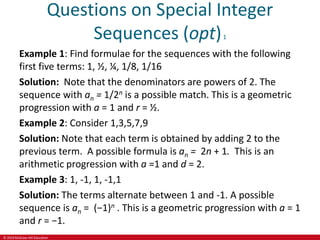
Questions on Special Integer
Sequences (opt)1
Example 1: Find formulae for the sequences with the following
first five terms: 1, ½, ¼, 1/8, 1/16
Solution: Note that the denominators are powers of 2. The
sequence with an = 1/2n is a possible match. This is a geometric
progression with a = 1 and r = ½.
Example 2: Consider 1,3,5,7,9
Solution: Note that each term is obtained by adding 2 to the
previous term. A possible formula is an = 2n + 1. This is an
arithmetic progression with a =1 and d = 2.
Example 3: 1, -1, 1, -1,1
Solution: The terms alternate between 1 and -1. A possible
sequence is an = (−1)n . This is a geometric progression with a = 1
and r = −1.
© 2019 McGraw-Hill Education
Questions on Special Integer
Sequences (opt)2
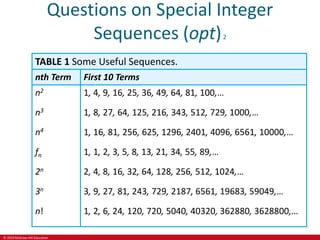
TABLE 1 Some Useful Sequences.
nth Term First 10 Terms
n2
n3
n4
fn
2n
3n
n!
1, 4, 9, 16, 25, 36, 49, 64, 81, 100,…
1, 8, 27, 64, 125, 216, 343, 512, 729, 1000,…
1, 16, 81, 256, 625, 1296, 2401, 4096, 6561, 10000,…
1, 1, 2, 3, 5, 8, 13, 21, 34, 55, 89,…
2, 4, 8, 16, 32, 64, 128, 256, 512, 1024,…
3, 9, 27, 81, 243, 729, 2187, 6561, 19683, 59049,…
1, 2, 6, 24, 120, 720, 5040, 40320, 362880, 3628800,…
© 2019 McGraw-Hill Education
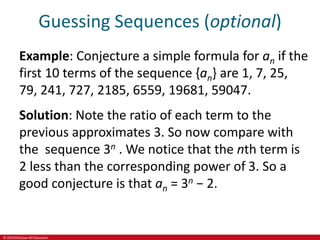
Guessing Sequences (optional)
Example: Conjecture a simple formula for an if the
first 10 terms of the sequence {an} are 1, 7, 25,
79, 241, 727, 2185, 6559, 19681, 59047.
Solution: Note the ratio of each term to the
previous approximates 3. So now compare with
the sequence 3n . We notice that the nth term is
2 less than the corresponding power of 3. So a
good conjecture is that an = 3n − 2.
© 2019 McGraw-Hill Education
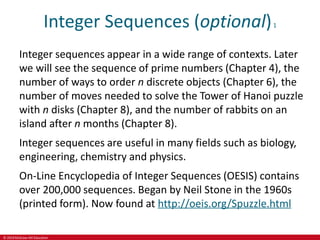
Integer Sequences (optional)1
Integer sequences appear in a wide range of contexts. Later
we will see the sequence of prime numbers (Chapter 4), the
number of ways to order n discrete objects (Chapter 6), the
number of moves needed to solve the Tower of Hanoi puzzle
with n disks (Chapter 8), and the number of rabbits on an
island after n months (Chapter 8).
Integer sequences are useful in many fields such as biology,
engineering, chemistry and physics.
On-Line Encyclopedia of Integer Sequences (OESIS) contains
over 200,000 sequences. Began by Neil Stone in the 1960s
(printed form). Now found at http://oeis.org/Spuzzle.html
© 2019 McGraw-Hill Education
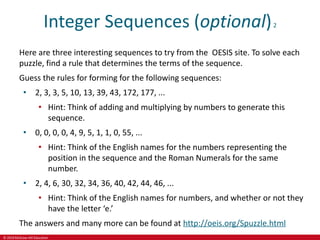
Integer Sequences (optional)2
Here are three interesting sequences to try from the OESIS site. To solve each
puzzle, find a rule that determines the terms of the sequence.
Guess the rules for forming for the following sequences:
• 2, 3, 3, 5, 10, 13, 39, 43, 172, 177, ...
• Hint: Think of adding and multiplying by numbers to generate this
sequence.
• 0, 0, 0, 0, 4, 9, 5, 1, 1, 0, 55, ...
• Hint: Think of the English names for the numbers representing the
position in the sequence and the Roman Numerals for the same
number.
• 2, 4, 6, 30, 32, 34, 36, 40, 42, 44, 46, ...
• Hint: Think of the English names for numbers, and whether or not they
have the letter ‘e.’
The answers and many more can be found at http://oeis.org/Spuzzle.html
© 2019 McGraw-Hill Education
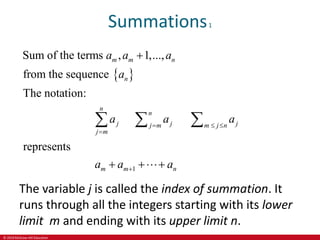
Summations1
 
1
Sum of the terms , 1,...,
from the sequence
The notation:
represents
m m n
n
n
n
j j j
j m m j n
j m
m m n
a a a
a
a a a
a a a
  



 
  
The variable j is called the index of summation. It
runs through all the integers starting with its lower
limit m and ending with its upper limit n.
© 2019 McGraw-Hill Education
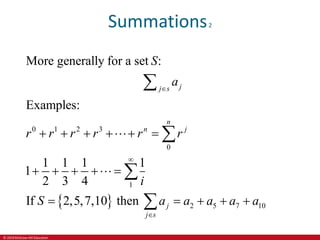
Summations2
 
0 1 2 3
0
1
2 5 7 10
More generally for a set :
Examples:
1 1 1 1
1
2 3 4
If 2,5,7,10 then
j
j s
n
n j
j
j s
S
a
r r r r r r
i
S a a a a a



    
    
    




© 2019 McGraw-Hill Education
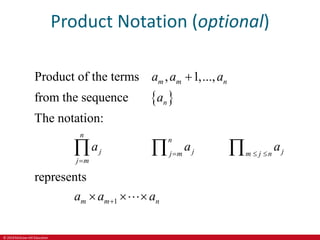
Product Notation (optional)
 
1
Product of the terms , 1,...,
from the sequence
The notation:
represents
m m n
n
n
n
j j j
j m m j n
j m
m m n
a a a
a
a a a
a a a
  



 
  
© 2019 McGraw-Hill Education
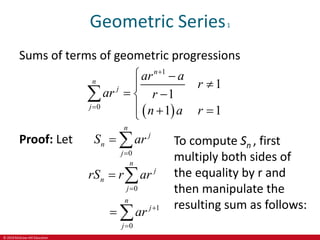
Geometric Series1
Sums of terms of geometric progressions
 
1
0
1
1
1 1
n
n
j
j
ar a
r
ar r
n a r


 


 

  


Proof: Let
0
n
j
n
j
S ar

 
0
n
j
n
j
rS r ar

 
1
0
n
j
j
ar 

 
To compute Sn , first
multiply both sides of
the equality by r and
then manipulate the
resulting sum as follows:
© 2019 McGraw-Hill Education
Geometric Series2
1
0
n
j
j
ar 

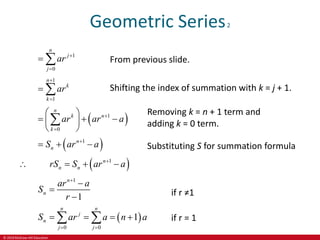
  From previous slide.
1
1
n
k
k
ar


  Shifting the index of summation with k = j + 1.
 
1
0
n
k n
k
ar ar a


 
  
 
 

Removing k = n + 1 term and
adding k = 0 term.
 
1
n
n
S ar a

   Substituting S for summation formula
 
1
n
n n
rS S ar a

   
1
1
n
n
ar a
S
r



 if r ≠1
 
0 0
1
n n
j
n
j j
S ar a n a
 
   
  if r = 1
© 2019 McGraw-Hill Education
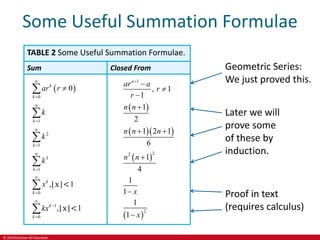
Some Useful Summation Formulae
TABLE 2 Some Useful Summation Formulae.
Sum Closed From
 
0
0
n
k
k
ar r



1
, 1
1
n
ar a
r
r




1
n
k
k


 
1
2
n n 
2
1
n
k
k


  
1 2 1
6
n n n
 
3
1
n
k
k

  
2
2
1
4
n n 
0
, 1
k
k
x


 | x|< 1
1 x

1
0
, 1
k
k
kx



 | x|<
 
2
1
1 x

Geometric Series:
We just proved this.
Later we will
prove some
of these by
induction.
Proof in text
(requires calculus)
© 2019 McGraw-Hill Education
Cardinality of Sets
Section 2.5
© 2019 McGraw-Hill Education
Section Summary6
Cardinality
Countable Sets
Computability
© 2019 McGraw-Hill Education
Cardinality1
Definition: The cardinality of a set A is equal to the
cardinality of a set B, denoted
|A| = |B|,
if and only if there is a one-to-one correspondence (i.e.,
a bijection) from A to B.
If there is a one-to-one function (i.e., an injection) from
A to B, the cardinality of A is less than or the same as the
cardinality of B and we write |A| ≤ |B|.
When |A| ≤ |B| and A and B have different cardinality,
we say that the cardinality of A is less than the
cardinality of B and write |A| < |B|.
© 2019 McGraw-Hill Education
Cardinality2
Definition: A set that is either finite or has the
same cardinality as the set of positive integers
(Z+) is called countable. A set that is not
countable is uncountable.
The set of real numbers R is an uncountable set.
When an infinite set is countable (countably
infinite) its cardinality is ℵ0 (where ℵ is aleph, the
1st letter of the Hebrew alphabet). We write |S| =
ℵ0 and say that S has cardinality “aleph null.”
© 2019 McGraw-Hill Education
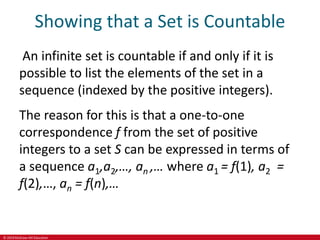
Showing that a Set is Countable
An infinite set is countable if and only if it is
possible to list the elements of the set in a
sequence (indexed by the positive integers).
The reason for this is that a one-to-one
correspondence f from the set of positive
integers to a set S can be expressed in terms of
a sequence a1,a2,…, an ,… where a1 = f(1), a2 =
f(2),…, an = f(n),…
© 2019 McGraw-Hill Education
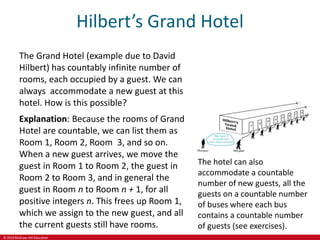
Hilbert’s Grand Hotel
The Grand Hotel (example due to David
Hilbert) has countably infinite number of
rooms, each occupied by a guest. We can
always accommodate a new guest at this
hotel. How is this possible?
Explanation: Because the rooms of Grand
Hotel are countable, we can list them as
Room 1, Room 2, Room 3, and so on.
When a new guest arrives, we move the
guest in Room 1 to Room 2, the guest in
Room 2 to Room 3, and in general the
guest in Room n to Room n + 1, for all
positive integers n. This frees up Room 1,
which we assign to the new guest, and all
the current guests still have rooms.
The hotel can also
accommodate a countable
number of new guests, all the
guests on a countable number
of buses where each bus
contains a countable number
of guests (see exercises).
© 2019 McGraw-Hill Education
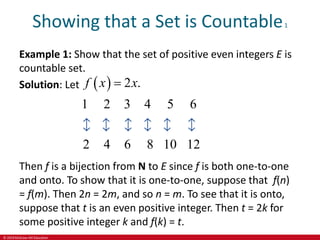
Showing that a Set is Countable1
Example 1: Show that the set of positive even integers E is
countable set.
Solution: Let   2 .
1 2 3 4 5 6
2 4 6 8 10 12
f x x

Then f is a bijection from N to E since f is both one-to-one
and onto. To show that it is one-to-one, suppose that f(n)
= f(m). Then 2n = 2m, and so n = m. To see that it is onto,
suppose that t is an even positive integer. Then t = 2k for
some positive integer k and f(k) = t.
© 2019 McGraw-Hill Education
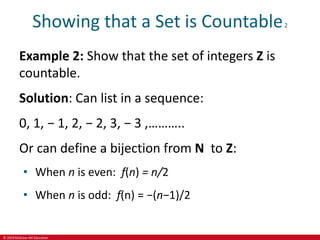
Showing that a Set is Countable2
Example 2: Show that the set of integers Z is
countable.
Solution: Can list in a sequence:
0, 1, − 1, 2, − 2, 3, − 3 ,………..
Or can define a bijection from N to Z:
• When n is even: f(n) = n/2
• When n is odd: f(n) = −(n−1)/2
© 2019 McGraw-Hill Education
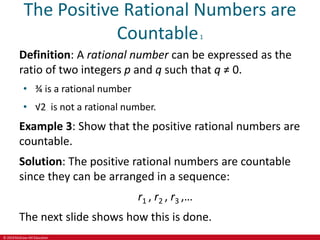
The Positive Rational Numbers are
Countable1
Definition: A rational number can be expressed as the
ratio of two integers p and q such that q ≠ 0.
• ¾ is a rational number
• √2 is not a rational number.
Example 3: Show that the positive rational numbers are
countable.
Solution: The positive rational numbers are countable
since they can be arranged in a sequence:
r1 , r2 , r3 ,…
The next slide shows how this is done.
© 2019 McGraw-Hill Education
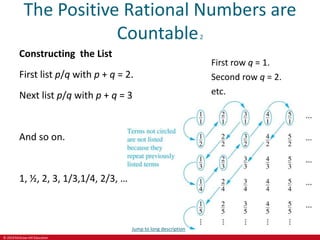
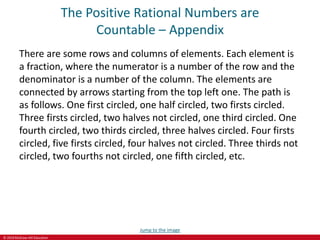
The Positive Rational Numbers are
Countable2
Constructing the List
First list p/q with p + q = 2.
Next list p/q with p + q = 3
And so on.
1, ½, 2, 3, 1/3,1/4, 2/3, ….
First row q = 1.
Second row q = 2.
etc.
Jump to long description
© 2019 McGraw-Hill Education
Strings2
Example 4: Show that the set of finite strings S over a finite
alphabet A is countably infinite.
Assume an alphabetical ordering of symbols in A
Solution: Show that the strings can be listed in a sequence.
First list
1. All the strings of length 0 in alphabetical order.
2. Then all the strings of length 1 in lexicographic (as in a dictionary)
order.
3. Then all the strings of length 2 in lexicographic order.
4. And so on.
This implies a bijection from N to S and hence it is a
countably infinite set.
© 2019 McGraw-Hill Education
The set of all Java programs is
countable.
Example 5: Show that the set of all Java programs is
countable.
Solution: Let S be the set of strings constructed from the
characters which can appear in a Java program. Use the
ordering from the previous example. Take each string in turn:
• Feed the string into a Java compiler. (A Java compiler will determine
if the input program is a syntactically correct Java program.)
• If the compiler says YES, this is a syntactically correct Java program,
we add the program to the list.
• We move on to the next string.
In this way we construct an implied bijection from N to the
set of Java programs. Hence, the set of Java programs is
countable.
© 2019 McGraw-Hill Education
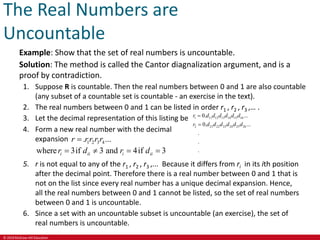
The Real Numbers are
Uncountable
Example: Show that the set of real numbers is uncountable.
Solution: The method is called the Cantor diagnalization argument, and is a
proof by contradiction.
1. Suppose R is countable. Then the real numbers between 0 and 1 are also countable
(any subset of a countable set is countable - an exercise in the text).
2. The real numbers between 0 and 1 can be listed in order r1 , r2 , r3 ,… .
3. Let the decimal representation of this listing be 1 11 12 13 14 15 16
2 21 22 23 24 25 26
0. ...
0. ...
.
.
.
r d d d d d d
r d d d d d d


4. Form a new real number with the decimal
expansion 1 2 3 4
. ...
r rr r r

where 3if 3 and 4if 3
i ii i ii
r d r d
   
5. r is not equal to any of the r1 , r2 , r3 ,... Because it differs from ri in its ith position
after the decimal point. Therefore there is a real number between 0 and 1 that is
not on the list since every real number has a unique decimal expansion. Hence,
all the real numbers between 0 and 1 cannot be listed, so the set of real numbers
between 0 and 1 is uncountable.
6. Since a set with an uncountable subset is uncountable (an exercise), the set of
real numbers is uncountable.
© 2019 McGraw-Hill Education
Computability (Optional)
Definition: We say that a function is computable if
there is a computer program in some programming
language that finds the values of this function. If a
function is not computable we say it is uncomputable.
There are uncomputable functions. We have shown
that the set of Java programs is countable. Exercise 38
in the text shows that there are uncountably many
different functions from a particular countably infinite
set (i.e., the positive integers) to itself. Therefore
(Exercise 39) there must be uncomputable functions.
© 2019 McGraw-Hill Education
Matrices
Section 2.6
© 2019 McGraw-Hill Education
Section Summary7
Definition of a Matrix
Matrix Arithmetic
Transposes and Powers of Arithmetic
Zero-One matrices
© 2019 McGraw-Hill Education
Matrices
Matrices are useful discrete structures that can be used in
many ways. For example, they are used to:
• describe certain types of functions known as linear transformations.
• Express which vertices of a graph are connected by edges (see
Chapter 10).
In later chapters, we will see matrices used to build models of:
• Transportation systems.
• Communication networks.
Algorithms based on matrix models will be presented in later
chapters.
Here we cover the aspect of matrix arithmetic that will be
needed later.
© 2019 McGraw-Hill Education
Matrix
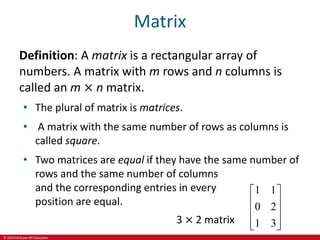
Definition: A matrix is a rectangular array of
numbers. A matrix with m rows and n columns is
called an m × n matrix.
• The plural of matrix is matrices.
• A matrix with the same number of rows as columns is
called square.
• Two matrices are equal if they have the same number of
rows and the same number of columns
and the corresponding entries in every
position are equal.
3 × 2 matrix
1 1
0 2
1 3
 
 
 
 
 
© 2019 McGraw-Hill Education
Notation
Let m and n be positive integers and let
11 12 1
21 22 2
1 2
...
...
A . . . .
. . .
.
...
n
n
m m mn
a a a
a a a
a a a
 
 
 
 

 
 
 
 
The ith row of A is the 1 × n matrix [ai1, ai2,…,ain]. The jth column
of A is the m × 1 matrix: 1
2
.
.
j
j
mj
a
a
a
 
 
 
 
 
 
 
 
The (i,j)th element or entry of A is the element aij. We can use A
= [aij ] to denote the matrix with its (i,j)th element equal to aij.
© 2019 McGraw-Hill Education
Matrix Arithmetic: Addition
Definition: Let A = [aij] and B = [bij] be m × n matrices.
The sum of A and B, denoted by A + B, is the m × n
matrix that has aij + bij as its (i,j)th element. In other
words, A + B = [aij + bij].
Example:
1 0 1 3 4 1 4 4 2
2 2 3 1 3 0 3 1 3
3 4 0 1 1 2 2 5 2
  
     
     
     
     
     

     
Note that matrices of different sizes can not be added.
© 2019 McGraw-Hill Education
Matrix Multiplication
Definition: Let A be an m × k matrix and B be a k × n matrix. The
product of A and B, denoted by AB, is the m × n matrix that has its
(i,j)th element equal to the sum of the products of the
corresponding elements from the ith row of A and the jth column
of B. In other words, if AB = [cij] then cij = ai1b1j + ai2b2j + … + akjb2j.
Example:
1 0 4 14 4
2 4
2 1 1 8 9
1 1
3 1 0 7 13
3 0
0 2 2 8 2
   
 
   
 
   

 
   
 
   
 
   
The product of two matrices is undefined when the number of
columns in the first matrix is not the same as the number of rows
in the second.
© 2019 McGraw-Hill Education
Illustration of Matrix Multiplication
The Product of A = [aij] and B = [bij]
11 12 1
21 22 2
1
1 1
2
2
. . .
. . .
A
. . .
. . .
k
k
m m m
i
k
i k
a a a
a a a
a a a
a a a
 
 
 
 
 
 

 
 
 
 
 
 
 
11 12 1
21 22
1
1
2
2
2
. . .
B
. . .
j
j
k
n
k
j
n
k k n
b a b
b b b
b b b
b
b
b
 
 
 
 

 
 
 
 
11 12 1
21 22 2
1 2
. . .
AB
. . .
. . .
m
i
n
n
m mn
j
c c c
c b c
c c c
c
 
 
 
 
  
 
 
 
 
 
1 1 2 2 ...
ij i j i j ik kj
c a b a b a b
   
© 2019 McGraw-Hill Education
Matrix Multiplication is not
Commutative
Example: Let
1 1
A
2 1
 
  
 
2 1
B
1 1
 
  
 
Does AB = BA?
Solution:
2 2
AB
5 3
 
  
 
4 3
BA
3 2
 
  
 
AB ≠ BA
© 2019 McGraw-Hill Education
Identity Matrix and Powers of Matrices
Definition: The identity matrix of order n is the m × n
matrix In = [ij], where ij = 1 if i = j and ij = 0 if i≠j.
n
1 0 0
0 1 0
. . .
I
. . . .
. . .
0 0 1
 
 
 
 
  
 
 
 
 
AIn = ImA = A
when A is an m × n matrix
Powers of square matrices can be defined. When A is an
n × n matrix, we have: 0
r times
A I A AAA A
r
n
 
© 2019 McGraw-Hill Education
Transposes of Matrices1
Definition: Let A = [aij] be an m × n matrix. The transpose
of A, denoted by At ,is the n × m matrix obtained by
interchanging the rows and columns of A.
If At = [bij], then bij = aji for i =1,2,…,n and j = 1,2, ...,m.
1 4
1 2 3
The transpose of the matrix is the matrix 2 5
4 5 6
3 6
 
   
   
   
 
© 2019 McGraw-Hill Education
Transposes of Matrices2
Definition: A square matrix A is called
symmetric if A = At. Thus A = [aij] is symmetric if
aij = aji for i and j with 1≤ i≤ n and 1≤ j≤ n.
1 1 0
The matrix 1 0 1 is square.
0 1 0
 
 
 
 
 
Square matrices do not change when their rows
and columns are interchanged.
© 2019 McGraw-Hill Education
Zero-One Matrices1
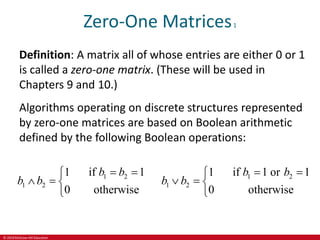
Definition: A matrix all of whose entries are either 0 or 1
is called a zero-one matrix. (These will be used in
Chapters 9 and 10.)
Algorithms operating on discrete structures represented
by zero-one matrices are based on Boolean arithmetic
defined by the following Boolean operations:
1 2
1 2
1 if 1
0 otherwise
b b
b b
 

  

1 2
1 2
1 if 1 or 1
0 otherwise
b b
b b
 

  

© 2019 McGraw-Hill Education
Zero-One Matrices2
Definition: Let A = [aij] and B = [bij] be an m  n zero-
one matrices.
• The join of A and B is the zero-one matrix with (i,j)th
entry aij ∨ bij. The join of A and B is denoted by A ∨ B.
• The meet of A and B is the zero-one matrix with
(i,j)th entry aij ∧ bij. The meet of A and B is denoted
by A ∧ B.
© 2019 McGraw-Hill Education
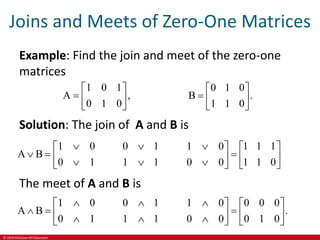
Joins and Meets of Zero-One Matrices
Example: Find the join and meet of the zero-one
matrices
1 0 1
A ,
0 1 0
 
  
 
0 1 0
B .
1 1 0
 
  
 
Solution: The join of A and B is
1 0 0 1 1 0 1 1 1
A B
0 1 1 1 0 0 1 1 0
  
   
  
   
  
   
The meet of A and B is
1 0 0 1 1 0 0 0 0
A B .
0 1 1 1 0 0 0 1 0
  
   
  
   
  
   
© 2019 McGraw-Hill Education
Boolean Product of Zero-One Matrices1
Definition: Let A = [aij] be an m × k zero-one matrix
and B = [bij] be a k × n zero-one matrix. The Boolean
product of A and B, denoted by A ⊙ B, is the m × n
zero-one matrix with(i,j)th entry
cij = (ai1 ∧ b1j)∨ (ai2 ∧ b2j) ∨ … ∨ (aik ∧ bkj).
Example: Find the Boolean product of A and B,
where
1 0
A 0 1 ,
1 0
 
 
  
 
 
1 1 0
B .
0 1 1
 
  
 
© 2019 McGraw-Hill Education
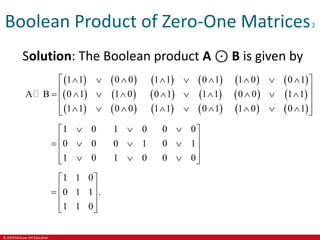
Boolean Product of Zero-One Matrices2
Solution: The Boolean product A ⊙ B is given by
   
   
   
   
   
   
   
   
   
1 1 0 0 1 1 0 1 1 0 0 1
A B 0 1 1 0 0 1 1 1 0 0 1 1
1 1 0 0 1 1 0 1 1 0 0 1
        
 
 
         
 
 
        
 
1 0 1 0 0 0
0 0 0 1 0 1
1 0 1 0 0 0
  
 
 
   
 
 
  
 
1 1 0
0 1 1 .
1 1 0
 
 
  
 
 
© 2019 McGraw-Hill Education
Boolean Powers of Zero-One Matrices1
Definition: Let A be a square zero-one matrix
and let r be a positive integer. The rth Boolean
power of A is the Boolean product of r factors
of A, denoted by A[r] . Hence,
 
r times
A A A A.
r

We define A[r] to be In.
(The Boolean product is well defined because the
Boolean product of matrices is associative.)
© 2019 McGraw-Hill Education
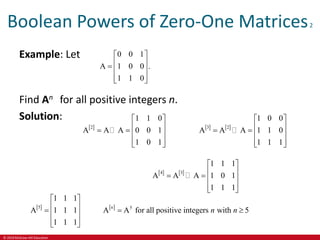
Boolean Powers of Zero-One Matrices2
Example: Let 0 0 1
A 1 0 0 .
1 1 0
 
 
  
 
 
Find An for all positive integers n.
Solution:
 
2
1 1 0
A A A 0 0 1
1 0 1
 
 
   
 
 
   
3 2
1 0 0
A A A 1 1 0
1 1 1
 
 
   
 
 
   
4 3
1 1 1
A A A 1 0 1
1 1 1
 
 
   
 
 
   
5 n 5
1 1 1
A 1 1 1 A A for all positive integers with 5
1 1 1
n n
 
 
  
 
 
 
© 2019 McGraw-Hill Education
Appendix of Image Long
Descriptions
© 2019 McGraw-Hill Education
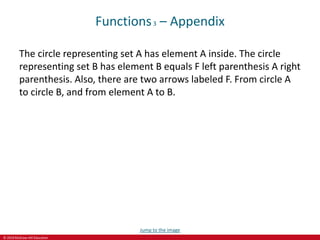
Functions3 – Appendix
The circle representing set A has element A inside. The circle
representing set B has element B equals F left parenthesis A right
parenthesis. Also, there are two arrows labeled F. From circle A
to circle B, and from element A to B.
Jump to the image
© 2019 McGraw-Hill Education
Inverse Functions1 – Appendix
There are two circles representing sets A and B. Circle A has
element A equal to F power minus one left parenthesis B right
parenthesis. Circle B has element B equal to F left parenthesis A
right parenthesis. Also, there are 4 arrows: an arrow from
element A to element B labeled F left parenthesis A right
parenthesis, an arrow from element B to element A labeled F
power minus one left parenthesis B right parenthesis, an arrow
from circle A to circle B labeled F. And arrow from circle B to
circle A labeled F power minus one.
Jump to the image
© 2019 McGraw-Hill Education
Composition1 – Appendix
There are three circles, representing sets A, B, and C. Circle A has
element A. Circle B has element G left parenthesis A right
parenthesis. Circle C has element F left parenthesis G left
parenthesis A two right parentheses. Also, there are 6 arrows.
From circle A to circle B labeled G. From circle B to circle C
labeled F. From circle A to circle C labeled F circle G. From
element A to element G left parenthesis A right parenthesis
labeled G left parenthesis A right parenthesis. From element G
left parenthesis A right parenthesis to element F left parenthesis
G left parenthesis A 2 right parentheses labeled F left
parenthesis G left parenthesis A 2 right parentheses. From
element A to element F left parenthesis G left parenthesis A 2
right parentheses labeled left parenthesis F circle G right
parenthesis left parenthesis A right parenthesis.
Jump to the image
© 2019 McGraw-Hill Education
Graphs of Functions – Appendix
There are eight rows by eight columns of plotted points. There is
a line passing through the points in the third column and a line
passing through the points in the sixth row. The point in the first
row fifth column, the point in the third row fourth column, and
the point in the fifth row third column are shaded.
Jump to the image
© 2019 McGraw-Hill Education
Floor and Ceiling Functions – Appendix
The X and Y axes range from -3 to 3, in increments of 1. There
are horizontal segments of unit length. In the floor graph, each
segment has a shaded point on its left end and a blank point on
its right end. The segments are: from x = −3 to −2 and y = −3,
from x = −2 to −1 and y = −2, from x = −1 to 0 and y = −1, from x =
0 to 1 and y = 0, from x = 1 to 2 and y = 1, from x = 2 to 3 and y =
2. In the ceiling graph, each segment has a blank point on its left
end and a shaded point on its right end. The segments are: from
x = −3 to −2 and y = −2, from x = −2 to −1 and y = −1, from x = −1
to 0 and y = 0, from x = 0 to 1 and y = 1, from x = 1 to 2 and y = 2,
from x = 2 to 3 and y = 3.
Jump to the image
© 2019 McGraw-Hill Education
The Positive Rational Numbers are
Countable – Appendix
There are some rows and columns of elements. Each element is
a fraction, where the numerator is a number of the row and the
denominator is a number of the column. The elements are
connected by arrows starting from the top left one. The path is
as follows. One first circled, one half circled, two firsts circled.
Three firsts circled, two halves not circled, one third circled. One
fourth circled, two thirds circled, three halves circled. Four firsts
circled, five firsts circled, four halves not circled. Three thirds not
circled, two fourths not circled, one fifth circled, etc.
Jump to the image

Chapter2.pptx

  • 1.
    Basic Structures: Sets, Functions,Sequences, Sums, and Matrices Chapter 2 With Question/Answer Animations © 2019 McGraw-Hill Education. All rights reserved. Authorized only for instructor use in the classroom. No reproduction or further distribution permitted without the prior written consent of McGraw-Hill Education.
  • 2.
    © 2019 McGraw-HillEducation Chapter Summary Sets • The Language of Sets • Set Operations • Set Identities Functions • Types of Functions • Operations on Functions • Computability Sequences and Summations • Types of Sequences • Summation Formulae Set Cardinality • Countable Sets Matrices • Matrix Arithmetic
  • 3.
    © 2019 McGraw-HillEducation Sets Section 2.1
  • 4.
    © 2019 McGraw-HillEducation Section Summary1 Definition of sets Describing Sets • Roster Method • Set-Builder Notation Some Important Sets in Mathematics Empty Set and Universal Set Subsets and Set Equality Cardinality of Sets Tuples Cartesian Product
  • 5.
    © 2019 McGraw-HillEducation Introduction Sets are one of the basic building blocks for the types of objects considered in discrete mathematics. • Important for counting. • Programming languages have set operations. Set theory is an important branch of mathematics. • Many different systems of axioms have been used to develop set theory. • Here we are not concerned with a formal set of axioms for set theory. Instead, we will use what is called naïve set theory.
  • 6.
    © 2019 McGraw-HillEducation Sets A set is an unordered collection of objects. • the students in this class • the chairs in this room The objects in a set are called the elements, or members of the set. A set is said to contain its elements. The notation a ∈ A denotes that a is an element of the set A. If a is not a member of A, write a ∉ A
  • 7.
    © 2019 McGraw-HillEducation Describing a Set: Roster Method S = {a,b,c,d} Order not important S = {a,b,c,d} = {b,c,a,d} Each distinct object is either a member or not; listing more than once does not change the set. S = {a,b,c,d} = {a,b,c,b,c,d} Elipses (…) may be used to describe a set without listing all of the members when the pattern is clear. S = {a,b,c,d, ……,z }
  • 8.
    © 2019 McGraw-HillEducation Roster Method Set of all vowels in the English alphabet: V = {a,e,i,o,u} Set of all odd positive integers less than 10: O = {1,3,5,7,9} Set of all positive integers less than 100: S = {1,2,3,……..,99} Set of all integers less than 0: S = {…., -3,-2,-1}
  • 9.
    © 2019 McGraw-HillEducation Some Important Sets N = natural numbers = {0,1,2,3….} Z = integers = {…,-3,-2,-1,0,1,2,3,…} Z⁺ = positive integers = {1,2,3,…..} R = set of real numbers R+ = set of positive real numbers C = set of complex numbers. Q = set of rational numbers
  • 10.
    © 2019 McGraw-HillEducation Set-Builder Notation Specify the property or properties that all members must satisfy: S = {x | x is a positive integer less than 100} O = {x | x is an odd positive integer less than 10} O = {x ∈ Z⁺ | x is odd and x < 10} A predicate may be used: S = {x | P(x)} Example: S = {x | Prime(x)} Positive rational numbers: Q+ = {x ∈ R | x = p/q, for some positive integers p,q}
  • 11.
    © 2019 McGraw-HillEducation Interval Notation closed interval [a,b] open interval (a,b)                 | | | , , , , | a b x a x b a b x a x b a b x a x b a b x a x b            
  • 12.
    © 2019 McGraw-HillEducation Universal Set and Empty Set The universal set U is the set containing everything currently under consideration. • Sometimes implicit • Sometimes explicitly stated. • Contents depend on the context. The empty set is the set with no elements. Symbolized ∅, but {} also used. Venn Diagram John Venn (1834-1923) Cambridge, UK
  • 13.
    © 2019 McGraw-HillEducation Russell’s Paradox Let S be the set of all sets which are not members of themselves. A paradox results from trying to answer the question “Is S a member of itself?” Related Paradox: • Henry is a barber who shaves all people who do not shave themselves. A paradox results from trying to answer the question “Does Henry shave himself?”
  • 14.
    © 2019 McGraw-HillEducation Some things to remember Sets can be elements of sets. {{1,2,3},a, {b,c}} {N,Z,Q,R} The empty set is different from a set containing the empty set. ∅ ≠ { ∅ }
  • 15.
    © 2019 McGraw-HillEducation Set Equality Definition: Two sets are equal if and only if they have the same elements. • Therefore if A and B are sets, then A and B are equal if and only if   x x A x B     • We write A = B if A and B are equal sets. {1,3,5} = {3, 5, 1} {1,5,5,5,3,3,1} = {1,3,5}
  • 16.
    © 2019 McGraw-HillEducation Subsets Definition: The set A is a subset of B, if and only if every element of A is also an element of B. • The notation A ⊆ B is used to indicate that A is a subset of the set B. • A ⊆ B holds if and only if   x x A x B     is true. 1. Because a ∈ ∅ is always false, ∅ ⊆ S ,for every set S. 2. Because a ∈ S  a ∈ S, S ⊆ S, for every set S.
  • 17.
    © 2019 McGraw-HillEducation Showing a Set is or is not a Subset of Another Set Showing that A is a Subset of B: To show that A ⊆ B, show that if x belongs to A, then x also belongs to B. Showing that A is not a Subset of B: To show that A is not a subset of B, A ⊈ B, find an element x ∈ A with x ∉ B. (Such an x is a counterexample to the claim that x ∈ A implies x ∈ B.) Examples: 1. The set of all computer science majors at your school is a subset of all students at your school. 2. The set of integers with squares less than 100 is not a subset of the set of nonnegative integers.
  • 18.
    © 2019 McGraw-HillEducation Another look at Equality of Sets Recall that two sets A and B are equal, denoted by A = B, iff   x x A x B     Using logical equivalences we have that A = B iff     x x A x B x B x A             This is equivalent to A ⊆ B and B ⊆ A
  • 19.
    © 2019 McGraw-HillEducation Proper Subsets Definition: If A ⊆ B, but A ≠B, then we say A is a proper subset of B, denoted by A ⊂ B. If A ⊂ B, then     x x A x B x x B x A           is true. Venn Diagram
  • 20.
    © 2019 McGraw-HillEducation Set Cardinality Definition: If there are exactly n distinct elements in S where n is a nonnegative integer, we say that S is finite. Otherwise it is infinite. Definition: The cardinality of a finite set A, denoted by |A|, is the number of (distinct) elements of A. Examples: 1. |ø| = 0 2. Let S be the letters of the English alphabet. Then |S| = 26 3. |{1,2,3}| = 3 4. |{ø}| = 1 5. The set of integers is infinite.
  • 21.
    © 2019 McGraw-HillEducation Power Sets Definition: The set of all subsets of a set A, denoted P(A), is called the power set of A. Example: If A = {a,b} then P(A) = {ø, {a},{b},{a,b}} If a set has n elements, then the cardinality of the power set is 2ⁿ. (In Chapters 5 and 6, we will discuss different ways to show this.)
  • 22.
    © 2019 McGraw-HillEducation Tuples The ordered n-tuple (a1,a2,…..,an) is the ordered collection that has a1 as its first element and a2 as its second element and so on until an as its last element. Two n-tuples are equal if and only if their corresponding elements are equal. 2-tuples are called ordered pairs. The ordered pairs (a,b) and (c,d) are equal if and only if a = c and b = d.
  • 23.
    © 2019 McGraw-HillEducation Cartesian Product1 Definition: The Cartesian Product of two sets A and B, denoted by A × B is the set of ordered pairs (a,b) where a ∈ A and b ∈ B .     , | A B a b a A b B      Example: A = {a,b} B = {1,2,3} A × B = {(a,1),(a,2),(a,3), (b,1),(b,2),(b,3)} Definition: A subset R of the Cartesian product A × B is called a relation from the set A to the set B. (Relations will be covered in depth in Chapter 9.)
  • 24.
    © 2019 McGraw-HillEducation Cartesian Product2 Definition: The cartesian products of the sets A1,A2,……,An, denoted by A1 × A2 × …… × An , is the set of ordered n-tuples (a1,a2,……,an) where ai belongs to Ai for i = 1, … n.     1 2 1 2 , , | for 1,2, n n i i A A A a a a a A i n       Example: What is A × B × C where A = {0,1}, B = {1,2} and C = {0,1,2} Solution: A × B × C = {(0,1,0), (0,1,1), (0,1,2),(0,2,0), (0,2,1), (0,2,2),(1,1,0), (1,1,1), (1,1,2), (1,2,0), (1,2,1), (1,2,2)}
  • 25.
    © 2019 McGraw-HillEducation Truth Sets of Quantifiers Given a predicate P and a domain D, we define the truth set of P to be the set of elements in D for which P(x) is true. The truth set of P(x) is denoted by     | x D P x  Example: The truth set of P(x) where the domain is the integers and P(x) is “|x| = 1” is the set {-1,1}
  • 26.
    © 2019 McGraw-HillEducation Set Operations Section 2.2
  • 27.
    © 2019 McGraw-HillEducation Section Summary2 Set Operations • Union • Intersection • Complementation • Difference More on Set Cardinality Set Identities Proving Identities Membership Tables
  • 28.
    © 2019 McGraw-HillEducation Boolean Algebra Propositional calculus and set theory are both instances of an algebraic system called a Boolean Algebra. This is discussed in Chapter 12. The operators in set theory are analogous to the corresponding operator in propositional calculus. As always there must be a universal set U. All sets are assumed to be subsets of U.
  • 29.
    © 2019 McGraw-HillEducation Union Definition: Let A and B be sets. The union of the sets A and B, denoted by A ∪ B, is the set:   | x x A x B    Example: What is {1,2,3} ∪ {3, 4, 5}? Solution: {1,2,3,4,5} Venn Diagram for A ∪ B
  • 30.
    © 2019 McGraw-HillEducation Intersection Definition: The intersection of sets A and B, denoted by A ∩ B, is   | x x A x B    Note if the intersection is empty, then A and B are said to be disjoint. Example: What is? {1,2,3} ∩ {3,4,5} ? Solution: {3} Example:What is? {1,2,3} ∩ {4,5,6} ? Solution: ∅ Venn Diagram for A ∩B
  • 31.
    © 2019 McGraw-HillEducation Complement Definition: If A is a set, then the complement of the A (with respect to U), denoted by Ā is the set U - A   | | A x x U x A    (The complement of A is sometimes denoted by Ac .) Example: If U is the positive integers less than 100, what is the complement of   | 70 x x    0 Solution : | 7 x x  Venn Diagram for Complement
  • 32.
    © 2019 McGraw-HillEducation Difference Definition: Let A and B be sets. The difference of A and B, denoted by A – B, is the set containing the elements of A that are not in B. The difference of A and B is also called the complement of B with respect to A.   – | A B x x A x B A B       Venn Diagram for A − B
  • 33.
    © 2019 McGraw-HillEducation The Cardinality of the Union of Two Sets Inclusion-Exclusion |A ∪ B| = |A| + | B| − |A ∩ B| Example: Let A be the math majors in your class and B be the CS majors. To count the number of students who are either math majors or CS majors, add the number of math majors and the number of CS majors, and subtract the number of joint CS/math majors. We will return to this principle in Chapter 6 and Chapter 8 where we will derive a formula for the cardinality of the union of n sets, where n is a positive integer. Venn Diagram for A, B, A ∩ B, A ∪ B
  • 34.
    © 2019 McGraw-HillEducation Review Questions Example: U = {0,1,2,3,4,5,6,7,8,9,10} A = {1,2,3,4,5}, B ={4,5,6,7,8} 1. A ∪ B Solution: {1,2,3,4,5,6,7,8} 2. A ∩ B Solution: {4,5} 3. Ā Solution: {0,6,7,8,9,10} 4. 𝐵 Solution: {0,1,2,3,9,10} 5. A – B Solution: {1,2,3} 6. B – A Solution: {6,7,8}
  • 35.
    © 2019 McGraw-HillEducation Symmetric Difference (optional) Definition: The symmetric difference of A and B, denoted by A B  is the set     A B B A    Example: U = {0,1,2,3,4,5,6,7,8,9,10} A = {1,2,3,4,5} B ={4,5,6,7,8} What is : A B  Solution: {1,2,3,6,7,8} Venn Diagram
  • 36.
    © 2019 McGraw-HillEducation Set Identities1 Identity laws A A A U A     Domination laws A U U A      Idempotent laws A A A A A A     Complementation law   A A 
  • 37.
    © 2019 McGraw-HillEducation Set Identities2 Commutative laws A B B A A B B A       Associative laws         A B C A B C A B C A B C           Distributive laws             A B C A B A C A B C A B A C            
  • 38.
    © 2019 McGraw-HillEducation Set Identities3 De Morgan’s laws A B A B A B A B       Absorption laws     A A B A A A B A       Complement laws A A U A A     
  • 39.
    © 2019 McGraw-HillEducation Proving Set Identities Different ways to prove set identities: 1. Prove that each set (side of the identity) is a subset of the other. 2. Use set builder notation and propositional logic. 3. Membership Tables: Verify that elements in the same combination of sets always either belong or do not belong to the same side of the identity. Use 1 to indicate it is in the set and a 0 to indicate that it is not
  • 40.
    © 2019 McGraw-HillEducation Proof of Second De Morgan Law1 Example: Prove that A B A B    Solution: We prove this identity by showing that:   1 and 2 A B A B A B A B      
  • 41.
    © 2019 McGraw-HillEducation Proof of Second De Morgan Law2 These steps show that: A B A B              by assumption defn. of complement by defn. of intersection 1st De Morgan law for Prop Logic defn. of negation defn. of complement by defn. of union x A B x A B x A x B x A x B x A x B x A x B x A B                     
  • 42.
    © 2019 McGraw-HillEducation Proof of Second De Morgan Law3 These steps show that: A B A B                        by assumption by defn. of union defn. of complement defn. of negation 1st De Morgan law for Prop Logic defn. of intersection defn. of complement x A B x A x B x A x B x A x B x A x B x A B x A B                       
  • 43.
    © 2019 McGraw-HillEducation Set-Builder Notation: Second De Morgan Law                  by defn. of complement | by defn. of does not belong symbol | by defn. of intersection | by 1st De Morgan law for Prop Logic | by defn. of not belong symbol | A B x A B x x A B x x A x B x x A x B x x A x B x x                              by defn. of complement | by defn. of union by meaning of notation A x B x x A B A B       
  • 44.
    © 2019 McGraw-HillEducation Membership Table Example: Construct a membership table to show that the distributive law holds.       A B C A B A C       Solution: A B C B∩C A∪ (B∩C) A∪B A∪C (A∪B) ∩ (A∪C) 1 1 1 1 1 1 1 1 1 1 0 0 1 1 1 1 1 0 1 0 1 1 1 1 1 0 0 0 1 1 1 1 0 1 1 1 1 1 1 1 0 1 0 0 0 1 0 0 0 0 1 0 0 0 1 0 0 0 0 0 0 0 0 0
  • 45.
    © 2019 McGraw-HillEducation Conversion Between Binary, Octal, and Hexadecimal Expansions Let A1, A2 ,…, An be an indexed collection of sets. We define: 1 2 1 1 2 1 n i n i n i n i A A A A A A A A           These are well defined, since union and intersection are associative. For i = 1,2,…, let Ai = {i, i + 1, i + 2, ….}. Then,         1 1 1 1 , 1, 2, 1,2,3, , 1, 2, , 1, 2, n n i i i n n i n i i A i i i A i i i n n n A               
  • 46.
    © 2019 McGraw-HillEducation Functions Section 2.3
  • 47.
    © 2019 McGraw-HillEducation Section Summary3 Definition of a Function. • Domain, Codomain • Image, Preimage Injection, Surjection, Bijection Inverse Function Function Composition Graphing Functions Floor, Ceiling, Factorial Partial Functions (optional)
  • 48.
    © 2019 McGraw-HillEducation Functions1 Definition: Let A and B be nonempty sets. A function f from A to B, denoted f: A  B is an assignment of each element of A to exactly one element of B. We write f(a) = b if b is the unique element of B assigned by the function f to the element a of A. • Functions are sometimes called mappings or transformations.
  • 49.
    © 2019 McGraw-HillEducation Functions2 A function f: A  B can also be defined as a subset of A×B (a relation). This subset is restricted to be a relation where no two elements of the relation have the same first element. Specifically, a function f from A to B contains one, and only one ordered pair (a, b) for every element a∈ A.   , x x A y y B x y f                and     1 2 1 2 1 2 , , , , x y y x y f x y f y y              
  • 50.
    © 2019 McGraw-HillEducation Functions3 Given a function f: A  B: • We say f maps A to B or f is a mapping from A to B. • A is called the domain of f. • B is called the codomain of f. • If f(a) = b, • then b is called the image of a under f. • a is called the preimage of b. • The range of f is the set of all images of points in A under f. We denote it by f(A). • Two functions are equal when they have the same domain, the same codomain and map each element of the domain to the same element of the codomain. Jump to long description
  • 51.
    © 2019 McGraw-HillEducation Representing Functions Functions may be specified in different ways: • An explicit statement of the assignment. Students and grades example. • A formula.   1 f x x   • A computer program. • A Java program that when given an integer n, produces the nth Fibonacci Number (covered in the next section and also in Chapter 5).
  • 52.
    © 2019 McGraw-HillEducation Questions f(a) = ? z The image of d is ? z The domain of f is ? A The codomain of f is ? B The preimage of y is ? b f(A) = ? {y,z} The preimage(s) of z is (are) ? {a,c,d}
  • 53.
    © 2019 McGraw-HillEducation Question on Functions and Sets If : f A B  and S is a subset of A, then       f S f s s S   | f {a,b,c,} is ? {y,z} f {c,d} is ? {z}
  • 54.
    © 2019 McGraw-HillEducation Injections Definition: A function f is said to be one-to-one , or injective, if and only if f(a) = f(b) implies that a = b for all a and b in the domain of f. A function is said to be an injection if it is one-to-one.
  • 55.
    © 2019 McGraw-HillEducation Surjections Definition: A function f from A to B is called onto or surjective, if and only if for every element b B  there is an element a A  with   . f a b  A function f is called a surjection if it is onto.
  • 56.
    © 2019 McGraw-HillEducation Bijections Definition: A function f is a one-to-one correspondence, or a bijection, if it is both one-to-one and onto (surjective and injective).
  • 57.
    © 2019 McGraw-HillEducation Showing that f is one-to-one or onto1 Suppose that f : A  B. To show that f is injective Show that if f (x) = f (y) for arbitrary x, y ∈ A, then x = y. To show that f is not injective Find particular elements x, y ∈ A such that x ≠ y and f (x) = f (y). To show that f is surjective Consider an arbitrary element y ∈ B and find an element x ∈ A such that f (x) = y. To show that f is not surjective Find a particular y ∈ B such that f (x) ≠ y for all x ∈ A.
  • 58.
    © 2019 McGraw-HillEducation Showing that f is one-to-one or onto2 Example 1: Let f be the function from {a,b,c,d} to {1,2,3} defined by f(a) = 3, f(b) = 2, f(c) = 1, and f(d) = 3. Is f an onto function? Solution: Yes, f is onto since all three elements of the codomain are images of elements in the domain. If the codomain were changed to {1,2,3,4}, f would not be onto. Example 2: Is the function f(x) = x2 from the set of integers to the set of integers onto? Solution: No, f is not onto because there is no integer x with x2 = −1, for example.
  • 59.
    © 2019 McGraw-HillEducation Inverse Functions1 Definition: Let f be a bijection from A to B. Then the inverse of f, denoted 1 , f  is the function from B to A defined as     1 iff f y x f x y    No inverse exists unless f is a bijection. Why? Jump to long description
  • 60.
    © 2019 McGraw-HillEducation Inverse Functions2
  • 61.
    © 2019 McGraw-HillEducation Questions1 Example 1: Let f be the function from {a,b,c} to {1,2,3} such that f(a) = 2, f(b) = 3, and f(c) = 1. Is f invertible and if so what is its inverse? Solution: The function f is invertible because it is a one-to-one correspondence. The inverse function f−1 reverses the correspondence given by f, so f−1 (1) = c, f−1 (2) = a, and f−1 (3) = b.
  • 62.
    © 2019 McGraw-HillEducation Questions2 Example 2: Let f: Z  Z be such that f(x) = x + 1. Is f invertible, and if so, what is its inverse? Solution: The function f is invertible because it is a one-to-one correspondence. The inverse function f−1 reverses the correspondence so f−1 (y) = y −1.
  • 63.
    © 2019 McGraw-HillEducation Questions3 Example 3: Let f: R  R be such that   2 f x x  Is f invertible, and if so, what is its inverse? Solution: The function f is not invertible because it is not one-to-one.
  • 64.
    © 2019 McGraw-HillEducation Composition1 Definition: Let f: B→C, g: A→B. The composition of f with g, denoted f g is the function from A to C defined by       f g x f g x  Jump to long description
  • 65.
    © 2019 McGraw-HillEducation Composition2
  • 66.
    © 2019 McGraw-HillEducation Composition3 Example 1: If               2 2 2 and 2 1, then 2 1 and 2 1 f x x g x x f g x x g f x x       
  • 67.
    © 2019 McGraw-HillEducation Composition Questions1 Example 2: Let g be the function from the set {a,b,c} to itself such that g(a) = b, g(b) = c, and g(c) = a. Let f be the function from the set {a,b,c} to the set {1,2,3} such that f(a) = 3, f(b) = 2, and f(c) = 1. What is the composition of f and g, and what is the composition of g and f. Solution: The composition f∘g is defined by                         2. 1. 3. g g f g a f a f b f g b f b f c f g c f a g c f          Note that g∘f is not defined, because the range of f is not a subset of the domain of g.
  • 68.
    © 2019 McGraw-HillEducation Composition Questions2 Example 2: Let f and g be functions from the set of integers to the set of integers defined by     2 3 and 3 2. f x x g x x     What is the composition of f and g, and also the composition of g and f ? Solution:                     3 2 2 3 2 3 6 7 3 2 3 3 2 2 6 11 f g x f f x x x g f x g g g x x f x x x                
  • 69.
    © 2019 McGraw-HillEducation Graphs of Functions Let f be a function from the set A to the set B. The graph of the function f is the set of ordered pairs       , and . | a b a A f a b   Graph of f(n) = 2n + 1 from Z to Z Graph of f(x) = x2 from Z to Z Jump to long description
  • 70.
    © 2019 McGraw-HillEducation Some Important Functions The floor function, denoted   f x x    is the largest integer less than or equal to x. The ceiling function, denoted   f x x    is the smallest integer greater than or equal to x Example: 3.5 3.5 1.5 1.5                
  • 71.
    © 2019 McGraw-HillEducation Floor and Ceiling Functions1 Graph of (a) Floor and (b) Ceiling Functions Jump to long description
  • 72.
    © 2019 McGraw-HillEducation Floor and Ceiling Functions2 TABLE 1 Useful Properties of the Floor and Ceiling Functions. (n is an integer, x is a real number)         1a if and only if 1 1b if and only if 1 1c if and only if 1 1d if and only if 1 x n n x n x n n x n x n x n x x n x n x                           2 1 1 x x x x x         < <     3a 3b x x x x                 4a 4b x n x n x n x n              
  • 73.
    © 2019 McGraw-HillEducation Proving Properties of Functions Example: Prove that x is a real number, then ⌊2x⌋= ⌊x⌋ + ⌊x + 1/2⌋ Solution: Let x = n + ε, where n is an integer and 0 ≤ ε< 1. Case 1: ε < ½ • 2x = 2n + 2ε and ⌊2x⌋ = 2n, since 0 ≤ 2ε< 1. • ⌊x + 1/2⌋ = n, since x + ½ = n + (1/2 + ε ) and 0 ≤ ½ +ε < 1. • Hence, ⌊2x⌋ = 2n and ⌊x⌋ + ⌊x + 1/2⌋ = n + n = 2n. Case 2: ε ≥ ½ • 2x = 2n + 2ε = (2n + 1) +(2ε − 1) and ⌊2x⌋ =2n + 1, since 0 ≤ 2 ε − 1< 1. • ⌊x + 1/2⌋ = ⌊ n + (1/2 + ε)⌋ = ⌊ n + 1 + (ε – 1/2)⌋ = n + 1 since 0 ≤ ε − 1/2< 1. • Hence, ⌊2x⌋ = 2n + 1 and ⌊x⌋ + ⌊x + 1/2⌋ = n + (n + 1) = 2n + 1.
  • 74.
    © 2019 McGraw-HillEducation Factorial Function Definition: f: N  Z+ , denoted by f(n) = n! is the product of the first n positive integers when n is a nonnegative integer.       1 2 –1 , 0 0! 1 f n n n f       Examples:         1 1! 1 2 2! 1 2 2 6 6! 1 2 3 4 5 6 720 20 2,432,902,008,176,640,000. f f f f                Stirling’s Formula:           ! 2 / / 1 n n n n n e f n g n lim f n g n    
  • 75.
    © 2019 McGraw-HillEducation Partial Functions (optional) Definition: A partial function f from a set A to a set B is an assignment to each element a in a subset of A, called the domain of definition of f, of a unique element b in B. • The sets A and B are called the domain and codomain of f, respectively. • We day that f is undefined for elements in A that are not in the domain of definition of f. • When the domain of definition of f equals A, we say that f is a total function. Example: f: N  R where f(n) = √n is a partial function from Z to R where the domain of definition is the set of nonnegative integers. Note that f is undefined for negative integers.
  • 76.
    © 2019 McGraw-HillEducation Sequences and Summations Section 2.4
  • 77.
    © 2019 McGraw-HillEducation Section Summary4 Sequences. • Examples: Geometric Progression, Arithmetic Progression Recurrence Relations • Example: Fibonacci Sequence Summations Special Integer Sequences (optional)
  • 78.
    © 2019 McGraw-HillEducation Introduction2 Sequences are ordered lists of elements. • 1, 2, 3, 5, 8 • 1, 3, 9, 27, 81, ……. Sequences arise throughout mathematics, computer science, and in many other disciplines, ranging from botany to music. We will introduce the terminology to represent sequences and sums of the terms in the sequences.
  • 79.
    © 2019 McGraw-HillEducation Sequences1 Definition: A sequence is a function from a subset of the integers (usually either the set {0, 1, 2, 3, 4, …..} or {1, 2, 3, 4, ….}) to a set S. The notation an is used to denote the image of the integer n. We can think of an as the equivalent of f(n) where f is a function from {0,1,2,…..} to S. We call an a term of the sequence.
  • 80.
    © 2019 McGraw-HillEducation Sequences2 Example: Consider the sequence an where     1 2 3 1 , , ... 1 1 1 1, , , 2 3 4 n n a a a a a n  
  • 81.
    © 2019 McGraw-HillEducation Geometric Progression Definition: A geometric progression is a sequence of the form: 2 , , , , n a ar ar   where the initial term a and the common ratio r are real numbers.                 0 1 2 3 4 0 1 2 3 4 0 1 2 3 4 1. Let 1and 1. Then : , , , , ,... 1, 1, 1, 1, 1,... 2. Let 2and 5. Then : , , , , ,... 2, 10, 50, 250, 1250,... 3. Let 6and 1/ 3. Then : 2 2 2 , , , , ,... 6, 2, , , ,... 3 9 27 n n n a r b b b b b b a r c c c c c c a r d d d d d d                     Examples : 
  • 82.
    © 2019 McGraw-HillEducation Arithmetic Progression Definition: A arithmetic progression is a sequence of the form: , , 2 ,..., ,... a a d a d a nd    where the initial term a and the common difference d are real numbers.                   0 1 2 3 4 0 1 2 3 4 0 1 2 3 4 1. Let 1and 4: , , , , ,... 1, 1, 1, 1, 1,... 2. Let 7and 3: , , , , ,... 7, 4, 1, 2, 5,... 3. Let 1and 2: , , , , ,... 1, 3, 5, 7, 9,... n n n a d s s s s s s a d t t t t t t a d u u u u u u                   Examples :
  • 83.
    © 2019 McGraw-HillEducation Strings1 Definition: A string is a finite sequence of characters from a finite set (an alphabet). Sequences of characters or bits are important in computer science. The empty string is represented by λ. The string abcde has length 5.
  • 84.
    © 2019 McGraw-HillEducation Recurrence Relations Definition: A recurrence relation for the sequence {an} is an equation that expresses an in terms of one or more of the previous terms of the sequence, namely, a0, a1, …, an−1, for all integers n with n ≥ n0, where n0 is a nonnegative integer. A sequence is called a solution of a recurrence relation if its terms satisfy the recurrence relation. The initial conditions for a sequence specify the terms that precede the first term where the recurrence relation takes effect.
  • 85.
    © 2019 McGraw-HillEducation Questions about Recurrence Relations1 Example 1: Let {an} be a sequence that satisfies the recurrence relation an = an−1 + 3 for n = 1,2,3,4,…. and suppose that a0 = 2. What are a1 , a2 and a3? [Here a0 = 2 is the initial condition.] Solution: We see from the recurrence relation that 1 0 2 3 3 2 3 5 5 3 8 8 3 11 a a a a           
  • 86.
    © 2019 McGraw-HillEducation Questions about Recurrence Relations2 Example 2: Let {an} be a sequence that satisfies the recurrence relation an = an-1 – an-2 for n = 2,3,4,…. and suppose that a0 = 3 and a1 = 5. What are a2 and a3? [Here the initial conditions are a0 = 3 and a1 = 5. ] Solution: We see from the recurrence relation that 2 1 0 3 2 1 5 3 2 2 5 3 a a a a a a           
  • 87.
    © 2019 McGraw-HillEducation Fibonacci Sequence Definition: Define the Fibonacci sequence, f0 ,f1 ,f2,…, by: • Initial Conditions: f0 = 0, f1 = 1 • Recurrence Relation: fn = fn−1 + fn−2 Example: Find f2 ,f3 ,f4 , f5 and f6 . 2 1 0 3 2 1 4 3 2 5 4 3 6 5 4 1 0 1, 1 1 2, 2 1 3, 3 2 5, 5 3 8. f f f f f f f f f f f f f f f                          Answer :
  • 88.
    © 2019 McGraw-HillEducation Solving Recurrence Relations Finding a formula for the nth term of the sequence generated by a recurrence relation is called solving the recurrence relation. Such a formula is called a closed formula. Various methods for solving recurrence relations will be covered in Chapter 8 where recurrence relations will be studied in greater depth. Here we illustrate by example the method of iteration in which we need to guess the formula. The guess can be proved correct by the method of induction (Chapter 5).
  • 89.
    © 2019 McGraw-HillEducation Iterative Solution Example1 Method 1: Working upward, forward substitution Let {an} be a sequence that satisfies the recurrence relation an = an−1 + 3 for n = 2,3,4,…. and suppose that a1 = 2. a2 = 2 + 3 a3 = (2 + 3) + 3 = 2 + 3 ∙ 2 a4 = (2 + 2 ∙ 3) + 3 = 2 + 3 ∙ 3 . . . an = an-1 + 3 = (2 + 3 ∙ (n – 2)) + 3 = 2 + 3(n − 1)
  • 90.
    © 2019 McGraw-HillEducation Iterative Solution Example2 Method 2: Working downward, backward substitution Let {an} be a sequence that satisfies the recurrence relation an = an−1 + 3for n = 2,3,4,…. and suppose that a1 = 2. an = an-1 + 3 = (an-2 + 3) + 3 = an-2 + 3 ∙ 2 = (an-3 + 3 )+ 3 ∙ 2 = an-3 + 3 ∙ 3 . . . = a2 + 3(n − 2) = (a1 + 3) + 3(n − 2) = 2 + 3(n − 1)
  • 91.
    © 2019 McGraw-HillEducation Financial Application1 Example: Suppose that a person deposits $10,000.00 in a savings account at a bank yielding 11% per year with interest compounded annually. How much will be in the account after n years? Let Pn denote the amount in the account after n years. Pn satisfies the following recurrence relation: Pn = Pn−1 + 0.11Pn−1 = (1.11) Pn−1 with the initial condition P0 = 10,000
  • 92.
    © 2019 McGraw-HillEducation Financial Application2 Pn = Pn−1 + 0.11Pn−1 = (1.11) Pn−1 with the initial condition P0 = 10,000 Solution: Forward Substitution P1 = (1.11)P0 P2 = (1.11)P1 = (1.11)2P0 P3 = (1.11)P2 = (1.11)3P0 : Pn = (1.11)Pn−1 = (1.11)nP0 = (1.11)n 10,000 Pn = (1.11)n 10,000 (Can prove by induction, covered in Chapter 5) P30 = (1.11)30 10,000 = $228,992.97
  • 93.
    © 2019 McGraw-HillEducation Special Integer Sequences (opt) Given a few terms of a sequence, try to identify the sequence. Conjecture a formula, recurrence relation, or some other rule. Some questions to ask? • Are there repeated terms of the same value? • Can you obtain a term from the previous term by adding an amount or multiplying by an amount? • Can you obtain a term by combining the previous terms in some way? • Are they cycles among the terms? • Do the terms match those of a well known sequence?
  • 94.
    © 2019 McGraw-HillEducation Questions on Special Integer Sequences (opt)1 Example 1: Find formulae for the sequences with the following first five terms: 1, ½, ¼, 1/8, 1/16 Solution: Note that the denominators are powers of 2. The sequence with an = 1/2n is a possible match. This is a geometric progression with a = 1 and r = ½. Example 2: Consider 1,3,5,7,9 Solution: Note that each term is obtained by adding 2 to the previous term. A possible formula is an = 2n + 1. This is an arithmetic progression with a =1 and d = 2. Example 3: 1, -1, 1, -1,1 Solution: The terms alternate between 1 and -1. A possible sequence is an = (−1)n . This is a geometric progression with a = 1 and r = −1.
  • 95.
    © 2019 McGraw-HillEducation Questions on Special Integer Sequences (opt)2 TABLE 1 Some Useful Sequences. nth Term First 10 Terms n2 n3 n4 fn 2n 3n n! 1, 4, 9, 16, 25, 36, 49, 64, 81, 100,… 1, 8, 27, 64, 125, 216, 343, 512, 729, 1000,… 1, 16, 81, 256, 625, 1296, 2401, 4096, 6561, 10000,… 1, 1, 2, 3, 5, 8, 13, 21, 34, 55, 89,… 2, 4, 8, 16, 32, 64, 128, 256, 512, 1024,… 3, 9, 27, 81, 243, 729, 2187, 6561, 19683, 59049,… 1, 2, 6, 24, 120, 720, 5040, 40320, 362880, 3628800,…
  • 96.
    © 2019 McGraw-HillEducation Guessing Sequences (optional) Example: Conjecture a simple formula for an if the first 10 terms of the sequence {an} are 1, 7, 25, 79, 241, 727, 2185, 6559, 19681, 59047. Solution: Note the ratio of each term to the previous approximates 3. So now compare with the sequence 3n . We notice that the nth term is 2 less than the corresponding power of 3. So a good conjecture is that an = 3n − 2.
  • 97.
    © 2019 McGraw-HillEducation Integer Sequences (optional)1 Integer sequences appear in a wide range of contexts. Later we will see the sequence of prime numbers (Chapter 4), the number of ways to order n discrete objects (Chapter 6), the number of moves needed to solve the Tower of Hanoi puzzle with n disks (Chapter 8), and the number of rabbits on an island after n months (Chapter 8). Integer sequences are useful in many fields such as biology, engineering, chemistry and physics. On-Line Encyclopedia of Integer Sequences (OESIS) contains over 200,000 sequences. Began by Neil Stone in the 1960s (printed form). Now found at http://oeis.org/Spuzzle.html
  • 98.
    © 2019 McGraw-HillEducation Integer Sequences (optional)2 Here are three interesting sequences to try from the OESIS site. To solve each puzzle, find a rule that determines the terms of the sequence. Guess the rules for forming for the following sequences: • 2, 3, 3, 5, 10, 13, 39, 43, 172, 177, ... • Hint: Think of adding and multiplying by numbers to generate this sequence. • 0, 0, 0, 0, 4, 9, 5, 1, 1, 0, 55, ... • Hint: Think of the English names for the numbers representing the position in the sequence and the Roman Numerals for the same number. • 2, 4, 6, 30, 32, 34, 36, 40, 42, 44, 46, ... • Hint: Think of the English names for numbers, and whether or not they have the letter ‘e.’ The answers and many more can be found at http://oeis.org/Spuzzle.html
  • 99.
    © 2019 McGraw-HillEducation Summations1   1 Sum of the terms , 1,..., from the sequence The notation: represents m m n n n n j j j j m m j n j m m m n a a a a a a a a a a            The variable j is called the index of summation. It runs through all the integers starting with its lower limit m and ending with its upper limit n.
  • 100.
    © 2019 McGraw-HillEducation Summations2   0 1 2 3 0 1 2 5 7 10 More generally for a set : Examples: 1 1 1 1 1 2 3 4 If 2,5,7,10 then j j s n n j j j s S a r r r r r r i S a a a a a                      
  • 101.
    © 2019 McGraw-HillEducation Product Notation (optional)   1 Product of the terms , 1,..., from the sequence The notation: represents m m n n n n j j j j m m j n j m m m n a a a a a a a a a a           
  • 102.
    © 2019 McGraw-HillEducation Geometric Series1 Sums of terms of geometric progressions   1 0 1 1 1 1 n n j j ar a r ar r n a r               Proof: Let 0 n j n j S ar    0 n j n j rS r ar    1 0 n j j ar     To compute Sn , first multiply both sides of the equality by r and then manipulate the resulting sum as follows:
  • 103.
    © 2019 McGraw-HillEducation Geometric Series2 1 0 n j j ar     From previous slide. 1 1 n k k ar     Shifting the index of summation with k = j + 1.   1 0 n k n k ar ar a             Removing k = n + 1 term and adding k = 0 term.   1 n n S ar a     Substituting S for summation formula   1 n n n rS S ar a      1 1 n n ar a S r     if r ≠1   0 0 1 n n j n j j S ar a n a         if r = 1
  • 104.
    © 2019 McGraw-HillEducation Some Useful Summation Formulae TABLE 2 Some Useful Summation Formulae. Sum Closed From   0 0 n k k ar r    1 , 1 1 n ar a r r     1 n k k     1 2 n n  2 1 n k k      1 2 1 6 n n n   3 1 n k k     2 2 1 4 n n  0 , 1 k k x    | x|< 1 1 x  1 0 , 1 k k kx     | x|<   2 1 1 x  Geometric Series: We just proved this. Later we will prove some of these by induction. Proof in text (requires calculus)
  • 105.
    © 2019 McGraw-HillEducation Cardinality of Sets Section 2.5
  • 106.
    © 2019 McGraw-HillEducation Section Summary6 Cardinality Countable Sets Computability
  • 107.
    © 2019 McGraw-HillEducation Cardinality1 Definition: The cardinality of a set A is equal to the cardinality of a set B, denoted |A| = |B|, if and only if there is a one-to-one correspondence (i.e., a bijection) from A to B. If there is a one-to-one function (i.e., an injection) from A to B, the cardinality of A is less than or the same as the cardinality of B and we write |A| ≤ |B|. When |A| ≤ |B| and A and B have different cardinality, we say that the cardinality of A is less than the cardinality of B and write |A| < |B|.
  • 108.
    © 2019 McGraw-HillEducation Cardinality2 Definition: A set that is either finite or has the same cardinality as the set of positive integers (Z+) is called countable. A set that is not countable is uncountable. The set of real numbers R is an uncountable set. When an infinite set is countable (countably infinite) its cardinality is ℵ0 (where ℵ is aleph, the 1st letter of the Hebrew alphabet). We write |S| = ℵ0 and say that S has cardinality “aleph null.”
  • 109.
    © 2019 McGraw-HillEducation Showing that a Set is Countable An infinite set is countable if and only if it is possible to list the elements of the set in a sequence (indexed by the positive integers). The reason for this is that a one-to-one correspondence f from the set of positive integers to a set S can be expressed in terms of a sequence a1,a2,…, an ,… where a1 = f(1), a2 = f(2),…, an = f(n),…
  • 110.
    © 2019 McGraw-HillEducation Hilbert’s Grand Hotel The Grand Hotel (example due to David Hilbert) has countably infinite number of rooms, each occupied by a guest. We can always accommodate a new guest at this hotel. How is this possible? Explanation: Because the rooms of Grand Hotel are countable, we can list them as Room 1, Room 2, Room 3, and so on. When a new guest arrives, we move the guest in Room 1 to Room 2, the guest in Room 2 to Room 3, and in general the guest in Room n to Room n + 1, for all positive integers n. This frees up Room 1, which we assign to the new guest, and all the current guests still have rooms. The hotel can also accommodate a countable number of new guests, all the guests on a countable number of buses where each bus contains a countable number of guests (see exercises).
  • 111.
    © 2019 McGraw-HillEducation Showing that a Set is Countable1 Example 1: Show that the set of positive even integers E is countable set. Solution: Let   2 . 1 2 3 4 5 6 2 4 6 8 10 12 f x x  Then f is a bijection from N to E since f is both one-to-one and onto. To show that it is one-to-one, suppose that f(n) = f(m). Then 2n = 2m, and so n = m. To see that it is onto, suppose that t is an even positive integer. Then t = 2k for some positive integer k and f(k) = t.
  • 112.
    © 2019 McGraw-HillEducation Showing that a Set is Countable2 Example 2: Show that the set of integers Z is countable. Solution: Can list in a sequence: 0, 1, − 1, 2, − 2, 3, − 3 ,……….. Or can define a bijection from N to Z: • When n is even: f(n) = n/2 • When n is odd: f(n) = −(n−1)/2
  • 113.
    © 2019 McGraw-HillEducation The Positive Rational Numbers are Countable1 Definition: A rational number can be expressed as the ratio of two integers p and q such that q ≠ 0. • ¾ is a rational number • √2 is not a rational number. Example 3: Show that the positive rational numbers are countable. Solution: The positive rational numbers are countable since they can be arranged in a sequence: r1 , r2 , r3 ,… The next slide shows how this is done.
  • 114.
    © 2019 McGraw-HillEducation The Positive Rational Numbers are Countable2 Constructing the List First list p/q with p + q = 2. Next list p/q with p + q = 3 And so on. 1, ½, 2, 3, 1/3,1/4, 2/3, …. First row q = 1. Second row q = 2. etc. Jump to long description
  • 115.
    © 2019 McGraw-HillEducation Strings2 Example 4: Show that the set of finite strings S over a finite alphabet A is countably infinite. Assume an alphabetical ordering of symbols in A Solution: Show that the strings can be listed in a sequence. First list 1. All the strings of length 0 in alphabetical order. 2. Then all the strings of length 1 in lexicographic (as in a dictionary) order. 3. Then all the strings of length 2 in lexicographic order. 4. And so on. This implies a bijection from N to S and hence it is a countably infinite set.
  • 116.
    © 2019 McGraw-HillEducation The set of all Java programs is countable. Example 5: Show that the set of all Java programs is countable. Solution: Let S be the set of strings constructed from the characters which can appear in a Java program. Use the ordering from the previous example. Take each string in turn: • Feed the string into a Java compiler. (A Java compiler will determine if the input program is a syntactically correct Java program.) • If the compiler says YES, this is a syntactically correct Java program, we add the program to the list. • We move on to the next string. In this way we construct an implied bijection from N to the set of Java programs. Hence, the set of Java programs is countable.
  • 117.
    © 2019 McGraw-HillEducation The Real Numbers are Uncountable Example: Show that the set of real numbers is uncountable. Solution: The method is called the Cantor diagnalization argument, and is a proof by contradiction. 1. Suppose R is countable. Then the real numbers between 0 and 1 are also countable (any subset of a countable set is countable - an exercise in the text). 2. The real numbers between 0 and 1 can be listed in order r1 , r2 , r3 ,… . 3. Let the decimal representation of this listing be 1 11 12 13 14 15 16 2 21 22 23 24 25 26 0. ... 0. ... . . . r d d d d d d r d d d d d d   4. Form a new real number with the decimal expansion 1 2 3 4 . ... r rr r r  where 3if 3 and 4if 3 i ii i ii r d r d     5. r is not equal to any of the r1 , r2 , r3 ,... Because it differs from ri in its ith position after the decimal point. Therefore there is a real number between 0 and 1 that is not on the list since every real number has a unique decimal expansion. Hence, all the real numbers between 0 and 1 cannot be listed, so the set of real numbers between 0 and 1 is uncountable. 6. Since a set with an uncountable subset is uncountable (an exercise), the set of real numbers is uncountable.
  • 118.
    © 2019 McGraw-HillEducation Computability (Optional) Definition: We say that a function is computable if there is a computer program in some programming language that finds the values of this function. If a function is not computable we say it is uncomputable. There are uncomputable functions. We have shown that the set of Java programs is countable. Exercise 38 in the text shows that there are uncountably many different functions from a particular countably infinite set (i.e., the positive integers) to itself. Therefore (Exercise 39) there must be uncomputable functions.
  • 119.
    © 2019 McGraw-HillEducation Matrices Section 2.6
  • 120.
    © 2019 McGraw-HillEducation Section Summary7 Definition of a Matrix Matrix Arithmetic Transposes and Powers of Arithmetic Zero-One matrices
  • 121.
    © 2019 McGraw-HillEducation Matrices Matrices are useful discrete structures that can be used in many ways. For example, they are used to: • describe certain types of functions known as linear transformations. • Express which vertices of a graph are connected by edges (see Chapter 10). In later chapters, we will see matrices used to build models of: • Transportation systems. • Communication networks. Algorithms based on matrix models will be presented in later chapters. Here we cover the aspect of matrix arithmetic that will be needed later.
  • 122.
    © 2019 McGraw-HillEducation Matrix Definition: A matrix is a rectangular array of numbers. A matrix with m rows and n columns is called an m × n matrix. • The plural of matrix is matrices. • A matrix with the same number of rows as columns is called square. • Two matrices are equal if they have the same number of rows and the same number of columns and the corresponding entries in every position are equal. 3 × 2 matrix 1 1 0 2 1 3          
  • 123.
    © 2019 McGraw-HillEducation Notation Let m and n be positive integers and let 11 12 1 21 22 2 1 2 ... ... A . . . . . . . . ... n n m m mn a a a a a a a a a                  The ith row of A is the 1 × n matrix [ai1, ai2,…,ain]. The jth column of A is the m × 1 matrix: 1 2 . . j j mj a a a                 The (i,j)th element or entry of A is the element aij. We can use A = [aij ] to denote the matrix with its (i,j)th element equal to aij.
  • 124.
    © 2019 McGraw-HillEducation Matrix Arithmetic: Addition Definition: Let A = [aij] and B = [bij] be m × n matrices. The sum of A and B, denoted by A + B, is the m × n matrix that has aij + bij as its (i,j)th element. In other words, A + B = [aij + bij]. Example: 1 0 1 3 4 1 4 4 2 2 2 3 1 3 0 3 1 3 3 4 0 1 1 2 2 5 2                                         Note that matrices of different sizes can not be added.
  • 125.
    © 2019 McGraw-HillEducation Matrix Multiplication Definition: Let A be an m × k matrix and B be a k × n matrix. The product of A and B, denoted by AB, is the m × n matrix that has its (i,j)th element equal to the sum of the products of the corresponding elements from the ith row of A and the jth column of B. In other words, if AB = [cij] then cij = ai1b1j + ai2b2j + … + akjb2j. Example: 1 0 4 14 4 2 4 2 1 1 8 9 1 1 3 1 0 7 13 3 0 0 2 2 8 2                                    The product of two matrices is undefined when the number of columns in the first matrix is not the same as the number of rows in the second.
  • 126.
    © 2019 McGraw-HillEducation Illustration of Matrix Multiplication The Product of A = [aij] and B = [bij] 11 12 1 21 22 2 1 1 1 2 2 . . . . . . A . . . . . . k k m m m i k i k a a a a a a a a a a a a                            11 12 1 21 22 1 1 2 2 2 . . . B . . . j j k n k j n k k n b a b b b b b b b b b b                  11 12 1 21 22 2 1 2 . . . AB . . . . . . m i n n m mn j c c c c b c c c c c                      1 1 2 2 ... ij i j i j ik kj c a b a b a b    
  • 127.
    © 2019 McGraw-HillEducation Matrix Multiplication is not Commutative Example: Let 1 1 A 2 1        2 1 B 1 1        Does AB = BA? Solution: 2 2 AB 5 3        4 3 BA 3 2        AB ≠ BA
  • 128.
    © 2019 McGraw-HillEducation Identity Matrix and Powers of Matrices Definition: The identity matrix of order n is the m × n matrix In = [ij], where ij = 1 if i = j and ij = 0 if i≠j. n 1 0 0 0 1 0 . . . I . . . . . . . 0 0 1                    AIn = ImA = A when A is an m × n matrix Powers of square matrices can be defined. When A is an n × n matrix, we have: 0 r times A I A AAA A r n  
  • 129.
    © 2019 McGraw-HillEducation Transposes of Matrices1 Definition: Let A = [aij] be an m × n matrix. The transpose of A, denoted by At ,is the n × m matrix obtained by interchanging the rows and columns of A. If At = [bij], then bij = aji for i =1,2,…,n and j = 1,2, ...,m. 1 4 1 2 3 The transpose of the matrix is the matrix 2 5 4 5 6 3 6                
  • 130.
    © 2019 McGraw-HillEducation Transposes of Matrices2 Definition: A square matrix A is called symmetric if A = At. Thus A = [aij] is symmetric if aij = aji for i and j with 1≤ i≤ n and 1≤ j≤ n. 1 1 0 The matrix 1 0 1 is square. 0 1 0           Square matrices do not change when their rows and columns are interchanged.
  • 131.
    © 2019 McGraw-HillEducation Zero-One Matrices1 Definition: A matrix all of whose entries are either 0 or 1 is called a zero-one matrix. (These will be used in Chapters 9 and 10.) Algorithms operating on discrete structures represented by zero-one matrices are based on Boolean arithmetic defined by the following Boolean operations: 1 2 1 2 1 if 1 0 otherwise b b b b        1 2 1 2 1 if 1 or 1 0 otherwise b b b b       
  • 132.
    © 2019 McGraw-HillEducation Zero-One Matrices2 Definition: Let A = [aij] and B = [bij] be an m  n zero- one matrices. • The join of A and B is the zero-one matrix with (i,j)th entry aij ∨ bij. The join of A and B is denoted by A ∨ B. • The meet of A and B is the zero-one matrix with (i,j)th entry aij ∧ bij. The meet of A and B is denoted by A ∧ B.
  • 133.
    © 2019 McGraw-HillEducation Joins and Meets of Zero-One Matrices Example: Find the join and meet of the zero-one matrices 1 0 1 A , 0 1 0        0 1 0 B . 1 1 0        Solution: The join of A and B is 1 0 0 1 1 0 1 1 1 A B 0 1 1 1 0 0 1 1 0                      The meet of A and B is 1 0 0 1 1 0 0 0 0 A B . 0 1 1 1 0 0 0 1 0                     
  • 134.
    © 2019 McGraw-HillEducation Boolean Product of Zero-One Matrices1 Definition: Let A = [aij] be an m × k zero-one matrix and B = [bij] be a k × n zero-one matrix. The Boolean product of A and B, denoted by A ⊙ B, is the m × n zero-one matrix with(i,j)th entry cij = (ai1 ∧ b1j)∨ (ai2 ∧ b2j) ∨ … ∨ (aik ∧ bkj). Example: Find the Boolean product of A and B, where 1 0 A 0 1 , 1 0            1 1 0 B . 0 1 1       
  • 135.
    © 2019 McGraw-HillEducation Boolean Product of Zero-One Matrices2 Solution: The Boolean product A ⊙ B is given by                                     1 1 0 0 1 1 0 1 1 0 0 1 A B 0 1 1 0 0 1 1 1 0 0 1 1 1 1 0 0 1 1 0 1 1 0 0 1                                       1 0 1 0 0 0 0 0 0 1 0 1 1 0 1 0 0 0                     1 1 0 0 1 1 . 1 1 0           
  • 136.
    © 2019 McGraw-HillEducation Boolean Powers of Zero-One Matrices1 Definition: Let A be a square zero-one matrix and let r be a positive integer. The rth Boolean power of A is the Boolean product of r factors of A, denoted by A[r] . Hence,   r times A A A A. r  We define A[r] to be In. (The Boolean product is well defined because the Boolean product of matrices is associative.)
  • 137.
    © 2019 McGraw-HillEducation Boolean Powers of Zero-One Matrices2 Example: Let 0 0 1 A 1 0 0 . 1 1 0            Find An for all positive integers n. Solution:   2 1 1 0 A A A 0 0 1 1 0 1                 3 2 1 0 0 A A A 1 1 0 1 1 1                 4 3 1 1 1 A A A 1 0 1 1 1 1                 5 n 5 1 1 1 A 1 1 1 A A for all positive integers with 5 1 1 1 n n             
  • 138.
    © 2019 McGraw-HillEducation Appendix of Image Long Descriptions
  • 139.
    © 2019 McGraw-HillEducation Functions3 – Appendix The circle representing set A has element A inside. The circle representing set B has element B equals F left parenthesis A right parenthesis. Also, there are two arrows labeled F. From circle A to circle B, and from element A to B. Jump to the image
  • 140.
    © 2019 McGraw-HillEducation Inverse Functions1 – Appendix There are two circles representing sets A and B. Circle A has element A equal to F power minus one left parenthesis B right parenthesis. Circle B has element B equal to F left parenthesis A right parenthesis. Also, there are 4 arrows: an arrow from element A to element B labeled F left parenthesis A right parenthesis, an arrow from element B to element A labeled F power minus one left parenthesis B right parenthesis, an arrow from circle A to circle B labeled F. And arrow from circle B to circle A labeled F power minus one. Jump to the image
  • 141.
    © 2019 McGraw-HillEducation Composition1 – Appendix There are three circles, representing sets A, B, and C. Circle A has element A. Circle B has element G left parenthesis A right parenthesis. Circle C has element F left parenthesis G left parenthesis A two right parentheses. Also, there are 6 arrows. From circle A to circle B labeled G. From circle B to circle C labeled F. From circle A to circle C labeled F circle G. From element A to element G left parenthesis A right parenthesis labeled G left parenthesis A right parenthesis. From element G left parenthesis A right parenthesis to element F left parenthesis G left parenthesis A 2 right parentheses labeled F left parenthesis G left parenthesis A 2 right parentheses. From element A to element F left parenthesis G left parenthesis A 2 right parentheses labeled left parenthesis F circle G right parenthesis left parenthesis A right parenthesis. Jump to the image
  • 142.
    © 2019 McGraw-HillEducation Graphs of Functions – Appendix There are eight rows by eight columns of plotted points. There is a line passing through the points in the third column and a line passing through the points in the sixth row. The point in the first row fifth column, the point in the third row fourth column, and the point in the fifth row third column are shaded. Jump to the image
  • 143.
    © 2019 McGraw-HillEducation Floor and Ceiling Functions – Appendix The X and Y axes range from -3 to 3, in increments of 1. There are horizontal segments of unit length. In the floor graph, each segment has a shaded point on its left end and a blank point on its right end. The segments are: from x = −3 to −2 and y = −3, from x = −2 to −1 and y = −2, from x = −1 to 0 and y = −1, from x = 0 to 1 and y = 0, from x = 1 to 2 and y = 1, from x = 2 to 3 and y = 2. In the ceiling graph, each segment has a blank point on its left end and a shaded point on its right end. The segments are: from x = −3 to −2 and y = −2, from x = −2 to −1 and y = −1, from x = −1 to 0 and y = 0, from x = 0 to 1 and y = 1, from x = 1 to 2 and y = 2, from x = 2 to 3 and y = 3. Jump to the image
  • 144.
    © 2019 McGraw-HillEducation The Positive Rational Numbers are Countable – Appendix There are some rows and columns of elements. Each element is a fraction, where the numerator is a number of the row and the denominator is a number of the column. The elements are connected by arrows starting from the top left one. The path is as follows. One first circled, one half circled, two firsts circled. Three firsts circled, two halves not circled, one third circled. One fourth circled, two thirds circled, three halves circled. Four firsts circled, five firsts circled, four halves not circled. Three thirds not circled, two fourths not circled, one fifth circled, etc. Jump to the image