Maryam Fida
Optometryand orthoptics
Sclera (scleritis and episcleritis, staphyloma)
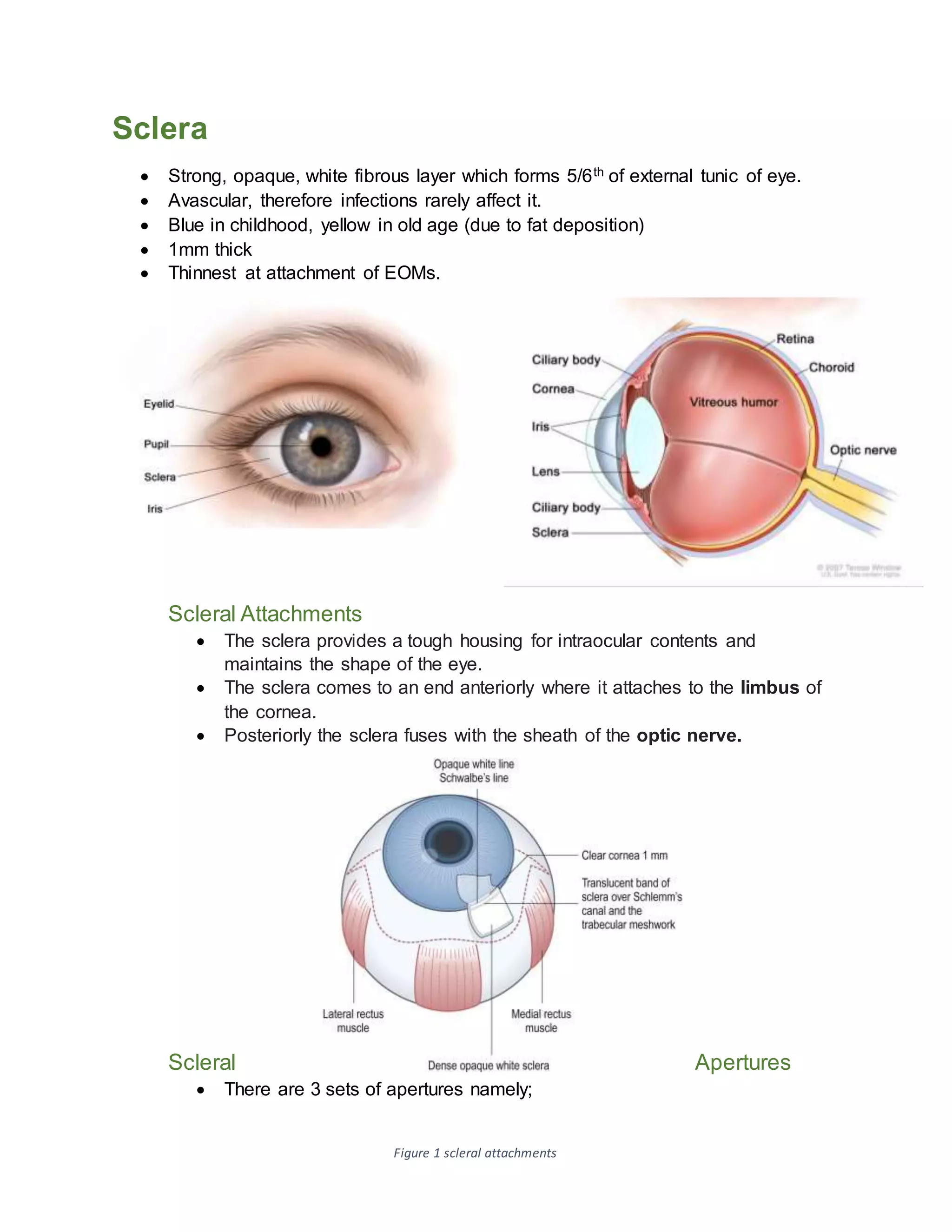
Figure 1 scleral attachments
Sclera
 Strong, opaque, white fibrous layer which forms 5/6th of external tunic of eye.
 Avascular, therefore infections rarely affect it.
 Blue in childhood, yellow in old age (due to fat deposition)
 1mm thick
 Thinnest at attachment of EOMs.
Scleral Attachments
 The sclera provides a tough housing for intraocular contents and
maintains the shape of the eye.
 The sclera comes to an end anteriorly where it attaches to the limbus of
the cornea.
 Posteriorly the sclera fuses with the sheath of the optic nerve.
Scleral Apertures
 There are 3 sets of apertures namely;
1. Anterior
o Anterior ciliary vessels
o Perivascular lymphatics
o Nerves
2. Middle
o Four vena vorticosa exit 4mm behind the equator
3. Posterior
o Optic nerve exit 3mm to the medial side and just above the
posterior pole
o Long and short ciliary vessels and nerves
Figure 2 posterior aspect of right eye
Scleritis Episcleritis
Inflammation of deep scleral tissues Inflammation of subconjunctival
and episcleral tissue
More severe Transient, self-limited
Can occur as anterior (95%) and posterior (5%)
scleritis
benign in nature
Etiology
1. Associated connective tissue diseases
such as,
o Rheumatoid arthritis
o Polychondritis
o Polyarteritis nodosa
2. Associated herpes zoster and gout.
Etiology
o Allergic reaction to
endogenous proteins or
toxin
o Maybe a collagen disease
associated with
Rheumatoid arthritis
o Associated with herpes
zoster and gout.
Types/Classification
1. Anterior scleritis
 Nodular scleritis
 Diffuse scleritis
 Necrotizing scleritis
 With inflammation
 Without inflammation
2. Posterior scleritis
Types
1. Simple diffuse
episcleritis
2. Nodular episcleritis
Incidences
o Women are affected commonly
o Bilateral usually
Incidences
o Common in women
o Bilateral usually
o Peek age incidence is in
4th decade
Pathology
o Extend more deep
o Dense lymphocytic infiltration
Pathology
o Lymphocytic infiltration of
subconjunctival and
episcleral tissue
Symptoms
o Localized redness
o Discomfort
o Mild to moderate pain
Symptoms
o Localized redness in
nodular episcleritis
o Discomfort
o Mild to moderate pain
Signs
o One or more nodules (nodular scleritis)
Signs
o Nodule like lentil situated
2-3mm away from limbus
o Hard, immovable and
tender
o Conjunctiva move freely
over nodule
o Conjunctiva looks purple
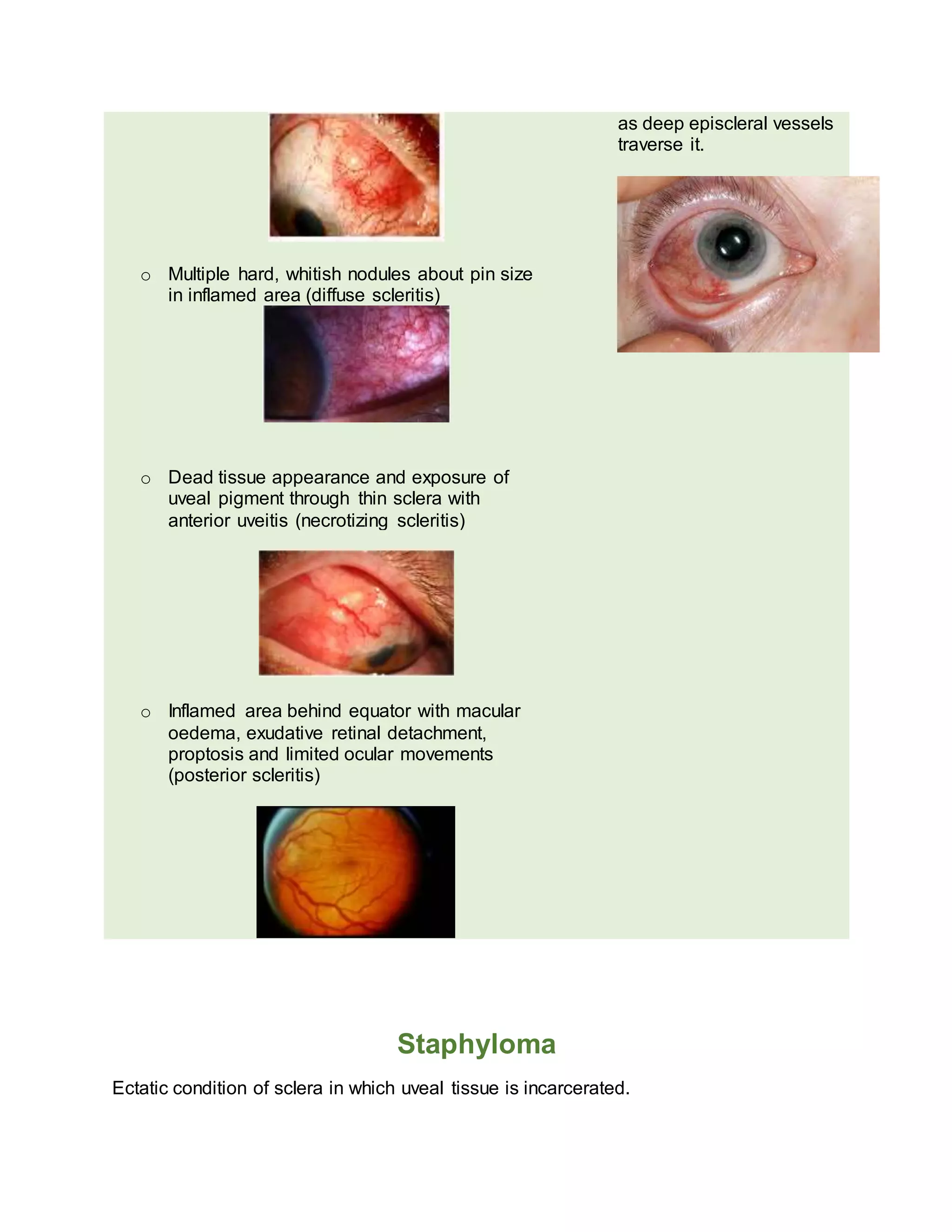
o Multiple hard, whitish nodules about pin size
in inflamed area (diffuse scleritis)
o Dead tissue appearance and exposure of
uveal pigment through thin sclera with
anterior uveitis (necrotizing scleritis)
o Inflamed area behind equator with macular
oedema, exudative retinal detachment,
proptosis and limited ocular movements
(posterior scleritis)
as deep episcleral vessels
traverse it.
Staphyloma
Ectatic condition of sclera in which uveal tissue is incarcerated.
Etiology:
Due to raised intraocular tension, staphylomas are formed due to thinning of sclera
Clinical types:
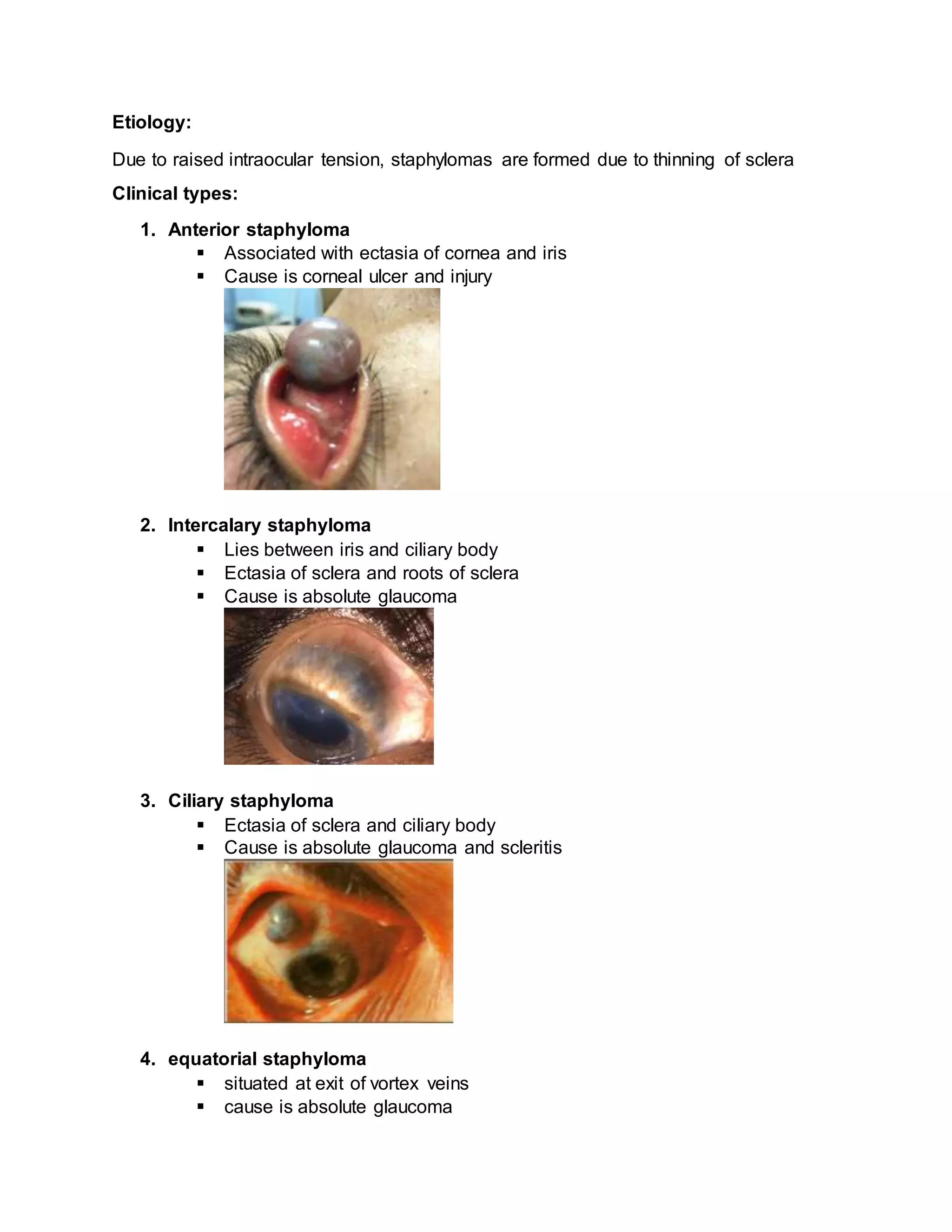
1. Anterior staphyloma
 Associated with ectasia of cornea and iris
 Cause is corneal ulcer and injury
2. Intercalary staphyloma
 Lies between iris and ciliary body
 Ectasia of sclera and roots of sclera
 Cause is absolute glaucoma
3. Ciliary staphyloma
 Ectasia of sclera and ciliary body
 Cause is absolute glaucoma and scleritis
4. equatorial staphyloma
 situated at exit of vortex veins
 cause is absolute glaucoma
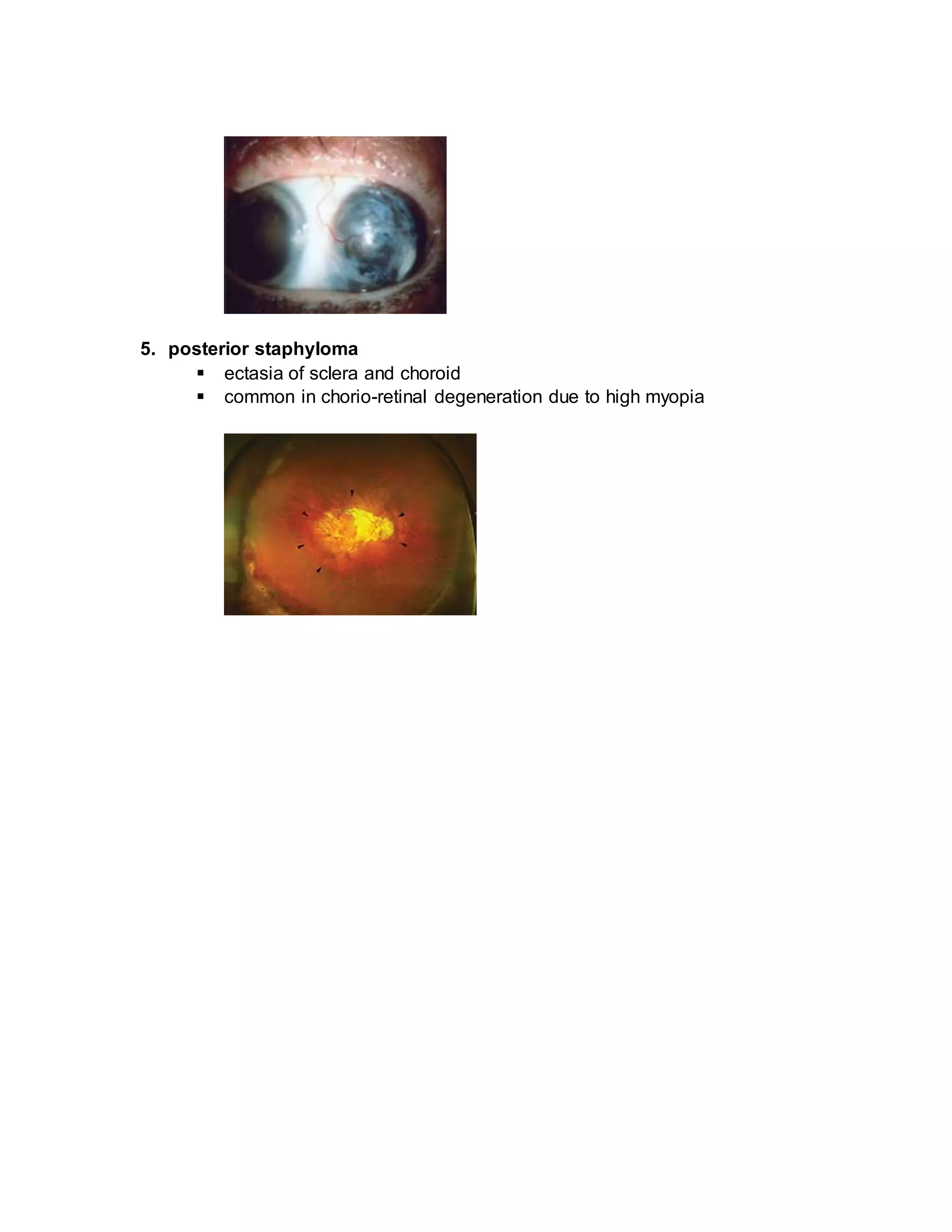
5. posterior staphyloma
 ectasia of sclera and choroid
 common in chorio-retinal degeneration due to high myopia

Sclera (scleritis and episcleritis, staphyloma)

  • 1.
    Maryam Fida Optometryand orthoptics Sclera(scleritis and episcleritis, staphyloma)
  • 2.
    Figure 1 scleralattachments Sclera  Strong, opaque, white fibrous layer which forms 5/6th of external tunic of eye.  Avascular, therefore infections rarely affect it.  Blue in childhood, yellow in old age (due to fat deposition)  1mm thick  Thinnest at attachment of EOMs. Scleral Attachments  The sclera provides a tough housing for intraocular contents and maintains the shape of the eye.  The sclera comes to an end anteriorly where it attaches to the limbus of the cornea.  Posteriorly the sclera fuses with the sheath of the optic nerve. Scleral Apertures  There are 3 sets of apertures namely;
  • 3.
    1. Anterior o Anteriorciliary vessels o Perivascular lymphatics o Nerves 2. Middle o Four vena vorticosa exit 4mm behind the equator 3. Posterior o Optic nerve exit 3mm to the medial side and just above the posterior pole o Long and short ciliary vessels and nerves Figure 2 posterior aspect of right eye Scleritis Episcleritis
  • 4.
    Inflammation of deepscleral tissues Inflammation of subconjunctival and episcleral tissue More severe Transient, self-limited Can occur as anterior (95%) and posterior (5%) scleritis benign in nature Etiology 1. Associated connective tissue diseases such as, o Rheumatoid arthritis o Polychondritis o Polyarteritis nodosa 2. Associated herpes zoster and gout. Etiology o Allergic reaction to endogenous proteins or toxin o Maybe a collagen disease associated with Rheumatoid arthritis o Associated with herpes zoster and gout. Types/Classification 1. Anterior scleritis  Nodular scleritis  Diffuse scleritis  Necrotizing scleritis  With inflammation  Without inflammation 2. Posterior scleritis Types 1. Simple diffuse episcleritis 2. Nodular episcleritis Incidences o Women are affected commonly o Bilateral usually Incidences o Common in women o Bilateral usually o Peek age incidence is in 4th decade Pathology o Extend more deep o Dense lymphocytic infiltration Pathology o Lymphocytic infiltration of subconjunctival and episcleral tissue Symptoms o Localized redness o Discomfort o Mild to moderate pain Symptoms o Localized redness in nodular episcleritis o Discomfort o Mild to moderate pain Signs o One or more nodules (nodular scleritis) Signs o Nodule like lentil situated 2-3mm away from limbus o Hard, immovable and tender o Conjunctiva move freely over nodule o Conjunctiva looks purple
  • 5.
    o Multiple hard,whitish nodules about pin size in inflamed area (diffuse scleritis) o Dead tissue appearance and exposure of uveal pigment through thin sclera with anterior uveitis (necrotizing scleritis) o Inflamed area behind equator with macular oedema, exudative retinal detachment, proptosis and limited ocular movements (posterior scleritis) as deep episcleral vessels traverse it. Staphyloma Ectatic condition of sclera in which uveal tissue is incarcerated.
  • 6.
    Etiology: Due to raisedintraocular tension, staphylomas are formed due to thinning of sclera Clinical types: 1. Anterior staphyloma  Associated with ectasia of cornea and iris  Cause is corneal ulcer and injury 2. Intercalary staphyloma  Lies between iris and ciliary body  Ectasia of sclera and roots of sclera  Cause is absolute glaucoma 3. Ciliary staphyloma  Ectasia of sclera and ciliary body  Cause is absolute glaucoma and scleritis 4. equatorial staphyloma  situated at exit of vortex veins  cause is absolute glaucoma
  • 7.
    5. posterior staphyloma ectasia of sclera and choroid  common in chorio-retinal degeneration due to high myopia