EPISCLERITIS/SCLERITIS
ANATOMY 
• Episclera 
• Scleral stroma 
• Lamina fusca
EPISCLERA 
• Outermost layer ……nutrition to sclera 
• low friction surface 
• Loose connective tissue 
• Rich blood supply -> superficial n deep ant plexus 
posterior episcleral plexus 
• Superficial plexus n Conjunctival vessels mainly involved 
in inflammation…..blanch with topical vasoconstictors
SCLERAL STROMA 
• Dense fibrous tissue intermingled with elastic tissue 
• Complete sphere of 22 mm diameter 
• Irregularly arranged collagen fibers make it opaque n tough 
• Visco elastic structure 
• Biphasic response to deforming force 
brief lengthening (elastic response) 
slow stretching (viscid response)
LAMINA FUSCA 
• Inner most layer 
• Faintly brown due to melanocytes 
• Separates it from external surface of choroid
BLOOD SUPPLY 
• Sclera relatively avascular 
structure 
• Ant ciliary arteries form a 
dense episcleral plexus ant to 
insertions of recti muscles 
• Long & short post ciliary 
arteries supply posterior part 
• Vessels don’t blanch with 
vasoconstrictor
Nerve Supply 
Ciliary nerves 
• pierce sclera around optic nerve 
• short ciliary nerves supply post. portion. 
• two long posterior ciliary nerves supply ant. 
region.
Functions of sclera 
• Protection of intra ocular contents from trauma & 
mechanical displacement. 
• Preservation of shape of eye ball. 
• Maintenance of exact position of different parts of optical 
system 
• Rigid insertion for extra ocular muscles
Ciliary flush / healing of surgical 
incisions 
• Scleral stroma has poor blood supply 
• Episclera has rich blood supply from ant ciliary arteries 
• Normally plexus is inconspicuous 
• But in inflammation involving cornea, iris, ciliary body marked 
vasodilatation may occur in limbal area, known as ciliary flush 
• Rich blood supply  rapid healing of surgical wounds
Nerve supply of sclera / eye pain 
• Profuse sensory innervation 
• Inflammation causes dull aching pain 
• Due to extra ocular muscles insertions into the 
sclera, pain is made worse by ocular movement.
EPISCLERITIS 
It is a common, benign self limiting and 
frequently recurrent disorder which 
typically affects young females 
May be associated with underlying 
disease(10%) 
Can be divided into 
– Simple 
– Nodular
EPISCLERITIS 
– PRESENTATION 
Unilateral redness 
Mild discomfort/ tenderness 
Watering 
Photophobia….may be present
– SIGNS: 
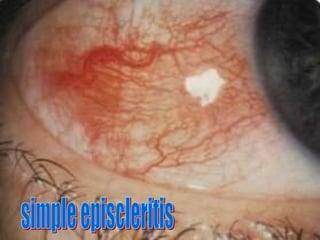
SIMPLE EPISCLERITIS: 
–Commonest type 
–Sectoral /diffuse redness 
–Resolves spontaneously in 1-2 
weeks
EPISCLERITIS 
NODULAR EPISCLERITIS: 
– Localized ,raised ,congested nodule 
– Takes longer time to resolve 
Sclera not swollen 
Sclera appears translucent
Nodular episcleritis
EPISCLERITIS 
TREATMENT: 
– Not always required 
– Reassurance / cold compressions 
– Simple lubricants 
– Topical steroids 
May lead to recurrence 
Frequent intense instillation on short term pulse 
based 
– Oral NSAIDs : 
Flurbiprofen 100 mg t.i.d
SCLERITIS 
It is characterized by edema and 
cellular infiltration of the entire 
thickness of sclera. 
Much less common than episcleritis 
Older age group 
Trivial……….sight threatening 
condition
Causes of Scleritis 
Causes and associations :50% of cases 
1.Autoimmune diseases 
Ankylosing spondylitis. 
Rheumatoid arthritis 
Wegner’s granulomatosis. 
Systemic lupus erythematosis. 
Psoriatic arthritis. 
Ulcerative colitis 
2.Granulomatous diseases 
T.B 
Syphilis 
Sarcoidosis 
Leprosy
Causes of Scleritis 
SURGICALLY INDUCED. 
INFECTIOUS SCLERITIS: 
– Spread of infection from corneal ulcer 
– Trauma 
– Excision of a pterygium or adjunctive 
B irradiation or mitomycin C 
– Causative agents: 
Pseudomonas aeruginosa 
Strep. Pneumoniae 
Stap. Aureus 
Varicella zoster virus
SCLERITIS 
INFECTIOUS SCLERITIS: 
– Spread of infection from corneal ulcer 
– Trauma 
– Excision of a pterygium or adjunctive B 
irradiation or mitomycin C 
– Causative agents: 
Pseudomonas aeruginosa 
Strep. Pneumoniae 
Stap. Aureus 
Varicella zoster virus
SCLERITIS 
Anatomical classification: 
– Anterior scleritis (98%) 
Non-necrotizing (85%) : diffuse or nodular 
Necrotizing (13%) : with or without 
inflammation 
– Posterior scleritis (2%)
ANTERIOR NON-NECROTIZING 
SCLERITIS 
PRESENTATION: 
– Similar to EPISCLERITIS 
– More severe discomfort 
SIGNS: 
– A. DIFFUSE SCLERITIS: 
Relatively benign condition 
Wide spread inflammation 
Involves a sector or entire sclera 
Characteristic distortion of normal radial 
vascular pattern
ANTERIOR NON-NECROTIZING 
SCLERITIS 
NODULAR SCLERITIS: 
– High association with HZO 
– Nodule can’t be moved over 
underlying tissue 
– Intermediate severity 
– 25% cases having visual 
impairment
ANTERIOR NON-NECROTIZING 
SCLERITIS 
TREATMENT: 
– Oral NSAIDS : flurbiprofen 100 mg t.i.d 
meloxicam 7.5 mg t.i.d 
– Oral prednisolone : 40-80 mg daily 
– Combined therapy 
– Subconjunctival steroid injections: 
Triamcinolone acetonide (40mg/ml) 
Only for non-necrotizing type
ANTERIOR NECROTIZING 
SCLERITIS WITH INFLAMMATION 
Most severe and distressing form 
Bilateral in 60% 
Not necessarily simultaneous 
There may be associated vascular 
disease 
Mortality rate of 25% within 5 yrs of 
onset
ANTERIOR NECROTIZING 
SCLERITIS WITH INFLAMMATION 
PRESENTATION: 
– Gradual onset of pain and localized redness 
– Pain becomes severe and persistent and 
radiates to temple ,brow or jaw 
– Frequently interferes with sleep 
– Responds poorly to analgesia
ANTERIOR NECROTIZING 
SCLERITIS WITH INFLAMMATION 
SIGNS: 
Vaso-occlusive : 
 Assosciated with RA 
 Isolated patches of scleral edema with overlying 
non perfused episclera and conjunctiva 
 Patches coalesce….scleral necrosis 
 Granulomatous: 
 Associated with WG n PAN 
 Start from limbus extend posteriorly 
 Within 24 hr involve conjunctiva , episclera , 
sclera
ANTERIOR NON-NECROTIZING 
SCLERITIS WITH INFLAMMATION 
COMPLICATIONS: 
– Staphyloma formation 
– Scleral thinning…….Perforation 
– Kerartitis: acute infiltrative,sclerosing,PUK 
– Anterior uveitis: 
Long standing uveitis may result into 
– Sec. cataract 
– Glaucoma 
– Macular oedema 
Poor prognosis 
High incidence of visual impairment
ANTERIOR NECROTIZING 
SCLERITIS WITH INFLAMMATIN 
TREATMENT 
– Oral prednisolone : 60-120 mg daily for 2- 
3 days 
– Immunosuppresive agents: 
Cyclophosphamide 
Azathioprine 
Cyclosporin 
Combined therapy: 
I/V methyl prednisolone 500-1000 mg + cyclophosphamide 
500mg
ANTERIOR NECROTIZING SCLERITIS 
WITHOUT INFLAMMATION 
Also known as scleromalacia perforans 
In women with long standing rheumatoid arthritis 
Usually bilateral 
SIGNS: 
– Asymptomatic yellow necrotic patches in uninflammed sclera 
– Enlargement ,spread and coalescence 
– Progressive exposure of underlying uvea as a result of scleral 
thinning 
– Staphyloma formation may occur 
– Spontaneous perforation is rare unless IOP is raised 
TREATMNENT is ineffective
POSTERIOR SCLERITIS 
Uncommon, often misdiagnosed 
Affects women twice as often as men 
1/3 rd patients are under 40 yrs of age at 
presentation 
Patients over 50 yrs: at inc. risk of harbouring 
systemic disease and suffering visual loss 
2/3 rd cases have unilateral involvement 
Guarded visual prognosis 
Visual impairment to some degree in 1/3 rd 
cases
POSTERIOR SCLERITIS 
PRESENTATION: 
– Variable 
– Depends upon exact site of involvement 
– Most common symptoms are pain and visual impairment 
SIGNS : 
– EXTERNAL : 
Lid oedema and fullness 
Proptosis and ophthalmoplegia 
Associated ant. Scleritis in 1/3 rd cases
POSTERIOR SCLERITIS 
INTERNAL : 
– Disc swelling 
– Macular oedema 
– Choroidal folds 
– Exudative retinal detachment 
– Ring choroidal detachment 
– Subretinal lipid exudation
POSTERIOR SCLERITIS 
INVESTIGATIONS: 
– ULTRASONOGRAPGHY: 
Thickening of post sclera 
Fluid in Tenon space – “T” sign 
Stem of “T” is formed by optic n. 
Cross bar by gap containing fluid in sub-Tenon 
space 
– CT SCAN: 
Post scleral thickening
POSTERIOR SCLERITIS 
USG / CT FINDINGS 
Thickening of 
posterior sclera
POSTERIOR SCLERITIS 
DIFFERENTIAL DIAGNOSIS: 
OPTIC NEURITIS 
RHEGMATOGENOUS RD 
CHOROIDAL TUMOUR
POSTERIOR SCLERITIS 
TREATMENT: 
– In elderly patients with associated systemic 
disease, as for necrotizing anterior scleritis 
– Young patients without associated systemic 
disease usually respond well to NSAIDs
Episcleritis & scleritis

Episcleritis & scleritis

  • 2.
  • 3.
    ANATOMY • Episclera • Scleral stroma • Lamina fusca
  • 4.
    EPISCLERA • Outermostlayer ……nutrition to sclera • low friction surface • Loose connective tissue • Rich blood supply -> superficial n deep ant plexus posterior episcleral plexus • Superficial plexus n Conjunctival vessels mainly involved in inflammation…..blanch with topical vasoconstictors
  • 5.
    SCLERAL STROMA •Dense fibrous tissue intermingled with elastic tissue • Complete sphere of 22 mm diameter • Irregularly arranged collagen fibers make it opaque n tough • Visco elastic structure • Biphasic response to deforming force brief lengthening (elastic response) slow stretching (viscid response)
  • 6.
    LAMINA FUSCA •Inner most layer • Faintly brown due to melanocytes • Separates it from external surface of choroid
  • 7.
    BLOOD SUPPLY •Sclera relatively avascular structure • Ant ciliary arteries form a dense episcleral plexus ant to insertions of recti muscles • Long & short post ciliary arteries supply posterior part • Vessels don’t blanch with vasoconstrictor
  • 8.
    Nerve Supply Ciliarynerves • pierce sclera around optic nerve • short ciliary nerves supply post. portion. • two long posterior ciliary nerves supply ant. region.
  • 9.
    Functions of sclera • Protection of intra ocular contents from trauma & mechanical displacement. • Preservation of shape of eye ball. • Maintenance of exact position of different parts of optical system • Rigid insertion for extra ocular muscles
  • 10.
    Ciliary flush /healing of surgical incisions • Scleral stroma has poor blood supply • Episclera has rich blood supply from ant ciliary arteries • Normally plexus is inconspicuous • But in inflammation involving cornea, iris, ciliary body marked vasodilatation may occur in limbal area, known as ciliary flush • Rich blood supply  rapid healing of surgical wounds
  • 11.
    Nerve supply ofsclera / eye pain • Profuse sensory innervation • Inflammation causes dull aching pain • Due to extra ocular muscles insertions into the sclera, pain is made worse by ocular movement.
  • 12.
    EPISCLERITIS It isa common, benign self limiting and frequently recurrent disorder which typically affects young females May be associated with underlying disease(10%) Can be divided into – Simple – Nodular
  • 13.
    EPISCLERITIS – PRESENTATION Unilateral redness Mild discomfort/ tenderness Watering Photophobia….may be present
  • 14.
    – SIGNS: SIMPLEEPISCLERITIS: –Commonest type –Sectoral /diffuse redness –Resolves spontaneously in 1-2 weeks
  • 17.
    EPISCLERITIS NODULAR EPISCLERITIS: – Localized ,raised ,congested nodule – Takes longer time to resolve Sclera not swollen Sclera appears translucent
  • 18.
  • 20.
    EPISCLERITIS TREATMENT: –Not always required – Reassurance / cold compressions – Simple lubricants – Topical steroids May lead to recurrence Frequent intense instillation on short term pulse based – Oral NSAIDs : Flurbiprofen 100 mg t.i.d
  • 21.
    SCLERITIS It ischaracterized by edema and cellular infiltration of the entire thickness of sclera. Much less common than episcleritis Older age group Trivial……….sight threatening condition
  • 22.
    Causes of Scleritis Causes and associations :50% of cases 1.Autoimmune diseases Ankylosing spondylitis. Rheumatoid arthritis Wegner’s granulomatosis. Systemic lupus erythematosis. Psoriatic arthritis. Ulcerative colitis 2.Granulomatous diseases T.B Syphilis Sarcoidosis Leprosy
  • 23.
    Causes of Scleritis SURGICALLY INDUCED. INFECTIOUS SCLERITIS: – Spread of infection from corneal ulcer – Trauma – Excision of a pterygium or adjunctive B irradiation or mitomycin C – Causative agents: Pseudomonas aeruginosa Strep. Pneumoniae Stap. Aureus Varicella zoster virus
  • 24.
    SCLERITIS INFECTIOUS SCLERITIS: – Spread of infection from corneal ulcer – Trauma – Excision of a pterygium or adjunctive B irradiation or mitomycin C – Causative agents: Pseudomonas aeruginosa Strep. Pneumoniae Stap. Aureus Varicella zoster virus
  • 25.
    SCLERITIS Anatomical classification: – Anterior scleritis (98%) Non-necrotizing (85%) : diffuse or nodular Necrotizing (13%) : with or without inflammation – Posterior scleritis (2%)
  • 26.
    ANTERIOR NON-NECROTIZING SCLERITIS PRESENTATION: – Similar to EPISCLERITIS – More severe discomfort SIGNS: – A. DIFFUSE SCLERITIS: Relatively benign condition Wide spread inflammation Involves a sector or entire sclera Characteristic distortion of normal radial vascular pattern
  • 27.
    ANTERIOR NON-NECROTIZING SCLERITIS NODULAR SCLERITIS: – High association with HZO – Nodule can’t be moved over underlying tissue – Intermediate severity – 25% cases having visual impairment
  • 28.
    ANTERIOR NON-NECROTIZING SCLERITIS TREATMENT: – Oral NSAIDS : flurbiprofen 100 mg t.i.d meloxicam 7.5 mg t.i.d – Oral prednisolone : 40-80 mg daily – Combined therapy – Subconjunctival steroid injections: Triamcinolone acetonide (40mg/ml) Only for non-necrotizing type
  • 29.
    ANTERIOR NECROTIZING SCLERITISWITH INFLAMMATION Most severe and distressing form Bilateral in 60% Not necessarily simultaneous There may be associated vascular disease Mortality rate of 25% within 5 yrs of onset
  • 30.
    ANTERIOR NECROTIZING SCLERITISWITH INFLAMMATION PRESENTATION: – Gradual onset of pain and localized redness – Pain becomes severe and persistent and radiates to temple ,brow or jaw – Frequently interferes with sleep – Responds poorly to analgesia
  • 31.
    ANTERIOR NECROTIZING SCLERITISWITH INFLAMMATION SIGNS: Vaso-occlusive :  Assosciated with RA  Isolated patches of scleral edema with overlying non perfused episclera and conjunctiva  Patches coalesce….scleral necrosis  Granulomatous:  Associated with WG n PAN  Start from limbus extend posteriorly  Within 24 hr involve conjunctiva , episclera , sclera
  • 33.
    ANTERIOR NON-NECROTIZING SCLERITISWITH INFLAMMATION COMPLICATIONS: – Staphyloma formation – Scleral thinning…….Perforation – Kerartitis: acute infiltrative,sclerosing,PUK – Anterior uveitis: Long standing uveitis may result into – Sec. cataract – Glaucoma – Macular oedema Poor prognosis High incidence of visual impairment
  • 34.
    ANTERIOR NECROTIZING SCLERITISWITH INFLAMMATIN TREATMENT – Oral prednisolone : 60-120 mg daily for 2- 3 days – Immunosuppresive agents: Cyclophosphamide Azathioprine Cyclosporin Combined therapy: I/V methyl prednisolone 500-1000 mg + cyclophosphamide 500mg
  • 35.
    ANTERIOR NECROTIZING SCLERITIS WITHOUT INFLAMMATION Also known as scleromalacia perforans In women with long standing rheumatoid arthritis Usually bilateral SIGNS: – Asymptomatic yellow necrotic patches in uninflammed sclera – Enlargement ,spread and coalescence – Progressive exposure of underlying uvea as a result of scleral thinning – Staphyloma formation may occur – Spontaneous perforation is rare unless IOP is raised TREATMNENT is ineffective
  • 37.
    POSTERIOR SCLERITIS Uncommon,often misdiagnosed Affects women twice as often as men 1/3 rd patients are under 40 yrs of age at presentation Patients over 50 yrs: at inc. risk of harbouring systemic disease and suffering visual loss 2/3 rd cases have unilateral involvement Guarded visual prognosis Visual impairment to some degree in 1/3 rd cases
  • 38.
    POSTERIOR SCLERITIS PRESENTATION: – Variable – Depends upon exact site of involvement – Most common symptoms are pain and visual impairment SIGNS : – EXTERNAL : Lid oedema and fullness Proptosis and ophthalmoplegia Associated ant. Scleritis in 1/3 rd cases
  • 39.
    POSTERIOR SCLERITIS INTERNAL: – Disc swelling – Macular oedema – Choroidal folds – Exudative retinal detachment – Ring choroidal detachment – Subretinal lipid exudation
  • 40.
    POSTERIOR SCLERITIS INVESTIGATIONS: – ULTRASONOGRAPGHY: Thickening of post sclera Fluid in Tenon space – “T” sign Stem of “T” is formed by optic n. Cross bar by gap containing fluid in sub-Tenon space – CT SCAN: Post scleral thickening
  • 41.
    POSTERIOR SCLERITIS USG/ CT FINDINGS Thickening of posterior sclera
  • 42.
    POSTERIOR SCLERITIS DIFFERENTIALDIAGNOSIS: OPTIC NEURITIS RHEGMATOGENOUS RD CHOROIDAL TUMOUR
  • 43.
    POSTERIOR SCLERITIS TREATMENT: – In elderly patients with associated systemic disease, as for necrotizing anterior scleritis – Young patients without associated systemic disease usually respond well to NSAIDs