Inflammation of the sclera
By
Anam
Sehreen
Doctor of
Optometry
Layers of Sclera
Consists of 3 layers
• Episclera
• Scleral stroma
• Lamina fusca
Inflammations of the sclera
There are two types of inflammations of the
sclera:
1. Episcleritis (superficial)
2. Scleritis (deep)
Episcleritis
• An inflammation of the subconjunctival and episcleral
tissues involving the overlying Tenon's capsule but not the
underlying sclera is known as episcleritis.
• It is a common, benign in nature, self limiting and
frequently recurrent disorder which typically affects
young adults, being twice as common in women than
men.
• Can be divided into
 Simple diffuse episcleritis
 Nodular episcleritis
Presentation (Symptoms)
• A localized redness is seen over sclera in nodular
episcleritis
• Mild ocular discomfort/tenderness such as gritty,
burning or foreign body sensation.
• Mild to moderate pain is present
• Mild photophobia.....may be present
• Watering
Signs
On examination two clinical types of episcleritis, diffuse and
nodular may be identified.
Simple Diffuse Episcleritis:
• Common type
• Although whole eye may be involved, the maximum
inflammation is confined to one or two quadrants
• Sectoral/diffuse redness
• Resolve spontaneously in 1-2 weeks
Signs
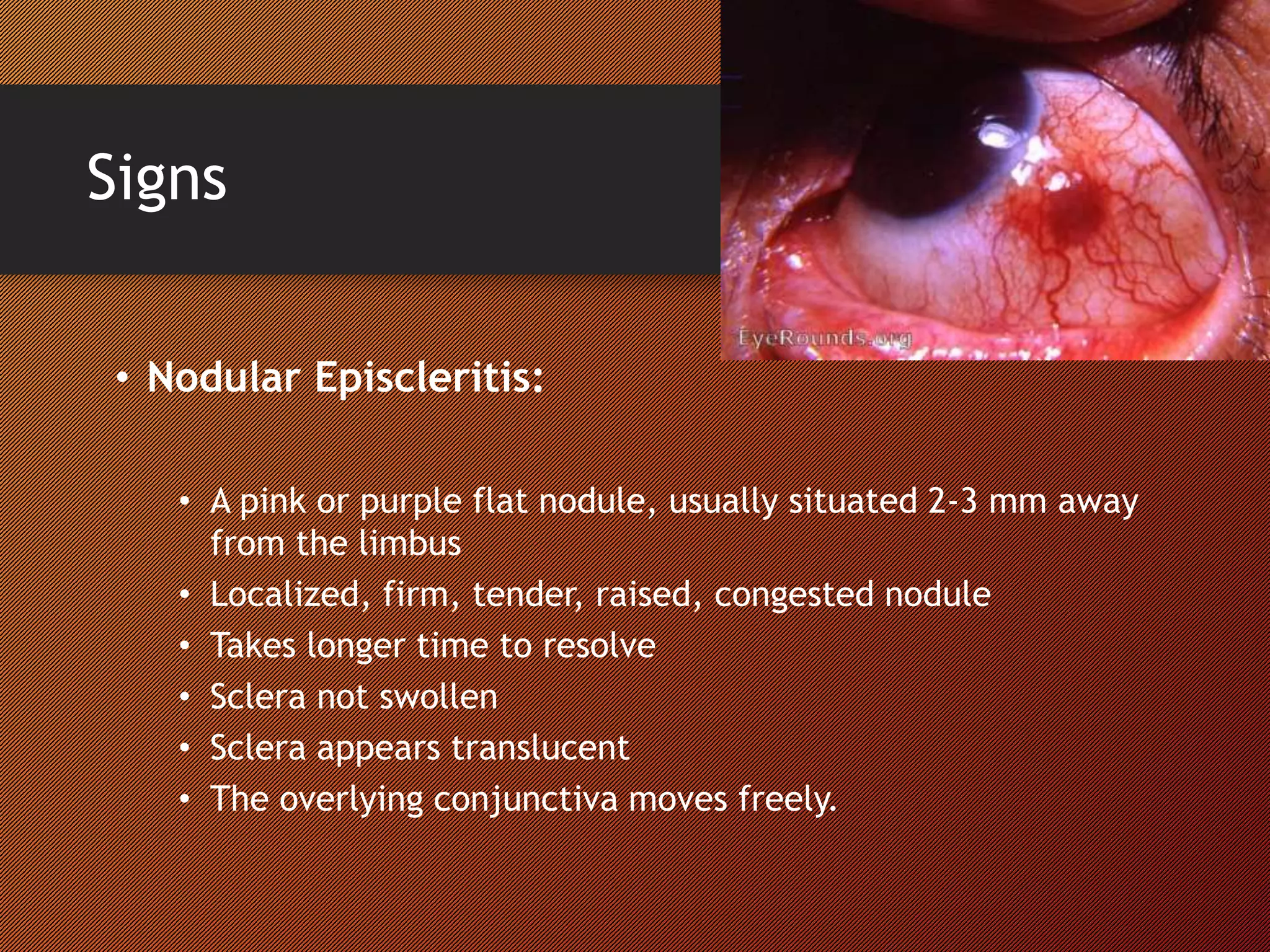
• Nodular Episcleritis:
• A pink or purple flat nodule, usually situated 2-3 mm away
from the limbus
• Localized, firm, tender, raised, congested nodule
• Takes longer time to resolve
• Sclera not swollen
• Sclera appears translucent
• The overlying conjunctiva moves freely.
Etiology
• It is an allergic (hypersensitivity) reaction to
endogenous protein, tubercular or streptococcal
toxin.
• It may be a collagen disease as history of
rheumatoid arthritis is often associated.
• It can be associated with prior episodes of
herpes zoster, gout, rosacea and psoriasis.
Pathology
• Histologically, there occurs localised lymphocytic
infiltration of subconjunctival and episcleral
tissue associated with oedema and congestion of
overlying Tenon's capsule and conjunctiva.
Differential diagnosis
Occasionally episcleritis may be confused with:
• Inflamed pinguecula
• Swelling and congestion due to foreign body
lodged in bulbar conjunctiva
• Very rarely scleritis
Complications
• Severe neuralgia may occur due to nerve
involvement.
• Scleritis results from deeper infiltration of
inflammation.
• There may be associated uveitis
Treatment
• Not always required because episcleritis runs a limited course of 10
days to 3 weeks and resolves spontaneously.
• Cold compressions: Cold compresses applied to the closed lids may
offer symptomatic relief from ocular discomfort.
• Simple lubricants
• Topical steroids: Topical corticosteroid eyedrops and ointment
instilled 2-3 hourly, render the eye more comfortable and resolve the
episcleritis within a few days.
• Oral/Systemic NSAIDs: NSAIDs e.g., flurbiprofen (300 mg OD),
indomethacin (25 mg 3 times a day), or oxyphenbutazone may be
used in recurrent cases to relieve pain and control inflammation.
Scleritis
• An inflammation of the deep scleral tissue is known
as scleritis. It is characterized by edema and
cellular infiltration of the entire thickness of sclera.
• Sight threatening condition and even loss of the eye
if treated inadequately.
Incidence
• Its incidence is much less common than that of
episcleritis
• It usually occurs in elderly patients (40-70 years)
involving females more than the males.
Causes/etiology of scleritis
It is found in association with multiple conditions which are as follows:
•Autoimune collagen diseases
 Rheumatoid arthritis, a most common association. 5% cases of scleritis are
associated with connective tissue disease. About 0.5% of patients (1 in 200)
suffering from seropositive RA develop scleritis. Other associated collagen
disorders are:
 Wegener's granulomatosis
 Polyarteritis nodosa (PAN)
 Systemic lupus erythematosus (SLE)
 Ankylosing spondylitis
 Dermatomyositis
Etiology
• Metabolic disorders
Like gout and thyrotoxicosis can also associated with scleritis.
• Infectious scleritis
Particularly herpes zoster ophthalmicus, chronic staphylococcal
and streptococcal infection can also cause scleritis.
Spread of infection from corneal ulcer
• Granulomatous diseases
Like tuberculosis, syphilis, sarcoidosis, leprosy can also cause
scleritis.
Etiology
• Miscellaneous conditions
Like irradiation, chemical burns, Vogt-Koyanagi-Harada
syndrome, Behcet's disease and rosacea.
• Surgically induced
 Surgically induced scleritis follows ocular surgery. It occurs within 6
month postoperatively. E.g. excision of pterygium
• Idiopathic
• Trauma
Pathology
• Histopathological changes such as a chronic granulomatous
disorder characterised by fibrinoid necrosis, destruction of
collagen together with dense infiltration by polymorphonuclear
cells, lymphocytes, plasma cells and macrophages of the sclera.
• The granuloma is surrounded by multinucleated epithelioid
giant cells and old and new vessels, some of which may show
evidence of vasculitis.
Classification
Scleritis is classified into two main forms as follows:
• 1. Anterior scleritis (98%)
 Non-necrotizing scleritis (85%)
• (a) Diffuse
• (b) Nodular
 Necrotizing scleritis (13%)
• (a) with inflammation
• (b) without inflammation (scleromalacia perforans)
• 2. Posterior scleritis (2%)
Anterior scleritis
• Most severe and distressing form
• Gradual onset of pain and localized redness
• Frequently interferes with sleep
• Respond poorly to analgesia
• Bilateral in 60%
Anterior scleritis
Signs
• Granulomatous
• Scleral thinning
• High incidence of visual impairment
Treatment
• Oral and IV steroids
• Oral NSAIDs
• Subconjunctival steroid injections
Posterior scleritis
• Uncommon, Often
misdiagnosed
• Visual impairment
to some degree in
1/3rd cases
Posterior scleritis
• Symptoms
• Most common symptoms are pain and visual impairment
• Signs
• Lid oedema
• Proptosis
• Associated anterior scleritis
• Disc swelling
• Macular oedema and exudative RD
Treatment: NSAIDs
Clinical features of scleritis
Symptoms
• Patients complain of moderate to severe pain which is deep and
often wakes the patient early in the morning.
• Ocular pain radiates to the jaw and temple.
• It is associated with localised or diffuse redness, a localized
redness is seen in the deep scleral tissue in nodular scleritis.
• Occasionally there occurs diminution of vision
• Mild to severe photophobia
• Lacrimation
Clinical features of scleritis
Signs
• The salient features of different clinical types of scleritis are as
follows:
1. Non-necrotizing anterior diffuse scleritis
• A commonest variety
• Multiple hard, whitish nodules, about the size of pin-head develop in
the inflamed area of the sclera.
• A widespread inflammation involving a quadrant or more of the
anterior sclera.
• The involved area is raised and salmon pink to purple in colour.
Non-necrotizing anterior
diffuse scleritis
Signs
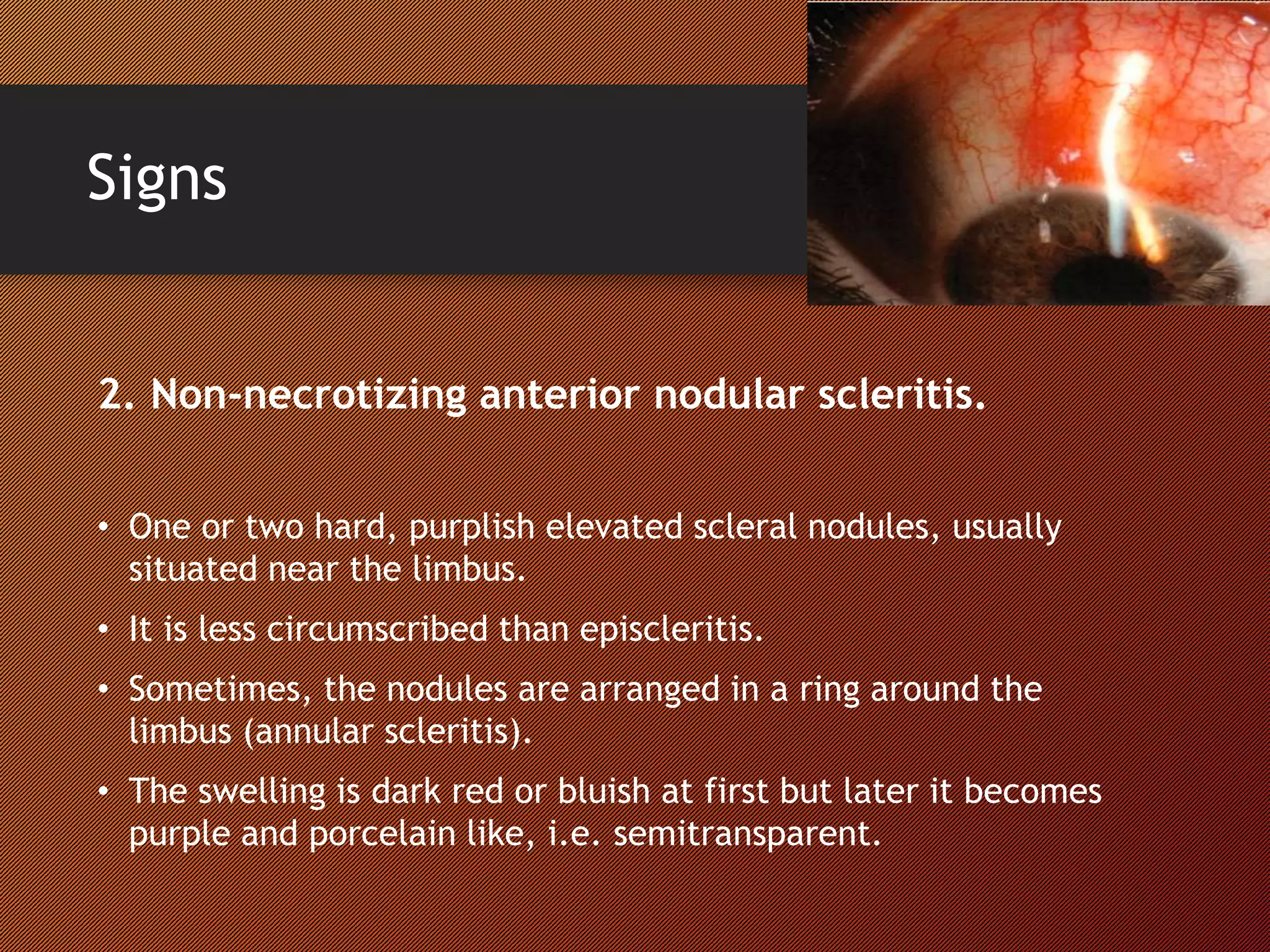
2. Non-necrotizing anterior nodular scleritis.
• One or two hard, purplish elevated scleral nodules, usually
situated near the limbus.
• It is less circumscribed than episcleritis.
• Sometimes, the nodules are arranged in a ring around the
limbus (annular scleritis).
• The swelling is dark red or bluish at first but later it becomes
purple and porcelain like, i.e. semitransparent.
Signs
3. Anterior necrotizing scleritis with inflammation
• An acute severe and serious form of scleritis
• An intense localised inflammation associated with areas of
infarction due to vasculitis.
• The affected necrosed area is thinned out and sclera becomes
transparent and ectatic with uveal tissue shining through a
markedly thin sclera.
• It is usually associated with anterior uveitis.
Signs
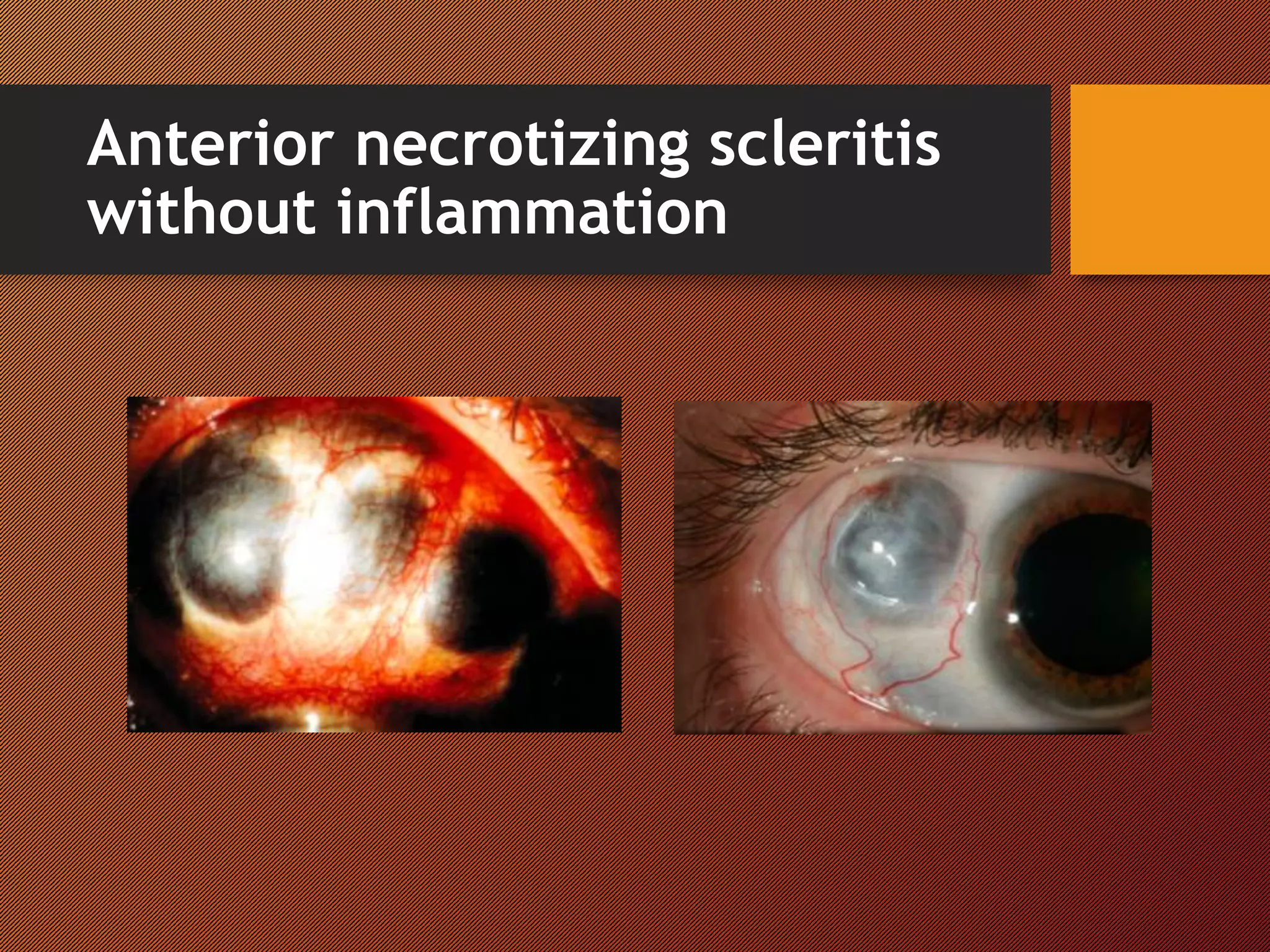
4. Anterior necrotizing scleritis without inflammation
• Occurs in elderly females suffering from long-standing RA.
• There is a yellowish patch of melting sclera (due to obliteration
of arterial supply) along with the overlying episcleral.
• Conjunctiva completely separates from the surrounding normal
sclera.
• This sequestrum of sclera becomes dead white in colour, which
eventually absorbs leaving behind it a large punched out area of
thin sclera through which the uveal tissue shines.
Anterior necrotizing scleritis
without inflammation
Signs
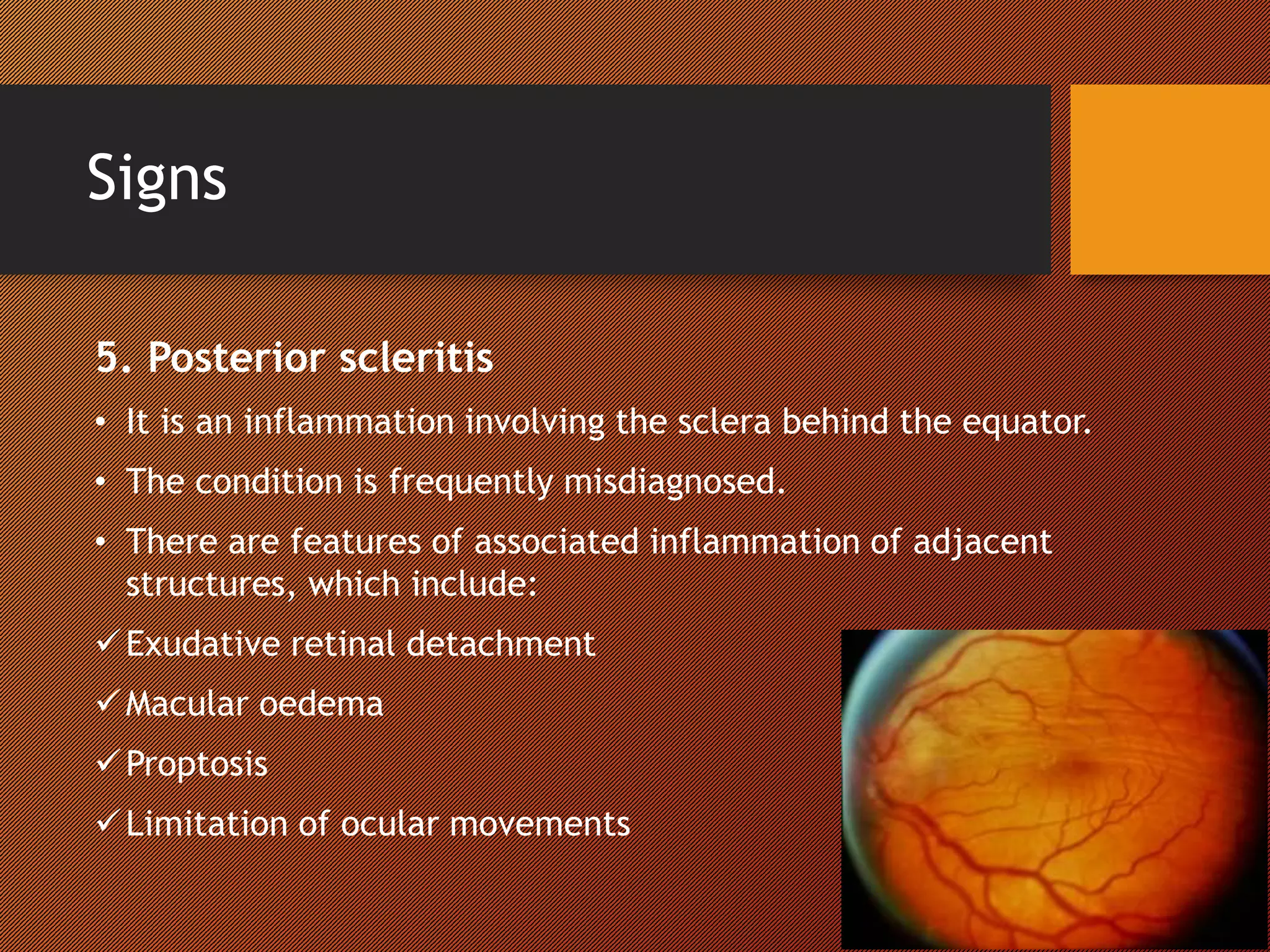
5. Posterior scleritis
• It is an inflammation involving the sclera behind the equator.
• The condition is frequently misdiagnosed.
• There are features of associated inflammation of adjacent
structures, which include:
Exudative retinal detachment
Macular oedema
Proptosis
Limitation of ocular movements
Investigations
Following laboratory studies may help to identify associated
systemic diseases or to establish the nature of immunologic
reaction:
• CBC and WBC count
• Erythrocyte sedimentation rate (ESR)
• Serologic tests for syphilis such as FTA - ABS, VDRL
• Rheumatoid factor, antinuclear factor, plasma protein and
immunoglobulin level
• FA of anterior or posterior segment for evidence of vasculitis.
Investigation
• Serum levels of complement (C3) and L.E cells for an
immunological survey
• X-rays of chest, paranasal sinuses, sacroiliac joint, hand,
feet, lumbosacral spine, and orbit to rule out foreign body
especially in patients with nodular scleritis
• Serum uric acid for gout
• Urine analysis
• Mantoux test
Complications
• Iritis, cyclitis, anterior choroiditis occur commonly
• Annular scleritis: A ring-shaped involvement of the sclera
• Corneal changes: 4 patterns of corneal involvement
• Ciliary staphyloma: due to scleral thinning
• Diffuse stromal keratitis: Opacities occur with immune ring
pattern and keratic precipitate in the corneal stroma
• Sclerosing stromal keratitis: Oedema and infiltration of the
stroma occur with vascularization and scarring
• Deep keratitis: White opaque sheets of infiltration occur at the
level of the Descemet’s membrane
Complications
• Limbal guttering and keratolysis: Limbal gutter can progress to
ectasia and melting of the stroma may occur.
• Secondary glaucoma: due to uveitis or associated trabeculitis
• Scleromalacia perforans: a necrotizing scleritis without
inflammation and exposure of the uvea but no pain
• Massive granuloma of the sclera
 A proliferation of chronic inflammatory cells
 The ‘Brawny scleritis’ is seen in the anterior segment of eye
 The sclera thickens and resembles tumour mass when posterior
segment is involved
Treatment
Non-necrotising scleritis
• Treated by topical steroid E/D and systemic indomethacin 100 mg
daily for a day and then 75 mg daily until inflammation resolves.
Necrotising scleritis
• Treated by topical steroids and heavy doses of oral steroids
tapered slowly.
• In non-responsive cases, immuno-suppressive agents like
methotrexate or cyclophos-phamide may be required.
• Subconjunctival steroids are contraindicated because they may
lead to scleral thinning and perforation.
Treatment
I. Medical therapy: first line of defense
• Local: Corticosteroids
• General
 Systemic corticosteroids
 Analgesics and anti-inflammatory drugs relieve pain and suppress
inflammation
 Cytotoxic immunosuppressive drugs, e.g. cyclophosphamide
Treatment
II. Surgical treatment
• Extreme scleral thinning or perforation requires reinforcement.
Donor sclera or cornea may be used but they usually swell with
oedema and soften. Fascia lata or periosteum is more resistant
to the melting process. All grafts must be covered with
conjunctiva to maintain their integrity.
• Extreme corneal marginal ulceration or keratolysis may require
corneal grafting usually as lamellar graft.
Episcleritis  and scleritis.ppt

Episcleritis and scleritis.ppt

  • 2.
    Inflammation of thesclera By Anam Sehreen Doctor of Optometry
  • 3.
    Layers of Sclera Consistsof 3 layers • Episclera • Scleral stroma • Lamina fusca
  • 4.
    Inflammations of thesclera There are two types of inflammations of the sclera: 1. Episcleritis (superficial) 2. Scleritis (deep)
  • 5.
    Episcleritis • An inflammationof the subconjunctival and episcleral tissues involving the overlying Tenon's capsule but not the underlying sclera is known as episcleritis. • It is a common, benign in nature, self limiting and frequently recurrent disorder which typically affects young adults, being twice as common in women than men. • Can be divided into  Simple diffuse episcleritis  Nodular episcleritis
  • 6.
    Presentation (Symptoms) • Alocalized redness is seen over sclera in nodular episcleritis • Mild ocular discomfort/tenderness such as gritty, burning or foreign body sensation. • Mild to moderate pain is present • Mild photophobia.....may be present • Watering
  • 7.
    Signs On examination twoclinical types of episcleritis, diffuse and nodular may be identified. Simple Diffuse Episcleritis: • Common type • Although whole eye may be involved, the maximum inflammation is confined to one or two quadrants • Sectoral/diffuse redness • Resolve spontaneously in 1-2 weeks
  • 8.
    Signs • Nodular Episcleritis: •A pink or purple flat nodule, usually situated 2-3 mm away from the limbus • Localized, firm, tender, raised, congested nodule • Takes longer time to resolve • Sclera not swollen • Sclera appears translucent • The overlying conjunctiva moves freely.
  • 9.
    Etiology • It isan allergic (hypersensitivity) reaction to endogenous protein, tubercular or streptococcal toxin. • It may be a collagen disease as history of rheumatoid arthritis is often associated. • It can be associated with prior episodes of herpes zoster, gout, rosacea and psoriasis.
  • 10.
    Pathology • Histologically, thereoccurs localised lymphocytic infiltration of subconjunctival and episcleral tissue associated with oedema and congestion of overlying Tenon's capsule and conjunctiva.
  • 11.
    Differential diagnosis Occasionally episcleritismay be confused with: • Inflamed pinguecula • Swelling and congestion due to foreign body lodged in bulbar conjunctiva • Very rarely scleritis
  • 12.
    Complications • Severe neuralgiamay occur due to nerve involvement. • Scleritis results from deeper infiltration of inflammation. • There may be associated uveitis
  • 13.
    Treatment • Not alwaysrequired because episcleritis runs a limited course of 10 days to 3 weeks and resolves spontaneously. • Cold compressions: Cold compresses applied to the closed lids may offer symptomatic relief from ocular discomfort. • Simple lubricants • Topical steroids: Topical corticosteroid eyedrops and ointment instilled 2-3 hourly, render the eye more comfortable and resolve the episcleritis within a few days. • Oral/Systemic NSAIDs: NSAIDs e.g., flurbiprofen (300 mg OD), indomethacin (25 mg 3 times a day), or oxyphenbutazone may be used in recurrent cases to relieve pain and control inflammation.
  • 14.
    Scleritis • An inflammationof the deep scleral tissue is known as scleritis. It is characterized by edema and cellular infiltration of the entire thickness of sclera. • Sight threatening condition and even loss of the eye if treated inadequately.
  • 15.
    Incidence • Its incidenceis much less common than that of episcleritis • It usually occurs in elderly patients (40-70 years) involving females more than the males.
  • 16.
    Causes/etiology of scleritis Itis found in association with multiple conditions which are as follows: •Autoimune collagen diseases  Rheumatoid arthritis, a most common association. 5% cases of scleritis are associated with connective tissue disease. About 0.5% of patients (1 in 200) suffering from seropositive RA develop scleritis. Other associated collagen disorders are:  Wegener's granulomatosis  Polyarteritis nodosa (PAN)  Systemic lupus erythematosus (SLE)  Ankylosing spondylitis  Dermatomyositis
  • 17.
    Etiology • Metabolic disorders Likegout and thyrotoxicosis can also associated with scleritis. • Infectious scleritis Particularly herpes zoster ophthalmicus, chronic staphylococcal and streptococcal infection can also cause scleritis. Spread of infection from corneal ulcer • Granulomatous diseases Like tuberculosis, syphilis, sarcoidosis, leprosy can also cause scleritis.
  • 18.
    Etiology • Miscellaneous conditions Likeirradiation, chemical burns, Vogt-Koyanagi-Harada syndrome, Behcet's disease and rosacea. • Surgically induced  Surgically induced scleritis follows ocular surgery. It occurs within 6 month postoperatively. E.g. excision of pterygium • Idiopathic • Trauma
  • 19.
    Pathology • Histopathological changessuch as a chronic granulomatous disorder characterised by fibrinoid necrosis, destruction of collagen together with dense infiltration by polymorphonuclear cells, lymphocytes, plasma cells and macrophages of the sclera. • The granuloma is surrounded by multinucleated epithelioid giant cells and old and new vessels, some of which may show evidence of vasculitis.
  • 20.
    Classification Scleritis is classifiedinto two main forms as follows: • 1. Anterior scleritis (98%)  Non-necrotizing scleritis (85%) • (a) Diffuse • (b) Nodular  Necrotizing scleritis (13%) • (a) with inflammation • (b) without inflammation (scleromalacia perforans) • 2. Posterior scleritis (2%)
  • 21.
    Anterior scleritis • Mostsevere and distressing form • Gradual onset of pain and localized redness • Frequently interferes with sleep • Respond poorly to analgesia • Bilateral in 60%
  • 22.
    Anterior scleritis Signs • Granulomatous •Scleral thinning • High incidence of visual impairment Treatment • Oral and IV steroids • Oral NSAIDs • Subconjunctival steroid injections
  • 23.
    Posterior scleritis • Uncommon,Often misdiagnosed • Visual impairment to some degree in 1/3rd cases
  • 24.
    Posterior scleritis • Symptoms •Most common symptoms are pain and visual impairment • Signs • Lid oedema • Proptosis • Associated anterior scleritis • Disc swelling • Macular oedema and exudative RD Treatment: NSAIDs
  • 25.
    Clinical features ofscleritis Symptoms • Patients complain of moderate to severe pain which is deep and often wakes the patient early in the morning. • Ocular pain radiates to the jaw and temple. • It is associated with localised or diffuse redness, a localized redness is seen in the deep scleral tissue in nodular scleritis. • Occasionally there occurs diminution of vision • Mild to severe photophobia • Lacrimation
  • 26.
    Clinical features ofscleritis Signs • The salient features of different clinical types of scleritis are as follows: 1. Non-necrotizing anterior diffuse scleritis • A commonest variety • Multiple hard, whitish nodules, about the size of pin-head develop in the inflamed area of the sclera. • A widespread inflammation involving a quadrant or more of the anterior sclera. • The involved area is raised and salmon pink to purple in colour.
  • 27.
  • 28.
    Signs 2. Non-necrotizing anteriornodular scleritis. • One or two hard, purplish elevated scleral nodules, usually situated near the limbus. • It is less circumscribed than episcleritis. • Sometimes, the nodules are arranged in a ring around the limbus (annular scleritis). • The swelling is dark red or bluish at first but later it becomes purple and porcelain like, i.e. semitransparent.
  • 29.
    Signs 3. Anterior necrotizingscleritis with inflammation • An acute severe and serious form of scleritis • An intense localised inflammation associated with areas of infarction due to vasculitis. • The affected necrosed area is thinned out and sclera becomes transparent and ectatic with uveal tissue shining through a markedly thin sclera. • It is usually associated with anterior uveitis.
  • 30.
    Signs 4. Anterior necrotizingscleritis without inflammation • Occurs in elderly females suffering from long-standing RA. • There is a yellowish patch of melting sclera (due to obliteration of arterial supply) along with the overlying episcleral. • Conjunctiva completely separates from the surrounding normal sclera. • This sequestrum of sclera becomes dead white in colour, which eventually absorbs leaving behind it a large punched out area of thin sclera through which the uveal tissue shines.
  • 31.
  • 32.
    Signs 5. Posterior scleritis •It is an inflammation involving the sclera behind the equator. • The condition is frequently misdiagnosed. • There are features of associated inflammation of adjacent structures, which include: Exudative retinal detachment Macular oedema Proptosis Limitation of ocular movements
  • 33.
    Investigations Following laboratory studiesmay help to identify associated systemic diseases or to establish the nature of immunologic reaction: • CBC and WBC count • Erythrocyte sedimentation rate (ESR) • Serologic tests for syphilis such as FTA - ABS, VDRL • Rheumatoid factor, antinuclear factor, plasma protein and immunoglobulin level • FA of anterior or posterior segment for evidence of vasculitis.
  • 34.
    Investigation • Serum levelsof complement (C3) and L.E cells for an immunological survey • X-rays of chest, paranasal sinuses, sacroiliac joint, hand, feet, lumbosacral spine, and orbit to rule out foreign body especially in patients with nodular scleritis • Serum uric acid for gout • Urine analysis • Mantoux test
  • 35.
    Complications • Iritis, cyclitis,anterior choroiditis occur commonly • Annular scleritis: A ring-shaped involvement of the sclera • Corneal changes: 4 patterns of corneal involvement • Ciliary staphyloma: due to scleral thinning • Diffuse stromal keratitis: Opacities occur with immune ring pattern and keratic precipitate in the corneal stroma • Sclerosing stromal keratitis: Oedema and infiltration of the stroma occur with vascularization and scarring • Deep keratitis: White opaque sheets of infiltration occur at the level of the Descemet’s membrane
  • 36.
    Complications • Limbal gutteringand keratolysis: Limbal gutter can progress to ectasia and melting of the stroma may occur. • Secondary glaucoma: due to uveitis or associated trabeculitis • Scleromalacia perforans: a necrotizing scleritis without inflammation and exposure of the uvea but no pain • Massive granuloma of the sclera  A proliferation of chronic inflammatory cells  The ‘Brawny scleritis’ is seen in the anterior segment of eye  The sclera thickens and resembles tumour mass when posterior segment is involved
  • 37.
    Treatment Non-necrotising scleritis • Treatedby topical steroid E/D and systemic indomethacin 100 mg daily for a day and then 75 mg daily until inflammation resolves. Necrotising scleritis • Treated by topical steroids and heavy doses of oral steroids tapered slowly. • In non-responsive cases, immuno-suppressive agents like methotrexate or cyclophos-phamide may be required. • Subconjunctival steroids are contraindicated because they may lead to scleral thinning and perforation.
  • 38.
    Treatment I. Medical therapy:first line of defense • Local: Corticosteroids • General  Systemic corticosteroids  Analgesics and anti-inflammatory drugs relieve pain and suppress inflammation  Cytotoxic immunosuppressive drugs, e.g. cyclophosphamide
  • 39.
    Treatment II. Surgical treatment •Extreme scleral thinning or perforation requires reinforcement. Donor sclera or cornea may be used but they usually swell with oedema and soften. Fascia lata or periosteum is more resistant to the melting process. All grafts must be covered with conjunctiva to maintain their integrity. • Extreme corneal marginal ulceration or keratolysis may require corneal grafting usually as lamellar graft.