Ophthalmic Diseases
KERATOCONUS
Optometry and orthoptics
Maryam Fida
KERATOCONUS
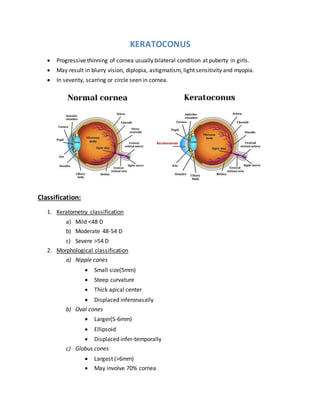
 Progressive thinning of cornea usually bilateral condition at puberty in girls.
 May result in blurry vision, diplopia, astigmatism, light sensitivity and myopia.
 In severity, scarring or circle seen in cornea.
Classification:
1. Keratometry classification
a) Mild <48 D
b) Moderate 48-54 D
c) Severe >54 D
2. Morphological classification
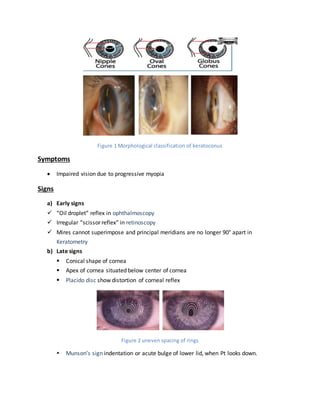
a) Nipple cones
 Small size(5mm)
 Steep curvature
 Thick apical center
 Displaced inferonasally
b) Oval cones
 Larger(5-6mm)
 Ellipsoid
 Displaced infer-temporally
c) Globus cones
 Largest (>6mm)
 May involve 70% cornea
Figure 1 Morphological classification of keratoconus
Symptoms
 Impaired vision due to progressive myopia
Signs
a) Early signs
 “Oil droplet” reflex in ophthalmoscopy
 Irregular “scissor reflex” in retinoscopy
 Mires cannot superimpose and principal meridians are no longer 90° apart in
Keratometry
b) Late signs
 Conical shape of cornea
 Apex of cornea situated below center of cornea
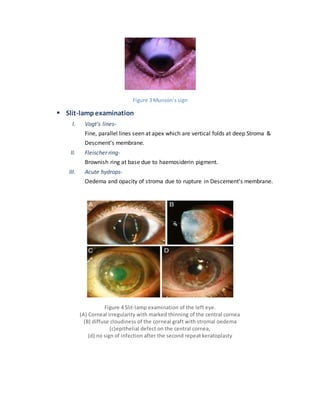
 Placido disc show distortion of corneal reflex
Figure 2 uneven spacing of rings
 Munson’s sign indentation or acute bulge of lower lid, when Pt looks down.
Figure 3 Munson’s sign
 Slit-lampexamination
I. Vogt’s lines-
Fine, parallel lines seen at apex which are vertical folds at deep Stroma &
Descment’s membrane.
II. Fleischer ring-
Brownish ring at base due to haemosiderin pigment.
III. Acute hydrops-
Oedema and opacity of stroma due to rupture in Descement’s membrane.
Figure 4 Slit-lamp examination of the left eye.
(A) Corneal irregularity with marked thinning of the central cornea
(B) diffuse cloudiness of the corneal graft with stromal oedema
(c)epithelial defect on the central cornea,
(d) no sign of infection after the second repeat keratoplasty
Assessment of keratoconus (Evaluationanddiagnosis)
 History and family history
 Follow up evaluation
 Slit-lamp exams
o Keratoscopy – keratometry
o Corneal thickness- pachymetry
o Topography- orbscan – pentacam

Keratoconus

  • 1.
  • 2.
    KERATOCONUS  Progressive thinningof cornea usually bilateral condition at puberty in girls.  May result in blurry vision, diplopia, astigmatism, light sensitivity and myopia.  In severity, scarring or circle seen in cornea. Classification: 1. Keratometry classification a) Mild <48 D b) Moderate 48-54 D c) Severe >54 D 2. Morphological classification a) Nipple cones  Small size(5mm)  Steep curvature  Thick apical center  Displaced inferonasally b) Oval cones  Larger(5-6mm)  Ellipsoid  Displaced infer-temporally c) Globus cones  Largest (>6mm)  May involve 70% cornea
  • 3.
    Figure 1 Morphologicalclassification of keratoconus Symptoms  Impaired vision due to progressive myopia Signs a) Early signs  “Oil droplet” reflex in ophthalmoscopy  Irregular “scissor reflex” in retinoscopy  Mires cannot superimpose and principal meridians are no longer 90° apart in Keratometry b) Late signs  Conical shape of cornea  Apex of cornea situated below center of cornea  Placido disc show distortion of corneal reflex Figure 2 uneven spacing of rings  Munson’s sign indentation or acute bulge of lower lid, when Pt looks down.
  • 4.
    Figure 3 Munson’ssign  Slit-lampexamination I. Vogt’s lines- Fine, parallel lines seen at apex which are vertical folds at deep Stroma & Descment’s membrane. II. Fleischer ring- Brownish ring at base due to haemosiderin pigment. III. Acute hydrops- Oedema and opacity of stroma due to rupture in Descement’s membrane. Figure 4 Slit-lamp examination of the left eye. (A) Corneal irregularity with marked thinning of the central cornea (B) diffuse cloudiness of the corneal graft with stromal oedema (c)epithelial defect on the central cornea, (d) no sign of infection after the second repeat keratoplasty
  • 5.
    Assessment of keratoconus(Evaluationanddiagnosis)  History and family history  Follow up evaluation  Slit-lamp exams o Keratoscopy – keratometry o Corneal thickness- pachymetry o Topography- orbscan – pentacam