VIRAL CORNEAL
ULCER
 Incidence of viral corneal ulcer has
become much greater due to the role of
antibiotics in eliminating pathogenic
bacterial flora.
 Epithelium of both conjunctiva and cornea
is affected .
 Typical viral lesions constitute the viral
keratoconjunctivitis
Common viral infections
Herpes simplex keratitis
Herpes zoster ophthalmicus
Adenovirus keratitis
Viral corneal
ulcer
Herpes
simplex
keratiis
Primary
ocular herpes
Recurrent
ocular herpes
Epithelial
keratitis
Stromal
keratitis
Metaherpetic
kerattis
Herpes
zoster
ophthalmicus
Herpes simplex keratitis
Etiology
 Herpes simplex virus
 DNA virus
 natural host man ,
 Epitheliotropic may become neurotropic
Types
1.HSV-I 2.HSV-II
Ocular lesions of herpes simplex
A. Primary herpes
1. Skin lesions
2. Conjunctiva-acute follicular conjunctivis
3. Cornea
• Fine epithelial punctate keratitis
• Coarse epithelial punctate keratitis
• Dendritic keratitis
Continued
B. Recurrent herpes
1. Active epithelial
keratitis
 Punctate epithelial
keratitis
 Dendritic ulcer
 Geographical ulcer
2. Stromal keraitis
i. Disciform keratitis
ii. Diffuse sromal necrotic
keratitis
3. Trophic keratitis<meta-
herpetic>
4. Herpetic iridocyclitis
Primary ocular herpes
 Initial infection due to direct contact of
mucous membrane with infected
secretions
 First attack involves non-immune person
 Child of 6 months to 5 yrs and in
teenagers.
Clinical features
1. Systemic features> mild fever ,malaise
and non-suppurative lymphadenopathy.
fetal when encephalitis develops
2. Skin lesions> seen in face, lips ,lids ,
periorbital region
3. Ocular lesion> acute follicular keratitis
with regional lymphadenitis,
keratitis-involve 50% of cornea
Recurrent ocular herpes
 Virus which lies dormant in trigeminal
ganglion, periodically reactivates and
replicates .
 Reactivated virus travels down along
trigeminal nerve to cause recurrent infection.
Its is typically unilateral disease.
 Predisposing stress stimuli like malarial fever,
flu, uv radiation exposure, general ill health,
emotional or physical exhaustion, mild
trauma, menstrual stress and
immunosuppressive agent.
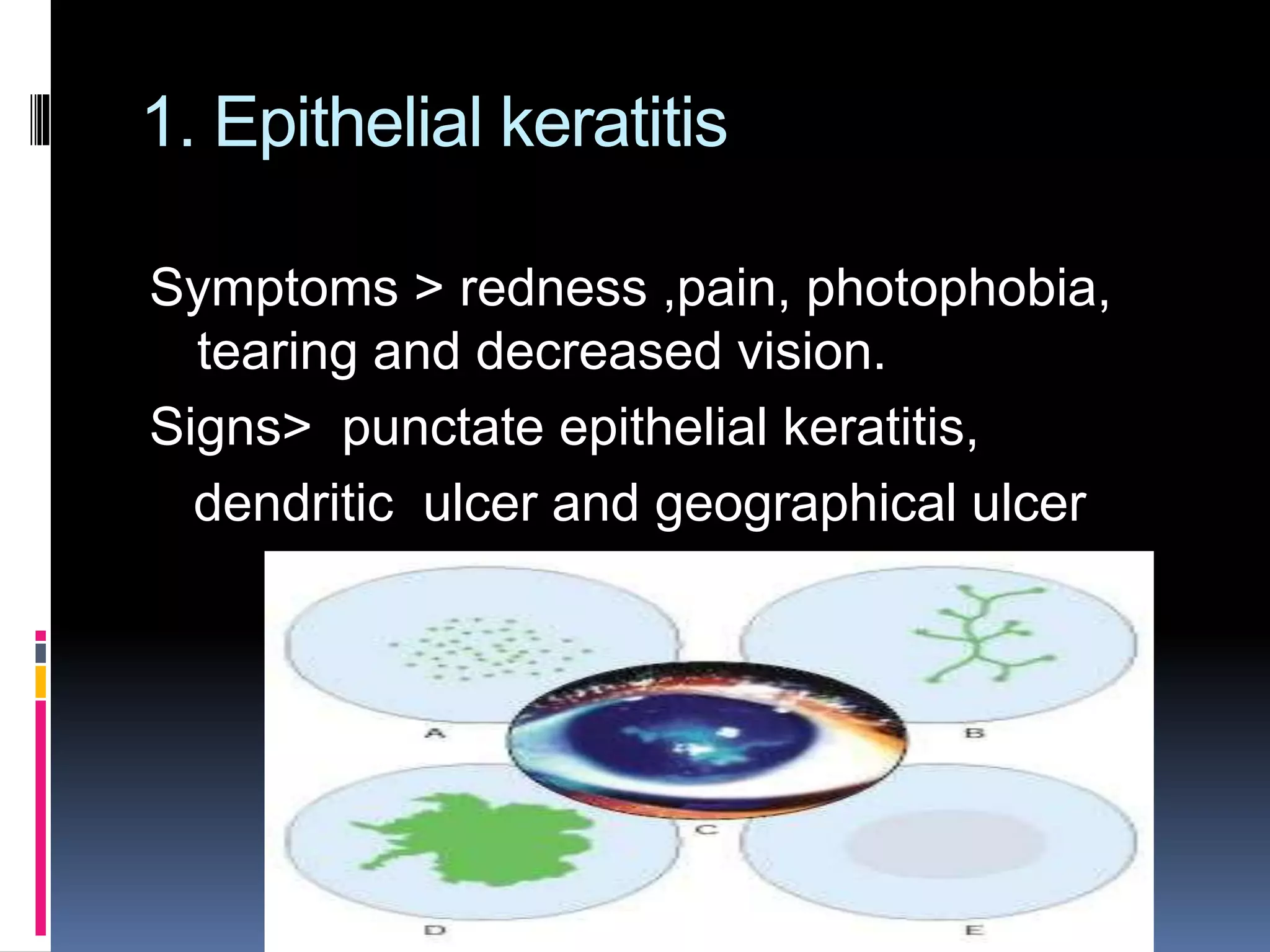
1. Epithelial keratitis
Symptoms > redness ,pain, photophobia,
tearing and decreased vision.
Signs> punctate epithelial keratitis,
dendritic ulcer and geographical ulcer
Treatment
A. Specific treatment
1. Antiviral drugs
 Acycloguanosine< Aciclovir> 3% ointment ,5
times a day for 14-21 days
 Ganciclovir 0.15% gel , 5times a day and
then 3 times a day for 5 days
 Triflurothymidine 1% drops , 2 hourly and
then 4 times a day for 5 days
 Adenine arabinoside 3% ointment 5 times a
day and then 3 times a day for 5 days
Continued
2. Mechanical debridement> involved area
along with a rim of surrounding healthy
epithelium with the help of sterile cotton
applicator under magnification helps by
removing the virus-laden cells
3. Systemic antiviral drugs> for 10-21days
 Acyclovir 400mg p.o.tid to bid or
 Famcyclovir 250mg p.o. bid or
 Valacyclovir 500mg p.o. bid
Continued
B. Non specific supportive therapy
a. Cycloplegic drugs 1% atropine eye drops
or ointmemnt
b. Systematic analgesics and anti-
inflammatory drugs<paracetamol and
ibuprofen
c. Vitamins <A,B-complex,C>
2. Stromal keratitis
a. Disciform keratitis
Pathogenesis
Delayed hypersensitivity to HSV antigen
forms endothelitis disciform corneal
oedema due to imbibition of aqueous
humour
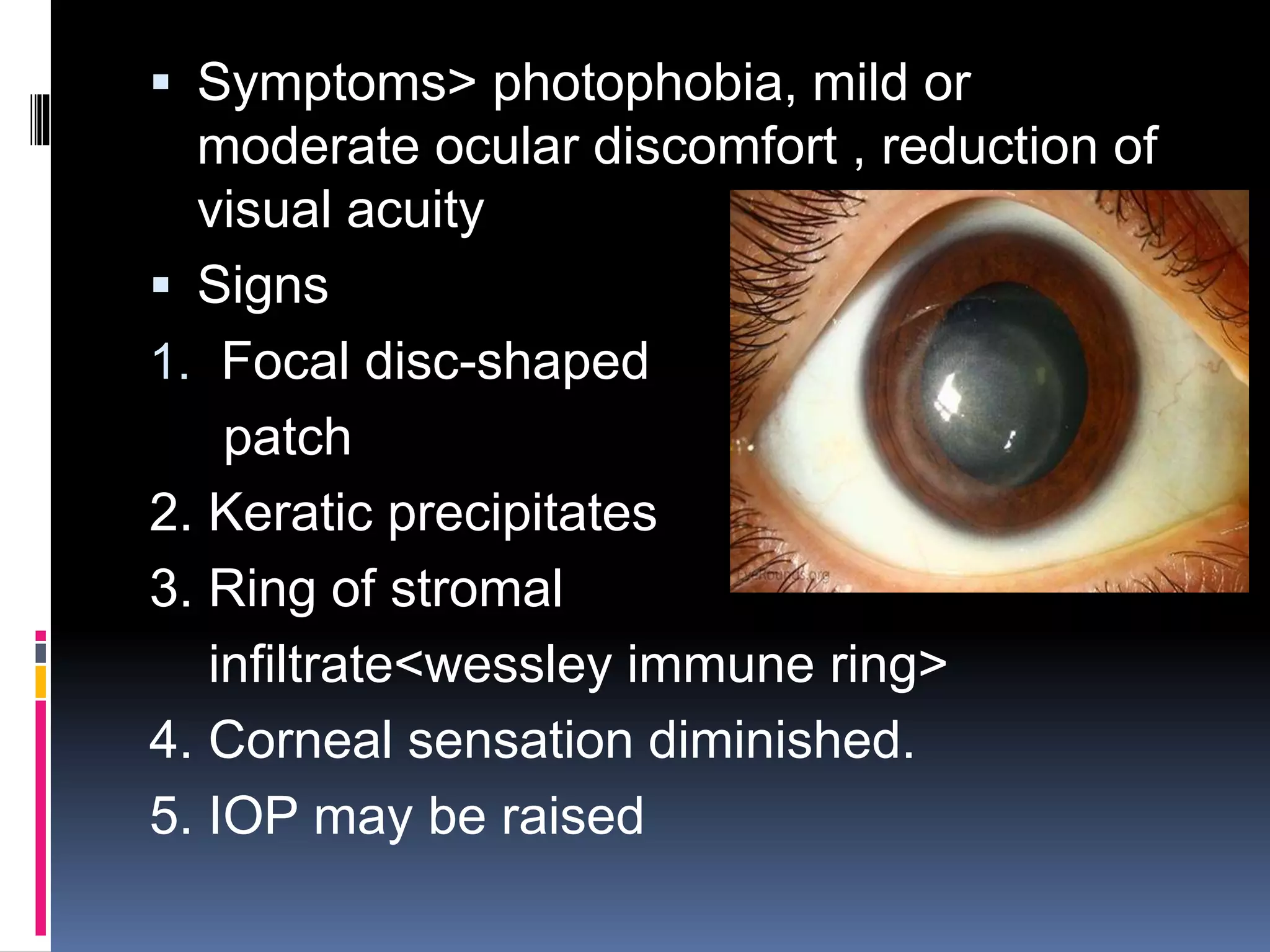
 Symptoms> photophobia, mild or
moderate ocular discomfort , reduction of
visual acuity
 Signs
1. Focal disc-shaped
patch
2. Keratic precipitates
3. Ring of stromal
infiltrate<wessley immune ring>
4. Corneal sensation diminished.
5. IOP may be raised
Treatment
 Diluted steroid eye drops instilled 4-5
times a day with an antiviral
cover<acyclovir 3%> twice a day and
steroid should be tapered over a period of
several weeks.
 Antiviral drugs should be started 5-7 days
before steroids
 Non specific supportive therapy.
B. Stromal necrotic keratitis
 Type of interstitial keratitis<IK> caused by
active viral invasion and tissue
destruction.
Symptoms
pain, photophobia and redness
Continued
Signs
Corneal lesions include
necrotic, blotchy, cheesy white
infiltrates
Mild iritis and keratic
precipitates are usually
associated<herpetic
keratouveitis>
Stromal vascularization
Treatment
 Similar to disciform keratitis but results are
unsatisfactory
 Systemic antiviral drugs for 10-21 days is
considered in recurrent cases and
associated with herpetic uveitis.
 Keratoplasty should be delayed until eye
has quiet with little or steroidal treatment
for several months, because viral
interstitial keratitis is the form of herpes
which is most likely to recur in a new graft.
3.Metaherpetic keratitis
 Occurs at the site of previous herpatic
ulcers.
 Persistent defect in BM of corneal
epithelium.
Clinical features
1. Indolent linear or ovoid epithelial defect
2. margin grey thickened
Continued
 Treatment
1. lubricants<artificial
tears>
2. Bandage soft
contact lens
3. Lid
closure<tarsorrhaph
y>
Herpes zoster ophthalmicus
 An acute infection of gasserian ganglion of
5th nerve by varicella zoster virus<VZV>
 10% of all cases of herpes zoster
 Occurs in immuno-compromised
individuals.
 Etiology
 VZV is DNA virus and produces
acidophilic intranuclear inclusion bodies
 Neurotropic in nature.
Clinical features
 Frontal nerve is frequently affected than
lacrimal and nasociliary nerve
 Ocular complications occurs in about 50%
cases
 hutchinson’s rule, which implies that
ocular involvement is frequent if the side
or tip of nose presents vesicles, is useful
but not infallible.
Continued
 Lesions are strictly
limited to one side of
the midline of head.
Clinical phases
1. Acute phase – resolve within few weeks
2. Chronic phase – persist for years
3. Relapsing phase – reappear
1.Acute phase lesion
A. General features
illness is sudden with fever, malaise , and
severe neuralgic pain
B. Cutaneous lesions
usually after 3-4 days of the onset of
disease
the skin of eye lids and other affected
areas become red and edematous
followed by vesicle formation.
Cutaneous lesions continued
 Vesicles change into
pustules
 Burst to become
crusting ulcers.
 Permanent pitted
scar are left.
 Severe neuralgic
pain diminishes with
the subsidence of
eruptive phase.
C. Ocular lesions
 May present as a combination of two or
more of the following lesions.
1. Conjunctivitis – mucopurulent
conjunctivitis with petechial
haemorrhages with regional
lymphadenopathy.
2. Zoster keratitis – occurs in 40% of cases
and in several forms.
Continued
 Epithelial keratitis
 Microdendritic
keratitis
 Nummular keratitis-
1/3 of cases
 Disciform keraitis-
50% of cases
Continued
3. Episcleritis and scleritis- ½ cases
4. Iridocyclitis- may / may not associated
with keratitis
associated with hypopyon and hyphaema
5. Acute retinal necrosis
6. Secondary glaucoma
7. Anterior segment necrosis and phthisis
bulbi
D. Associated neurological
complications
 Motor nerve palsies-3rd ,4th,6th or 7th nerve
 optic neuritis in 1% of cases
 Encephalitis <rare>
2. Chronic phase lesion
I. Post herpetic neuralgia-persistent pain
even after subsidence of eruptive phase,
pain is mild to moderate in intensity
worsens at night and aggravated by
touch and heat.
II. Lid lesions-sequelae of scarring include
ptosis, trichiasis, entropion and notching.
III. Conjunctival lesions- chronic mucous
secreting conjunctivitis
Continued
IV. Corneal lesion
Neuroparalytic ulceration-acute infection
and gasserian ganglion
Exposure keratitis- supervene in some
cases due to associated facial palsy.
Mucous plaque keratitis-in 5%, stain with
rose bengal.
V.Scleritis and uveitis
3. Relapsing phase lesions
 May recur even after 10 years of acute
phase include nummular keratitis,
episcleritis , scleritis , mucous plaque
keratitis and secondary glaucoma.
Treatment
1. Systemic therapy
I. Oral antiviral drugs- acyclovir 800 mg 5
times a day for 10 days , or
valaciclovir 500 mg tds
II. Analgesics- combination of mephenamic
acid and paracetamol or pentazocin or even
pethidine
III. Systemic steroids- given cases developing
neurological complications such as 3rd
nerve palsy and optic neuritis.
Continued
IV. Cimetidine- 300 mg qid for 2-3 weeks
starting within 48-72 hours of onset
V. Amitriptyline- relieve depression in acute
phase.
2.Local therapy for skin lesions
Antibiotic –corticosteroid skin ointment or
lotion- 3 times a day
3. Local therapy of ocular lesion
i. For zoster keratitis, iridocyclitis and
scleritis
 Topical steroid eyedrops 4 times a day
 Cyclopentolate eyedrops bd or atropine
eye ointment od
 Topical acyclovir 3% eye ointment 5
times a day for 2 weeks
ii.To prevent secondary infections topical
antibiotics are used.
Continued
iii. For secondary glaucoma- 0.5% timolol or
0.5% betaoxol drops bd , acetazolamide
250 mg qid
iv. For mucous plaque-topical mucolytics e.g
acetyl cysteine 5 to 10% ,3 times a day.
v.For persistent epithelial defects
 lubricating artificial tear drops
Bandage soft contact lens.
Surgical treatment
 For neuroparalytic corneal ulcer caused
by herpes zoster.
I. Lateral tarsorrhaphy
II. Amniotic membrane transplantation or
conjunctival flap for non healing cases
III. Tissue adhesive with bandage contact
lens for corneal perforation
IV. Keratoplasty – visual rehabilitation of
zoster patient with dense scarring .
Viral corneal ulcer

Viral corneal ulcer

  • 1.
  • 2.
     Incidence ofviral corneal ulcer has become much greater due to the role of antibiotics in eliminating pathogenic bacterial flora.  Epithelium of both conjunctiva and cornea is affected .  Typical viral lesions constitute the viral keratoconjunctivitis
  • 3.
    Common viral infections Herpessimplex keratitis Herpes zoster ophthalmicus Adenovirus keratitis
  • 4.
    Viral corneal ulcer Herpes simplex keratiis Primary ocular herpes Recurrent ocularherpes Epithelial keratitis Stromal keratitis Metaherpetic kerattis Herpes zoster ophthalmicus
  • 5.
    Herpes simplex keratitis Etiology Herpes simplex virus  DNA virus  natural host man ,  Epitheliotropic may become neurotropic Types 1.HSV-I 2.HSV-II
  • 6.
    Ocular lesions ofherpes simplex A. Primary herpes 1. Skin lesions 2. Conjunctiva-acute follicular conjunctivis 3. Cornea • Fine epithelial punctate keratitis • Coarse epithelial punctate keratitis • Dendritic keratitis
  • 8.
    Continued B. Recurrent herpes 1.Active epithelial keratitis  Punctate epithelial keratitis  Dendritic ulcer  Geographical ulcer 2. Stromal keraitis i. Disciform keratitis ii. Diffuse sromal necrotic keratitis 3. Trophic keratitis<meta- herpetic> 4. Herpetic iridocyclitis
  • 9.
    Primary ocular herpes Initial infection due to direct contact of mucous membrane with infected secretions  First attack involves non-immune person  Child of 6 months to 5 yrs and in teenagers.
  • 10.
    Clinical features 1. Systemicfeatures> mild fever ,malaise and non-suppurative lymphadenopathy. fetal when encephalitis develops 2. Skin lesions> seen in face, lips ,lids , periorbital region 3. Ocular lesion> acute follicular keratitis with regional lymphadenitis, keratitis-involve 50% of cornea
  • 11.
    Recurrent ocular herpes Virus which lies dormant in trigeminal ganglion, periodically reactivates and replicates .  Reactivated virus travels down along trigeminal nerve to cause recurrent infection. Its is typically unilateral disease.  Predisposing stress stimuli like malarial fever, flu, uv radiation exposure, general ill health, emotional or physical exhaustion, mild trauma, menstrual stress and immunosuppressive agent.
  • 12.
    1. Epithelial keratitis Symptoms> redness ,pain, photophobia, tearing and decreased vision. Signs> punctate epithelial keratitis, dendritic ulcer and geographical ulcer
  • 13.
    Treatment A. Specific treatment 1.Antiviral drugs  Acycloguanosine< Aciclovir> 3% ointment ,5 times a day for 14-21 days  Ganciclovir 0.15% gel , 5times a day and then 3 times a day for 5 days  Triflurothymidine 1% drops , 2 hourly and then 4 times a day for 5 days  Adenine arabinoside 3% ointment 5 times a day and then 3 times a day for 5 days
  • 14.
    Continued 2. Mechanical debridement>involved area along with a rim of surrounding healthy epithelium with the help of sterile cotton applicator under magnification helps by removing the virus-laden cells 3. Systemic antiviral drugs> for 10-21days  Acyclovir 400mg p.o.tid to bid or  Famcyclovir 250mg p.o. bid or  Valacyclovir 500mg p.o. bid
  • 15.
    Continued B. Non specificsupportive therapy a. Cycloplegic drugs 1% atropine eye drops or ointmemnt b. Systematic analgesics and anti- inflammatory drugs<paracetamol and ibuprofen c. Vitamins <A,B-complex,C>
  • 16.
    2. Stromal keratitis a.Disciform keratitis Pathogenesis Delayed hypersensitivity to HSV antigen forms endothelitis disciform corneal oedema due to imbibition of aqueous humour
  • 17.
     Symptoms> photophobia,mild or moderate ocular discomfort , reduction of visual acuity  Signs 1. Focal disc-shaped patch 2. Keratic precipitates 3. Ring of stromal infiltrate<wessley immune ring> 4. Corneal sensation diminished. 5. IOP may be raised
  • 18.
    Treatment  Diluted steroideye drops instilled 4-5 times a day with an antiviral cover<acyclovir 3%> twice a day and steroid should be tapered over a period of several weeks.  Antiviral drugs should be started 5-7 days before steroids  Non specific supportive therapy.
  • 19.
    B. Stromal necrotickeratitis  Type of interstitial keratitis<IK> caused by active viral invasion and tissue destruction. Symptoms pain, photophobia and redness
  • 20.
    Continued Signs Corneal lesions include necrotic,blotchy, cheesy white infiltrates Mild iritis and keratic precipitates are usually associated<herpetic keratouveitis> Stromal vascularization
  • 21.
    Treatment  Similar todisciform keratitis but results are unsatisfactory  Systemic antiviral drugs for 10-21 days is considered in recurrent cases and associated with herpetic uveitis.  Keratoplasty should be delayed until eye has quiet with little or steroidal treatment for several months, because viral interstitial keratitis is the form of herpes which is most likely to recur in a new graft.
  • 22.
    3.Metaherpetic keratitis  Occursat the site of previous herpatic ulcers.  Persistent defect in BM of corneal epithelium. Clinical features 1. Indolent linear or ovoid epithelial defect 2. margin grey thickened
  • 23.
    Continued  Treatment 1. lubricants<artificial tears> 2.Bandage soft contact lens 3. Lid closure<tarsorrhaph y>
  • 24.
    Herpes zoster ophthalmicus An acute infection of gasserian ganglion of 5th nerve by varicella zoster virus<VZV>  10% of all cases of herpes zoster  Occurs in immuno-compromised individuals.  Etiology  VZV is DNA virus and produces acidophilic intranuclear inclusion bodies  Neurotropic in nature.
  • 26.
    Clinical features  Frontalnerve is frequently affected than lacrimal and nasociliary nerve  Ocular complications occurs in about 50% cases  hutchinson’s rule, which implies that ocular involvement is frequent if the side or tip of nose presents vesicles, is useful but not infallible.
  • 27.
    Continued  Lesions arestrictly limited to one side of the midline of head.
  • 28.
    Clinical phases 1. Acutephase – resolve within few weeks 2. Chronic phase – persist for years 3. Relapsing phase – reappear
  • 29.
    1.Acute phase lesion A.General features illness is sudden with fever, malaise , and severe neuralgic pain B. Cutaneous lesions usually after 3-4 days of the onset of disease the skin of eye lids and other affected areas become red and edematous followed by vesicle formation.
  • 30.
    Cutaneous lesions continued Vesicles change into pustules  Burst to become crusting ulcers.  Permanent pitted scar are left.  Severe neuralgic pain diminishes with the subsidence of eruptive phase.
  • 31.
    C. Ocular lesions May present as a combination of two or more of the following lesions. 1. Conjunctivitis – mucopurulent conjunctivitis with petechial haemorrhages with regional lymphadenopathy. 2. Zoster keratitis – occurs in 40% of cases and in several forms.
  • 32.
    Continued  Epithelial keratitis Microdendritic keratitis  Nummular keratitis- 1/3 of cases  Disciform keraitis- 50% of cases
  • 33.
    Continued 3. Episcleritis andscleritis- ½ cases 4. Iridocyclitis- may / may not associated with keratitis associated with hypopyon and hyphaema 5. Acute retinal necrosis 6. Secondary glaucoma 7. Anterior segment necrosis and phthisis bulbi
  • 35.
    D. Associated neurological complications Motor nerve palsies-3rd ,4th,6th or 7th nerve  optic neuritis in 1% of cases  Encephalitis <rare>
  • 36.
    2. Chronic phaselesion I. Post herpetic neuralgia-persistent pain even after subsidence of eruptive phase, pain is mild to moderate in intensity worsens at night and aggravated by touch and heat. II. Lid lesions-sequelae of scarring include ptosis, trichiasis, entropion and notching. III. Conjunctival lesions- chronic mucous secreting conjunctivitis
  • 37.
    Continued IV. Corneal lesion Neuroparalyticulceration-acute infection and gasserian ganglion Exposure keratitis- supervene in some cases due to associated facial palsy. Mucous plaque keratitis-in 5%, stain with rose bengal. V.Scleritis and uveitis
  • 38.
    3. Relapsing phaselesions  May recur even after 10 years of acute phase include nummular keratitis, episcleritis , scleritis , mucous plaque keratitis and secondary glaucoma.
  • 39.
    Treatment 1. Systemic therapy I.Oral antiviral drugs- acyclovir 800 mg 5 times a day for 10 days , or valaciclovir 500 mg tds II. Analgesics- combination of mephenamic acid and paracetamol or pentazocin or even pethidine III. Systemic steroids- given cases developing neurological complications such as 3rd nerve palsy and optic neuritis.
  • 40.
    Continued IV. Cimetidine- 300mg qid for 2-3 weeks starting within 48-72 hours of onset V. Amitriptyline- relieve depression in acute phase. 2.Local therapy for skin lesions Antibiotic –corticosteroid skin ointment or lotion- 3 times a day
  • 41.
    3. Local therapyof ocular lesion i. For zoster keratitis, iridocyclitis and scleritis  Topical steroid eyedrops 4 times a day  Cyclopentolate eyedrops bd or atropine eye ointment od  Topical acyclovir 3% eye ointment 5 times a day for 2 weeks ii.To prevent secondary infections topical antibiotics are used.
  • 42.
    Continued iii. For secondaryglaucoma- 0.5% timolol or 0.5% betaoxol drops bd , acetazolamide 250 mg qid iv. For mucous plaque-topical mucolytics e.g acetyl cysteine 5 to 10% ,3 times a day. v.For persistent epithelial defects  lubricating artificial tear drops Bandage soft contact lens.
  • 43.
    Surgical treatment  Forneuroparalytic corneal ulcer caused by herpes zoster. I. Lateral tarsorrhaphy II. Amniotic membrane transplantation or conjunctival flap for non healing cases III. Tissue adhesive with bandage contact lens for corneal perforation IV. Keratoplasty – visual rehabilitation of zoster patient with dense scarring .

Editor's Notes

  • #11 Primary infection self limiting but virus travels up to trigeminal ganglion and establishes latent infection.